


 Скачать презентацию Econ 8009 International Monetary Economics Warwick J Mc
50419413f330146d6aca8b04a195cb8c.ppt
- Количество слайдов: 53
 Econ 8009 International Monetary Economics Warwick J Mc. Kibbin
 Lectures • 1. Puzzles in International Macroeconomics • 2. Modeling the International Economy Using Dynamic Intertemporal GE models • 3. Some applications – “International Capital Flows, Financial Reform & Consequences of Changing Risk Perceptions in APEC Economies”
 Lecture 2: Modeling The International Economy Using Dynamic Intertemporal GE Models Warwick J. Mc. Kibbin ANU & Brookings Institution
 Background papers are available from: WWW. SENSIBLEPOLICY. COM Or WWWECONOMICS. COM
 Overview – What are models? – How to Use them – Economy Wide and Global Economic Models • Key Features • Strengths and Weaknesses – How to Build a DIGE Model – Next week how to use these for analyzing key issues in international monetary economics
 What is an Empirical Economic Model? • A set of equations embodying the history of theoretical and empirical economic knowledge • Key bits – identities – behavioural equations – exogenous inputs
 How to Use Economic Models • Very carefully! • Can get – quantitative estimates • Best guess • Degree of uncertainty – new insights on complex issues • Stickiness plus intertemporal features
 What Features are Important in a Model? • Does the model explain anything we observe today or in the recent past (VALIDATION)? ; • Is the model continually reviewed by experts who actually use it; is it published in the refereed academic literature; is a full listing of all equations available on request; and is it generally open to evaluation by others? ;
 What Features are Important in a Model? • Is the private market willing to purchase the model for the value it provides? ; • Do the model results pass the test of common sense? ; • Are the mechanisms in the model transparent to other trained economists?
 Types of Economic Models • • • Input/output models Computable general equilibrium (CGE) models Old style macro-econometric models Modern macro-econometric models Dynamic intertemporal general equilibrium models • Micro-simulation models/ artificial life models
 Types of Economic Models • Input Output Models – Examples: • United Nations Global models developed by Wassily Leontieff, Faye Duchin
 Types of Economic Models • Input Output Models – Trace the flow of resources between sectors; – Little role for relative price changes or substitution of inputs or consumption bundles; – Tend to be static; – No allowance for capital accumulation or international financial flows; – Ignore the role of money and asset prices;
 Types of Economic Models • Computable General Equilibrium Models (CGE) – Examples: • Domestic – ORANI model, Monash Model – Murphy 303 • Multi-Country – MEGABARE, GIGABARE, GTEM – GTAP World Trade Model – Michigan World Trade Model
 Types of Economic Models • Computable General Equilibrium Models (CGE) – Derived from microeconomic optimization theory; – Considerable attention to individual behavior; – Relatively easy to understand results given theoretical structure; – Inadequate macroeconomic behavior; – Tend to be comparative static or recursive dynamic;
 Types of Economic Models • Computable General Equilibrium Models (CGE) • Inadequate treatment of intertemporal saving and investment decisions, capital accumulation, financial capital flows; • Ignore the role of money and asset prices; • Rarely validated with actual experience either econometrically or through forecasting or shock replication.
 Types of Models • Old Style Macroeconometric Models – Examples • Domestic – NIF Treasury Model – Reserve Bank Models I & II • International – Data Resources Inc (DRI) – Warton
 Types of Models • Old Style Macroeconometric Models – Rely on correlations in time series data based on aggregate economic theory; – Reasonably good for short term forecasting (tend to be quarterly) – Difficult to understand results because of lack of theoretical structure; – Unclear long run properties;
 Types of Models • Modern Macroeconometric Models – Examples • Domestic – Murphy model 2 – Access Economics – Treasury TRYM model • International – IMF Multimod – Oxford Econometric Forecasting (OEF) – GEM model of LBS/ NIESR
 Types of Models • Modern Macroeconometric Models – More tightly specified theory – Rational Expectations in some markets – short run data consistency with long run theoretical properties – tend to be quarterly
 Types of Models • Dynamic Intertemporal GE Models – Examples • The MSG 2 Multi-Country Model » (Mc. Kibbin & Sachs) • The GCUBED Multi-Country Model » (Mc. Kibbin & Wilcoxen) – GCUBED Environment – GCUBED (Asia Pacific) – GCUBED (Agriculture) • The MSG 3 Multi-Country Model
 Types of Models • Dynamic Intertemporal GE Models – integrates the key features of the other types of models – mix of econometric estimation and calibration – annual frequency – problem with large degree of dis-aggregation because of complexity of the numerical algorithms needs
 Types of Models • Others – Micro Simulation Models (NATSEM) – Artificial Life Models (Sante Fe Institute, Brookings Institution)
 Inside one class of models Dynamic Intertemporal General Equilibrium Models
 Overall model development strategy • Funding is both through research grants and private consulting • Hub and spoke approach to coordinating a global research project – The model is managed/developed in the core research team in Australia and Texas – Users (researchers/ governments/ financial investors) in difference countries feed back to the core group both their own developments of the model as well as funding the core for new developments. All of which we are able to incorporate into the model over time
 Features of DIGE models • • Dynamic Intertemporal General Equilibrium Multi-Country Multi-sectoral Econometric Macroeconomic/ Monetary
 The MSG 2 Multi-country model Mc. Kibbin and Sachs
 Development and Subscription Funding – – – – Mc. Kibbin Software Group Inc US Congressional Budget Office The Brookings Institution US Department of Commerce US Government United Nations World Bank Australian Treasury Centre for International Economics Nomura Research Institute Daewoo Research Institute (Korea) Warwick Modeling Bureau Many Academic Colleagues
 The MSG 2 Model • Countries • • • United States Japan Germany France Canada United Kingdom Italy Austria Australia New Zealand China - Taiwan - Malaysia - Indonesia - Thailand - India -Philippines - Hong Kong - Singapore - Korea
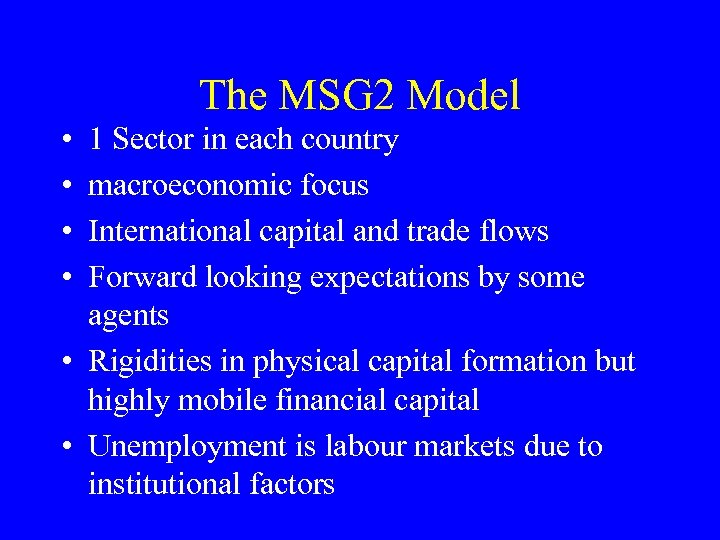 The MSG 2 Model • • 1 Sector in each country macroeconomic focus International capital and trade flows Forward looking expectations by some agents • Rigidities in physical capital formation but highly mobile financial capital • Unemployment is labour markets due to institutional factors
 The G-Cubed Model Mc. Kibbin & Wilcoxen
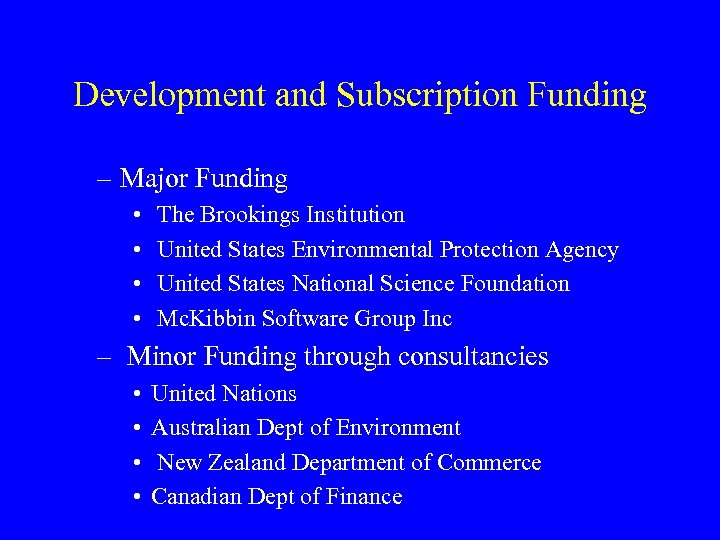 Development and Subscription Funding – Major Funding • • The Brookings Institution United States Environmental Protection Agency United States National Science Foundation Mc. Kibbin Software Group Inc – Minor Funding through consultancies • • United Nations Australian Dept of Environment New Zealand Department of Commerce Canadian Dept of Finance
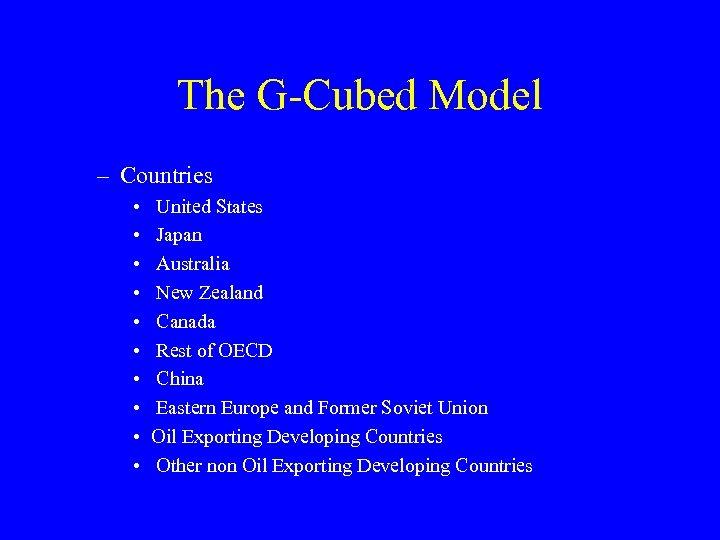 The G-Cubed Model – Countries • • • United States Japan Australia New Zealand Canada Rest of OECD China Eastern Europe and Former Soviet Union Oil Exporting Developing Countries Other non Oil Exporting Developing Countries
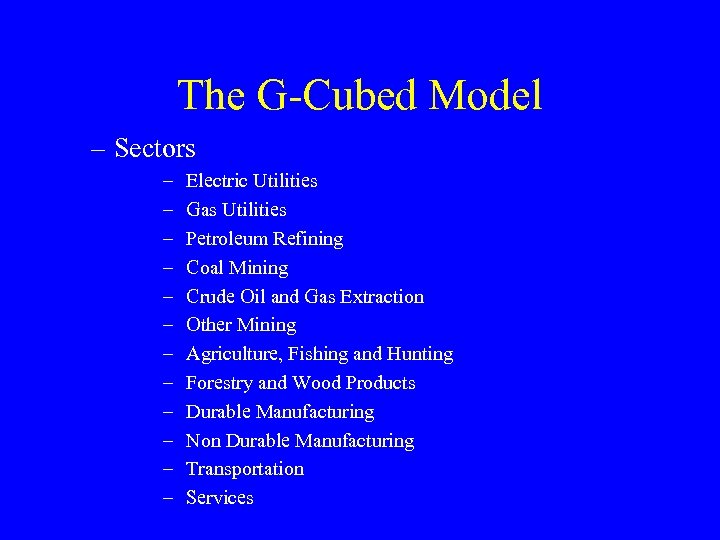 The G-Cubed Model – Sectors – – – Electric Utilities Gas Utilities Petroleum Refining Coal Mining Crude Oil and Gas Extraction Other Mining Agriculture, Fishing and Hunting Forestry and Wood Products Durable Manufacturing Non Durable Manufacturing Transportation Services
 The G-Cubed (Asia Pacific) Model
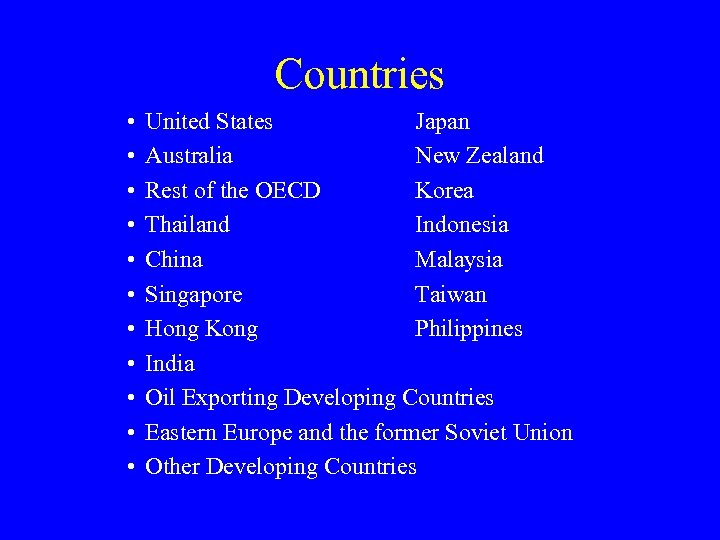 Countries • • • United States Japan Australia New Zealand Rest of the OECD Korea Thailand Indonesia China Malaysia Singapore Taiwan Hong Kong Philippines India Oil Exporting Developing Countries Eastern Europe and the former Soviet Union Other Developing Countries
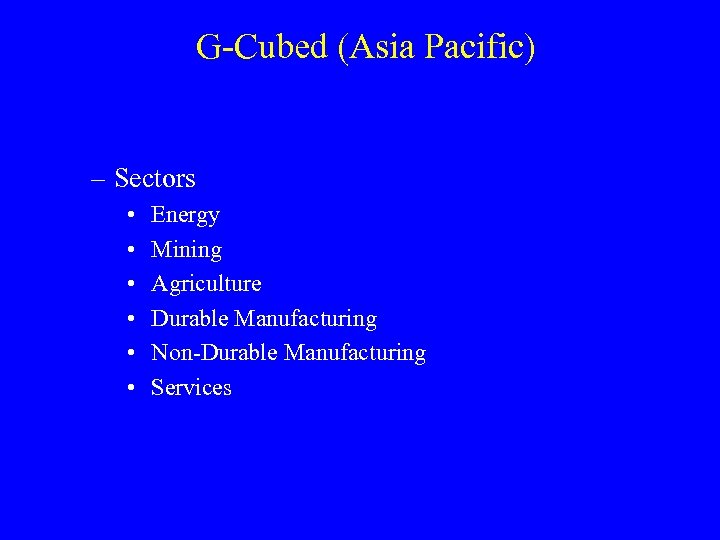 G-Cubed (Asia Pacific) – Sectors • • • Energy Mining Agriculture Durable Manufacturing Non-Durable Manufacturing Services
 The G-Cubed (Agriculture) Model
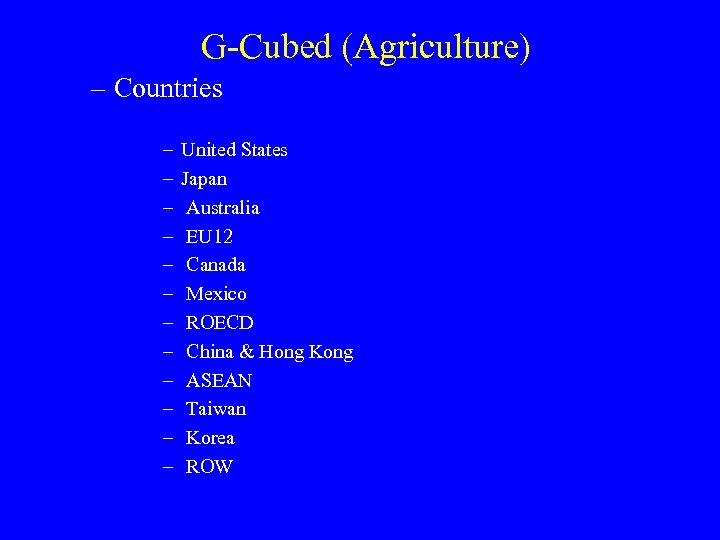 G-Cubed (Agriculture) – Countries – – – United States Japan Australia EU 12 Canada Mexico ROECD China & Hong Kong ASEAN Taiwan Korea ROW
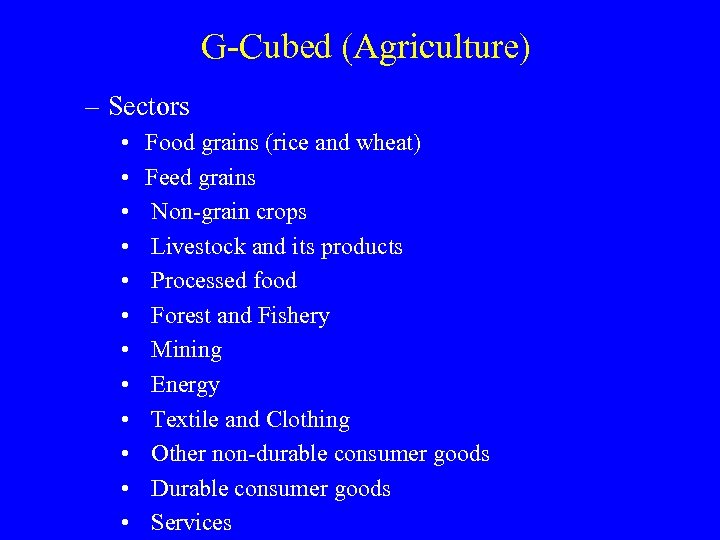 G-Cubed (Agriculture) – Sectors • • • Food grains (rice and wheat) Feed grains Non-grain crops Livestock and its products Processed food Forest and Fishery Mining Energy Textile and Clothing Other non-durable consumer goods Durable consumer goods Services
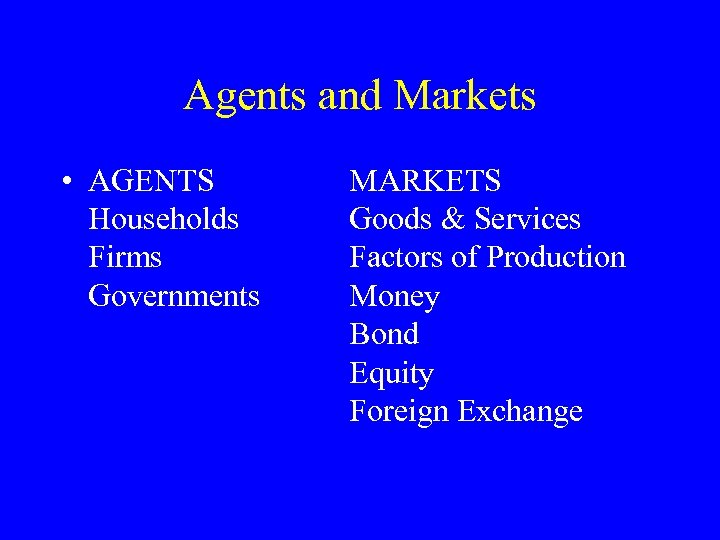 Agents and Markets • AGENTS Households Firms Governments MARKETS Goods & Services Factors of Production Money Bond Equity Foreign Exchange
 Based on Simple Neoclassical model in the long run • Plus stickiness in the short run – Adjustment costs in capital accumulation – Some agents re-optimize while others use long run optimal rules of thumb – Money required for transactions – Nominal wages adjust gradually
 Key Features • the demand supply side of the major economies are explicitly modeled ; • In the long run a neoclassical steady growth model state but with a Keynesian short run.
 Households – 2 types • A) maximize an intertemporal utility function consisting of all goods and services produced domestically and overseas, subject to an intertemporal budget constraint that the present value of consumption is bounded by the present value of after tax income from all sources • B)Base aggregate consumption expenditure on an optimal rule of thumb with current consumption of each good allocated so as to maximize contemporaneous utility
 Firms – 2 types • A) Maximise their share market value (the present value of the future stream of dividends) subject to production technology, a cost of adjustment model of capital and taking prices as given. This implies a Tobin’s Q model. • B)Base aggregate investment expenditure on a valuation of Q that follows an error correction model towards the intertemporal Q. • Apart from physical capital other factors of production are flexible – Labor, energy and imported intermediates in MSG 2 – Labor, energy, materials, resources in GCUBED
 Governments • Governments provide public goods that enter into the utility functions on households (additively seperable) and transfer payments; • In MSG 2 governments provide infrastructure that enters into the production function of firms with increasing returns • They collect a wide variety of taxes on income of firms households, imports, sales. • Governments are subject to the intertemporal budget constraint that the present value of spending and transfers is bounded by the present value of future tax collections.
 Countries • Countries are collections of individual firms, households and governments that trade goods and services as well as financial assets; • Labor is immobile between countries but mobile within countries; • Financial capital is mobile within and between countries; • Physical capital is sector and country specific at any point in time and subject to adjustment costs over time.
 Role of Money • Money is required for transactions between all agents. There is a technology that combines money with produced goods and services and the combined product is what is available in the market. • The supply of money is determined by the a central bank in each economy in conjunction with assumptions about the exchange rate regime.
 Financial Markets • Financial markets exist for – – – Money Government Bonds Equity Foreign Assets Foreign Exchange • Each financial asset represents a claim over real resources – – Money over purchasing power Bonds are claims over future tax collections Equity is a claim over the future dividend stream of a firm Foreign assets are claims over the future exports of the debtor country
 Goods and Services Markets • Households, Firms and Governments trade goods and services and price for each is assumed to clear the markets at an annual frequency
 Factor Markets – Labor Markets • Nominal wages are set by different institutional structures in each country; • Given the nominal wage and the market prices for goods and services firms higher labor until the real wage in each sector equals the marginal product of labor; • Aggregate unemployment can result although over time it is assumed that unemployment tends to force the nominal wage towards the labor market clearing level.
 Factor Markets – Capital • once installed physical capital is costly to move; • Capital produces a flow of services for firms that have installed a capital stock through investment decisions in the past; • Investment is subject to rising marginal costs of installation and depreciation over time.
 Factor Markets – Energy and Materials in GCUBED • Firms purchase the output of other sectors as inputs in production; • Total demand for the materials and energy sectors is final demand plus demand for intermediate inputs in each sector; • In contrast to standard CGE models (which assume Leontieff fixed coefficients between intermediate inputs and value added ) there is a CES production technology which allows substitution of capital, labor energy and materials in production.
 Running the model • Given values for all exogenous variables the model is solved for an equilibrium over time in which all equations hold given current and expected future variables. • Adjustments are made to risk premia etc such that the model exactly generates the base year data set.