


 Скачать презентацию Econ 522 Economics of Law Dan Quint Spring
babe43823352f7ec7acce634b14cdef6.ppt
- Количество слайдов: 43
 Econ 522 Economics of Law Dan Quint Spring 2017 Lecture 14
 Logistics w HW 3 is up, not due till after Spring Break w No lecture next Wednesday w MT 1 is graded – I’ll return bluebooks at end of lecture 1
 Results of Monday’s Experiment (trust) 2
 The game we played w Player A starts with $5 Chooses how much of it to give to player B w That money is quadrupled w w Player B has $5, plus 4 x whatever A gave him/her w Chooses how much (if any) to give back to player A w Tried it three ways: Anonymous w On paper, but with names w Face to face in front of class w 3
 What is subgame perfect equilibrium? w No matter what player A does, B is best off keeping everything w So A is best off sending nothing w So subgame perfect equilibrium payoffs are ($5, $5), even though total surplus of $25 could be achieved through cooperation w So how did you guys do? 4
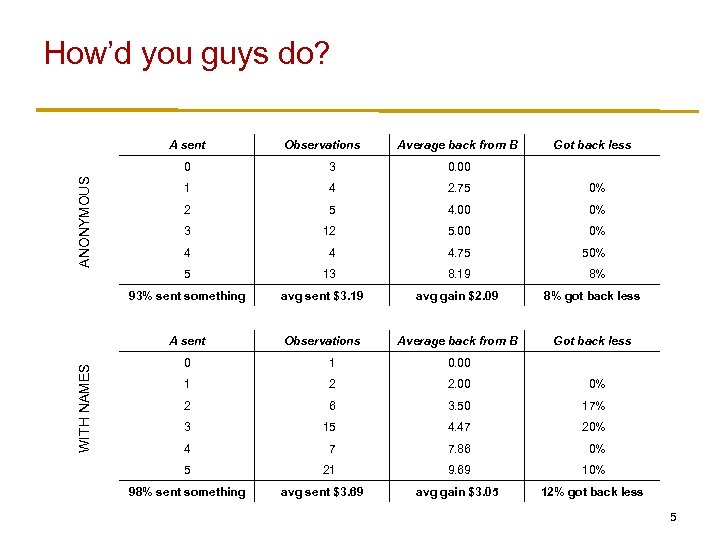 How’d you guys do? A sent Observations Average back from B Got back less ANONYMOUS 0 3 0. 00 1 4 2. 75 0% 2 5 4. 00 0% 3 12 5. 00 0% 4 4 4. 75 50% 5 13 8. 19 8% avg sent $3. 19 avg gain $2. 09 8% got back less A sent WITH NAMES 93% sent something Observations Average back from B Got back less 0 1 0. 00 1 2 2. 00 0% 2 6 3. 50 17% 3 15 4. 47 20% 4 7 7. 86 0% 5 21 9. 69 10% avg gain $3. 05 12% got back less 98% sent something avg sent $3. 69 5
 So, is trust a problem? w Not that much w Even with anonymity… most people sent something w very few who did lost money w and 64% of the possible gains were achieved w w With names, almost everyone sent something w few lost money w and 74% of the possible gains were achieved w w Face to face in front of the class, everyone achieved the maximal payoffs, and nobody got screwed w (Maybe there’s more trust in this classroom than in the real world? ) 6
 Back to work 7
 Monday – more reasons a contract might not be enforced w Dire constraints – duress and necessity w Impossibility w Doctrines based on bad information Fraud, failure to disclose – one party had bad information w Frustration of purpose, mutual mistake – both had bad information w Principle of “uniting knowledge and control” w w Unilateral mistake does not get you out of a contract w Laidlaw v Organ – OK to profit from private information 8
 Two reasons why unilateral mistake shouldn’t invalidate a contract w Contracts based on unilateral mistake often unite knowledge and control You mistakenly sell me a valuable antique, or land with oil under it w I have better knowledge of how to get value from it, so sale unites knowledge and control w w Enforcing them creates incentive to acquire/generate information Info that a car is a valuable antique, or that there’s oil under your land, is socially valuable – it generates new surplus w If I can profit from that information, I have an incentive to get it! w 9
 Textbook distinguishes between productive versus redistributive information w Productive information: information that can be used to produce more wealth w Redistributive information: information that can be used to redistribute wealth in favor of informed party w Cooter and Ulen Contracts based on one party’s knowledge of productive information should be enforced… w …especially if that knowledge was the result of active investment w Contracts based on one party’s knowledge of purely redistributive information, or fortuitously acquired information, should not be enforced w 10
 Other reasons a contract may not be enforced 11
 Vague contract terms w Courts will generally not enforce contract terms that are overly vague w Can be thought of as a penalty default “Punish” the parties by refusing to enforce contract… w …so people will be more clear when they write contracts w w But some exceptions w Parties may commit to renegotiating the contract “in good faith” under certain contingencies 12
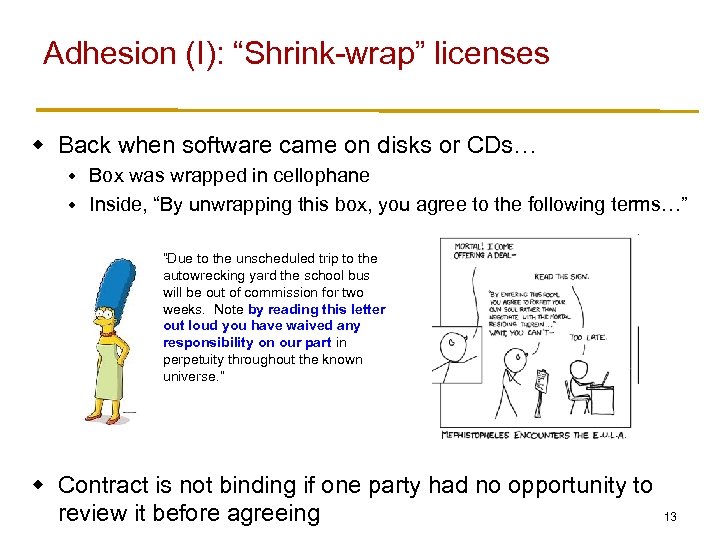 Adhesion (I): “Shrink-wrap” licenses w Back when software came on disks or CDs… Box was wrapped in cellophane w Inside, “By unwrapping this box, you agree to the following terms…” w “Due to the unscheduled trip to the autowrecking yard the school bus will be out of commission for two weeks. Note by reading this letter out loud you have waived any responsibility on our part in perpetuity throughout the known universe. ” w Contract is not binding if one party had no opportunity to review it before agreeing 13
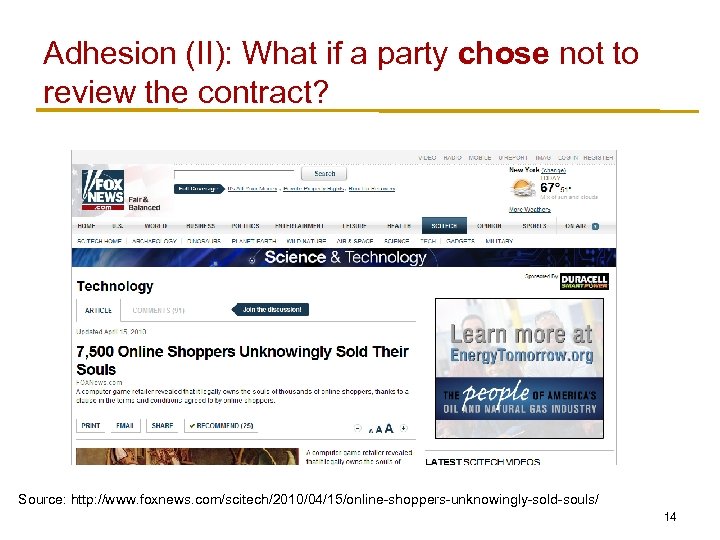 Adhesion (II): What if a party chose not to review the contract? Source: http: //www. foxnews. com/scitech/2010/04/15/online-shoppers-unknowingly-sold-souls/ 14
 Adhesion (II): What if a party chose not to review the contract? w British computer game retailer Game. Station, on April Fool’s Day, added this to Terms & Conditions customers agreed to before buying online: “By placing an order via this website… you agree to grant us a non-transferable option to claim, for now and for ever more, your immortal soul. Should we wish to exercise this option, you agree to surrender your immortal soul, and any claim you may have on it, within 5 (five) working days of receiving written notification from gamestation. co. uk or one of its duly authorised minions. …If you a) do not believe you have an immortal soul, b) have already given it to another party, or c) do not wish to grant us such a license, please click the link below to nullify this sub-clause and proceed with your transaction. ” 15
 Adhesion w Contract of Adhesion: standardized “take-it-or-leave-it” contract where terms are not negotiable w “Bogus duress” w Not illegal per se, but might attract “closer scrutiny” w A few state courts have adopted a rule: if I have “reason to believe that the other party would not agree if he knew the contract contained a particular term, the term is not part of the agreement” 16
 What if you signed a contract that was dramatically unfair? w Under bargain theory, courts should ask only whether a bargain occurred, not whether it was fair w Hamer v Sidway (drinking and smoking) w But both common and civil law have doctrines for not enforcing overly one-sided contracts Unconscionability/Lesion w “Absence of meaningful choice on the part of one party due to one -sided contract provisions, together with terms which are so oppressive that no reasonable person would make them and no fair and honest person would accept them” w When “the sum total of its provisions drives too hard a bargain for a court of conscience to assist” w Terms which would “shock the conscience of the court” w 17
 Unconscionability: Williams v Walker. Thomas Furniture (CA Dist Ct, 1965) w “Unconscionability has generally been recognized to include an absence of meaningful choice on the part of one of the parties together with contract terms which are unreasonably favorable to the other party. …In many cases the meaningfulness of the choice is negated by a gross inequality of bargaining power. ” 18
 Unconscionability: Williams v Walker. Thomas Furniture (CA Dist Ct, 1965) w “Unconscionability has generally been recognized to include an absence of meaningful choice on the part of one of the parties together with contract terms which are unreasonably favorable to the other party. …In many cases the meaningfulness of the choice is negated by a gross inequality of bargaining power. ” 19
 Unconscionability: Williams v Walker. Thomas Furniture (CA Dist Ct, 1965) w “Unconscionability has generally been recognized to include an absence of meaningful choice on the part of one of the parties together with contract terms which are unreasonably favorable to the other party. …In many cases the meaningfulness of the choice is negated by a gross inequality of bargaining power. ” w Not normal monopoly cases but “situational monopolies” w Think of Ploof v Putnam (sailboat in a storm), not Microsoft 20
 Remedies for breach of contract 21
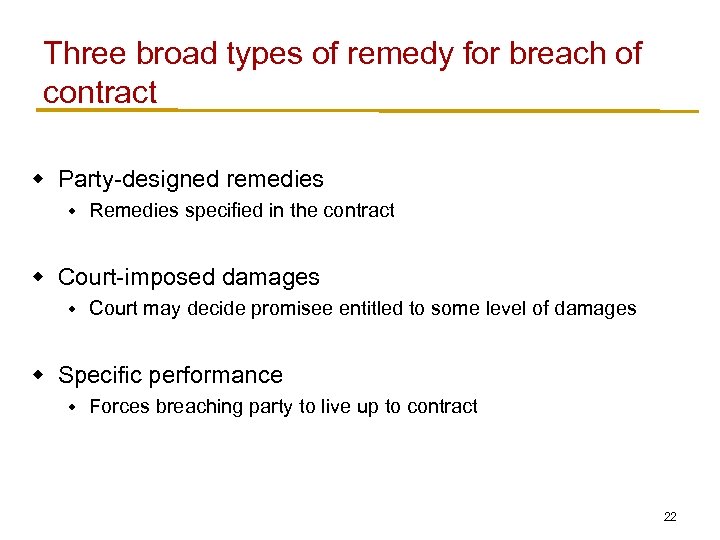 Three broad types of remedy for breach of contract w Party-designed remedies w Remedies specified in the contract w Court-imposed damages w Court may decide promisee entitled to some level of damages w Specific performance w Forces breaching party to live up to contract 22
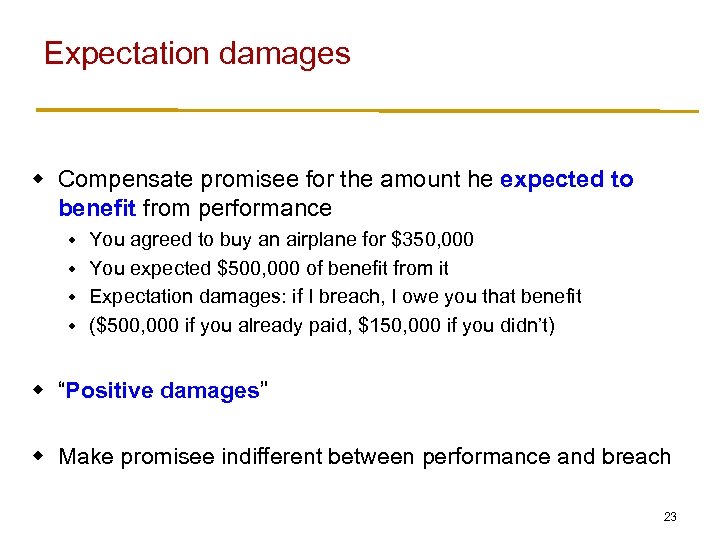 Expectation damages w Compensate promisee for the amount he expected to benefit from performance You agreed to buy an airplane for $350, 000 w You expected $500, 000 of benefit from it w Expectation damages: if I breach, I owe you that benefit w ($500, 000 if you already paid, $150, 000 if you didn’t) w w “Positive damages” w Make promisee indifferent between performance and breach 23
 Reliance damages w Reimburse promisee for cost of any reliance investments made, but not for additional surplus he expected to gain w Restore promisee to level of well-being before he signed the contract You contracted to buy the plane and built a hangar w If I breach, I owe you what you spent on the hangar, nothing else w w “Negative damages” – undo the negative (harm) that occurred 24
 Opportunity cost damages w Give promisee benefit he would have gotten from his next -best option w w w Make promisee indifferent between breach of the contract that was signed, and performance of best alternative contract You value plane at $500, 000 You contract to buy plane from me for $350, 000 Someone else was selling similar plane for $400, 000 By the time I breach, that plane is no longer available I owe you $100, 000 – the benefit you would have gotten from buying the other seller’s plane 25
 Example: expectation, reliance, and opportunity cost damages w You agree to sell me ticket to Wisconsin-Illinois football game for $50 Expectation damages: you owe me value of game minus $50 w If I pay scalper $150, then expectation damages = $100 w Reliance damages: maybe 0, or cost of whatever pre-game investments I made w 26
 Example: expectation, reliance, and opportunity cost damages w You agree to sell me ticket to Wisconsin-Illinois football game for $50 w w w Expectation damages: you owe me value of game minus $50 If I pay scalper $150, then expectation damages = $100 Reliance damages: maybe 0, or cost of whatever pre-game investments I made When you agreed to sell me ticket, other tickets available for $70 Opportunity cost damages: $80 (I paid a scalper $150 to get in; I would have been $80 better off if I’d ignored your offer and paid someone else $70) 27
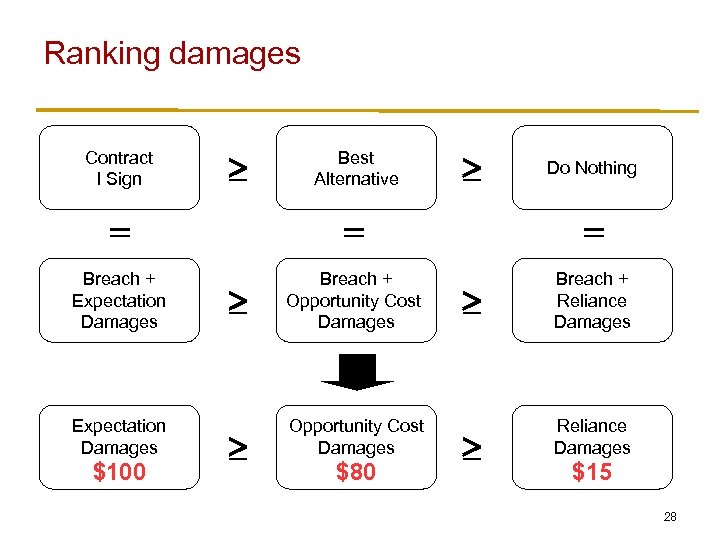 Ranking damages Contract I Sign ³ Best Alternative ³ Do Nothing = = = Breach + Expectation Damages ³ Breach + Opportunity Cost Damages ³ Breach + Reliance Damages ³ Opportunity Cost Damages ³ Reliance Damages Expectation Damages $100 $80 $15 28
 Hawkins v Mc. Gee (“hairy hand case”) w Hawkins had a scar on his hand w Mc. Gee promised surgery to “make the hand a hundred percent perfect” w Surgery was a disaster, left scar bigger and covered with hair 29
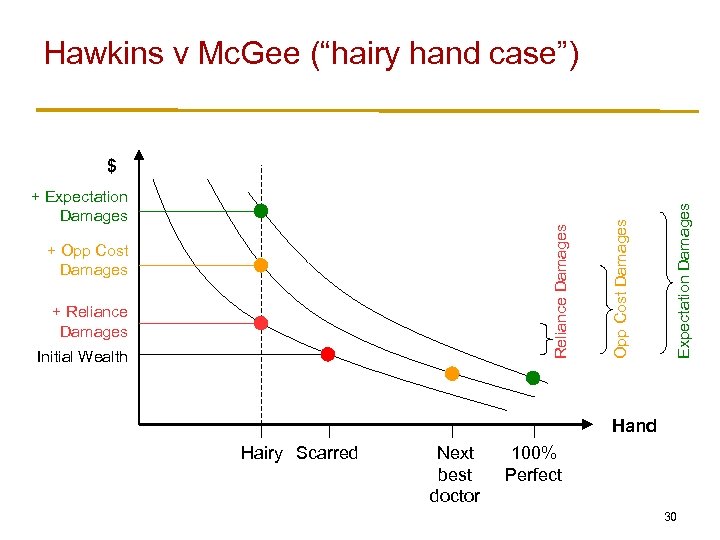 Hawkins v Mc. Gee (“hairy hand case”) + Opp Cost Damages + Reliance Damages Initial Wealth Expectation Damages Reliance Damages + Expectation Damages Opp Cost Damages $ Hand Hairy Scarred Next best doctor 100% Perfect 30
 Other court-ordered remedies w Restitution w Return money that was already received w Disgorgement w Give up wrongfully-gained profits 31
 Other court-ordered remedies w Restitution w Return money that was already received w Disgorgement w Give up wrongfully-gained profits w Specific Performance Promisor is forced to honor promise w Civil law: often ordered instead of money damages w Common law: money damages more common; S. P. sometimes used when seller breaches contract to sell a unique good w Like injunctive relief w 32
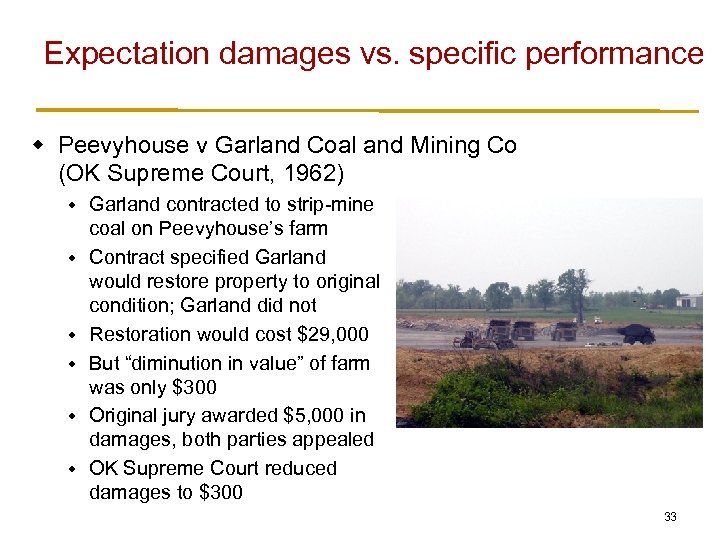 Expectation damages vs. specific performance w Peevyhouse v Garland Coal and Mining Co (OK Supreme Court, 1962) w w w Garland contracted to strip-mine coal on Peevyhouse’s farm Contract specified Garland would restore property to original condition; Garland did not Restoration would cost $29, 000 But “diminution in value” of farm was only $300 Original jury awarded $5, 000 in damages, both parties appealed OK Supreme Court reduced damages to $300 33
 Expectation damages vs. specific performance w At first, sounds like a perfect example of efficient breach Performing last part of contract would cost $29, 000 w Benefit to Peevyhouses would be $300 w Efficient to breach and pay expectation damages, which is what happened w w But… Most coal mining contracts: standard per-acre diminution payment w Peevyhouses refused to sign contract unless it specifically promised the restorative work w Dissent: Peevyhouses entitled to specific performance w (Peevyhouses seemed to value condition of property much more highly than change in market value) w 34
 Think about Peevyhouse in terms of penalty defaults w Contract promised restoration work, didn’t specify remedy if it wasn’t performed w Which default rule works better: Default rule allowing Garland to breach and pay diminution fee? w Default rule forcing Garland to perform restoration work? w w Ayres and Gertner: default rule should penalize the betterinformed party w w w Garland routinely signed contracts like these Peevyhouses were doing this for the first time Default rule allows Garland to pay diminution fee: they have no reason to bring it up, Peevyhouses don’t know Default rule forces Garland to do cleanup: if that’s inefficient, they could bring it up during negotiations 35 Specific performance would serve as a penalty default
 Party-designed remedies w Remedy for breach could be written directly into contract w But common law courts don’t always enforce remedy terms Liquidated damages – party-specified damages that reasonably approximate actual harm done by breach w Penalty damages – damages greater than actual harm done w Civil law courts are generally willing to enforce penalty damages w But common law courts often do not w 36
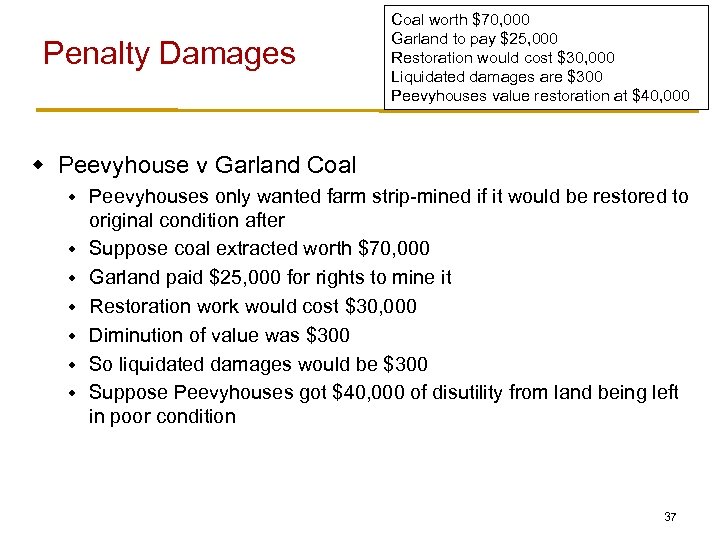 Penalty Damages Coal worth $70, 000 Garland to pay $25, 000 Restoration would cost $30, 000 Liquidated damages are $300 Peevyhouses value restoration at $40, 000 w Peevyhouse v Garland Coal w w w w Peevyhouses only wanted farm strip-mined if it would be restored to original condition after Suppose coal extracted worth $70, 000 Garland paid $25, 000 for rights to mine it Restoration work would cost $30, 000 Diminution of value was $300 So liquidated damages would be $300 Suppose Peevyhouses got $40, 000 of disutility from land being left in poor condition 37
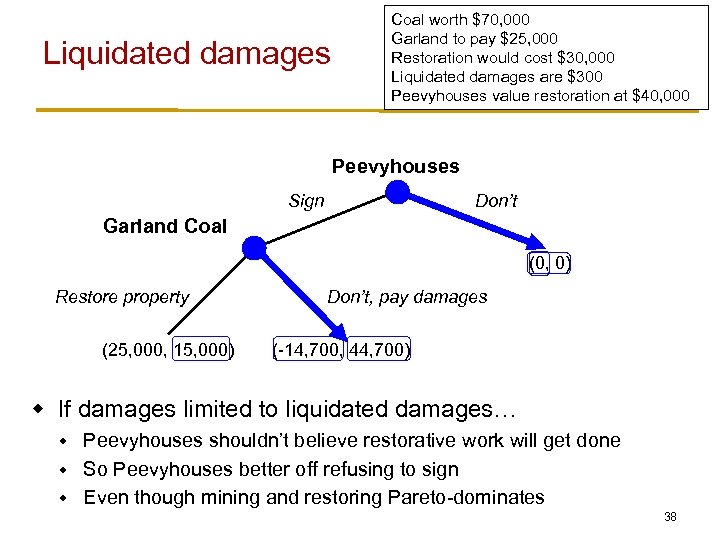 Liquidated damages Coal worth $70, 000 Garland to pay $25, 000 Restoration would cost $30, 000 Liquidated damages are $300 Peevyhouses value restoration at $40, 000 Peevyhouses Sign Don’t Garland Coal (0, 0) Restore property (25, 000, 15, 000) Don’t, pay damages (-14, 700, 44, 700) w If damages limited to liquidated damages… Peevyhouses shouldn’t believe restorative work will get done w So Peevyhouses better off refusing to sign w Even though mining and restoring Pareto-dominates w 38
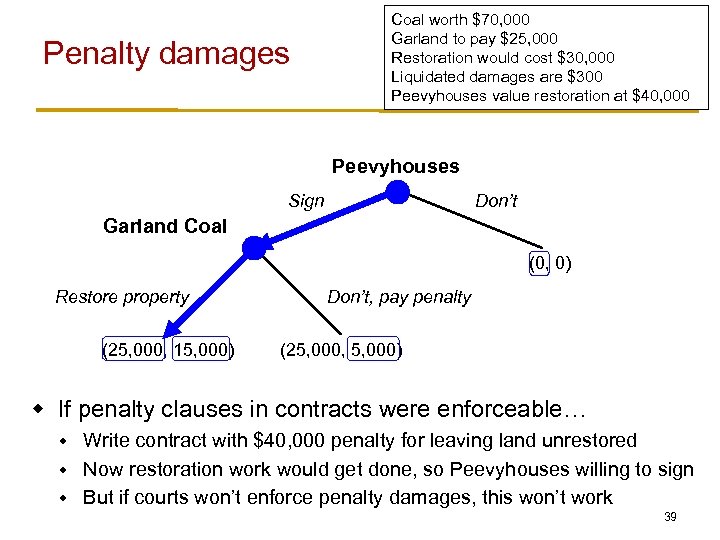 Penalty damages Coal worth $70, 000 Garland to pay $25, 000 Restoration would cost $30, 000 Liquidated damages are $300 Peevyhouses value restoration at $40, 000 Peevyhouses Sign Don’t Garland Coal (0, 0) Restore property (25, 000, 15, 000) Don’t, pay penalty (25, 000, 5, 000) w If penalty clauses in contracts were enforceable… Write contract with $40, 000 penalty for leaving land unrestored w Now restoration work would get done, so Peevyhouses willing to sign w But if courts won’t enforce penalty damages, this won’t work w 39
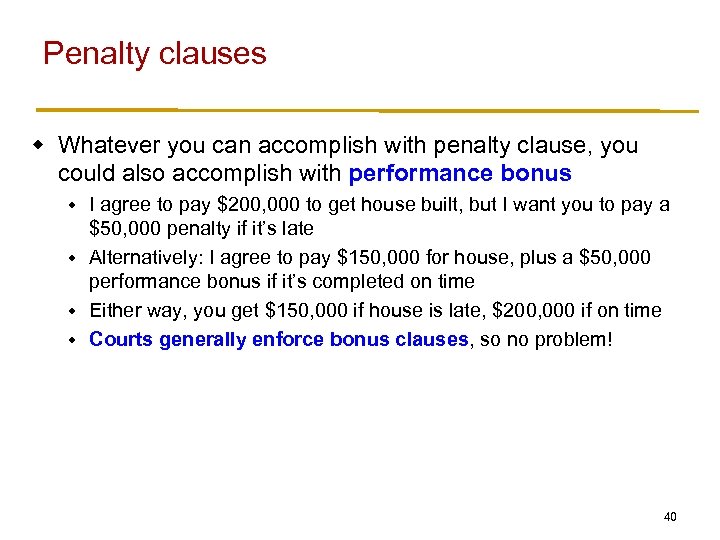 Penalty clauses w Whatever you can accomplish with penalty clause, you could also accomplish with performance bonus I agree to pay $200, 000 to get house built, but I want you to pay a $50, 000 penalty if it’s late w Alternatively: I agree to pay $150, 000 for house, plus a $50, 000 performance bonus if it’s completed on time w Either way, you get $150, 000 if house is late, $200, 000 if on time w Courts generally enforce bonus clauses, so no problem! w 40
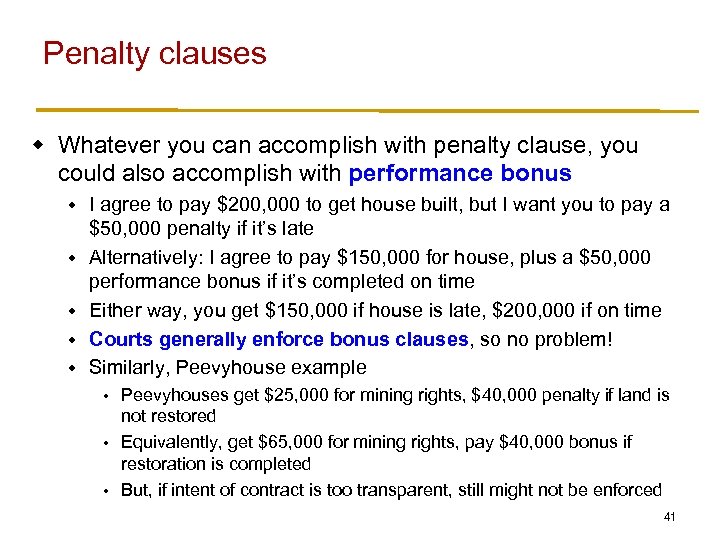 Penalty clauses w Whatever you can accomplish with penalty clause, you could also accomplish with performance bonus w w w I agree to pay $200, 000 to get house built, but I want you to pay a $50, 000 penalty if it’s late Alternatively: I agree to pay $150, 000 for house, plus a $50, 000 performance bonus if it’s completed on time Either way, you get $150, 000 if house is late, $200, 000 if on time Courts generally enforce bonus clauses, so no problem! Similarly, Peevyhouse example Peevyhouses get $25, 000 for mining rights, $40, 000 penalty if land is not restored Equivalently, get $65, 000 for mining rights, pay $40, 000 bonus if restoration is completed But, if intent of contract is too transparent, still might not be enforced 41
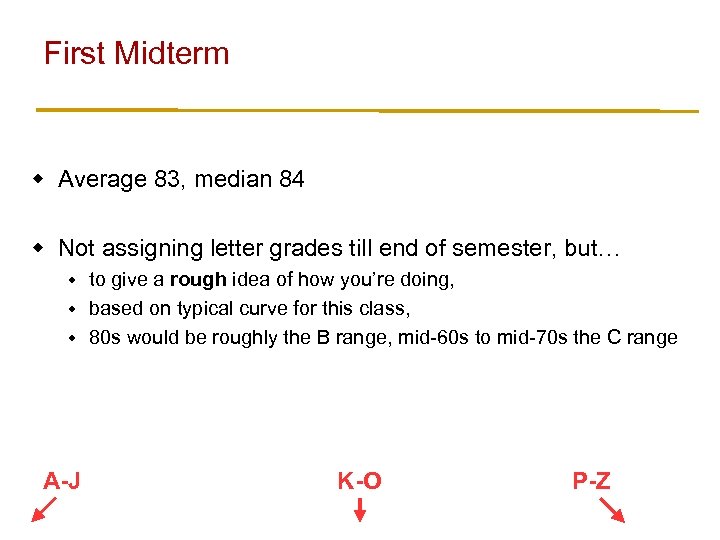 First Midterm w Average 83, median 84 w Not assigning letter grades till end of semester, but… to give a rough idea of how you’re doing, w based on typical curve for this class, w 80 s would be roughly the B range, mid-60 s to mid-70 s the C range w A-J K-O P-Z