


 Скачать презентацию ECON 4100 Industrial Organization Lecture 15 add-on Product
aa8b5af7be2f31d3e573fade76c7c7f4.ppt
- Количество слайдов: 19
 ECON 4100: Industrial Organization Lecture 15 add-on Product differentiation and mergers
 Introduction • Product differentiation and mergers • The spatial model…again • Add price discrimination
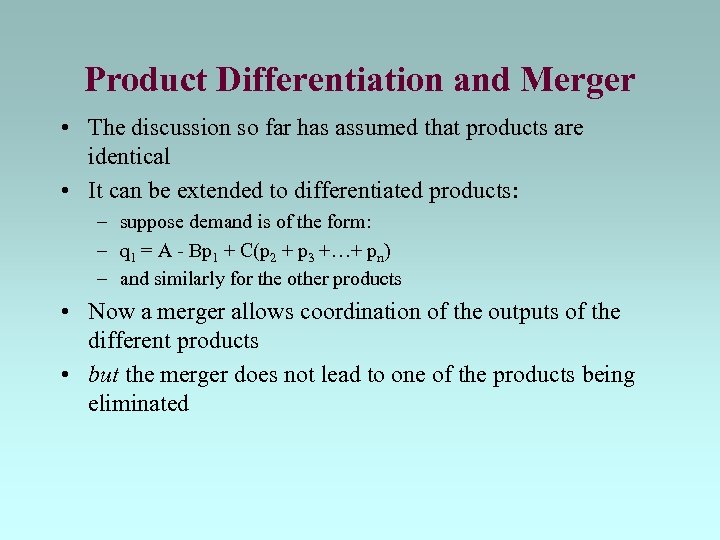 Product Differentiation and Merger • The discussion so far has assumed that products are identical • It can be extended to differentiated products: – suppose demand is of the form: – q 1 = A - Bp 1 + C(p 2 + p 3 +…+ pn) – and similarly for the other products • Now a merger allows coordination of the outputs of the different products • but the merger does not lead to one of the products being eliminated
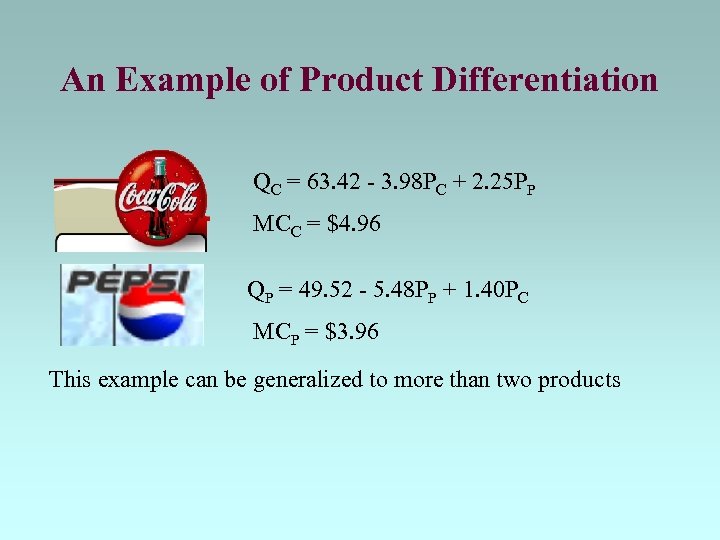 An Example of Product Differentiation QC = 63. 42 - 3. 98 PC + 2. 25 PP MCC = $4. 96 QP = 49. 52 - 5. 48 PP + 1. 40 PC MCP = $3. 96 This example can be generalized to more than two products
 Product differentiation • Take a different approach – spatial model of product differentiation • The idea is simple – suppose firms are offering different varieties of a product – the analogy is that these products have different “locations” – then merger between some of these firms avoids some of the problems of the merger paradox • don’t have to close down particular locations • but can coordinate prices and, perhaps, locations • Many mergers “look like” this – join product lines that compete but do not perfectly overlap
 The Spatial Model • The model is as follows – – – a market called Main Circle of length L consumers uniformly distributed over this market supplied by firms located along the street the firms are competitors: fixed costs F, zero marginal cost each consumer buys exactly one unit of the good provided that its full price is less than V – consumers incur transport costs of t per unit distance in travelling to a firm – a consumer buys from the firm offering the lowest full price • What prices will the firms charge? • To see what is happening consider two representative firms
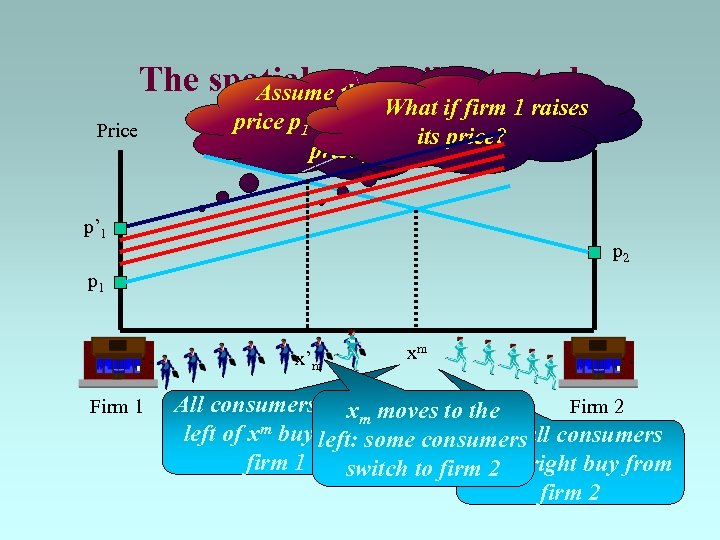 The spatial model illustrated Assume that firm 1 sets Price What if firm 1 raises price p 1 and firm 2 sets Price its price? price p 2 p’ 1 p 2 p 1 x’m Firm 1 xm All consumers to x moves to the Firm 2 m left of xm buy left: some consumersall consumers from And firm 1 to the switch to firm 2 right buy from firm 2
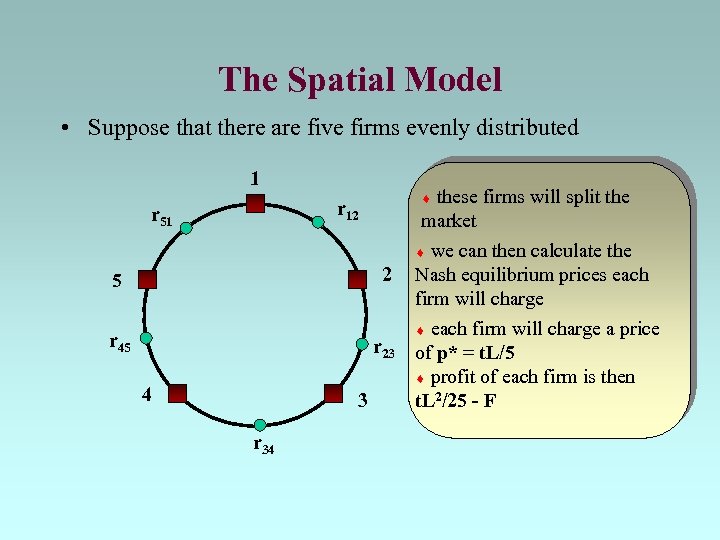 The Spatial Model • Suppose that there are five firms evenly distributed 1 r 51 2 5 r 45 r 23 4 3 r 34 these firms will split the market we can then calculate the Nash equilibrium prices each firm will charge r 12 each firm will charge a price of p* = t. L/5 profit of each firm is then t. L 2/25 - F
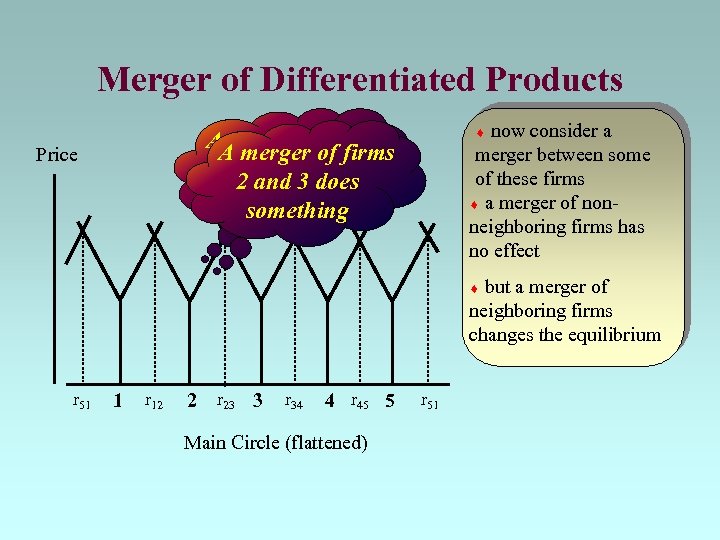 Merger of Differentiated Products now consider a merger between some of these firms a merger of nonneighboring firms has no effect AA merger of firms 22 and 3 does and 4 does nothing something Price but a merger of neighboring firms changes the equilibrium r 51 1 r 12 2 r 23 3 r 34 4 r 45 5 Main Circle (flattened) r 51
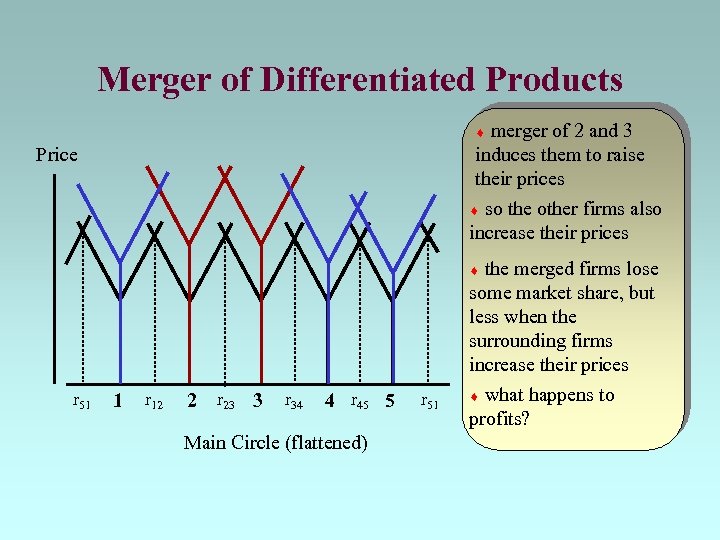 Merger of Differentiated Products merger of 2 and 3 induces them to raise their prices Price so the other firms also increase their prices the merged firms lose some market share, but less when the surrounding firms increase their prices r 51 1 r 12 2 r 23 3 r 34 4 r 45 5 Main Circle (flattened) r 51 what happens to profits?
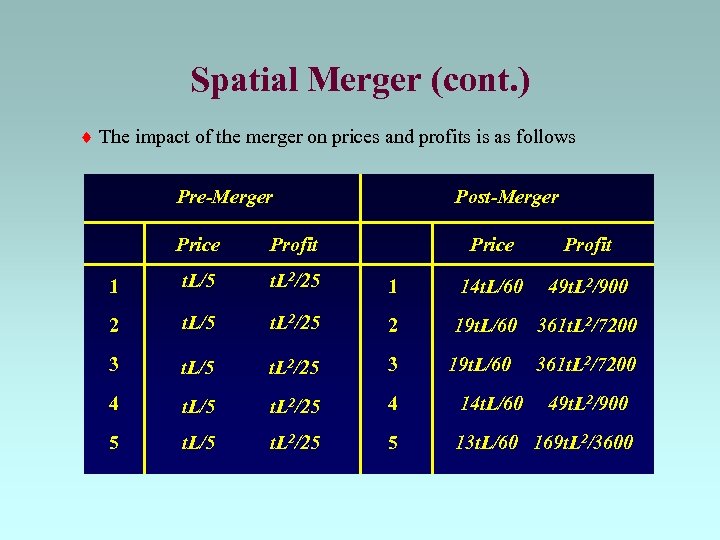 Spatial Merger (cont. ) The impact of the merger on prices and profits is as follows Pre-Merger Price Profit 1 t. L/5 t. L 2/25 2 t. L/5 3 Post-Merger Price Profit 1 14 t. L/60 49 t. L 2/900 t. L 2/25 2 19 t. L/60 361 t. L 2/7200 t. L/5 t. L 2/25 3 19 t. L/60 361 t. L 2/7200 4 t. L/5 t. L 2/25 4 14 t. L/60 5 t. L/5 t. L 2/25 5 13 t. L/60 169 t. L 2/3600 49 t. L 2/900
 Spatial Merger (cont. ) • This merger is profitable for the merged firms • And it is not the best that they can do – change the locations of the merged firms • expect them to move “outwards”, retaining captive consumers – perhaps change the number of firms: or products on offer • expect some increase in variety
 Spatial Merger (cont. ) • But consumers lose out from this type of merger – all prices have increased • For consumers to derive any benefits either – increased product variety so that consumers are “closer” – there are cost synergies not available to the non-merged firms • e. g. if there are economies of scope • Profitability comes from credible commitment
 Spatial Merger (cont. ) • Profitability comes from credible commitment • In the case with no product differentiation, we had to think of commitment in terms of output levels • Now we only need to commit to a certain range of locations or varieties • It is easier now to establish a credible commitment!!! • Commitment in terms of output levels is less credible (unless we go back to ideas of capacity), because producing that high level of output is not the best Cournot response to an output decision by the other firms
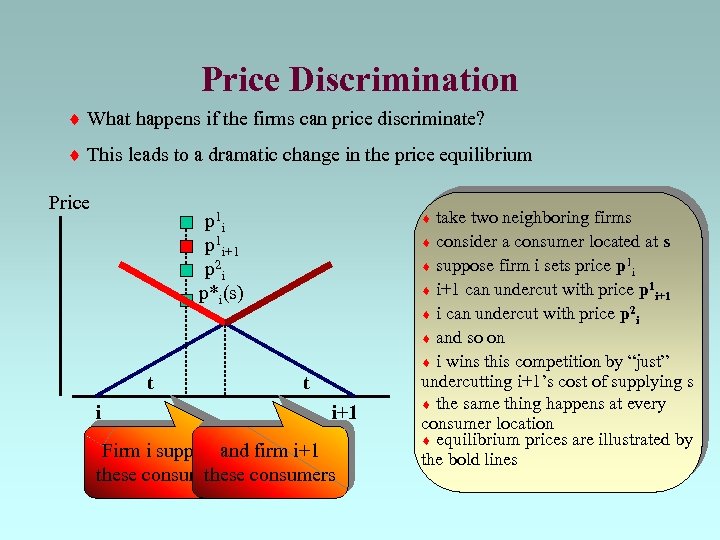 Price Discrimination What happens if the firms can price discriminate? This leads to a dramatic change in the price equilibrium Price p 1 i+1 p 2 i p*i(s) t i t s take two neighboring firms consider a consumer located at s suppose firm i sets price p 1 i i+1 can undercut with price p 1 i+1 i can undercut with price p 2 i and so on i wins this competition by “just” undercutting i+1’s cost of supplying s the same thing happens at every consumer location equilibrium prices are illustrated by the bold lines i+1 Firm i suppliesand firm i+1 these consumers these
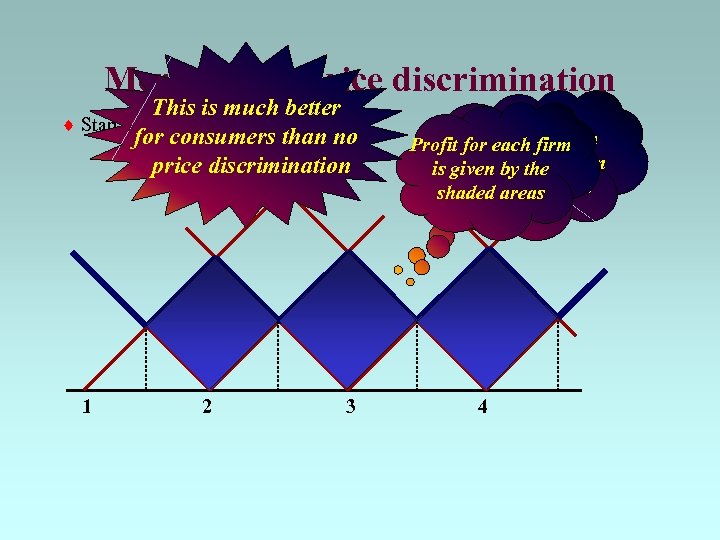 Merger with price discrimination This is much better Start with a no-merger equilibrium for consumers than no price discrimination 1 2 3 Price equilibrium Profit for each firm ispre-merger is given by the bold shaded areas lines 4
 • Interestingly, the highest pre-delivery price that the consumers pay now is the lowest price they paid with no price-discrimination (t. L/5) • Price-discrimination benefits consumers. Why? • With no price-discrimination, if you reduce the price for one consumer you have to reduce it for all • With price-discrimination you can reduce the price in one location (shop, or variety) without reducing it in others • This will make it less credible for you to commit to high prices • Therefore price competition between firms will be fiercer • And consumers benefit
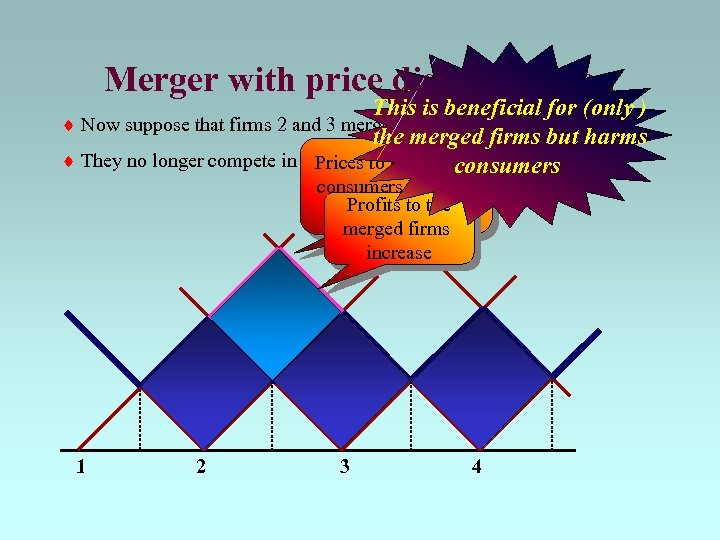 Merger with price discrimination This is beneficial for (only ) Now suppose that firms 2 and 3 merge the merged firms but harms They no longer compete in prices soto the captive Prices the price equilibrium changes consumers between Profits to the 2 and 3 increase merged firms increase 1 2 3 4
 Next Vertical and Complementary Mergers