 Скачать презентацию ECON 3313 Money and Banking Abdul Munasib Department
938e5e4dd916d1e44d0f1144345575ef.ppt
- Количество слайдов: 30



ECON 3313 Money and Banking Abdul Munasib Department of Economics
Mishkin, Frederick S. The Economics of Money, Banking and Financial Markets 8 th Edition, Addison Wesley, 2006
Contacts • • • Office 343 Business Building Office Hrs TR 3: 30 -4: 30 (and by appointment) Phone 4 -8763 E-mail munasib@okstate. edu Course Website http: //spears. okstate. edu/home/munasib/Money. Banking_3313/Firstpage. html Or, go to http: //spears. okstate. edu/home/munasib/ , click “Teaching”, click “Money and Banking”.
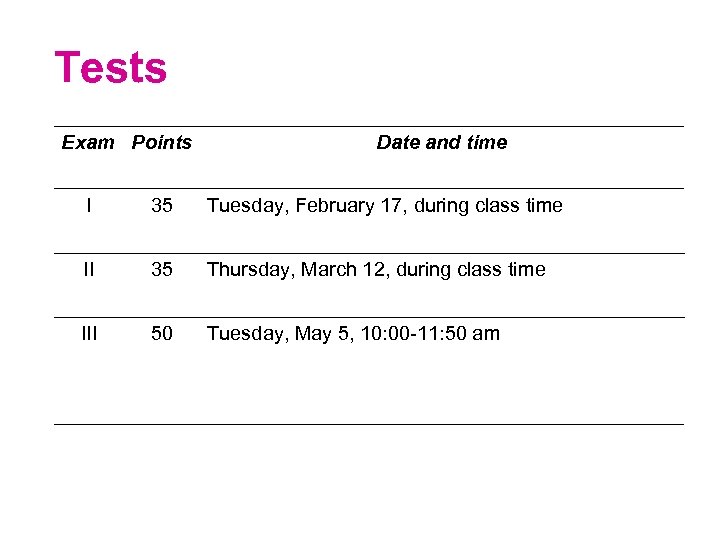
Tests Exam Points Date and time I 35 Tuesday, February 17, during class time II 35 Thursday, March 12, during class time III 50 Tuesday, May 5, 10: 00 -11: 50 am
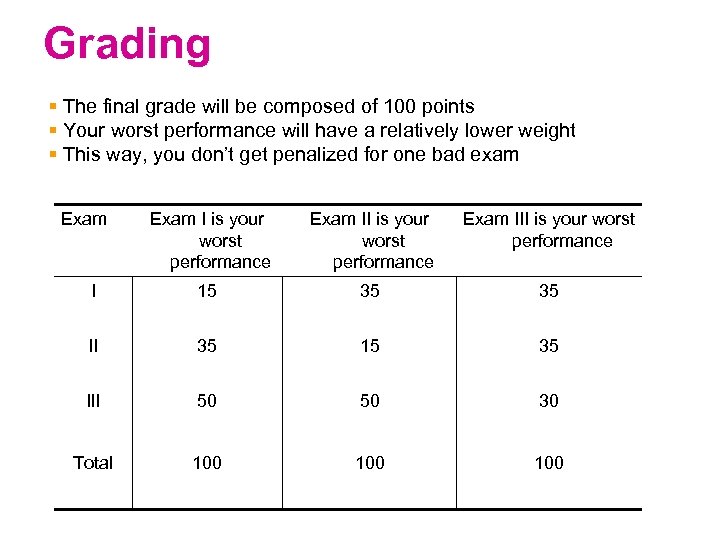
Grading § The final grade will be composed of 100 points § Your worst performance will have a relatively lower weight § This way, you don’t get penalized for one bad exam Exam I is your worst performance Exam III is your worst performance I 15 35 35 II 35 15 35 III 50 50 30 Total 100 100
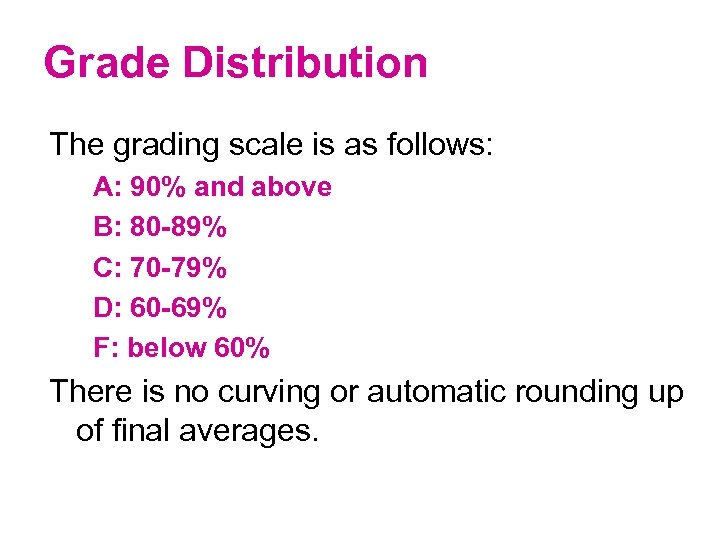
Grade Distribution The grading scale is as follows: A: 90% and above B: 80 -89% C: 70 -79% D: 60 -69% F: below 60% There is no curving or automatic rounding up of final averages.
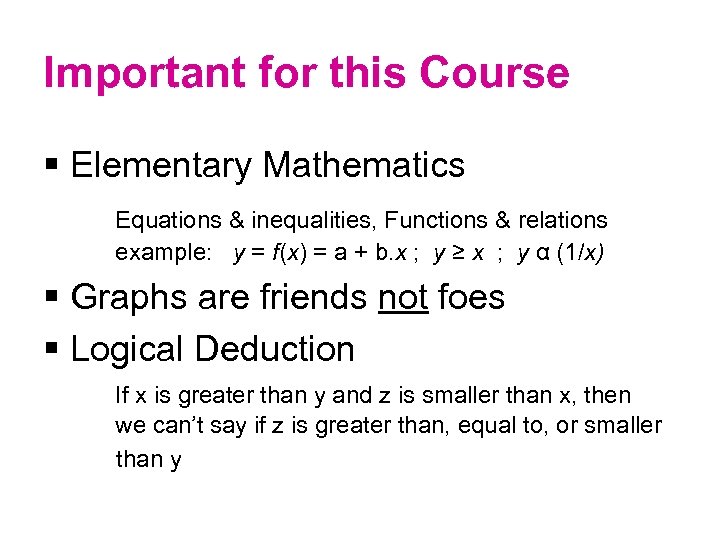
Important for this Course § Elementary Mathematics Equations & inequalities, Functions & relations example: y = f(x) = a + b. x ; y ≥ x ; y α (1/x) § Graphs are friends not foes § Logical Deduction If x is greater than y and z is smaller than x, then we can’t say if z is greater than, equal to, or smaller than y
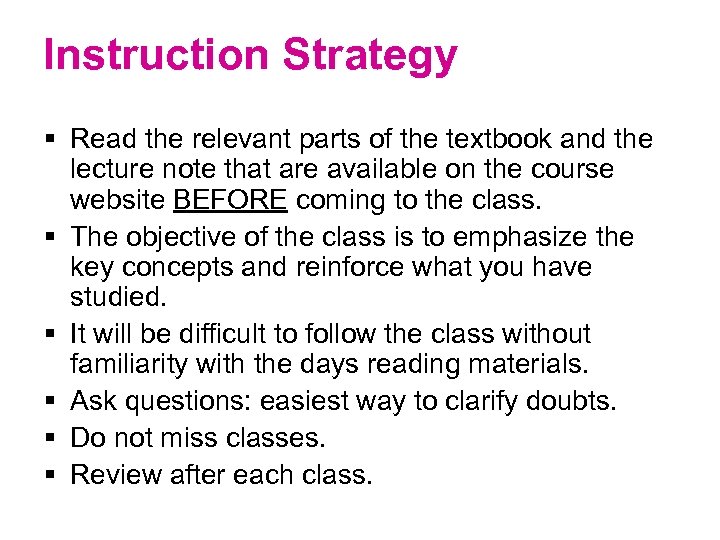
Instruction Strategy § Read the relevant parts of the textbook and the lecture note that are available on the course website BEFORE coming to the class. § The objective of the class is to emphasize the key concepts and reinforce what you have studied. § It will be difficult to follow the class without familiarity with the days reading materials. § Ask questions: easiest way to clarify doubts. § Do not miss classes. § Review after each class.

Classroom Etiquette § Turn off your cell phones and other electronic devices (such as i. Pod, MP 3 player etc. ) before coming to class. § If you leave class to talk on your cell phone you are not allowed to return to class. § Academic Integrity http: //academicintegrity. okstate. edu
Course Website Go to http: //spears. okstate. edu/home/munasib/ Then click “Teaching”, Click “Money and Banking”. § § § Lecture slides Additional materials and handouts Announcements End-of-the-chapter questions Answer keys to the exams
Why Study Money & Banking? § Individuals financial decisions § § Buying a car Being a homeowner Going to the job market Understanding what’s going on § The economy § Functioning of the economy in the short-run § Growth of the economy in the long-run
We’ll Focus On • What is money? What is its role in the economy? • Financial markets: markets for bonds, stocks, and foreign exchanges. • Financial Institutions: banks, insurance companies, mutual funds, etc. And, most importantly, • What are macroeconomic implications of money, financial markets and financial institutions?
Recap: Remember from ‘Principles’? § Rationality and Incentives § Opportunity costs § The difference between movements along the curve and shifts of curves § Demand Supply § Market Equilibrium § Models in Economics
The Generic Macro Model § Agents: who make economic decisions § Households: Maximize utility § Firms: Maximize profits § Government: Taxes, Public goods, Policies § Rest of the world: Trade § Market: where agents interact § Equilibrium § where the market ‘tends’ to go (uniqueness) § and ‘tends’ to stay put (stability)
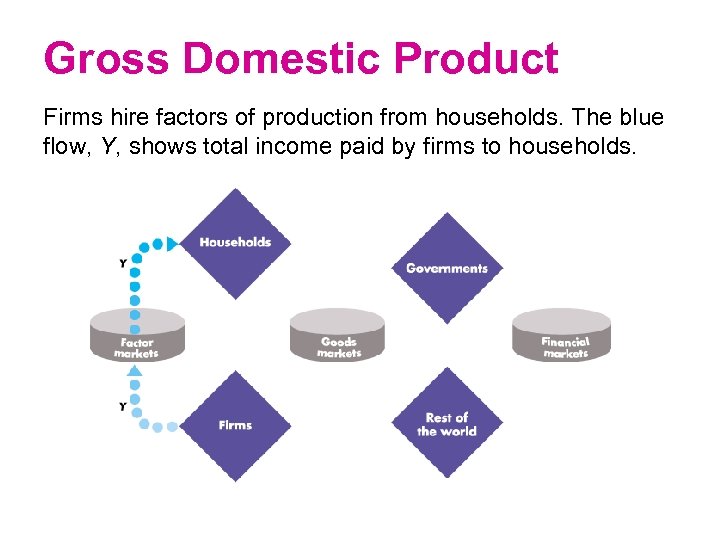
Gross Domestic Product Firms hire factors of production from households. The blue flow, Y, shows total income paid by firms to households.
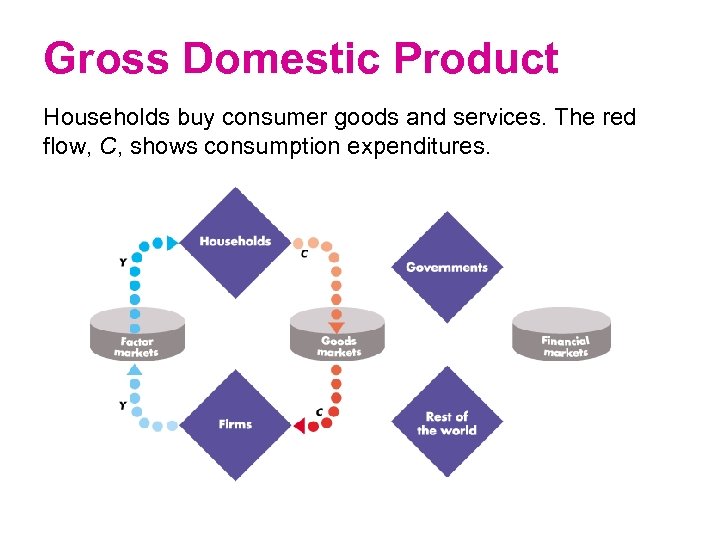
Gross Domestic Product Households buy consumer goods and services. The red flow, C, shows consumption expenditures.
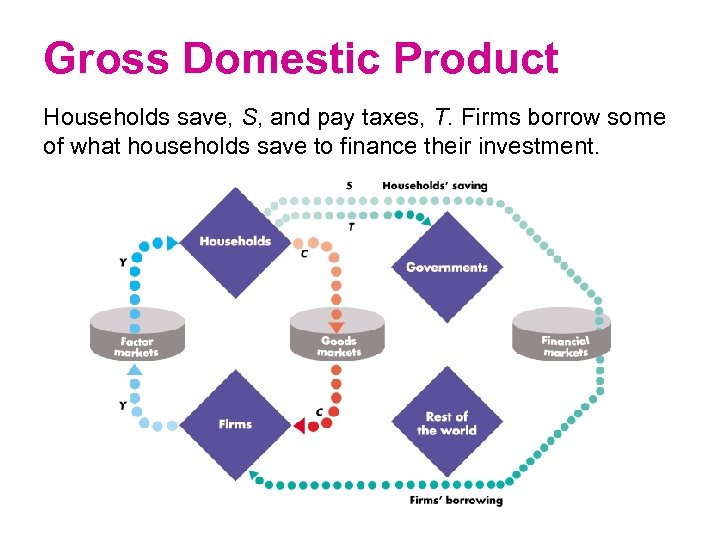
Gross Domestic Product Households save, S, and pay taxes, T. Firms borrow some of what households save to finance their investment.
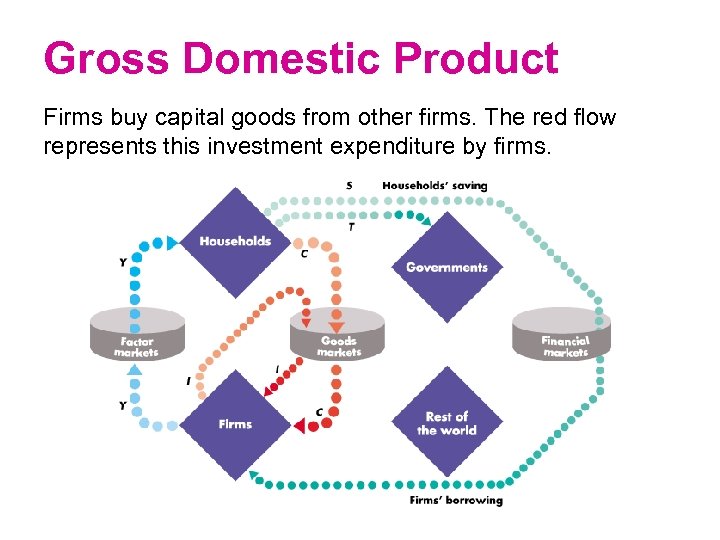
Gross Domestic Product Firms buy capital goods from other firms. The red flow represents this investment expenditure by firms.
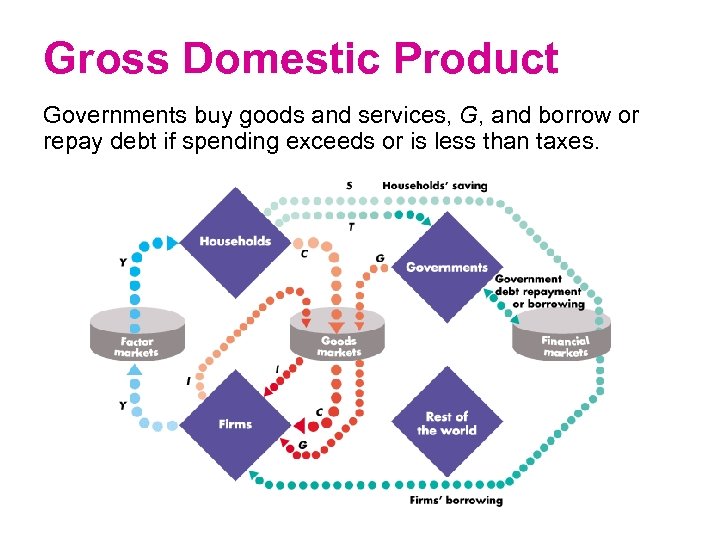
Gross Domestic Product Governments buy goods and services, G, and borrow or repay debt if spending exceeds or is less than taxes.
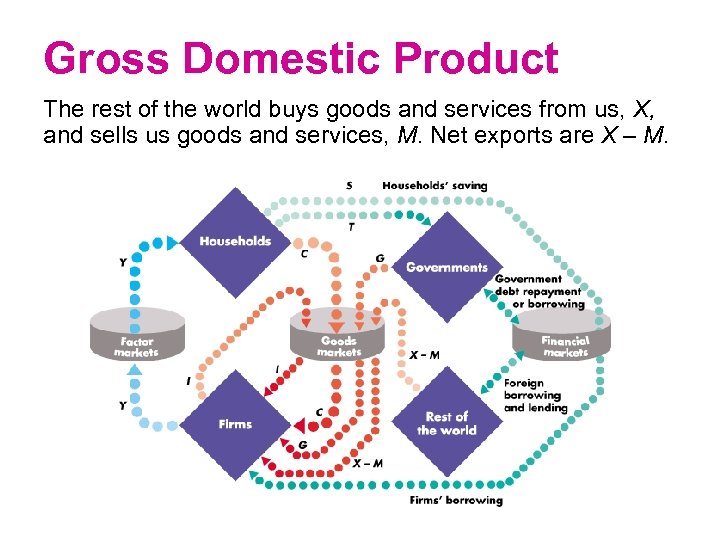
Gross Domestic Product The rest of the world buys goods and services from us, X, and sells us goods and services, M. Net exports are X – M.
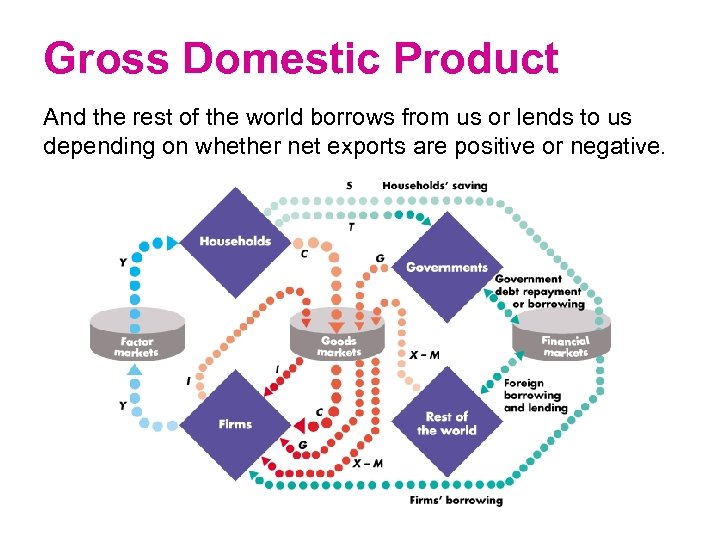
Gross Domestic Product And the rest of the world borrows from us or lends to us depending on whether net exports are positive or negative.
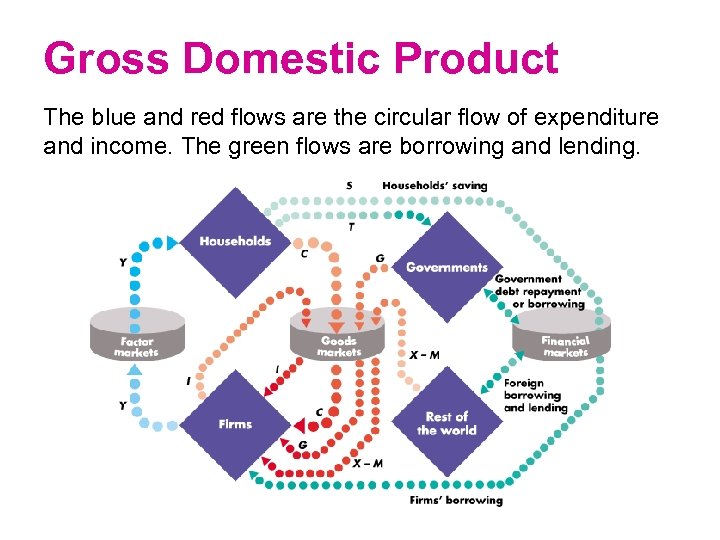
Gross Domestic Product The blue and red flows are the circular flow of expenditure and income. The green flows are borrowing and lending.
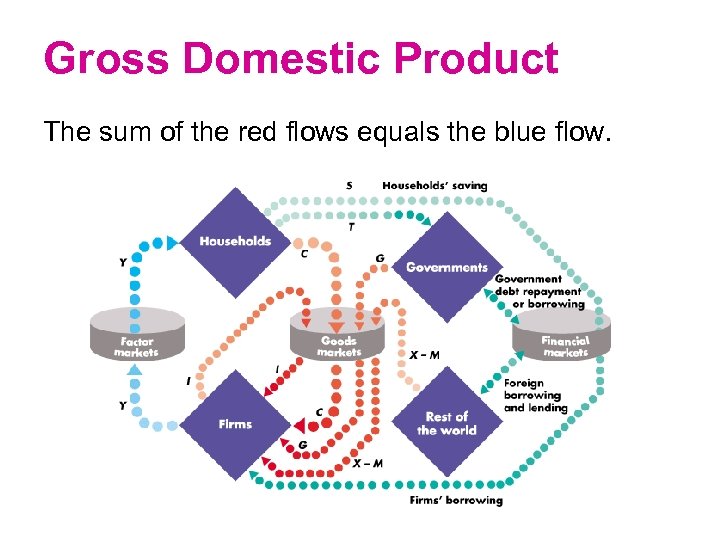
Gross Domestic Product The sum of the red flows equals the blue flow.
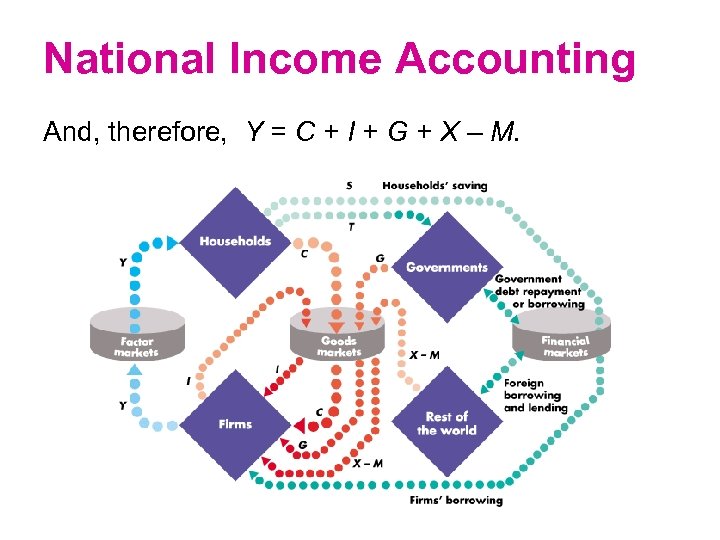
National Income Accounting And, therefore, Y = C + I + G + X – M.
Helpful Reviews § History matters: Refresher of the key events in recent American history § A few definitions refresher
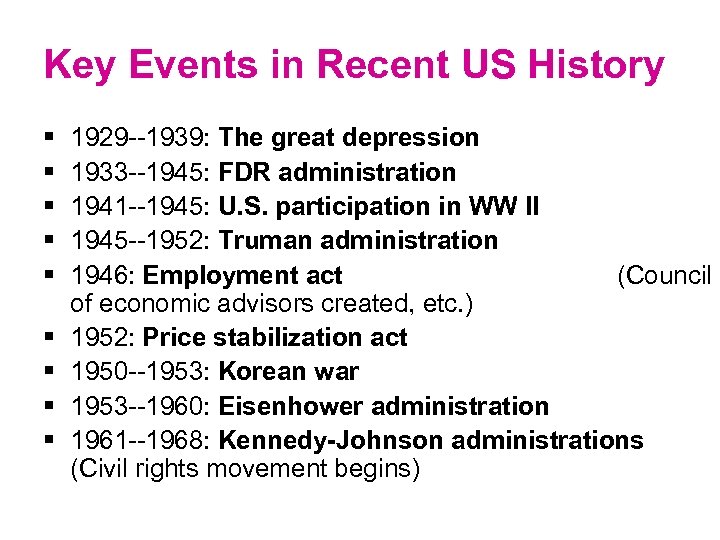
Key Events in Recent US History § § § § § 1929 --1939: The great depression 1933 --1945: FDR administration 1941 --1945: U. S. participation in WW II 1945 --1952: Truman administration 1946: Employment act (Council of economic advisors created, etc. ) 1952: Price stabilization act 1950 --1953: Korean war 1953 --1960: Eisenhower administration 1961 --1968: Kennedy-Johnson administrations (Civil rights movement begins)
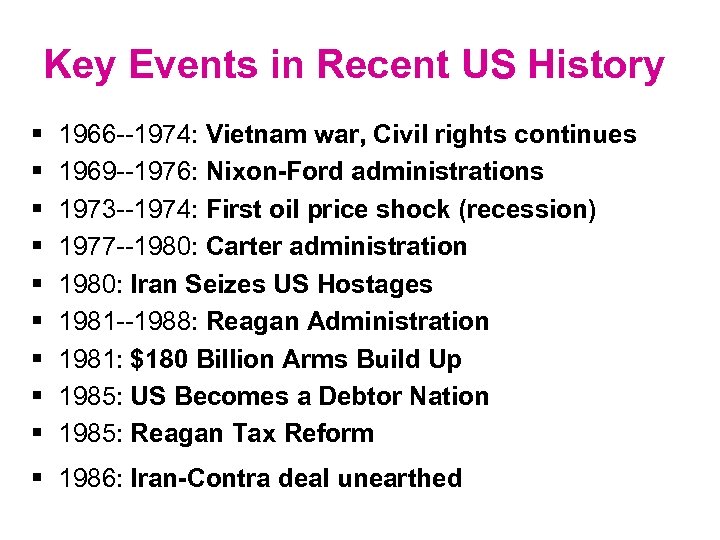
Key Events in Recent US History § § § § § 1966 --1974: Vietnam war, Civil rights continues 1969 --1976: Nixon-Ford administrations 1973 --1974: First oil price shock (recession) 1977 --1980: Carter administration 1980: Iran Seizes US Hostages 1981 --1988: Reagan Administration 1981: $180 Billion Arms Build Up 1985: US Becomes a Debtor Nation 1985: Reagan Tax Reform § 1986: Iran-Contra deal unearthed
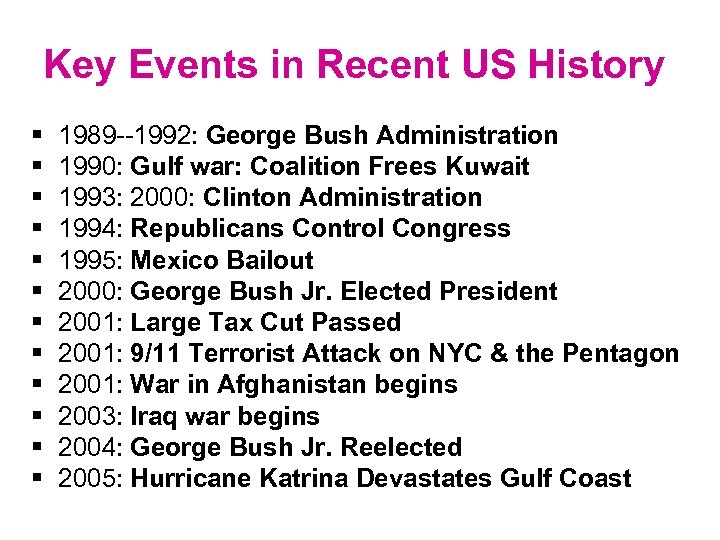
Key Events in Recent US History § § § 1989 --1992: George Bush Administration 1990: Gulf war: Coalition Frees Kuwait 1993: 2000: Clinton Administration 1994: Republicans Control Congress 1995: Mexico Bailout 2000: George Bush Jr. Elected President 2001: Large Tax Cut Passed 2001: 9/11 Terrorist Attack on NYC & the Pentagon 2001: War in Afghanistan begins 2003: Iraq war begins 2004: George Bush Jr. Reelected 2005: Hurricane Katrina Devastates Gulf Coast
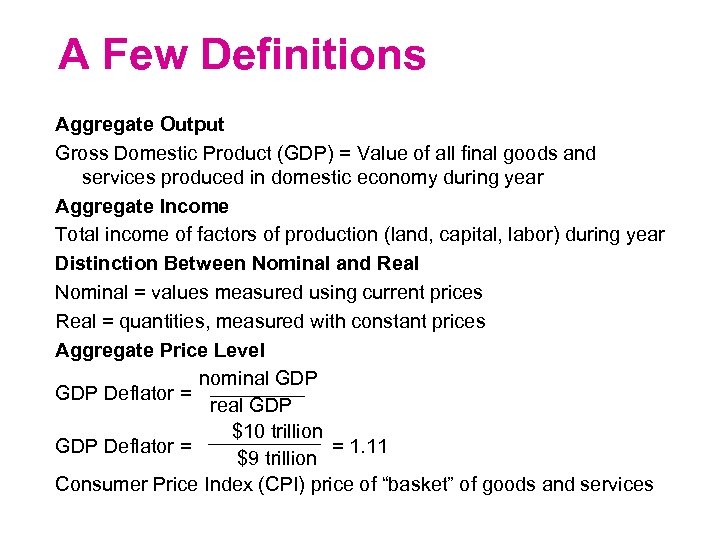
A Few Definitions Aggregate Output Gross Domestic Product (GDP) = Value of all final goods and services produced in domestic economy during year Aggregate Income Total income of factors of production (land, capital, labor) during year Distinction Between Nominal and Real Nominal = values measured using current prices Real = quantities, measured with constant prices Aggregate Price Level nominal GDP Deflator = real GDP $10 trillion GDP Deflator = = 1. 11 $9 trillion Consumer Price Index (CPI) price of “basket” of goods and services
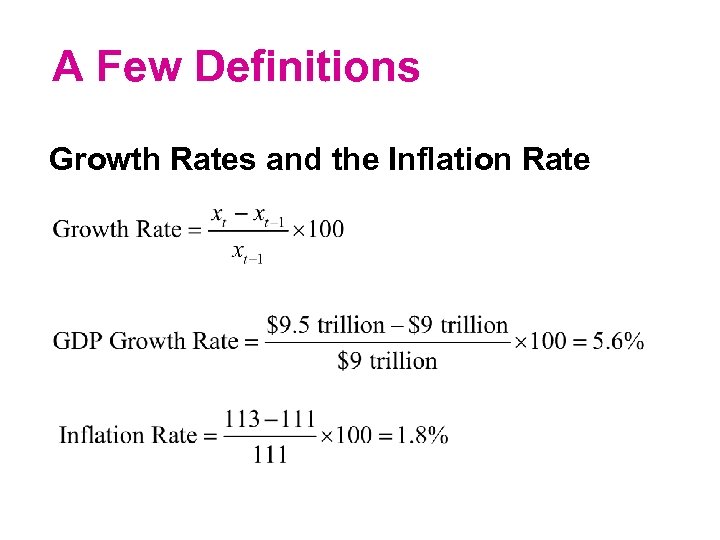
A Few Definitions Growth Rates and the Inflation Rate
Скачать презентацию ECON 3313 Money and Banking Abdul Munasib Department
938e5e4dd916d1e44d0f1144345575ef.ppt