


 Скачать презентацию Econ 201 Lecture 2 4 Essential Concepts and
0f176947a7d2a7add9a32101860fdfe6.ppt
- Количество слайдов: 13
 Econ 201 Lecture 2. 4 Essential Concepts and Terms 1 -15 -2009
 Defining Economics • Economics studies (Wikipedia): – 1) the production, – 2) distribution, and – 3) consumption of goods and services. • The term economics comes from the Greek for oikos (house) and nomos (custom or law), hence "rules of the house(hold). “
 Production of Goods and Services • How do we decide which goods and services get produced? – How much is produced? – Who/which firms produce it? – Which resources are used to produce it? • A couple of approaches: – Decentralized – Adam Smith’s invisible hand • Market demand determines which goods (and how much) gets produced – Centralized – planned economy • Government planners determine production
 Distribution of Goods and Services • How are the goods and services distributed? – To which consumers? – How much to each consumer? • A couple of approaches – Decentralized: goods are allocated to consumers based on their willingness-to-pay – Centralized: allocated or rationed to consumers • WW II: rationing food/clothing by coupons
 Another Way of Looking At It • Lionel Robbins (1932): • "the science which studies human behaviour as a relationship between ends and scarce means which have alternative uses. " • Scarcity means that available resources are insufficient to satisfy all wants and needs. • Absent scarcity and alternative uses of available resources, there is no economic problem. The subject thus defined involves the study of choices as they are affected by incentives and resources.
 Scarcity • There are not enough resources to produce and consume all of the goods and services we desire – An example: production possibilities frontier (PPF) • Federal Government: guns and butter (or child health care and the Iraq war) • Detroit: SUVs/Humvees and smaller/fuel-efficient cars
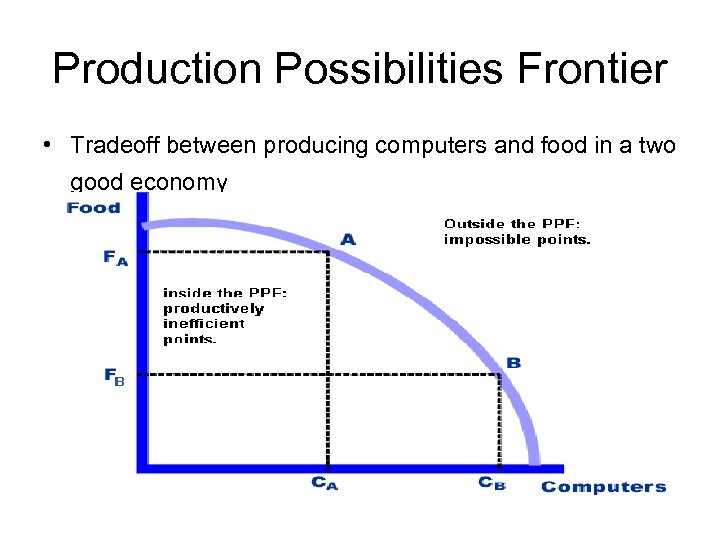 Production Possibilities Frontier • Tradeoff between producing computers and food in a two good economy
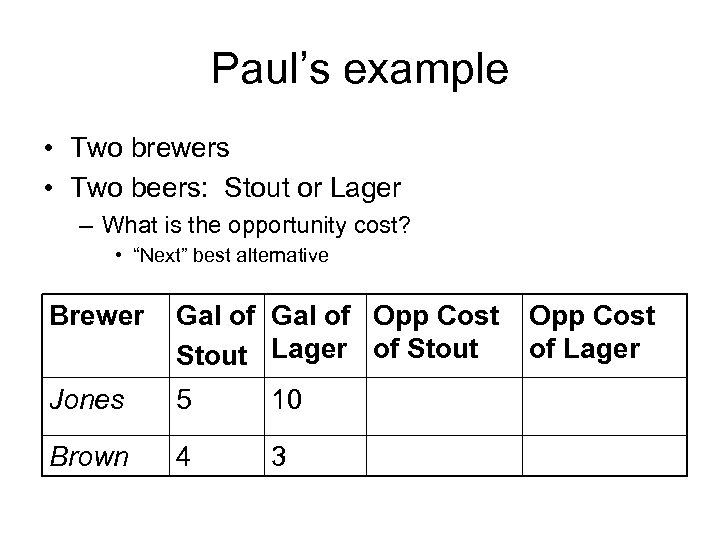 Paul’s example • Two brewers • Two beers: Stout or Lager – What is the opportunity cost? • “Next” best alternative Brewer Gal of Opp Cost Stout Lager of Stout Jones 5 10 Brown 4 3 Opp Cost of Lager
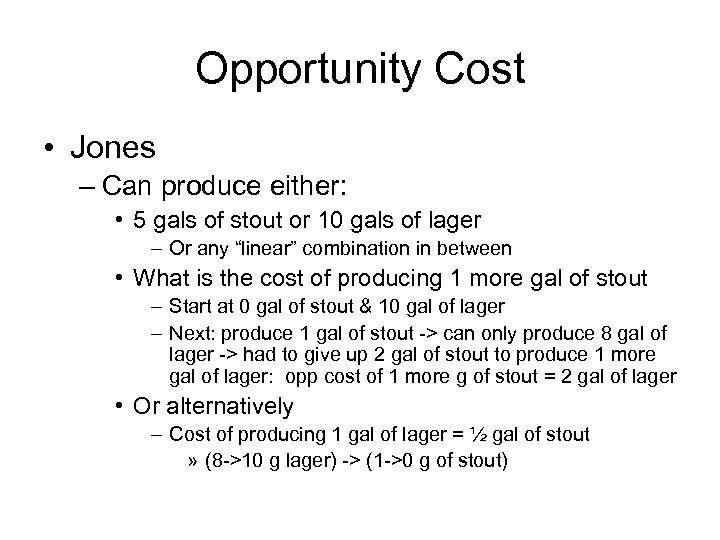 Opportunity Cost • Jones – Can produce either: • 5 gals of stout or 10 gals of lager – Or any “linear” combination in between • What is the cost of producing 1 more gal of stout – Start at 0 gal of stout & 10 gal of lager – Next: produce 1 gal of stout -> can only produce 8 gal of lager -> had to give up 2 gal of stout to produce 1 more gal of lager: opp cost of 1 more g of stout = 2 gal of lager • Or alternatively – Cost of producing 1 gal of lager = ½ gal of stout » (8 ->10 g lager) -> (1 ->0 g of stout)
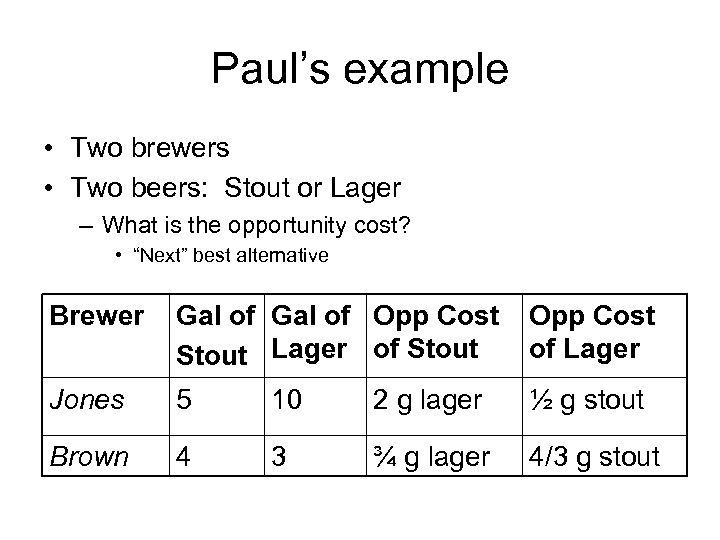 Paul’s example • Two brewers • Two beers: Stout or Lager – What is the opportunity cost? • “Next” best alternative Brewer Gal of Opp Cost Stout Lager of Stout Opp Cost of Lager Jones 5 10 2 g lager ½ g stout Brown 4 3 ¾ g lager 4/3 g stout
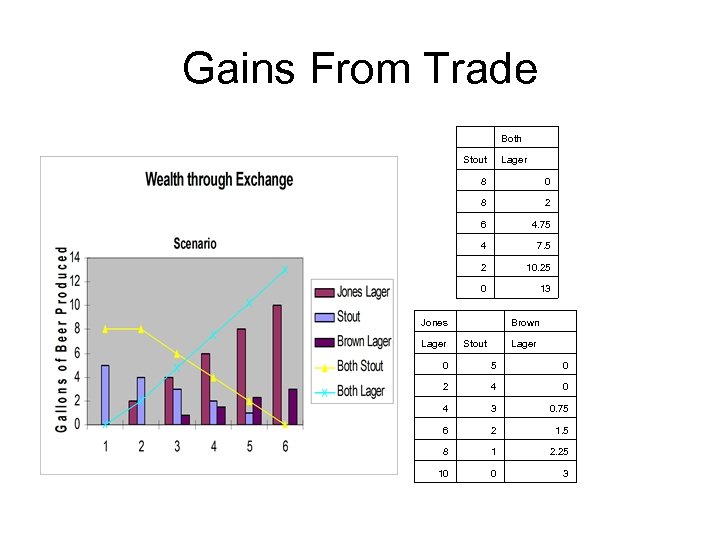 Gains From Trade Both Stout Lager 8 0 8 2 6 4. 75 4 7. 5 2 10. 25 0 13 Jones Brown Lager Stout Lager 0 5 0 2 4 0 4 3 0. 75 6 2 1. 5 8 1 2. 25 10 0 3
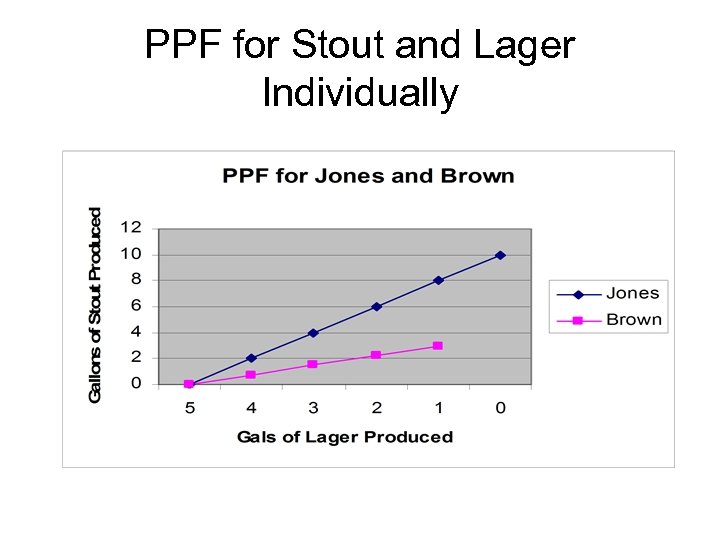 PPF for Stout and Lager Individually
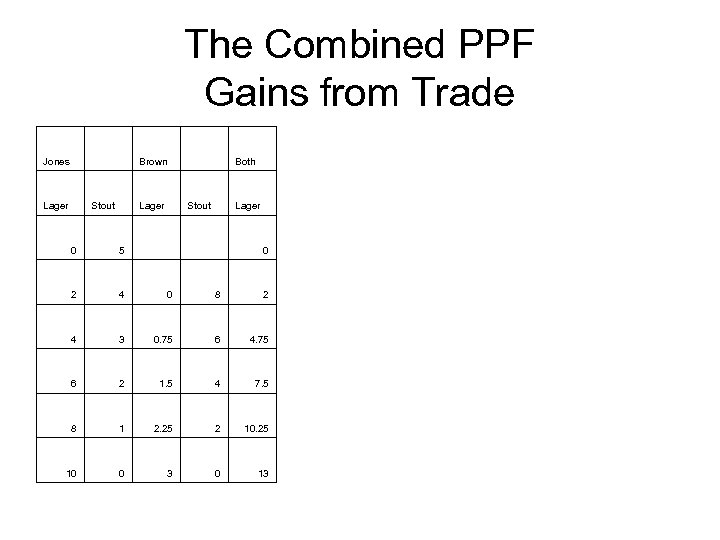 The Combined PPF Gains from Trade Jones Brown Both Lager Stout Lager 0 5 0 2 4 0 8 2 4 3 0. 75 6 4. 75 6 2 1. 5 4 7. 5 8 1 2. 25 2 10. 25 10 0 3 0 13