


 Скачать презентацию ECON 151 PRINCIPLES OF MACROECONOMICS Chapter 8
6859e30fbacef1039ea9ac38e0db8c3e.ppt
- Количество слайдов: 58
 ECON 151 – PRINCIPLES OF MACROECONOMICS Chapter 8: Measuring the Economy’s Performance Materials include content from Pearson Addison-Wesley which has been modified by the instructor and displayed with permission of the publisher. All rights reserved.
 Learning Objectives Describe the circular flow of income and output n Define gross domestic product (GDP) n Understand the limitations of using GDP as a measure of national welfare n 2
 Learning Objectives Explain the expenditure approach to tabulating GDP n Explain the income approach to computing GDP n Distinguish between nominal GDP and real GDP n 3
 National Income Accounting n National Income Accounting ¨A measurement system used to estimate national income and its components 4
 The Simple Circular Flow Figure 8 -1 5
 The Simple Circular Flow Figure 8 -1 6
 The Simple Circular Flow Figure 8 -1 7
 The Simple Circular Flow Figure 8 -1 8
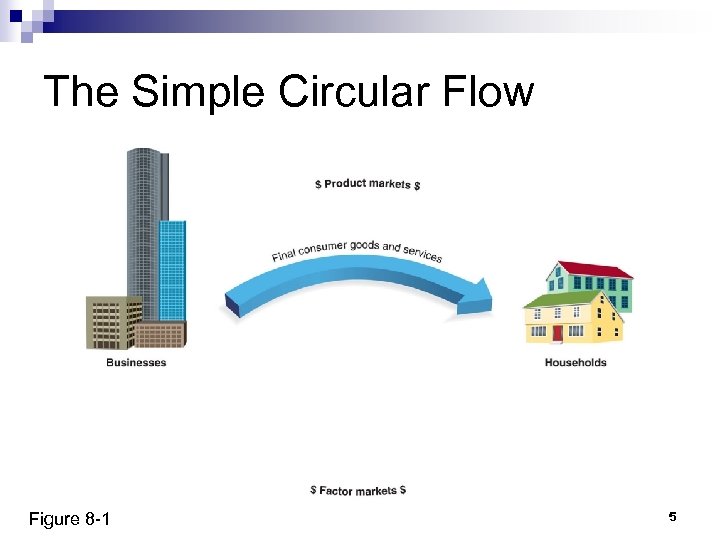
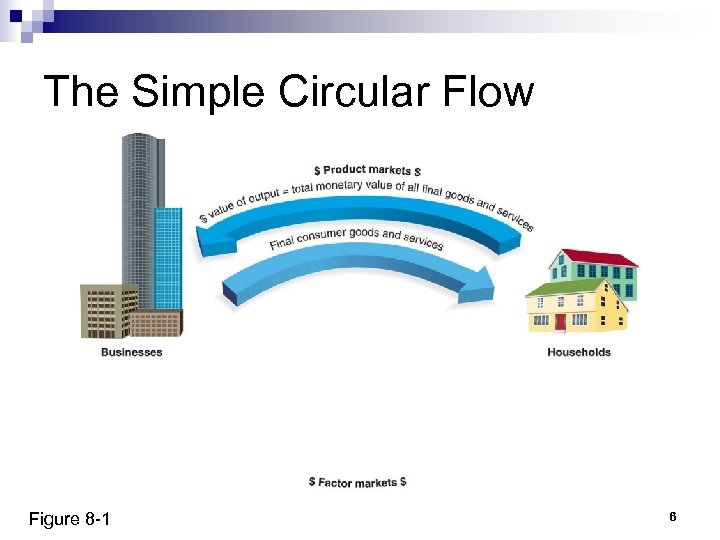
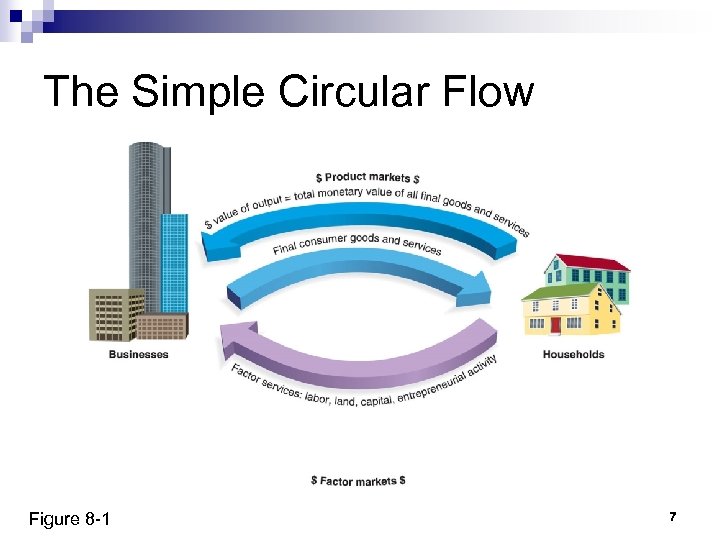
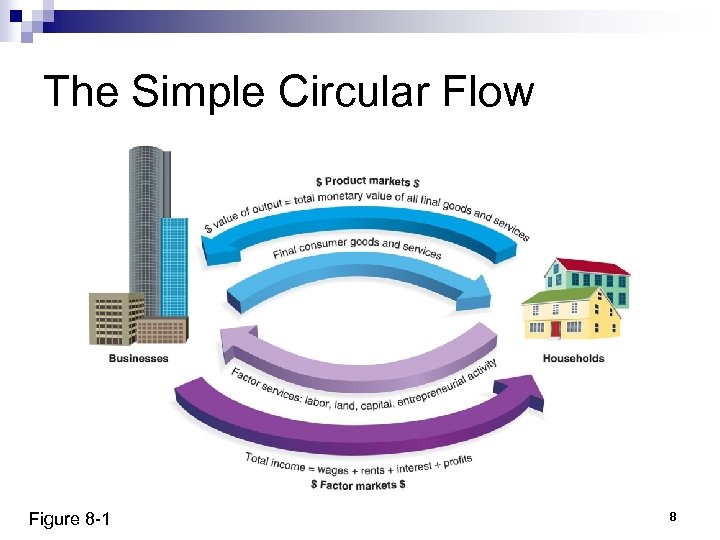
 The Simple Circular Flow n Two observations ¨ ¨ In every economic exchange, the seller receives exactly the same amount that the buyer spends. Goods and services flow in one direction and money payments flow in the other. 9
 The Simple Circular Flow n Profits explained ¨ Question n ¨ Why is profit a cost of production? Answer n Profits are the return entrepreneurs receive for the risk they incur when organizing productive activities 10
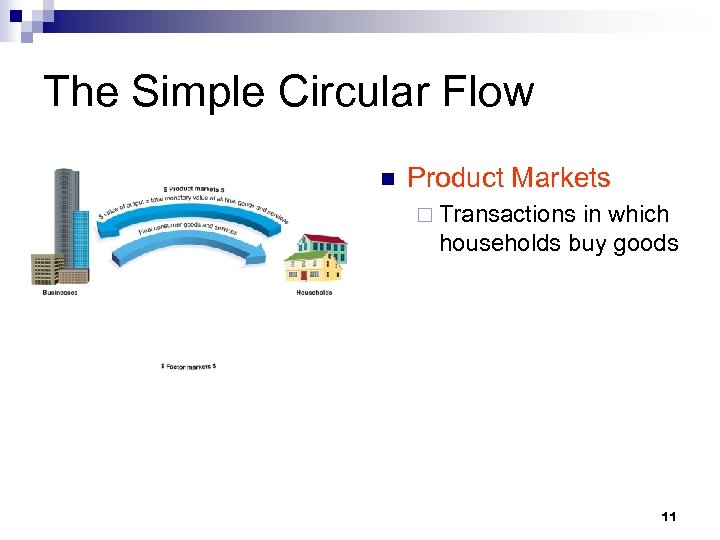 The Simple Circular Flow n Product Markets ¨ Transactions in which households buy goods 11
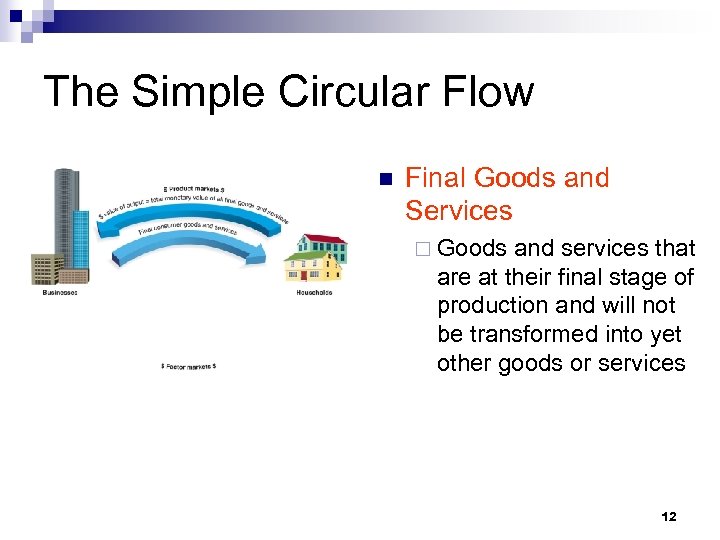 The Simple Circular Flow n Final Goods and Services ¨ Goods and services that are at their final stage of production and will not be transformed into yet other goods or services 12
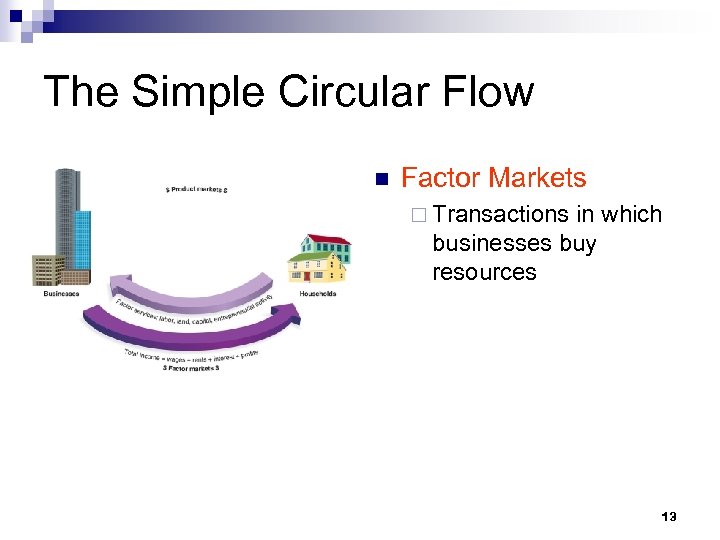 The Simple Circular Flow n Factor Markets ¨ Transactions in which businesses buy resources 13
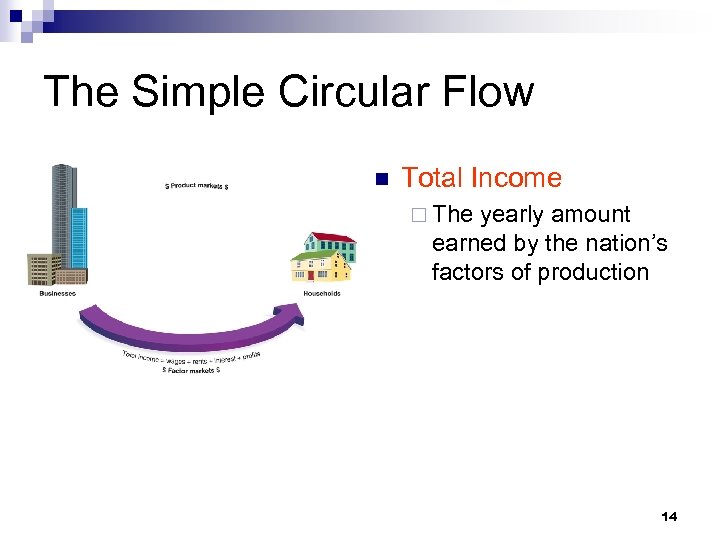 The Simple Circular Flow n Total Income ¨ The yearly amount earned by the nation’s factors of production 14
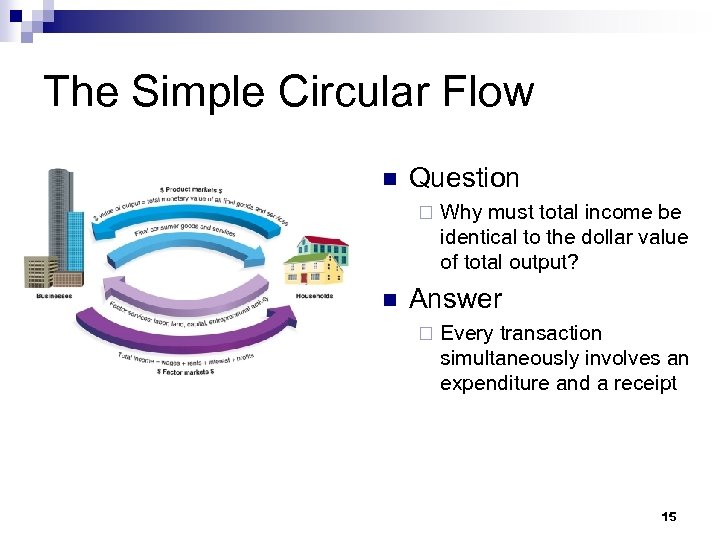 The Simple Circular Flow n Question ¨ n Why must total income be identical to the dollar value of total output? Answer ¨ Every transaction simultaneously involves an expenditure and a receipt 15
 National Income Accounting n Gross Domestic Product (GDP) ¨ The total market value of all final goods and services produced by factors of production located within a nation’s borders 16
 National Income Accounting n Observations ¨ GDP measures the dollar value of final output ¨ GDP measures the dollar value of final goods and services produced per year by factors of production located within a nation’s borders 17
 National Income Accounting n Intermediate Goods ¨ Goods used up entirely in the production of final goods 18
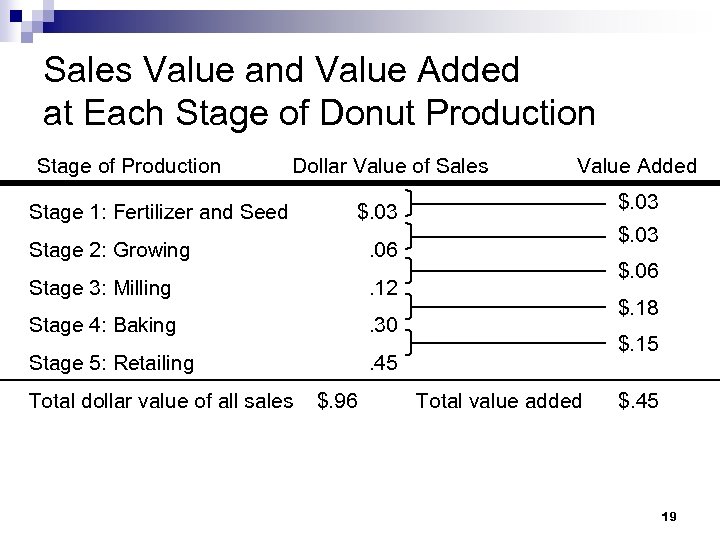 Sales Value and Value Added at Each Stage of Donut Production Stage of Production Dollar Value of Sales Stage 1: Fertilizer and Seed Value Added $. 03 Stage 2: Growing . 06 Stage 3: Milling . 12 Stage 4: Baking . 30 Stage 5: Retailing $. 03 . 45 Total dollar value of all sales $. 96 $. 06 $. 18 $. 15 Total value added $. 45 19
 National Income Accounting n Exclusion of financial transactions, transfer payments, and secondhand goods ¨ Numerous transactions occur that have nothing to do with final goods and services being produced. 20
 National Income Accounting n Financial transactions ¨ Securities n Stocks and bonds ¨ Government n n Social Security Unemployment compensation ¨ Private n n transfer payments Individual gifts Corporate gifts 21
 National Income Accounting n Transfer of secondhand goods ¨ Why not count the sale of a used car, stereo, or snowboard as part of GDP? n Other excluded transactions ¨ Household production ¨ Legal underground transactions ¨ Illegal underground transactions 22
 Recognizing GDP Limitations n GDP’s limitations ¨ Excludes non-market production ¨ Different countries have different legal versus illegal activities ¨ Quality of life is not measured ¨ GDP poorly measures a nation’s well-being 23
 Two Main Methods of Measuring GDP n Expenditure Approach ¨A way of computing national income by adding up the dollar value at current market prices of all final goods and services 24
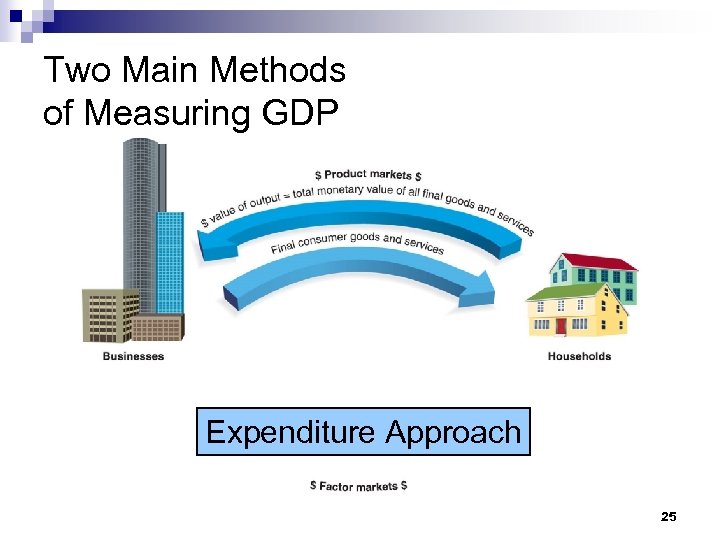 Two Main Methods of Measuring GDP Expenditure Approach 25
 Two Main Methods of Measuring GDP n Income Approach ¨A way of measuring national income by adding up income received by all factors of production 26
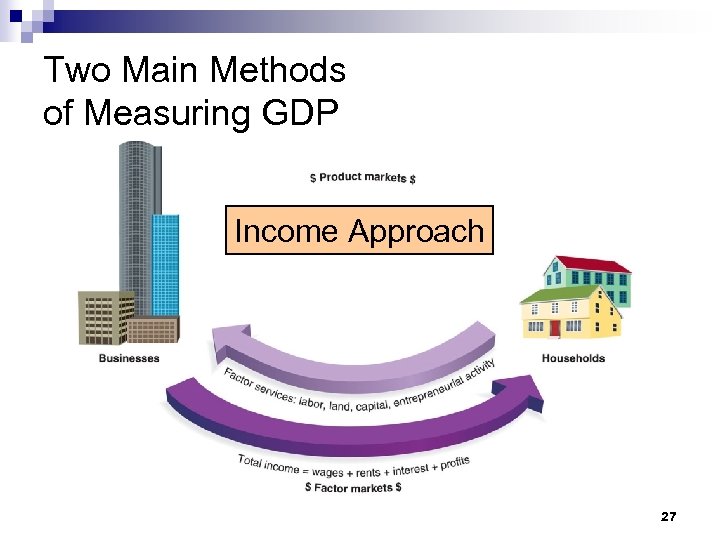 Two Main Methods of Measuring GDP Income Approach 27
 Two Main Methods of Measuring GDP n Deriving GDP by the expenditure approach ¨ Consumption n Durables ¨ n Life span of more than three years Nondurables ¨ n Expenditure (C) Life span of less than three years Services ¨ Intangible commodities 28
 Two Main Methods of Measuring GDP n Deriving GDP by the expenditure approach ¨ Gross Private Domestic Investment (I) n The creation of capital goods, such as factories and machines, that can yield production and hence consumption in the future 29
 Two Main Methods of Measuring GDP n Deriving GDP by the expenditure approach ¨ Government Expenditures n State, local, and federal n Valued at cost (G) 30
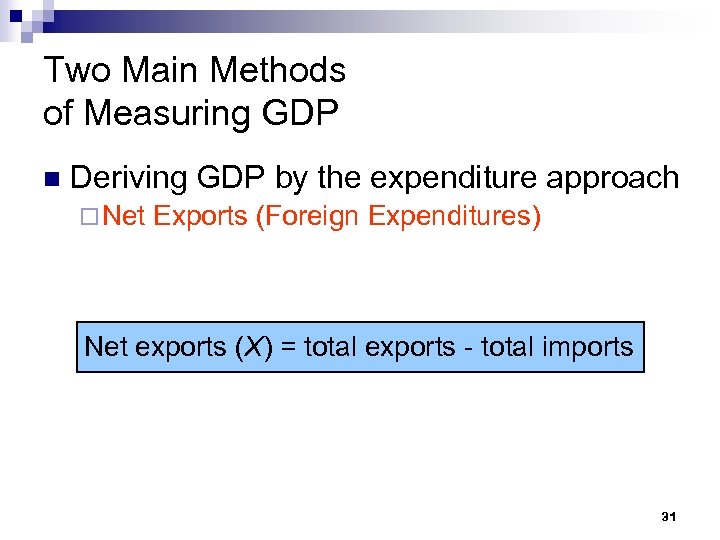 Two Main Methods of Measuring GDP n Deriving GDP by the expenditure approach ¨ Net Exports (Foreign Expenditures) Net exports (X) = total exports - total imports 31
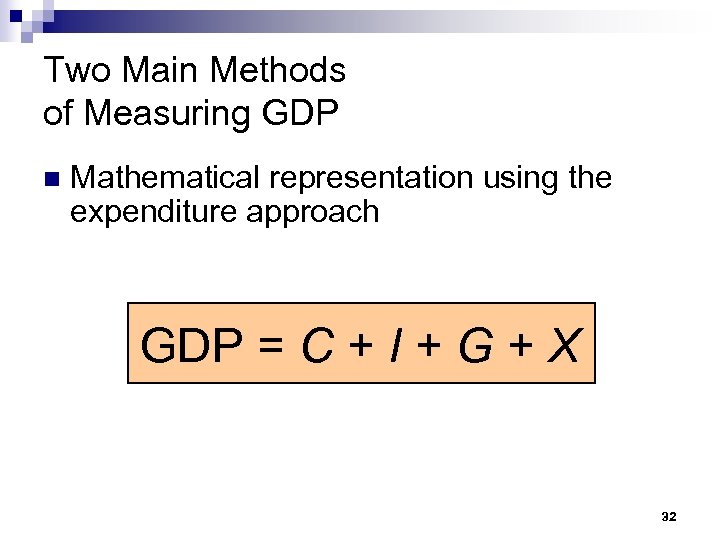 Two Main Methods of Measuring GDP n Mathematical representation using the expenditure approach GDP = C + I + G + X 32
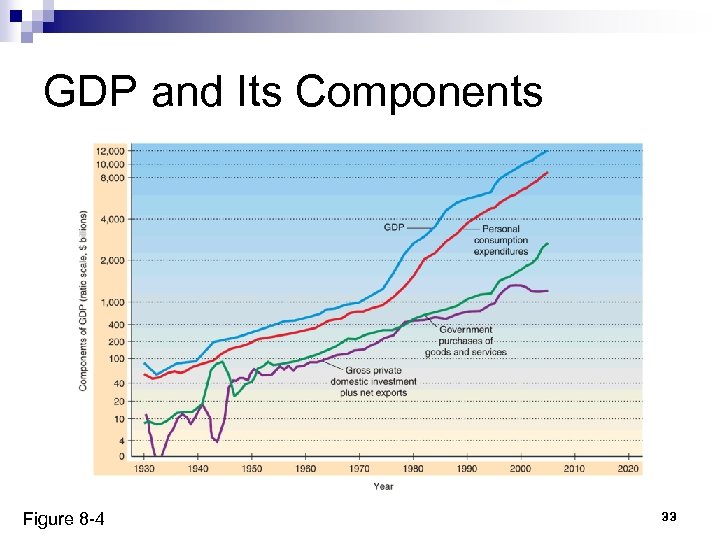 GDP and Its Components Figure 8 -4 33
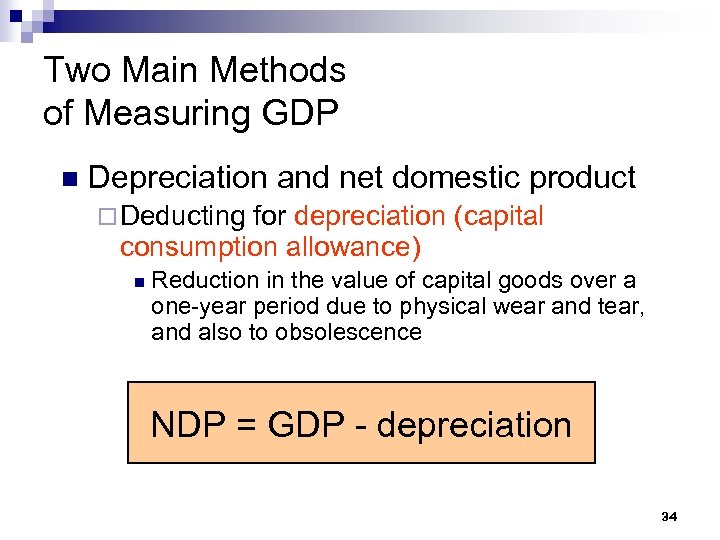 Two Main Methods of Measuring GDP n Depreciation and net domestic product ¨ Deducting for depreciation (capital consumption allowance) n Reduction in the value of capital goods over a one-year period due to physical wear and tear, and also to obsolescence NDP = GDP - depreciation 34
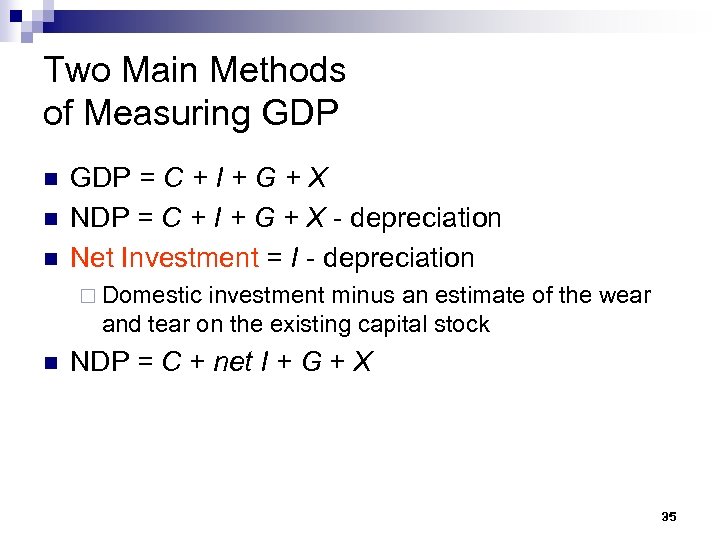 Two Main Methods of Measuring GDP n n n GDP = C + I + G + X NDP = C + I + G + X - depreciation Net Investment = I - depreciation ¨ Domestic investment minus an estimate of the wear and tear on the existing capital stock n NDP = C + net I + G + X 35
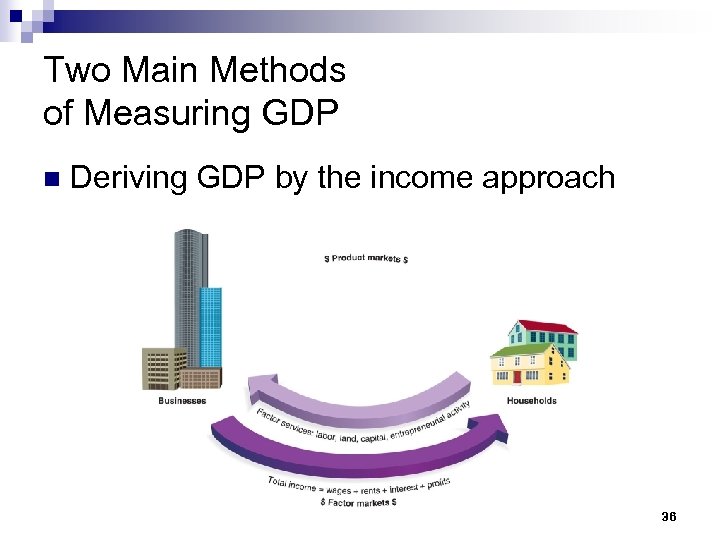 Two Main Methods of Measuring GDP n Deriving GDP by the income approach 36
 Deriving GDP by the Income Approach n Gross Domestic Income (GDI) ¨ The sum of all income—wages, interest, rent, and profits—paid to the four factors of production 37
 Two Main Methods of Measuring GDP n Gross Domestic Income (GDI) ¨ Wages ¨ Interest ¨ Rent ¨ Profits 38
 Two Main Methods of Measuring GDP Gross domestic product equals gross domestic income plus indirect business taxes and depreciation. n These last items are called nonincome expense items. n 39
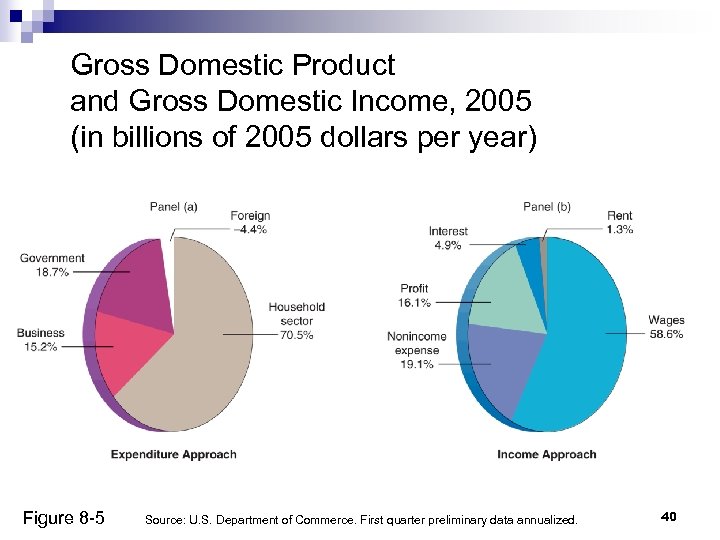 Gross Domestic Product and Gross Domestic Income, 2005 (in billions of 2005 dollars per year) Figure 8 -5 Source: U. S. Department of Commerce. First quarter preliminary data annualized. 40
 Other Components of National Income Accounting n National Income (NI) ¨ The total of all factor payments to resource owners n Personal Income (PI) ¨ The amount of income that households actually receive before they pay personal income taxes 41
 Other Components of National Income Accounting n Disposable Personal Income (DPI) ¨ Personal income after personal income taxes have been paid 42
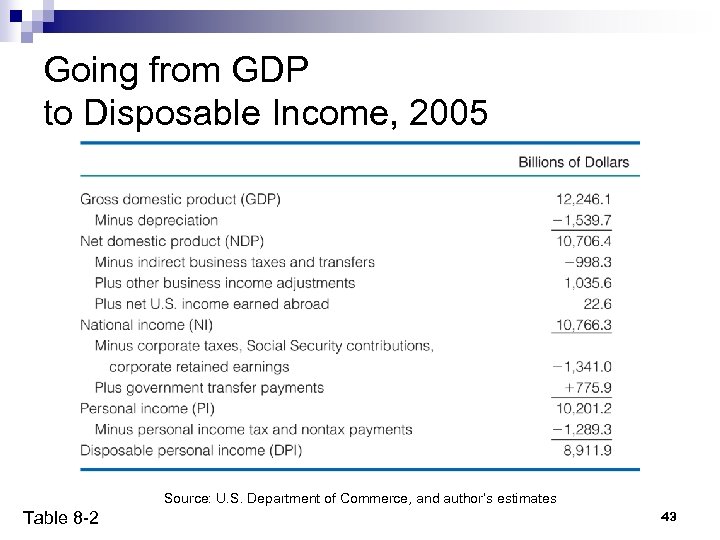 Going from GDP to Disposable Income, 2005 Source: U. S. Department of Commerce, and author’s estimates Table 8 -2 43
 Distinguishing Between Nominal and Real Values n Nominal Values ¨ Measurements in terms of the actual market prices at which goods are sold; expressed in current dollars 44
 Distinguishing Between Nominal and Real Values n Real Values ¨ Measurements after adjustments have been made for changes in the average of prices between years; expressed in constant dollars 45
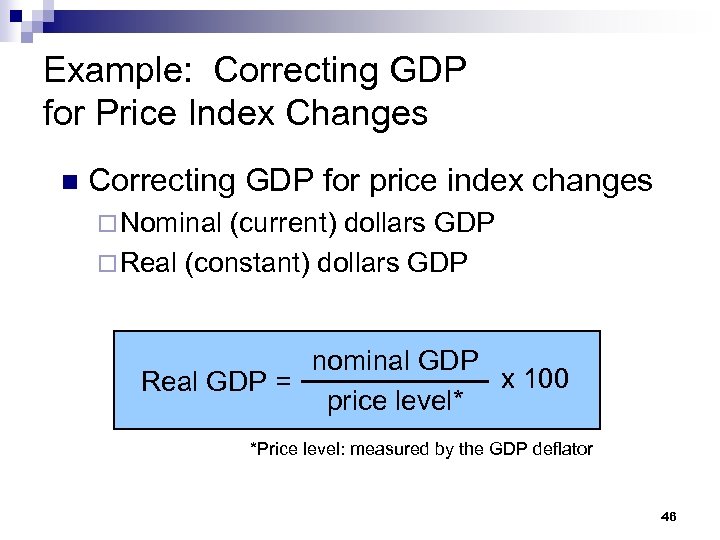 Example: Correcting GDP for Price Index Changes n Correcting GDP for price index changes ¨ Nominal (current) dollars GDP ¨ Real (constant) dollars GDP nominal GDP x 100 Real GDP = price level* *Price level: measured by the GDP deflator 46
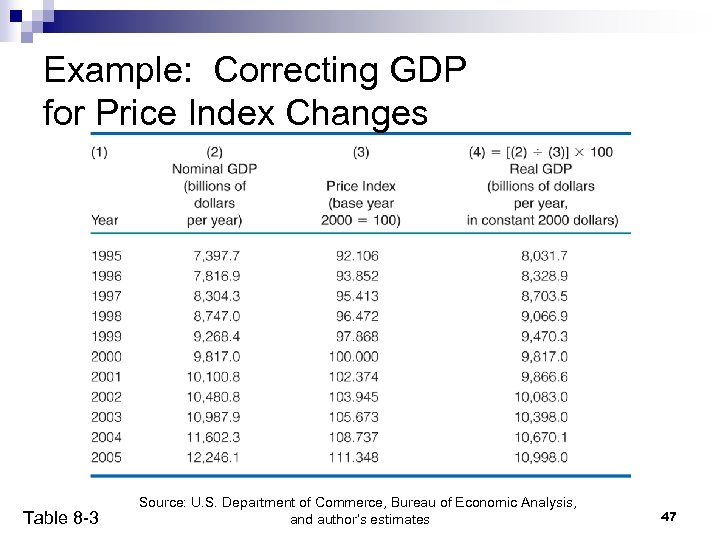 Example: Correcting GDP for Price Index Changes Table 8 -3 Source: U. S. Department of Commerce, Bureau of Economic Analysis, and author’s estimates 47
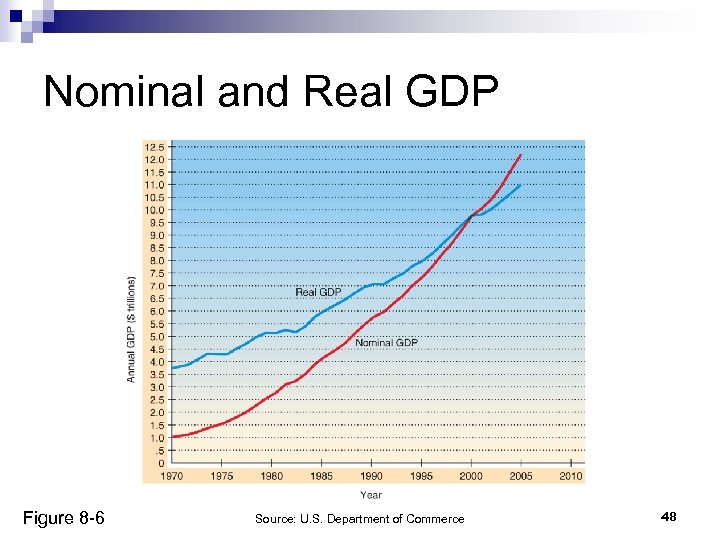 Nominal and Real GDP Figure 8 -6 Source: U. S. Department of Commerce 48
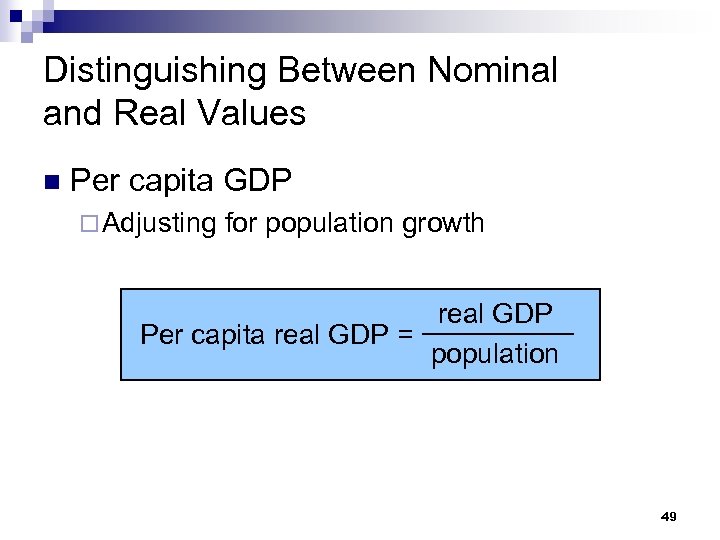 Distinguishing Between Nominal and Real Values n Per capita GDP ¨ Adjusting for population growth real GDP Per capita real GDP = population 49
 Nominal and Real GDP n n The Bureau of Economic Analysis now uses a chain-weighted measure of real GDP. This means that changes in the prices and output levels of a certain good will contribute to overall changes in GDP to the extent that the good accounts for a significant share of overall economic activity. 50
 Distinguishing Between Nominal and Real Values n Some issues ¨ The distribution of output ¨ Changes in leisure time ¨ Increased traffic congestion ¨ Air pollution ¨ Crime ¨ Housework 51
 Comparing GDP Throughout the World n Example ¨ France $1. 25 = 1 euro n Per capita income = 23, 168. 80 euros n ¨ France per capita income in terms of dollars equals 23, 168. 80 x 1. 25 = $28, 961. 52
 Comparing GDP Throughout the World n True purchasing power ¨ Accounting for goods and services that are not traded in the world market ¨ Purchasing Power Parity n Adjustments in exchange rate conversions that takes into account differences in the true cost of living across countries 53
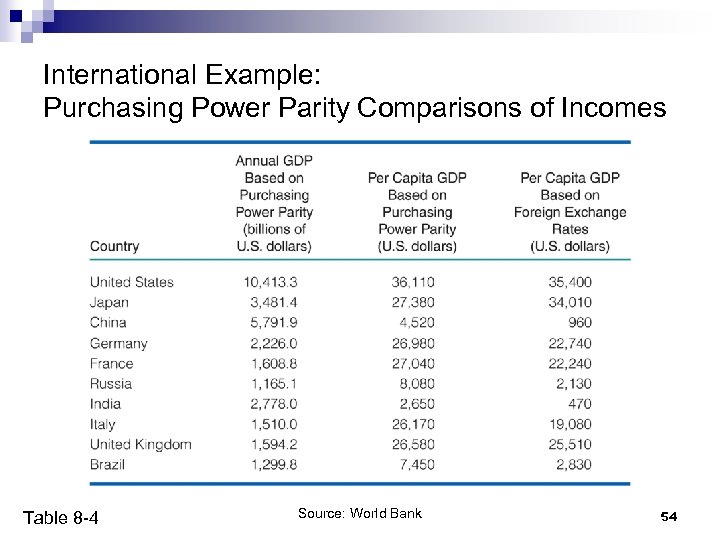 International Example: Purchasing Power Parity Comparisons of Incomes Table 8 -4 Source: World Bank 54
 Summary Discussion of Learning Objectives n The circular flow of income and output ¨ In every economic transaction, receipts exactly equal expenditures ¨ Goods and services flow in one direction and money payments flow in the other n Gross Domestic Product (GDP) ¨ The total market value of a nation’s final output of goods and services produced in a year using factors of production located within its borders 55
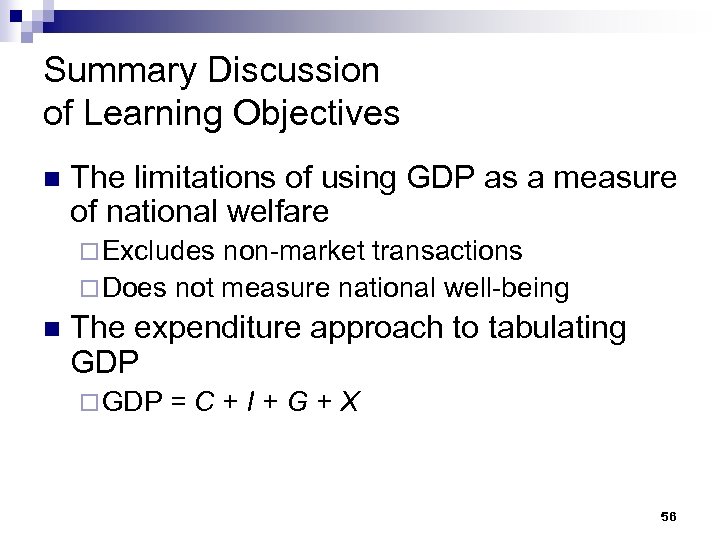 Summary Discussion of Learning Objectives n The limitations of using GDP as a measure of national welfare ¨ Excludes non-market transactions ¨ Does not measure national well-being n The expenditure approach to tabulating GDP ¨ GDP =C+I+G+X 56
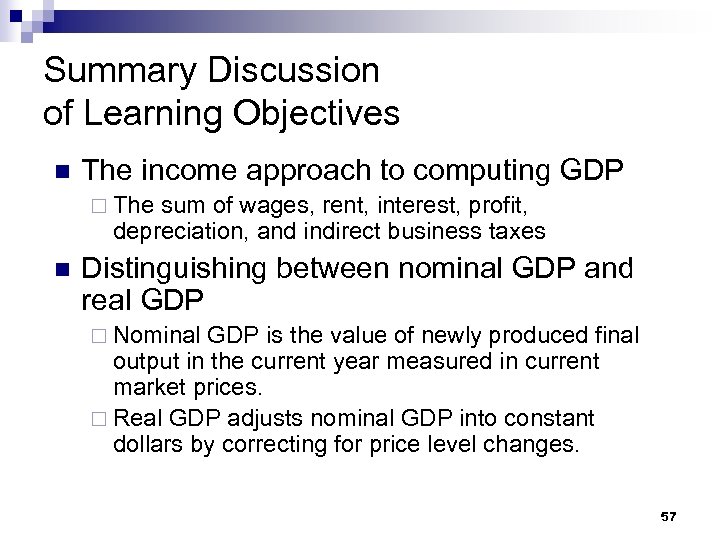 Summary Discussion of Learning Objectives n The income approach to computing GDP ¨ The sum of wages, rent, interest, profit, depreciation, and indirect business taxes n Distinguishing between nominal GDP and real GDP ¨ Nominal GDP is the value of newly produced final output in the current year measured in current market prices. ¨ Real GDP adjusts nominal GDP into constant dollars by correcting for price level changes. 57
 ECON 151 – PRINCIPLES OF MACROECONOMICS Chapter 8: Measuring the Economy’s Performance Materials include content from Pearson Addison-Wesley which has been modified by the instructor and displayed with permission of the publisher. All rights reserved.