


 Скачать презентацию ECON 102 004 Principles of Microeconomics S W
ab4f8d0648760101ba31ac021f2d5bcb.ppt
- Количество слайдов: 39
 ECON 102. 004 – Principles of Microeconomics S&W, Chapter 5 The Consumption Decision Instructor: Mehmet S. Tosun, Ph. D. Department of Economics University of Nevada, Reno 1
 Lecture Outline • • • Consumer Choice Income elasticity of demand Deriving demand curves Income and substitution effects Utility Beyond the basic competitive model 2
 Assumption of Rationality • There are over 100 million households in the United States choosing millions of different types and brands of goods daily. • Economists assume all of them are rational! – This is not so farfetched. – Rationality simply means not wasting resources. 3
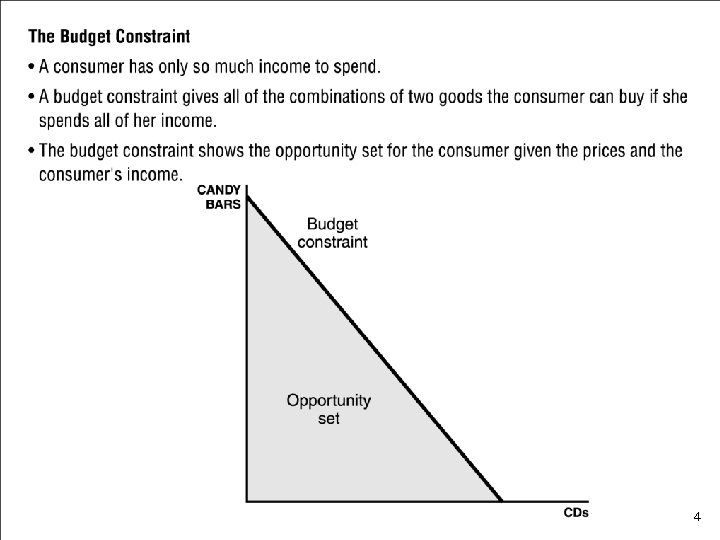 The Budget Constraint • A consumer has only so much income to spend. • A budget constraint gives all of the combinations of two goods the consumer can buy if she spends all of her income. • The budget constraint shows the opportunity set for the consumer given the prices and the consumer's income. 4
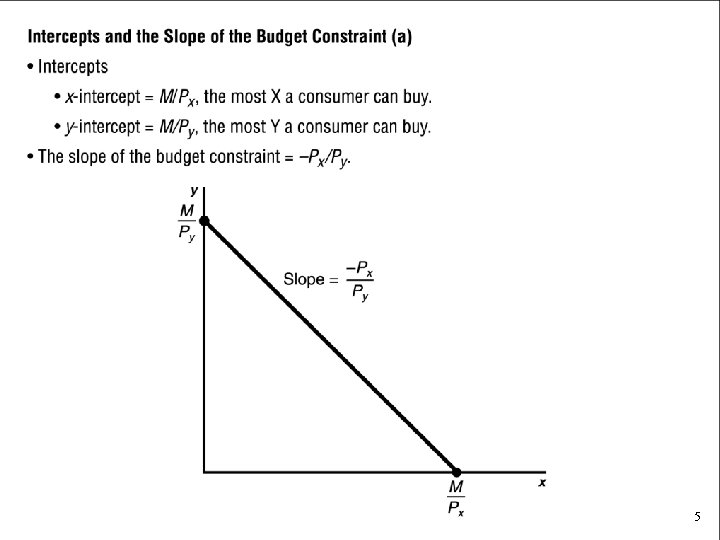 Intercepts and the Slope of the Budget Constraint (a) • Intercepts – x‑intercept = M/p. X, the most X a consumer can buy. – y‑intercept = M/p. Y, the most Y a consumer can buy. • The slope of the budget constraint = p. X/p. Y. 5
 Intercepts and the Slope of the Budget Constraint (b) • The slope of the budget constraint shows the trade‑off a consumer faces. – If p. X = $2 and p. Y = $1, then 2 Ys trade for 1 X; – The slope of the budget constraint is –Px/Py = $2/$1 = -2. • The ratio of the relative prices, the trade‑off between X and Y, and the slope are all the same. 6
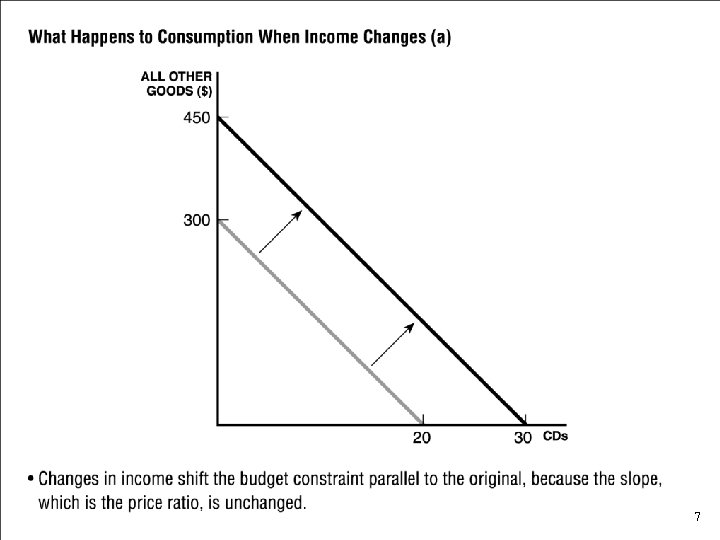 What Happens to Consumption When Income Changes (a) • Changes in income shift the budget constraint parallel to the original, because the slope, which is the price ratio, is unchanged. 7
 What Happens to Consumption When Income Changes (a) (cont. ) • If income increases, the budget constraint shifts out from the origin, parallel to the old budget constraint. – The increase in income makes consumers better off. – Consumers’ opportunity set expands and they can buy more goods. • If income decreases, the budget constraint shifts in toward the origin, parallel to the old budget constraint. 8
 What Happens to Consumption When Income Changes (b) • When income increases, consumers choose a new point on a new budget constraint farther from the origin. • The point they choose depends on their own tastes or preferences. • When income rises, the consumption of most goods rises: – These are normal goods. • When income rises, consumption of some goods falls: – These are inferior goods. 9
 What Happens to Consumption When Income Changes (c) • Income elasticity of demand: sensitivity of demand to changes in income. • Income elasticity of demand = % Qd /% income. – Income elasticity for normal goods > 0. – Income elasticity for inferior goods < 0. • The income elasticity of luxuries (movies, restaurant meals) is high. • The income elasticity of necessities (car repairs, clothing, furniture) is low. 10
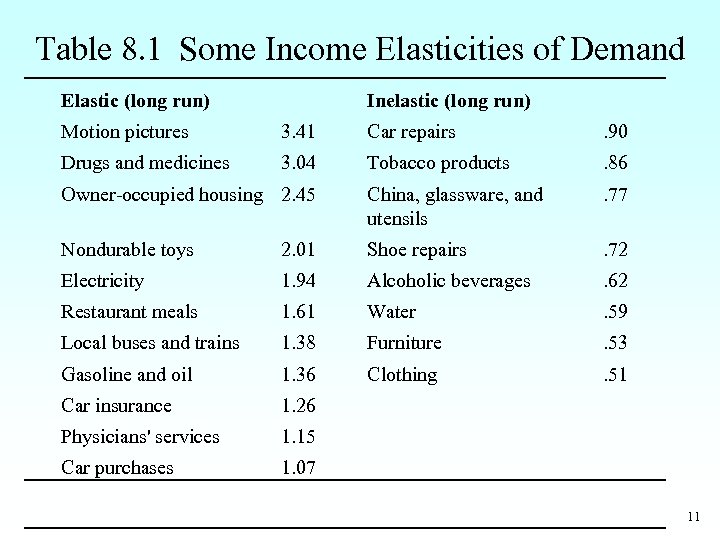 Table 8. 1 Some Income Elasticities of Demand Elastic (long run) Inelastic (long run) Motion pictures 3. 41 Car repairs . 90 Drugs and medicines 3. 04 Tobacco products . 86 Owner‑occupied housing 2. 45 China, glassware, and utensils . 77 Nondurable toys 2. 01 Shoe repairs . 72 Electricity 1. 94 Alcoholic beverages . 62 Restaurant meals 1. 61 Water . 59 Local buses and trains 1. 38 Furniture . 53 Gasoline and oil 1. 36 Clothing . 51 Car insurance 1. 26 Physicians' services 1. 15 Car purchases 1. 07 11
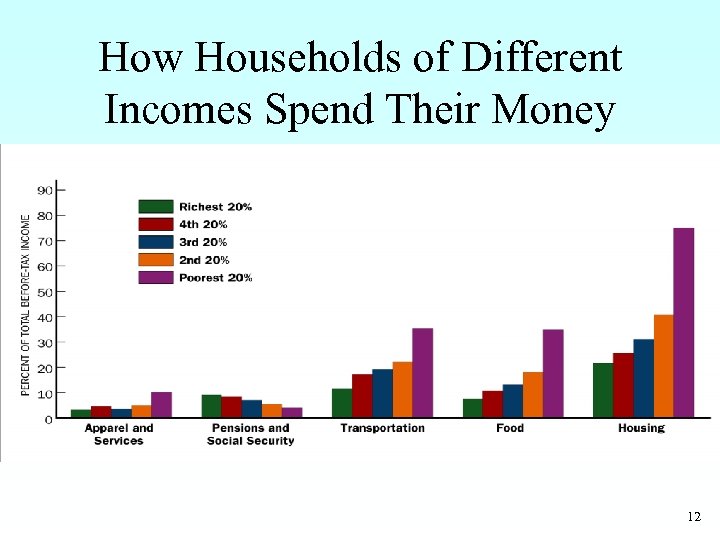 How Households of Different Incomes Spend Their Money 12
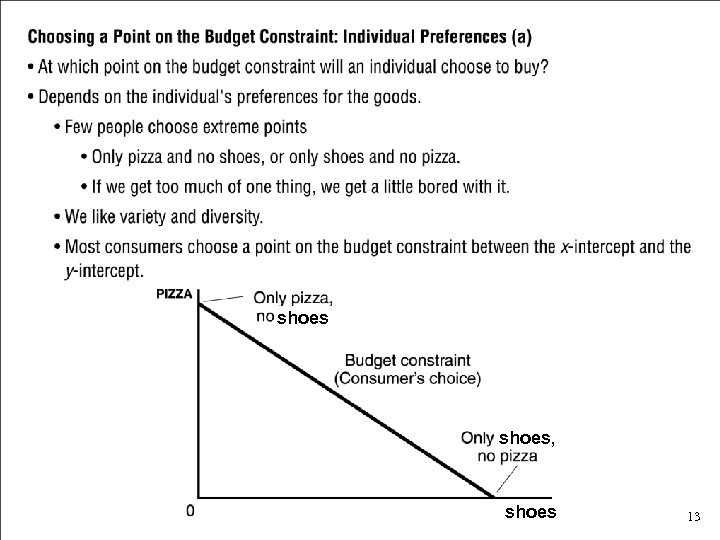 Choosing a Point on the Budget Constraint: Individual Preferences (a) • At which point on the budget constraint will an individual choose to buy? • Depends on the individual's preferences for the goods. shoes – Few people choose extreme points • Only pizza and no shoes, or only shoes and no pizza. shoes, • If we get too much of one thing, we get a little bored with it. – We like variety and diversity. shoes 13
 Choosing a Point on the Budget Constraint: Individual Preferences (b) • The consumer’s choice depends on how they value the two goods. • When making decisions people look at the marginal value. • Example: Pizza and shoes – The consumer considers the value of an additional pair of shoes. – He compares this to the opportunity cost of an additional pair of shoes: • If he buys one more pair of shoes, how many pizzas must he do without? – If the value of an additional pair of shoes > the cost of an additional pair of shoes, the consumer buys an additional pair of shoes. 14
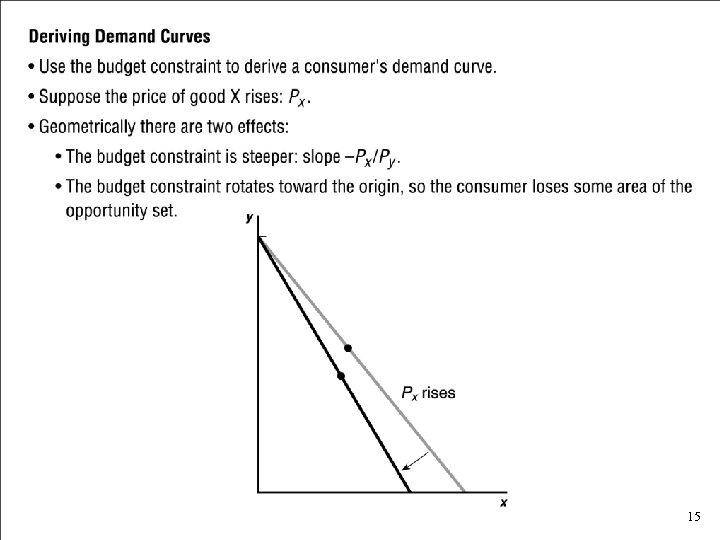 Deriving Demand Curves • Use the budget constraint to derive a consumer's demand curve. • Suppose the price of good X rises: p. X. • Geometrically there are two effects: – The budget constraint is steeper: slope p. X/p. Y. – The budget constraint rotates toward the origin, so the consumer loses some area of the opportunity set. 15
 The Income Effect of a Price Change • When the price of X rises, p. X , consumers lose purchasing power, or real income. – The opportunity set shrinks so the consumer is poorer. – Because she is poorer, she will change her consumption of good X. – If X is a normal good, she buys less X. – If X is an inferior good, since she has been made poorer by the price increase, she buys more X. 16
 The Substitution Effect of a Price Change • When the price of X rises, p. X , – The good X is relatively more expensive compared to good Y. – The consumer substitutes away from good X toward good Y. – This effect is represented by the steepness of the new budget constraint. 17
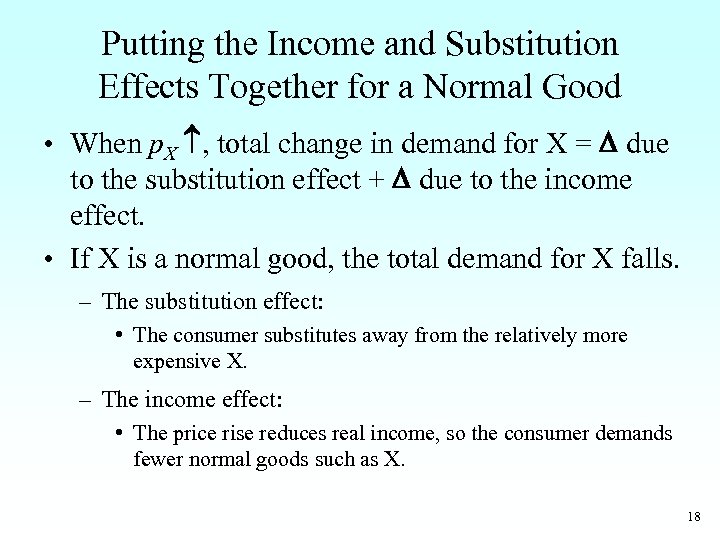 Putting the Income and Substitution Effects Together for a Normal Good • When p. X , total change in demand for X = due to the substitution effect + due to the income effect. • If X is a normal good, the total demand for X falls. – The substitution effect: • The consumer substitutes away from the relatively more expensive X. – The income effect: • The price rise reduces real income, so the consumer demands fewer normal goods such as X. 18
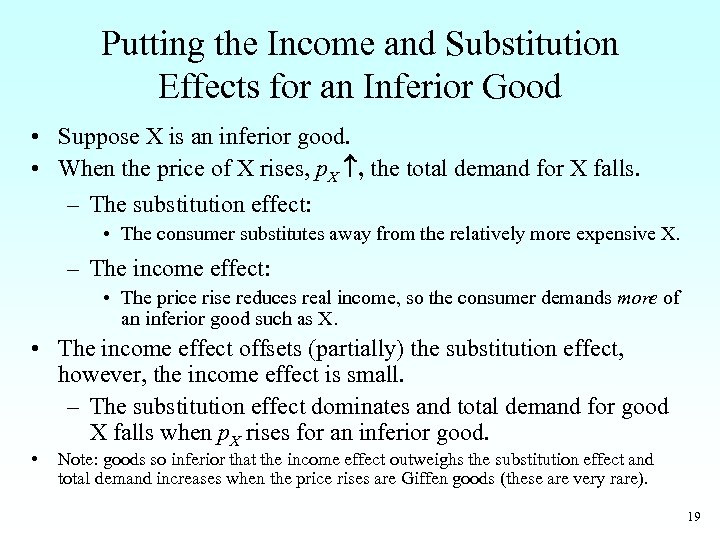 Putting the Income and Substitution Effects for an Inferior Good • Suppose X is an inferior good. • When the price of X rises, p. X , the total demand for X falls. – The substitution effect: • The consumer substitutes away from the relatively more expensive X. – The income effect: • The price rise reduces real income, so the consumer demands more of an inferior good such as X. • The income effect offsets (partially) the substitution effect, however, the income effect is small. – The substitution effect dominates and total demand for good X falls when p. X rises for an inferior good. • Note: goods so inferior that the income effect outweighs the substitution effect and total demand increases when the price rises are Giffen goods (these are very rare). 19
 Utility • The benefits derived from consuming are called utility (happiness). • One cannot compare the utilities of different people. – One cannot say, "You are happier than I am. " – However one can say, "You would be willing to pay more than I would for some good. " 20
 Willingness to Pay • Economists use “willingness to pay” as a criterion to measure utility or happiness. – Marginal utility: how much extra utility or happiness a consumer receives from one additional unit of the good. – Marginal willingness to pay = how much the consumer will pay for the next unit. • Marginal willingness to pay is a way of measuring, in dollars, marginal utility. • As a consumer buys more sweaters, each successive sweater provides less additional utility: – Diminishing marginal utility. • Successive increments of a good eventually become less desirable. • The willingness to pay for additional units also diminishes. 21
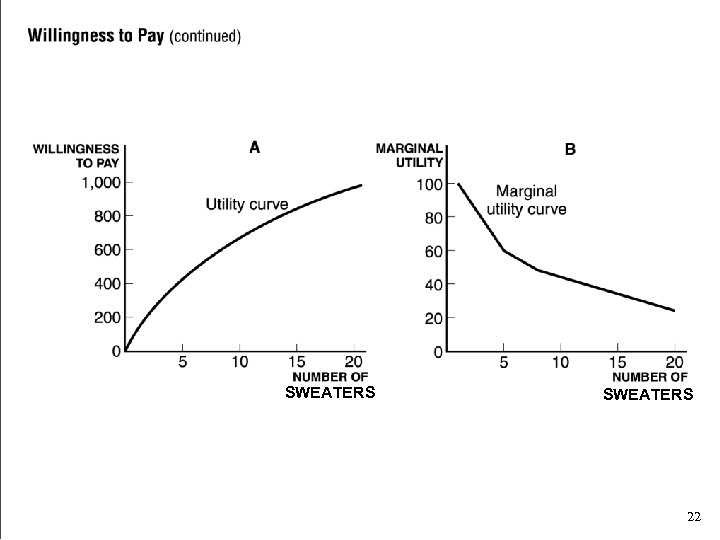 Willingness to Pay (cont. ) SWEATERS 22
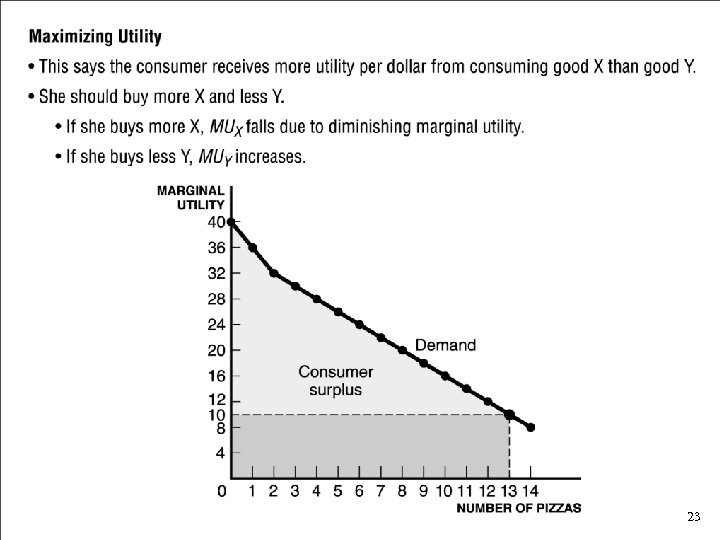 Maximizing Utility (a) • This says the consumer receives more utility per dollar from consuming good X than good Y. • She should buy more X and less Y. – If she buys more X, MUX falls due to diminishing marginal utility. – If she buys less Y, MUY increases. 23
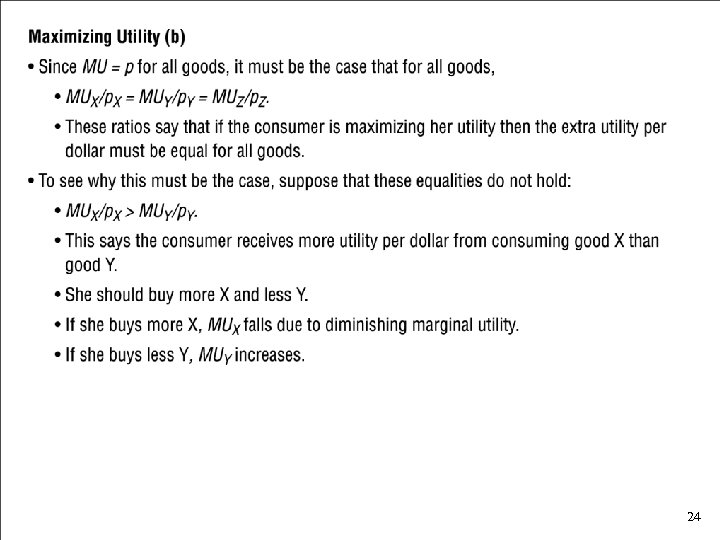 Maximizing Utility (b) • Since MU = p for all goods, it must be the case that for all goods, – MUX/p. X = MUY/p. Y = MUz/pz. – These ratios say that if the consumer is maximizing her utility then the extra utility per dollar must be equal for all goods. • To see why this must be the case, suppose that these equalities do not hold: 24
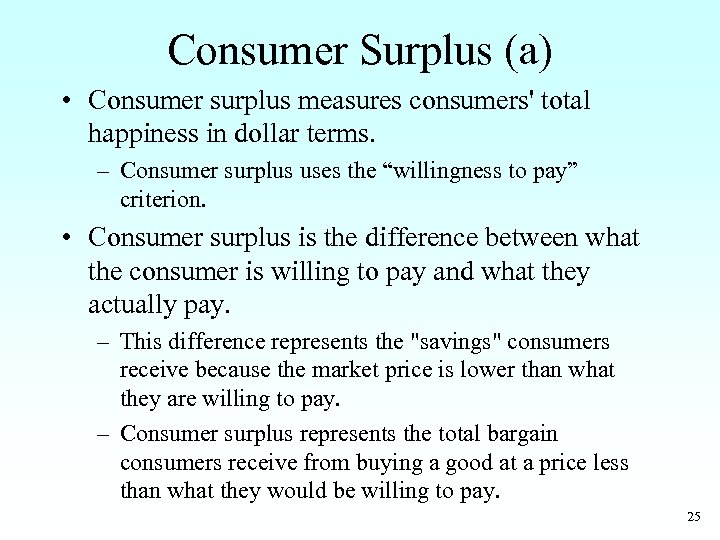 Consumer Surplus (a) • Consumer surplus measures consumers' total happiness in dollar terms. – Consumer surplus uses the “willingness to pay” criterion. • Consumer surplus is the difference between what the consumer is willing to pay and what they actually pay. – This difference represents the "savings" consumers receive because the market price is lower than what they are willing to pay. – Consumer surplus represents the total bargain consumers receive from buying a good at a price less than what they would be willing to pay. 25
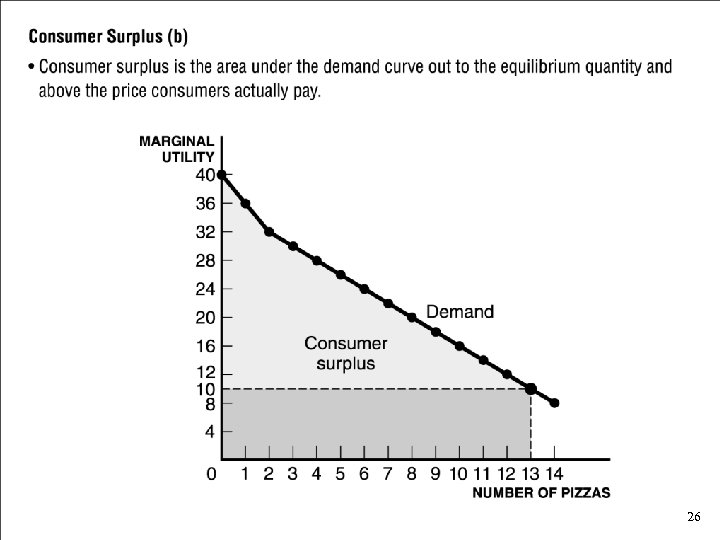 Consumer Surplus (b) • Consumer surplus is the area under the demand curve out to the equilibrium quantity and above the price consumers actually pay. 26
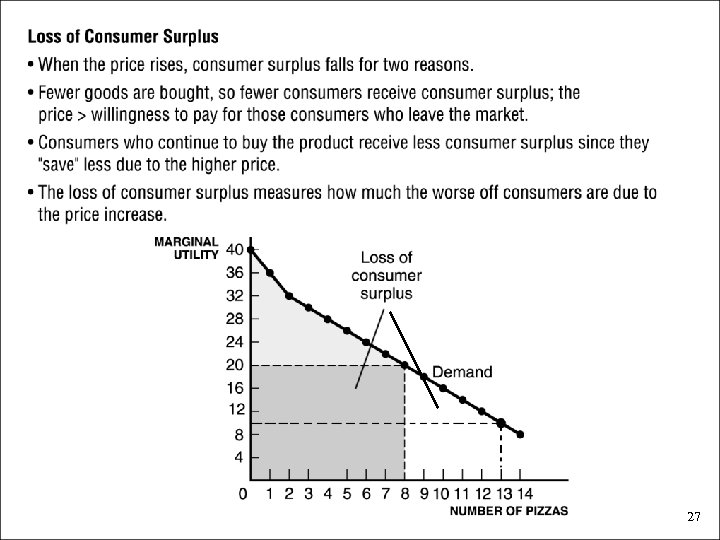 Loss of Consumer Surplus • When the price rises, consumer surplus falls for two reasons. • Fewer goods are bought, so fewer consumers receive consumer surplus; the price > willingness to pay for those consumers who leave the market. • Consumers who continue to buy the product receive less consumer surplus since they "save" less due to the higher 27
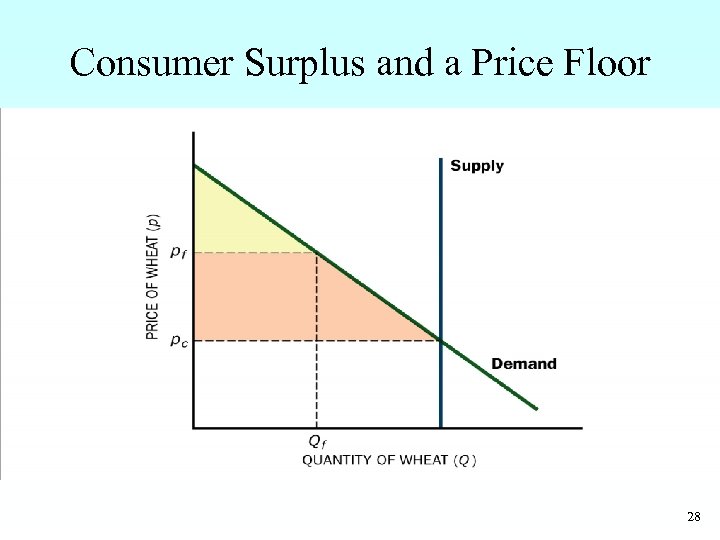 Consumer Surplus and a Price Floor 28
 Consumer Surplus and Taxes • Taxes on goods tend to increase the price of the good being taxed. • The loss of consumer surplus measures the total harm of the tax to consumers. 29
 The Basic Model of Consumer Choice • The basic model of theory of consumer choice provides powerful insights into the behavior of consumers and suppliers. – It is not without its critics and criticisms. 30
 Criticisms of the Basic Model • Few consumers make economic decisions by consciously examining budget constraints and computing marginal utility. – True but irrelevant – It is like saying a physicist's explanation of how billiard balls travel cannot be correct because the players do not work out the equations beforehand. • Consumers do not really know what they want. – True – Judging by their purchases, many consumers seem to have ill-formed and unstable preferences. 31
 Criticisms of the Basic Model cont’d • Consumers lack complete information about prices, and hence cannot know their budget constraints. • The interaction of preferences and prices may make a person's decision process very complex; e. g. , the price of an object may influence a person's attitude toward it. 32
 Behavioral Economics • Combines the insights of psychology and economics to study how people make choices. – Should base theory of consumption on how people actually choose. • Laboratory experiments are often used. 33
 Insights of Behavioral Economics (a) • Endowment effects: possessing something can alter preferences of owner – Experiment: mugs randomly distributed to college students –- very few were traded when in principle around half should have been. – Experiment: college students were given either a lottery ticket or $2 and could trade them – not very many did. 34
 Insights of Behavioral Economics (b) • Loss Aversion: related to endowment effects – People seem particularly sensitive to loss. – A person with $1, 100 who loses $100 feels worse than a person with $900 who finds $100. 35
 Insights of Behavioral Economics (c) • Status Quo Bias: – A reference level of consumption is important. • The first person had a reference level of $1, 100, the second had a reference level of $900. – The difference between actual consumption and reference level consumption is important. – Why? » An accustomed standard of living » “Keeping up with the Jones” • The basic consumption model -- the level of consumption matters 36
 Tendency for People to Accept the Default Option • When 401(k) retirement participation is automatic very few people opt-out. – Default option is not to participate, a smaller proportion opt-in 37
 Implications of Behavioral Economics • The simple model of consumer choice is incomplete. • Do we need to change basic ideas? – No. People still respond to incentives. • Demand curves still slope downward. • Behavioral Economics shows that people have a greater reluctance to change than the basic model predicts. – May be the reason not all mutually beneficial trades are made. 38
 Beyond the Basic Model • While there are valid critiques of the basic consumption model they only show that the model is not complete. – The model is still useful. • By being explicit about our assumptions, we can know which ones (if any) are not valid in a particular instance. 39