


 Скачать презентацию Ecommerce Session 1 Agenda
1b1af787bc0110327ef4ca52c42648ce.ppt
- Количество слайдов: 56
 Ecommerce
 Session 1
 Agenda • • • The rise and fall of the dot. com economy e-Business vs e-Commerce vs Internet What makes e-Business different from business? Successful business models for e-Business The drivers of benefit for e-Business applications E-commerce
 History of the Internet
 Understanding E-commerce: Organizing Themes n Technology: – Development and mastery of digital computing and communications technology n Business: – New technologies present businesses with new ways of organizing production and transacting business n Society: – Intellectual property, individual privacy, public welfare policy
 Amazon: A Picture Is Worth a Thousand Words n Have you used Amazon or any other websites? What are your main interests? n Have you purchased anything based on a recommandation? n Why do Amazon links drive more purchasing than Facebook links?
 What Is E-commerce? n Use of Internet and Web to transact business n More formally: – Digitally enabled commercial transactions between and among organizations and individuals
 “When history is written, the creation of the Internet may be ranked alongside Johann Gutenberg’s printing press and Marconi’s radio as among the major advancements in human communication. ” Roanoke Times, March 1, 1997
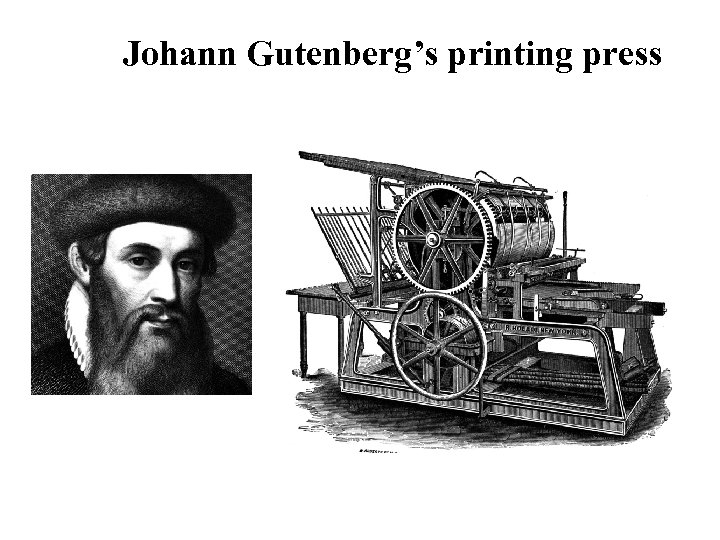 Johann Gutenberg’s printing press
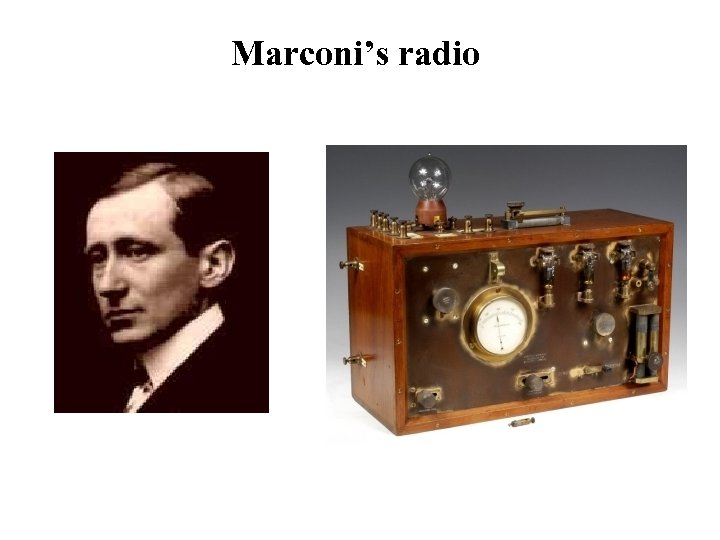 Marconi’s radio
 Origins and Growth of E-commerce n Precursors: – Baxter Healthcare – Electronic Data Interchange (EDI) – French Minitel (1980 s videotex system) – None had functionality of Internet n 1995: Beginning of e-commerce – First sales of banner advertisements n E-commerce fastest growing form of commerce in United States
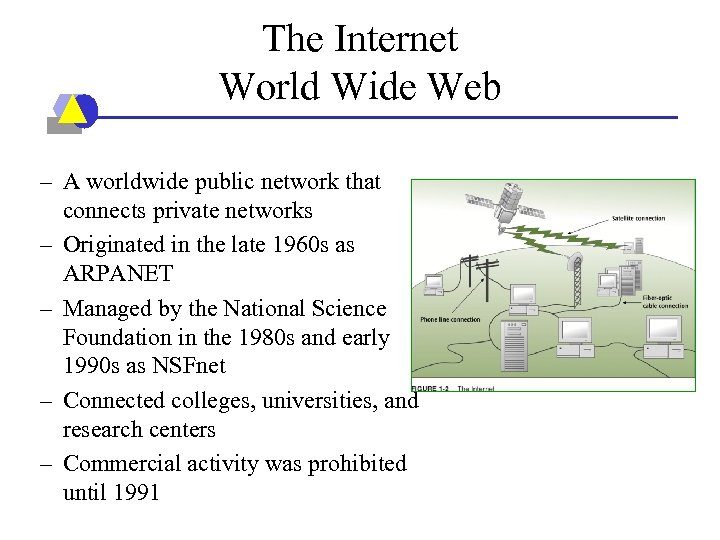 The Internet World Wide Web – A worldwide public network that connects private networks – Originated in the late 1960 s as ARPANET – Managed by the National Science Foundation in the 1980 s and early 1990 s as NSFnet – Connected colleges, universities, and research centers – Commercial activity was prohibited until 1991
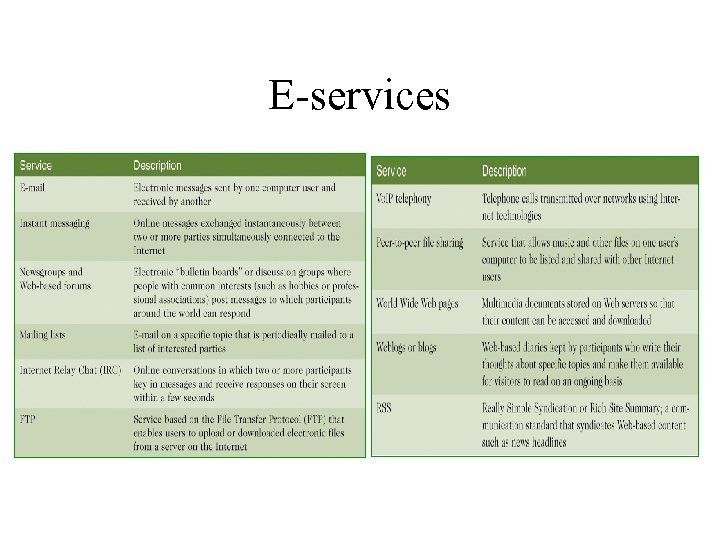 E-services
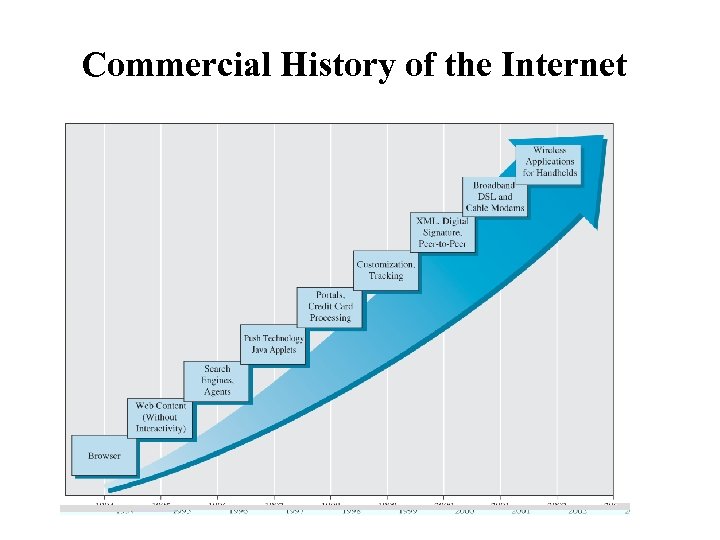 Commercial History of the Internet
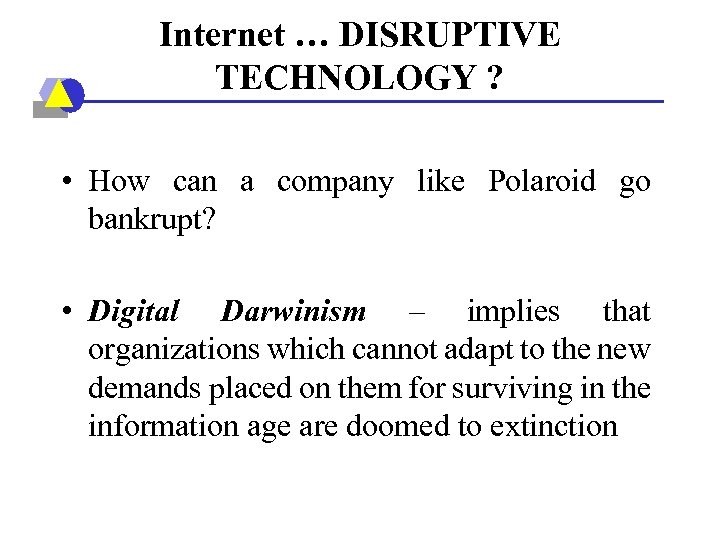 Internet … DISRUPTIVE TECHNOLOGY ? • How can a company like Polaroid go bankrupt? • Digital Darwinism – implies that organizations which cannot adapt to the new demands placed on them for surviving in the information age are doomed to extinction
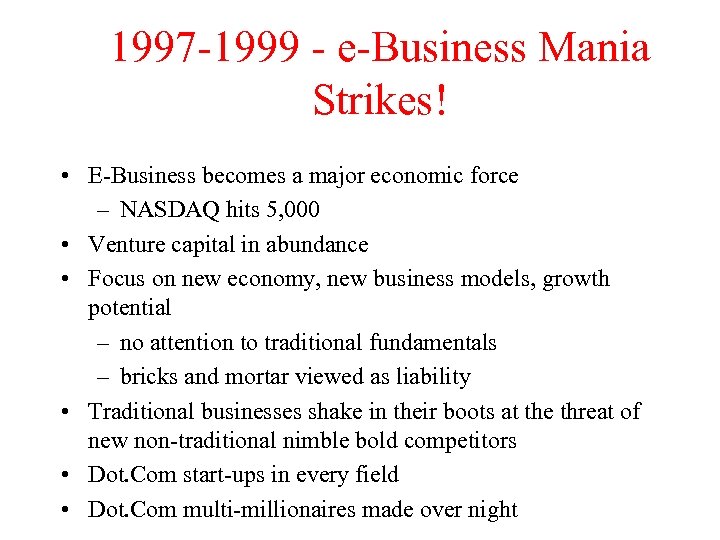 1997 -1999 - e-Business Mania Strikes! • E-Business becomes a major economic force – NASDAQ hits 5, 000 • Venture capital in abundance • Focus on new economy, new business models, growth potential – no attention to traditional fundamentals – bricks and mortar viewed as liability • Traditional businesses shake in their boots at the threat of new non-traditional nimble bold competitors • Dot. Com start-ups in every field • Dot. Com multi-millionaires made over night
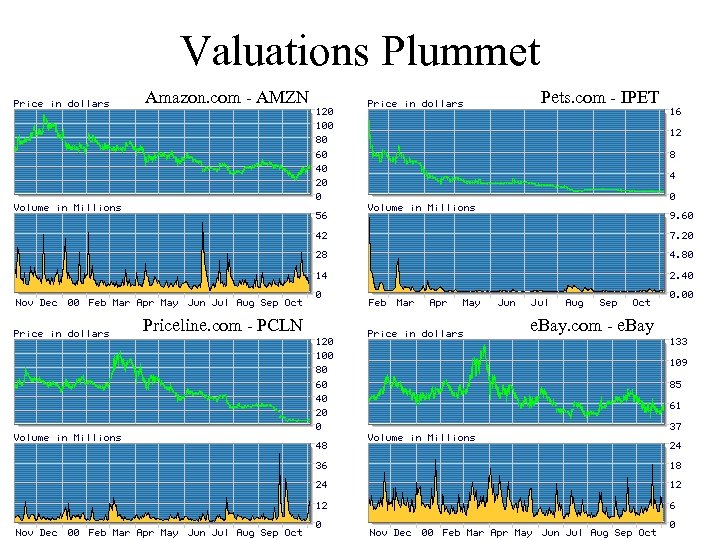
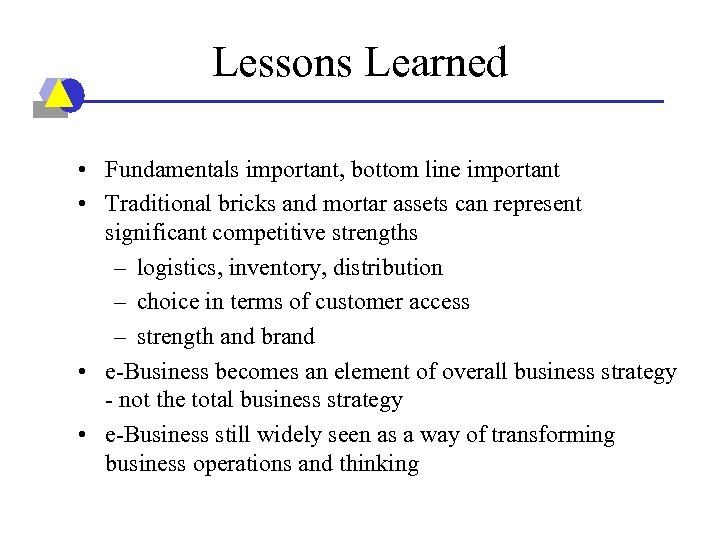
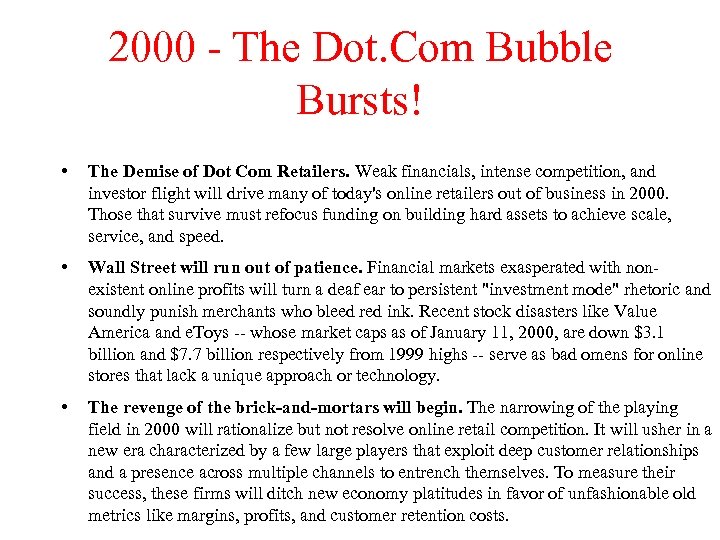 2000 - The Dot. Com Bubble Bursts! • The Demise of Dot Com Retailers. Weak financials, intense competition, and investor flight will drive many of today's online retailers out of business in 2000. Those that survive must refocus funding on building hard assets to achieve scale, service, and speed. • Wall Street will run out of patience. Financial markets exasperated with nonexistent online profits will turn a deaf ear to persistent "investment mode" rhetoric and soundly punish merchants who bleed red ink. Recent stock disasters like Value America and e. Toys -- whose market caps as of January 11, 2000, are down $3. 1 billion and $7. 7 billion respectively from 1999 highs -- serve as bad omens for online stores that lack a unique approach or technology. • The revenge of the brick-and-mortars will begin. The narrowing of the playing field in 2000 will rationalize but not resolve online retail competition. It will usher in a new era characterized by a few large players that exploit deep customer relationships and a presence across multiple channels to entrench themselves. To measure their success, these firms will ditch new economy platitudes in favor of unfashionable old metrics like margins, profits, and customer retention costs.
 Valuations Plummet Amazon. com - AMZN Priceline. com - PCLN Pets. com - IPET e. Bay. com - e. Bay
 Lessons Learned • Fundamentals important, bottom line important • Traditional bricks and mortar assets can represent significant competitive strengths – logistics, inventory, distribution – choice in terms of customer access – strength and brand • e-Business becomes an element of overall business strategy - not the total business strategy • e-Business still widely seen as a way of transforming business operations and thinking
 ‘Bricks and Clicks’ - A Hybrid Model Traditional Pure Web - Dot. com “Bricks and Mortar” “Clicks” Combines strengths from traditional and pure Web approaches
 Emergence of the Hybrid Strategy
 E-commerce: A Brief History (cont. ) • 2001– 2006: Consolidation v. Emphasis on business-driven approach v. Traditional large firms expand presence v. Start-up financing shrinks up v. More complex products and services sold v. Growth of search engine advertising v. Business Web presences expand to include e-mail, display and search advertising, and limited community feedback features
 E-commerce: A Brief History (cont. ) • 2007–Present: Reinvention v. Rapid growth of: • Online social networks • Mobile platform • Local commerce v. Entertainment content develops as source of revenues v. Transformation of marketing • Coordinated marketing on social, mobile, local platforms • Analytic technologies
 E-commerce Trends 2013– 2014 • Expansion of social, local, and mobile e-commerce • Mobile platform begins to rival PC platform • Continued growth of cloud computing • Explosive growth in “Big Data” • E-books gain wide acceptance • Continued growth of user-generated content
 Why Study E-commerce? n E-commerce technology is different, more powerful than previous technologies n E-commerce brings fundamental changes to commerce n Traditional commerce: – – – Consumer as passive targets Mass-marketing driven Sales-force driven Fixed prices Information asymmetry
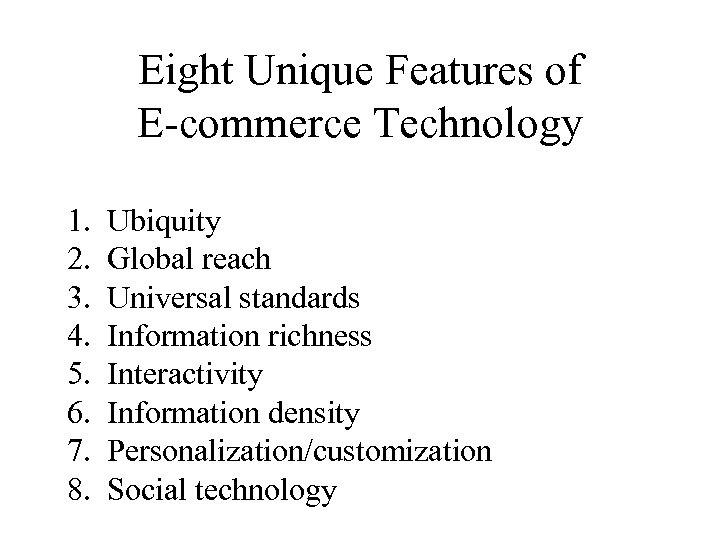 Eight Unique Features of E-commerce Technology 1. 2. 3. 4. 5. 6. 7. 8. Ubiquity Global reach Universal standards Information richness Interactivity Information density Personalization/customization Social technology
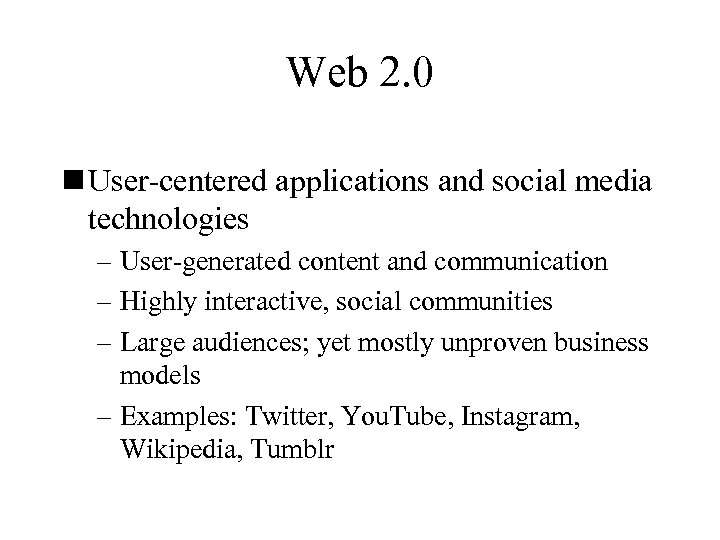 Web 2. 0 n User-centered applications and social media technologies – User-generated content and communication – Highly interactive, social communities – Large audiences; yet mostly unproven business models – Examples: Twitter, You. Tube, Instagram, Wikipedia, Tumblr
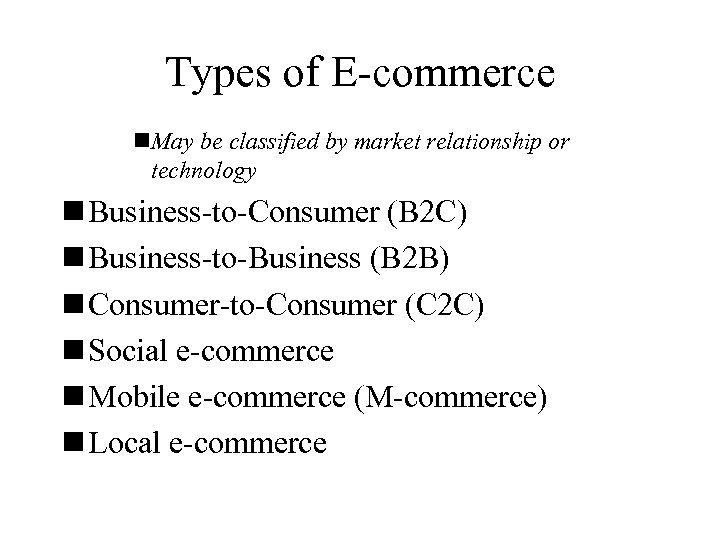 Types of E-commerce n. May be classified by market relationship or technology n Business-to-Consumer (B 2 C) n Business-to-Business (B 2 B) n Consumer-to-Consumer (C 2 C) n Social e-commerce n Mobile e-commerce (M-commerce) n Local e-commerce
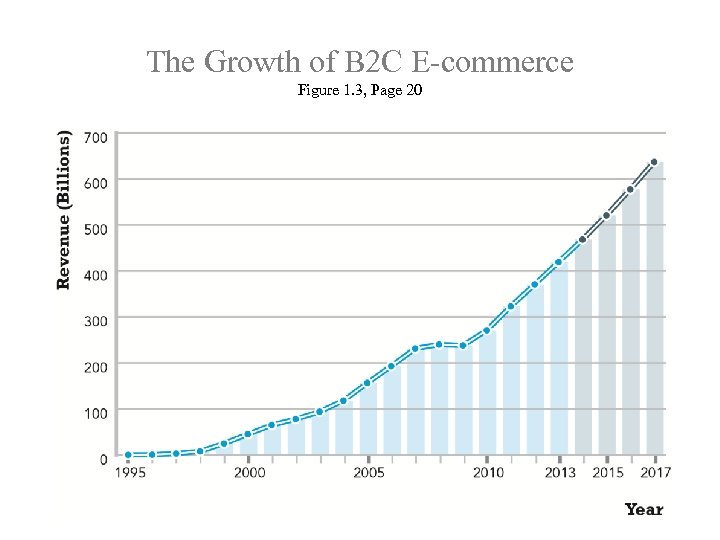 The Growth of B 2 C E-commerce Figure 1. 3, Page 20
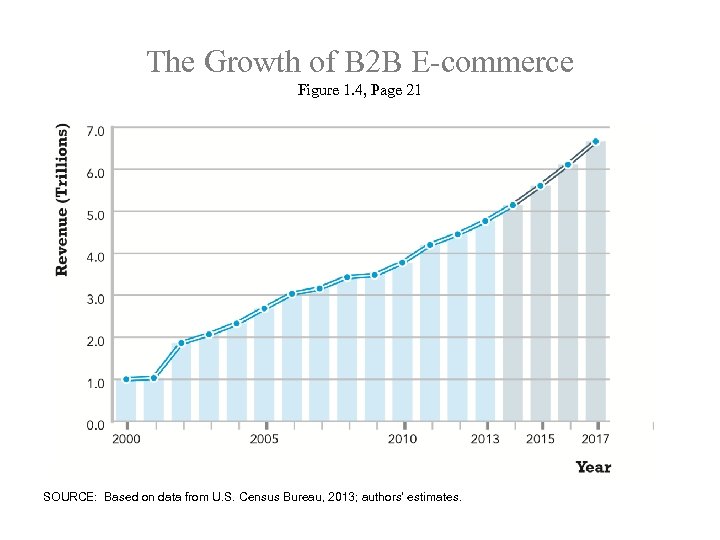 The Growth of B 2 B E-commerce Figure 1. 4, Page 21 SOURCE: Based on data from U. S. Census Bureau, 2013; authors’ estimates.
 The Mobile Platform n Most recent development in Internet infrastructure n Enables access to the Internet via wireless networks or cell-phone service n Mobile devices include – Tablets – Smartphones – Ultra-lightweight laptops
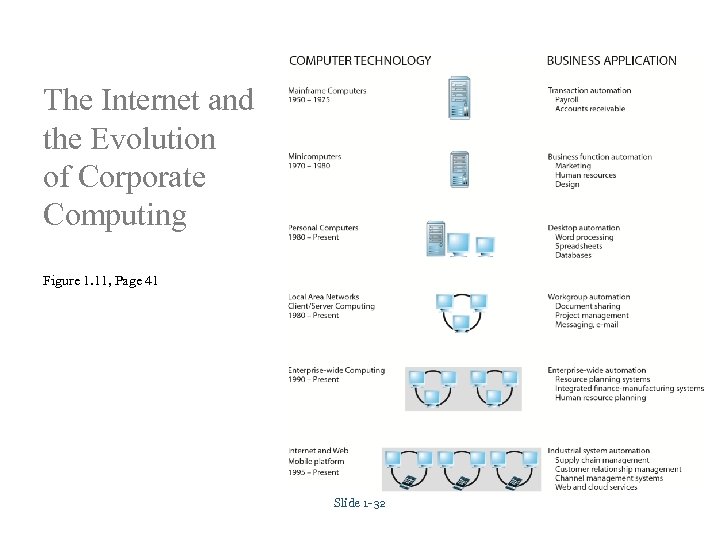 The Internet and the Evolution of Corporate Computing Figure 1. 11, Page 41 Slide 1 -32
 e-Commerce vs e. Business
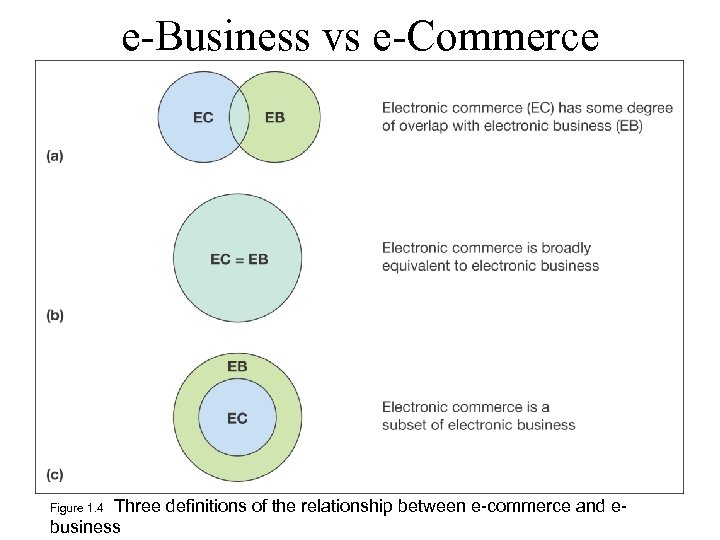 e-Business vs e-Commerce Three definitions of the relationship between e-commerce and ebusiness Figure 1. 4
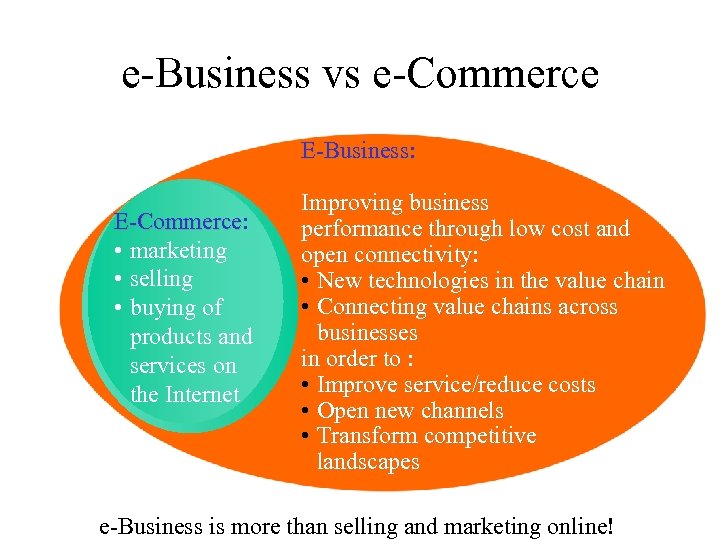 e-Business vs e-Commerce E-Business: E-Commerce • marketing • selling • buying of products and services on the Internet Improving business performance through low cost and open connectivity: • New technologies in the value chain • Connecting value chains across businesses in order to : • Improve service/reduce costs • Open new channels • Transform competitive landscapes e-Business is more than selling and marketing online!
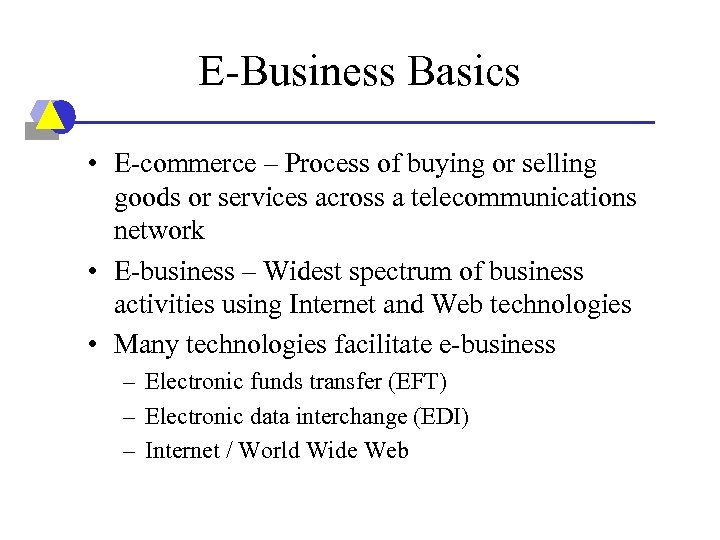 E-Business Basics • E-commerce – Process of buying or selling goods or services across a telecommunications network • E-business – Widest spectrum of business activities using Internet and Web technologies • Many technologies facilitate e-business – Electronic funds transfer (EFT) – Electronic data interchange (EDI) – Internet / World Wide Web
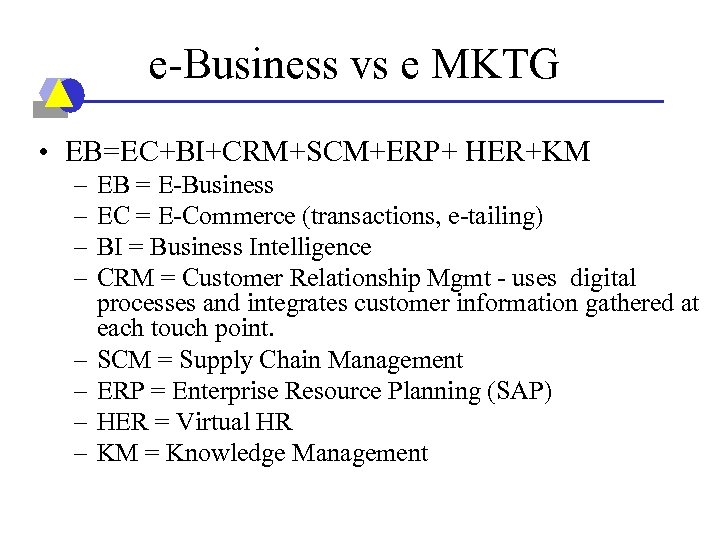 e-Business vs e MKTG • EB=EC+BI+CRM+SCM+ERP+ HER+KM – – – – EB = E-Business EC = E-Commerce (transactions, e-tailing) BI = Business Intelligence CRM = Customer Relationship Mgmt - uses digital processes and integrates customer information gathered at each touch point. SCM = Supply Chain Management ERP = Enterprise Resource Planning (SAP) HER = Virtual HR KM = Knowledge Management
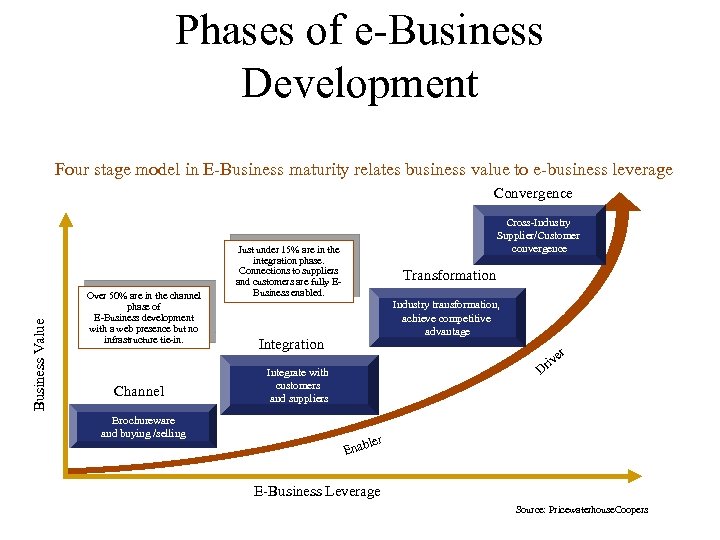 Phases of e-Business Development Four stage model in E-Business maturity relates business value to e-business leverage Business Value Convergence Over 50% are in the channel phase of E-Business development with a web presence but no infrastructure tie-in. Channel Brochureware and buying /selling Cross-Industry Supplier/Customer convergence Just under 15% are in the integration phase. Connections to suppliers and customers are fully EBusiness enabled. Transformation Industry transformation, achieve competitive advantage Integration er iv Dr Integrate with customers and suppliers ler Enab E-Business Leverage Source: Pricewaterhouse. Coopers
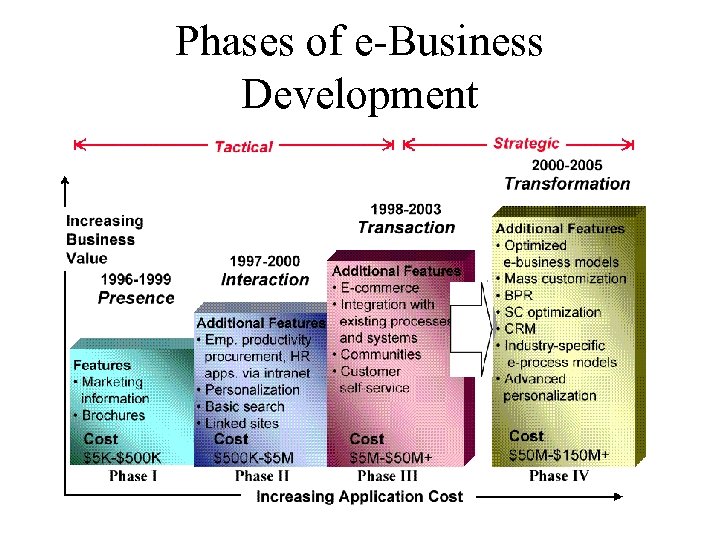 Phases of e-Business Development
 e. Business vs Business
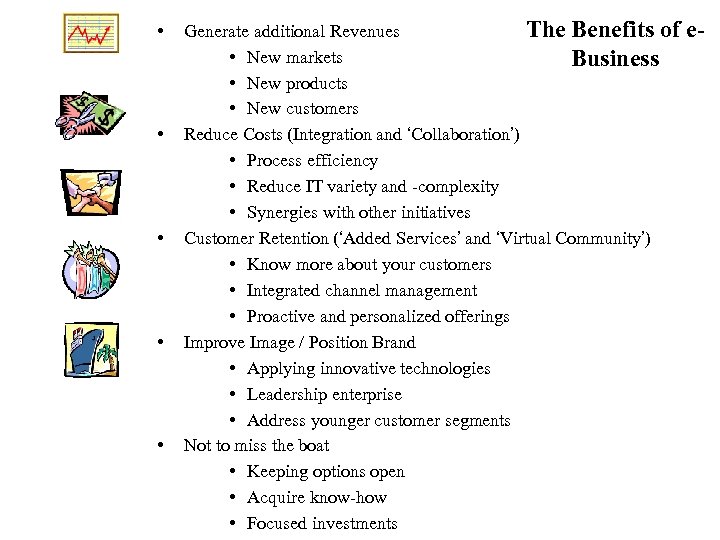 • • • Generate additional Revenues The Benefits of • New markets Business • New products • New customers Reduce Costs (Integration and ‘Collaboration’) • Process efficiency • Reduce IT variety and -complexity • Synergies with other initiatives Customer Retention (‘Added Services’ and ‘Virtual Community’) • Know more about your customers • Integrated channel management • Proactive and personalized offerings Improve Image / Position Brand • Applying innovative technologies • Leadership enterprise • Address younger customer segments Not to miss the boat • Keeping options open • Acquire know-how • Focused investments e-
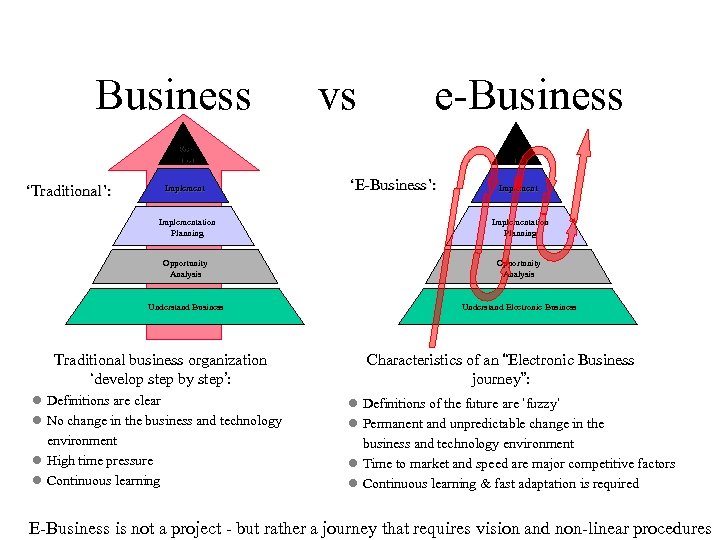 Business vs e-Business Re. Assess ‘Traditional’: Implement Re. Assess ‘E-Business’: Implementation Planning Opportunity Analysis Understand Business Understand Electronic Business Traditional business organization ‘develop step by step’: l Definitions are clear l No change in the business and technology environment l High time pressure l Continuous learning Characteristics of an “Electronic Business journey”: l Definitions of the future are ‘fuzzy’ l Permanent and unpredictable change in the business and technology environment l Time to market and speed are major competitive factors l Continuous learning & fast adaptation is required E-Business is not a project - but rather a journey that requires vision and non-linear procedures
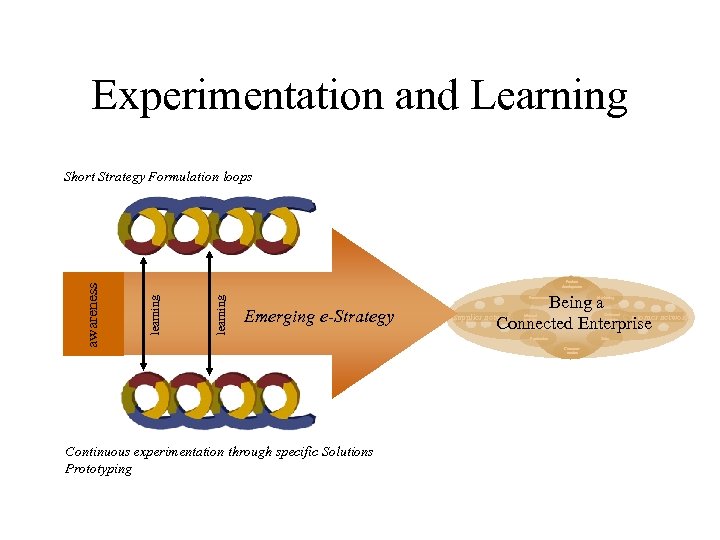 Experimentation and Learning learning Product development learning awareness Short Strategy Formulation loops Being a Supplier network Customer network Connected Enterprise Procurement Emerging e-Strategy Continuous experimentation through specific Solutions Prototyping Marketing Outbound logistics Inbound logistics Production Sales Customer service
 Types of Business model
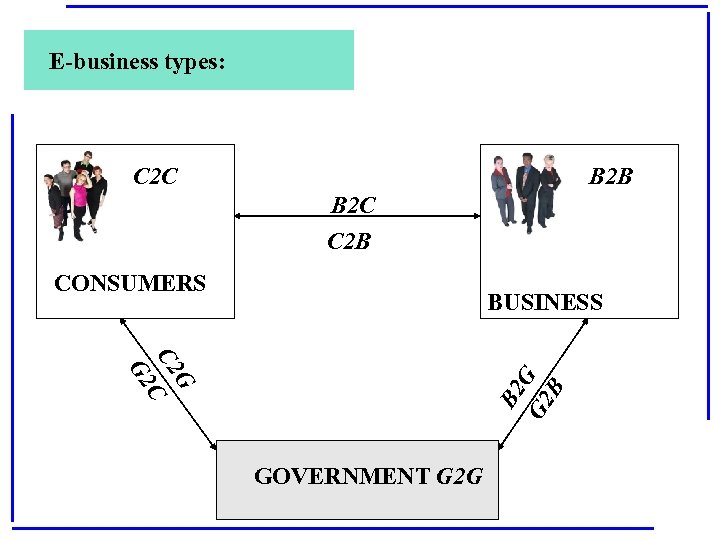 E-business types: C 2 C B 2 B B 2 C C 2 B CONSUMERS BUSINESS B 2 G G 2 B G C 2 C G 2 GOVERNMENT G 2 G
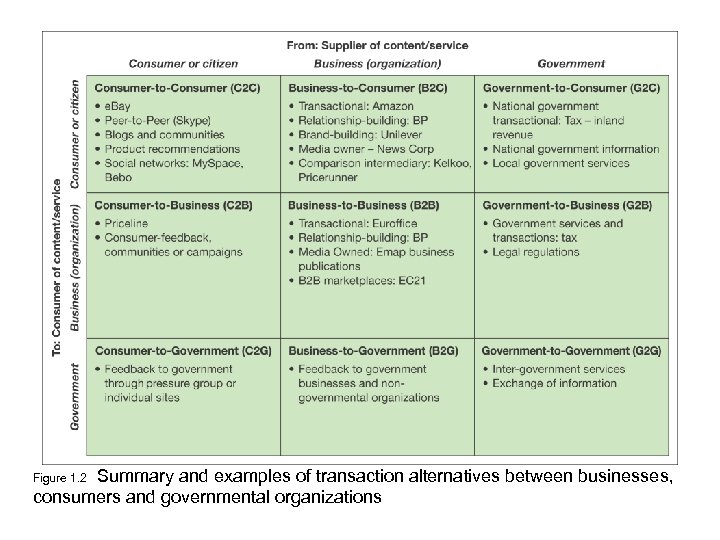 Summary and examples of transaction alternatives between businesses, consumers and governmental organizations Figure 1. 2
 E-Commerce
 E-Commerce Management issues • How does e-commerce strategy differ from traditional business strategy? • How should we integrate e-commerce strategy with existing business and IS strategy?
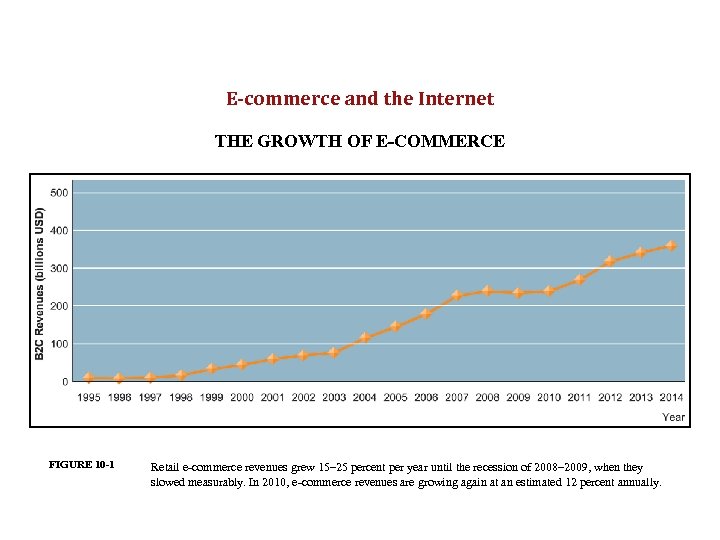 E-commerce and the Internet THE GROWTH OF E-COMMERCE FIGURE 10 -1 Retail e-commerce revenues grew 15– 25 percent per year until the recession of 2008– 2009, when they slowed measurably. In 2010, e-commerce revenues are growing again at an estimated 12 percent annually. 49 © Pearson Education 2012
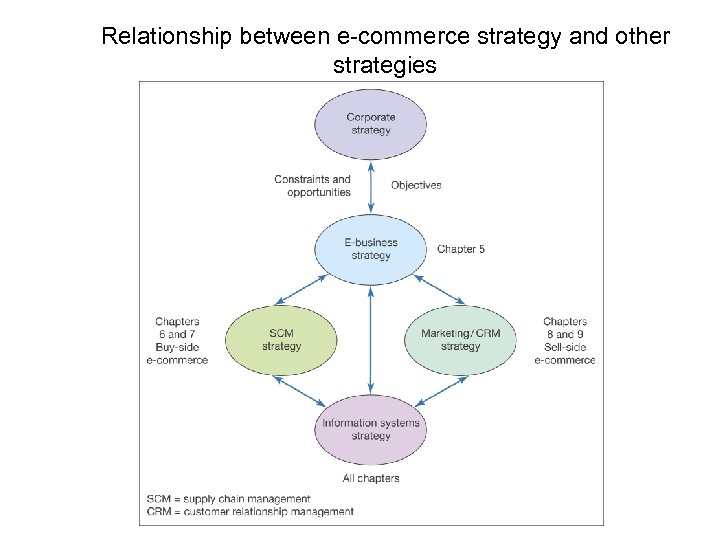 Relationship between e-commerce strategy and other strategies
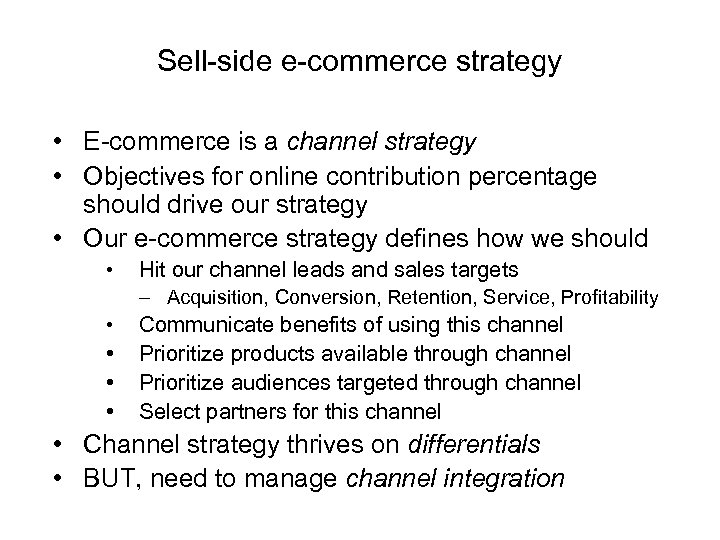 Sell-side e-commerce strategy • E-commerce is a channel strategy • Objectives for online contribution percentage should drive our strategy • Our e-commerce strategy defines how we should • Hit our channel leads and sales targets – Acquisition, Conversion, Retention, Service, Profitability • • Communicate benefits of using this channel Prioritize products available through channel Prioritize audiences targeted through channel Select partners for this channel • Channel strategy thrives on differentials • BUT, need to manage channel integration
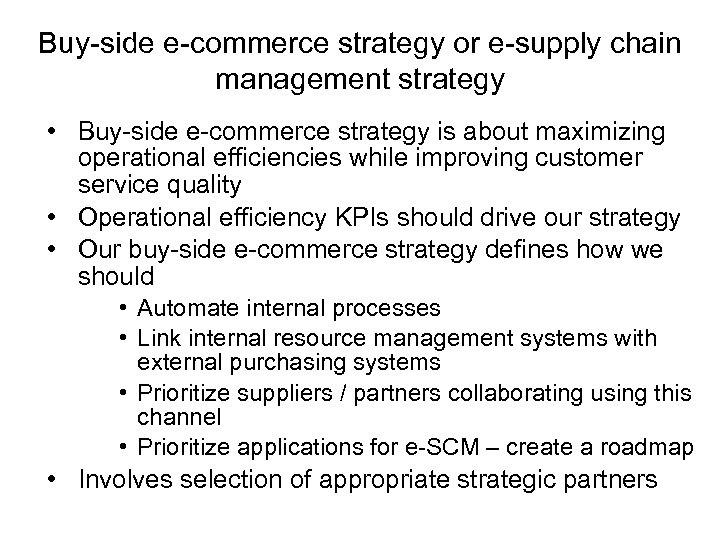 Buy-side e-commerce strategy or e-supply chain management strategy • Buy-side e-commerce strategy is about maximizing operational efficiencies while improving customer service quality • Operational efficiency KPIs should drive our strategy • Our buy-side e-commerce strategy defines how we should • Automate internal processes • Link internal resource management systems with external purchasing systems • Prioritize suppliers / partners collaborating using this channel • Prioritize applications for e-SCM – create a roadmap • Involves selection of appropriate strategic partners
 Case study
 OPENING CASE QUESTIONS 1. What is Amazon’s e-business model? 2. How can Amazon use m-commerce to influence its business? 3. What are some of the business challenges facing Amazon?
 OPENING CASE QUESTIONS Amazon • http: //www. youtube. com/watch? v=Ylgkf. Or _GLY • http: //www. youtube. com/watch? v=zkn. Lf. U 7 GJIw
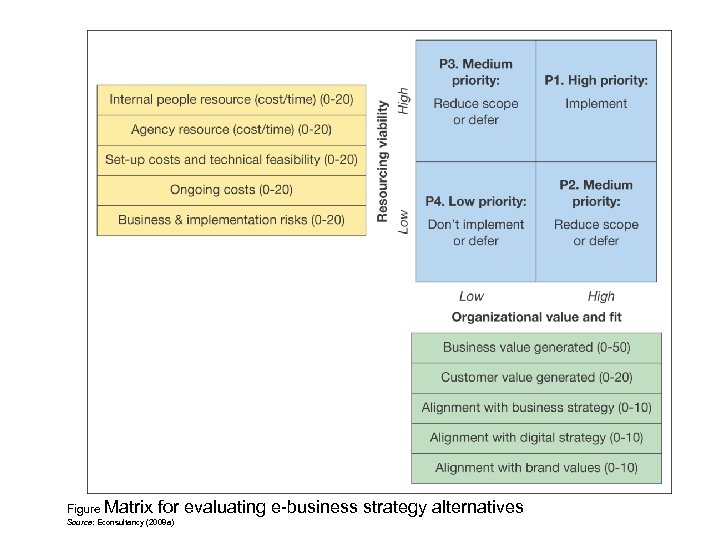 Figure Matrix for evaluating e-business strategy alternatives Source: Econsultancy (2008 a)