


 Скачать презентацию Ecological Gap Analysis Status 6 Ongoing for FSM
0358ade975fb2d95b055f2fa1e257934.ppt
- Количество слайдов: 3
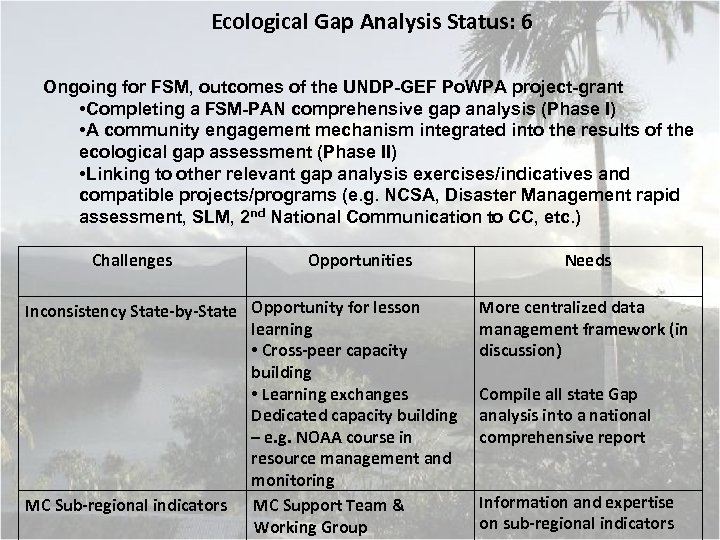 Ecological Gap Analysis Status: 6 Ongoing for FSM, outcomes of the UNDP-GEF Po. WPA project-grant • Completing a FSM-PAN comprehensive gap analysis (Phase I) • A community engagement mechanism integrated into the results of the ecological gap assessment (Phase II) • Linking to other relevant gap analysis exercises/indicatives and compatible projects/programs (e. g. NCSA, Disaster Management rapid assessment, SLM, 2 nd National Communication to CC, etc. ) Challenges Opportunities Inconsistency State-by-State Opportunity for lesson learning • Cross-peer capacity building • Learning exchanges Dedicated capacity building – e. g. NOAA course in resource management and monitoring MC Sub-regional indicators MC Support Team & Working Group Needs More centralized data management framework (in discussion) Compile all state Gap analysis into a national comprehensive report Information and expertise on sub-regional indicators
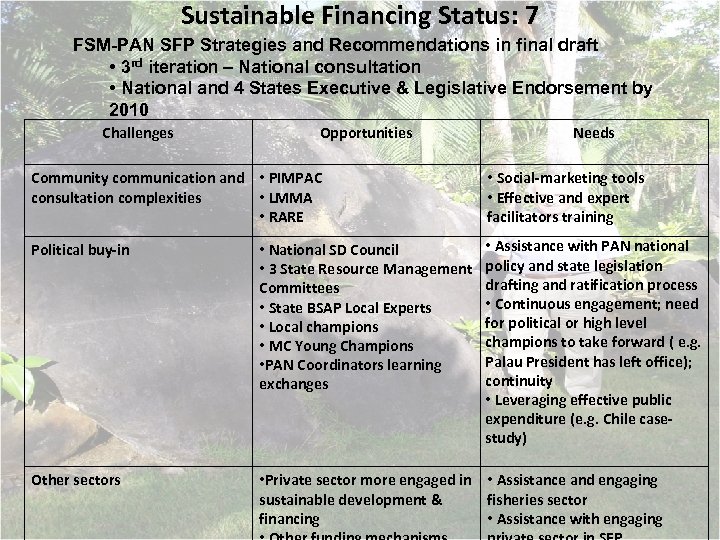 Sustainable Financing Status: 7 FSM-PAN SFP Strategies and Recommendations in final draft • 3 rd iteration – National consultation • National and 4 States Executive & Legislative Endorsement by 2010 Challenges Opportunities Needs Community communication and • PIMPAC consultation complexities • LMMA • RARE • Social-marketing tools • Effective and expert facilitators training Political buy-in • National SD Council • 3 State Resource Management Committees • State BSAP Local Experts • Local champions • MC Young Champions • PAN Coordinators learning exchanges • Assistance with PAN national policy and state legislation drafting and ratification process • Continuous engagement; need for political or high level champions to take forward ( e. g. Palau President has left office); continuity • Leveraging effective public expenditure (e. g. Chile casestudy) Other sectors • Private sector more engaged in • Assistance and engaging sustainable development & fisheries sector financing • Assistance with engaging
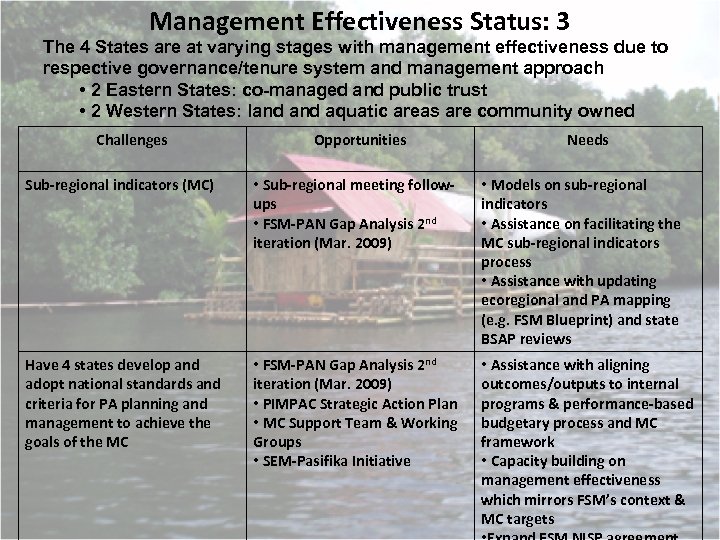 Management Effectiveness Status: 3 The 4 States are at varying stages with management effectiveness due to respective governance/tenure system and management approach • 2 Eastern States: co-managed and public trust • 2 Western States: land aquatic areas are community owned Challenges Opportunities Needs Sub-regional indicators (MC) • Sub-regional meeting followups • FSM-PAN Gap Analysis 2 nd iteration (Mar. 2009) • Models on sub-regional indicators • Assistance on facilitating the MC sub-regional indicators process • Assistance with updating ecoregional and PA mapping (e. g. FSM Blueprint) and state BSAP reviews Have 4 states develop and adopt national standards and criteria for PA planning and management to achieve the goals of the MC • FSM-PAN Gap Analysis 2 nd iteration (Mar. 2009) • PIMPAC Strategic Action Plan • MC Support Team & Working Groups • SEM-Pasifika Initiative • Assistance with aligning outcomes/outputs to internal programs & performance-based budgetary process and MC framework • Capacity building on management effectiveness which mirrors FSM’s context & MC targets