 Скачать презентацию Ecolinguistics Facts about Languages l l l
Ecolinguistics.ppt
- Количество слайдов: 49



Ecolinguistics
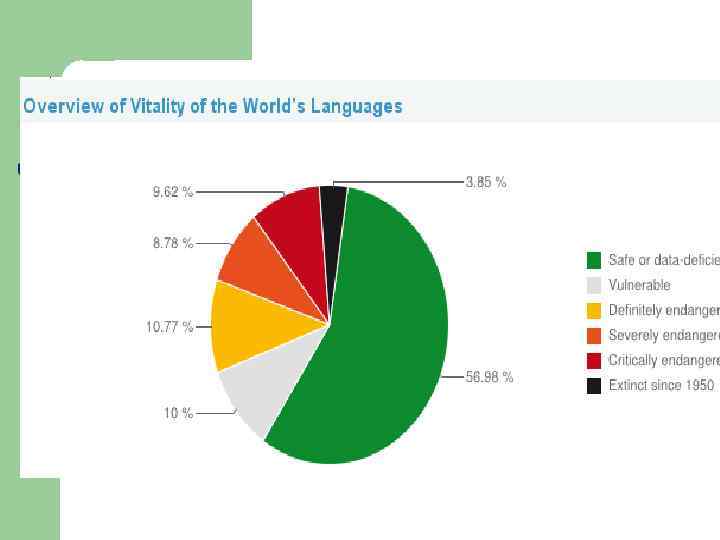
Facts about Languages l l l l There around 7, 000 languages spoken in the world today. More than half of the world's languages have no written form. Half of the languages spoken in the world today are predicted to disappear during this century. There are 2, 000 languages spoken in Africa. 80% of African languages have no written form. Fewer than 10% of the world's languages can be considered entirely safe from endangerment. A language dies every 14 days 96% of the world's languages are spoken by just 4% of the population.
Facts about Languages l l l Over 10% of the world's languages are spoken in Papua New Guinea. In 1991, there were 181 languages that had fewer than 10 speakers. Over 80% of the languages spoken in the United States are endangered. Over 90% of the languages spoken in Siberia are endangered. Half of the world's languages are spoken in Asia and the Pacific Islands. Only 4% of the world's languages come from Europe.
English & ecolinguistics The last speaker of Cornish as a mother tongue died 200 years ago, though constant efforts were made to revive the language, only 50 -60 persons can speak it.
English & ecolinguistics A similar fate befell Manx, a Celtic language spoken on the Isle of Man, whose last native speakers died in the 1960 s.
English & ecolinguistics l As David Crystal notes: 'In the 19 th century, there were more than 1, 000 Indian languages in Brazil, many spoken in small, isolated villages in the rain forest; today there a mere 200, most of which have never been written down or recorded.
English & ecolinguistics l l l In Africa, the United Nations estimate that more than half of the 1, 400 indigenous languages are either in decline or under threat, largely due to the influence of English and other colonial languages other major languages, such as Russian and Chinese have probably contributed to similar linguistic reduction in their own countries. 130 languages in Russia are endangered
English & ecolinguistics l 80% of world population speak English, Mandarin and Russian l 50% of world population speak English, Russian, Mandarin, Hindi, Spanish
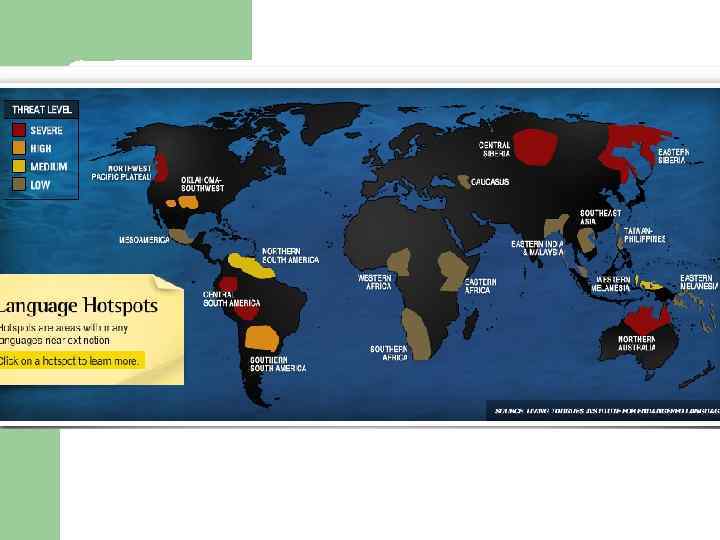
English & ecolinguistics l l l According to the National Geographic Soicety, a language dies out every 14 days. At the rate, almost 3500 languages (50% languages spoken now) will be out of use by 2100. “Hotspots” are New Guinea, the Caucasus, Siberia Linguists try to revitalize these languages to preserve cultural insights, cultural identities
Australia l l Before the British arrived in the 18 th century, approximately 250 Aboriginal languages were spoken in Australia. Today 100 have totally disappeared, 140 are almost exclusively spoken by elderly people, and only 12 are still very much alive and spoken by children.
South America l l l The blow was very significant after the colonization of Mexico: 90% of the Native population disappeared. During the pre-Columbian era, there were 1200 languages in Brazil. Nowadays, only 170 remain and most of these are headed for oblivion. Nearly half of these languages, located in regions that are hard to access, have not yet been studied. In Uruguay, the Indian population has completely disappeared and no Native Indian language has survived.
North America l There were between 600 and 700 languages before the arrival of the Europeans. By the middle of the 20 th Century, only 213 remained. With the generalisation of English as the language of global communication, this figure has continued to drop and today, only one language is not threatened by extinction: Kalaalisut (an Inuit language, from the Eskimo-Aleut linguistic family) in Greenland.
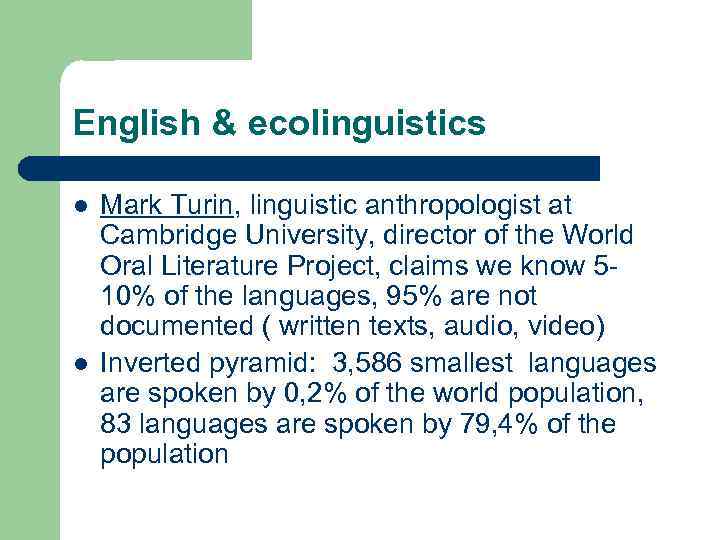
English & ecolinguistics l l Mark Turin, linguistic anthropologist at Cambridge University, director of the World Oral Literature Project, claims we know 510% of the languages, 95% are not documented ( written texts, audio, video) Inverted pyramid: 3, 586 smallest languages are spoken by 0, 2% of the world population, 83 languages are spoken by 79, 4% of the population
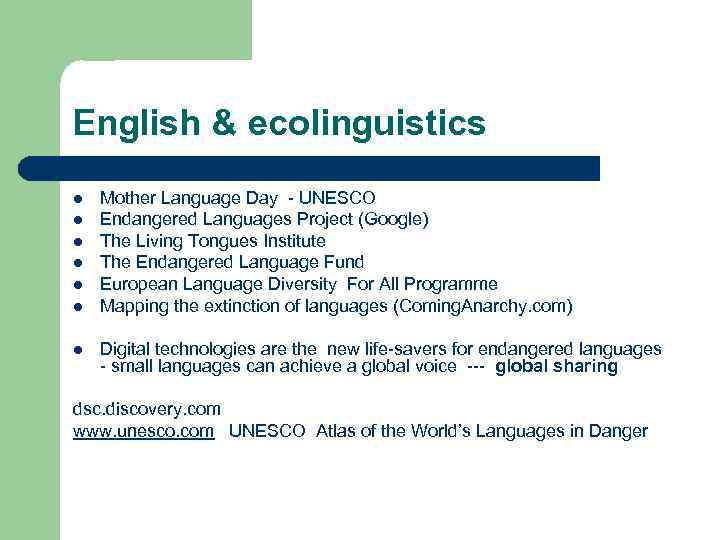
English & ecolinguistics l l l l Mother Language Day - UNESCO Endangered Languages Project (Google) The Living Tongues Institute The Endangered Language Fund European Language Diversity For All Programme Mapping the extinction of languages (Coming. Anarchy. com) Digital technologies are the new life-savers for endangered languages - small languages can achieve a global voice --- global sharing dsc. discovery. com www. unesco. com UNESCO Atlas of the World’s Languages in Danger
English & ecolinguistics l l New Linguistic trend & discipline - language documentation (1999 Nikolaus Himmelmann, Germany) funding sources, specialized archives, advocacy organizations, publications, supporting local language revitalization efforts, recording and analyzing the data, global sharing You. Tube) Online resources on Endangered Languages
English & ecolinguistics l ecolinguistics as a component of language policy l Languages of small ethnic groups Ancestral languages & heritage l
English & ecolinguistics l l Ecolinguistics VS ecologically-oriented communication in gardens, zoos, when visitors are constantly reminded about the need to protect animals, birds, plants, nature in general
Ecolinguistics l Buenos Airs ZOO










Variability of English & teacheability l Variability of English brings a methodological problem – how to teach English in this diverse cultural and sociological background.
Variability of English & teacheability l International Standard English l BBC English Against the background of l WORLD ENGLISHES
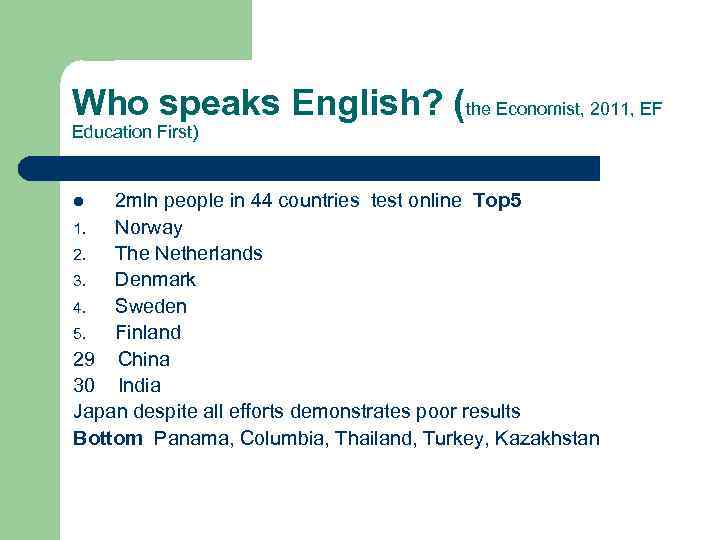
Who speaks English? (the Economist, 2011, EF Education First) 2 mln people in 44 countries test online Top 5 1. Norway 2. The Netherlands 3. Denmark 4. Sweden 5. Finland 29 China 30 India Japan despite all efforts demonstrates poor results Bottom Panama, Columbia, Thailand, Turkey, Kazakhstan l
Who speaks English? (the Economist, 2011, EF Education First) l l l Spanish is still very important as an international language Latin America is the worst, Spain was the worst in Western Europe The bigger the country – the worse in English Those who export more do better in English Starting to learn English young may not pay off
English & its teacheability l l l computers and information technologies electronic communication Internet social nets electronic variants of newspapers and magazines video, media-libraries
English & its teacheability FTF vs CMC
Nomination telephone l l mobile phone/ cell phone VS → fixed-line telephone
Nomination l on-line VS → off-line l e-mail VS → snailmail l hi-fi VS wi-fi
English & its teacheability l l e- business, e-life, e-pal, e-service, e-shopping, e-money, e-tax, e-cruiter, e-body-shopper retailer → e-tailer e-commerce → e-comm e-mmersion (electronic + immersion) on analogy with immersion principle in Language Immersion Villages.
English & its teacheability l The focus in WEB-based assignments is on fluency, accuracy and complexity.
English & its teacheability l CMC / IT-mediated communication as written speaking. l e-communication requires specific type of computer literacy, visual literacy, competence in web-design and being hypertext-literate.
English & its teacheability l MALL (mobile-assisted language learning) l Voice- operated computers → LINGUATRONIC (Mercedes-Benz)
English & its teacheability l Electronic plagiarism l Brits and global English
English & its teacheability l Motherese & language of teachers in primary schools l Humor in classrooms
English & its teacheability l Greying world: Eugen Rosenstock –Huessy young generation and old generation do not communicate as their speaking styles are too different (age-gap). l Gerontolinguistics l Aphasia, Alzheimer’s disease, Autism
English & its teacheability Gender factor l l All-female workplace Gendered talk at work (range of workplace roles) Females in mixed-sex groups Extralinguistic factors that change feminine communication strategies
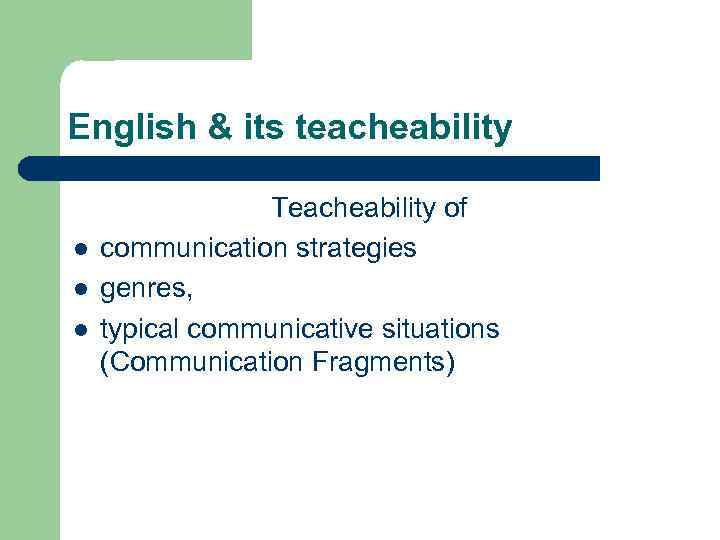
English & its teacheability l l l Teacheability of communication strategies genres, typical communicative situations (Communication Fragments)
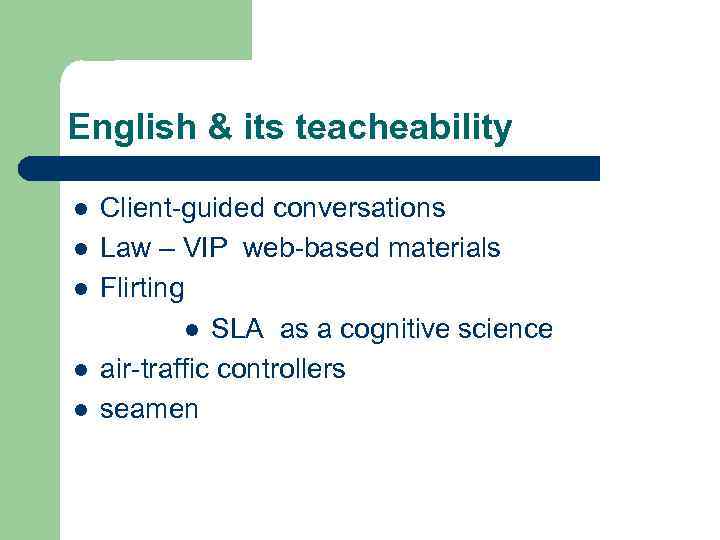
English & its teacheability l l l Client-guided conversations Law – VIP web-based materials Flirting l SLA as a cognitive science air-traffic controllers seamen
English & its teacheability l l non-verbal means of communication. ASL
Скачать презентацию Ecolinguistics Facts about Languages l l l
Ecolinguistics.ppt