


 Скачать презентацию ECO R European Centre for Ontological Research Requirements
d5a476d9b03eb7a1f116c0866ddba8da.ppt
- Количество слайдов: 50
 ECO R European Centre for Ontological Research Requirements for natural language understanding in referent-tracking based electronic patient records. CS seminar, Bolzano, Dec 5, 2005 Dr. W. Ceusters European Centre for Ontological Research Saarland University, Saarbrücken - Germany
 ECO R European Centre for Ontological Research Presentation overview • ECOR and me • The Electronic Health Record (EHR) • Problems with terminologies and their use in the EHR • Realist ontology • Referent Tracking • Opportunities for narural language understanding
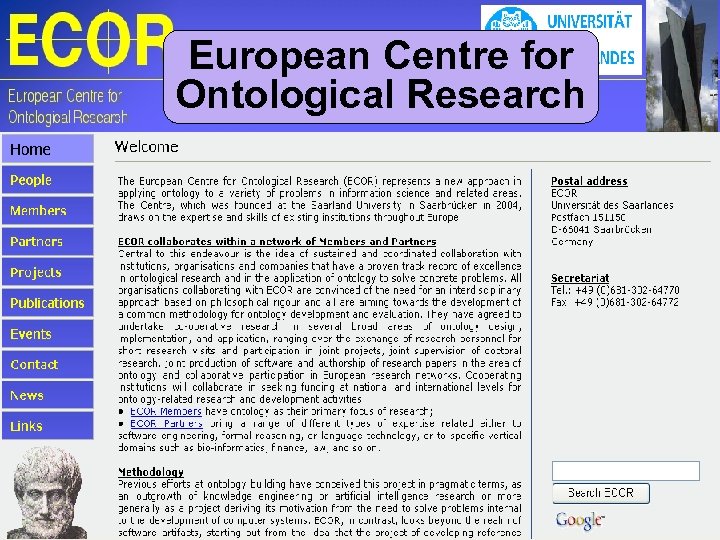 ECO R European Centre for Ontological Research
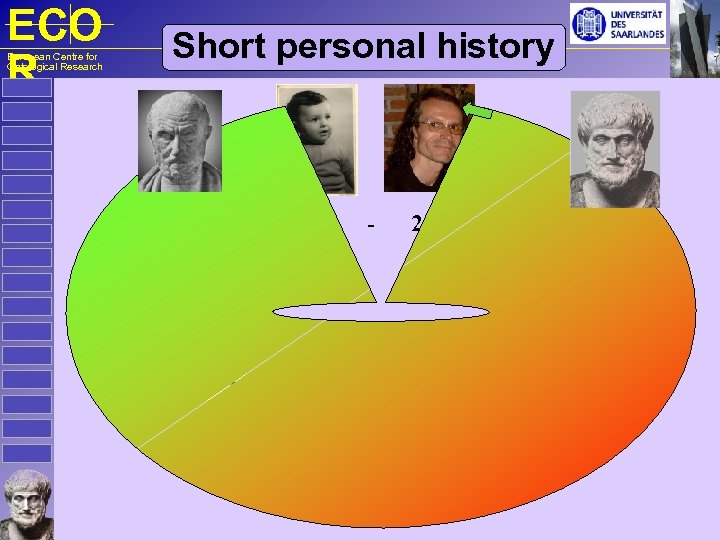 ECO R Short personal history European Centre for Ontological Research 1977 1959 - 2005 2004 1989 2002 1998
 ECO R European Centre for Ontological Research The Electronic Health Record
 ECO R Electronic Health Record European Centre for Ontological Research • ISO/TS 18308: 2003 – Electronic Health Record (EHR): • A repository of information regarding the health of a subject of care, in computer processable form. – EHR system: • the set of components that form the mechanism by which electronic health records are created, used, stored, and retrieved. It includes people, data, rules and procedures, processing and storage devices, and communication and support facilities. • More common meaning of EHR system: – only the “software being executed”
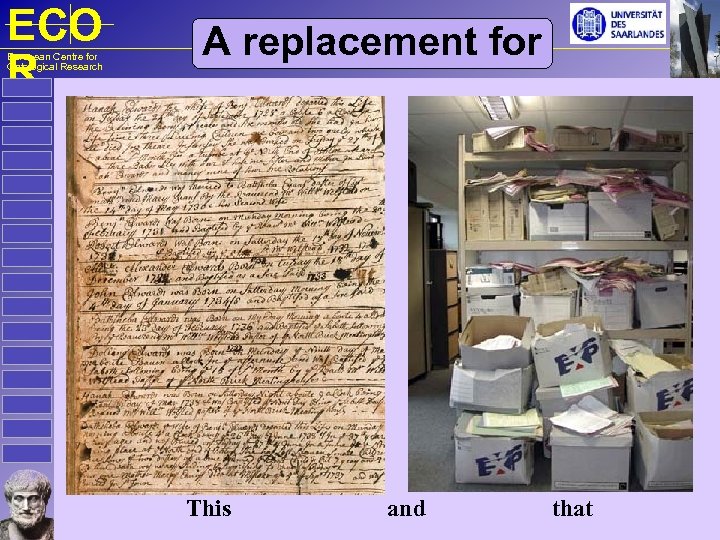 ECO R European Centre for Ontological Research A replacement for This and that
 ECO R European Centre for Ontological Research The Medical Informatics dogma To structure or NOT to be • Fact: computers can only deal with a structured representation of reality: – structured data: • relational databases, spread sheets – structured information: • XML simulates context – structured knowledge: • rule-based knowledge systems • Conclusion: a need for structured data entry (? ? ? )
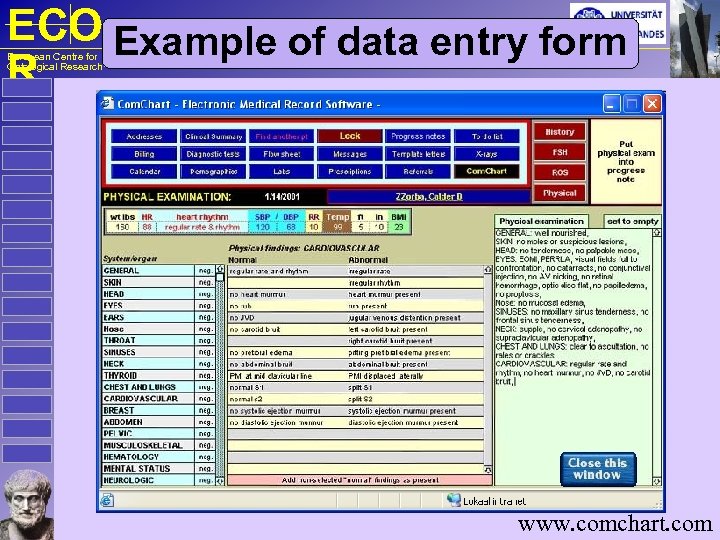 ECO Example of data entry form R European Centre for Ontological Research www. comchart. com
 ECO Structured EHR data entry R European Centre for Ontological Research • Current technical solutions: – Data entry forms • provide the structure • various paradigms: – Rigid, pre-fixed – Adaptable to user-preferences, but fixed when used – Dynamically adapting to entered data in context – Terminologies, coding and classification systems: • provide the language to be used • Exchange of information preserving meaning • Statistics and epidemiology
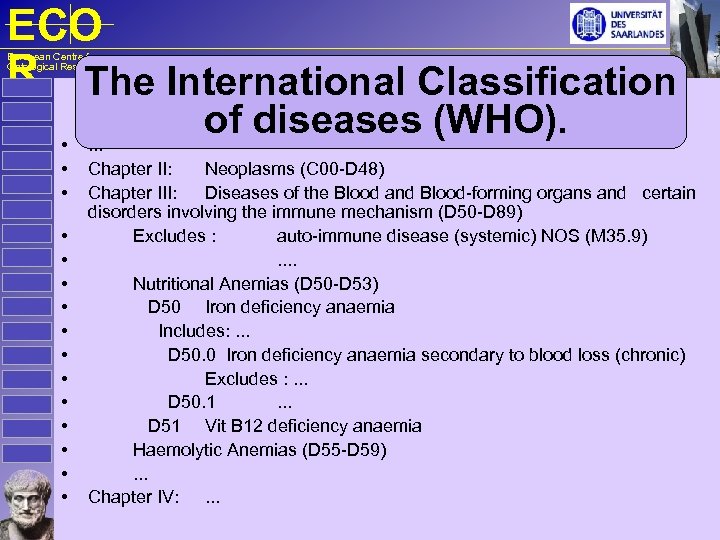 ECO R The International Classification European Centre for Ontological Research • • • • of diseases (WHO). . Chapter II: Neoplasms (C 00 -D 48) Chapter III: Diseases of the Blood and Blood-forming organs and certain disorders involving the immune mechanism (D 50 -D 89) Excludes : auto-immune disease (systemic) NOS (M 35. 9). . Nutritional Anemias (D 50 -D 53) D 50 Iron deficiency anaemia Includes: . . . D 50. 0 Iron deficiency anaemia secondary to blood loss (chronic) Excludes : . . . D 50. 1. . . D 51 Vit B 12 deficiency anaemia Haemolytic Anemias (D 55 -D 59). . . Chapter IV: . . .
 ECO R European Centre for Ontological Research Main problems • Internal and external consistency of terminologies. • What do the terms in a terminology stand for ?
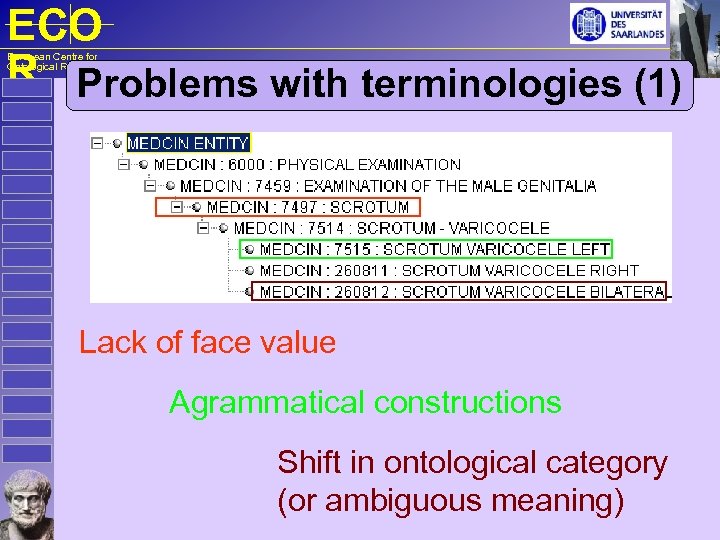 ECO R Problems with terminologies (1) European Centre for Ontological Research Lack of face value Agrammatical constructions Shift in ontological category (or ambiguous meaning)
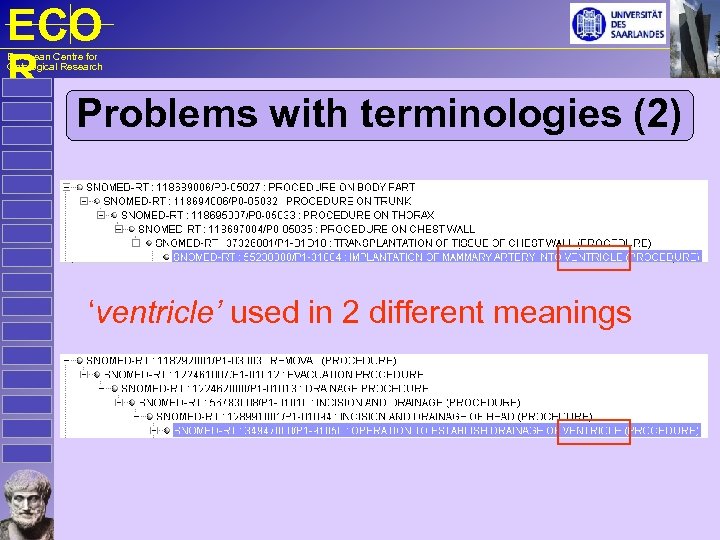 ECO R European Centre for Ontological Research Problems with terminologies (2) ‘ventricle’ used in 2 different meanings
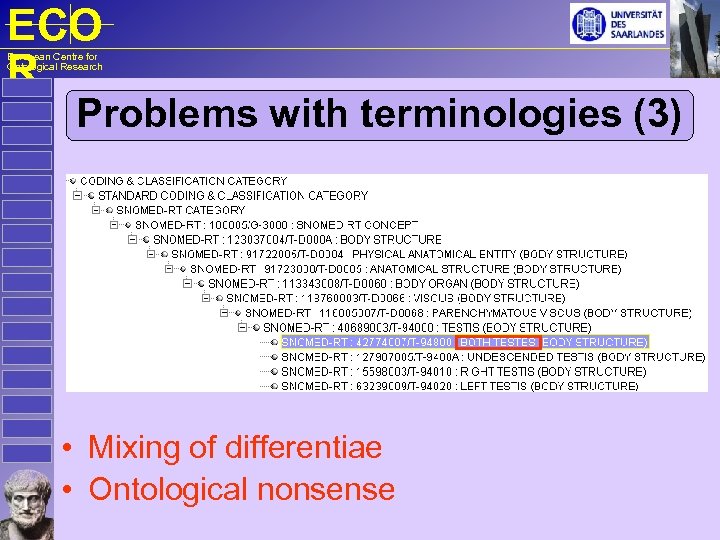 ECO R European Centre for Ontological Research Problems with terminologies (3) • Mixing of differentiae • Ontological nonsense
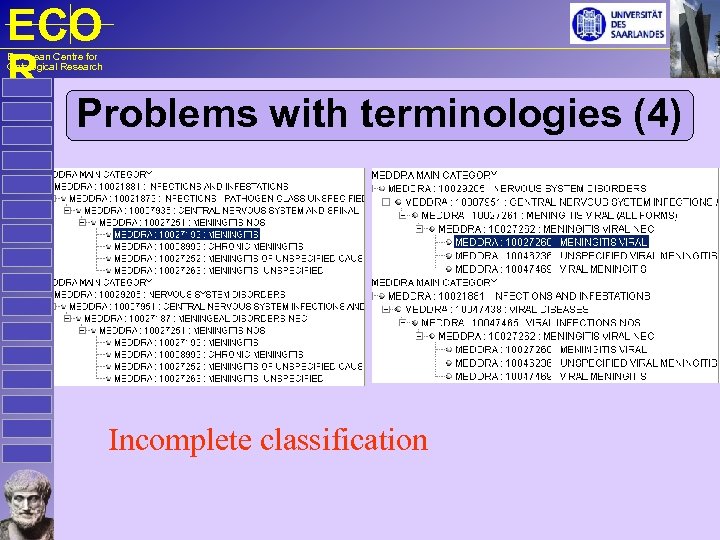 ECO R European Centre for Ontological Research Problems with terminologies (4) Incomplete classification
 ECO R European Centre for Ontological Research What’s wrong with current use of terminologies in the EHR ?
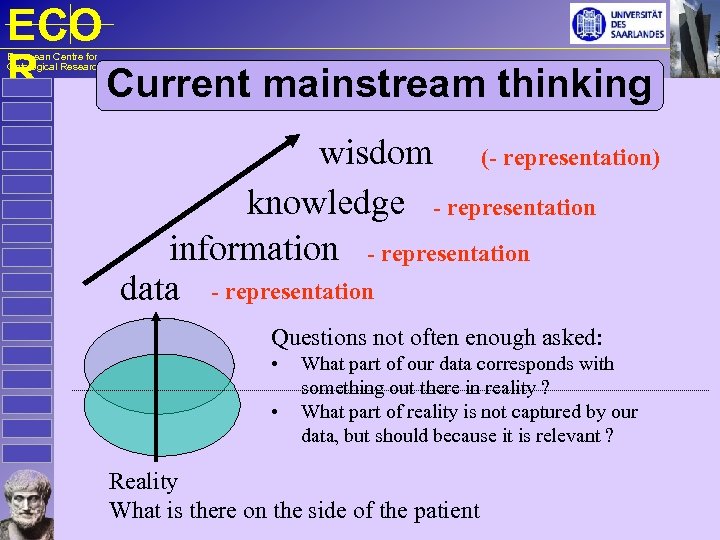 ECO R Current mainstream thinking European Centre for Ontological Research wisdom (- representation) knowledge - representation information - representation data - representation Questions not often enough asked: • • What part of our data corresponds with something out there in reality ? What part of reality is not captured by our data, but should because it is relevant ? Reality What is there on the side of the patient
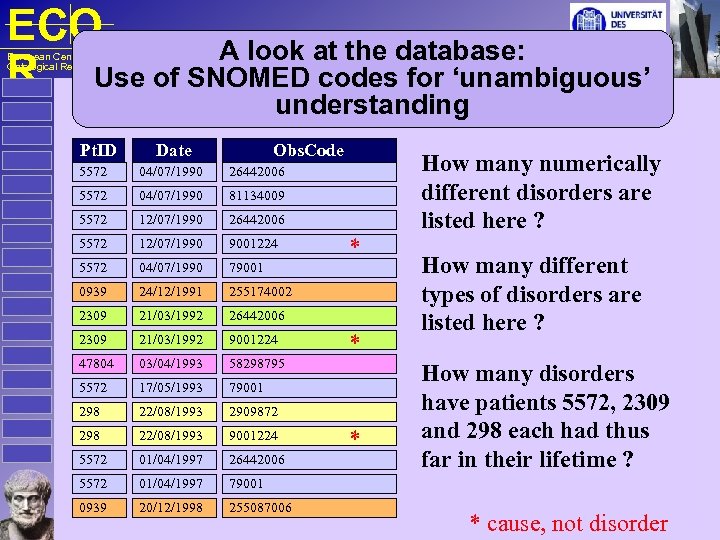 ECO A look at the database: R Use of SNOMED codes for ‘unambiguous’ European Centre for Ontological Research understanding Pt. ID Date Obs. Code Narrative How many of femur closed fracture of shaft numerically different disorders are Fracture, closed, spiral closed fracture of shaft of femur listed here ? 5572 04/07/1990 26442006 5572 04/07/1990 81134009 5572 12/07/1990 26442006 5572 12/07/1990 9001224 5572 04/07/1990 79001 0939 24/12/1991 255174002 2309 21/03/1992 26442006 2309 21/03/1992 9001224 47804 03/04/1993 58298795 5572 17/05/1993 79001 298 22/08/1993 2909872 298 22/08/1993 9001224 5572 01/04/1997 26442006 5572 01/04/1997 79001 Essential hypertension 0939 20/12/1998 255087006 malignant polyp of biliary tract * * Accident in public building (supermarket) How many different benign polypof biliary tract types of disorders are closed fracture of shaft of femur listed here ? Essential hypertension Accident in public building (supermarket) Other lesion on other specified region How many disorders have patients 5572, 2309 Closed fracture of radial head and 298 each (supermarket) Accident in public buildinghad thus closed fracture of shaft lifetime ? far in their of femur Essential hypertension * * cause, not disorder
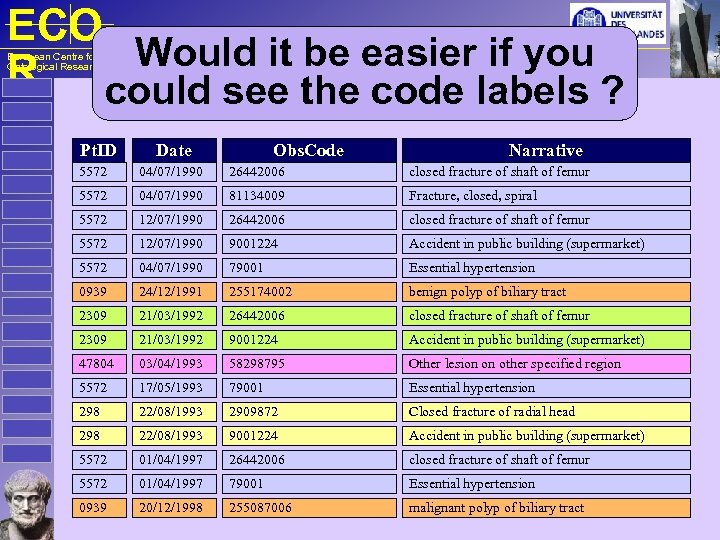 ECO Would it be easier if you R could see the code labels ? European Centre for Ontological Research Pt. ID Date Obs. Code Narrative 5572 04/07/1990 26442006 closed fracture of shaft of femur 5572 04/07/1990 81134009 Fracture, closed, spiral 5572 12/07/1990 26442006 closed fracture of shaft of femur 5572 12/07/1990 9001224 Accident in public building (supermarket) 5572 04/07/1990 79001 Essential hypertension 0939 24/12/1991 255174002 benign polyp of biliary tract 2309 21/03/1992 26442006 closed fracture of shaft of femur 2309 21/03/1992 9001224 Accident in public building (supermarket) 47804 03/04/1993 58298795 Other lesion on other specified region 5572 17/05/1993 79001 Essential hypertension 298 22/08/1993 2909872 Closed fracture of radial head 298 22/08/1993 9001224 Accident in public building (supermarket) 5572 01/04/1997 26442006 closed fracture of shaft of femur 5572 01/04/1997 79001 Essential hypertension 0939 20/12/1998 255087006 malignant polyp of biliary tract
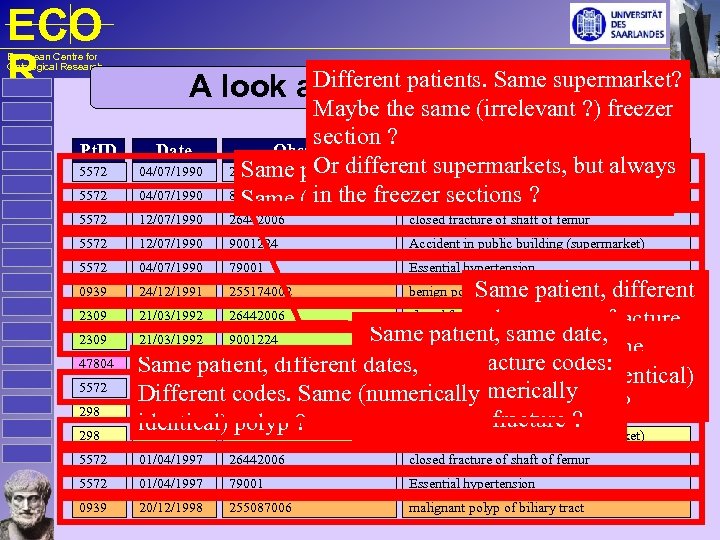 ECO R European Centre for Ontological Research Pt. ID Different patients. Same supermarket? A look at the problems. . . Date Maybe the same (irrelevant ? ) freezer section ? Obs. Code Narrative 26442006 patient, same hypertensionfemur always closed fracture of shaft of but Same Or different supermarkets, code: 81134009 (numerically identical) hypertension ? Fracture, closed, spiral Same in the freezer sections ? 5572 04/07/1990 5572 12/07/1990 26442006 closed fracture of shaft of femur 5572 12/07/1990 9001224 Accident in public building (supermarket) 5572 04/07/1990 79001 Essential hypertension 24/12/1991 255174002 benign polyp of biliary tract 298 Same patient, different 21/03/1992 26442006 closed fracturedates, same fracture of shaft of femur Same patient, same date, 21/03/1992 9001224 Accident in public building (supermarket) codes: same 03/04/1993 58298795 Other on other specified region 2 different fracture codes: Same patient, different dates, lesion(numericallycodes: Different patients, same fracture identical) 17/05/1993 Essential same (numerically Different 79001 Same (numericallyhypertension fracture ? ? codes. Same (numerically identical) fracture 22/08/1993 2909872 Closed fracture of radial head identical) fracture ? identical) 9001224 ? polyp 22/08/1993 Accident in public building (supermarket) 5572 01/04/1997 26442006 closed fracture of shaft of femur 5572 01/04/1997 79001 Essential hypertension 0939 20/12/1998 255087006 malignant polyp of biliary tract 0939 2309 47804 5572 298
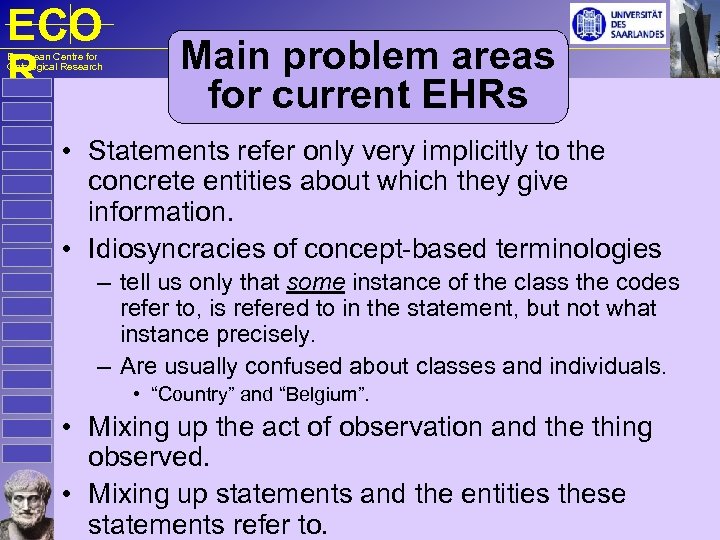 ECO R European Centre for Ontological Research Main problem areas for current EHRs • Statements refer only very implicitly to the concrete entities about which they give information. • Idiosyncracies of concept-based terminologies – tell us only that some instance of the class the codes refer to, is refered to in the statement, but not what instance precisely. – Are usually confused about classes and individuals. • “Country” and “Belgium”. • Mixing up the act of observation and the thing observed. • Mixing up statements and the entities these statements refer to.
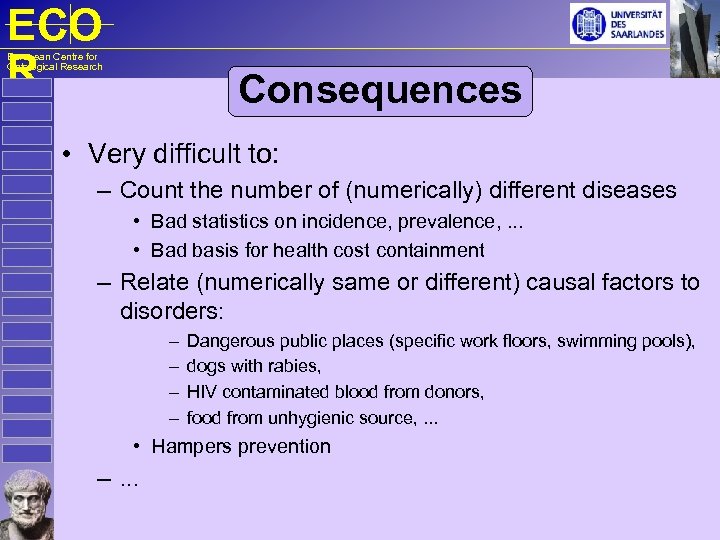 ECO R European Centre for Ontological Research Consequences • Very difficult to: – Count the number of (numerically) different diseases • Bad statistics on incidence, prevalence, . . . • Bad basis for health cost containment – Relate (numerically same or different) causal factors to disorders: – – Dangerous public places (specific work floors, swimming pools), dogs with rabies, HIV contaminated blood from donors, food from unhygienic source, . . . • Hampers prevention –. . .
 ECO R European Centre for Ontological Research Proposed solution: Referent Tracking • Foundation: Realist ontology
 ECO R European Centre for Ontological Research Ontology • ‘Ontology’: the study of being as a science • ‘An ontology’ is a representation of some preexisting domain of reality which – (1) reflects the properties of the objects within its domain in such a way that there obtains a systematic correlation between reality and the representation itself, – (2) is intelligible to a domain expert – (3) is formalized in a way that allows it to support automatic information processing • ‘ontological’ (as adjective): – Within an ontology. – Derived by applying the methodology of ontology –. . .
 ECO R Proposed solution: European Centre for Ontological Research Referent Tracking • Purpose: – explicit reference to the concrete individual entities relevant to the accurate description of each patient’s condition, therapies, outcomes, . . . • Method: – Introduce an Instance Unique Identifier (IUI) for each relevant individual (= particular, = instance). – Distinguish between • IUI assignment: for instances that do exist • IUI reservation: for entities expected to come into existence in the future
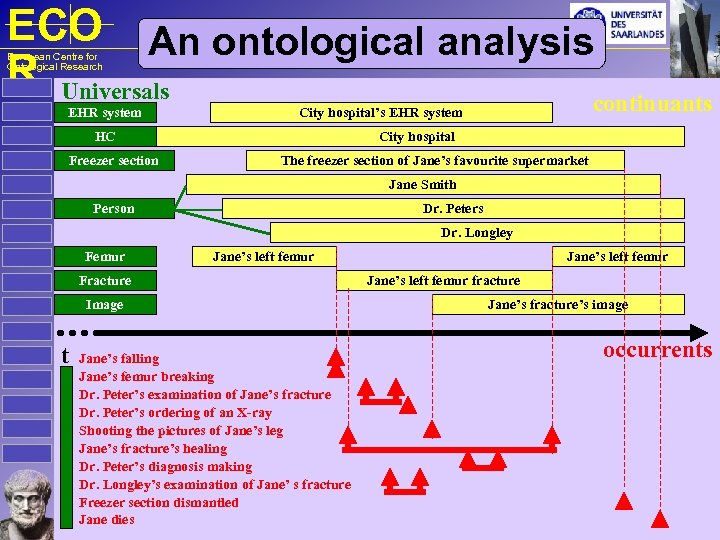 ECO An ontological analysis R Universals European Centre for Ontological Research EHR system HC Freezer section continuants City hospital’s EHR system City hospital The freezer section of Jane’s favourite supermarket Jane Smith Person Dr. Peters Dr. Longley Femur Jane’s left femur Fracture Image t Jane’s falling Jane’s femur breaking Dr. Peter’s examination of Jane’s fracture Dr. Peter’s ordering of an X-ray Shooting the pictures of Jane’s leg Jane’s fracture’s healing Dr. Peter’s diagnosis making Dr. Longley’s examination of Jane’ s fracture Freezer section dismantled Jane dies Jane’s left femur fracture Jane’s fracture’s image occurrents
 ECO R Essentials of Referent Tracking European Centre for Ontological Research • Generation of universally unique identifiers; • deciding what particulars should receive a IUI; • finding out whether or not a particular has already been assigned a IUI (each particular should receive maximally one IUI); • using IUIs in the EHR, i. e. issues concerning the syntax and semantics of statements containing IUIs; • determining the truth values of statements in which IUIs are used; • correcting errors in the assignment of IUIs.
 ECO R European Centre for Ontological Research IUI assignment • = an act carried out by the first ‘cognitive agent’ feeling the need to acknowledge the existence of a particular it has information about by labelling it with a UUID. • ‘cognitive agent’: – A person; – An organisation; – A device or software agent, e. g. • Bank note printer, • Image analysis software.
 ECO R Criteria for IUI assignment (1) European Centre for Ontological Research 1. The particular’s existence must be determined: – – Easy for persons in front of you, body parts, . . . Easy for ‘planned acts’: they do not exist before the plan is executed ! • – More difficult: subjective symptoms • – Only the plan exists and possibly the statements made about the future execution of the plan But the statements the patient makes about them do exist ! However: • • no need to know what the particular exactly is, i. e. which universal it instantiates No need to be able to point to it precisely – – One bee out of a particular swarm that stung the patient, one pain out of a series of pain attacks that made the patient worried But: this is not a matter of choice, not ‘any’ out of. . .
 ECO R Criteria for IUI assignment (2) European Centre for Ontological Research 2. The particular’s existence ‘may not already have been determined as the existence of something else’: • • • Morning star and evening star Himalaya Multiple sclerosis 3. May not have already been assigned a IUI. 4. It must be relevant to do so: • • • Personal decision, (scientific) community guideline, . . . Possibilities offered by the EHR system If a IUI has been assigned by somebody, everybody else making statements about the particular should use it
 ECO Representation in the EHR R European Centre for Ontological Research • Relevant particulars referred to using IUIs • Relationships that obtain between particulars at time t expressed using relations from an ontology (type OBO) • Statements describing for each particular, at time t: – Of what universal from an ontology it is an instance of – AND/OR (if one insists): – By means of what concept from a concept-based system it can sensibly be described
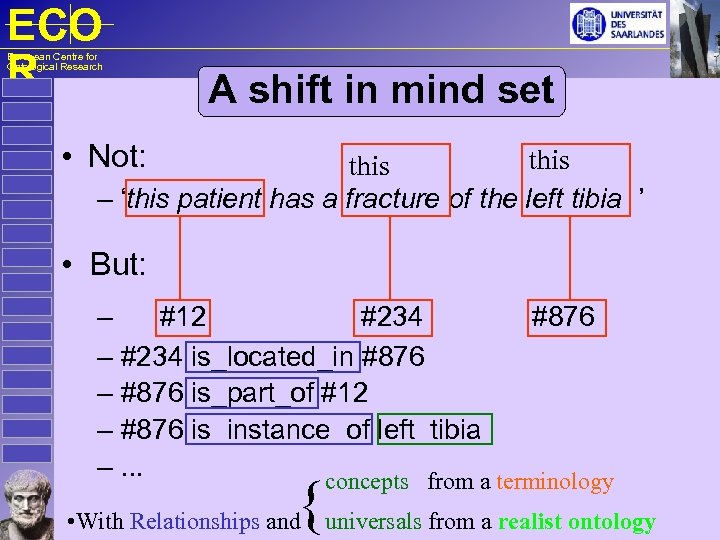 ECO R European Centre for Ontological Research A shift in mind set • Not: this – ‘this patient has a fracture of the left tibia ’ • But: – #12 #234 #876 – #234 is_located_in #876 – #876 is_part_of #12 – #876 is_instance_of left_tibia –. . . concepts from a terminology { • With Relationships and universals from a realist ontology
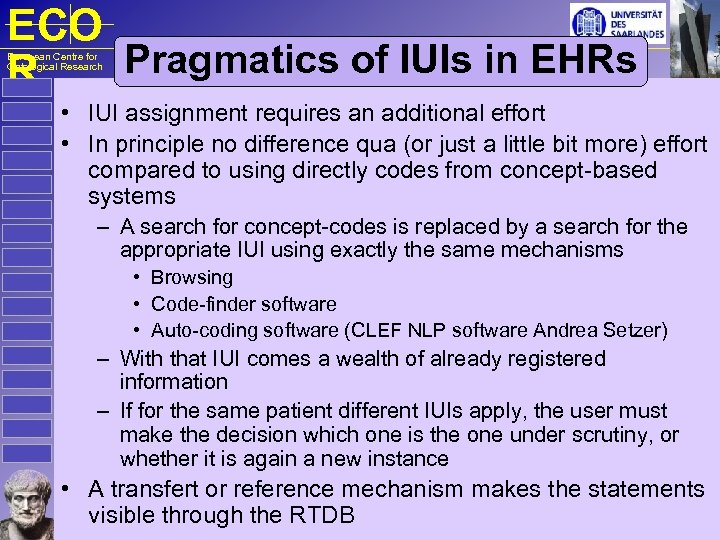 ECO Pragmatics of IUIs in EHRs R European Centre for Ontological Research • IUI assignment requires an additional effort • In principle no difference qua (or just a little bit more) effort compared to using directly codes from concept-based systems – A search for concept-codes is replaced by a search for the appropriate IUI using exactly the same mechanisms • Browsing • Code-finder software • Auto-coding software (CLEF NLP software Andrea Setzer) – With that IUI comes a wealth of already registered information – If for the same patient different IUIs apply, the user must make the decision which one is the one under scrutiny, or whether it is again a new instance • A transfert or reference mechanism makes the statements visible through the RTDB
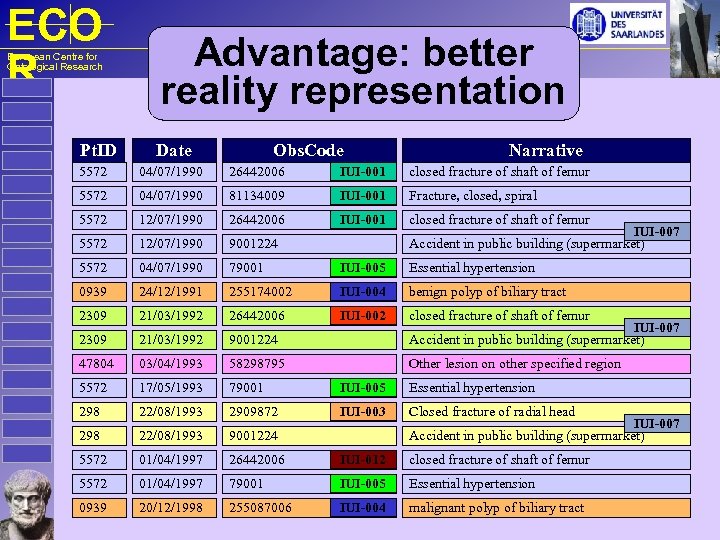 ECO R European Centre for Ontological Research Pt. ID Advantage: better reality representation Date Obs. Code Narrative 5572 04/07/1990 26442006 IUI-001 closed fracture of shaft of femur 5572 04/07/1990 81134009 IUI-001 Fracture, closed, spiral 5572 12/07/1990 26442006 IUI-001 closed fracture of shaft of femur 5572 12/07/1990 9001224 5572 04/07/1990 79001 IUI-005 Essential hypertension 0939 24/12/1991 255174002 IUI-004 benign polyp of biliary tract 2309 21/03/1992 26442006 IUI-002 closed fracture of shaft of femur 2309 21/03/1992 9001224 IUI-007 Accident in public building (supermarket) 47804 03/04/1993 58298795 Other lesion on other specified region 5572 17/05/1993 79001 IUI-005 Essential hypertension 298 22/08/1993 2909872 IUI-003 Closed fracture of radial head 298 22/08/1993 9001224 5572 01/04/1997 26442006 IUI-012 closed fracture of shaft of femur 5572 01/04/1997 79001 IUI-005 Essential hypertension 0939 20/12/1998 255087006 IUI-004 malignant polyp of biliary tract IUI-007 Accident in public building (supermarket)
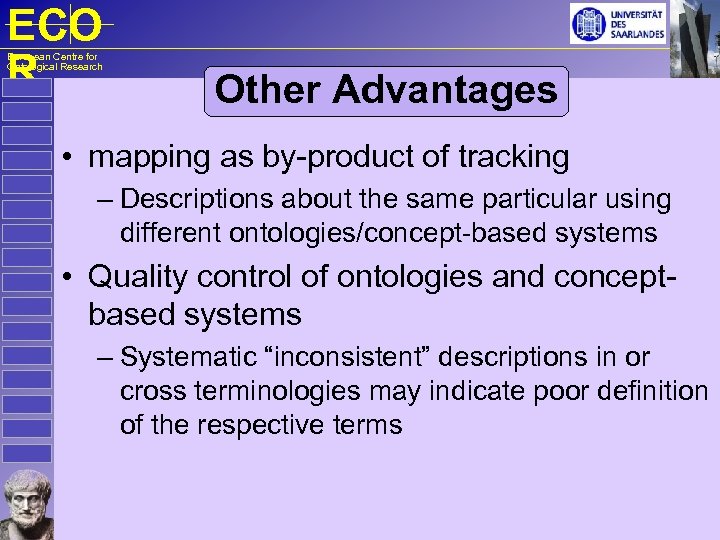 ECO R European Centre for Ontological Research Other Advantages • mapping as by-product of tracking – Descriptions about the same particular using different ontologies/concept-based systems • Quality control of ontologies and conceptbased systems – Systematic “inconsistent” descriptions in or cross terminologies may indicate poor definition of the respective terms
 ECO R European Centre for Ontological Research How to make this practical for the text-based parts of an EHR ? Referent tracking in the linguistic sense !
 ECO R The problem summarised European Centre for Ontological Research • natural language is the only medium that is able to communicate clinical information about individual patients without loss of necessary detail; • (virtual) structured data repositories are required to make subsequent analyses possible; • any transformation from free language to coding and classification systems results in information loss that is unacceptable for individual patient care, but at the other hand is a conditio sine qua non for population based studies; • today’s graphical user interfaces can deal reasonably well with picking lists build around controlled vocabularies that fulfil a bridging function from free language towards coding and classification systems but are incompatible with referent tracking
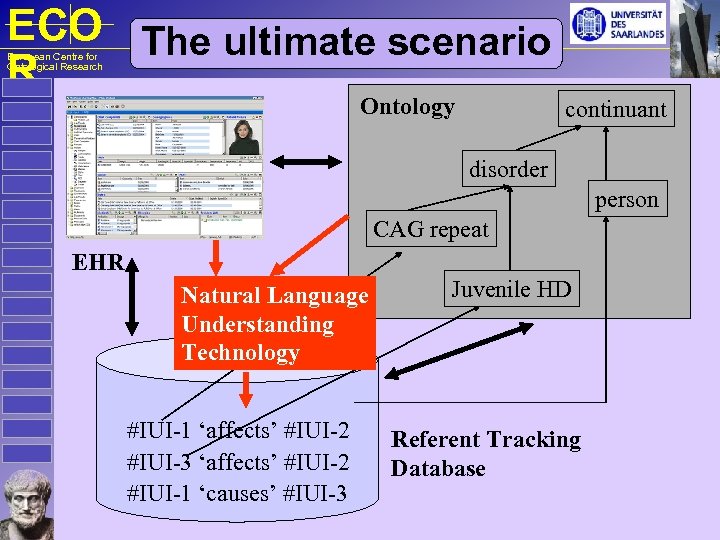 ECO The ultimate scenario R European Centre for Ontological Research Ontology continuant disorder person CAG repeat EHR Natural Language Understanding Technology #IUI-1 ‘affects’ #IUI-2 #IUI-3 ‘affects’ #IUI-2 #IUI-1 ‘causes’ #IUI-3 Juvenile HD Referent Tracking Database
 ECO R European Centre for Ontological Research Jim Cimino’s Woods Hole case First sentence: Jane Smith is a 30 year old, Native American female who presents to the emergency room with the chief complaint of cough and chest pain.
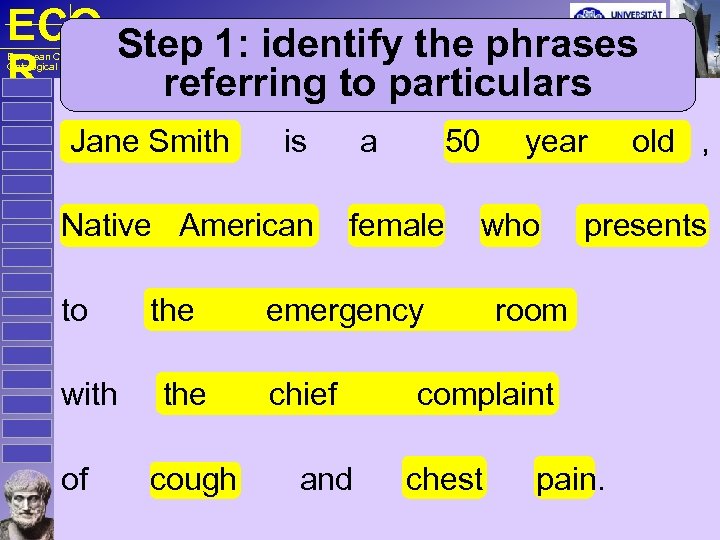 ECO Step 1: identify the phrases R referring to particulars European Centre for Ontological Research Jane Smith is Native American to with of the cough a 50 female year who emergency chief and presents room complaint chest old , pain.
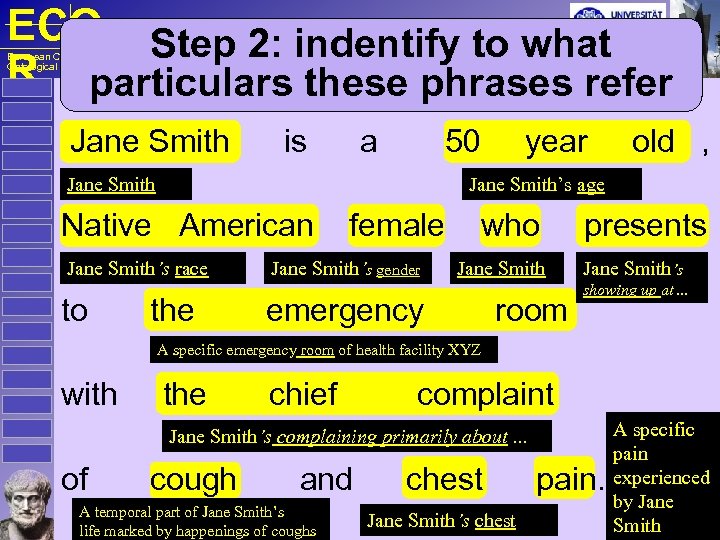 ECO Step 2: indentify to what R particulars these phrases refer European Centre for Ontological Research Jane Smith is a 50 Jane Smith old , Jane Smith’s age Native American Jane Smith’s race to year the female Jane Smith’s gender who Jane Smith emergency room presents Jane Smith’s showing up at. . . A specific emergency room of health facility XYZ with the chief complaint Jane Smith’s complaining primarily about. . . of cough and A temporal part of Jane Smith’s life marked by happenings of coughs chest Jane Smith’s chest pain. A specific pain experienced by Jane Smith
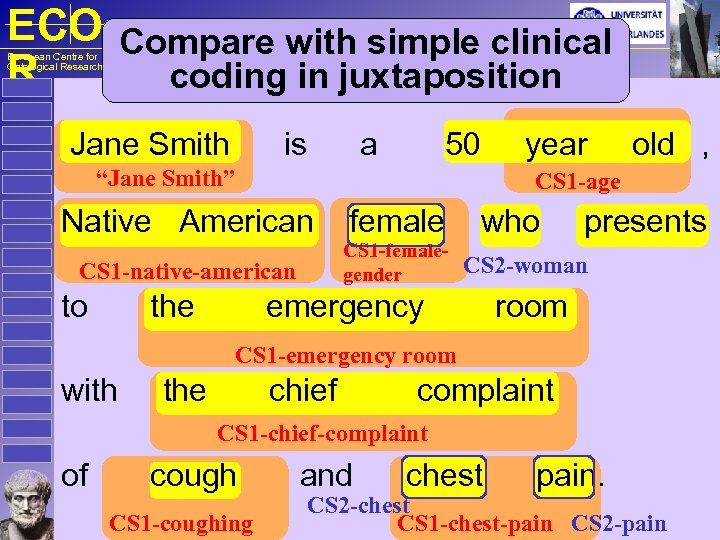 ECO Compare with simple clinical R coding in juxtaposition European Centre for Ontological Research Jane Smith is a 50 year “Jane Smith” CS 1 -age Native American female CS 1 -native-american CS 1 -femalegender to the old , who presents CS 2 -woman emergency room CS 1 -emergency room with the chief complaint CS 1 -chief-complaint of cough CS 1 -coughing and chest pain. CS 2 -chest CS 1 -chest-pain CS 2 -pain
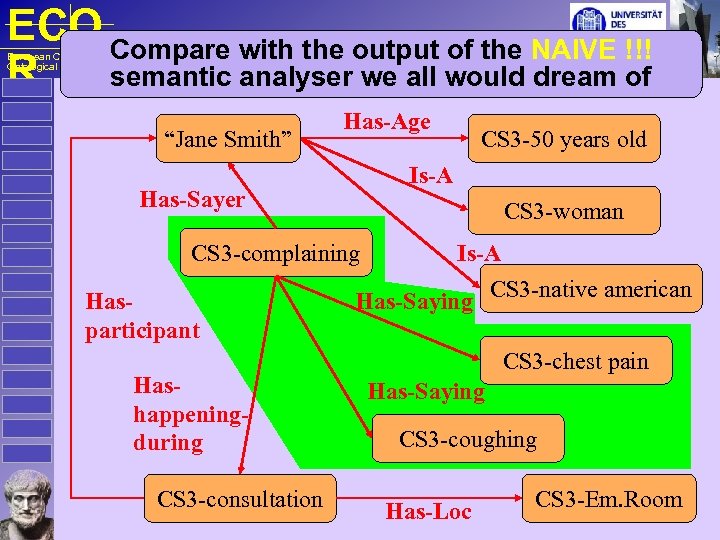 ECO Compare with the output of the NAIVE !!! Compare with the output of the perfect R semantic analyser we all would dream of European Centre for Ontological Research “Jane Smith” Has-Age Is-A Has-Sayer CS 3 -woman CS 3 -complaining Hasparticipant Hashappeningduring CS 3 -consultation CS 3 -50 years old Is-A Has-Saying CS 3 -native american CS 3 -chest pain Has-Saying CS 3 -coughing Has-Loc CS 3 -Em. Room
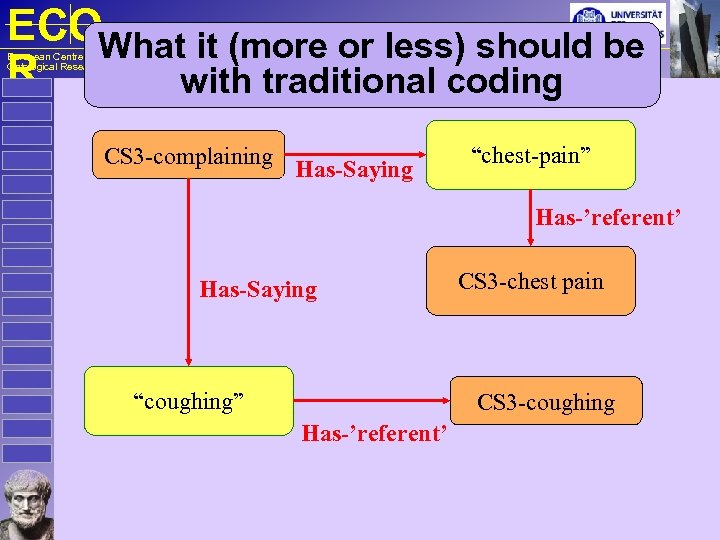 ECOWhat it (more or less) should be R with traditional coding European Centre for Ontological Research CS 3 -complaining Has-Saying “chest-pain” Has-’referent’ Has-Saying “coughing” CS 3 -chest pain CS 3 -coughing Has-’referent’
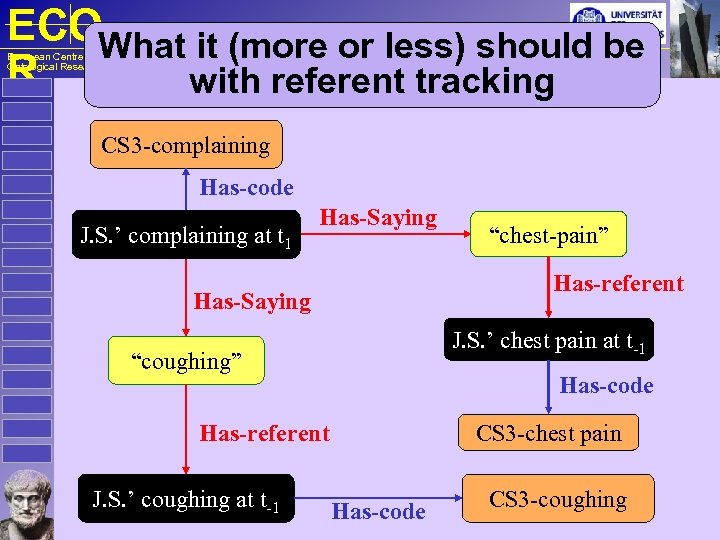 ECOWhat it (more or less) should be R with referent tracking European Centre for Ontological Research CS 3 -complaining Has-code J. S. ’ complaining at t 1 Has-Saying Has-referent Has-Saying J. S. ’ chest pain at t-1 “coughing” Has-code CS 3 -chest pain Has-referent J. S. ’ coughing at t-1 “chest-pain” Has-code CS 3 -coughing
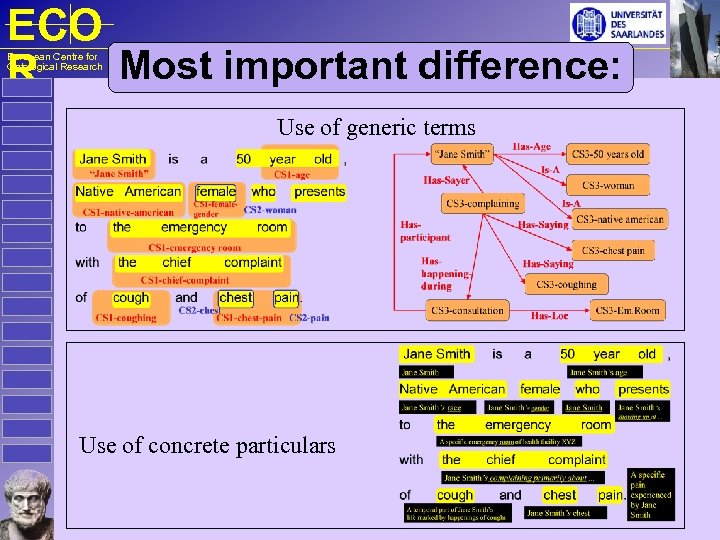 ECO Most important difference: R European Centre for Ontological Research Use of generic terms Use of concrete particulars
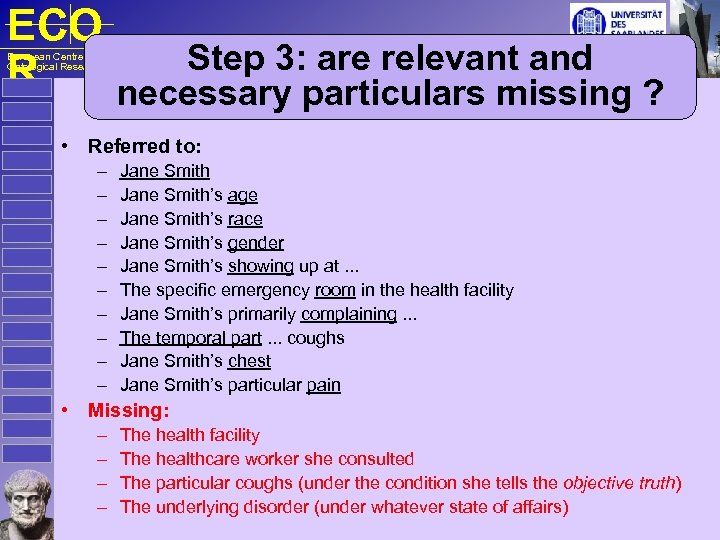 ECO Step 3: are relevant and R necessary particulars missing ? European Centre for Ontological Research • Referred to: – – – – – Jane Smith’s age Jane Smith’s race Jane Smith’s gender Jane Smith’s showing up at. . . The specific emergency room in the health facility Jane Smith’s primarily complaining. . . The temporal part. . . coughs Jane Smith’s chest Jane Smith’s particular pain • Missing: – – The health facility The healthcare worker she consulted The particular coughs (under the condition she tells the objective truth) The underlying disorder (under whatever state of affairs)
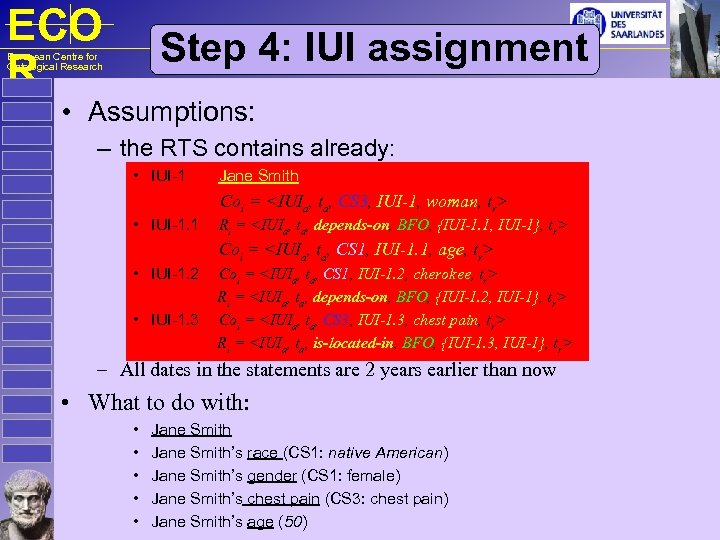 ECO R Step 4: IUI assignment European Centre for Ontological Research • Assumptions: – the RTS contains already: • IUI-1 Jane Smith Coi =
 ECO R European Centre for Ontological Research Conclusion • Referent tracking can solve a number of problems in an elegant way. • Existing (or emerging) technologies can be used for the implementation. • Old technologies (cbs) can play an interesting role. • Big Brother feeling is to be expected but with adequate measures easy to fight. • The proof of the pudding is in the eating – Pilote is going to be set up • Collaboration sought for dealing with NLU