


 Скачать презентацию Eco Pilot Training at OAA Captain Michael Fitz-Costa
8a7f459e8b876fe93b427e698653eafa.ppt
- Количество слайдов: 29
 Eco Pilot Training at OAA Captain Michael Fitz-Costa
 Industry COPENHAGEN - AND BEYOND
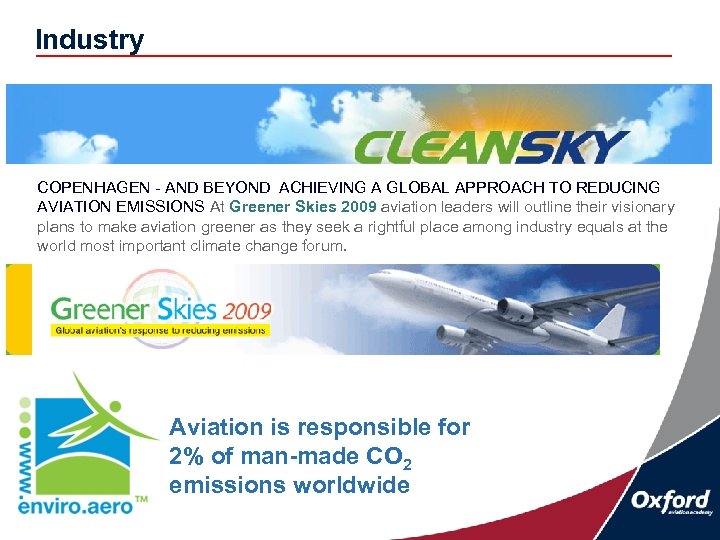
ACHIEVING A GLOBAL APPROACH TO REDUCING AVIATION EMISSIONS At Greener Skies 2009 aviation leaders will outline their visionary plans to make aviation greener as they seek a rightful place among industry equals at the world most important climate change forum. Aviation is responsible for 2% of man-made CO 2 emissions worldwide
Industry COPENHAGEN - AND BEYOND
ACHIEVING A GLOBAL APPROACH TO REDUCING AVIATION EMISSIONS At Greener Skies 2009 aviation leaders will outline their visionary plans to make aviation greener as they seek a rightful place among industry equals at the world most important climate change forum. Aviation is responsible for 2% of man-made CO 2 emissions worldwide
 Industry G 8 and ICAO policy, 50% CO 2 reduction by 2050 Emissions Trading System (ETS) EU directives are now in place Effecting 2700 air carriers flying to and from Europe The EU require details of both Revenue Tonne Kilometers (RTK) and CO 2 emissions to be kept by all carriers
 Industry Problems with ETS… ETS Aug. 31 deadline extended UK's announced that it does not have "a firm and agreed list" of operators to be regulated by each member state European Commission has not yet announced 2012 emissions cap for flight into Europe Industry is waiting for further information on ETS
 Carbon Footprint
 Carbon Footprint Every Kg of combusted jet-A 1 is generating 3. 16 kgs of CO 2 i. e. 100 kgs jet-A 1 corresponds to 316 kgs of CO 2 which can be mathematically proven with Stoichiometric law CH 4 + 2(O 2 + 3. 76 N 2) -> CO 2 + 2 H 2 O + 7. 52 N 2
 Why Eco Pilot Training? An important piece in the Airlines fuel saving strategy
 The Airline: Why? • Environmental issues affecting all airlines – (Branding) • Emissions Trading Scheme (ETS) is coming • Fuel cost savings – with training program, it will strengthen the airlines’ saving potential
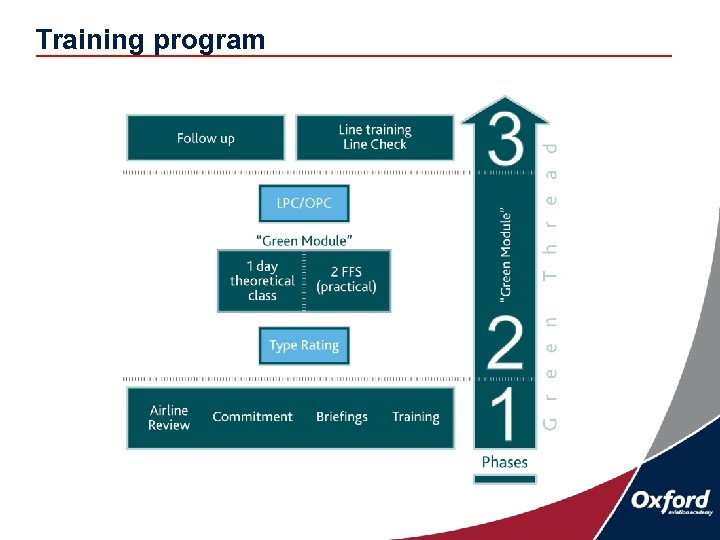
 The Airline: Expand into fuel saving behaviour within: • Type rating and conversion training • Recurrent training – LPC/OPC Strengthening fuel saving behaviour and environmental thinking in pilots
 Target Customers: • Small and medium sized Operators • Training must be flexible due to very different level of maturity among the Airlines fuel conservation programs Fuel cost today per A/C per year: • Charter: € 8 -10 Million • Scheduled: € 5 -8 Million
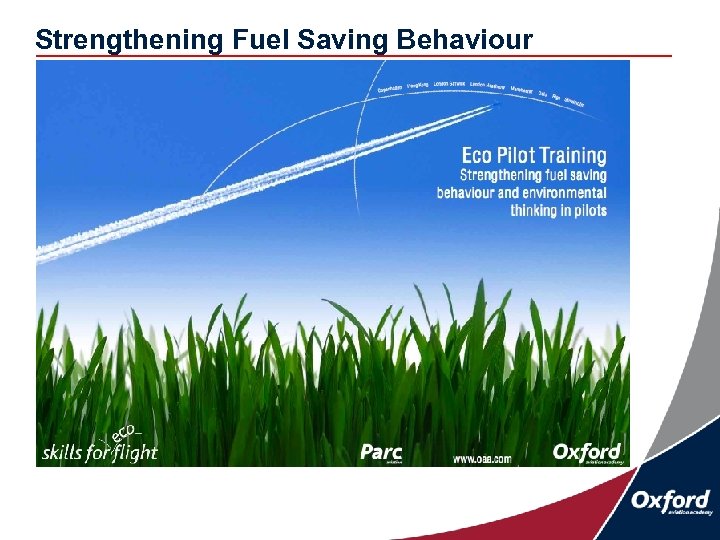 Strengthening Fuel Saving Behaviour
 Training program
 Phase 1 commitment Management Commitment… “Plan for Success” Key players… CEO, DFO and Chief pilots Time frame… 1 -3 days with OAA consultants and lecture basis
 Phase 1 Briefing Executive Management decision Top priority… Fuel saving Flight Operations A review of ALL Operating Procedure Review ALL fuel critical areas Training of employees Change of culture
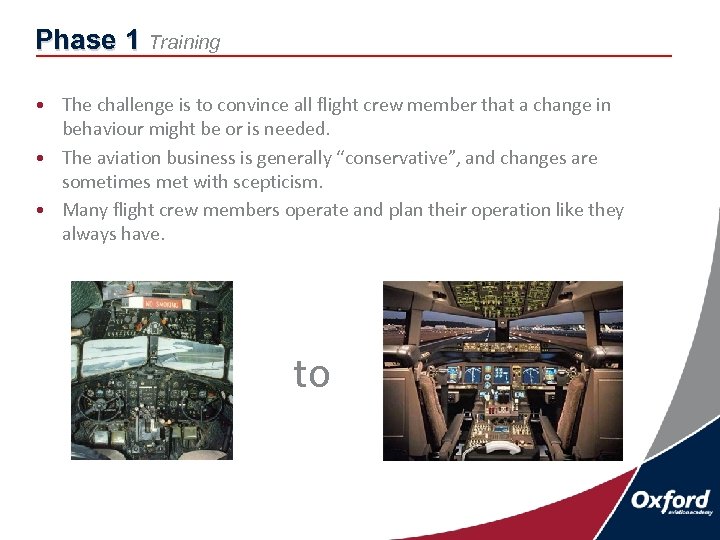 Phase 1 Training • The challenge is to convince all flight crew member that a change in behaviour might be or is needed. • The aviation business is generally “conservative”, and changes are sometimes met with scepticism. • Many flight crew members operate and plan their operation like they always have. to
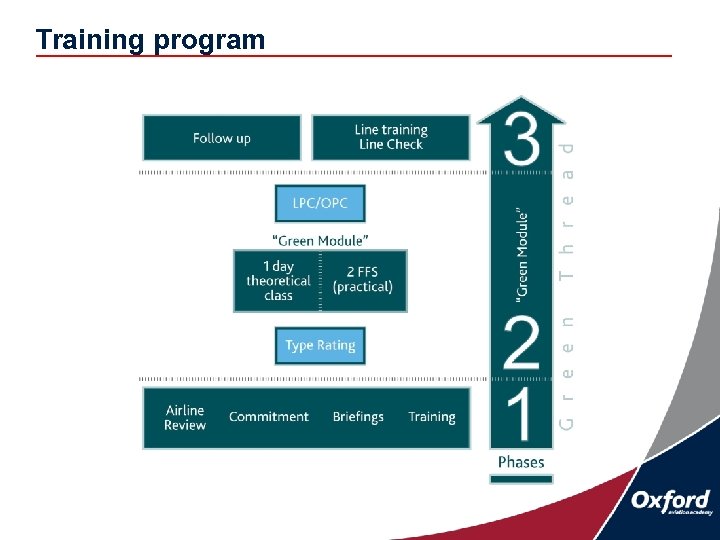 Training program
 Phase 2 Course summary “Green Module” • Flight crew awareness of how to operate the aircraft more fuel efficient • Lower the operating costs of the airline, more profit to the airline and secure long-term success of the company • More environmental friendly operation
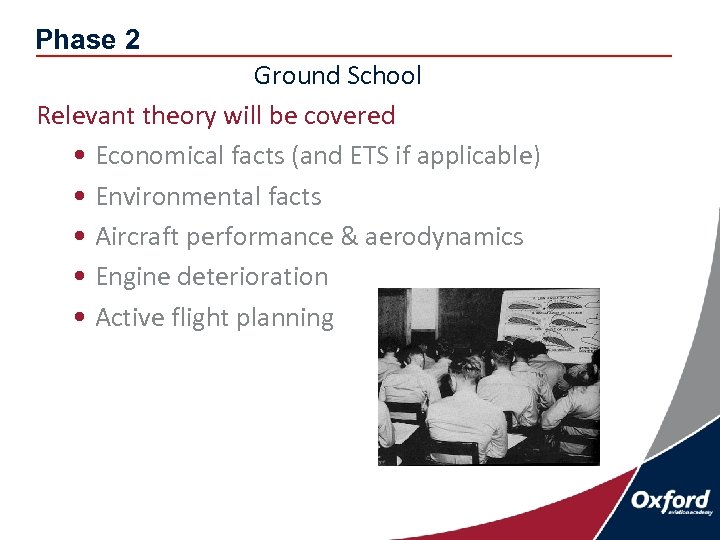 Phase 2 Ground School Relevant theory will be covered • Economical facts (and ETS if applicable) • Environmental facts • Aircraft performance & aerodynamics • Engine deterioration • Active flight planning
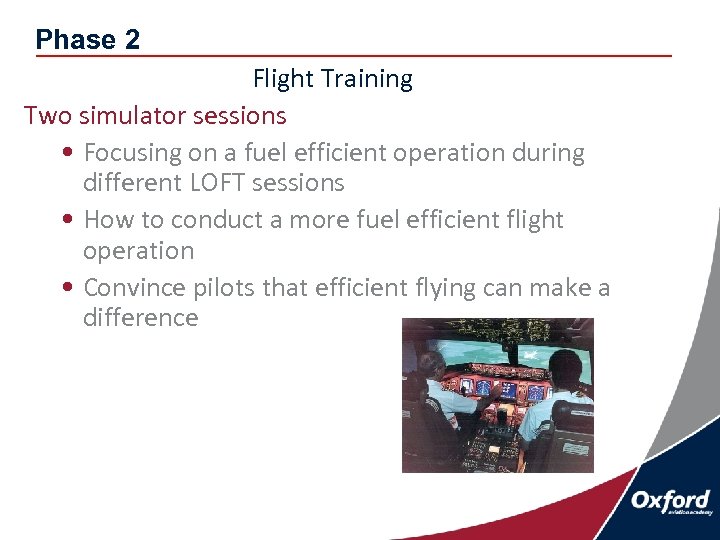 Phase 2 Flight Training Two simulator sessions • Focusing on a fuel efficient operation during different LOFT sessions • How to conduct a more fuel efficient flight operation • Convince pilots that efficient flying can make a difference
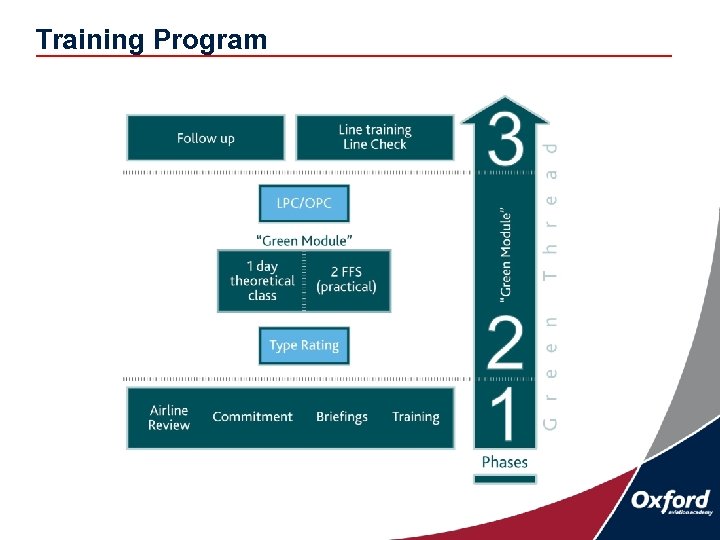 Training Program
 Phase 3 Consultation and follow up performed 3 x in first year • To ensure that the airline continue to work with the program in a day-to-day operations • To monitor the progress of the program and solve any issues • External operational expertise is offered via Parc Aviation on demand for line training, line checks etc
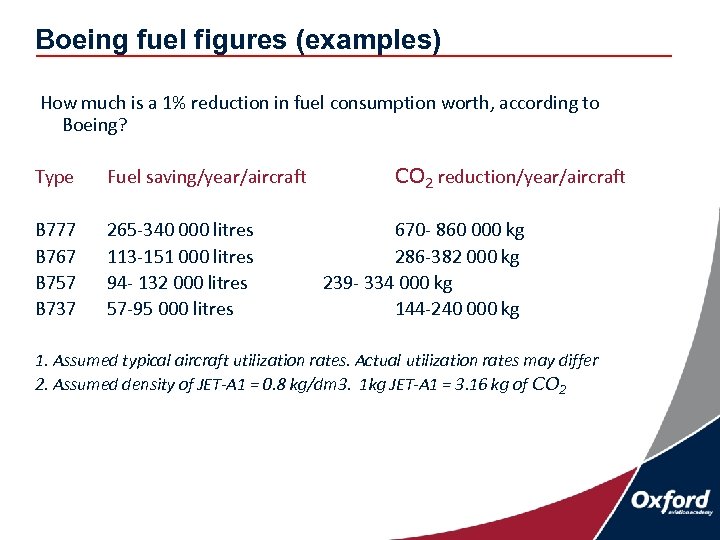 Boeing fuel figures (examples) How much is a 1% reduction in fuel consumption worth, according to Boeing? Type Fuel saving/year/aircraft B 777 B 767 B 757 B 737 265 -340 000 litres 113 -151 000 litres 94 - 132 000 litres 57 -95 000 litres CO 2 reduction/year/aircraft 670 - 860 000 kg 286 -382 000 kg 239 - 334 000 kg 144 -240 000 kg 1. Assumed typical aircraft utilization rates. Actual utilization rates may differ 2. Assumed density of JET-A 1 = 0. 8 kg/dm 3. 1 kg JET-A 1 = 3. 16 kg of CO 2
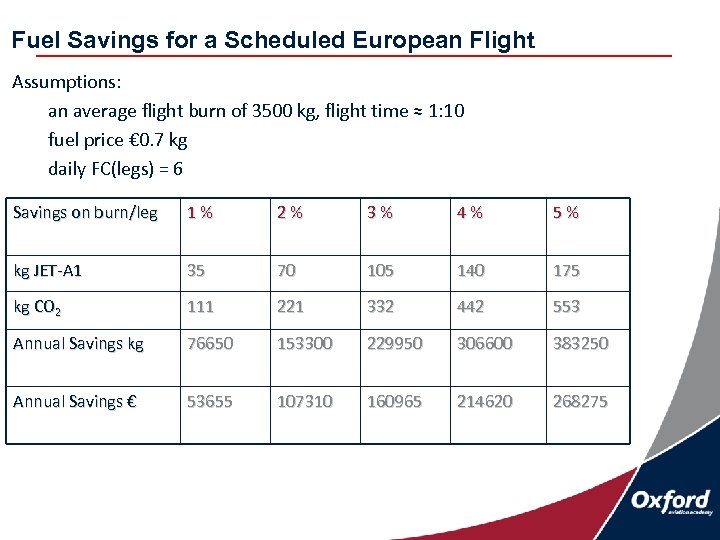 Fuel Savings for a Scheduled European Flight Assumptions: an average flight burn of 3500 kg, flight time ≈ 1: 10 fuel price € 0. 7 kg daily FC(legs) = 6 Savings on burn/leg 1% 2% 3% 4% 5% kg JET-A 1 35 70 105 140 175 kg CO 2 111 221 332 442 553 Annual Savings kg 76650 153300 229950 306600 383250 Annual Savings € 53655 107310 160965 214620 268275
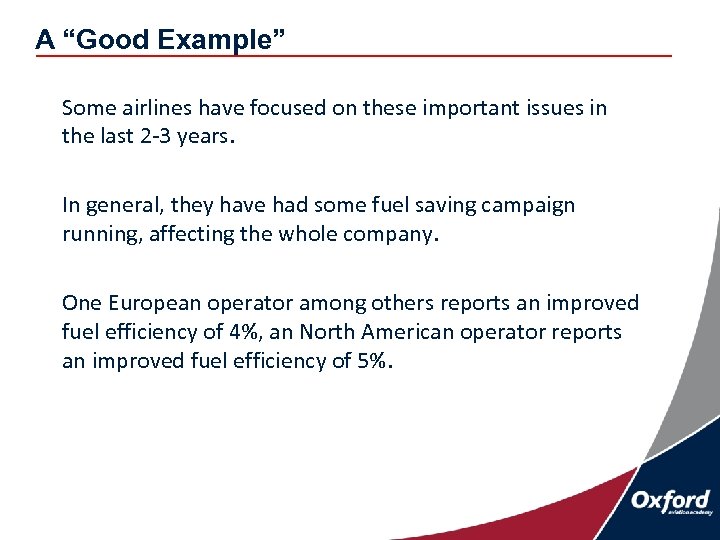 A “Good Example” Some airlines have focused on these important issues in the last 2 -3 years. In general, they have had some fuel saving campaign running, affecting the whole company. One European operator among others reports an improved fuel efficiency of 4%, an North American operator reports an improved fuel efficiency of 5%.
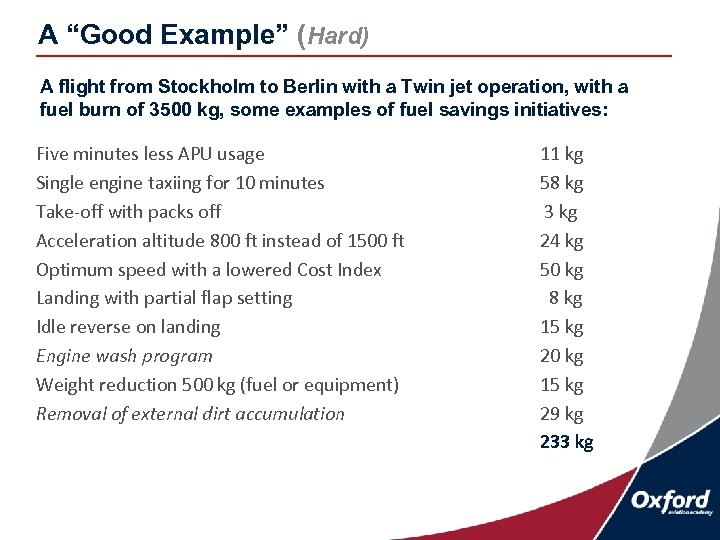 A “Good Example” (Hard) A flight from Stockholm to Berlin with a Twin jet operation, with a fuel burn of 3500 kg, some examples of fuel savings initiatives: Five minutes less APU usage Single engine taxiing for 10 minutes Take-off with packs off Acceleration altitude 800 ft instead of 1500 ft Optimum speed with a lowered Cost Index Landing with partial flap setting Idle reverse on landing Engine wash program Weight reduction 500 kg (fuel or equipment) Removal of external dirt accumulation 11 kg 58 kg 3 kg 24 kg 50 kg 8 kg 15 kg 20 kg 15 kg 29 kg 233 kg
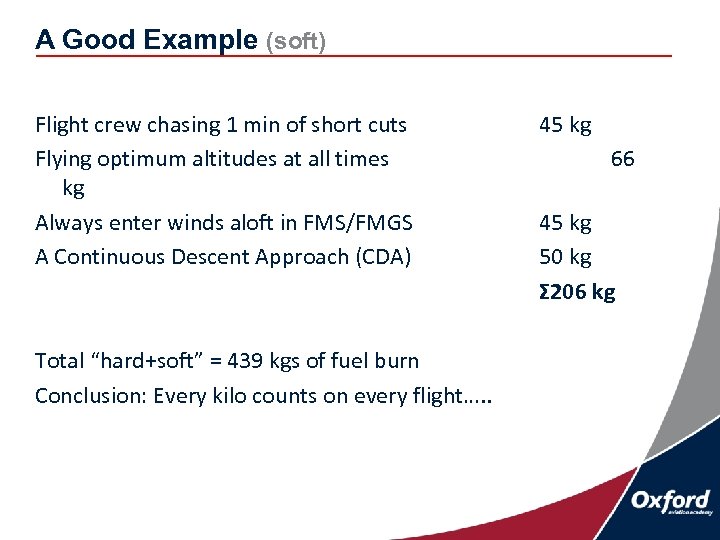 A Good Example (soft) Flight crew chasing 1 min of short cuts Flying optimum altitudes at all times kg Always enter winds aloft in FMS/FMGS A Continuous Descent Approach (CDA) Total “hard+soft” = 439 kgs of fuel burn Conclusion: Every kilo counts on every flight…. . 45 kg 66 45 kg 50 kg Σ 206 kg
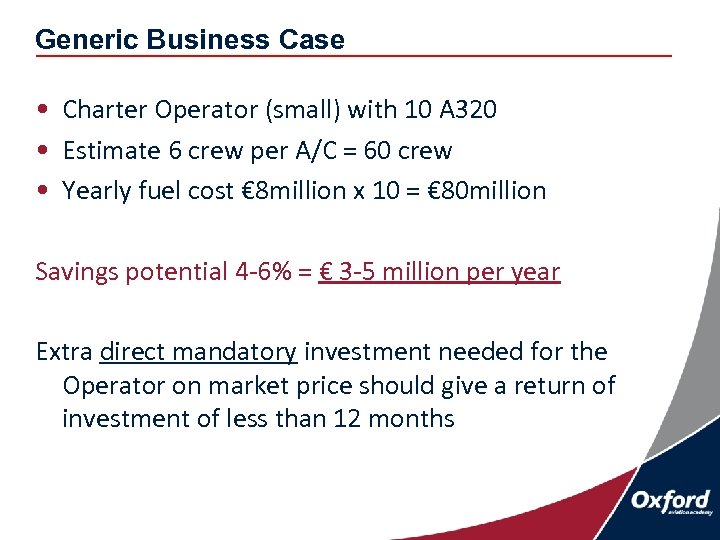 Generic Business Case • Charter Operator (small) with 10 A 320 • Estimate 6 crew per A/C = 60 crew • Yearly fuel cost € 8 million x 10 = € 80 million Savings potential 4 -6% = € 3 -5 million per year Extra direct mandatory investment needed for the Operator on market price should give a return of investment of less than 12 months
 Thank you!