 Скачать презентацию Eco-organic farming in Estonia institutions supply environmental public
75dfe0e66fa9f5a88f770b7bf2ae2840.ppt
- Количество слайдов: 14



Eco-organic farming in Estonia: institutions, supply, environmental public goods and integrated sustainable development planning in rural areas Ahto Oja IDARI PHD student ESTONIA
CONTENT n INTRODUCTION 1. 2. 3. n SUPPLY EXTERNAL PUBLIC ENVIRONMENTAL BENEFITS INSTITUTIONS OBJECTIVES
ESTONIA TOTAL POPULATION 1, 4 MILLION, ONE THIRD RUSSIAN SPEAKING, CAPITAL - TALLINN
Introduction n Total area of Estonia ~4 500 000 ha Agricultural land ~ 1 million hectar Organically farmed 30 600 ha in 2002 n n n The growth 7, 5 times during last 4 years The number of eco-organic farmers has increased from 89 to 583 from 1999 to 2002 in Estonia 2/3 out of 583 have cattle, but only 136 have certificate to sell organic meat
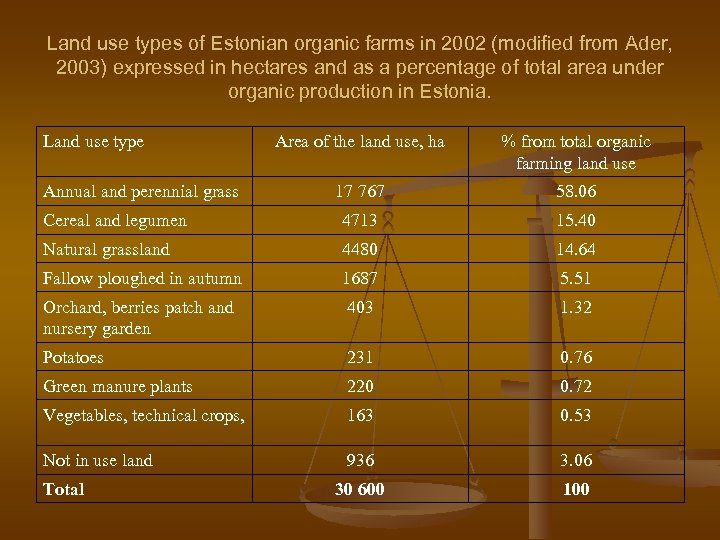
Land use types of Estonian organic farms in 2002 (modified from Ader, 2003) expressed in hectares and as a percentage of total area under organic production in Estonia. Land use type Area of the land use, ha % from total organic farming land use 17 767 58. 06 Cereal and legumen 4713 15. 40 Natural grassland 4480 14. 64 Fallow ploughed in autumn 1687 5. 51 Orchard, berries patch and nursery garden 403 1. 32 Potatoes 231 0. 76 Green manure plants 220 0. 72 Vegetables, technical crops, 163 0. 53 Not in use land 936 3. 06 30 600 100 Annual and perennial grass Total
Supply n n Demand for organic products has increased new opportunities to export organic produce The area of land cultivated organically will rise in the near future in Estonia, Economic aspects (effectiveness, competitiveness) are not investigated in Estonian context
Eco-organic agriculture and external effects n n n External benefits and costs associated with eco-organic farming recreation benefits ecological functions: landscape nutrient leaching soil erosion
Eco-organic farming institutions n n n The Law on Organic Farming Estonian Organic Farming Database Estonian Foundation for Organic Farming Association of the Organic Producers of Estonia Informal: Traditional farming methods n www. sahver. ee n
OBJECTIVES Supply n n n Determine the economic viability of ecoorganic production Estimate the opportunity costs of developing the sector Evaluate the willingness of land managers to supply eco-organic products;
OBJECTIVES Eco-organic agriculture and external effects n n n Evaluate and quantify the supply of non-market environmental goods and services The cost of non-market environmental benefits Measure the public demand preferences for non-market environmental goods and services
OBJECTIVES Eco-organic farming institutions n n n Establish the attitudes to eco-organic production Assess the compliance of Estonian traditional farming methods with eco-organic farming certified requirements Ascertain the formal and informal obstacles Find out the impact of EU and governmental support mechanisms Propose policy initiatives
OBJECTIVES Eco-organic farming institutions n Analyse the policy integration n Assess the level of participation

THANK YOU VERY MUCH!
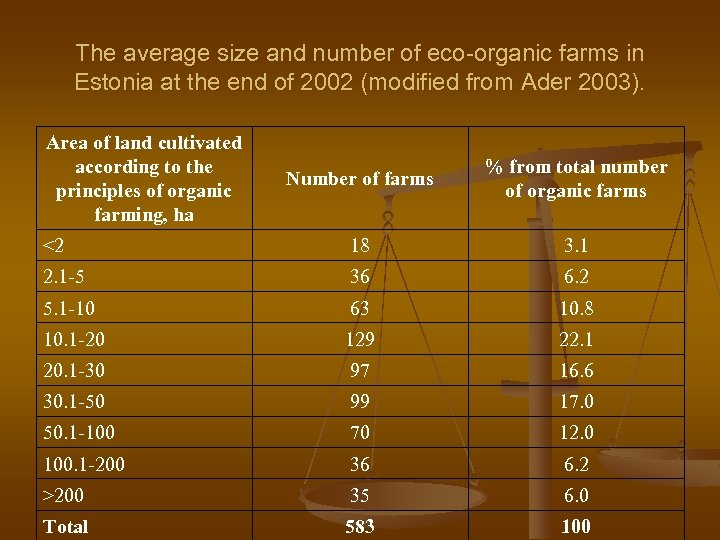
The average size and number of eco-organic farms in Estonia at the end of 2002 (modified from Ader 2003). Area of land cultivated according to the principles of organic farming, ha Number of farms % from total number of organic farms <2 18 3. 1 2. 1 -5 36 6. 2 5. 1 -10 63 10. 8 10. 1 -20 129 22. 1 20. 1 -30 97 16. 6 30. 1 -50 99 17. 0 50. 1 -100 70 12. 0 100. 1 -200 36 6. 2 >200 35 6. 0 Total 583 100
Скачать презентацию Eco-organic farming in Estonia institutions supply environmental public
75dfe0e66fa9f5a88f770b7bf2ae2840.ppt