


 Скачать презентацию Echelle Spectroscopy Dr Ray Stathakis AAO What
72c1cd10174f1e197b914bd207c67a62.ppt
- Количество слайдов: 12
 Echelle Spectroscopy Dr Ray Stathakis, AAO
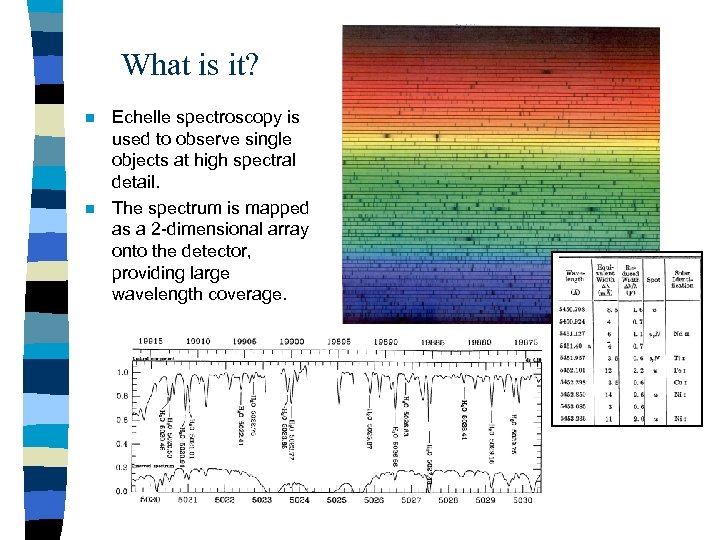 What is it? n n Echelle spectroscopy is used to observe single objects at high spectral detail. The spectrum is mapped as a 2 -dimensional array onto the detector, providing large wavelength coverage.
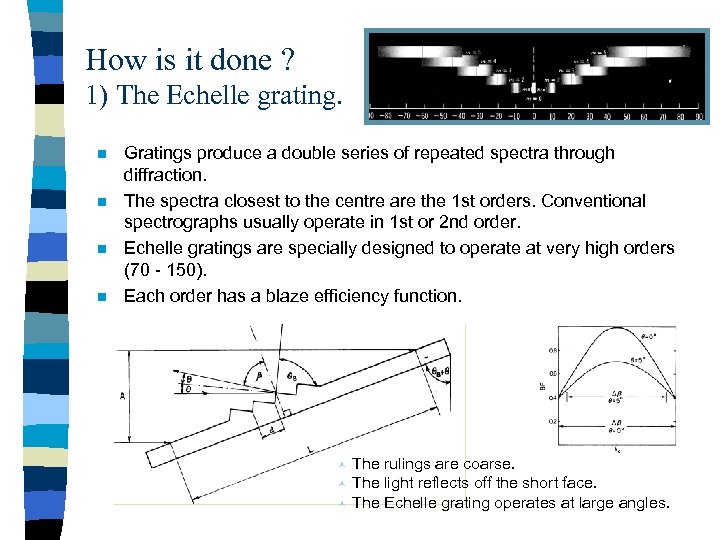 How is it done ? 1) The Echelle grating. n n Gratings produce a double series of repeated spectra through diffraction. The spectra closest to the centre are the 1 st orders. Conventional spectrographs usually operate in 1 st or 2 nd order. Echelle gratings are specially designed to operate at very high orders (70 - 150). Each order has a blaze efficiency function. The rulings are coarse. © The light reflects off the short face. © The Echelle grating operates at large angles. ©
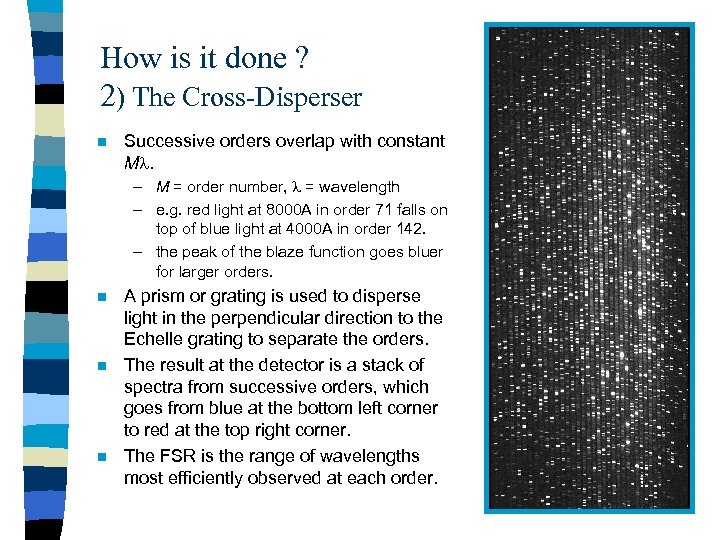 How is it done ? 2) The Cross-Disperser n Successive orders overlap with constant Ml. – M = order number, l = wavelength – e. g. red light at 8000 A in order 71 falls on top of blue light at 4000 A in order 142. – the peak of the blaze function goes bluer for larger orders. n n n A prism or grating is used to disperse light in the perpendicular direction to the Echelle grating to separate the orders. The result at the detector is a stack of spectra from successive orders, which goes from blue at the bottom left corner to red at the top right corner. The FSR is the range of wavelengths most efficiently observed at each order.
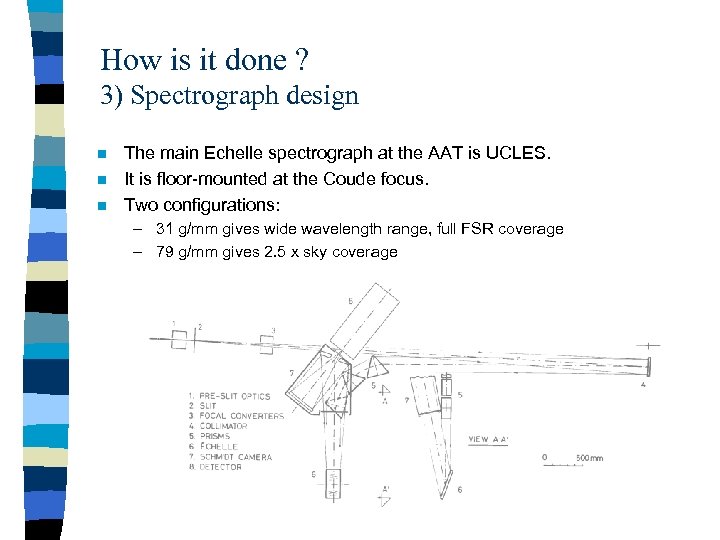 How is it done ? 3) Spectrograph design n The main Echelle spectrograph at the AAT is UCLES. It is floor-mounted at the Coude focus. Two configurations: – 31 g/mm gives wide wavelength range, full FSR coverage – 79 g/mm gives 2. 5 x sky coverage
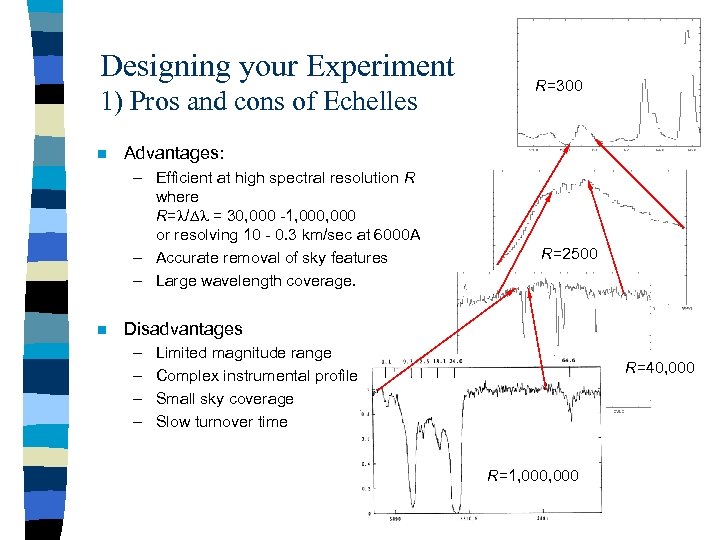 Designing your Experiment 1) Pros and cons of Echelles n Advantages: – Efficient at high spectral resolution R where R=l/Dl = 30, 000 -1, 000 or resolving 10 - 0. 3 km/sec at 6000 A – Accurate removal of sky features – Large wavelength coverage. n R=300 R=2500 Disadvantages – – Limited magnitude range Complex instrumental profile Small sky coverage Slow turnover time R=40, 000 R=1, 000
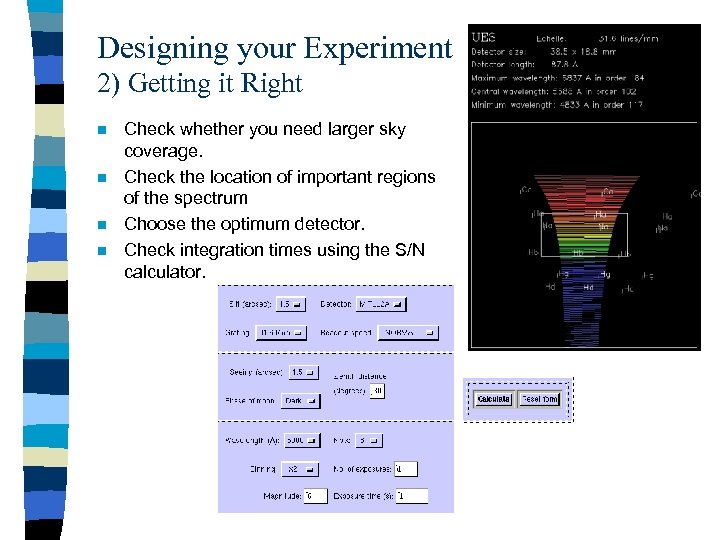 Designing your Experiment 2) Getting it Right n n Check whether you need larger sky coverage. Check the location of important regions of the spectrum Choose the optimum detector. Check integration times using the S/N calculator.
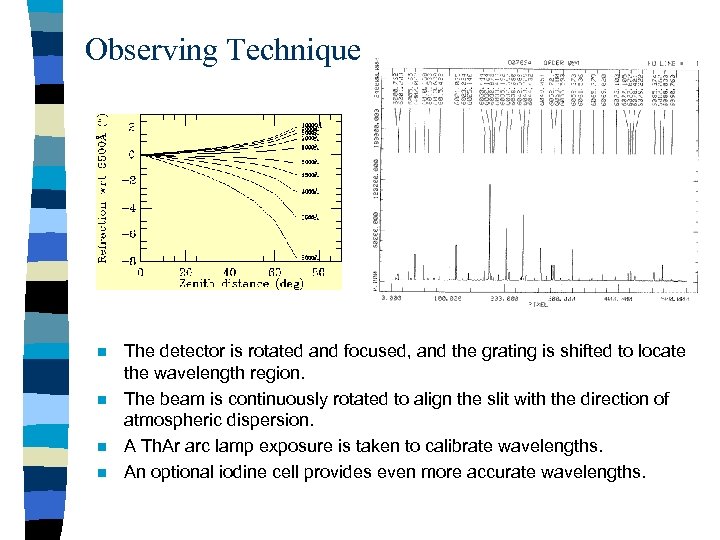 Observing Technique n n The detector is rotated and focused, and the grating is shifted to locate the wavelength region. The beam is continuously rotated to align the slit with the direction of atmospheric dispersion. A Th. Ar arc lamp exposure is taken to calibrate wavelengths. An optional iodine cell provides even more accurate wavelengths.
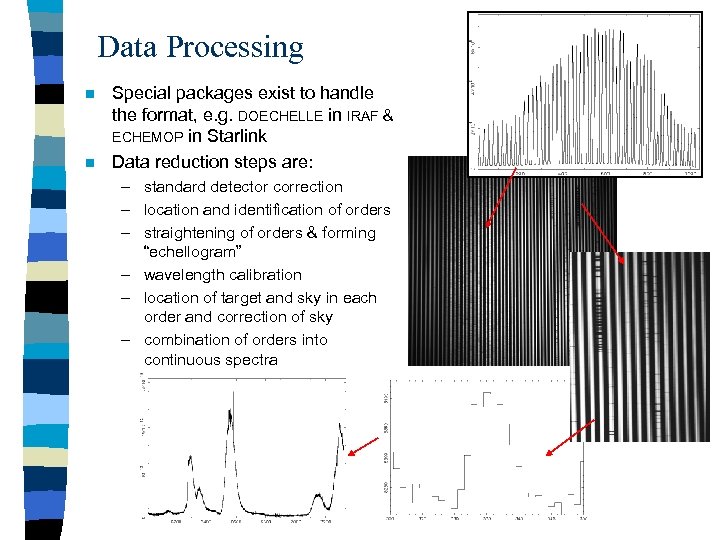 Data Processing n n Special packages exist to handle the format, e. g. DOECHELLE in IRAF & ECHEMOP in Starlink Data reduction steps are: – standard detector correction – location and identification of orders – straightening of orders & forming “echellogram” – wavelength calibration – location of target and sky in each order and correction of sky – combination of orders into continuous spectra
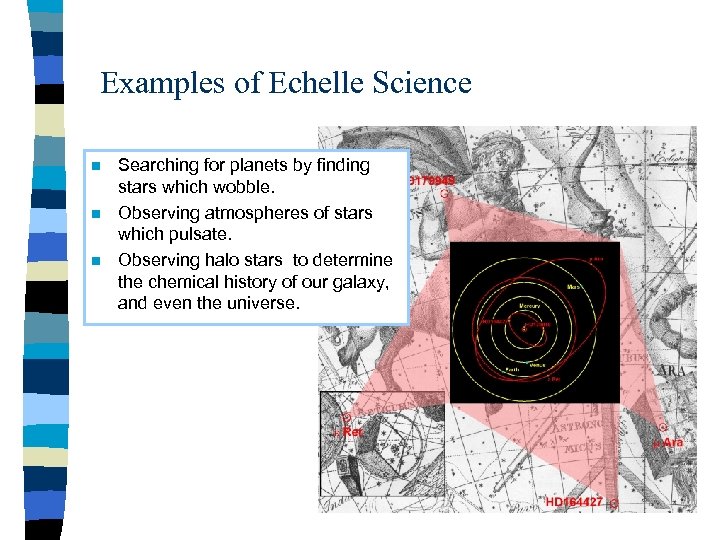 Examples of Echelle Science n n n Searching for planets by finding stars which wobble. Observing atmospheres of stars which pulsate. Observing halo stars to determine the chemical history of our galaxy, and even the universe.
 Other Echelle Techniques n UHRF - provides single order observations at up to R = 940, 000. – UHRF is ideal for studying cool clouds in the ISM. – Other projects include atmospheric lines from Mercury and isotopes in stars. n n The Semel polarimeter is used with UCLES. The main project is Zeeman Doppler Mapping of the magnetic structure of stars. The Manchester Echelle provides single order observations over a large area, and is ideal for ISM emission line studies.
 Useful sites and references Useful technical information can be obtained at the AAO web site: – http: //www. aao. gov. au/astro/instrum. html under UCLES and UHRF. See the on-line manual, the S/N calculator and on-line Th. Ar arc atlas. Further reading includes: – “Astronomical Optics” by Daniel Schoeder, 1987, Academic Press Inc. (General) – Walker, D. D. & Diego, F. 1985, MNRAS, 217, 355 -365 (UCLES) – Barlow, M. J. et al. , 1995, MNRAS, 272, 333 -345 (UHRF) – Diego, F. , et al. 1995, MNRAS, 272, 323 -332 (UHRF) – Diego, F. & Walker, D. D. 1985, MNRAS, 217, 347 (UCLES & UHRF)