 Скачать презентацию ECGR-6185 Advanced Embedded Systems ZIGBEE 802 15 4
fff7b27a11f8efbaccb5f87c19f04686.ppt
- Количество слайдов: 44



ECGR-6185 Advanced Embedded Systems ZIGBEE 802. 15. 4 University of North Carolina-Charlotte ØChaitanya Misal ØVamsee Krishna Chaitanya Misal, Vamsee Krishna
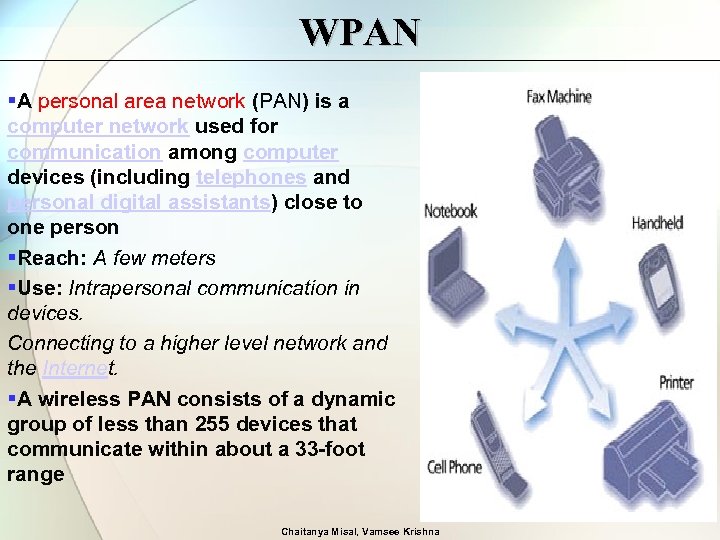
WPAN §A personal area network (PAN) is a computer network used for communication among computer devices (including telephones and personal digital assistants) close to one person §Reach: A few meters §Use: Intrapersonal communication in devices. Connecting to a higher level network and the Internet. §A wireless PAN consists of a dynamic group of less than 255 devices that communicate within about a 33 -foot range Chaitanya Misal, Vamsee Krishna
802. 15 § IEEE 802. 15 is the 15 th working group of the IEEE 802 § Specializes in Wireless PAN (Personal Area Network) § It includes four task groups (numbered from 1 to 4) Chaitanya Misal, Vamsee Krishna
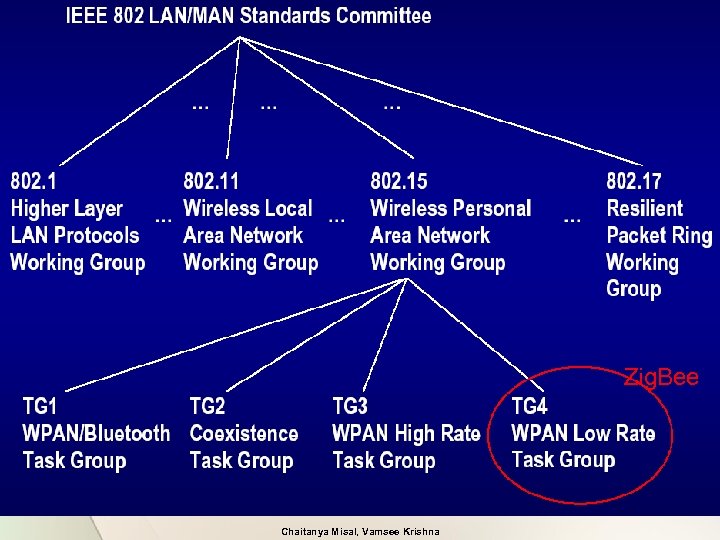
Zig. Bee Chaitanya Misal, Vamsee Krishna
• IEEE 802. 15. 4 - Standard released in May 2003 for LR-WPAN • Zigbee - set of high level communication protocols based upon the specification produced by 802. 15. 4 • The Zig. Bee Alliance is an association of companies working together to enable reliable, cost-effective, low-power, wirelessly networked, monitoring and control products based on an open global standard. Chaitanya Misal, Vamsee Krishna
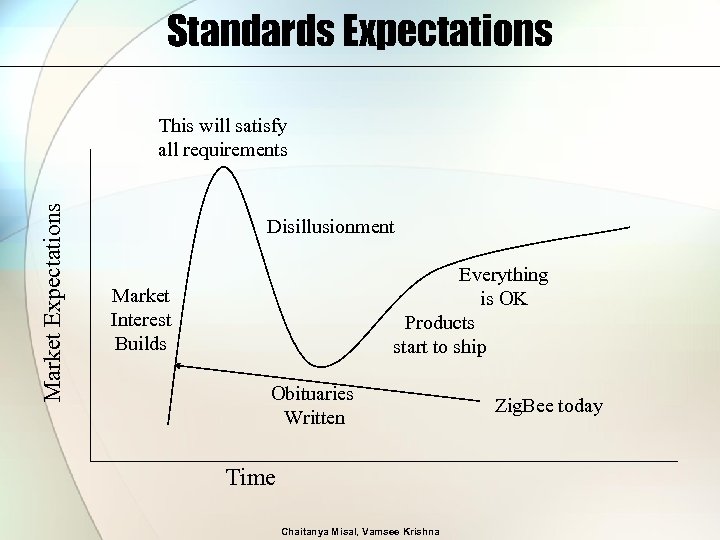
Standards Expectations Market Expectations This will satisfy all requirements Disillusionment Everything is OK Products start to ship Market Interest Builds Obituaries Written Time Chaitanya Misal, Vamsee Krishna Zig. Bee today
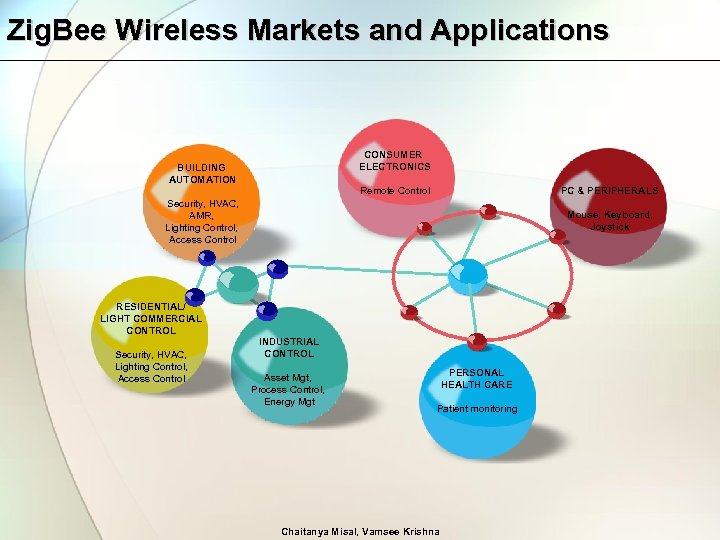
Zig. Bee Wireless Markets and Applications CONSUMER ELECTRONICS BUILDING AUTOMATION Remote Control PC & PERIPHERALS Security, HVAC, AMR, Lighting Control, Access Control Mouse, Keyboard, Joystick RESIDENTIAL/ LIGHT COMMERCIAL CONTROL Security, HVAC, Lighting Control, Access Control INDUSTRIAL CONTROL Asset Mgt, Process Control, Energy Mgt PERSONAL HEALTH CARE Patient monitoring Chaitanya Misal, Vamsee Krishna
Zig. Bee Network Chaitanya Misal, Vamsee Krishna
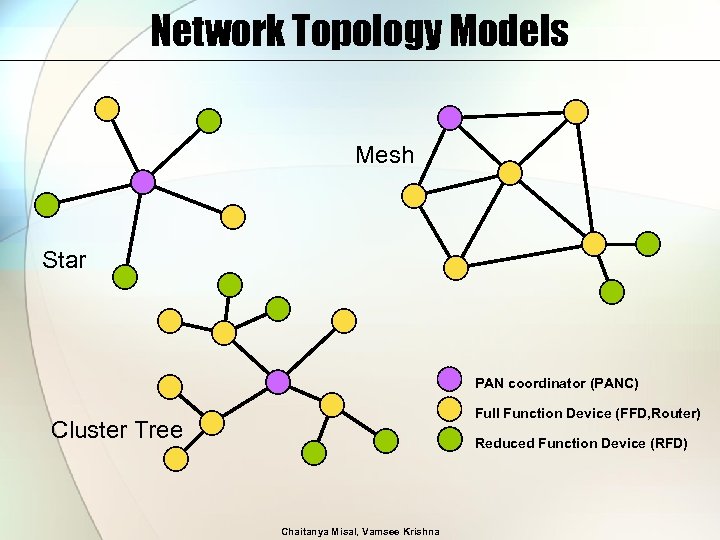
Network Topology Models Mesh Star PAN coordinator (PANC) Full Function Device (FFD, Router) Cluster Tree Reduced Function Device (RFD) Chaitanya Misal, Vamsee Krishna
Wireless networking Basics Network Scan Device scans the 16 channels to determine the best channel to occupy. Creating/Joining a PAN Device can create a network (coordinator) on a free channel or join an existing network Device Discovery Device queries the network to discover the identity of devices on active channels Service Discovery Device scans for supported services on devices within the network Binding Devices communicate via command/control messaging Chaitanya Misal, Vamsee Krishna
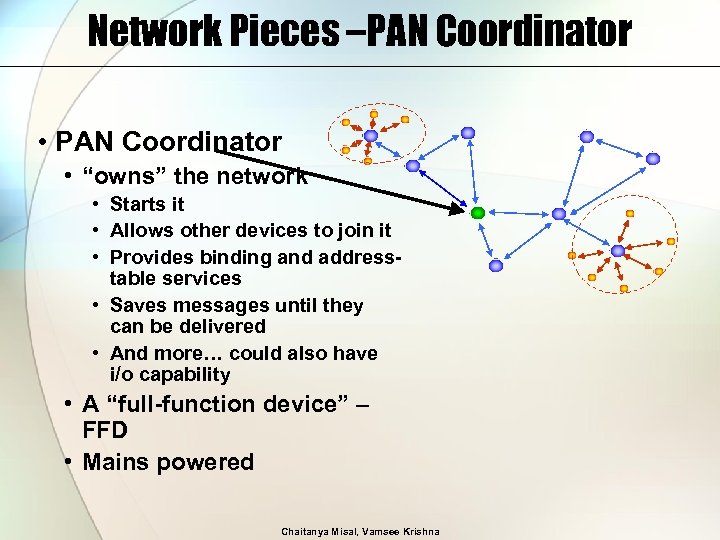
Network Pieces –PAN Coordinator • “owns” the network • Starts it • Allows other devices to join it • Provides binding and addresstable services • Saves messages until they can be delivered • And more… could also have i/o capability • A “full-function device” – FFD • Mains powered Chaitanya Misal, Vamsee Krishna
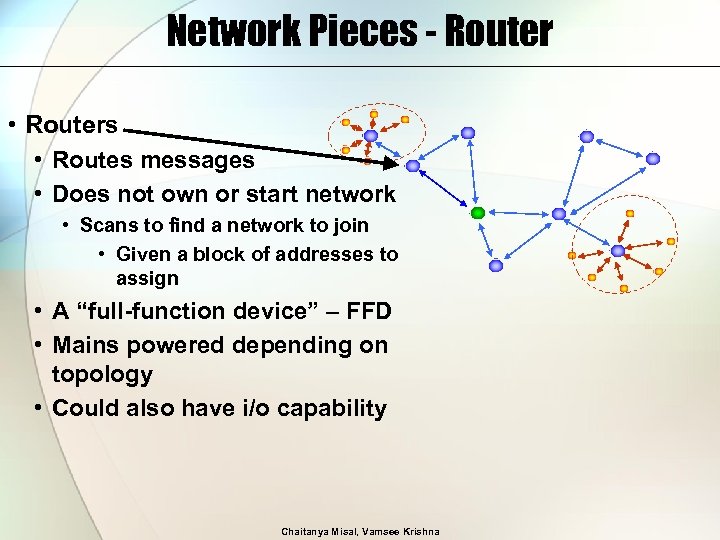
Network Pieces - Router • Routers • Routes messages • Does not own or start network • Scans to find a network to join • Given a block of addresses to assign • A “full-function device” – FFD • Mains powered depending on topology • Could also have i/o capability Chaitanya Misal, Vamsee Krishna
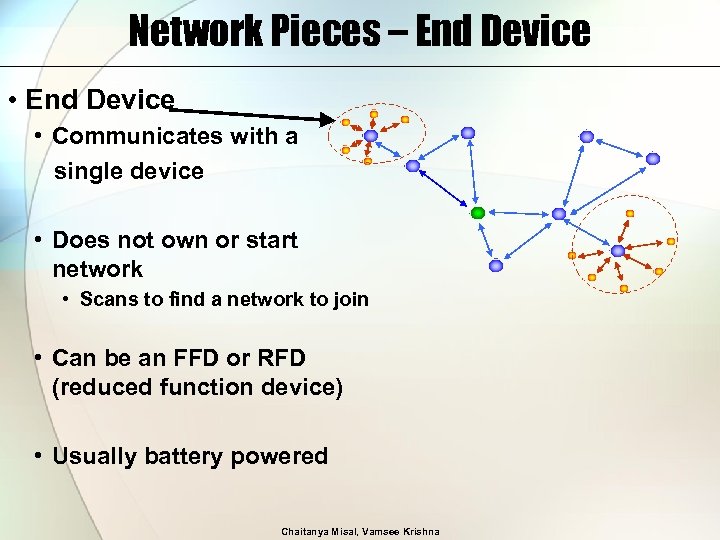
Network Pieces – End Device • Communicates with a single device • Does not own or start network • Scans to find a network to join • Can be an FFD or RFD (reduced function device) • Usually battery powered Chaitanya Misal, Vamsee Krishna
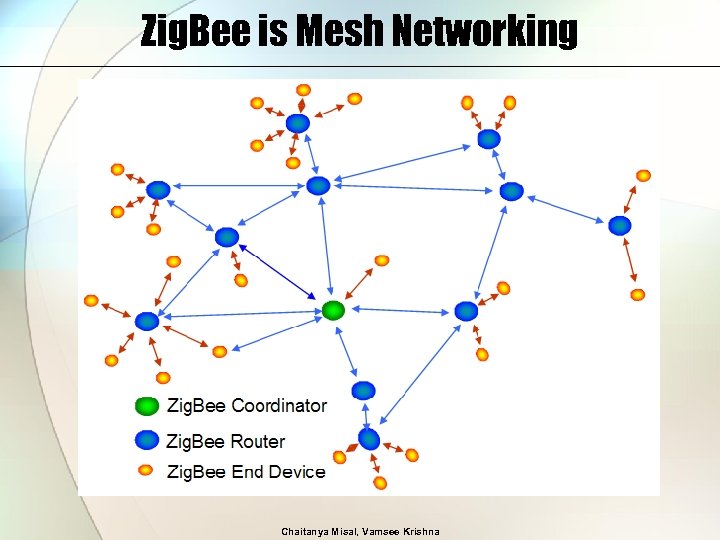
Zig. Bee is Mesh Networking Chaitanya Misal, Vamsee Krishna
Traffic types • Periodic data • Application defined rate (e. g. sensing temperature) • Intermittent data • Application/external stimulus defined rate (e. g. light switch) • Repetitive low latency data • Allocation of time slots (e. g. mouse) Chaitanya Misal, Vamsee Krishna
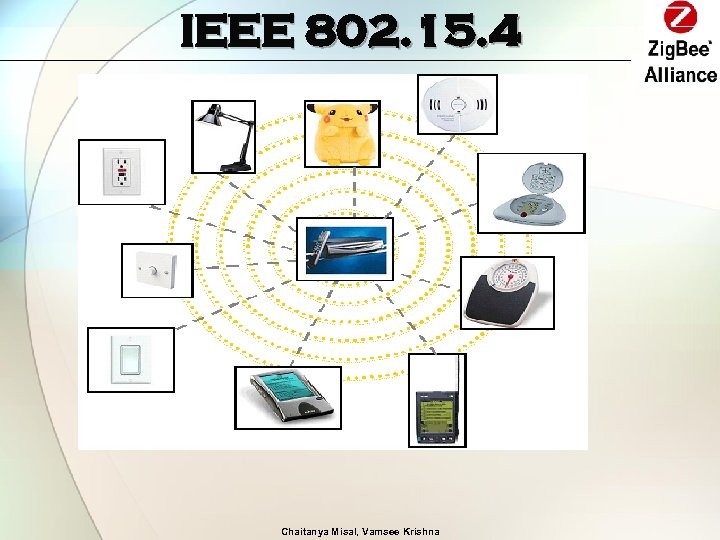
IEEE 802. 15. 4 Chaitanya Misal, Vamsee Krishna
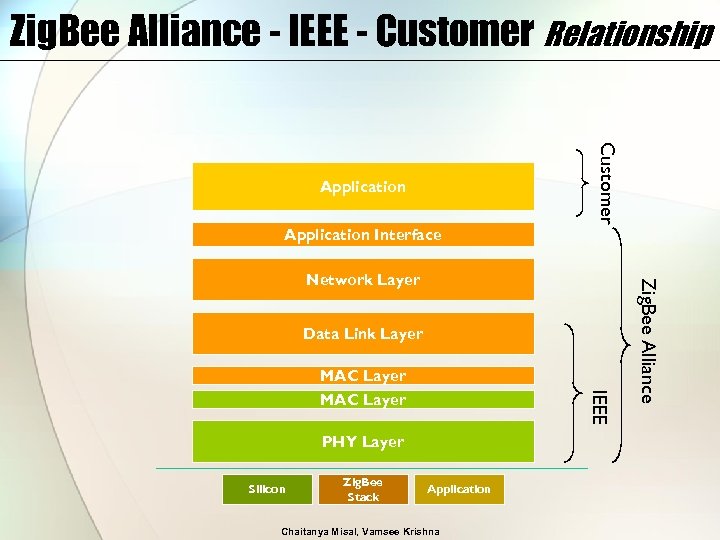
Zig. Bee Alliance - IEEE - Customer Relationship Customer Application Interface Data Link Layer IEEE MAC Layer PHY Layer Silicon Zig. Bee Stack Application Chaitanya Misal, Vamsee Krishna Zig. Bee Alliance Network Layer
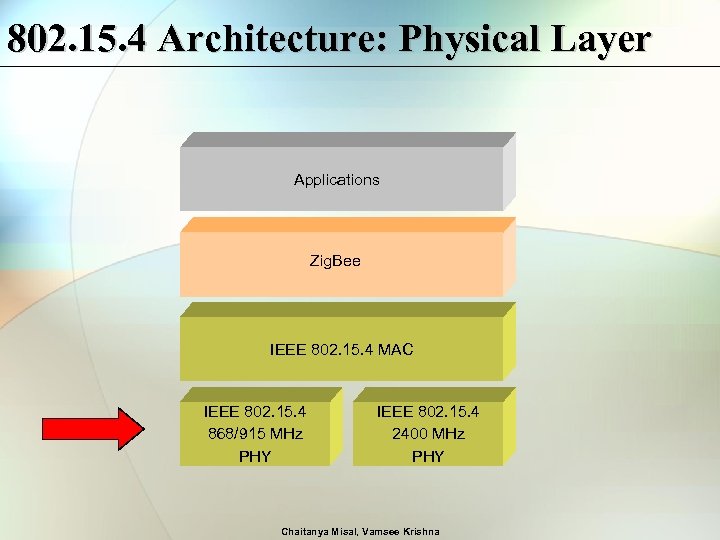
802. 15. 4 Architecture: Physical Layer Applications Zig. Bee IEEE 802. 15. 4 MAC IEEE 802. 15. 4 868/915 MHz PHY IEEE 802. 15. 4 2400 MHz PHY Chaitanya Misal, Vamsee Krishna
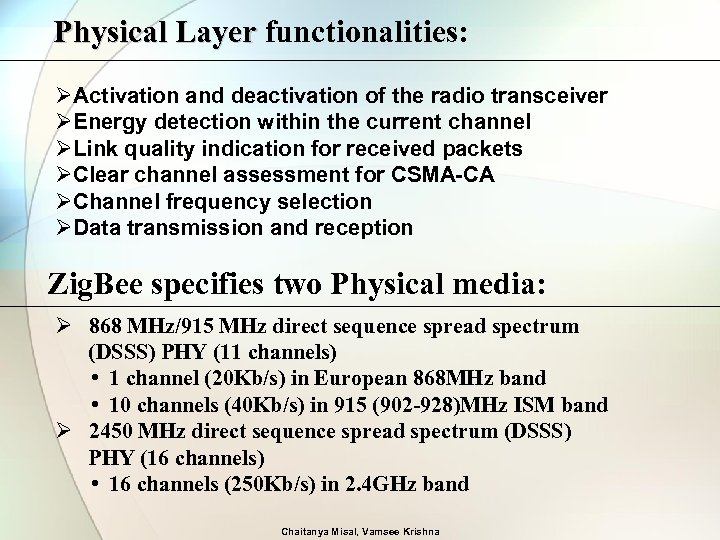
Physical Layer functionalities: ØActivation and deactivation of the radio transceiver ØEnergy detection within the current channel ØLink quality indication for received packets ØClear channel assessment for CSMA-CA ØChannel frequency selection ØData transmission and reception Zig. Bee specifies two Physical media: Ø 868 MHz/915 MHz direct sequence spread spectrum (DSSS) PHY (11 channels) • 1 channel (20 Kb/s) in European 868 MHz band • 10 channels (40 Kb/s) in 915 (902 -928)MHz ISM band Ø 2450 MHz direct sequence spread spectrum (DSSS) PHY (16 channels) • 16 channels (250 Kb/s) in 2. 4 GHz band Chaitanya Misal, Vamsee Krishna
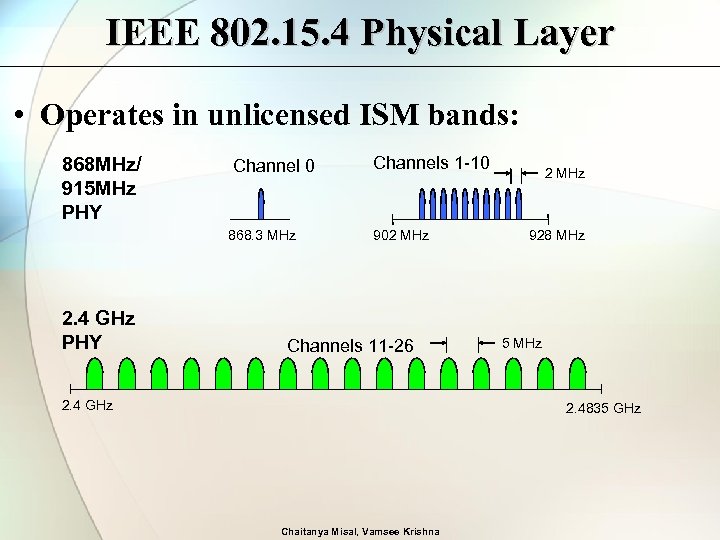
IEEE 802. 15. 4 Physical Layer • Operates in unlicensed ISM bands: 868 MHz/ 915 MHz PHY Channel 0 868. 3 MHz 2. 4 GHz PHY Channels 1 -10 902 MHz Channels 11 -26 2. 4 GHz 2 MHz 928 MHz 5 MHz 2. 4835 GHz Chaitanya Misal, Vamsee Krishna
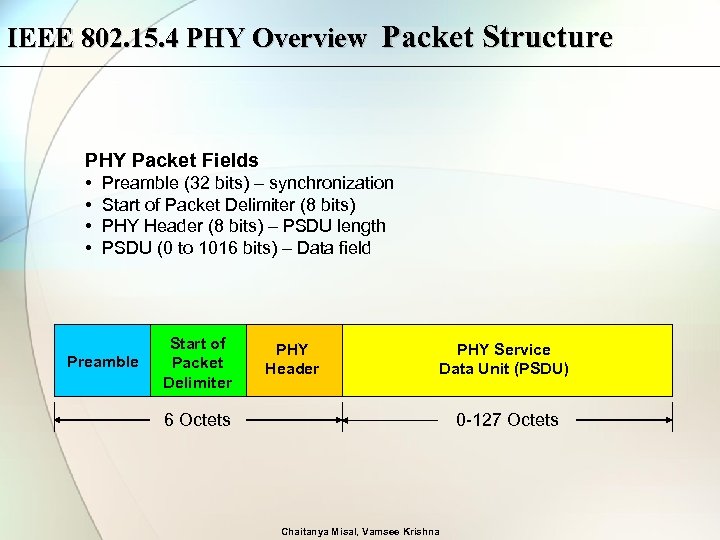
IEEE 802. 15. 4 PHY Overview Packet Structure PHY Packet Fields • • Preamble (32 bits) – synchronization Start of Packet Delimiter (8 bits) PHY Header (8 bits) – PSDU length PSDU (0 to 1016 bits) – Data field Preamble Start of Packet Delimiter PHY Header PHY Service Data Unit (PSDU) 6 Octets 0 -127 Octets Chaitanya Misal, Vamsee Krishna
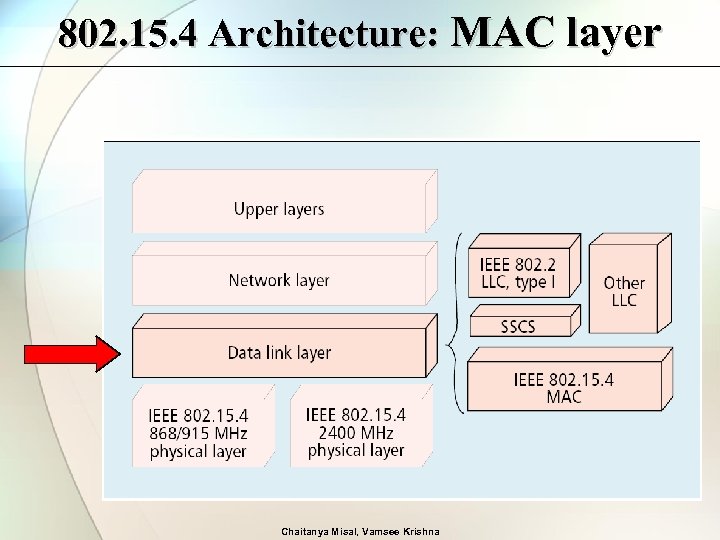
802. 15. 4 Architecture: MAC layer Chaitanya Misal, Vamsee Krishna
IEEE 802. 15. 4 MAC Overview Design Drivers Ø Extremely low cost Ø Ease of implementation Ø Reliable data transfer Ø Short range operation Ø Very low power consumption Simple but flexible protocol ! Chaitanya Misal, Vamsee Krishna
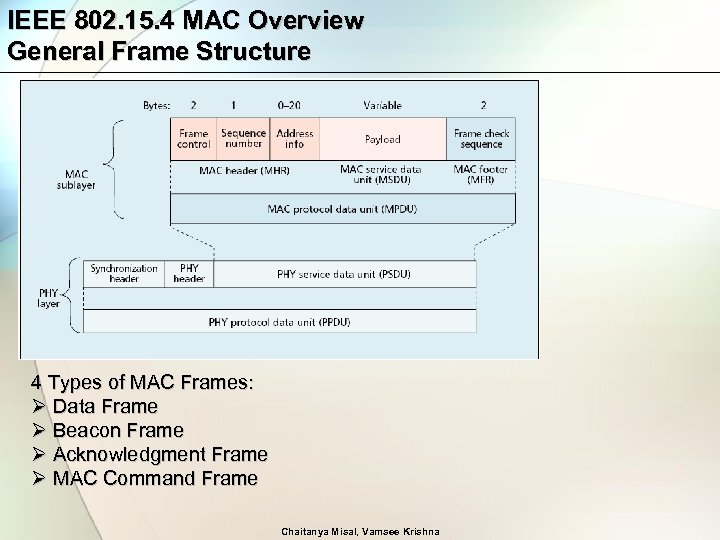
IEEE 802. 15. 4 MAC Overview General Frame Structure 4 Types of MAC Frames: Ø Data Frame Ø Beacon Frame Ø Acknowledgment Frame Ø MAC Command Frame Chaitanya Misal, Vamsee Krishna
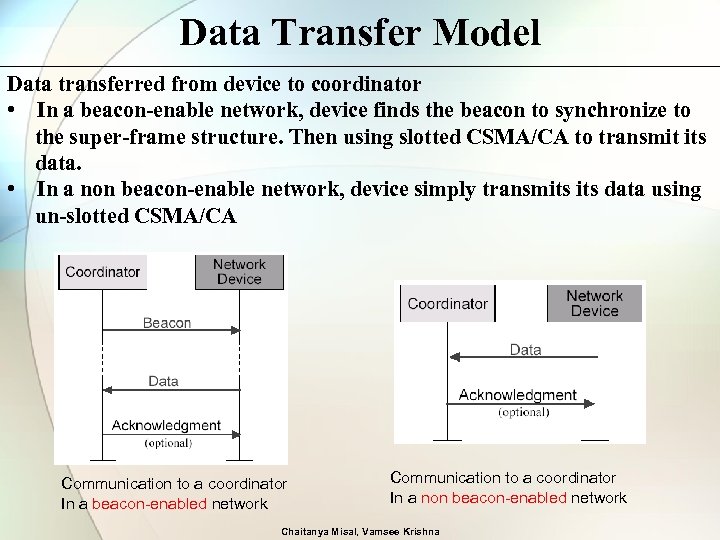
Data Transfer Model Data transferred from device to coordinator • In a beacon-enable network, device finds the beacon to synchronize to the super-frame structure. Then using slotted CSMA/CA to transmit its data. • In a non beacon-enable network, device simply transmits data using un-slotted CSMA/CA Communication to a coordinator In a beacon-enabled network Communication to a coordinator In a non beacon-enabled network Chaitanya Misal, Vamsee Krishna
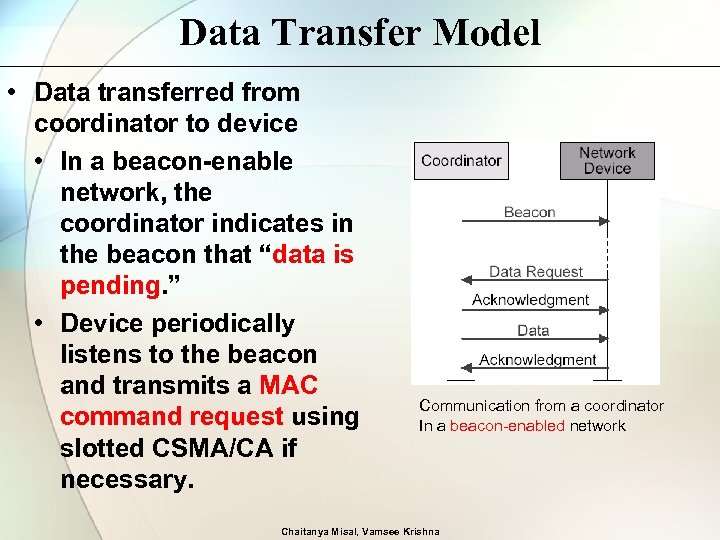
Data Transfer Model • Data transferred from coordinator to device • In a beacon-enable network, the coordinator indicates in the beacon that “data is pending. ” • Device periodically listens to the beacon and transmits a MAC command request using slotted CSMA/CA if necessary. Communication from a coordinator In a beacon-enabled network Chaitanya Misal, Vamsee Krishna
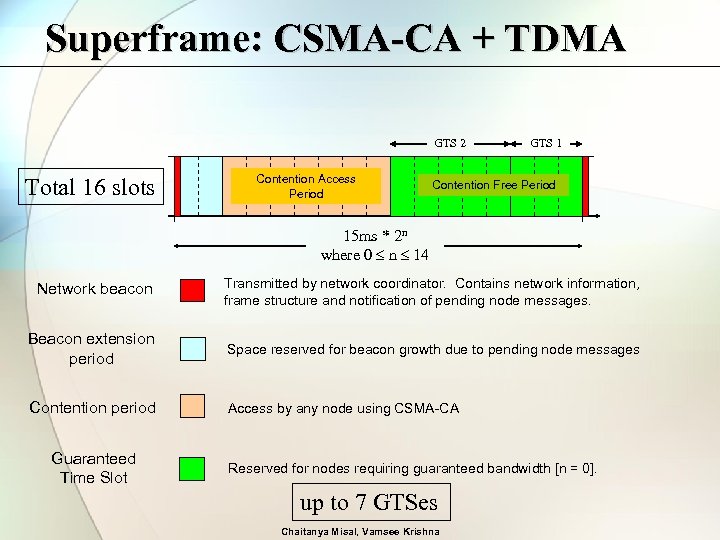
Superframe: CSMA-CA + TDMA GTS 2 Total 16 slots Contention Access Period GTS 1 Contention Free Period 15 ms * 2 n where 0 n 14 Network beacon Transmitted by network coordinator. Contains network information, frame structure and notification of pending node messages. Beacon extension period Space reserved for beacon growth due to pending node messages Contention period Access by any node using CSMA-CA Guaranteed Time Slot Reserved for nodes requiring guaranteed bandwidth [n = 0]. up to 7 GTSes Chaitanya Misal, Vamsee Krishna
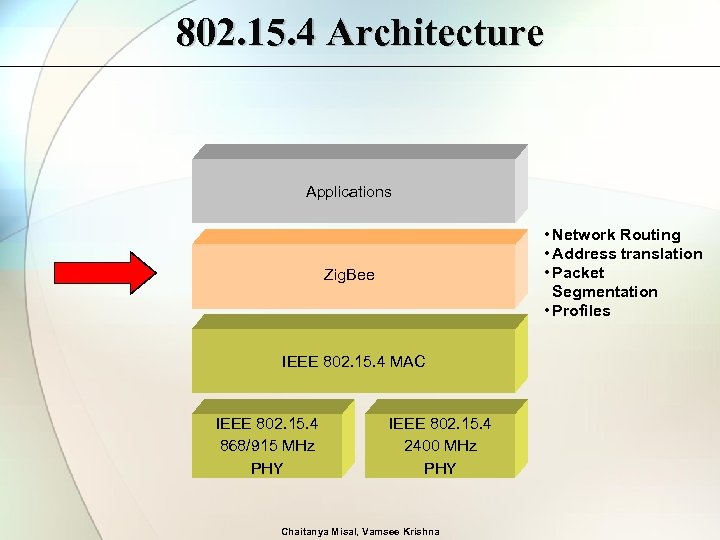
802. 15. 4 Architecture Applications • Network Routing • Address translation • Packet Segmentation • Profiles Zig. Bee IEEE 802. 15. 4 MAC IEEE 802. 15. 4 868/915 MHz PHY IEEE 802. 15. 4 2400 MHz PHY Chaitanya Misal, Vamsee Krishna
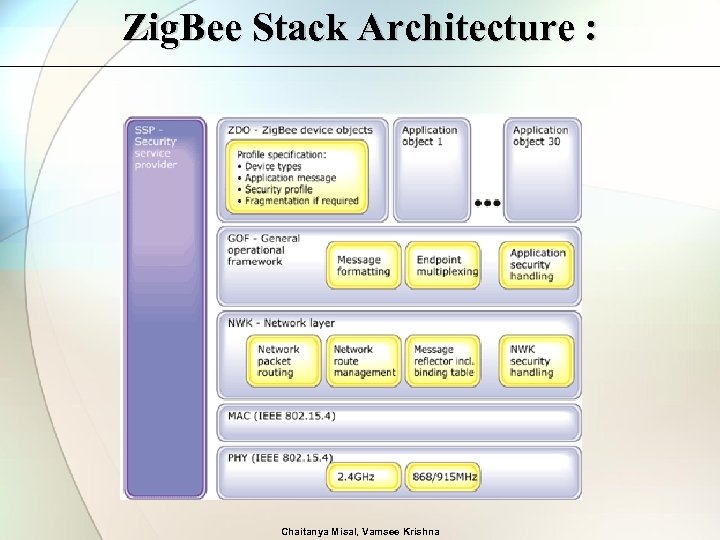
Zig. Bee Stack Architecture : Chaitanya Misal, Vamsee Krishna
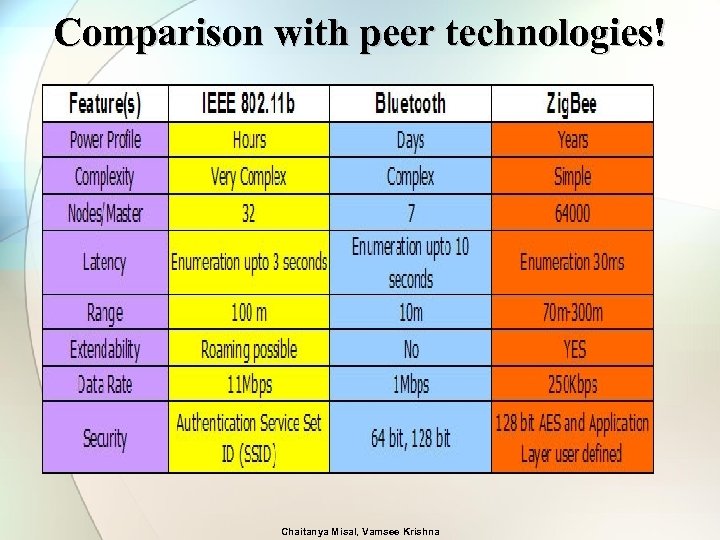
Comparison with peer technologies! Chaitanya Misal, Vamsee Krishna
Zig. Bee vs Bluetooth Competition or Complementary? Chaitanya Misal, Vamsee Krishna
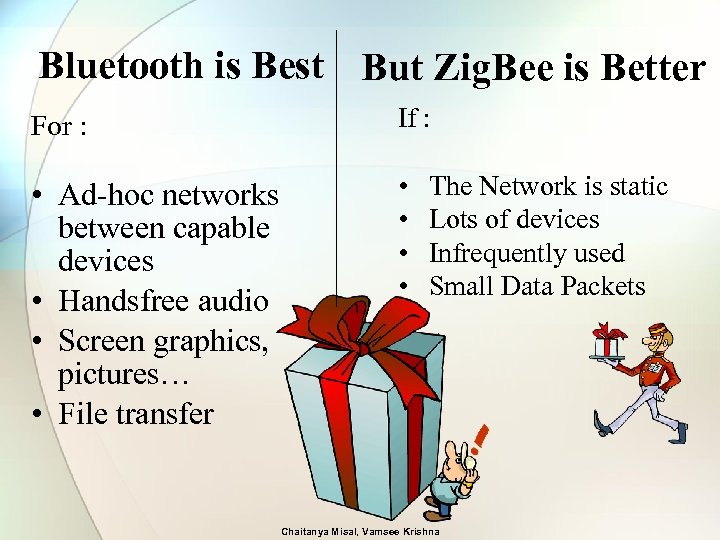
Bluetooth is Best But Zig. Bee is Better For : If : • Ad-hoc networks between capable devices • Handsfree audio • Screen graphics, pictures… • File transfer • • The Network is static Lots of devices Infrequently used Small Data Packets Chaitanya Misal, Vamsee Krishna
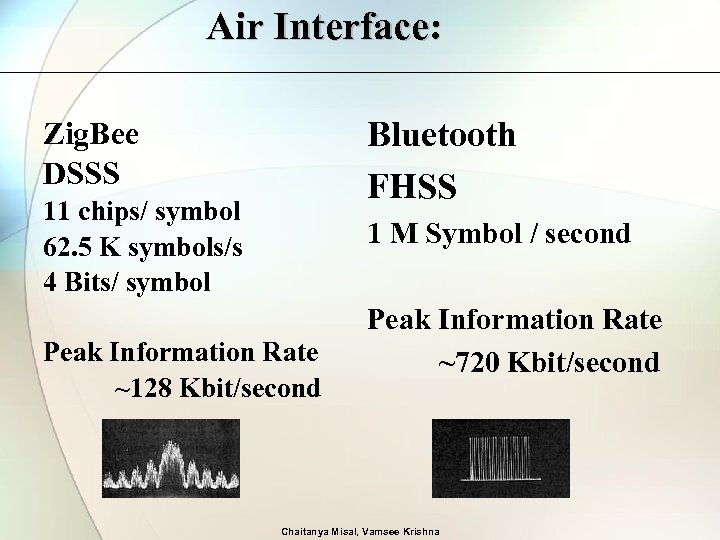
Air Interface: Bluetooth FHSS Zig. Bee DSSS 11 chips/ symbol 62. 5 K symbols/s 4 Bits/ symbol 1 M Symbol / second Peak Information Rate ~128 Kbit/second Peak Information Rate ~720 Kbit/second Chaitanya Misal, Vamsee Krishna
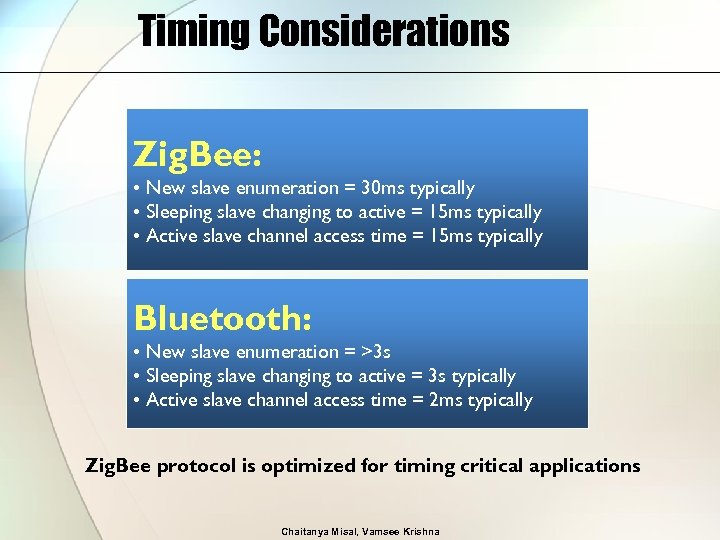
Timing Considerations Zig. Bee: • New slave enumeration = 30 ms typically • Sleeping slave changing to active = 15 ms typically • Active slave channel access time = 15 ms typically Bluetooth: • New slave enumeration = >3 s • Sleeping slave changing to active = 3 s typically • Active slave channel access time = 2 ms typically Zig. Bee protocol is optimized for timing critical applications Chaitanya Misal, Vamsee Krishna
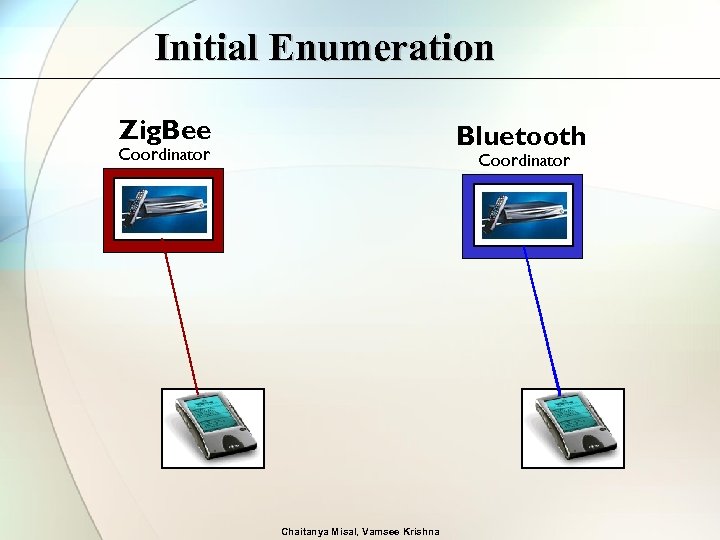
Initial Enumeration Zig. Bee Bluetooth Coordinator Chaitanya Misal, Vamsee Krishna
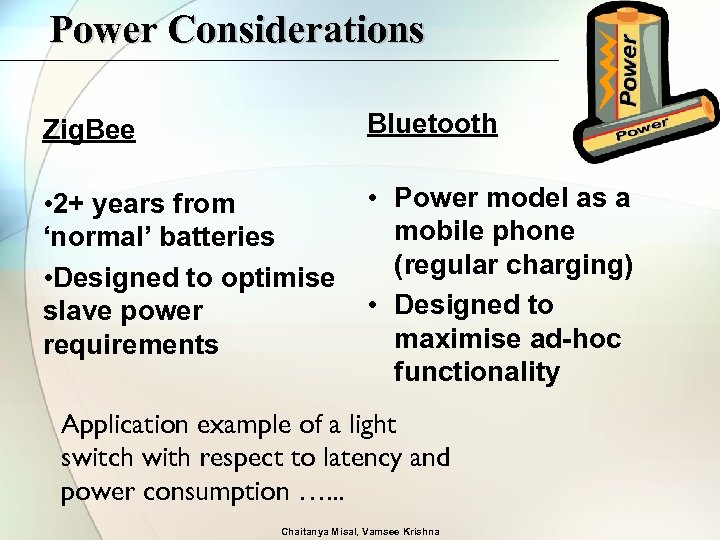
Power Considerations Zig. Bee Bluetooth • 2+ years from ‘normal’ batteries • Designed to optimise slave power requirements • Power model as a mobile phone (regular charging) • Designed to maximise ad-hoc functionality Application example of a light switch with respect to latency and power consumption …. . . Chaitanya Misal, Vamsee Krishna
Some Interesting Applications of Zig. Bee • Using the power of the mesh to automate a manual process Ø Rental Car Return Automation* • Long life battery powered sensing Ø Wireless Termite Detection* *From Software Technologies Group Chaitanya Misal, Vamsee Krishna
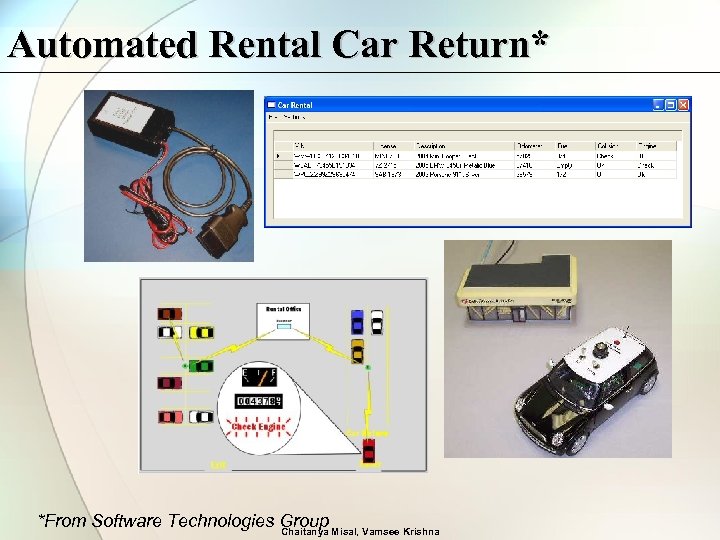
Automated Rental Car Return* *From Software Technologies Group Misal, Vamsee Krishna Chaitanya
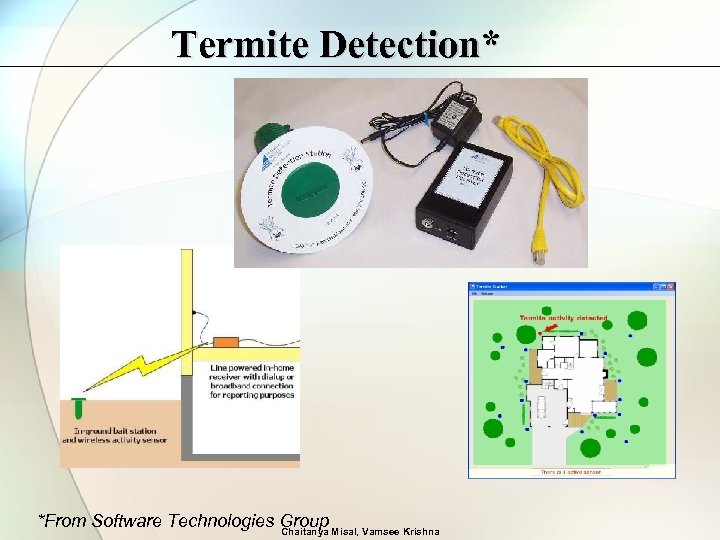
Termite Detection* *From Software Technologies Group Misal, Vamsee Krishna Chaitanya
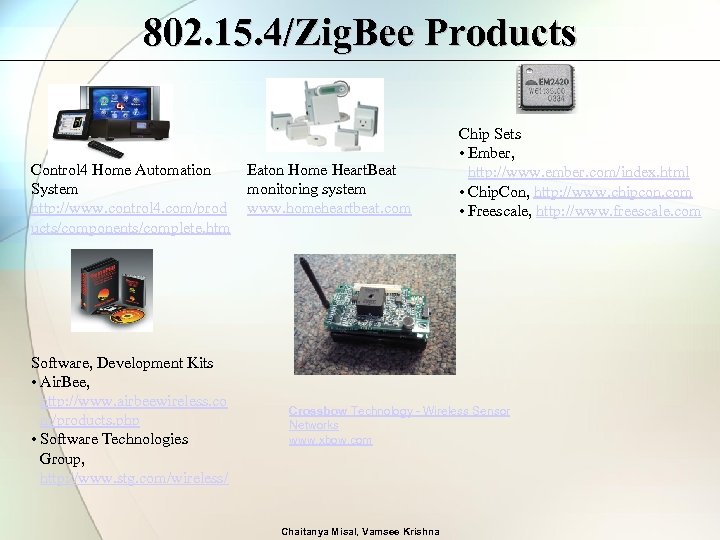
802. 15. 4/Zig. Bee Products Control 4 Home Automation System http: //www. control 4. com/prod ucts/components/complete. htm Software, Development Kits • Air. Bee, http: //www. airbeewireless. co m/products. php • Software Technologies Group, http: //www. stg. com/wireless/ Eaton Home Heart. Beat monitoring system www. homeheartbeat. com Chip Sets • Ember, http: //www. ember. com/index. html • Chip. Con, http: //www. chipcon. com • Freescale, http: //www. freescale. com Crossbow Technology - Wireless Sensor Networks www. xbow. com Chaitanya Misal, Vamsee Krishna
SUMMARY: • IEEE 802. 15. 4 and Zig. Bee • Allows Designer to concentrate on end application • Silicon vendors and Zig. Bee Alliance take care of transceiver, RF channel and protocol, Zig. Bee “look and feel” • Reliable and robust communications • PHY and MAC outperform all known non-standardsbased products currently available • Flexible network architectures • Very long primary battery life (months to years to decades) • Low system complexity. (Due to its architecture) Chaitanya Misal, Vamsee Krishna
References: q IEEE 2003 version of 802. 15. 4 MAC & Phy standard q http: //standards. ieee. org/getieee 802/download/8 02. 15. 4 -2003. pdf q Zig. Bee Specification q http: //www. zigbee. org/en/spec_download/downl oad_request. asp q 802. 15. 4 Tutorial q http: //grouper. ieee. org/groups/802/15/pub/2003/ Jan 03/03036 r 0 P 802 -15_WG-802 -15 -4 -TG 4 Tutorial. ppt q Zig. Bee Technology: Wireless Control that Simply Works q http: //www. hometoys. com/htinews/oct 03/article s/kinney/zigbee. htm q Home networking with Zigbee q http: //www. embedded. com//show. Article. jhtml? article. ID=18902431 q www. howstuffwork. com q http: //en. wikipedia. org/wiki/Zigbee Chaitanya Misal, Vamsee Krishna
Any Questions Shoot! Chaitanya Misal, Vamsee Krishna

Thank You Chaitanya Misal, Vamsee Krishna
Скачать презентацию ECGR-6185 Advanced Embedded Systems ZIGBEE 802 15 4
fff7b27a11f8efbaccb5f87c19f04686.ppt