


 Скачать презентацию ECG Case Studies Moosa Kalla Case 1
bbdae407499609ad8ab6321e3b35b9ed.ppt
- Количество слайдов: 54
 ECG Case Studies Moosa Kalla
 Case 1 • • 52 yr old man No Hx of IHD Known HPT on Rx Presents with acute onset chest Initial ECG normal Cardiac enzymes normal Admitted for observations
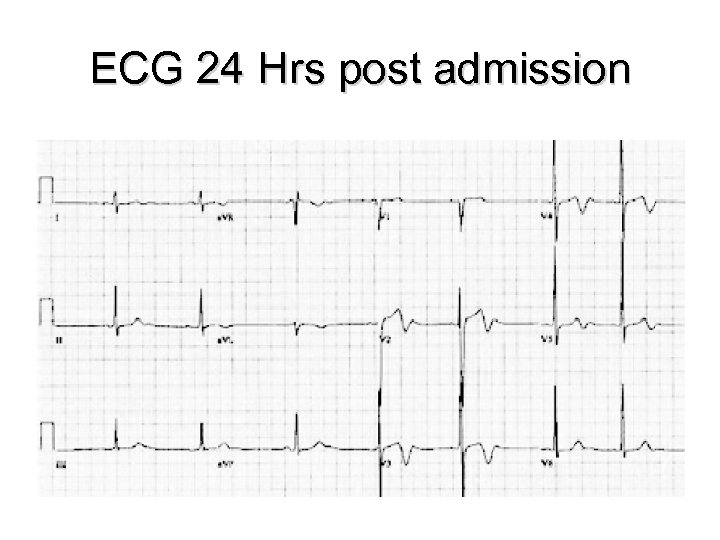 ECG 24 Hrs post admission
 ECG findings • • • Rate: 50 Rythym: sinus PRI: normal QRS: <0. 12 : Rwave progression normal ST seg: biphasic Twaves V 2 -V 5 slight STE V 1 No Q waves AVR normal
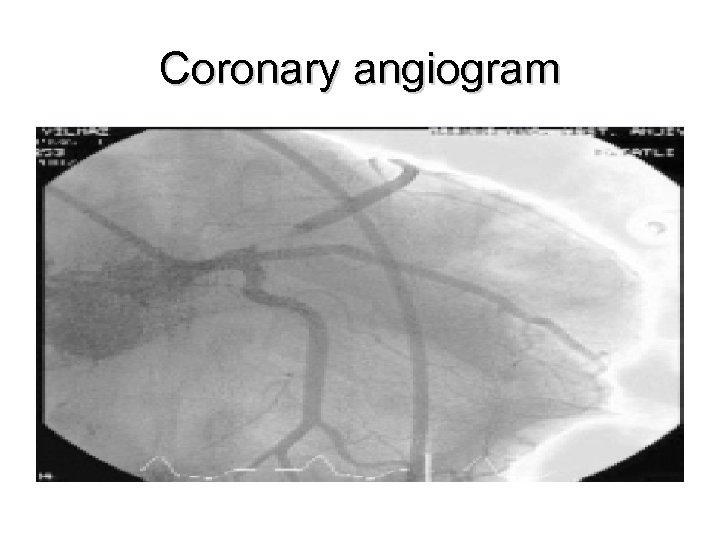 Coronary angiogram
 Management • Diagnosed with Wellen’s Syndrome • Coronary angiogram showed 95% stenosis of LAD • Percutaneous angioplasty and stinting performed • Patient discharged 3 days later
 Wellen’s Syndrome • 1982 Wellen’s et al first published ECG criteria for subgroup of pt. with AMI • Later came to be known as Wellen’s syndrome • Wellen’s syndrome is a pre-infarction stage of coronary artery disease • Recognition of this ECG pattern allows identification of pt with severe LAD disease and hence at risk of anterior wall MI
 Charecteristics of Wellen’s Sx • Charecterised by Bi-phasic or T wave inversion in precordial leads • Typically caused by critical stenosis in proximal LAD • The charecteristic ECG pattern often develops while pt is pain free • During chest pain ST-segemnet-T-wave abnormalities normalize or develop into ST -segment elevation
 Case 2 • 28 year old man c/o lightheadedness and shortness of breath, than collapses • On scene is PEA, • CPR instituted and intubated • Arrives in ED 15 min post collapse • ECG showed fine VF • Defib at 200 J and ECG redone at 2 min
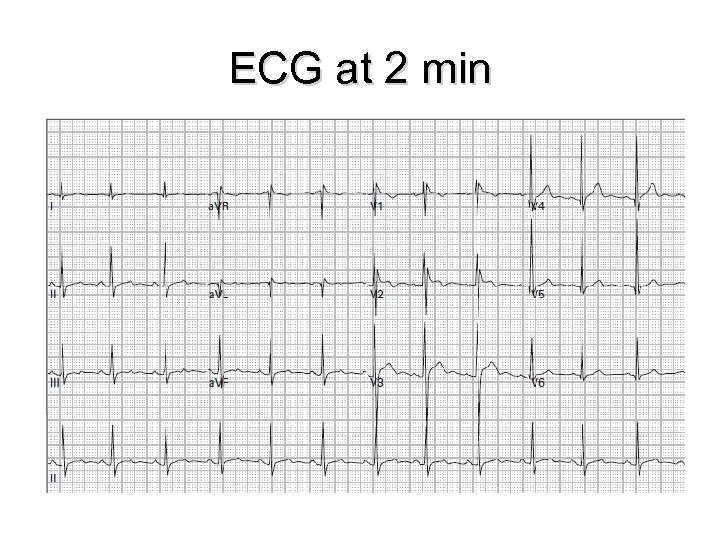 ECG at 2 min
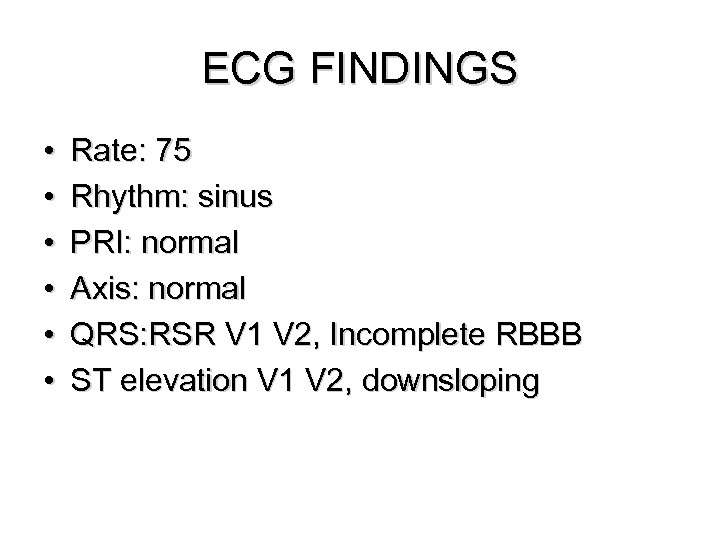 ECG FINDINGS • • • Rate: 75 Rhythm: sinus PRI: normal Axis: normal QRS: RSR V 1 V 2, Incomplete RBBB ST elevation V 1 V 2, downsloping
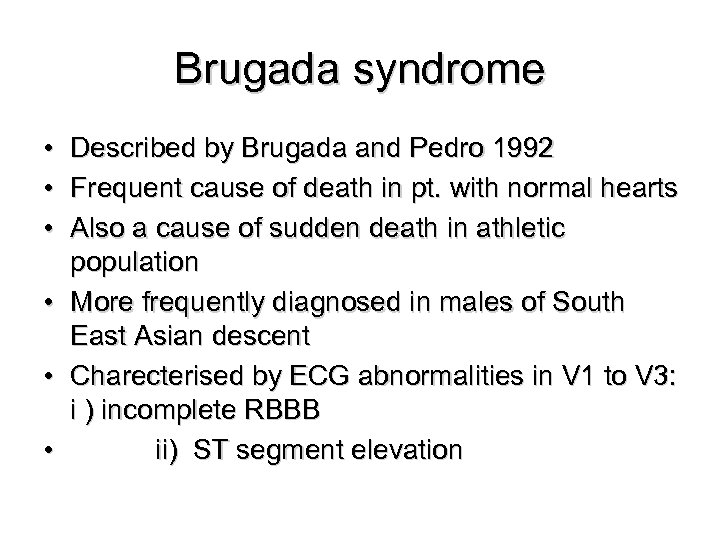 Brugada syndrome • Described by Brugada and Pedro 1992 • Frequent cause of death in pt. with normal hearts • Also a cause of sudden death in athletic population • More frequently diagnosed in males of South East Asian descent • Charecterised by ECG abnormalities in V 1 to V 3: i ) incomplete RBBB • ii) ST segment elevation
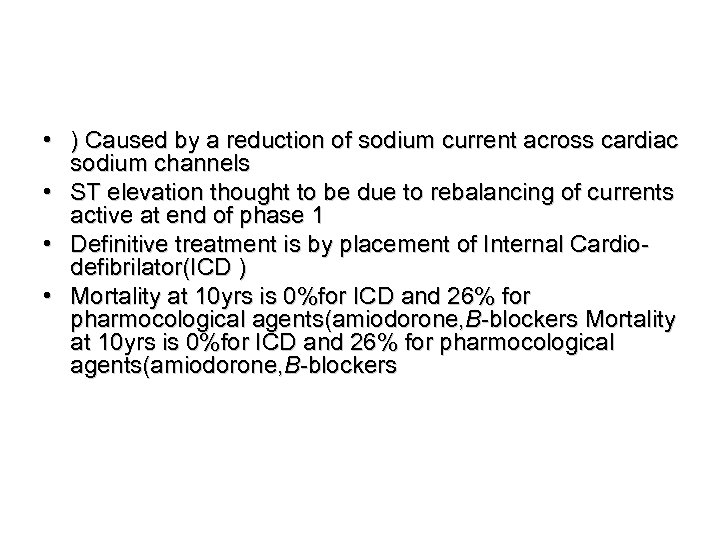 • ) Caused by a reduction of sodium current across cardiac sodium channels • ST elevation thought to be due to rebalancing of currents active at end of phase 1 • Definitive treatment is by placement of Internal Cardiodefibrilator(ICD ) • Mortality at 10 yrs is 0%for ICD and 26% for pharmocological agents(amiodorone, B-blockers
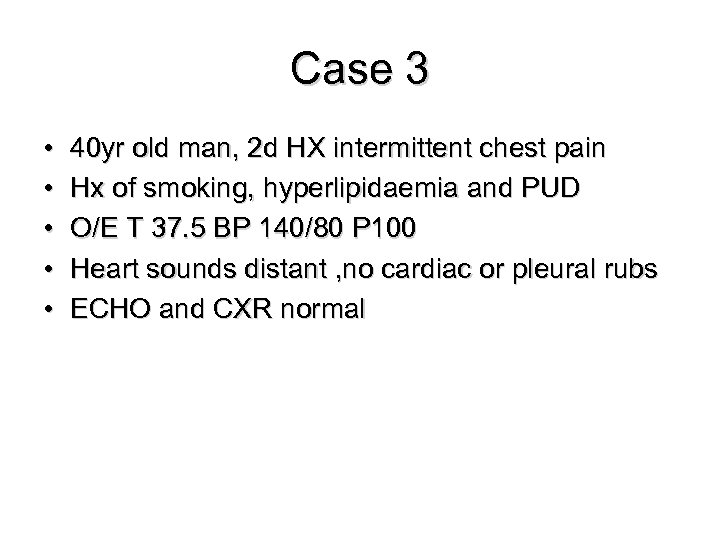 Case 3 • • • 40 yr old man, 2 d HX intermittent chest pain Hx of smoking, hyperlipidaemia and PUD O/E T 37. 5 BP 140/80 P 100 Heart sounds distant , no cardiac or pleural rubs ECHO and CXR normal
 ECG
ECG
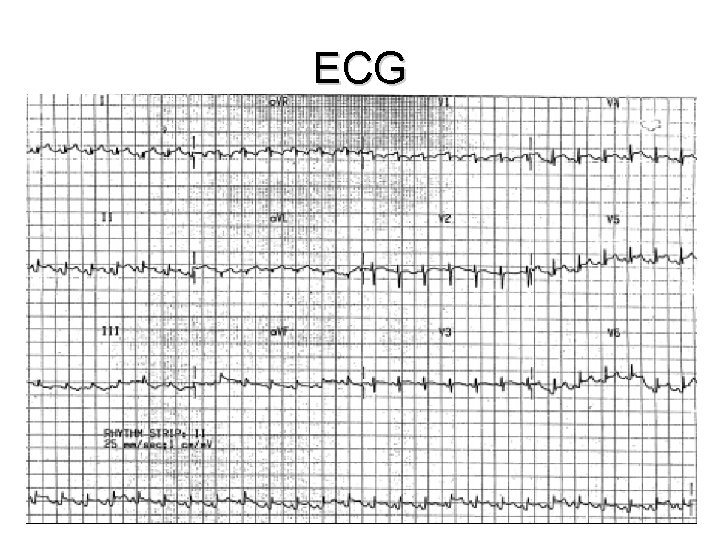
 ECG Findings • • • Rate: 140 Rythym: sinus PRI: normal PR seg: elevation a. VR, : depression ii V 5 V 6 Axis: normal QRS: <. 012 ST seg: concave STE I II III V 4 -V 6 No reciprical changes
 LAB findings • • Trop t negative WCC 12. 5 ESR 50 Urgent angiography showed healthy coronary arteries
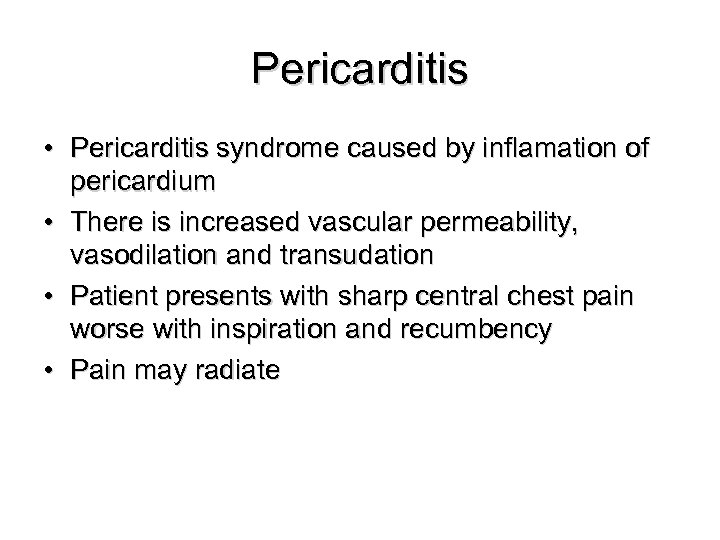 Pericarditis • Pericarditis syndrome caused by inflamation of pericardium • There is increased vascular permeability, vasodilation and transudation • Patient presents with sharp central chest pain worse with inspiration and recumbency • Pain may radiate
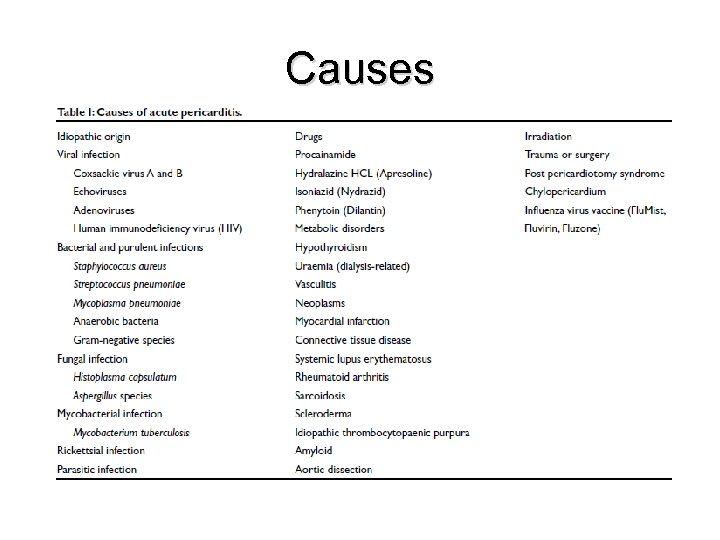 Causes
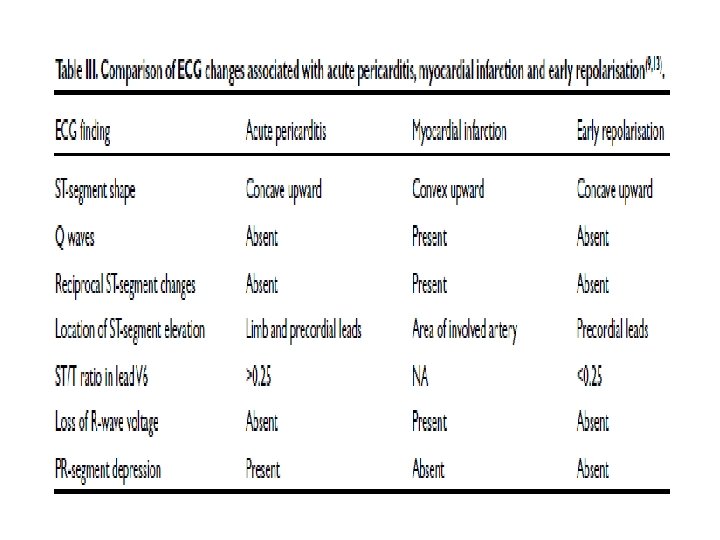
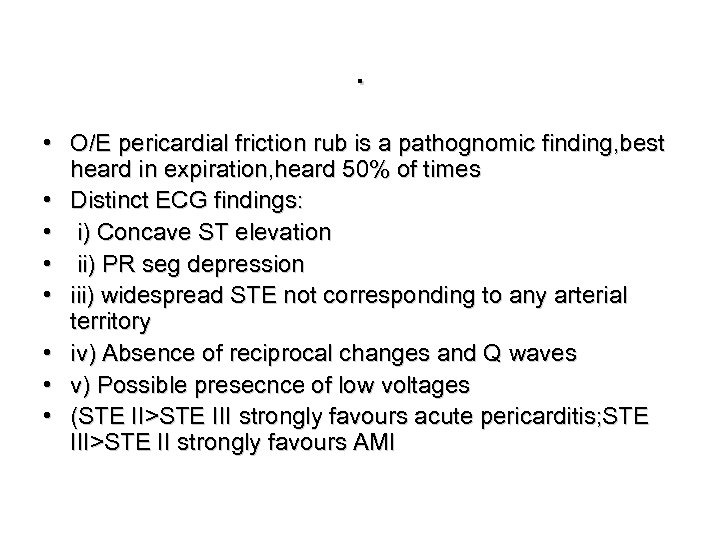 . • O/E pericardial friction rub is a pathognomic finding, best heard in expiration, heard 50% of times • Distinct ECG findings: • i) Concave ST elevation • ii) PR seg depression • iii) widespread STE not corresponding to any arterial territory • iv) Absence of reciprocal changes and Q waves • v) Possible presecnce of low voltages • (STE II>STE III strongly favours acute pericarditis; STE III>STE II strongly favours AMI
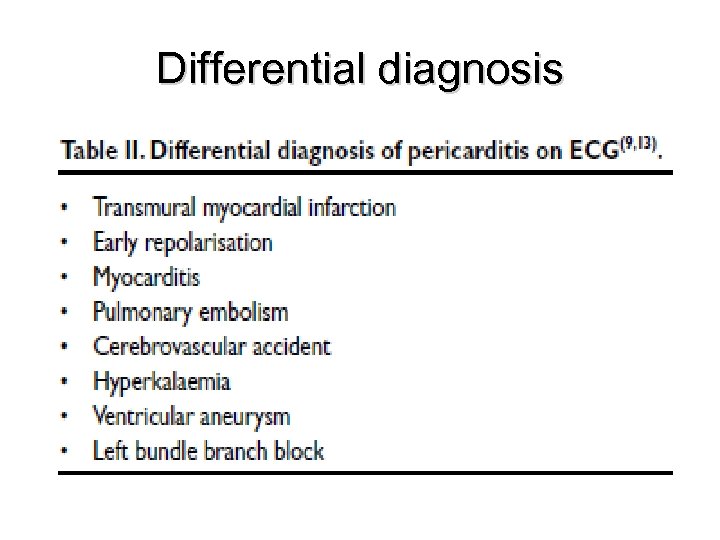 Differential diagnosis
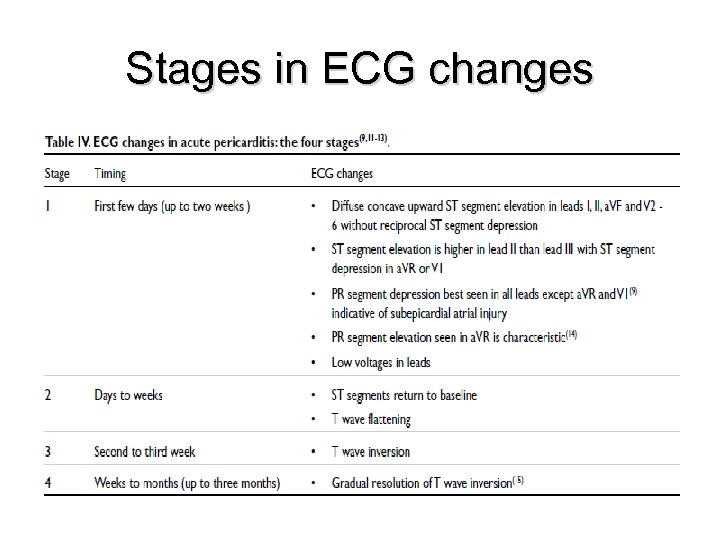 Stages in ECG changes
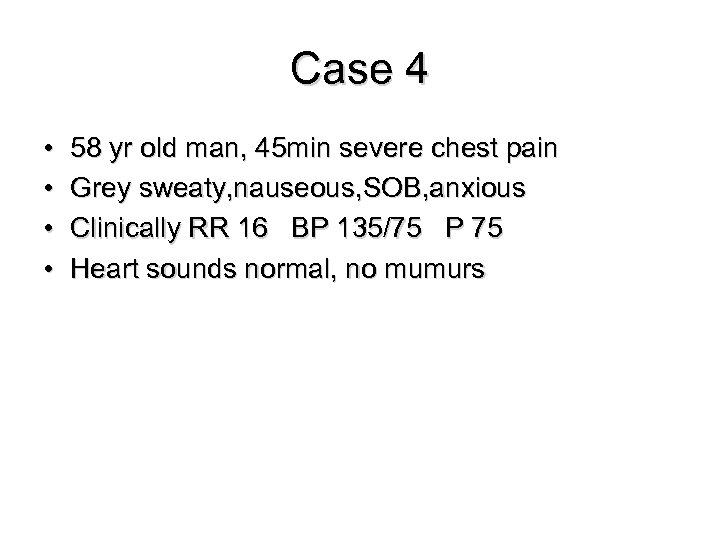 Case 4 • • 58 yr old man, 45 min severe chest pain Grey sweaty, nauseous, SOB, anxious Clinically RR 16 BP 135/75 P 75 Heart sounds normal, no mumurs
 ECG
ECG
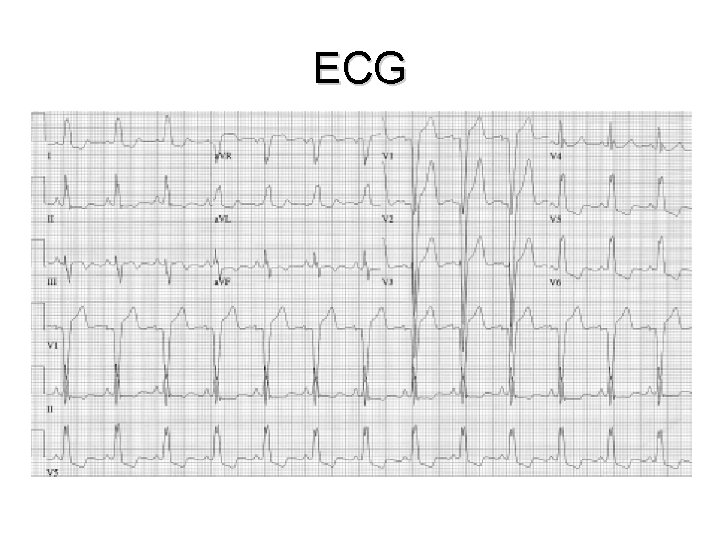
 ECG • • • Rate: 80 Rythym: sinus PR: normal QRS: LBBB ST seg: global discordance : concordance V 4 1 mm
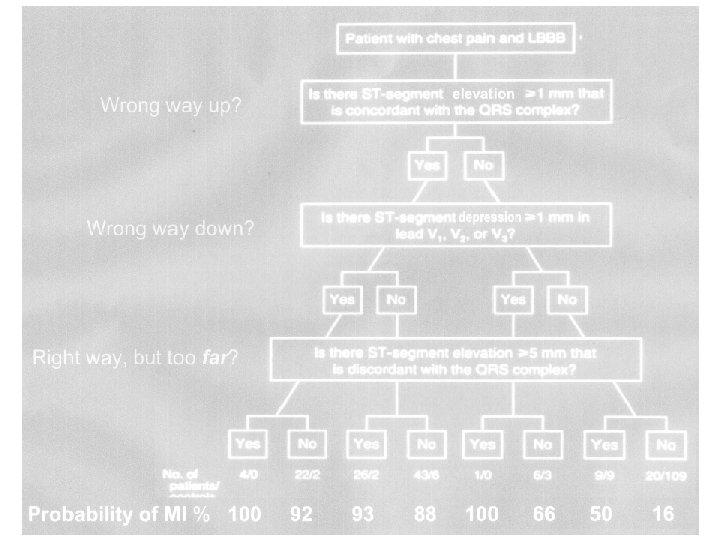
 Sgarbossa criteria • LBB on ECG may mask changes of AMI • Can delay reognition of AMI and thrombolysis • Sgarbossa et al tested criteria for AMI in presence of LBBB • Data used from patients enrolled on GUSTO-1 trial • These patients had AMI confirmed by enzyme studies
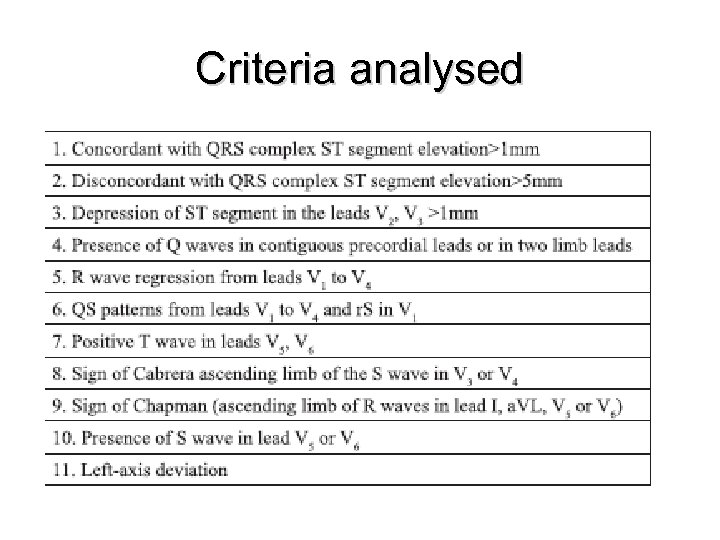 Criteria analysed
 Findings • ST segment deviations only ECG findings useful in diagnosisng acute myocardal infarction in the presence of LBBB
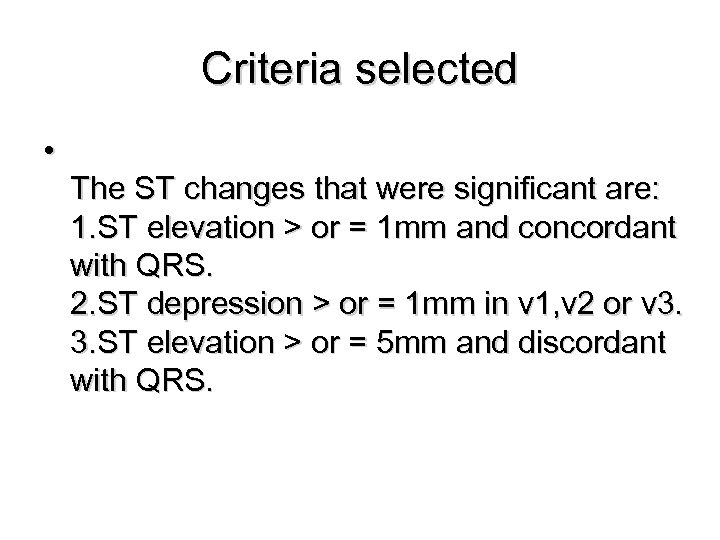 Criteria selected • The ST changes that were significant are: 1. ST elevation > or = 1 mm and concordant with QRS. 2. ST depression > or = 1 mm in v 1, v 2 or v 3. 3. ST elevation > or = 5 mm and discordant with QRS.
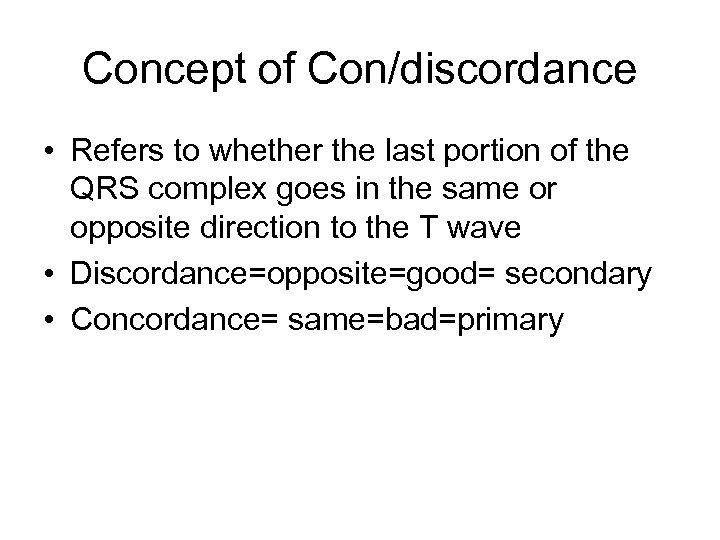 Concept of Con/discordance • Refers to whether the last portion of the QRS complex goes in the same or opposite direction to the T wave • Discordance=opposite=good= secondary • Concordance= same=bad=primary
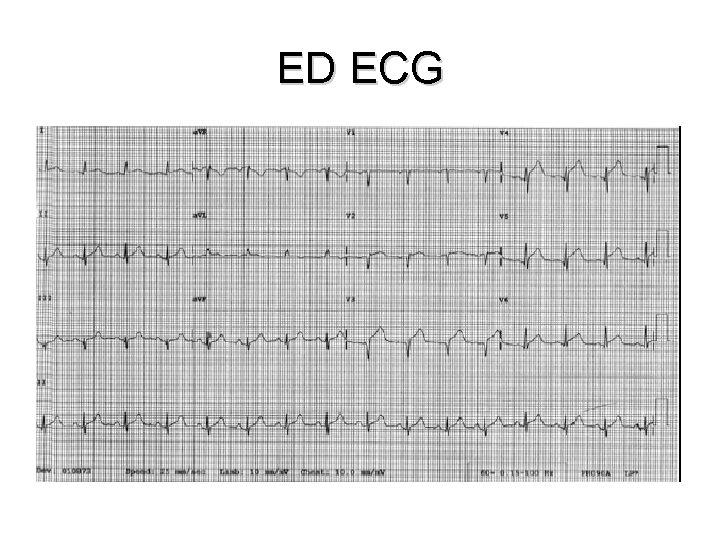
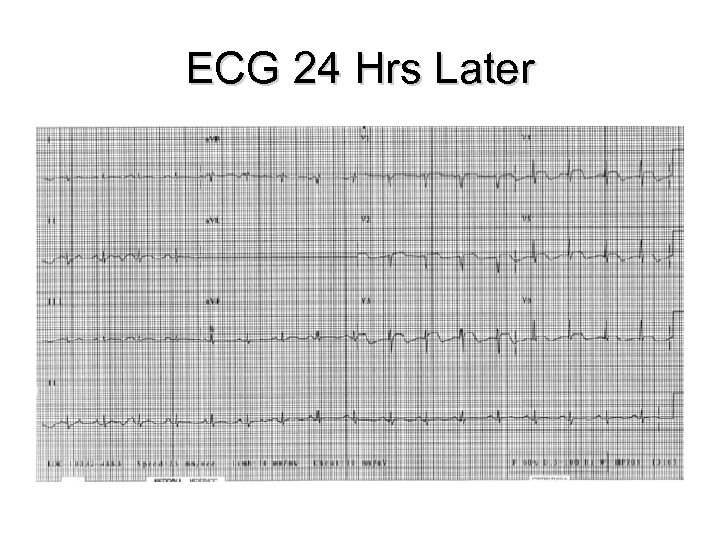
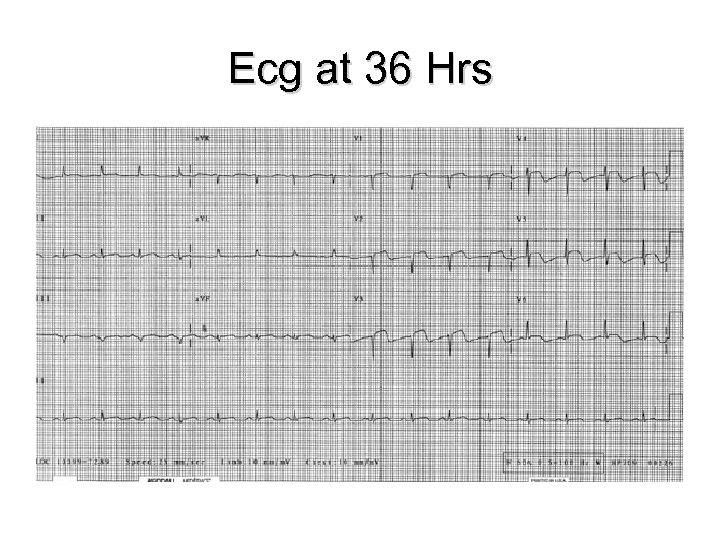
 ECG 5 • • Elderly lady, far-east origin New onset chest pain Nausea and diaphoresis Recent severe social stressors
 ED ECG
 Hospital course • Emergency cardiac catherisatrion… no obstructive coronary artery disease • Patient had haemodynamic profile of cardiogenic shock: • intra-aortic balloon pump • started on vasopressor support
 ECG 24 Hrs Later
 ECHO findings at 24 hours • Moderate to severe systolic dysfunction of LV which is segmental • Only proximal segment of IV septum and anterolateral wall contracting normally • Ballooning of distal ventricle • EF estimated at 20% • Consistent findings of Taka-Tsubo syndrome • Moderate mitral regurgitation
 Ecg at 36 Hrs
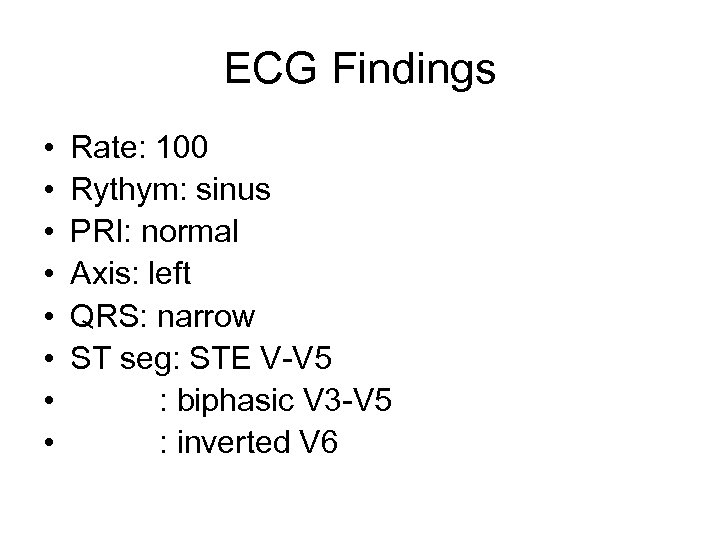 ECG Findings • • Rate: 100 Rythym: sinus PRI: normal Axis: left QRS: narrow ST seg: STE V-V 5 : biphasic V 3 -V 5 : inverted V 6
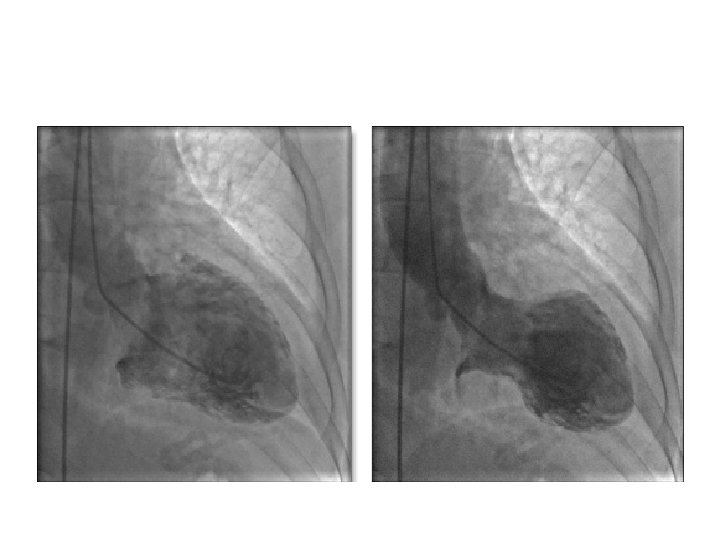
 Tokatsubo Cardiomyopathy • Acute stress cardiomyopathy, described as form of Reversible Left Ventricular Systolic Dysfunction in the absence of coronary artery disease • First described in Japan • Now global distribution • Also known as Broken Heart Syndrome (BHS) • Pathogenisis not well understood • More common in woman aged 62 -75
 Presentation • Typically triggered by emotional, physical or medical stressors • Commonly present with SOB • Shock • ECG changes of ischaemia
 Postulated mechanisms • i) cathecholamine-induced vent dysfunction(due to stress hormone release) • ii)multivessel coronary spasm • iii) dynamic left vent outflow tract obstruction
 Distinguishing from ACS • Features distinguishing SC from LAD territory infarction are: • i) Abnormal ST elevation/depression, t wave inversion, raerely Q waves • ii) cardiac biomarkers mildly elevated • iii) wall motion abnormal on ECHO-large area for single artery involvement • iv)Lack of delayed hyperenhancement on MRI with gadolinium
 Clinical course • Recovery of baseline Left ventricular function within 1 -4 weeks • Low mortality ranging from 0 -8% • Diagnosis is mainly by exclusion of ACS • NB suspicion of stress cardiomyopathy not sufficient reason to withold treatment for acute ACS…stress cardiomyopathy diagnosed by presence of all 4 criterai listed above
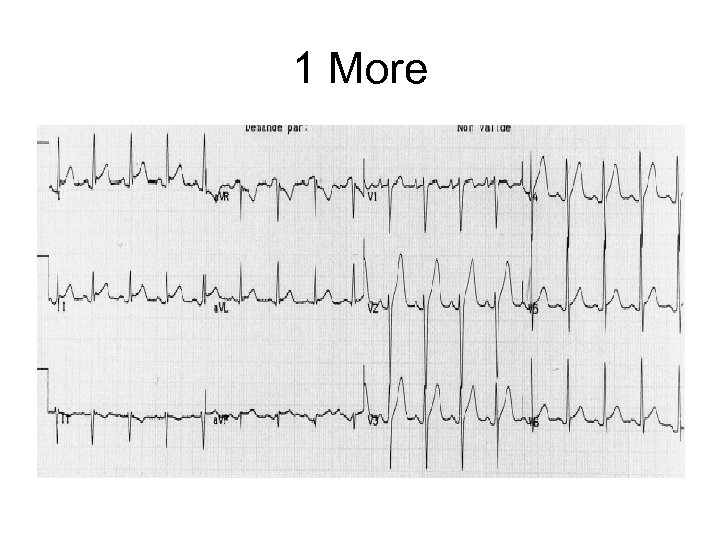
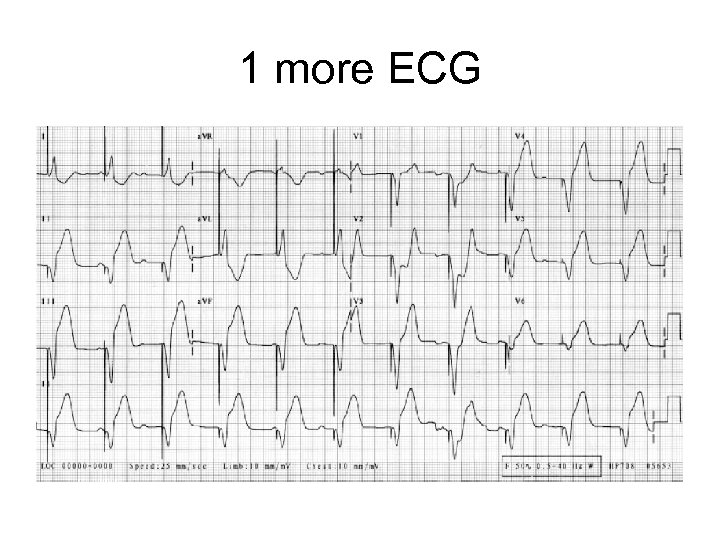 1 more ECG
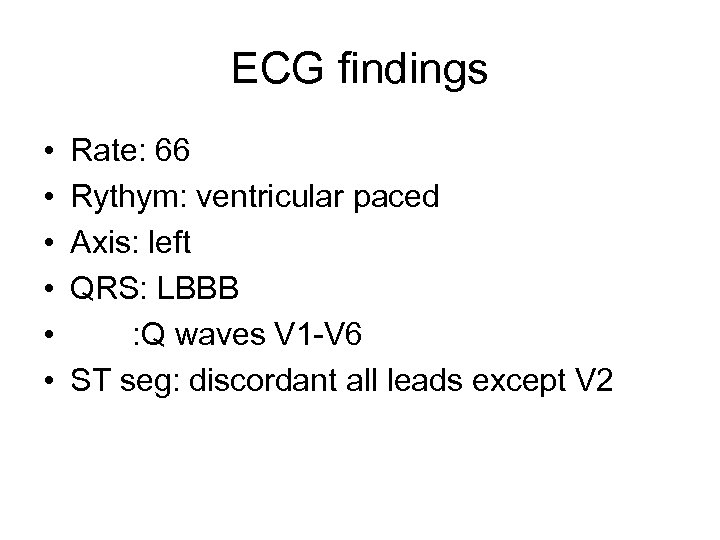 ECG findings • • • Rate: 66 Rythym: ventricular paced Axis: left QRS: LBBB : Q waves V 1 -V 6 ST seg: discordant all leads except V 2
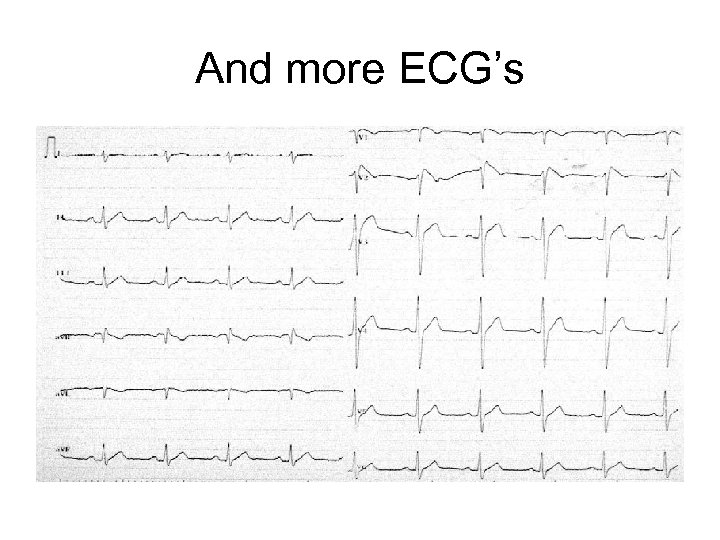
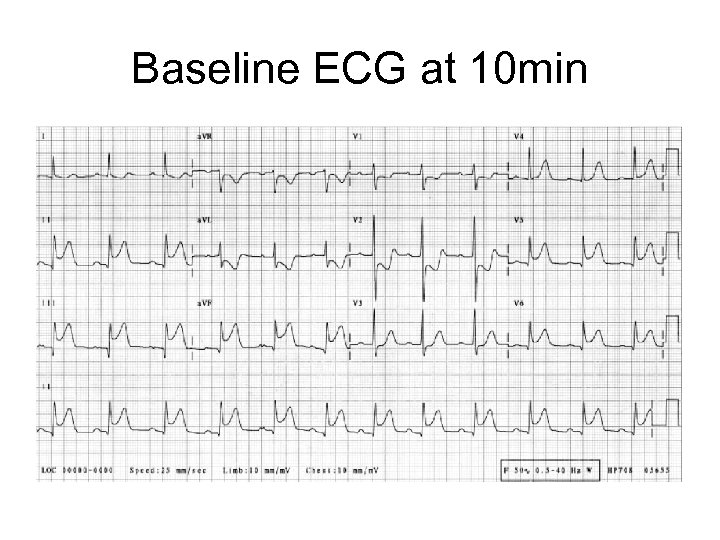 Baseline ECG at 10 min
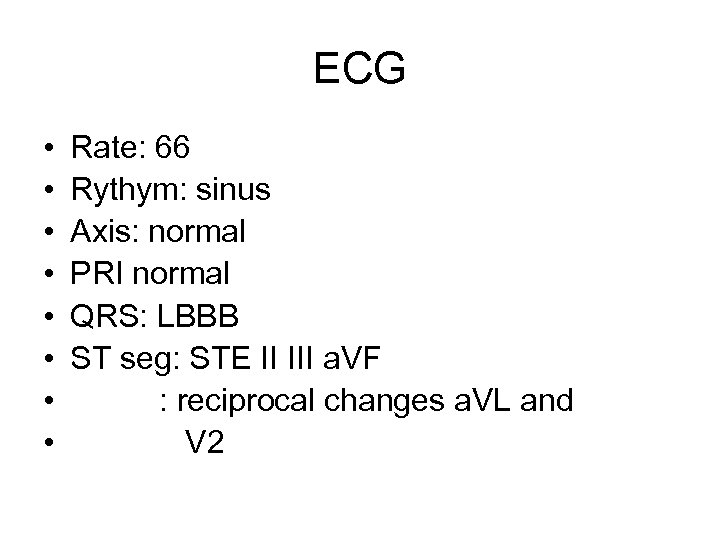 ECG • • Rate: 66 Rythym: sinus Axis: normal PRI normal QRS: LBBB ST seg: STE II III a. VF : reciprocal changes a. VL and V 2
 Management • • • Aspirin 300 mg TNT 2 tabs S Morphine 2. 5 mg IVI GTN infusion commenced Pain decreased from 8/10 to 6/10 Spontaneously reverted to native rythym
 Management • Reteplase started 30 min after arrival • Had hypotensive episode, responded to 1000 ml N/S • ST segment elevation decreased • Pain-free 35 min after initial bolus(110 min after onset of pain) • Coronary angio at 36 hrs showed tightly narrowed right coronary artery which was stented • Had good LV function
 1 More
 And more ECG’s
 References • 1. A Faras Husain, A Abu. Zayed, Brugada syndrome causing Cardiac Arrest, Arab Health magazine, Issue three 2008, p 22 -23 • 2. Glancy DL, Bahij K; Chest pain and LBBB; BUMC Proceedings; Vol 14 no 4, p 452 -454 3. Karen marzlin; Clinical insights from unusual case studies in cardiovascular care: NIT 2008; www. cardionursing. com 4. R Farah, E Nassier; The Brugada Syndrome: An easily identifiable and preventable cause of sudden cardiac death; Israeli Journal of Emergency Medicine; Vol 6, no 1 Feb 2006 5. J Knott; Diagnosis of acute myocardial infarction with ventricular paced rythym; Emergency Medicine 2003 15 (100 -103) 6. HC CHEW, SH LIM; ECG case. ST Elevation: Is this an infarct? ; Singapore med Journal; 2005 46 (11): 656 7. A De Meester et al; Symptomatic pericarditis after influenza vaccine. CHESTT / 117/6 June 200 p 1803 -1805 8. A Mattu, W Braddy; ECG’s for the Emergency Physician, BMJ 2003