


 Скачать презентацию ECE CS 552 Introduction To Computer Architecture Instructor Mikko
9b618c78e4195bff5f9e986d285a8b3d.ppt
- Количество слайдов: 25
 ECE/CS 552: Introduction To Computer Architecture Instructor: Mikko H Lipasti TA: Guangyu Shi Fall 2010 University of Wisconsin-Madison Lecture notes partially based on set created by Mark Hill.
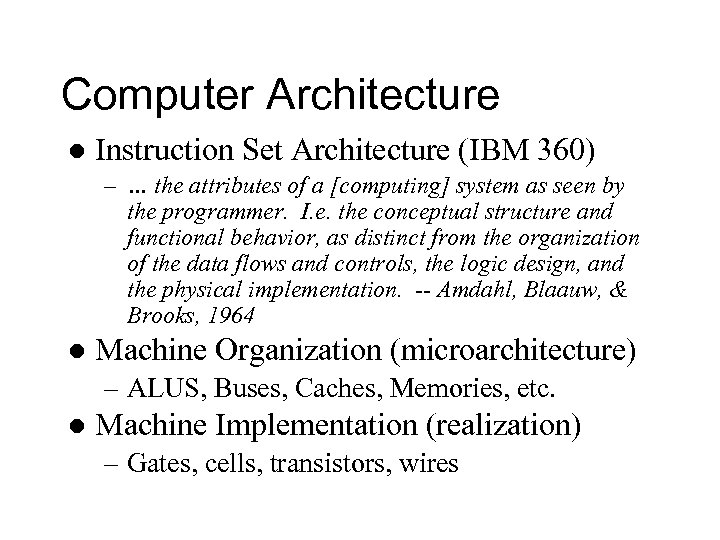 Computer Architecture l Instruction Set Architecture (IBM 360) – … the attributes of a [computing] system as seen by the programmer. I. e. the conceptual structure and functional behavior, as distinct from the organization of the data flows and controls, the logic design, and the physical implementation. -- Amdahl, Blaauw, & Brooks, 1964 l Machine Organization (microarchitecture) – ALUS, Buses, Caches, Memories, etc. l Machine Implementation (realization) – Gates, cells, transistors, wires
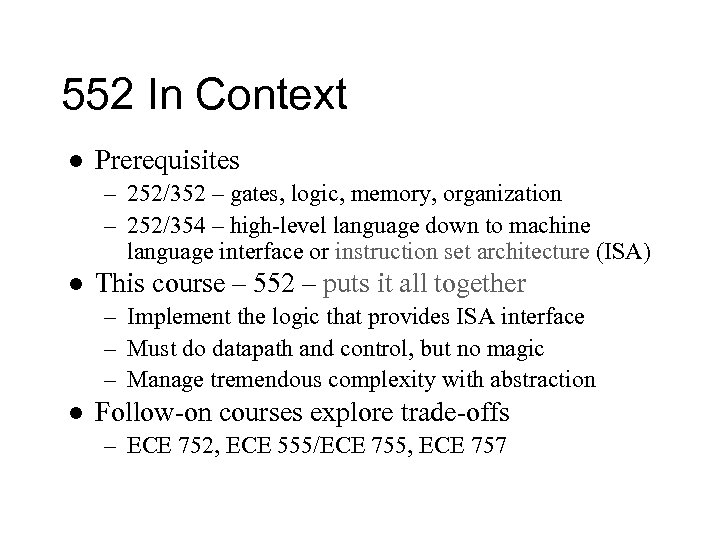 552 In Context l Prerequisites – 252/352 – gates, logic, memory, organization – 252/354 – high-level language down to machine language interface or instruction set architecture (ISA) l This course – 552 – puts it all together – Implement the logic that provides ISA interface – Must do datapath and control, but no magic – Manage tremendous complexity with abstraction l Follow-on courses explore trade-offs – ECE 752, ECE 555/ECE 755, ECE 757
 Why Take 552? l To become a computer designer – Alumni of this class helped design your computer l To learn what is under the hood of a computer – – l Innate curiosity To better understand when things break To write better code/applications To write better system software (O/S, compiler, etc. ) Because it is intellectually fascinating! – What is the most complex man-made device?
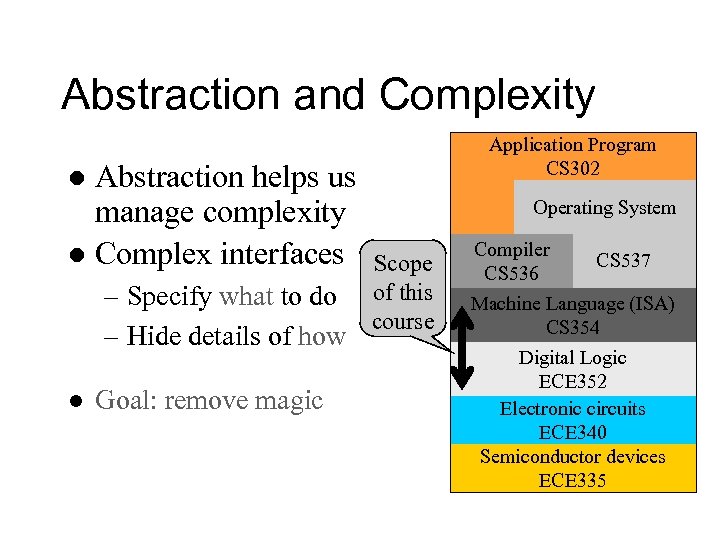 Abstraction and Complexity Abstraction helps us manage complexity l Complex interfaces Application Program CS 302 l – Specify what to do – Hide details of how l Goal: remove magic Operating System Scope of this course Compiler CS 536 CS 537 Machine Language (ISA) CS 354 Digital Logic ECE 352 Electronic circuits ECE 340 Semiconductor devices ECE 335
 Computer Architecture l Exercise in engineering tradeoff analysis – Find the fastest/cheapest/power-efficient/etc. solution – Optimization problem with 100 s of variables l All the variables are changing – At non-uniform rates – With inflection points – Only one guarantee: Today’s right answer will be wrong tomorrow l Two high-level effects: – Technology push – Application Pull
 Technology Push l What do these two intervals have in common? – 1776 -1999 (224 years) – 2000 -2001 (2 years) l Answer: Equal progress in processor speed! l The power of exponential growth! Driven by Moore’s Law l – Device per chips doubles every 18 -24 months l Computer architects work to turn the additional resources into speed/power savings/functionality!
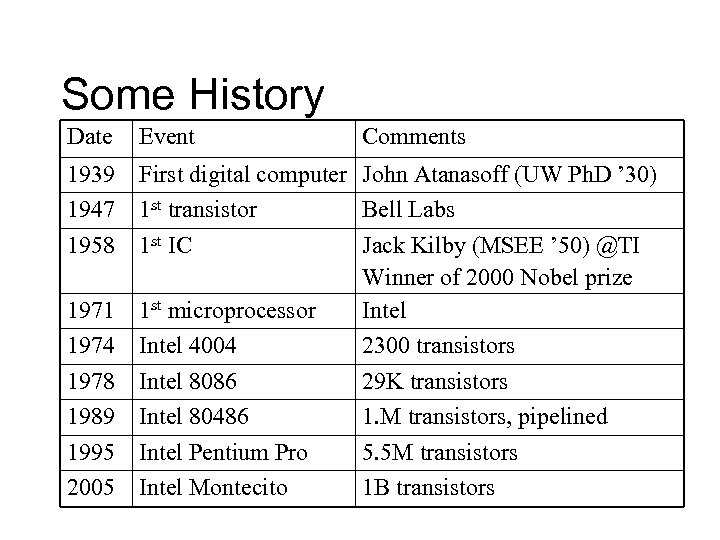 Some History Date Event 1939 1947 1958 First digital computer John Atanasoff (UW Ph. D ’ 30) 1 st transistor Bell Labs 1 st IC Jack Kilby (MSEE ’ 50) @TI Winner of 2000 Nobel prize 1 st microprocessor Intel 4004 2300 transistors Intel 8086 29 K transistors Intel 80486 1. M transistors, pipelined Intel Pentium Pro 5. 5 M transistors Intel Montecito 1 B transistors 1971 1974 1978 1989 1995 2005 Comments
![Performance Growth l Unmatched by any other industry ! [John Crawford, Intel] Doubling every](https://present5.com/presentation/9b618c78e4195bff5f9e986d285a8b3d/image-9.jpg "Performance Growth l Unmatched by any other industry ! [John Crawford, Intel] Doubling every") Performance Growth l Unmatched by any other industry ! [John Crawford, Intel] Doubling every 18 months (1982 -1996): 800 x – Cars travel at 44, 000 mph and get 16, 000 mpg – Air travel: LA to NY in 22 seconds (MACH 800) – Wheat yield: 80, 000 bushels per acre l Doubling every 24 months (1971 -1996): 9, 000 x – Cars travel at 600, 000 mph, get 150, 000 mpg – Air travel: LA to NY in 2 seconds (MACH 9, 000) – Wheat yield: 900, 000 bushels per acre
Performance Growth l Unmatched by any other industry ! [John Crawford, Intel] Doubling every 18 months (1982 -1996): 800 x – Cars travel at 44, 000 mph and get 16, 000 mpg – Air travel: LA to NY in 22 seconds (MACH 800) – Wheat yield: 80, 000 bushels per acre l Doubling every 24 months (1971 -1996): 9, 000 x – Cars travel at 600, 000 mph, get 150, 000 mpg – Air travel: LA to NY in 2 seconds (MACH 9, 000) – Wheat yield: 900, 000 bushels per acre
 Technology Push l Technology advances at varying rates – E. g. DRAM capacity increases at 60%/year – But DRAM speed only improves 10%/year – Creates gap with processor frequency! l Inflection points – Crossover causes rapid change – E. g. enough devices for multicore processor (2001) l Current issues causing an “inflection point” – Power consumption – Reliability – Variability
 Application Pull l Corollary to Moore’s Law: Cost halves every two years In a decade you can buy a computer for less than its sales tax today. –Jim Gray l Computers cost-effective for – – – National security – weapons design Enterprise computing – banking Departmental computing – computer-aided design Personal computer – spreadsheets, email, web Pervasive computing – prescription drug labels
 Application Pull l l What about the future? Must dream up applications that are not costeffective today – – l Virtual reality Telepresence Mobile applications Sensing, analyzing, actuating in real-world environments This is your job!
 Abstraction l Difference between interface and implementation – Interface: WHAT something does – Implementation: HOW it does so
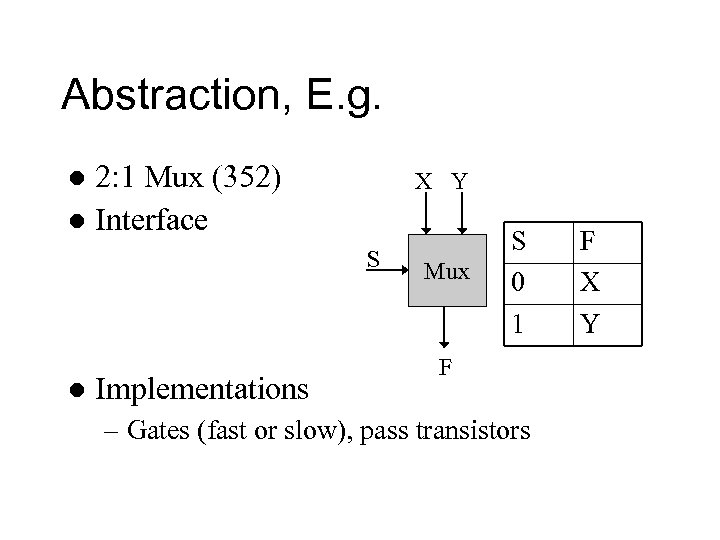 Abstraction, E. g. 2: 1 Mux (352) l Interface l X Y S l Implementations Mux S 0 1 F – Gates (fast or slow), pass transistors F X Y
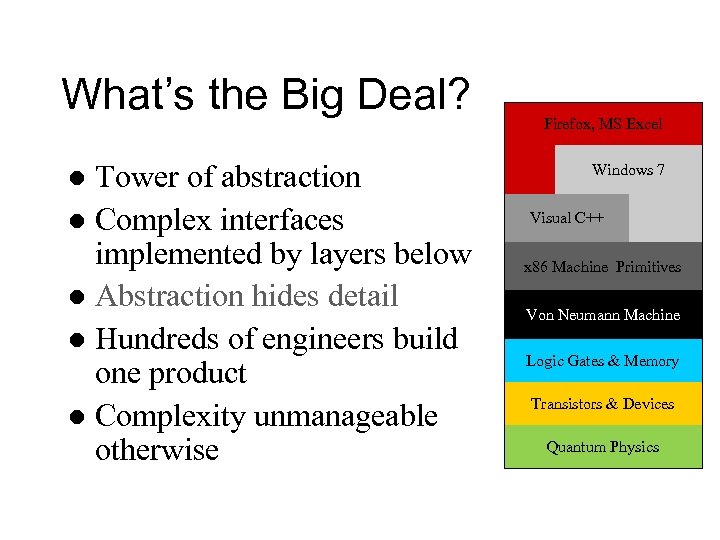 What’s the Big Deal? Tower of abstraction l Complex interfaces implemented by layers below l Abstraction hides detail l Hundreds of engineers build one product l Complexity unmanageable otherwise l Firefox, MS Excel Windows 7 Visual C++ x 86 Machine Primitives Von Neumann Machine Logic Gates & Memory Transistors & Devices Quantum Physics
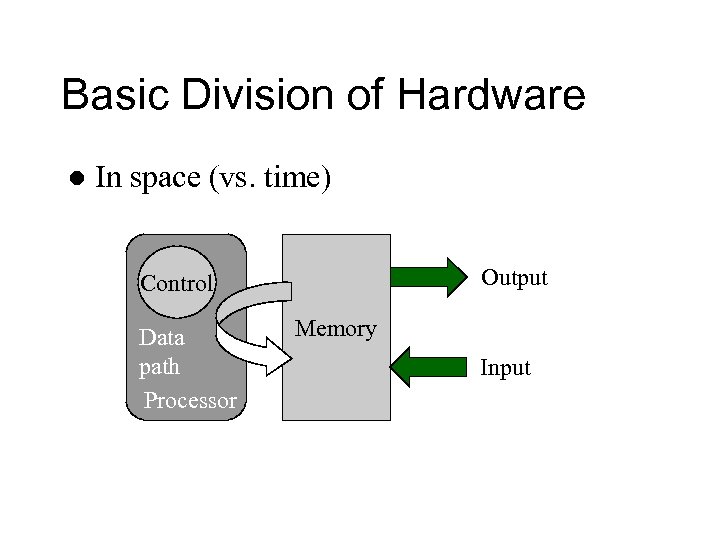 Basic Division of Hardware l In space (vs. time) Output Control Data path Processor Memory Input
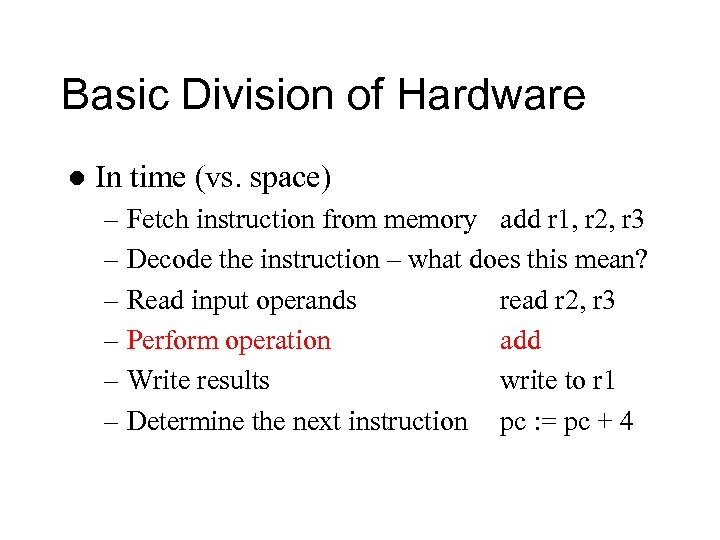 Basic Division of Hardware l In time (vs. space) – Fetch instruction from memory add r 1, r 2, r 3 – Decode the instruction – what does this mean? – Read input operands read r 2, r 3 – Perform operation add – Write results write to r 1 – Determine the next instruction pc : = pc + 4
 Building Computer Chips l Complex multi-step process – Slice silicon ingots into wafers – Process wafers into patterned wafers – Dice patterned wafers into dies – Test dies, select good dies – Bond to package – Test parts – Ship to customers and make money
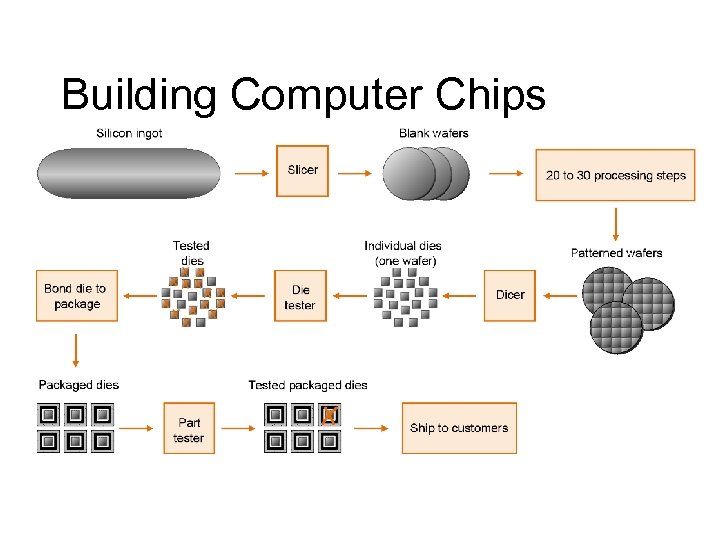 Building Computer Chips
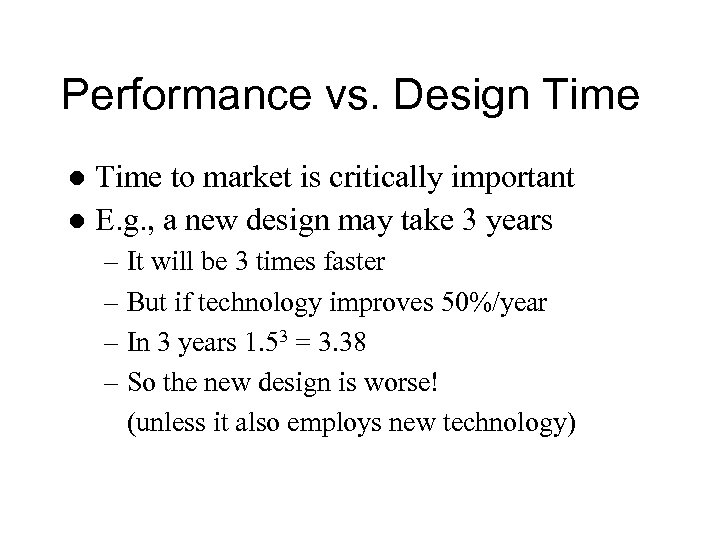 Performance vs. Design Time to market is critically important l E. g. , a new design may take 3 years l – It will be 3 times faster – But if technology improves 50%/year – In 3 years 1. 53 = 3. 38 – So the new design is worse! (unless it also employs new technology)
 Bottom Line Designers must know BOTH software and hardware l Both contribute to layers of abstraction l IC costs and performance l Compilers and Operating Systems l
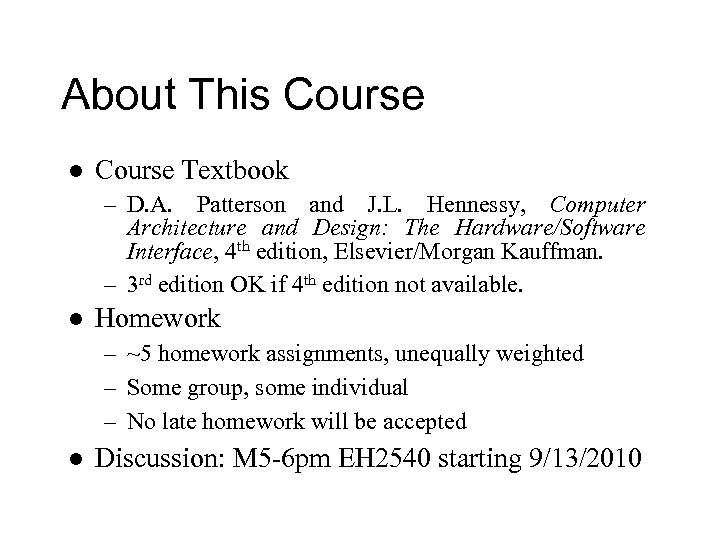 About This Course l Course Textbook – D. A. Patterson and J. L. Hennessy, Computer Architecture and Design: The Hardware/Software Interface, 4 th edition, Elsevier/Morgan Kauffman. – 3 rd edition OK if 4 th edition not available. l Homework – ~5 homework assignments, unequally weighted – Some group, some individual – No late homework will be accepted l Discussion: M 5 -6 pm EH 2540 starting 9/13/2010
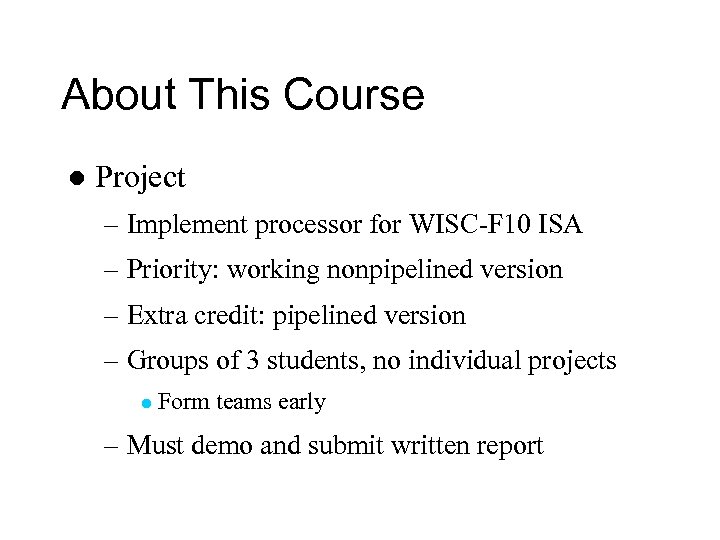 About This Course l Project – Implement processor for WISC-F 10 ISA – Priority: working nonpipelined version – Extra credit: pipelined version – Groups of 3 students, no individual projects l Form teams early – Must demo and submit written report
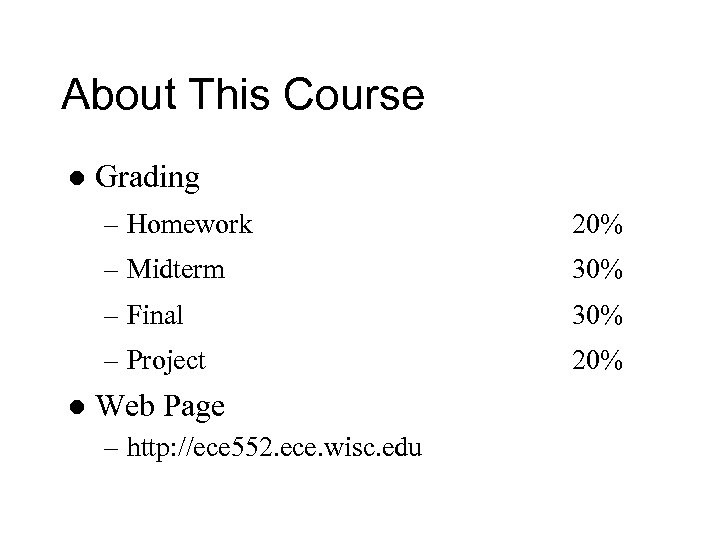 About This Course l Grading – Homework – Midterm 30% – Final 30% – Project l 20% Web Page – http: //ece 552. ece. wisc. edu
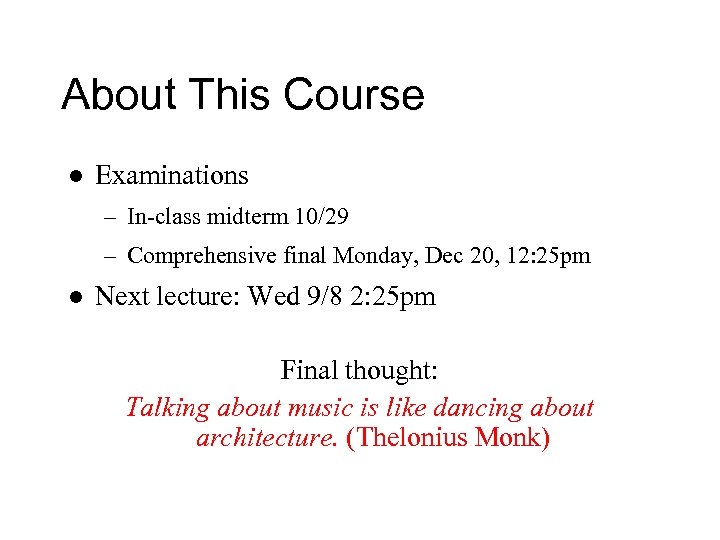 About This Course l Examinations – In-class midterm 10/29 – Comprehensive final Monday, Dec 20, 12: 25 pm l Next lecture: Wed 9/8 2: 25 pm Final thought: Talking about music is like dancing about architecture. (Thelonius Monk)