


 Скачать презентацию ECE 7995 Computer Storage and Operating System Design
017fc4a5bdb84ca4d2948eea82c5a081.ppt
- Количество слайдов: 67
 ECE 7995 Computer Storage and Operating System Design Lecture 4: Memory Management
 Outline • Background • Contiguous Memory Allocation Paging Structure of the Page Table Segmentation Example: The Intel Pentium • •
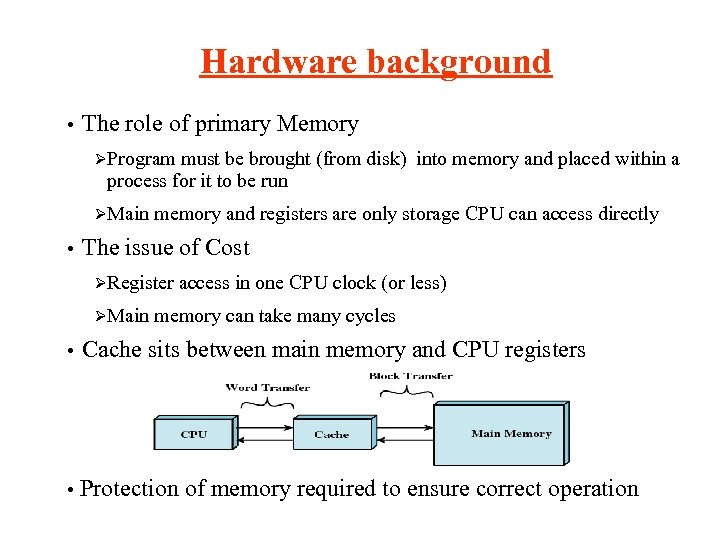 Hardware background • The role of primary Memory ØProgram must be brought (from disk) into memory and placed within a process for it to be run ØMain • memory and registers are only storage CPU can access directly The issue of Cost ØRegister ØMain access in one CPU clock (or less) memory can take many cycles • Cache sits between main memory and CPU registers • Protection of memory required to ensure correct operation
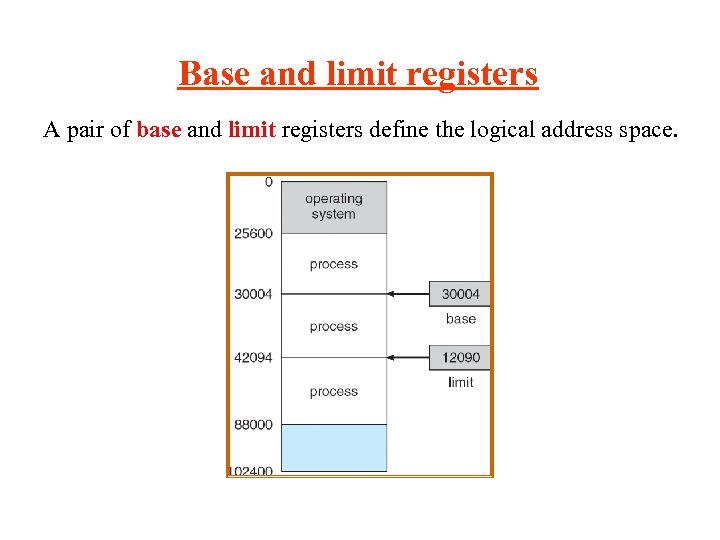 Base and limit registers A pair of base and limit registers define the logical address space.
 Logical vs. physical address space • The separation of logical address space from physical address space is central to proper memory management ØLogical address – is a memory location seen by an application program and is generated by the CPU; also referred to as virtual address. ―User program can always start its address space from 0; ―A compiler generates relocatable addresses for each module; ―Linker or loader bind the addresses to absolute address from 0 ØPhysical address – address seen by the memory unit ―The final mapping of logical address to physical address is done in execution time and can be changed during the period. ―The user program deals with logical addresses; it never sees the real physical addresses • The mapping of logical address to physical is supported by hardware (Memory-Management Unit (MMU))
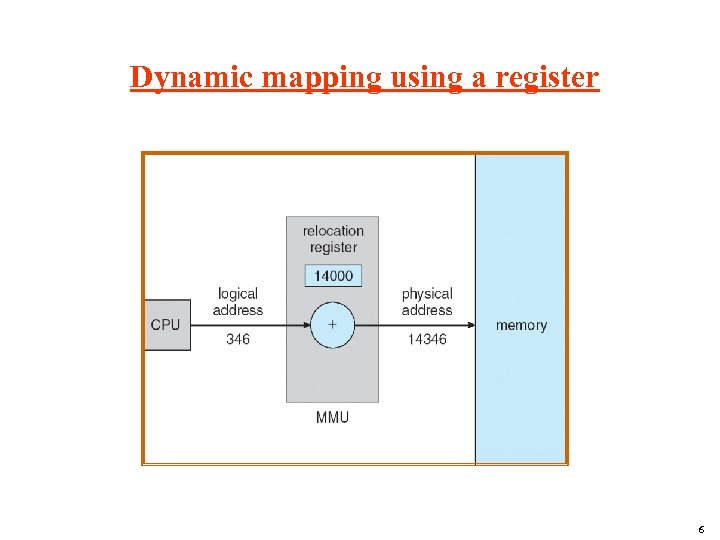 Dynamic mapping using a register 6
 Contiguous memory allocation • Main memory usually into two partitions: ØResident operating system, usually held in low memory with interrupt vector ØUser processes then held in high memory • Relocation registers used to protect user processes from each other, and from changing operating-system code and data ØBase register contains value of smallest physical address ØLimit register contains range of logical addresses – each logical address must be less than the limit register ØMMU maps logical address dynamically
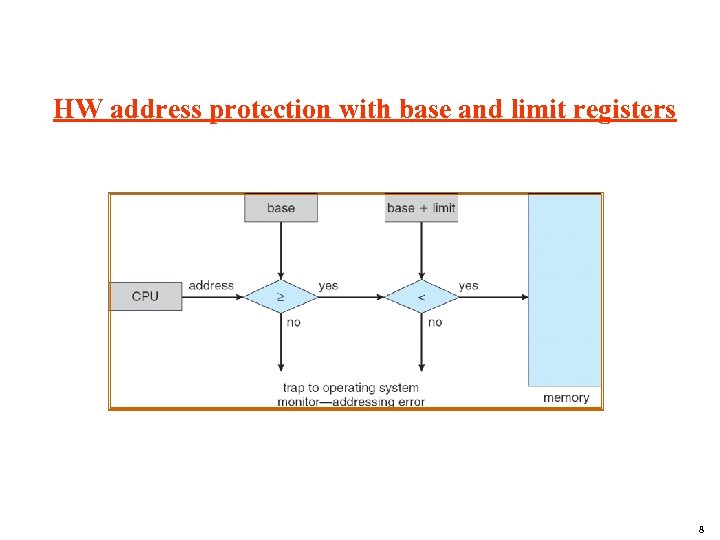 HW address protection with base and limit registers 8
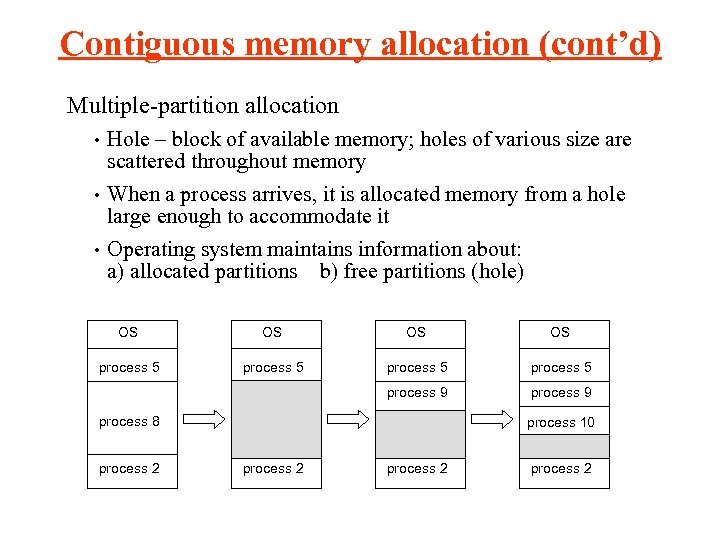 Contiguous memory allocation (cont’d) Multiple-partition allocation Hole – block of available memory; holes of various size are scattered throughout memory • When a process arrives, it is allocated memory from a hole large enough to accommodate it • Operating system maintains information about: a) allocated partitions b) free partitions (hole) • OS OS process 5 process 9 process 8 process 2 process 10 process 2
 Fragmentation External Fragmentation – total memory space exists to satisfy a request, but it is not contiguous • Internal Fragmentation – allocated memory may be slightly larger than requested memory; this size difference is memory internal to a partition, but not being used • Reduce external fragmentation by compaction • ØShuffle memory contents to place all free memory together in one large block ØCompaction is possible only if relocation is possible, and is done at execution time ØI/O problem Latch job in memory while it is involved in I/O – Do I/O only into OS buffers –
 • The goal of paging Paging üBoth logical address space and physical address space of a process can be noncontiguous; üProcess can be allocated physical memory dynamically according to the memory competition; • The mechanism – dividing both spaces into small units Ø Divide physical memory into fixed-sized blocks called frames (size is power of 2) ― usually between 512 bytes and 8, 192 bytes Ø Divide logical memory into blocks of same size called pages Ø Keep track of all free frames Ø Map a free frame to a page upon program loading or on page fault exception Set up a per-process page table to translate logical to physical addresses • Internal fragmentation •
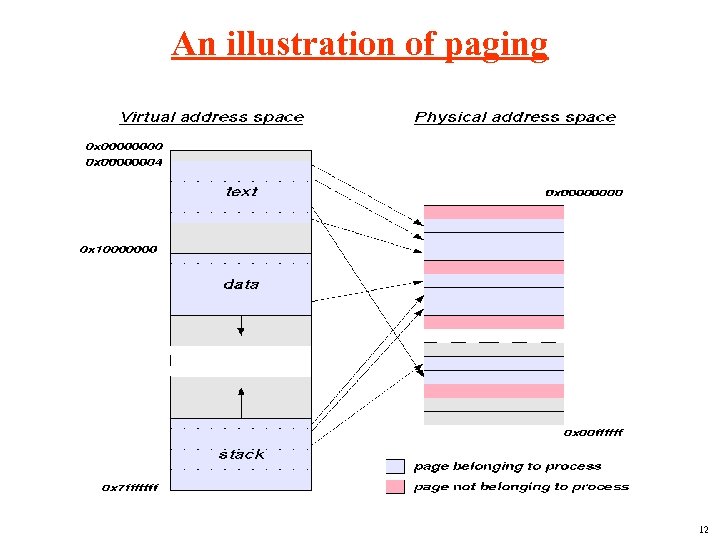 An illustration of paging 12
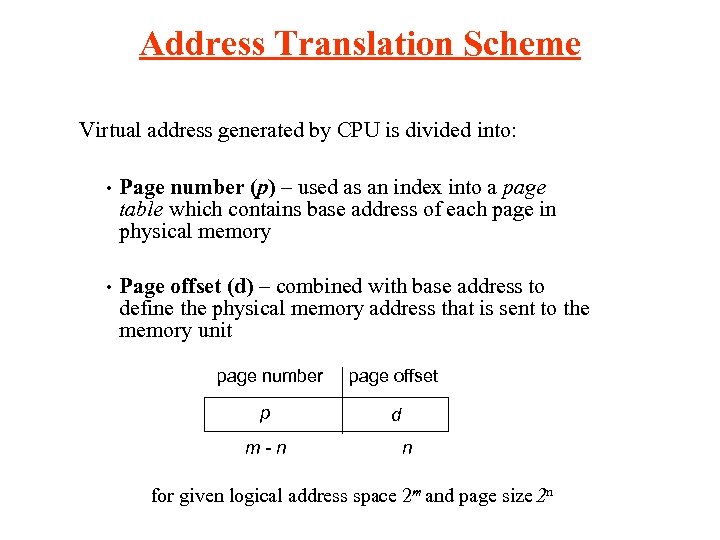 Address Translation Scheme Virtual address generated by CPU is divided into: • Page number (p) – used as an index into a page table which contains base address of each page in physical memory • Page offset (d) – combined with base address to define the physical memory address that is sent to the memory unit page number page offset p d m-n n for given logical address space 2 m and page size 2 n
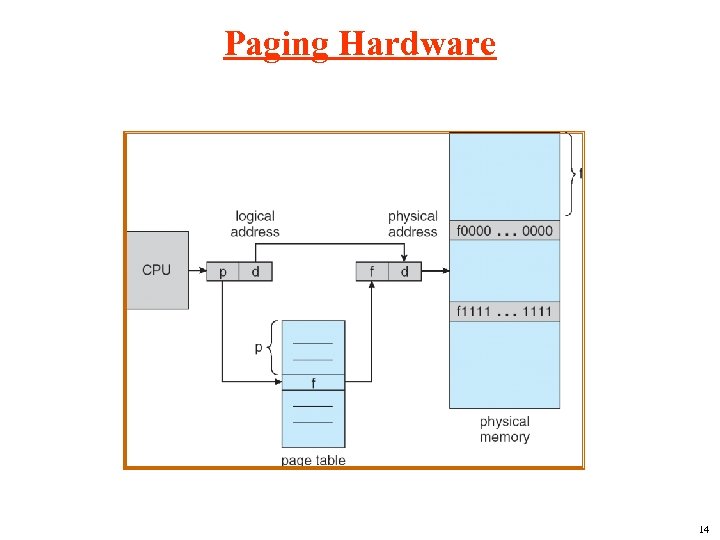 Paging Hardware 14
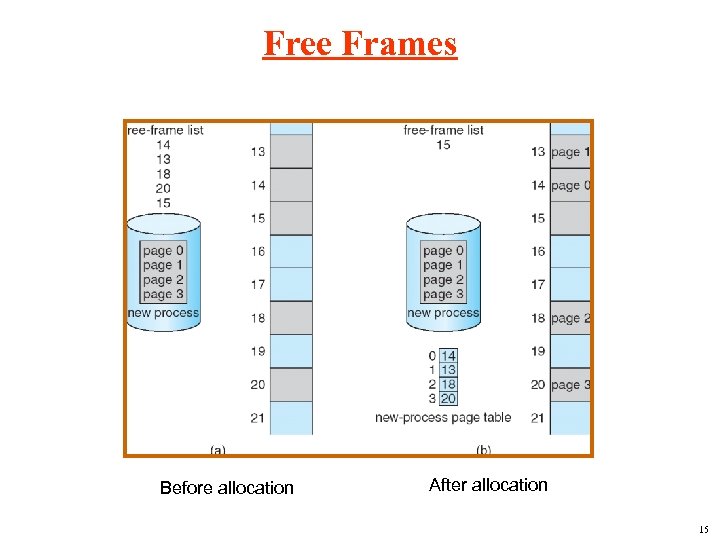 Free Frames Before allocation After allocation 15
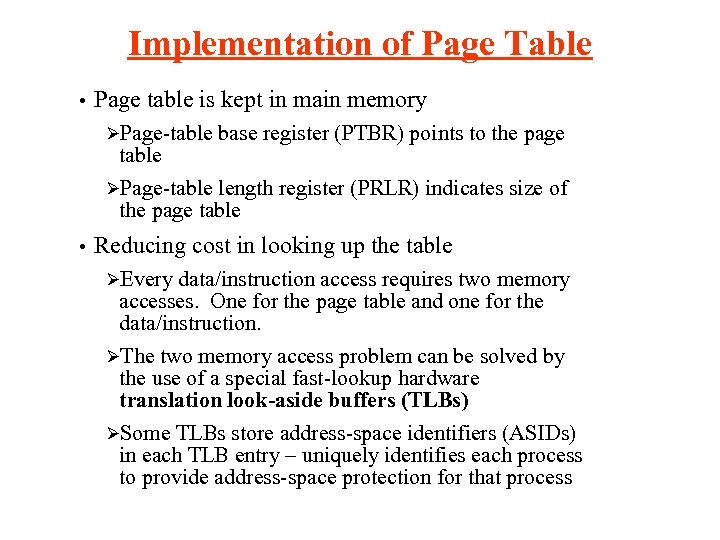 Implementation of Page Table • Page table is kept in main memory ØPage-table base register (PTBR) points to the page table ØPage-table length register (PRLR) indicates size of the page table • Reducing cost in looking up the table ØEvery data/instruction access requires two memory accesses. One for the page table and one for the data/instruction. ØThe two memory access problem can be solved by the use of a special fast-lookup hardware translation look-aside buffers (TLBs) ØSome TLBs store address-space identifiers (ASIDs) in each TLB entry – uniquely identifies each process to provide address-space protection for that process
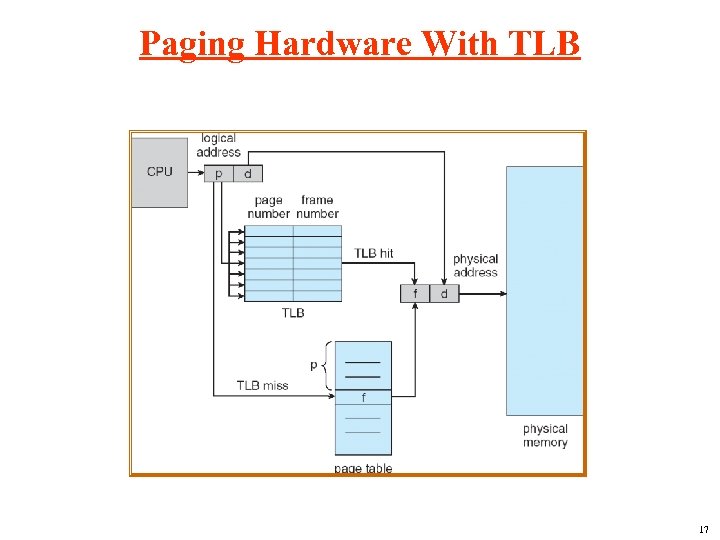 Paging Hardware With TLB 17
 Memory protection • Memory protection implemented by associating protection bit with each frame • Valid-invalid bit attached to each entry in the page table: Ø“valid” indicates that the associated page is in the process’ logical address space, and is thus a legal page Ø“invalid” indicates that the page is not in the process’ logical address space
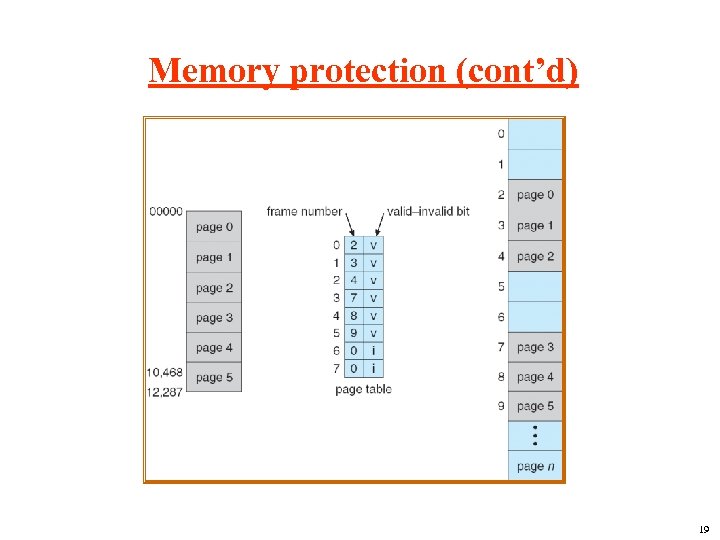 Memory protection (cont’d) 19
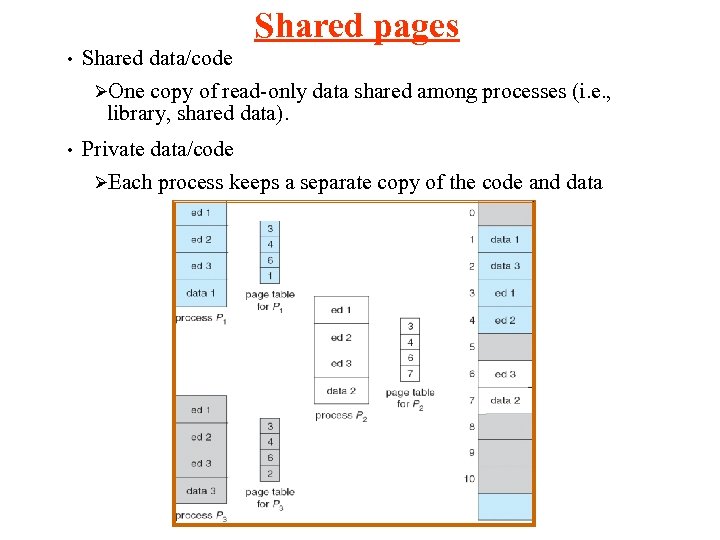 Shared pages • Shared data/code ØOne copy of read-only data shared among processes (i. e. , library, shared data). • Private data/code ØEach process keeps a separate copy of the code and data
 Multi-level page tables • Reducing the amount of memory required for perprocess page table. If a one-level page table was used, it needs 220 entries (e. g. , at 4 bytes per entry, 4 MB of RAM) to represent the page table for each process, assuming a full 4 GB linear address space is used. Ø • Multiple-level page table Break up the logical address space into multiple-level page tables ØOuter/up level page table must be set up for each process ØHowever, lower-level page tables can be allocated on demand Ø
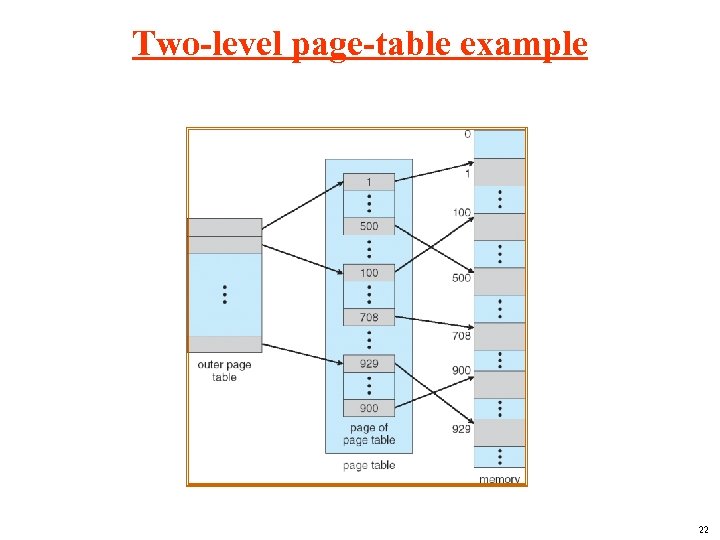 Two-level page-table example 22
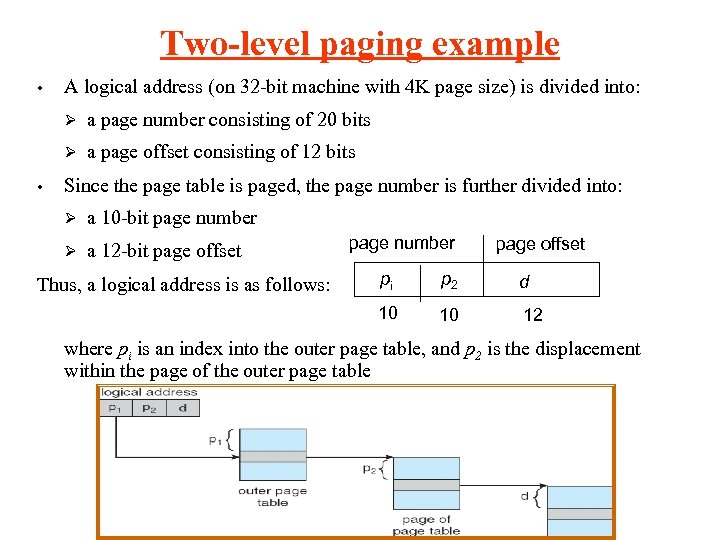 Two-level paging example • A logical address (on 32 -bit machine with 4 K page size) is divided into: Ø Ø • a page number consisting of 20 bits a page offset consisting of 12 bits Since the page table is paged, the page number is further divided into: Ø a 10 -bit page number Ø a 12 -bit page offset page number page offset pi p 2 d 10 Thus, a logical address is as follows: 10 12 where pi is an index into the outer page table, and p 2 is the displacement within the page of the outer page table
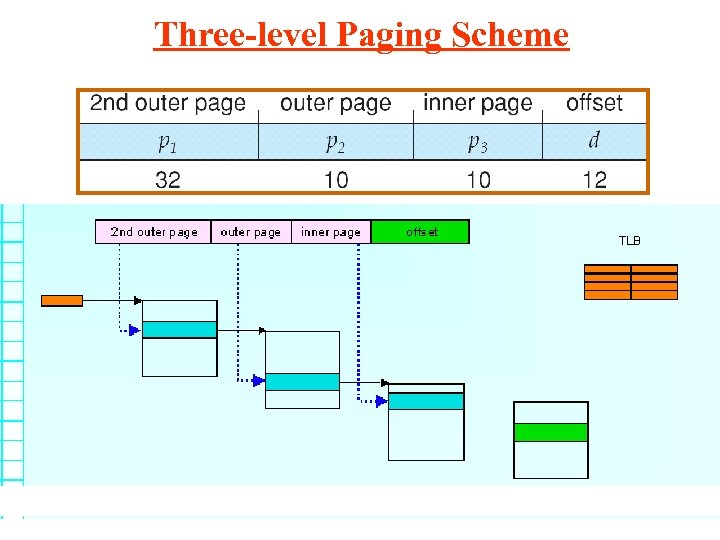 Three-level Paging Scheme
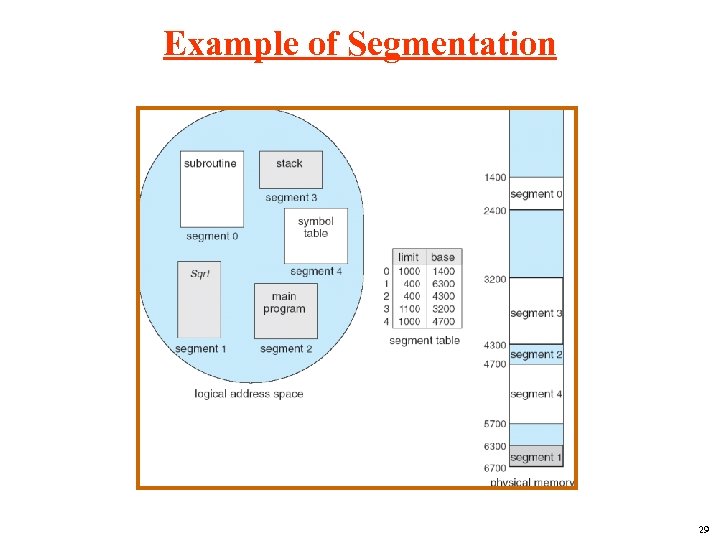
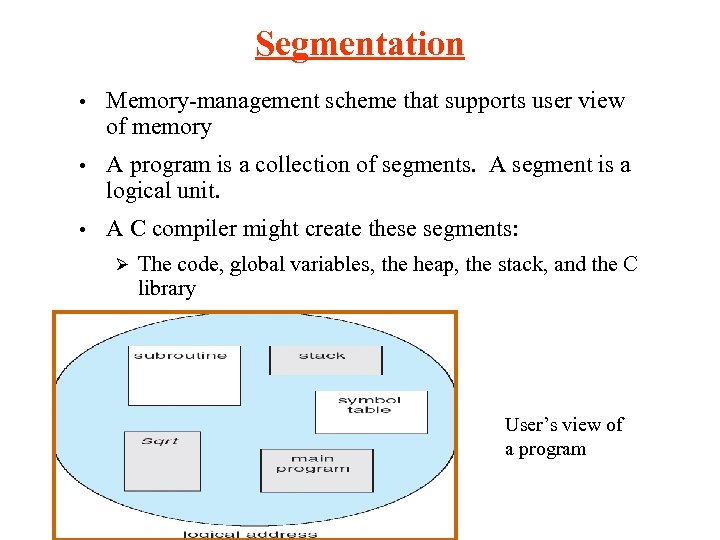 Segmentation • Memory-management scheme that supports user view of memory • A program is a collection of segments. A segment is a logical unit. • A C compiler might create these segments: Ø The code, global variables, the heap, the stack, and the C library User’s view of a program
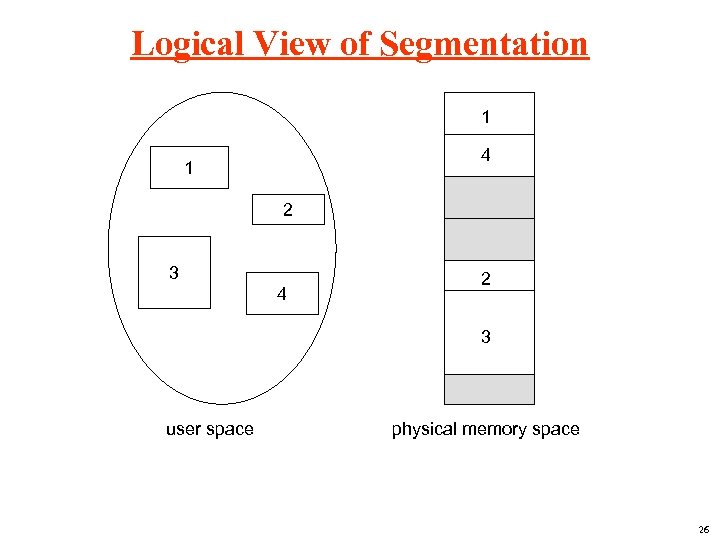 Logical View of Segmentation 1 4 1 2 3 4 2 3 user space physical memory space 26
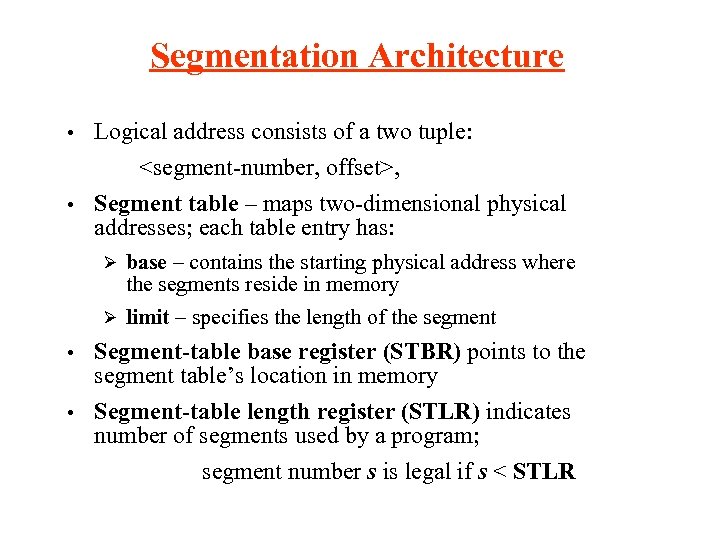 Segmentation Architecture • Logical address consists of a two tuple:
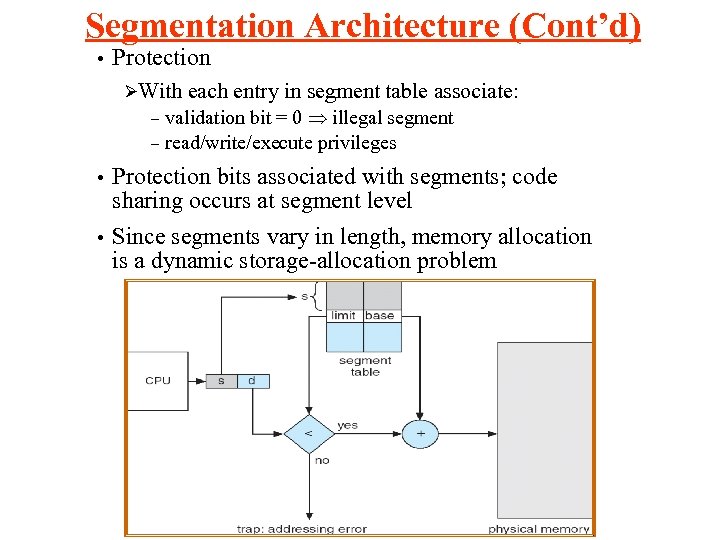 Segmentation Architecture (Cont’d) • Protection ØWith each entry in segment table associate: validation bit = 0 illegal segment – read/write/execute privileges – Protection bits associated with segments; code sharing occurs at segment level • Since segments vary in length, memory allocation is a dynamic storage-allocation problem •
 Example of Segmentation 29
 Example: The Intel Pentium • Supports both segmentation and segmentation with paging • CPU generates logical address ØGiven – to segmentation unit which produces linear addresses ØLinear address given to paging unit which generates physical address in main memory – Segmentation and paging units form MMU –
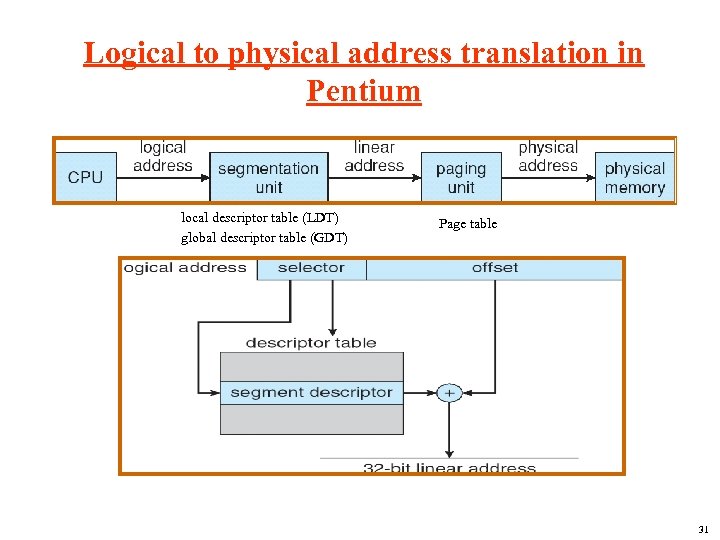 Logical to physical address translation in Pentium local descriptor table (LDT) global descriptor table (GDT) Page table 31
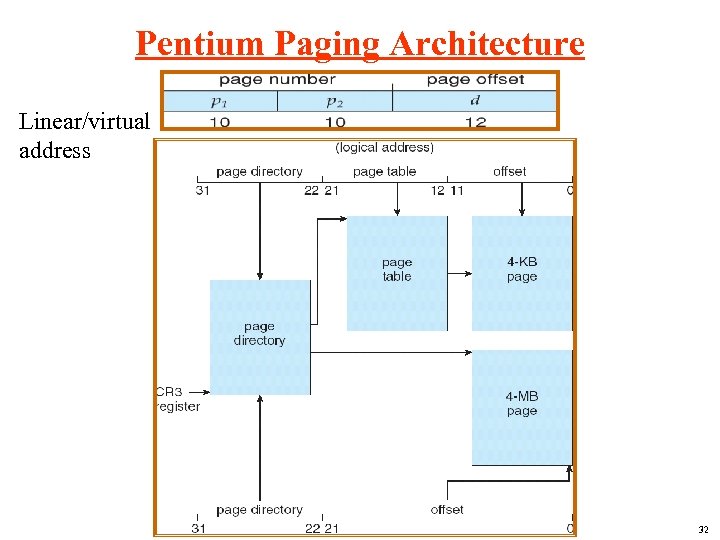 Pentium Paging Architecture Linear/virtual address 32
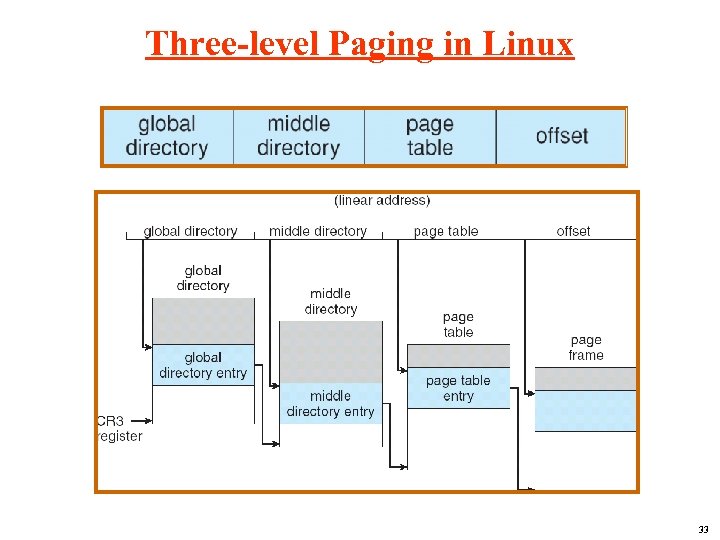 Three-level Paging in Linux 33
 Background of Virtual Memory • Virtual memory – a technique that allows the execution of processes that are not completely in memory, so that many processes can stay in memory simultaneously to allow multiprogramming. • Enabling technique: separation of user logical memory from physical memory. ØOnly part of the program needs to be in memory for execution ØLogical address space can therefore be much larger than physical address space ØAllows for more efficient process creation • Virtual memory can be implemented via: ØDemand paging ØDemand segmentation
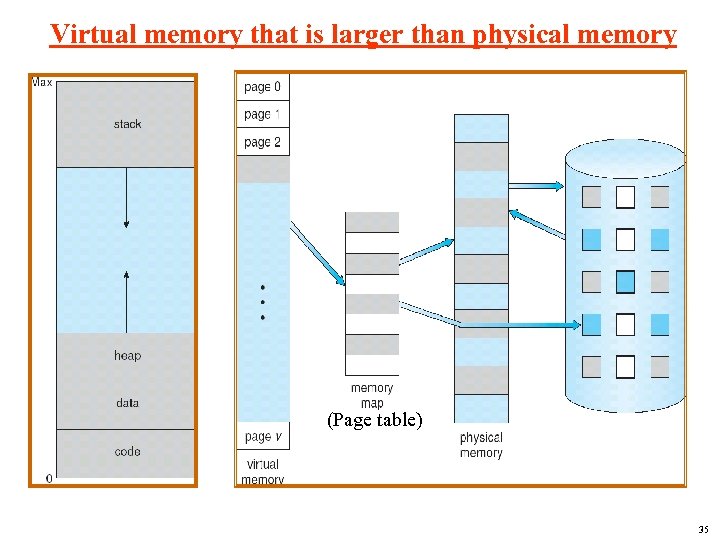 Virtual memory that is larger than physical memory (Page table) 35
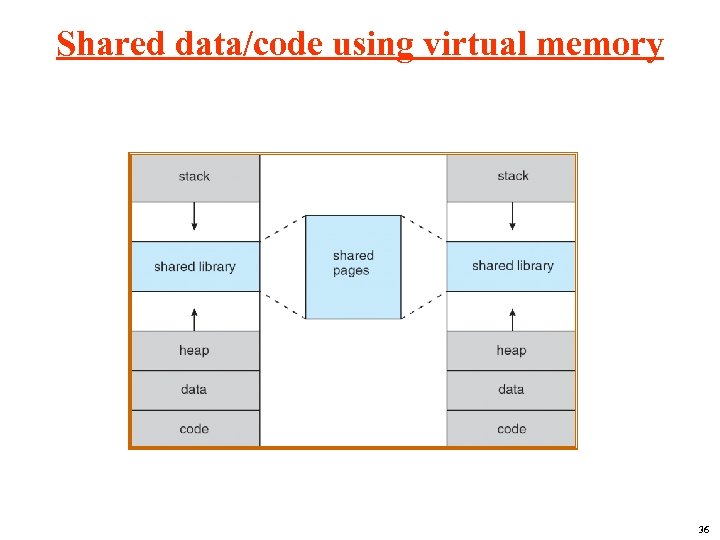 Shared data/code using virtual memory 36
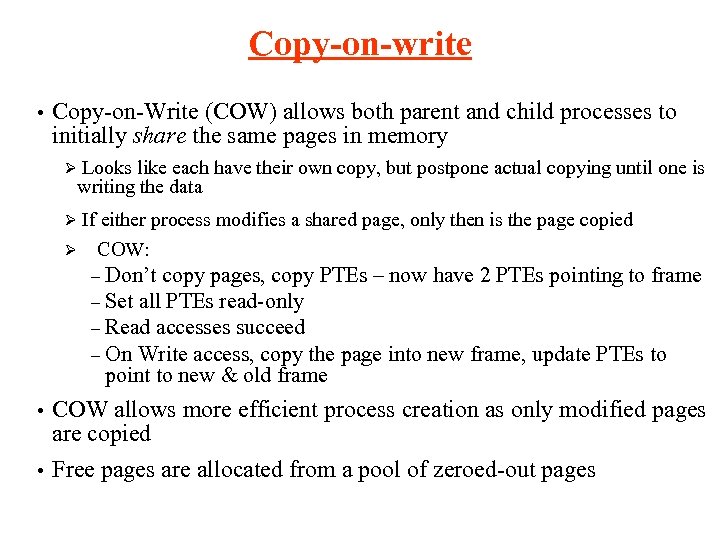 Copy-on-write • Copy-on-Write (COW) allows both parent and child processes to initially share the same pages in memory Ø Ø Ø Looks like each have their own copy, but postpone actual copying until one is writing the data If either process modifies a shared page, only then is the page copied COW: – – Don’t copy pages, copy PTEs – now have 2 PTEs pointing to frame Set all PTEs read-only Read accesses succeed On Write access, copy the page into new frame, update PTEs to point to new & old frame COW allows more efficient process creation as only modified pages are copied • Free pages are allocated from a pool of zeroed-out pages •
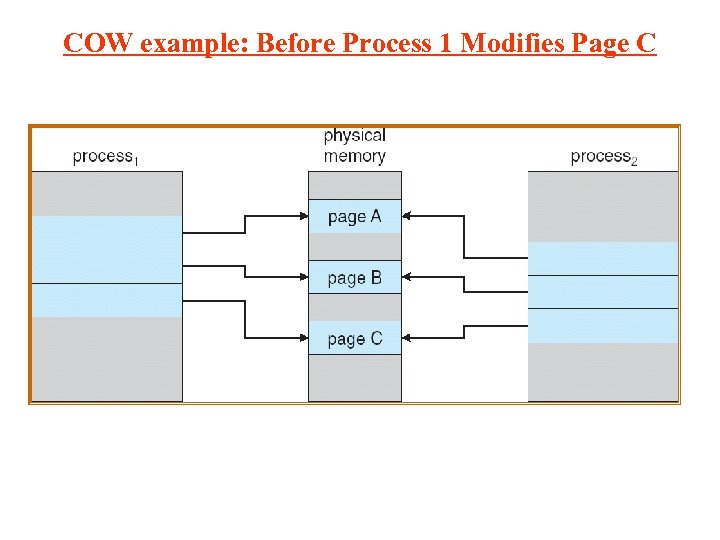 COW example: Before Process 1 Modifies Page C
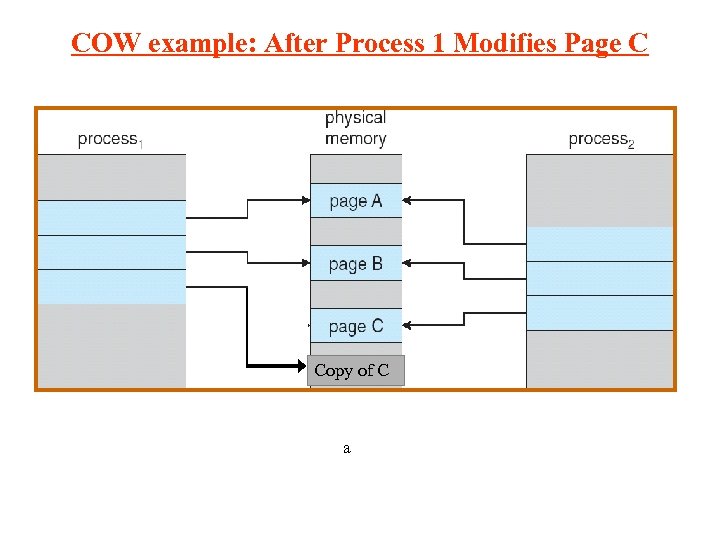 COW example: After Process 1 Modifies Page C Copy of C a
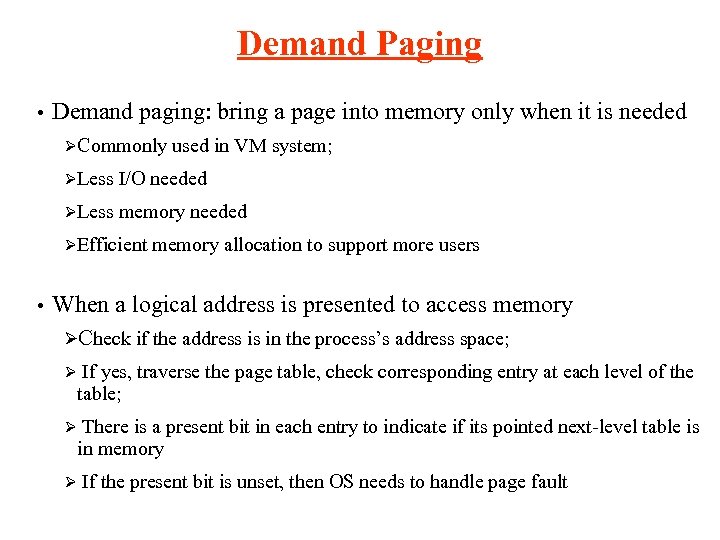 Demand Paging • Demand paging: bring a page into memory only when it is needed ØCommonly used in VM system; ØLess I/O needed ØLess memory needed ØEfficient • memory allocation to support more users When a logical address is presented to access memory ØCheck if the address is in the process’s address space; Ø If yes, traverse the page table, check corresponding entry at each level of the table; Ø There is a present bit in each entry to indicate if its pointed next-level table is in memory Ø If the present bit is unset, then OS needs to handle page fault
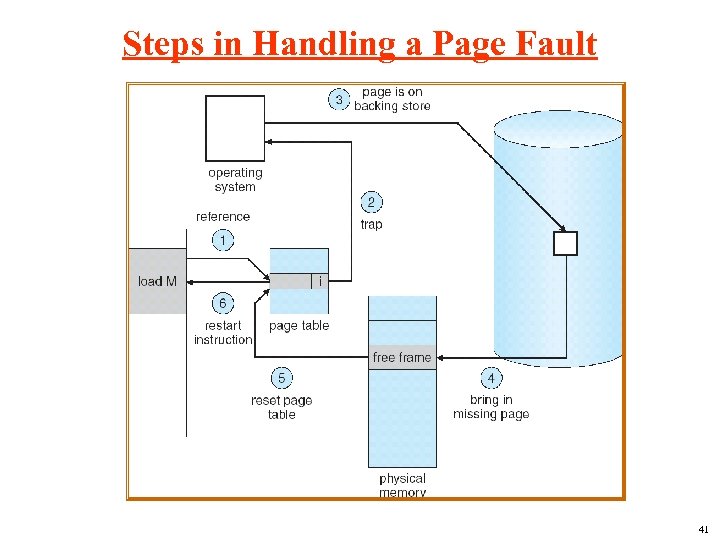 Steps in Handling a Page Fault 41
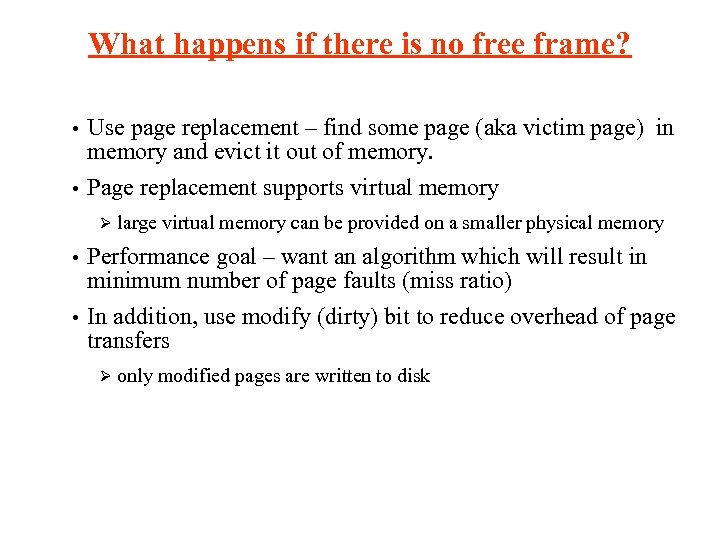 What happens if there is no free frame? Use page replacement – find some page (aka victim page) in memory and evict it out of memory. • Page replacement supports virtual memory • Ø large virtual memory can be provided on a smaller physical memory Performance goal – want an algorithm which will result in minimum number of page faults (miss ratio) • In addition, use modify (dirty) bit to reduce overhead of page transfers • Ø only modified pages are written to disk
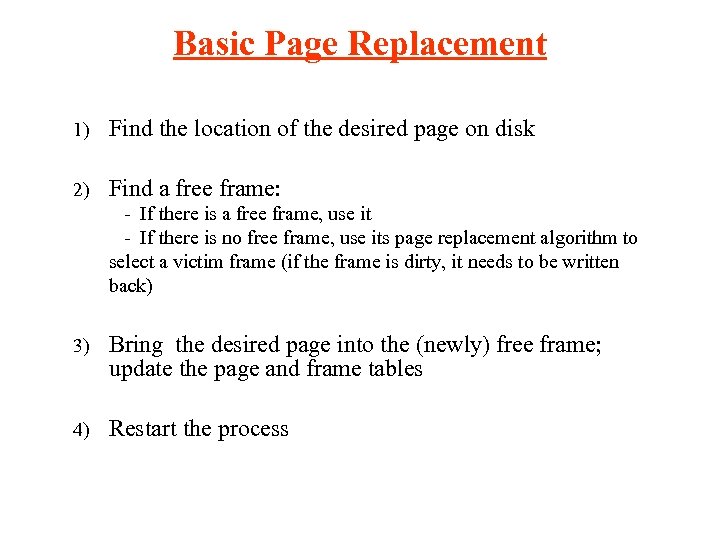 Basic Page Replacement 1) Find the location of the desired page on disk 2) Find a free frame: - If there is a free frame, use it - If there is no free frame, use its page replacement algorithm to select a victim frame (if the frame is dirty, it needs to be written back) 3) Bring the desired page into the (newly) free frame; update the page and frame tables 4) Restart the process
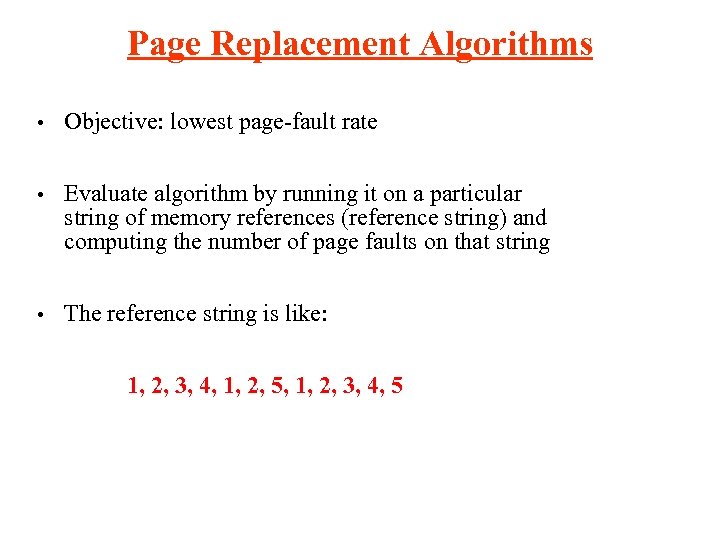 Page Replacement Algorithms • Objective: lowest page-fault rate • Evaluate algorithm by running it on a particular string of memory references (reference string) and computing the number of page faults on that string • The reference string is like: 1, 2, 3, 4, 1, 2, 5, 1, 2, 3, 4, 5
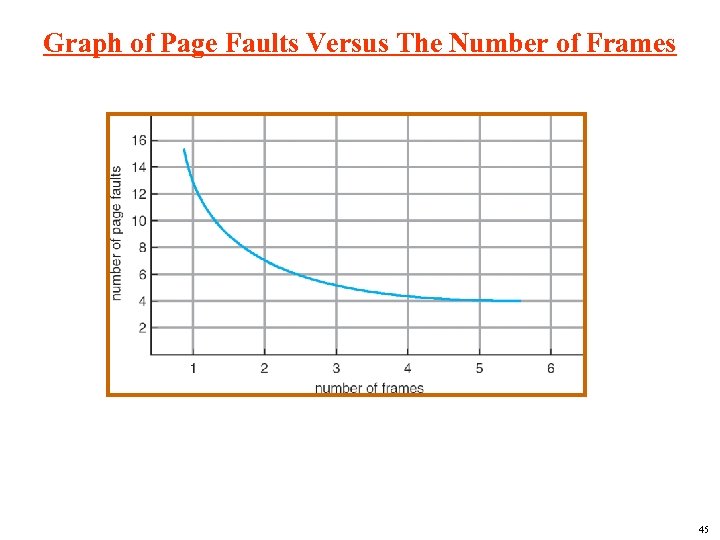 Graph of Page Faults Versus The Number of Frames 45
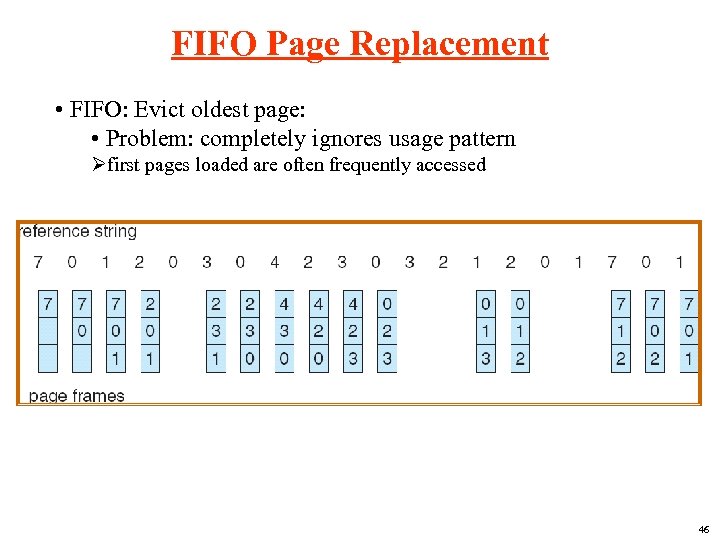 FIFO Page Replacement • FIFO: Evict oldest page: • Problem: completely ignores usage pattern Øfirst pages loaded are often frequently accessed 46
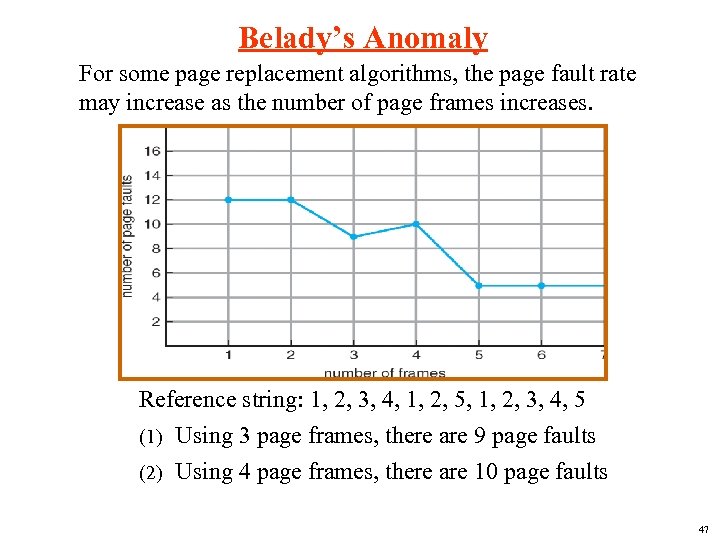 Belady’s Anomaly For some page replacement algorithms, the page fault rate may increase as the number of page frames increases. Reference string: 1, 2, 3, 4, 1, 2, 5, 1, 2, 3, 4, 5 Using 3 page frames, there are 9 page faults (2) Using 4 page frames, there are 10 page faults (1) 47
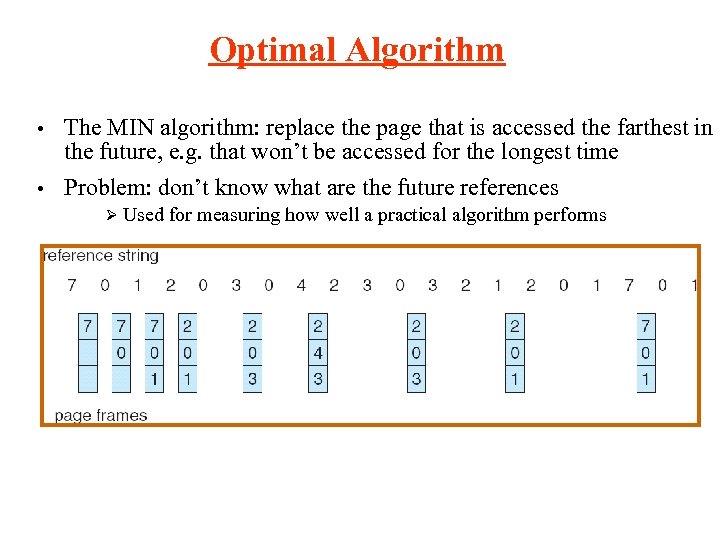 Optimal Algorithm The MIN algorithm: replace the page that is accessed the farthest in the future, e. g. that won’t be accessed for the longest time • Problem: don’t know what are the future references • Ø Used for measuring how well a practical algorithm performs
 Least Recently Used (LRU) Algorithm • LRU: Evict least-recently-used page • LRU is designed according to the temporal locality ØA page recently accessed is likely to be accessed again in the near future • Good performance if past is predictive of future. • Major problem: would have to keep track of “recency” on every access, either timestamp, or move to front of a list Ø infeasible
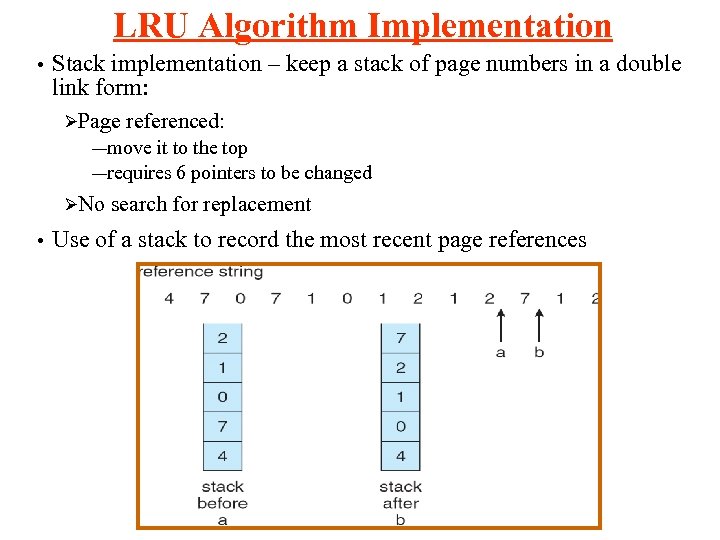 LRU Algorithm Implementation • Stack implementation – keep a stack of page numbers in a double link form: ØPage referenced: ―move it to the top ―requires 6 pointers to be changed ØNo • search for replacement Use of a stack to record the most recent page references
 LRU Approximation Algorithms • Hardware support: reference bit ØWith each page associate a bit, initially = 0 ØWhen page is referenced bit set to 1 ØReplace – • the one which is 0 (if one exists) We do not know the order, however Second chance algorithm ØNeed reference bit ØClock ØIf replacement page to be replaced (in clock order) has reference bit = 1 then: set reference bit 0 – leave page in memory – replace next page (in clock order), subject to same rules –
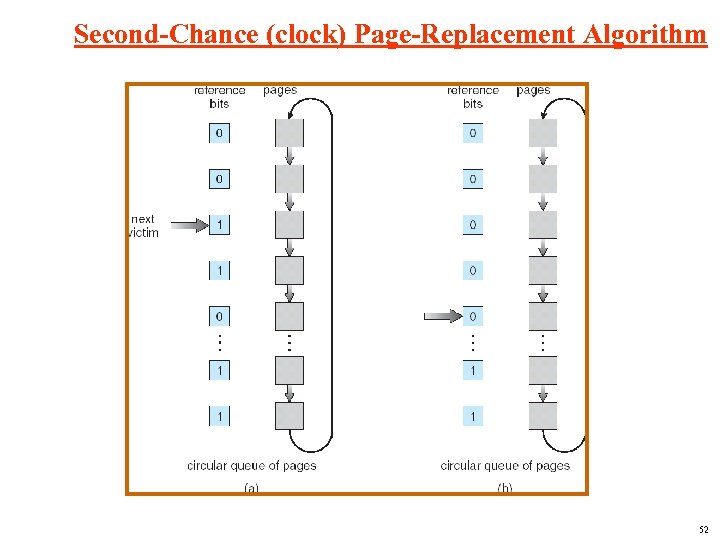 Second-Chance (clock) Page-Replacement Algorithm 52
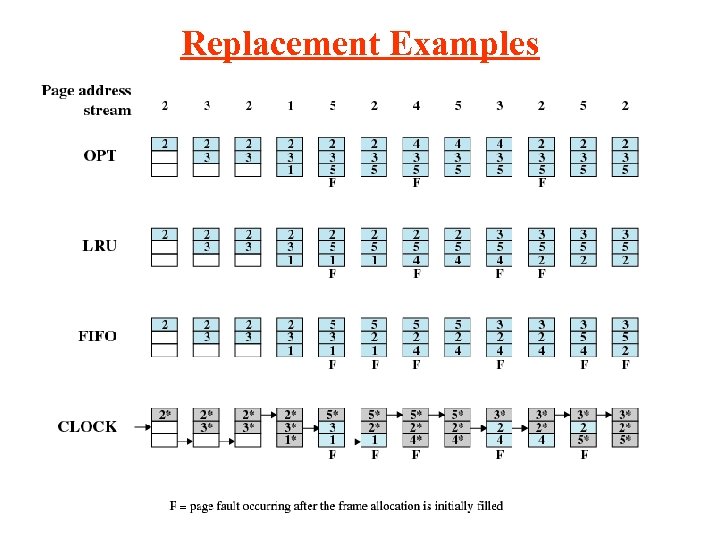 Replacement Examples
 Other Replacement Algorithms • LFU Algorithm: Keep a counter of the number of references that have been made to each page and replaces page with smallest count • MRU Algorithm: replace most-recently-used page
 Global vs. Local Allocation • Local replacement ØOS selects a victim page from only the set of frames allocated to the process that has the page fault ØPro: One process can hold its allocated frames without worrying about interference from others. ØCon: the number of allocated memory cannot be dynamically adjusted according to changing memory demands of various processes. • Global replacement ØOS selects a victim frame from the set of all frames; one process can take a frame from another ØPro: has greater system throughput and is more commonly used. ØCon: One process can excessively lose its frames, leading to thrashing
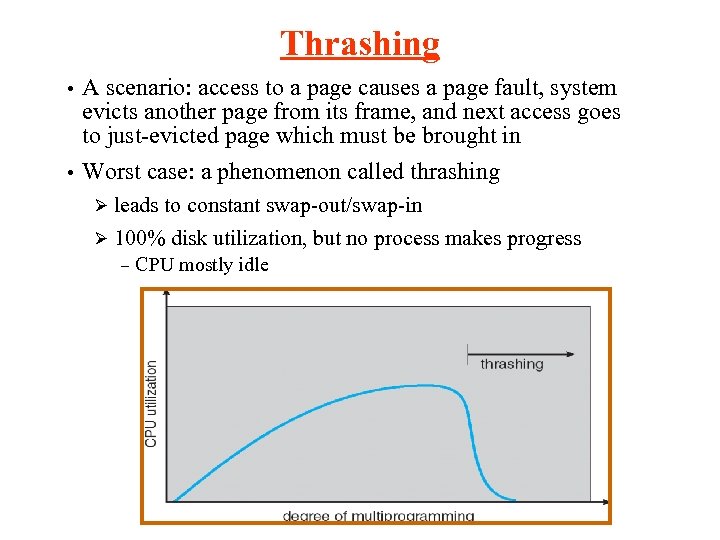 Thrashing A scenario: access to a page causes a page fault, system evicts another page from its frame, and next access goes to just-evicted page which must be brought in • Worst case: a phenomenon called thrashing • leads to constant swap-out/swap-in Ø 100% disk utilization, but no process makes progress Ø – CPU mostly idle
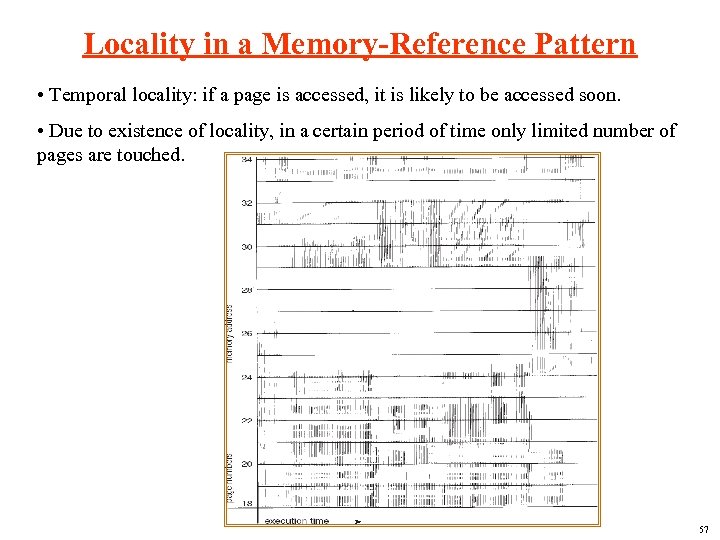 Locality in a Memory-Reference Pattern • Temporal locality: if a page is accessed, it is likely to be accessed soon. • Due to existence of locality, in a certain period of time only limited number of pages are touched. 57
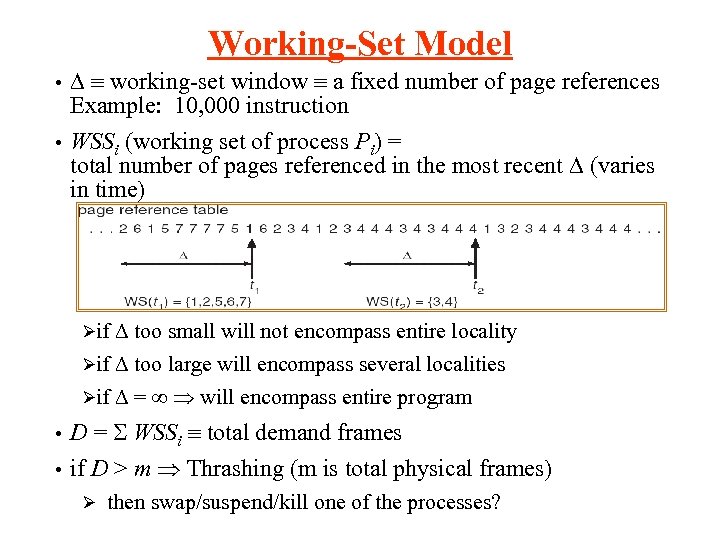 Working-Set Model working-set window a fixed number of page references Example: 10, 000 instruction • WSSi (working set of process Pi) = total number of pages referenced in the most recent (varies in time) • too small will not encompass entire locality Øif too large will encompass several localities Øif = will encompass entire program Øif D = WSSi total demand frames • if D > m Thrashing (m is total physical frames) • Ø then swap/suspend/kill one of the processes?
 Keeping Track of the Working Set • Approximate with interval timer + reference bits = 10, 000 ―Timer interrupts after every 5000 time units ―Keep in memory 2 bits for each page ―Whenever a timer interrupts, copy and set the values of all reference bits to 0 ―If one of the bits in memory = 1 page in working set ØExample: • Why is this not completely accurate? ØWorking ØIn set is a property inherent to a process; a multiprogramming environment, this approach cannot accurately track WS of a particular process.
 Can Thrashing be Prevented? • Why is there thrashing? ØProcess does exhibit locality, but the locality is simply too large ØProcesses individually fit & exhibit locality, but in total they are too large for the system to accommodate all • Possible solutions: ØBuy more memory ―ultimately have to do that ―The reason why thrashing is nowadays less of a problem than in the past – still OS must have strategy to avoid worst case Ø • Let OS decide to kill processes that are thrashing ― Linux kills a process if many trials of searching of a free page frame for the process fail Approach to prevent thrashing in a multiprogramming environment – token-ordered LRU
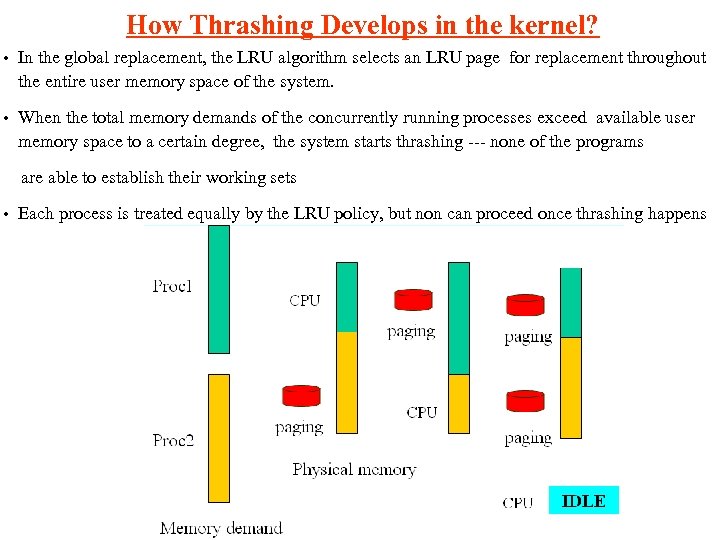 How Thrashing Develops in the kernel? • In the global replacement, the LRU algorithm selects an LRU page for replacement throughout the entire user memory space of the system. • When the total memory demands of the concurrently running processes exceed available user memory space to a certain degree, the system starts thrashing --- none of the programs are able to establish their working sets • Each process is treated equally by the LRU policy, but non can proceed once thrashing happens
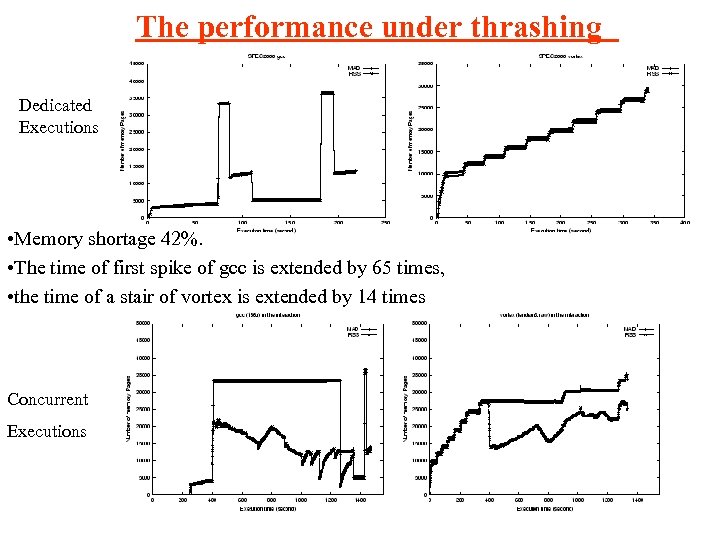 The performance under thrashing Dedicated Executions • Memory shortage 42%. • The time of first spike of gcc is extended by 65 times, • the time of a stair of vortex is extended by 14 times Concurrent Executions
 The False LRU Page • A page frame of a process becomes a replacement candidate under the LRU algorithm if the page has not been used for a certain period of time. • There are two conditions under which a page is not accessed by its owner process: 1) the process does not need to access the page; 2) the process is conducting page faults (sleeping) so that it is not able to access the page although it might have done so without the page faults. • We call the LRU pages generated on the first condition true LRU pages, and those on the secondition false LRU pages. • These false LRU pages are produced by the time delay of page faults, not by the access delay of the program. Ø The LRU principle is not maintained. • However, LRU page replacement implementations do not discriminate between these two types of LRU pages, and treats them equally!
 Thrashing Prevention: Token-order LRU • The basic idea: Ø Set a token in the system. Ø The token is taken by one of the processes when page faults occur. Ø The system eliminates the false LRU pages from the process holding the token to allow it to quickly establish its working set. ØThe token process is expected to complete its execution and release its allocated memory as well as its token. Ø Other processes then compete for the token and complete their runs in turn. By transferring privilege among processes in thrashing from one to another, the system can reduce the total number of false LRU pages and to transform the chaotic order of page usages to an arranged order. • The policy can be designed to allow token transferred more intelligently among processes to address issues such as fairness and starvation. •
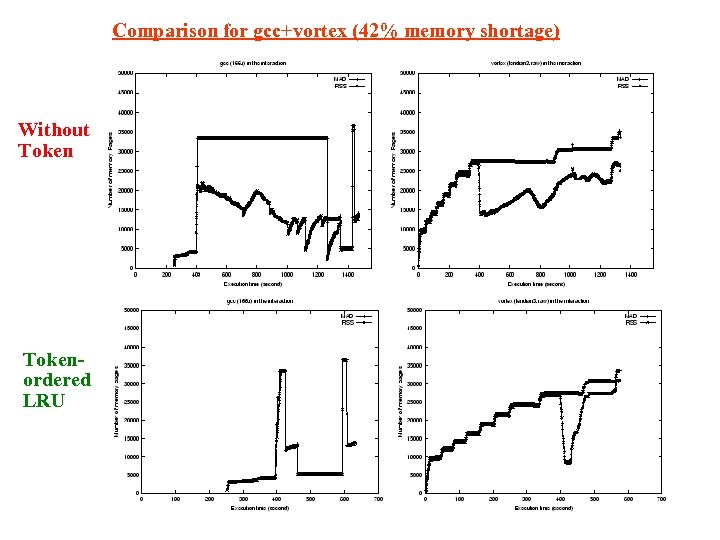 Comparison for gcc+vortex (42% memory shortage) Without Tokenordered LRU
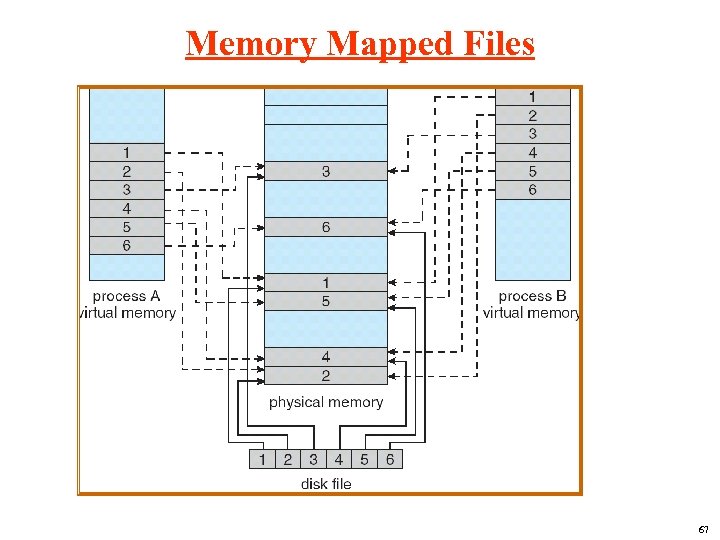
 Memory-Mapped Files • Memory-mapped file I/O allows file I/O to be treated as routine memory access by mapping a disk block to a page in memory (e. g. , using mmap() system call) • A page-sized portion of the file is read from the file system into a physical page and mapped to a process’s address space. Subsequent memory address to this address space is equivalent to reads/writes to/from the corresponding region in the file. Demand paging is still applied. • Simplifies file access by treating file I/O through memory rather than read(), write() system calls • Also allows several processes to map the same file allowing the pages in memory to be shared
 Memory Mapped Files 67