 Скачать презентацию ECE 636 Reconfigurable Computing Lecture 1 Course Introduction
14cf1627b9c1dd6e739297d5d3eec26d.ppt
- Количество слайдов: 33




ECE 636 Reconfigurable Computing Lecture 1 Course Introduction Prof. Russell Tessier Lecture 1: Course Introduction September 6, 2016
What is Reconfigurable Computing? • Computation using hardware that can adapt at the logic level to solve specific problems ° Why is this interesting? • Many applications are poorly suited to microprocessors • VLSI “explosion” provides increasing resources. How can we use them? - “field-programmable” devices • Allows for high performance, bug fixes, and fast time -to market for a selection of applications Lecture 1: Course Introduction September 6, 2016
Background needed for this course 1. Basic VLSI – transistors, delay models. 2. Basic algorithms – graph algorithms, searches 3. Computer Architecture – ALU, microprocessor 4. Digital Design – adder, counter, etc. Topic self-contained! Reconfigurable Computing is a lot more than just devices Lecture 1: Course Introduction September 6, 2016
Course Organization • Homework assignments (15%) • Final project (30%) • Mid-term (25%) • Final exam (25%) • Class participation/attendance (5%) - Students expected to participate in class discussion • No required text – readings will be assigned from research papers. - We will use material from the three survey papers on the course web site a lot Lecture 1: Course Introduction September 6, 2016
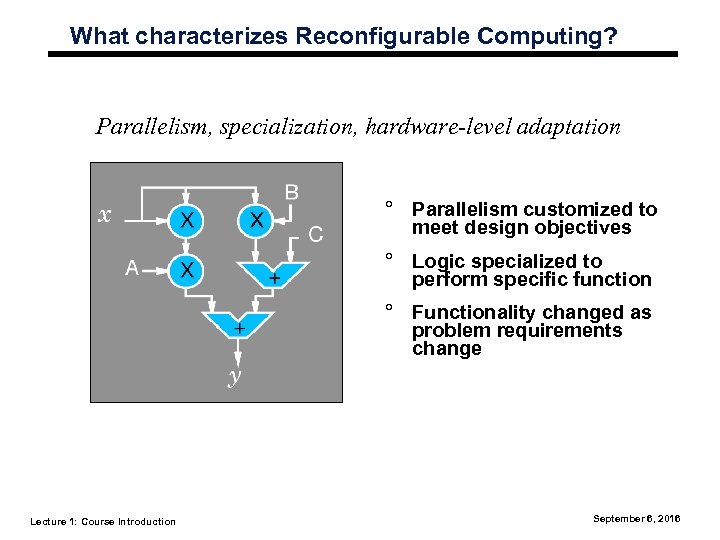
What characterizes Reconfigurable Computing? Parallelism, specialization, hardware-level adaptation ° Parallelism customized to meet design objectives ° Logic specialized to perform specific function ° Functionality changed as problem requirements change Lecture 1: Course Introduction September 6, 2016
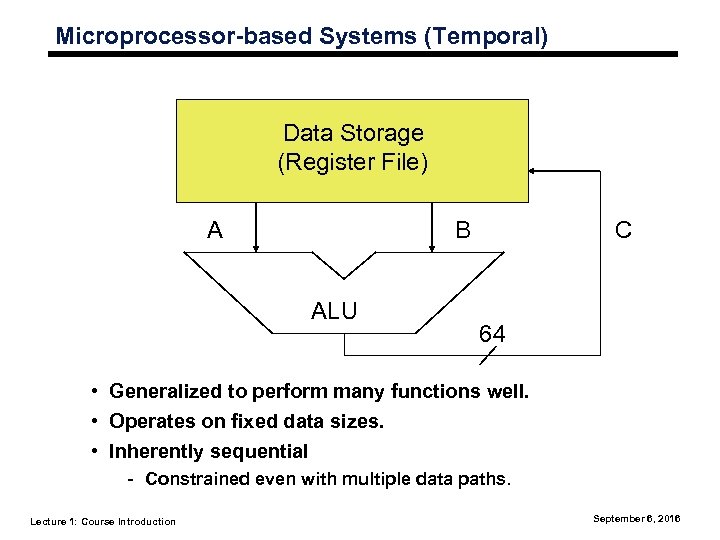
Microprocessor-based Systems (Temporal) Data Storage (Register File) A B ALU C 64 • Generalized to perform many functions well. • Operates on fixed data sizes. • Inherently sequential - Constrained even with multiple data paths. Lecture 1: Course Introduction September 6, 2016
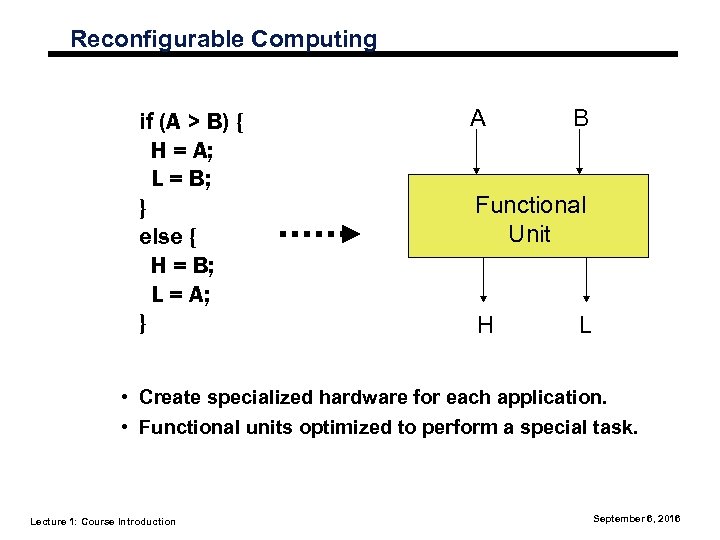
Reconfigurable Computing if (A > B) { H = A; L = B; } else { H = B; L = A; } A B Functional Unit H L • Create specialized hardware for each application. • Functional units optimized to perform a special task. Lecture 1: Course Introduction September 6, 2016
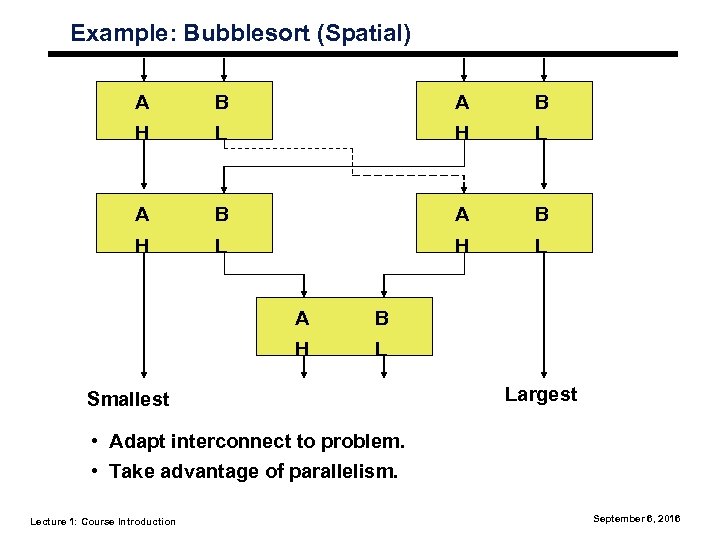
Example: Bubblesort (Spatial) A B A B H L H L A B H L Smallest Largest • Adapt interconnect to problem. • Take advantage of parallelism. Lecture 1: Course Introduction September 6, 2016
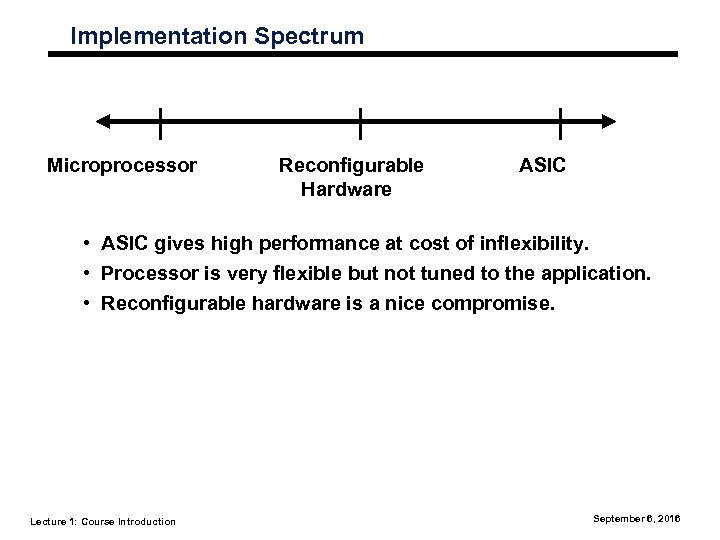
Implementation Spectrum Microprocessor Reconfigurable Hardware ASIC • ASIC gives high performance at cost of inflexibility. • Processor is very flexible but not tuned to the application. • Reconfigurable hardware is a nice compromise. Lecture 1: Course Introduction September 6, 2016
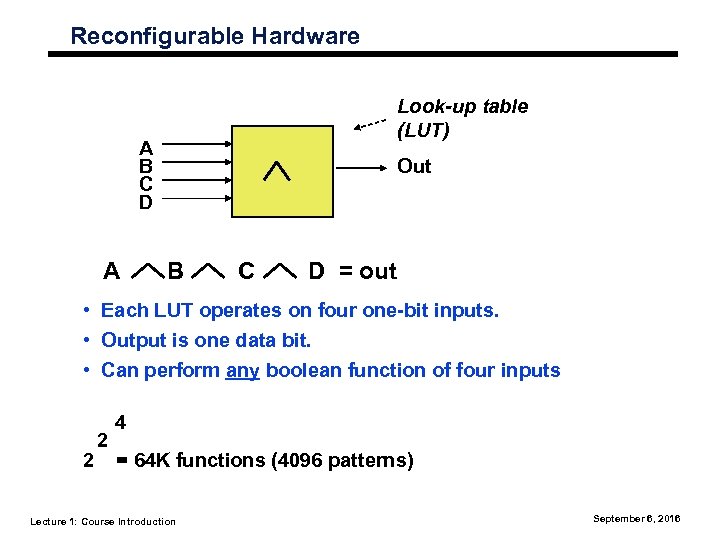
Reconfigurable Hardware Look-up table (LUT) A B C D A Out B C D = out • Each LUT operates on four one-bit inputs. • Output is one data bit. • Can perform any boolean function of four inputs 2 2 4 = 64 K functions (4096 patterns) Lecture 1: Course Introduction September 6, 2016
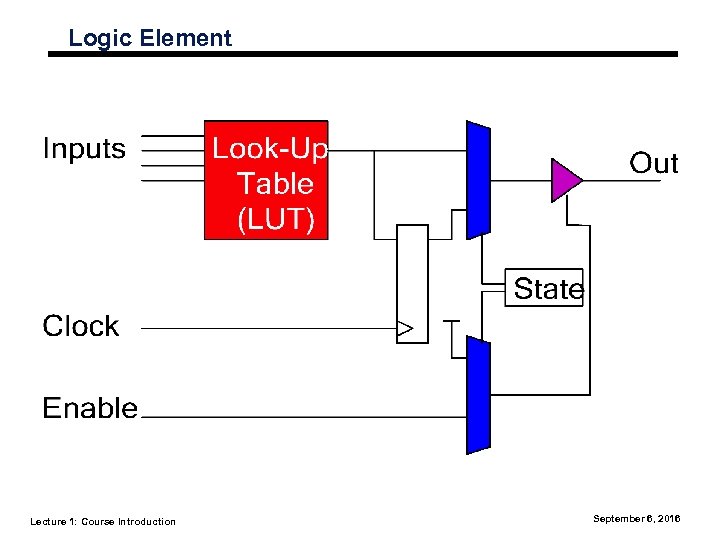
Logic Element Lecture 1: Course Introduction September 6, 2016
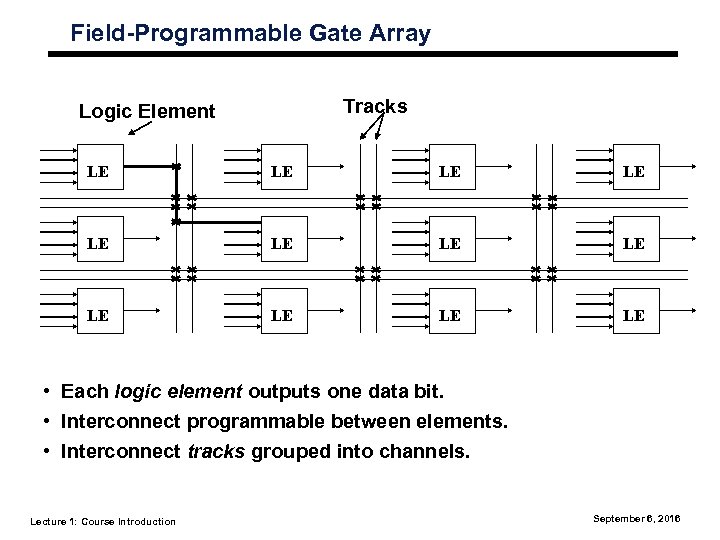
Field-Programmable Gate Array Tracks Logic Element LE LE LE • Each logic element outputs one data bit. • Interconnect programmable between elements. • Interconnect tracks grouped into channels. Lecture 1: Course Introduction September 6, 2016
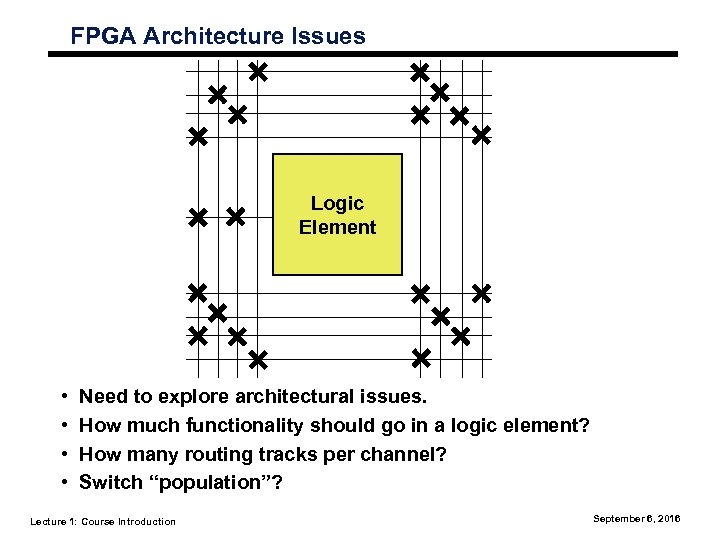
FPGA Architecture Issues Logic Element • • Need to explore architectural issues. How much functionality should go in a logic element? How many routing tracks per channel? Switch “population”? Lecture 1: Course Introduction September 6, 2016

In the Beginning - Xilinx XC 4000 Cell Lecture 1: Course Introduction • 2 4 -input look-up tables • 1 3 -input look-up table • 2 D flip flops September 6, 2016
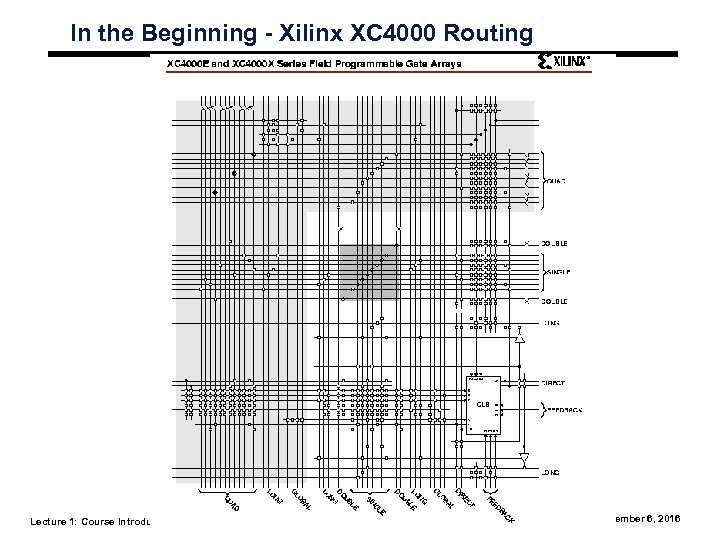
In the Beginning - Xilinx XC 4000 Routing Lecture 1: Course Introduction 25 September 6, 2016
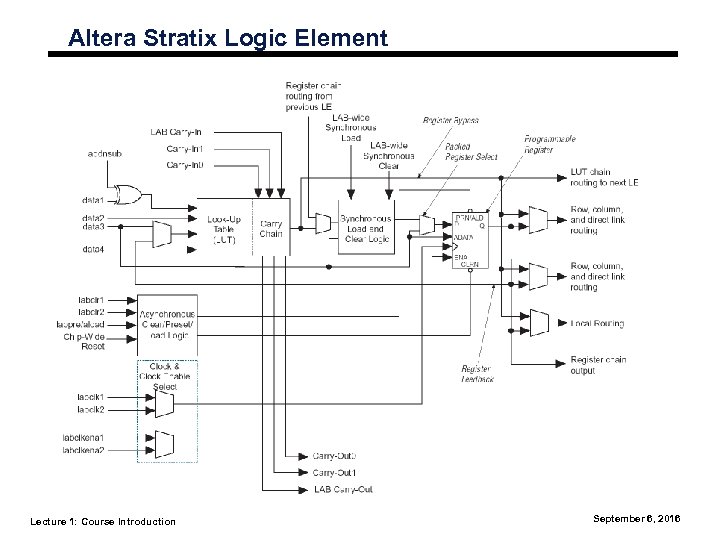
Altera Stratix Logic Element Lecture 1: Course Introduction September 6, 2016
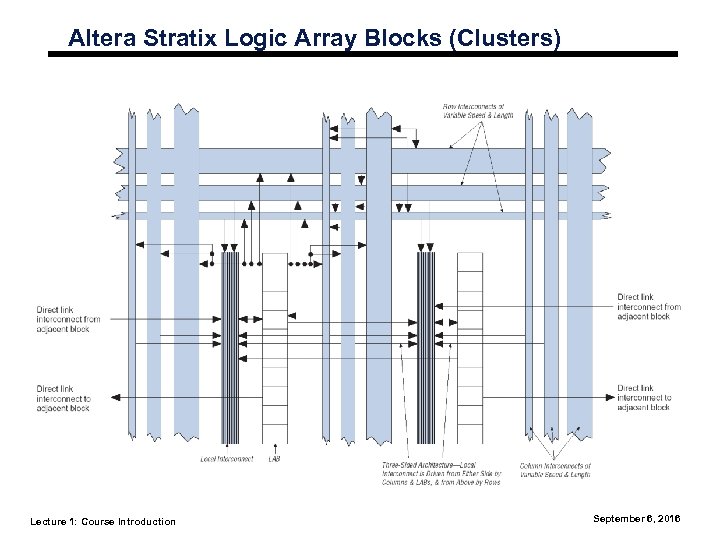
Altera Stratix Logic Array Blocks (Clusters) Lecture 1: Course Introduction September 6, 2016
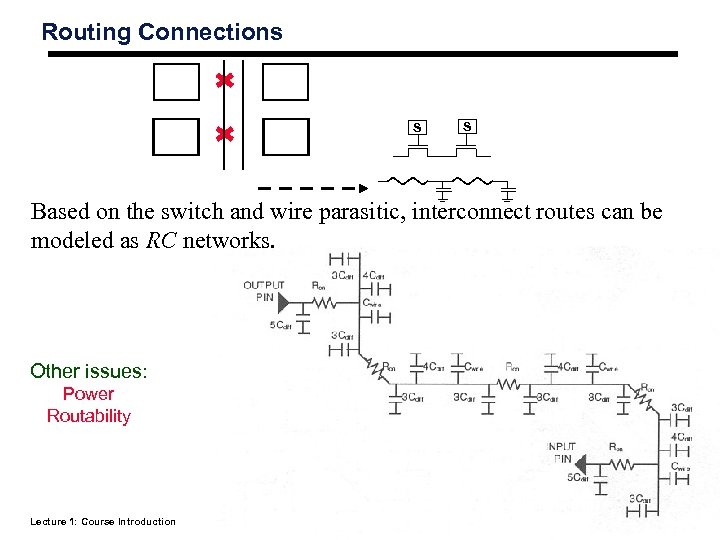
Routing Connections S S Based on the switch and wire parasitic, interconnect routes can be modeled as RC networks. Other issues: Power Routability Lecture 1: Course Introduction September 6, 2016
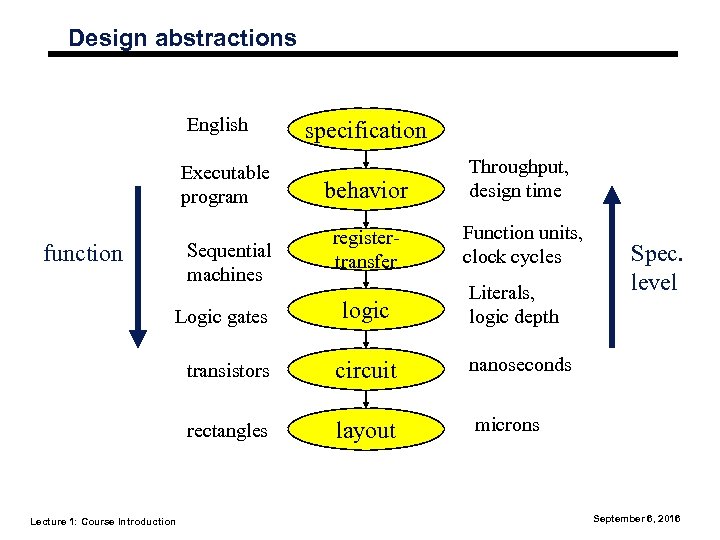
Design abstractions English Executable program Sequential machines function Logic gates specification behavior Throughput, design time registertransfer Function units, clock cycles logic Literals, logic depth transistors nanoseconds rectangles Lecture 1: Course Introduction circuit layout Spec. level microns September 6, 2016
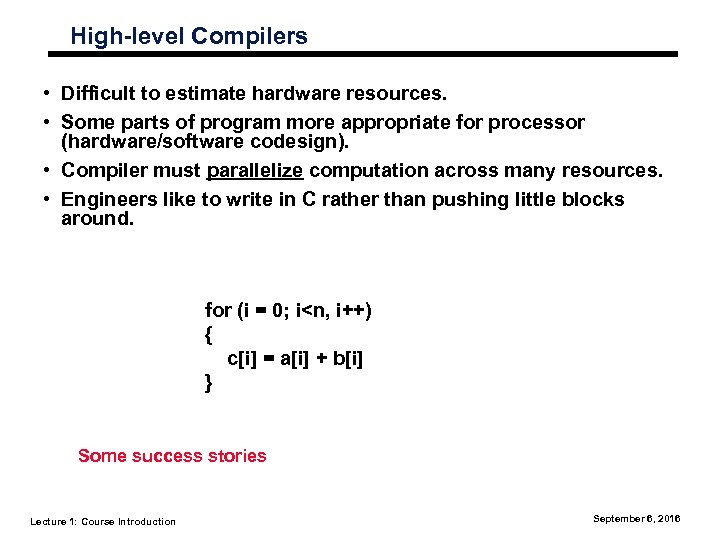
High-level Compilers • Difficult to estimate hardware resources. • Some parts of program more appropriate for processor (hardware/software codesign). • Compiler must parallelize computation across many resources. • Engineers like to write in C rather than pushing little blocks around. for (i = 0; i<n, i++) { c[i] = a[i] + b[i] } Some success stories Lecture 1: Course Introduction September 6, 2016
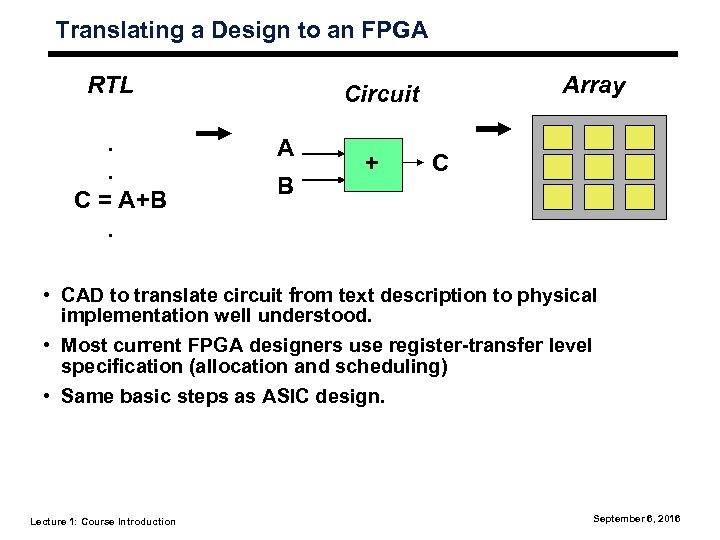
Translating a Design to an FPGA RTL. . C = A+B. Array Circuit A B + C • CAD to translate circuit from text description to physical implementation well understood. • Most current FPGA designers use register-transfer level specification (allocation and scheduling) • Same basic steps as ASIC design. Lecture 1: Course Introduction September 6, 2016
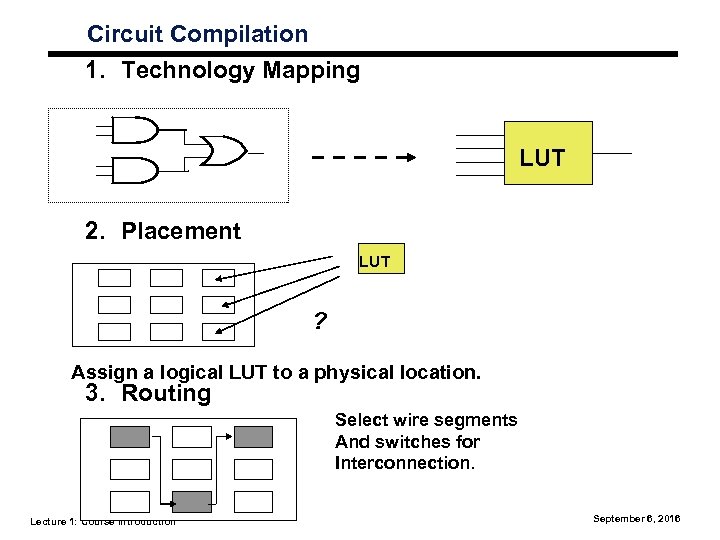
Circuit Compilation 1. Technology Mapping LUT 2. Placement LUT ? Assign a logical LUT to a physical location. 3. Routing Select wire segments And switches for Interconnection. Lecture 1: Course Introduction September 6, 2016
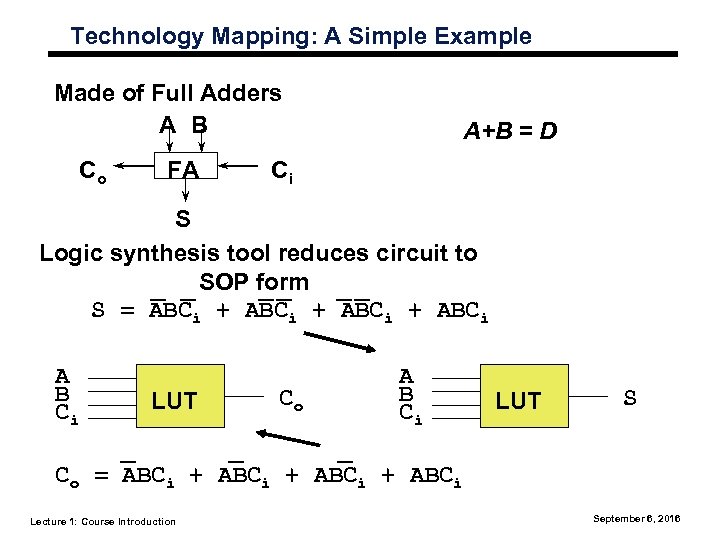
Technology Mapping: A Simple Example Made of Full Adders A B Co FA A+B = D Ci S Logic synthesis tool reduces circuit to SOP form S = ABCi + ABCi A B Ci LUT Co A B Ci LUT S Co = ABCi + ABCi Lecture 1: Course Introduction September 6, 2016
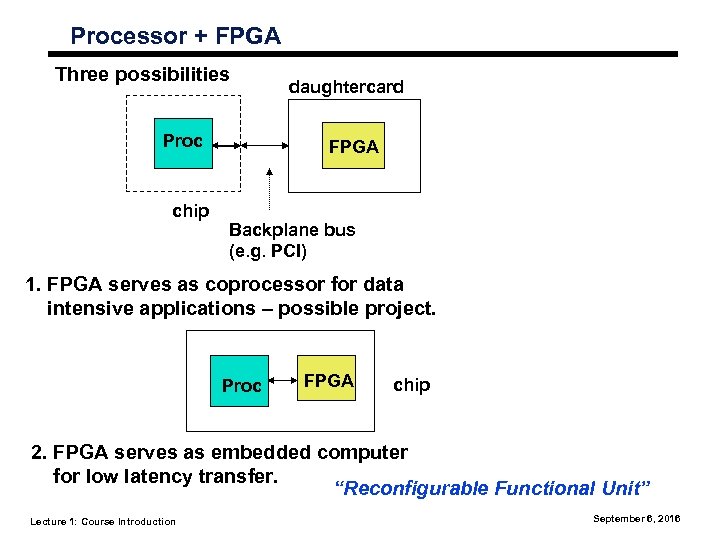
Processor + FPGA Three possibilities Proc chip daughtercard FPGA Backplane bus (e. g. PCI) 1. FPGA serves as coprocessor for data intensive applications – possible project. Proc FPGA chip 2. FPGA serves as embedded computer for low latency transfer. “Reconfigurable Functional Unit” Lecture 1: Course Introduction September 6, 2016
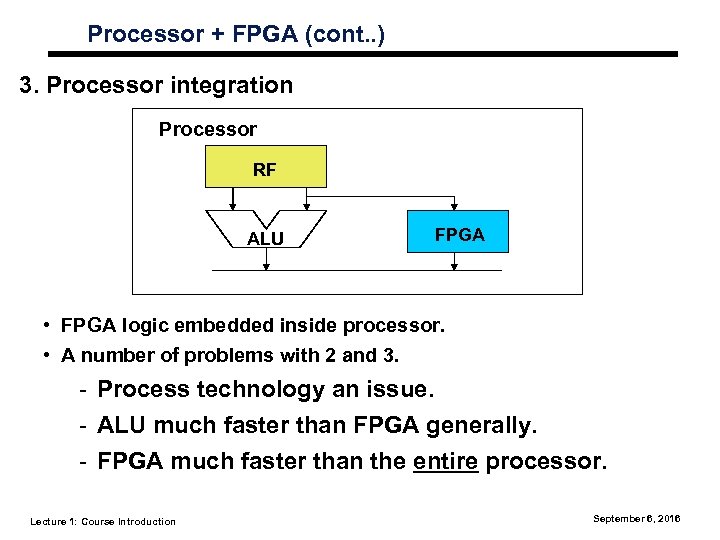
Processor + FPGA (cont. . ) 3. Processor integration Processor RF ALU FPGA • FPGA logic embedded inside processor. • A number of problems with 2 and 3. - Process technology an issue. - ALU much faster than FPGA generally. - FPGA much faster than the entire processor. Lecture 1: Course Introduction September 6, 2016
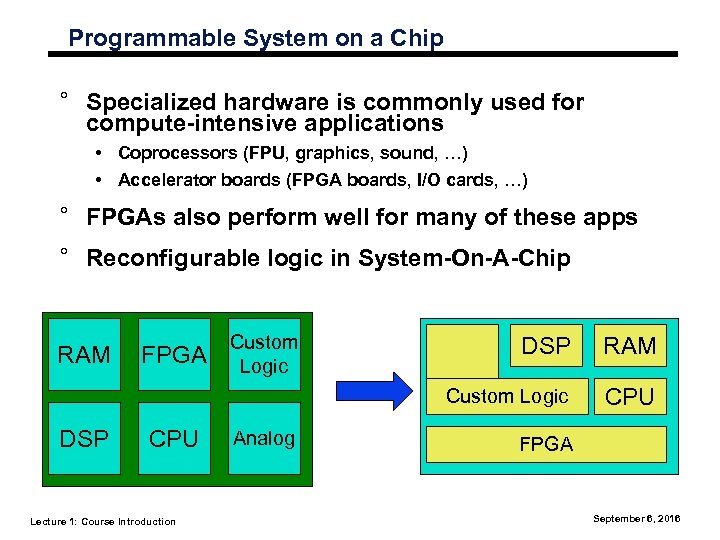
Programmable System on a Chip ° Specialized hardware is commonly used for compute-intensive applications • Coprocessors (FPU, graphics, sound, …) • Accelerator boards (FPGA boards, I/O cards, …) ° FPGAs also perform well for many of these apps ° Reconfigurable logic in System-On-A-Chip Custom Logic DSP FPGA CPU Lecture 1: Course Introduction Analog DSP RAM Custom Logic RAM CPU FPGA September 6, 2016
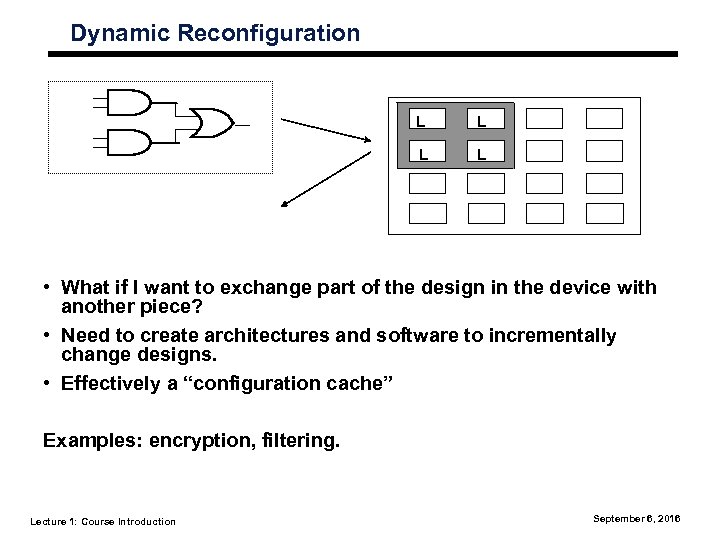
Dynamic Reconfiguration L L • What if I want to exchange part of the design in the device with another piece? • Need to create architectures and software to incrementally change designs. • Effectively a “configuration cache” Examples: encryption, filtering. Lecture 1: Course Introduction September 6, 2016
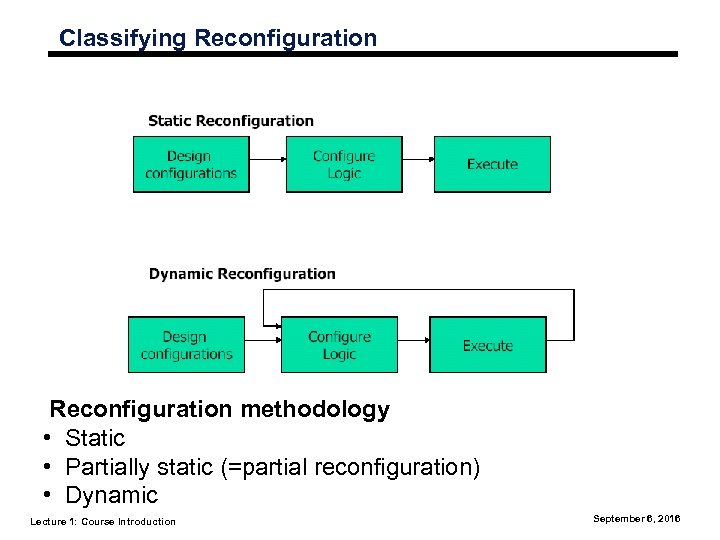
Classifying Reconfiguration methodology • Static • Partially static (=partial reconfiguration) • Dynamic Lecture 1: Course Introduction September 6, 2016
Types of Reconfiguration ° Types of reconfiguration • Static reconfiguration – application is not running • Semi-static – different portions of application time-sliced on same hardware fabric • Dynamic reconfiguration – application modified in response to changing environmental issues ° What is reconfigured? • Processor reconfiguration – customized instruction sets, pipelining, bit width • Parameter reconfiguration • Control reconfiguration Can you think of other applications? Lecture 1: Course Introduction September 6, 2016
Hot Reconfigurable Computing Research Areas • Determining what fixed components should go in an FPGA (I/O, routers, network interfaces, etc) • Important new applications for reconfigurable devices (especially embedded applications and security) • Better understanding the role of standard microprocessors, GPUs, and reconfigurable hardware. - They all have benefits - Programming environments are improving - Computing in the cloud • Compiler / run-time environments - Broadening of programming (Altera: Open. CL, Xilinx: Vivado) - Operating system management / virtual machine Lecture 1: Course Introduction September 6, 2016
Course Software: Versatile Place and Route • Performs FPGA placement and routing. • Written in C • Runs on Linux and PCs - We support execution on quark. ecs. umass. edu - Generally straightforward to install and use. • Estimates device sizes and performance • Very widely used in FPGA research community • More advanced version of VPR are available. - Appropriate for use in course projects Lecture 1: Course Introduction September 6, 2016
Ideas for the Course Project • Evaluate an application using a microprocessor and an FPGA - Consider performance and power consumption • Modify/update CAD algorithms associated with VPR • Model modern FPGAs which include multiple dice. • FPGA security: encryption, hardware obfuscation • High-level compilation - Adapt and evaluate Leg. Up (high-level synthesis tool) - Use Open. CL compiler to target multiple platforms Topic must involve experimentation. Lecture 1: Course Introduction September 6, 2016
Summary ° Reconfigurable computing relies heavily on new VLSI technology ° Device architectures have matured. • New features constantly considered ° Application development progressing at rapid pace ° Integration of hardware and software a difficult challenge ° FPGAs are a multi-billion dollar a year business • Devices are much different now than 20 years ago ° Active area of research at UMass. Lecture 1: Course Introduction September 6, 2016
Скачать презентацию ECE 636 Reconfigurable Computing Lecture 1 Course Introduction
14cf1627b9c1dd6e739297d5d3eec26d.ppt