


 Скачать презентацию ECE 5465 Advanced Microcomputers 9 22 2010 Lecture 1 —
ec313e7886744a6b427dbb1a566d1925.ppt
- Количество слайдов: 23
 ECE 5465 Advanced Microcomputers 9/22/2010 Lecture 1 - Introduction 1
 Outline o o Course Overview Historical Perspective 9/22/2010 Lecture 1 - Introduction 2
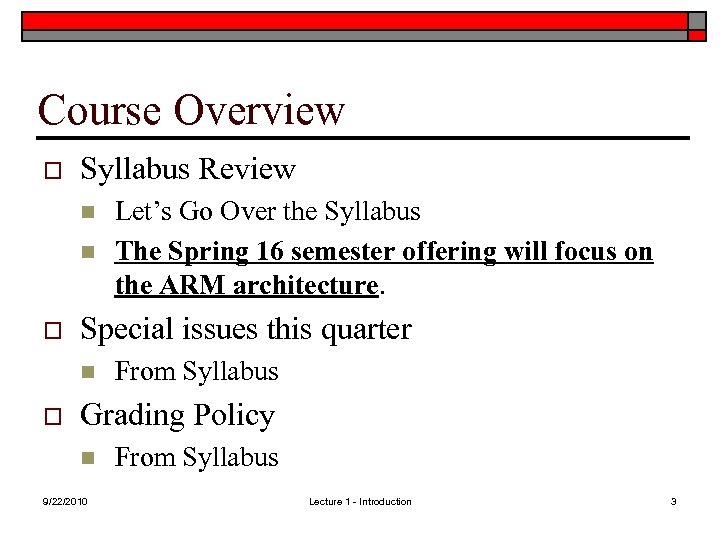 Course Overview o Syllabus Review n n o Special issues this quarter n o Let’s Go Over the Syllabus The Spring 16 semester offering will focus on the ARM architecture. From Syllabus Grading Policy n 9/22/2010 From Syllabus Lecture 1 - Introduction 3
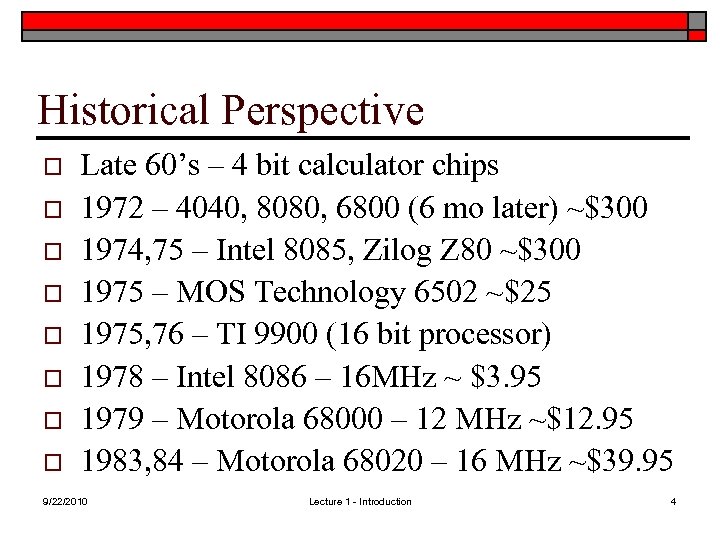 Historical Perspective o o o o Late 60’s – 4 bit calculator chips 1972 – 4040, 8080, 6800 (6 mo later) ~$300 1974, 75 – Intel 8085, Zilog Z 80 ~$300 1975 – MOS Technology 6502 ~$25 1975, 76 – TI 9900 (16 bit processor) 1978 – Intel 8086 – 16 MHz ~ $3. 95 1979 – Motorola 68000 – 12 MHz ~$12. 95 1983, 84 – Motorola 68020 – 16 MHz ~$39. 95 9/22/2010 Lecture 1 - Introduction 4
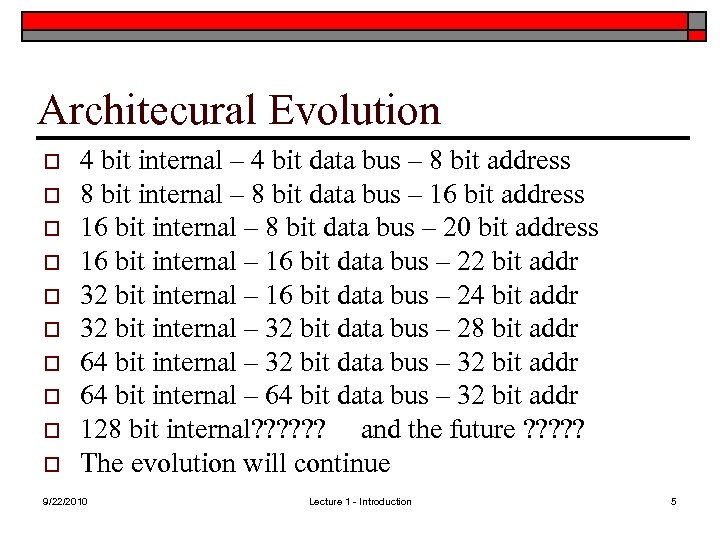 Architecural Evolution o o o o o 4 bit internal – 4 bit data bus – 8 bit address 8 bit internal – 8 bit data bus – 16 bit address 16 bit internal – 8 bit data bus – 20 bit address 16 bit internal – 16 bit data bus – 22 bit addr 32 bit internal – 16 bit data bus – 24 bit addr 32 bit internal – 32 bit data bus – 28 bit addr 64 bit internal – 32 bit data bus – 32 bit addr 64 bit internal – 64 bit data bus – 32 bit addr 128 bit internal? ? ? and the future ? ? ? The evolution will continue 9/22/2010 Lecture 1 - Introduction 5
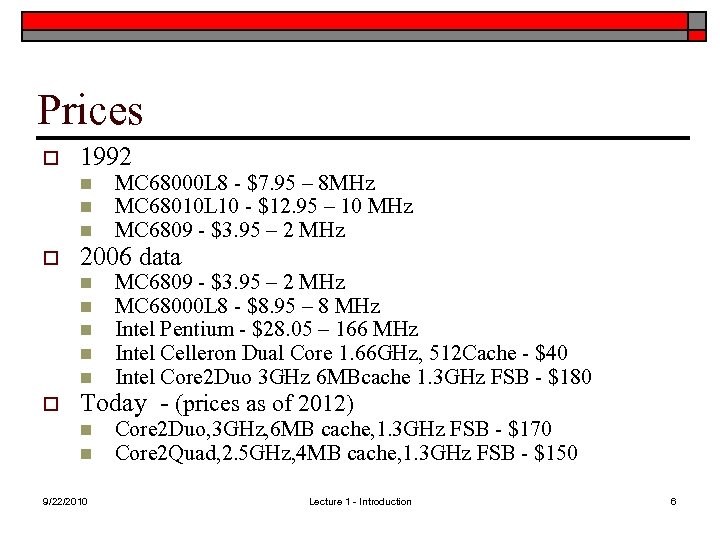 Prices o 1992 n n n o 2006 data n n n o MC 68000 L 8 - $7. 95 – 8 MHz MC 68010 L 10 - $12. 95 – 10 MHz MC 6809 - $3. 95 – 2 MHz MC 68000 L 8 - $8. 95 – 8 MHz Intel Pentium - $28. 05 – 166 MHz Intel Celleron Dual Core 1. 66 GHz, 512 Cache - $40 Intel Core 2 Duo 3 GHz 6 MBcache 1. 3 GHz FSB - $180 Today - (prices as of 2012) n n 9/22/2010 Core 2 Duo, 3 GHz, 6 MB cache, 1. 3 GHz FSB - $170 Core 2 Quad, 2. 5 GHz, 4 MB cache, 1. 3 GHz FSB - $150 Lecture 1 - Introduction 6
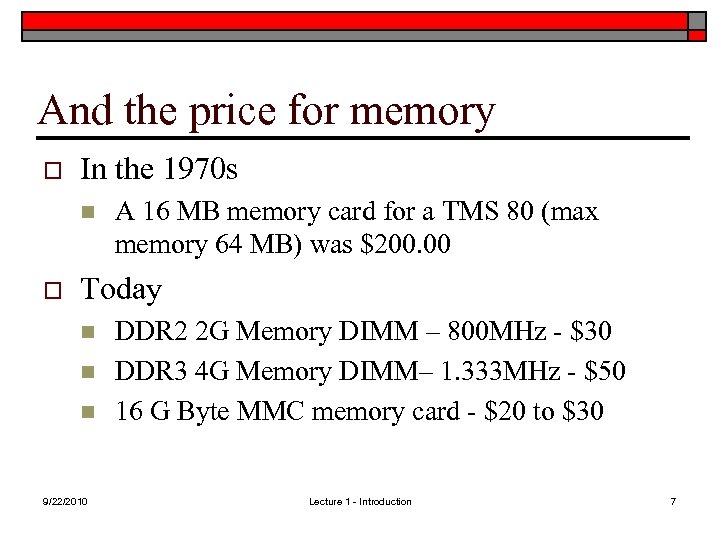 And the price for memory o In the 1970 s n o A 16 MB memory card for a TMS 80 (max memory 64 MB) was $200. 00 Today n n n 9/22/2010 DDR 2 2 G Memory DIMM – 800 MHz - $30 DDR 3 4 G Memory DIMM– 1. 333 MHz - $50 16 G Byte MMC memory card - $20 to $30 Lecture 1 - Introduction 7
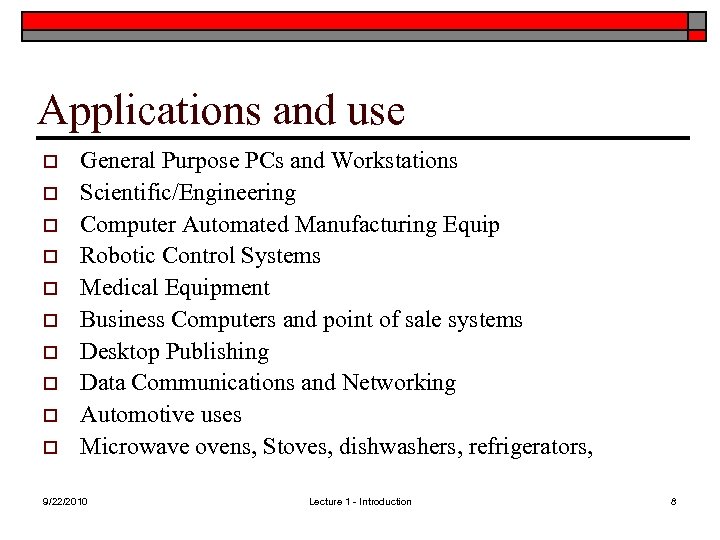 Applications and use o o o o o General Purpose PCs and Workstations Scientific/Engineering Computer Automated Manufacturing Equip Robotic Control Systems Medical Equipment Business Computers and point of sale systems Desktop Publishing Data Communications and Networking Automotive uses Microwave ovens, Stoves, dishwashers, refrigerators, 9/22/2010 Lecture 1 - Introduction 8
 Course Goals o o o Understand more advanced micro-computer architecture concepts through the study of a representative architecture. Previous = The 68000 family is one of several microprocessor families available. It has a relatively simple instruction set and representative interfacing capabilities. It also supports multitasking. Now = The ARM architecture 9/22/2010 Lecture 1 - Introduction 9
 Some basic definitions o Microprocessor – a single CPU on a single IC chip. Contains both control and RALU n o o o Does not have on chip memory, timers, or I/O ports Microcomputer – u. Processor with memory, I/O, timing, control, interfaces, powersupply Microcontroller – has the elements of a microprocessor with supporting memory, I/O, timers, clock, interfaces (such as A-to-D) on board. RALU – Register/Arithmetic Logic Unit 9/22/2010 Lecture 1 - Introduction 10
 Von Neumann Atchitecture 9/22/2010 Lecture 1 - Introduction 11
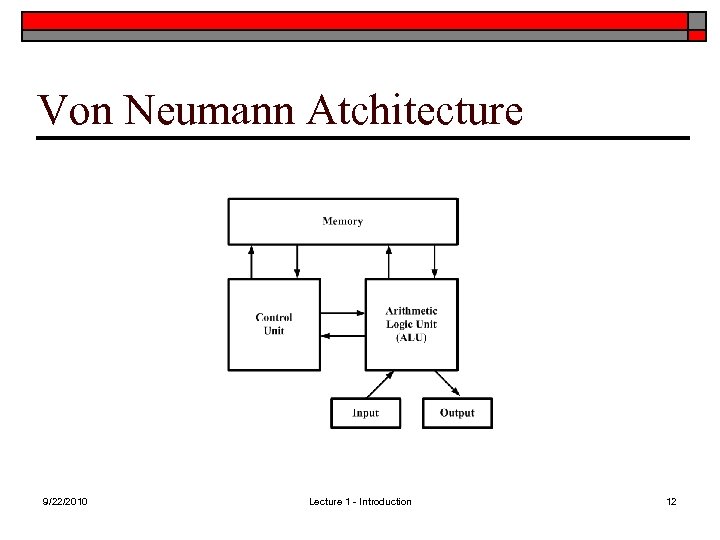 Von Neumann Atchitecture 9/22/2010 Lecture 1 - Introduction 12
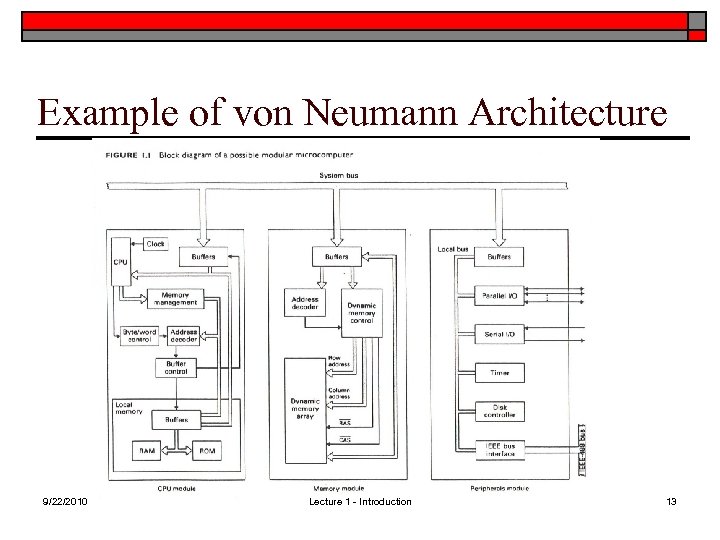 Example of von Neumann Architecture 9/22/2010 Lecture 1 - Introduction 13
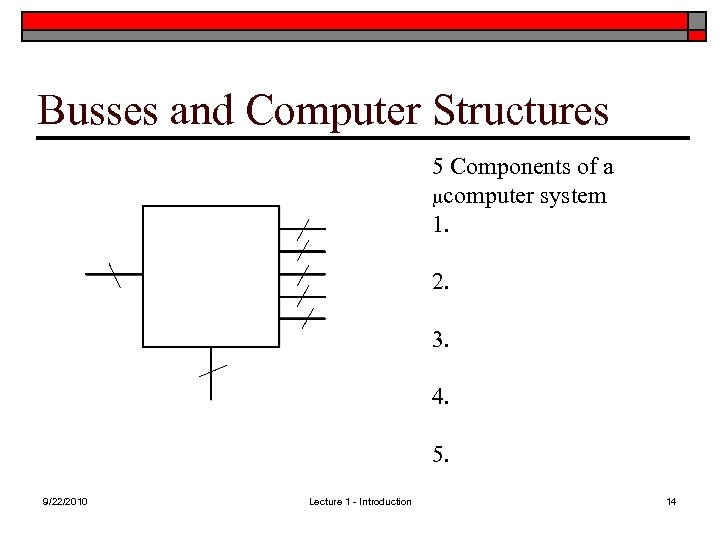 Busses and Computer Structures 5 Components of a mcomputer system 1. 2. 3. 4. 5. 9/22/2010 Lecture 1 - Introduction 14
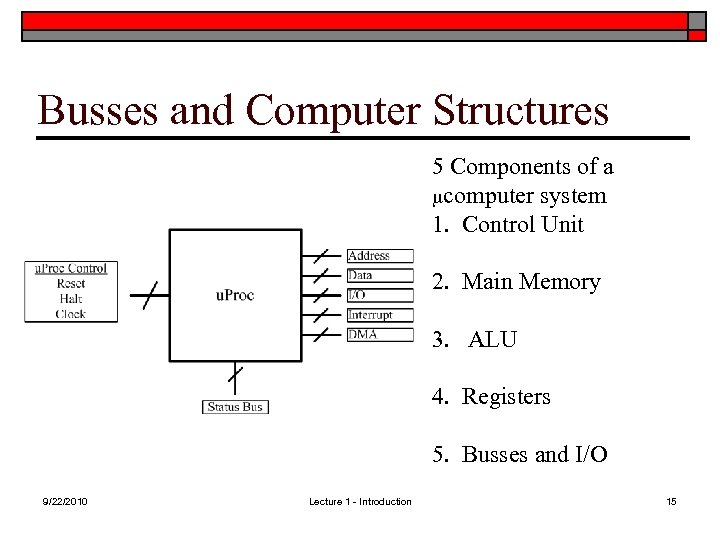 Busses and Computer Structures 5 Components of a mcomputer system 1. Control Unit 2. Main Memory 3. ALU 4. Registers 5. Busses and I/O 9/22/2010 Lecture 1 - Introduction 15
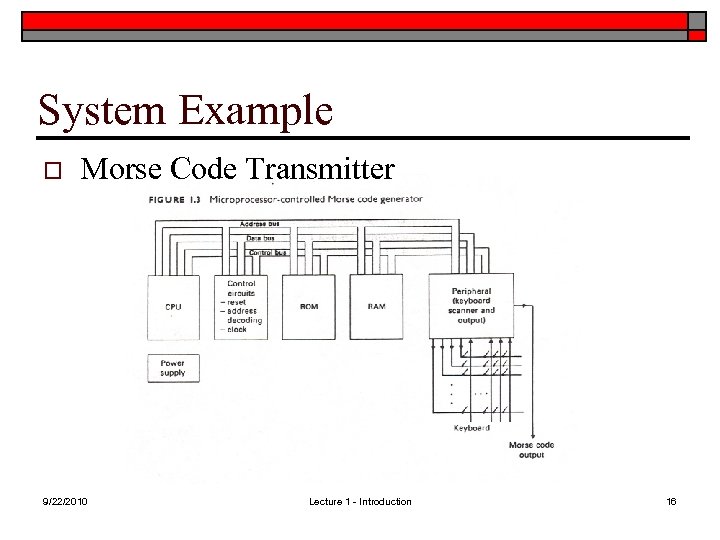 System Example o Morse Code Transmitter 9/22/2010 Lecture 1 - Introduction 16
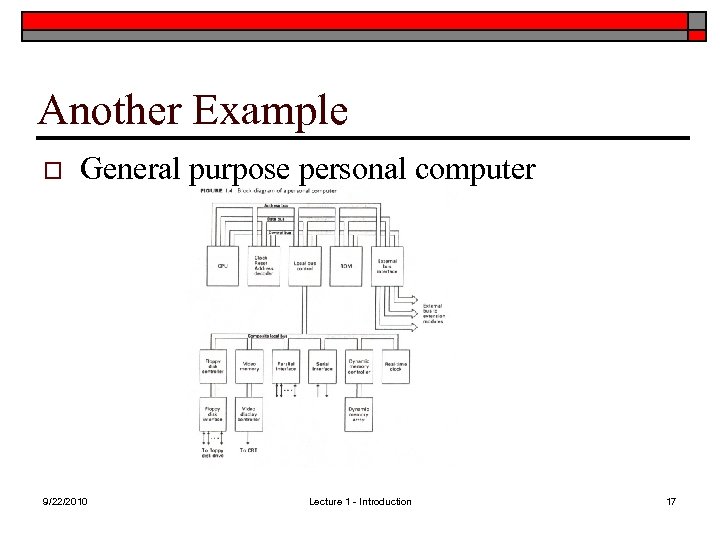 Another Example o General purpose personal computer 9/22/2010 Lecture 1 - Introduction 17
 The ARM architecture o The text focuses around a SOC based on a microprocessor core and in designing the core itself. Why is a modern processor designed the way it is? o BUY THE BOOK!!! YOU WILL NEED IT!!! 9/22/2010 Lecture 1 - Introduction 18
 ARM o o o 26 April 1985 – first ARM prototypes arrive at Acorn Computers Limited in Cambridge, England. Chips were fabricated by VLIS Technology, Inc. in San Jose, Ca. A few hours after arrival they were running code. A bottle of bubbly was opened for the celebration. For the remainder of the 80 s, ARM was quietly developed to underpin Acorn’s desktop products which formed the basic of educational computing in the UK. Over the 90 s, ARM advanced onto the world stage and established a market leading position in high performance embedded applications. 9/22/2010 Lecture 1 - Introduction 19
 USE today o o All cell phones have multiple ARM processor chips in them. All vehicles have multiple ARM processors in them. 9/22/2010 Lecture 1 - Introduction 20
 This class o o o Students will form into groups of 3. Each group of 3 will make multiple presentation over the semester. By Wednesday of week 1 a list of presentation topics for week 2 will be set up. Week 2 will only be a class on Wednesday. Each day 2 groups will make a 15 to 20 minute presentation of the topic to be followed by general discussion. The presentation will be graded so it important that all group members talk about 1/3 the time. 9/22/2010 Lecture 1 - Introduction 21
 Assignment o Read Introduction and chapter 1 of “ARM system-on-chip architecture” o Remainder of today and Wednesday – form into groups o Wednesday - Microbaby 9/22/2010 Lecture 1 - Introduction 22
 Assignment o Go to Wikipedia and read on John von Neumann. Write and 2 or 3 page summary of his life and career. Due to Drop Box on CARMEN. 9/22/2010 Lecture 1 - Introduction 23