


 Скачать презентацию ECE 476 POWER SYSTEM ANALYSIS Lecture 9 Transformers
ccfbdacdfa7355302b7153ad98867eac.ppt
- Количество слайдов: 38
 ECE 476 POWER SYSTEM ANALYSIS Lecture 9 Transformers, Per Unit Calculations Professor Tom Overbye Department of Electrical and Computer Engineering
 Announcements l l For lectures 9 and 10 please be reading Chapter 3 Homework #4 4. 34, 4. 35, 5. 14, 5. 26; due 9/25 (Thursday) 1
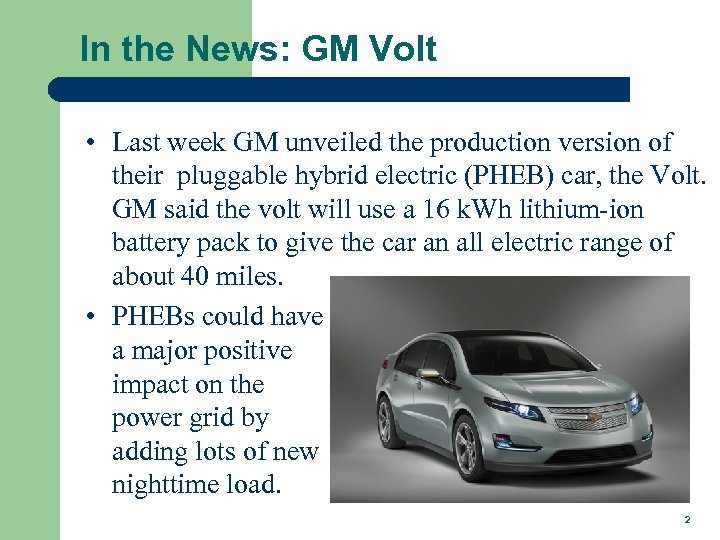 In the News: GM Volt • Last week GM unveiled the production version of their pluggable hybrid electric (PHEB) car, the Volt. GM said the volt will use a 16 k. Wh lithium-ion battery pack to give the car an all electric range of about 40 miles. • PHEBs could have a major positive impact on the power grid by adding lots of new nighttime load. 2
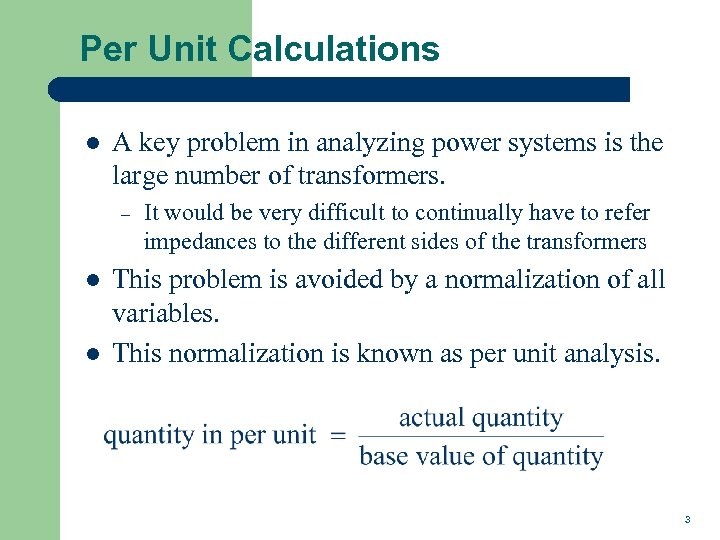 Per Unit Calculations l A key problem in analyzing power systems is the large number of transformers. – l l It would be very difficult to continually have to refer impedances to the different sides of the transformers This problem is avoided by a normalization of all variables. This normalization is known as per unit analysis. 3
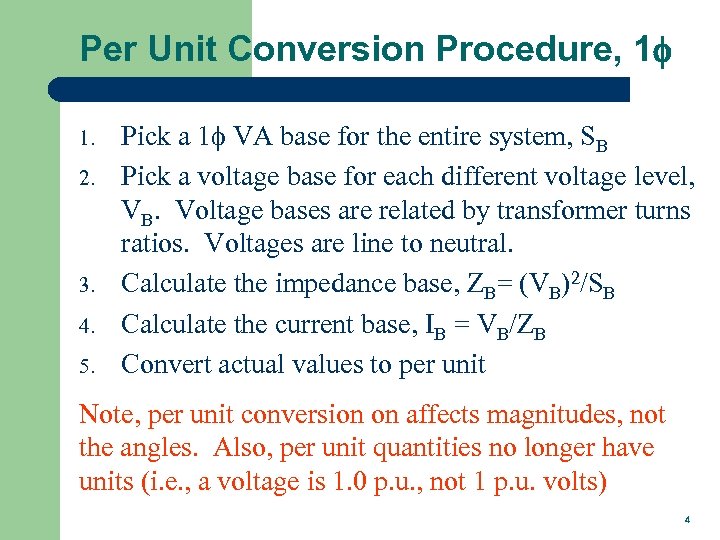 Per Unit Conversion Procedure, 1 f 1. 2. 3. 4. 5. Pick a 1 f VA base for the entire system, SB Pick a voltage base for each different voltage level, VB. Voltage bases are related by transformer turns ratios. Voltages are line to neutral. Calculate the impedance base, ZB= (VB)2/SB Calculate the current base, IB = VB/ZB Convert actual values to per unit Note, per unit conversion on affects magnitudes, not the angles. Also, per unit quantities no longer have units (i. e. , a voltage is 1. 0 p. u. , not 1 p. u. volts) 4
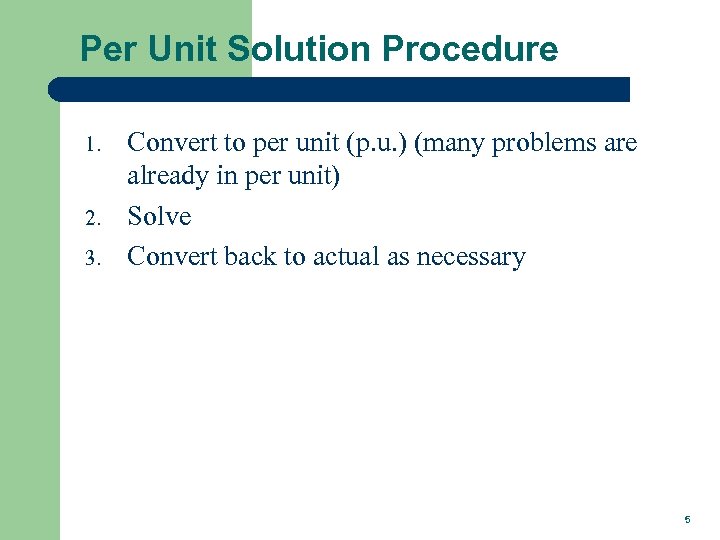 Per Unit Solution Procedure 1. 2. 3. Convert to per unit (p. u. ) (many problems are already in per unit) Solve Convert back to actual as necessary 5
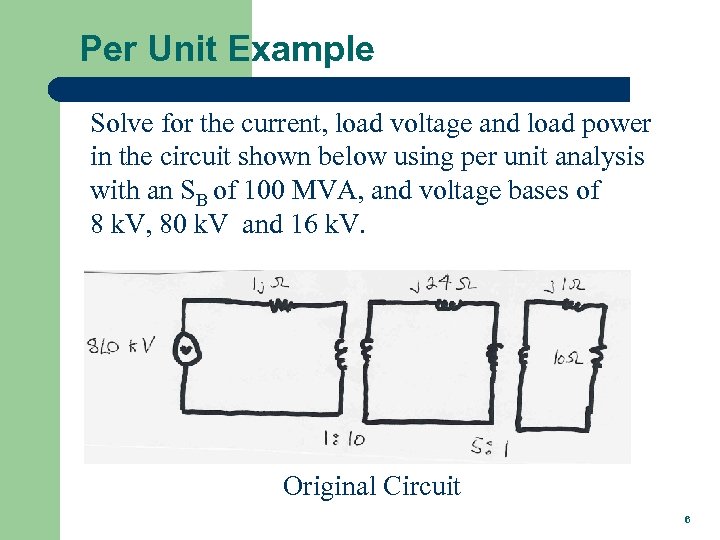 Per Unit Example Solve for the current, load voltage and load power in the circuit shown below using per unit analysis with an SB of 100 MVA, and voltage bases of 8 k. V, 80 k. V and 16 k. V. Original Circuit 6
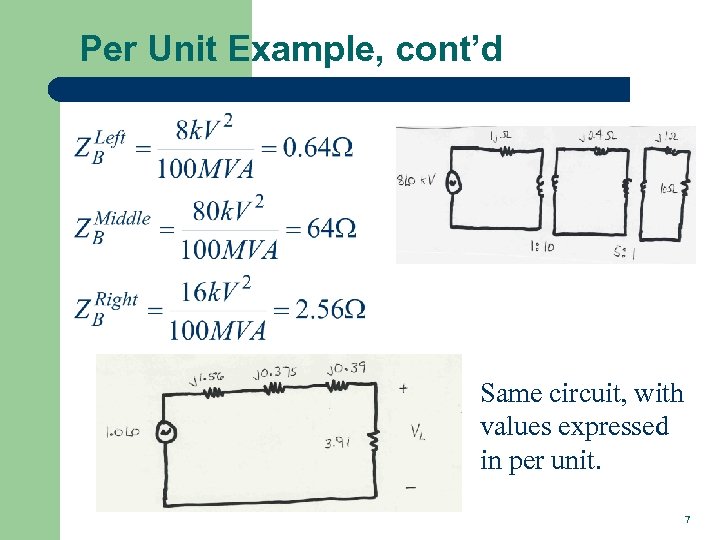 Per Unit Example, cont’d Same circuit, with values expressed in per unit. 7
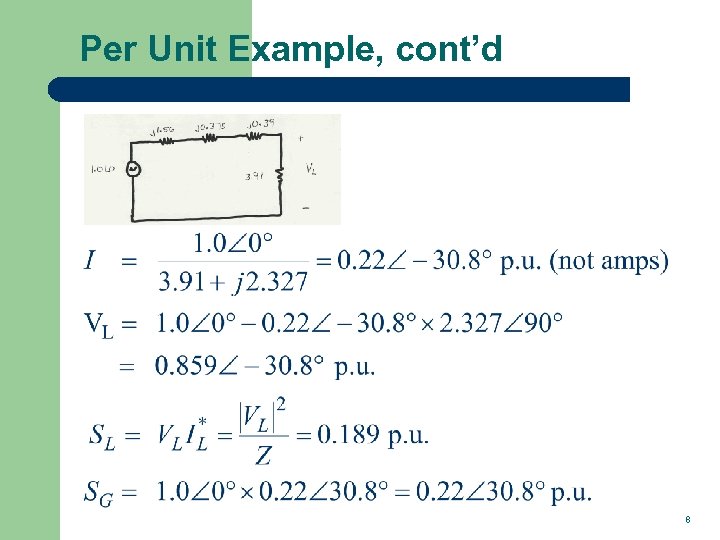 Per Unit Example, cont’d 8
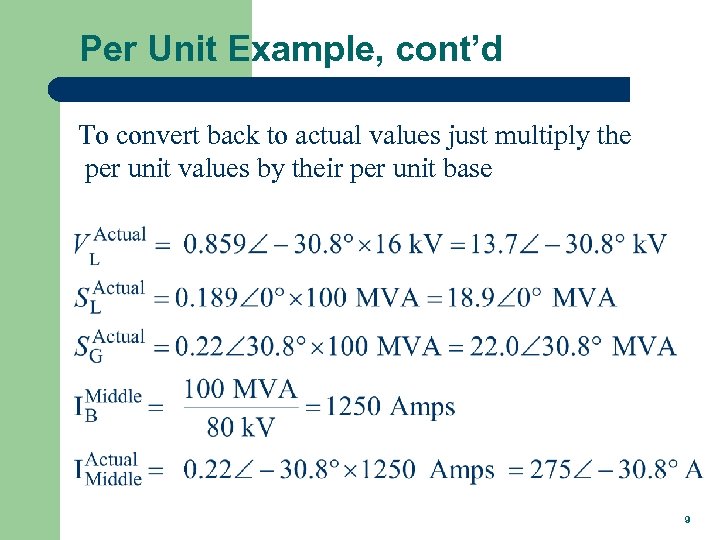 Per Unit Example, cont’d To convert back to actual values just multiply the per unit values by their per unit base 9
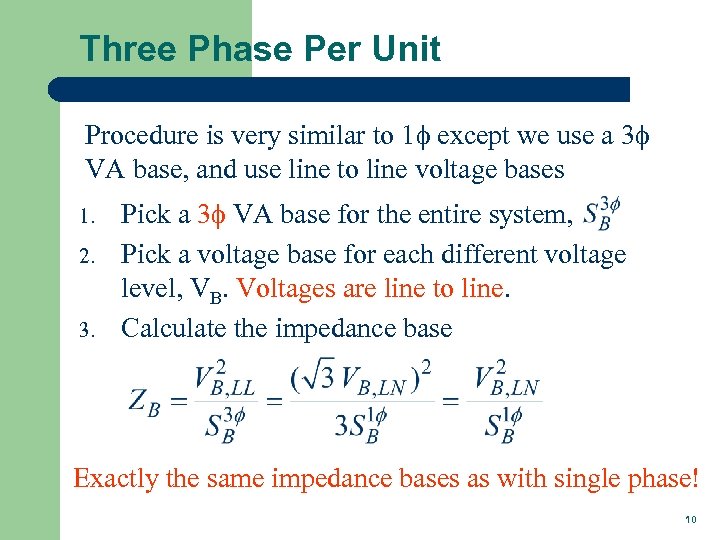 Three Phase Per Unit Procedure is very similar to 1 f except we use a 3 f VA base, and use line to line voltage bases 1. 2. 3. Pick a 3 f VA base for the entire system, Pick a voltage base for each different voltage level, VB. Voltages are line to line. Calculate the impedance base Exactly the same impedance bases as with single phase! 10
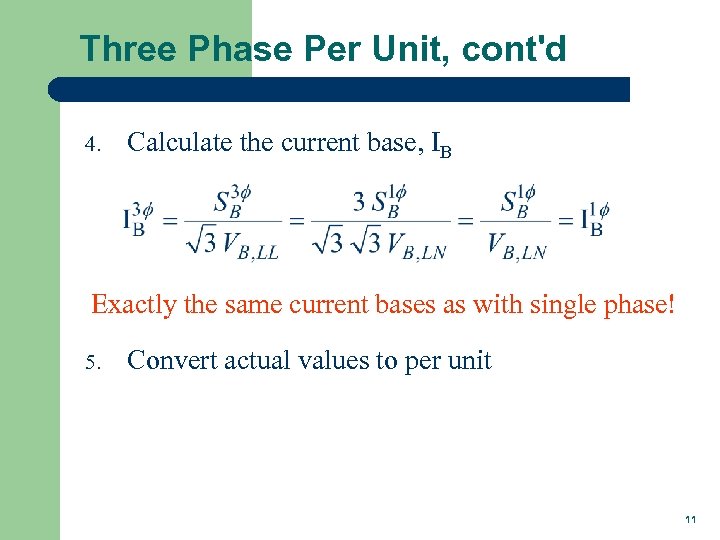 Three Phase Per Unit, cont'd 4. Calculate the current base, IB Exactly the same current bases as with single phase! 5. Convert actual values to per unit 11
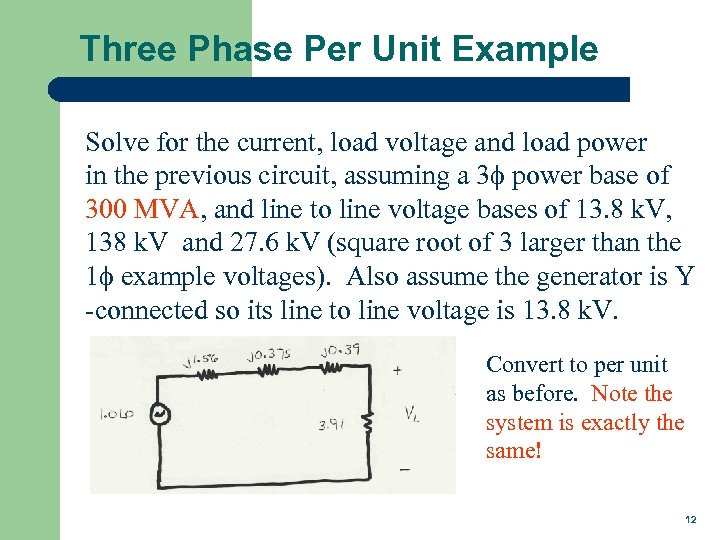 Three Phase Per Unit Example Solve for the current, load voltage and load power in the previous circuit, assuming a 3 f power base of 300 MVA, and line to line voltage bases of 13. 8 k. V, 138 k. V and 27. 6 k. V (square root of 3 larger than the 1 f example voltages). Also assume the generator is Y -connected so its line to line voltage is 13. 8 k. V. Convert to per unit as before. Note the system is exactly the same! 12
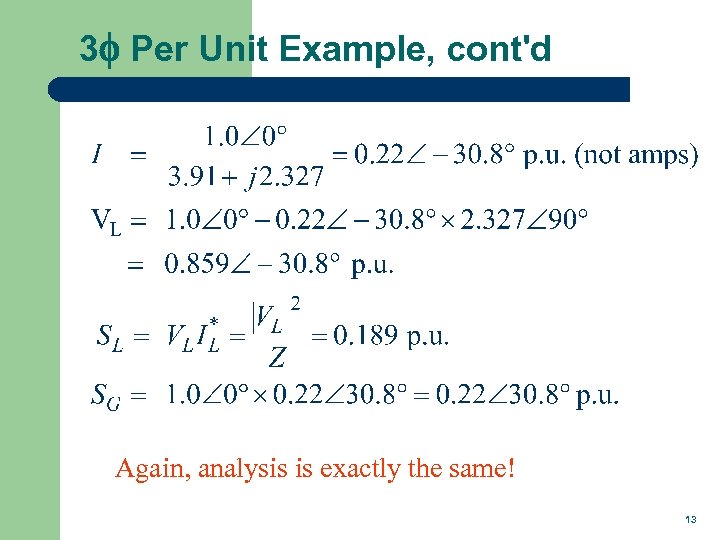 3 f Per Unit Example, cont'd Again, analysis is exactly the same! 13
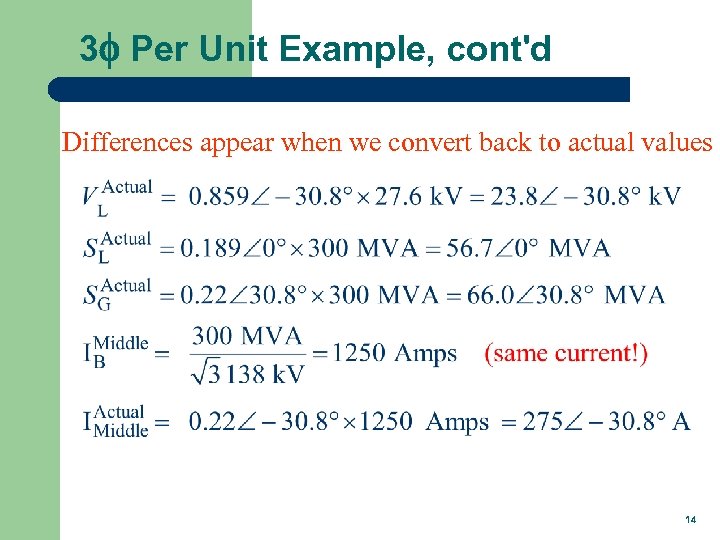 3 f Per Unit Example, cont'd Differences appear when we convert back to actual values 14
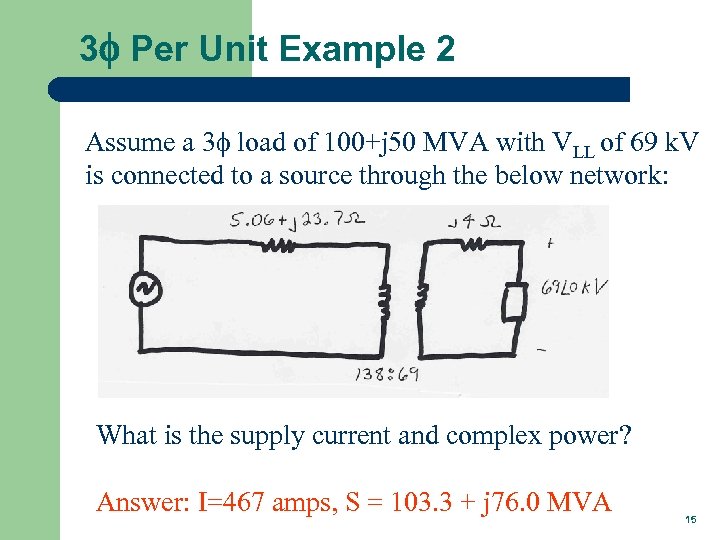 3 f Per Unit Example 2 Assume a 3 f load of 100+j 50 MVA with VLL of 69 k. V is connected to a source through the below network: What is the supply current and complex power? Answer: I=467 amps, S = 103. 3 + j 76. 0 MVA 15
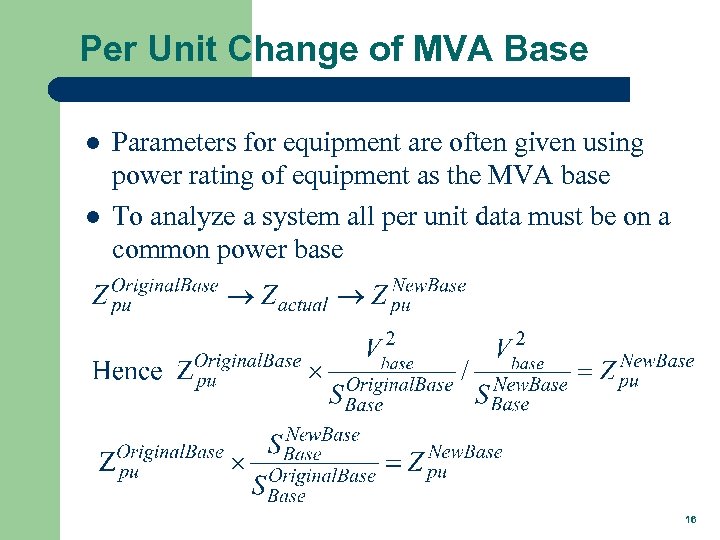 Per Unit Change of MVA Base l l Parameters for equipment are often given using power rating of equipment as the MVA base To analyze a system all per unit data must be on a common power base 16
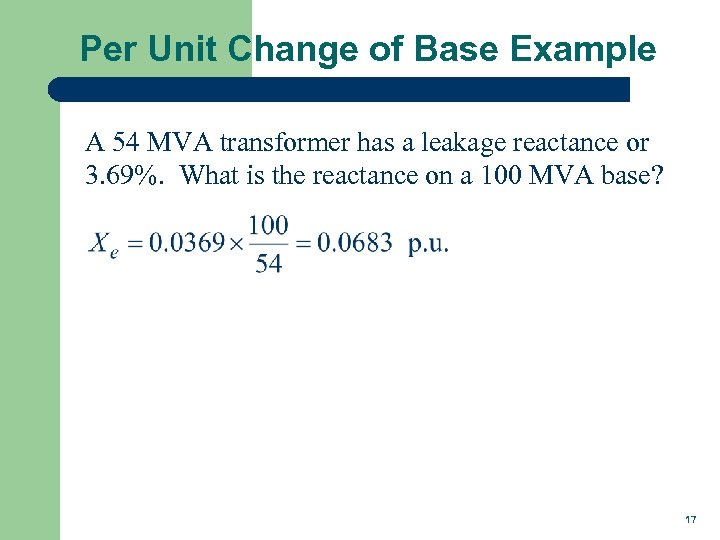 Per Unit Change of Base Example A 54 MVA transformer has a leakage reactance or 3. 69%. What is the reactance on a 100 MVA base? 17
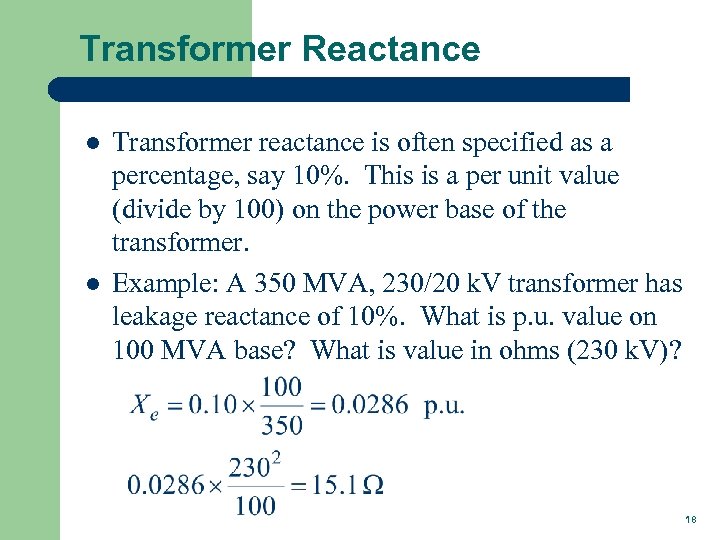 Transformer Reactance l l Transformer reactance is often specified as a percentage, say 10%. This is a per unit value (divide by 100) on the power base of the transformer. Example: A 350 MVA, 230/20 k. V transformer has leakage reactance of 10%. What is p. u. value on 100 MVA base? What is value in ohms (230 k. V)? 18
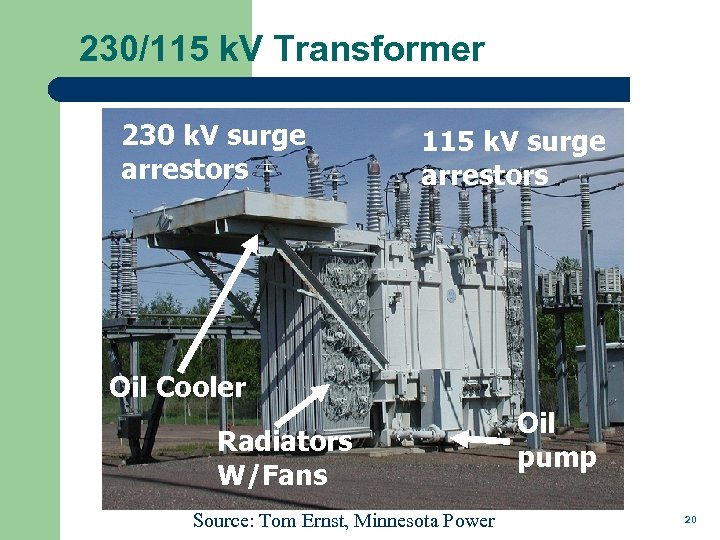
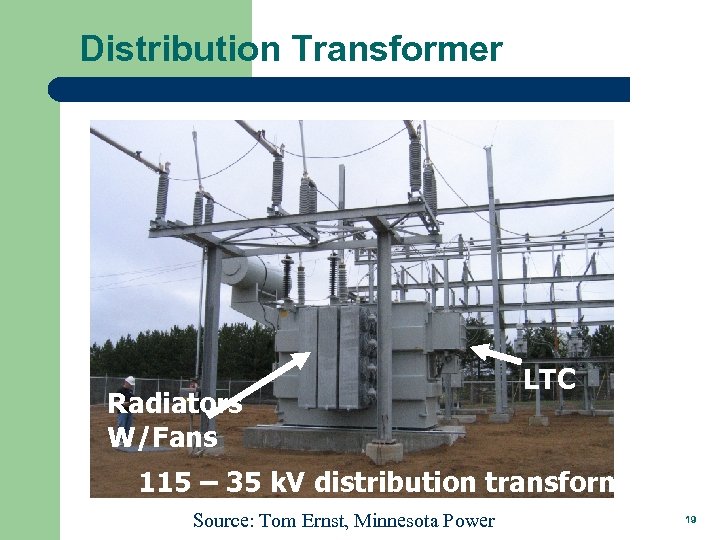 Distribution Transformer Radiators W/Fans LTC 115 – 35 k. V distribution transformer Source: Tom Ernst, Minnesota Power 19
 230/115 k. V Transformer 230 k. V surge arrestors 115 k. V surge arrestors Oil Cooler Radiators W/Fans Source: Tom Ernst, Minnesota Power Oil pump 20
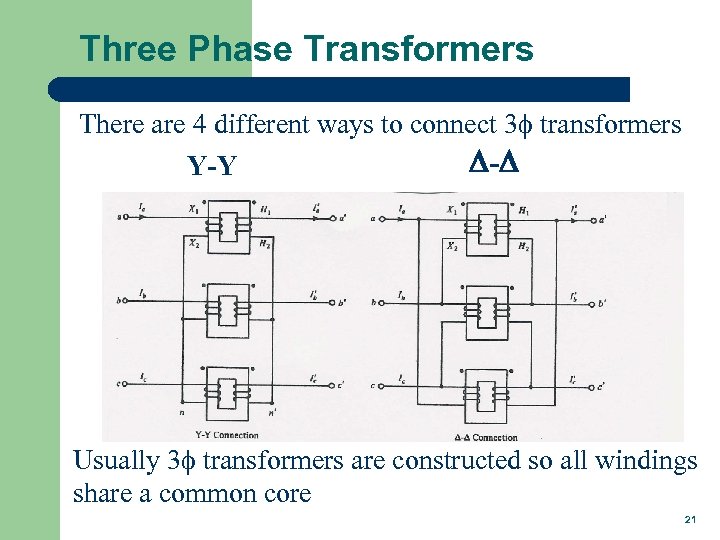 Three Phase Transformers There are 4 different ways to connect 3 f transformers Y-Y D-D Usually 3 f transformers are constructed so all windings share a common core 21
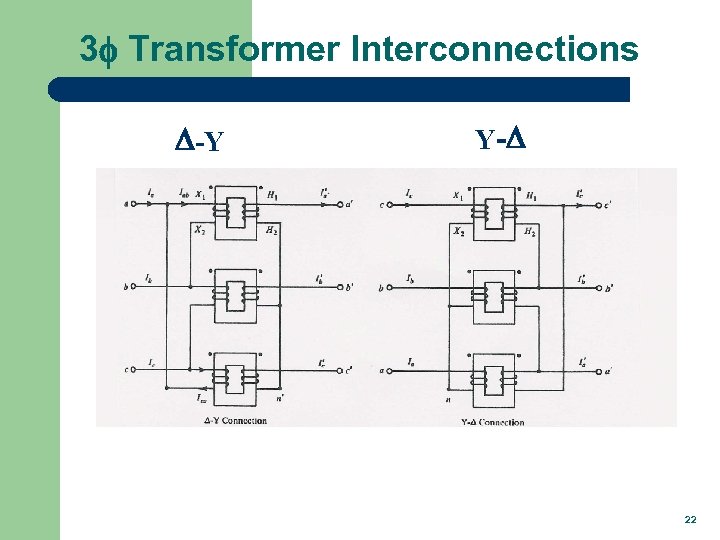 3 f Transformer Interconnections D-Y Y-D 22
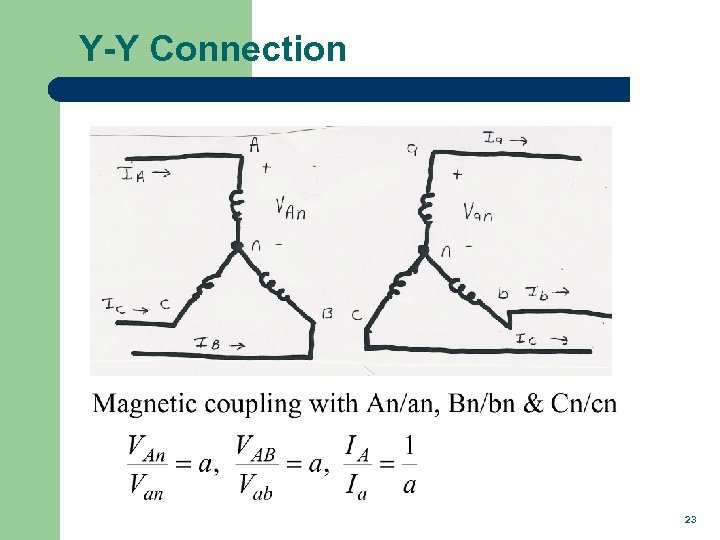 Y-Y Connection 23
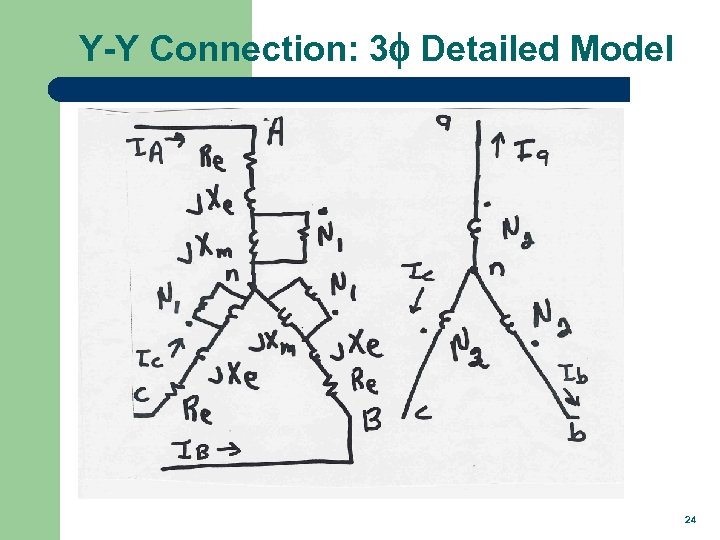 Y-Y Connection: 3 f Detailed Model 24
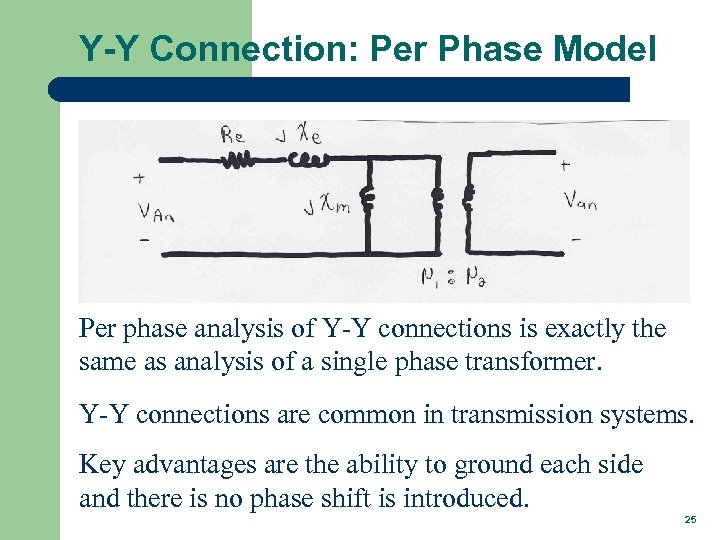 Y-Y Connection: Per Phase Model Per phase analysis of Y-Y connections is exactly the same as analysis of a single phase transformer. Y-Y connections are common in transmission systems. Key advantages are the ability to ground each side and there is no phase shift is introduced. 25
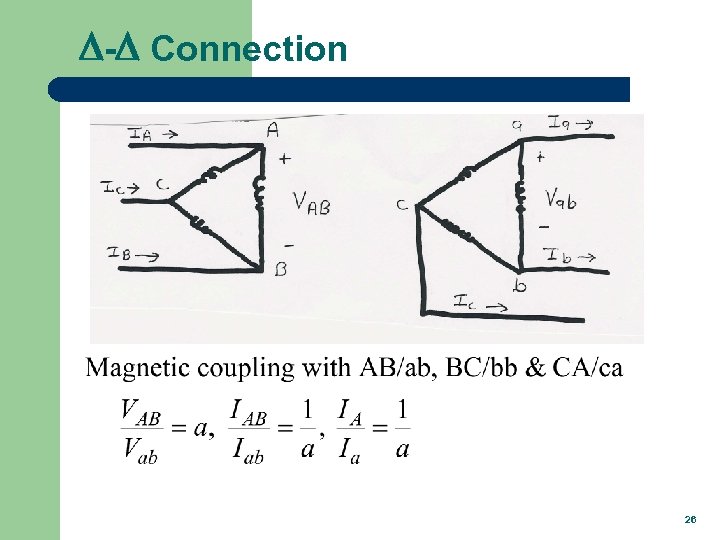 D-D Connection 26
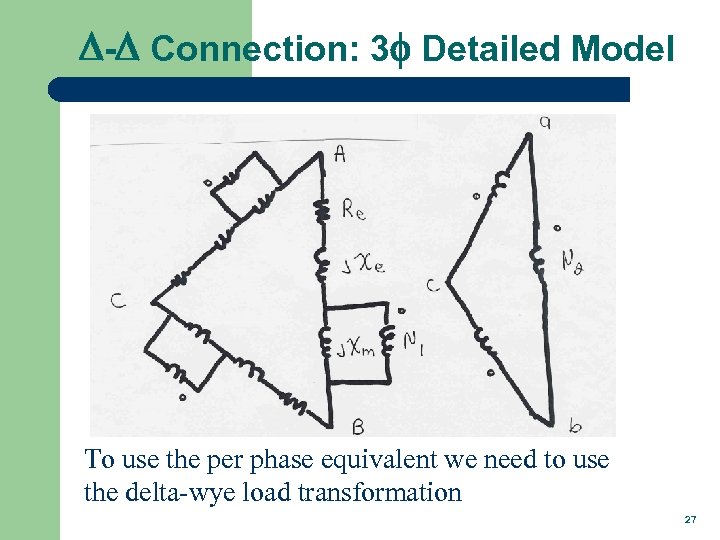 D-D Connection: 3 f Detailed Model To use the per phase equivalent we need to use the delta-wye load transformation 27
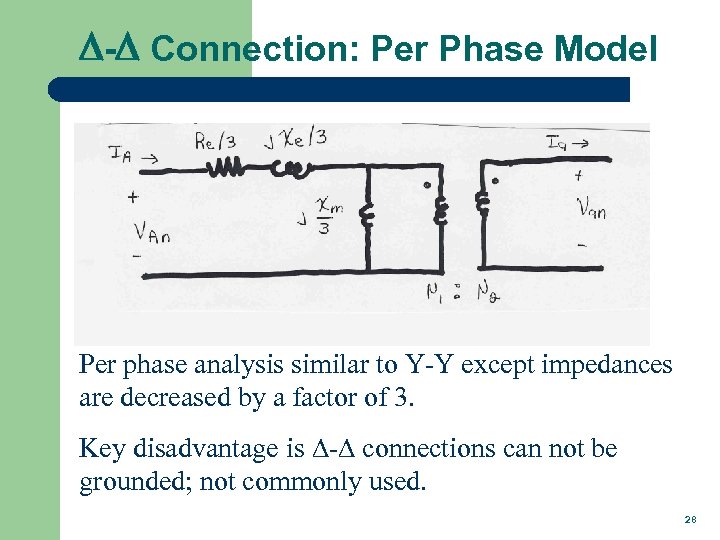 D-D Connection: Per Phase Model Per phase analysis similar to Y-Y except impedances are decreased by a factor of 3. Key disadvantage is D-D connections can not be grounded; not commonly used. 28
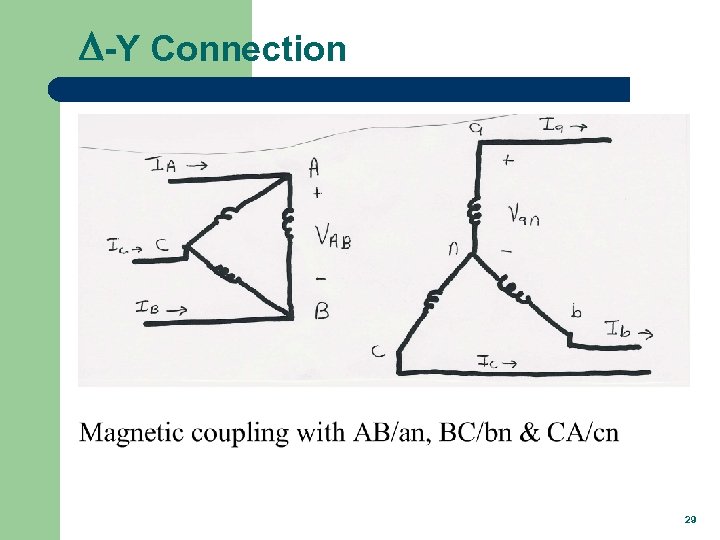 D-Y Connection 29
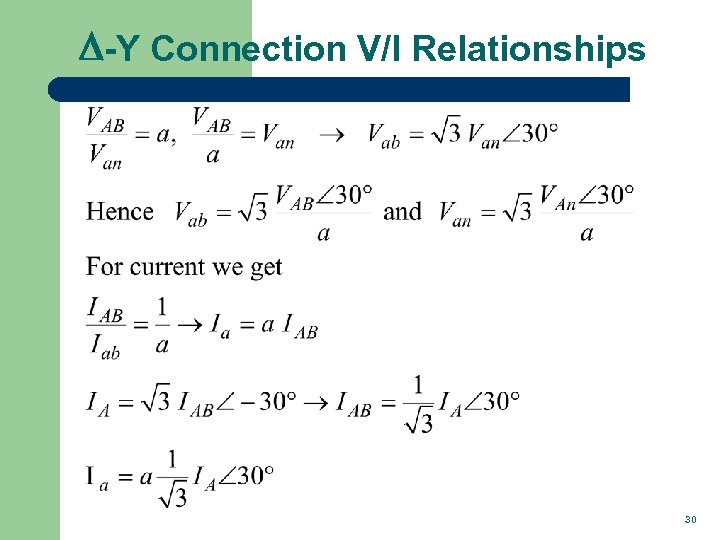 D-Y Connection V/I Relationships 30
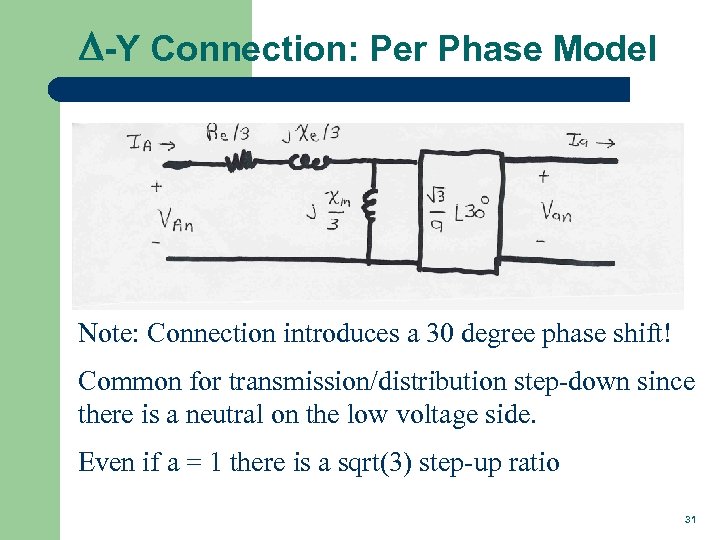 D-Y Connection: Per Phase Model Note: Connection introduces a 30 degree phase shift! Common for transmission/distribution step-down since there is a neutral on the low voltage side. Even if a = 1 there is a sqrt(3) step-up ratio 31
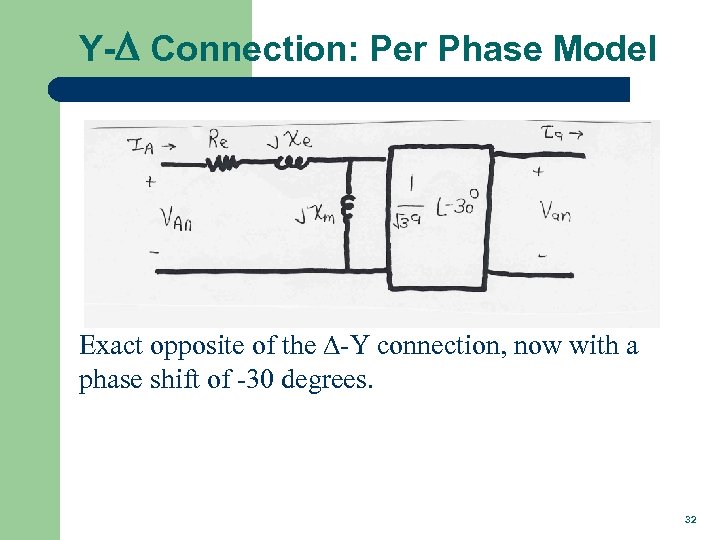 Y-D Connection: Per Phase Model Exact opposite of the D-Y connection, now with a phase shift of -30 degrees. 32
 Load Tap Changing Transformers l l LTC transformers have tap ratios that can be varied to regulate bus voltages The typical range of variation is 10% from the nominal values, usually in 33 discrete steps (0. 0625% per step). Because tap changing is a mechanical process, LTC transformers usually have a 30 second deadband to avoid repeated changes. Unbalanced tap positions can cause "circulating vars" 33
 Phase Shifting Transformers l l l Phase shifting transformers are used to control the phase angle across the transformer Since power flow through the transformer depends upon phase angle, this allows the transformer to regulate the power flow through the transformer Phase shifters can be used to prevent inadvertent "loop flow" and to prevent line overloads. 34
 Com. ED Control Center 35
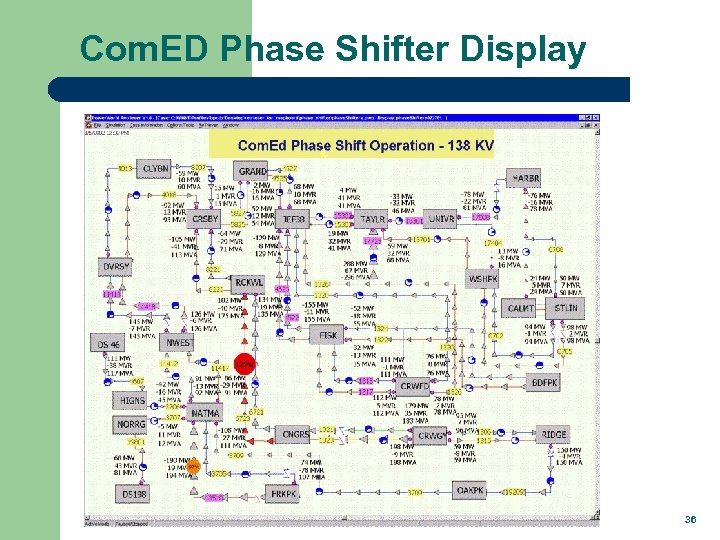 Com. ED Phase Shifter Display 36
 Autotransformers l l l Autotransformers are transformers in which the primary and secondary windings are coupled magnetically and electrically. This results in lower cost, and smaller size and weight. The key disadvantage is loss of electrical isolation between the voltage levels. This can be an important safety consideration when a is large. For example in stepping down 7160/240 V we do not ever want 7160 on the low side! 37