


 Скачать презентацию ECE 281 Sophomore Seminar Note Set 2
446ec6c4febf0b11f63f52e61cf31c2e.ppt
- Количество слайдов: 25
 ECE 281 Sophomore Seminar Note Set #2 • Intro to EE Department (Sect. 10. 5 & 10. 1) • Overview of EE and Co. E (Ch. 5, Sect. 10. 5) 1
 Intro to EE Department at SUNYIT/Binghamton • Programs, Courses, Objectives, & Advice • Academic Honesty 2
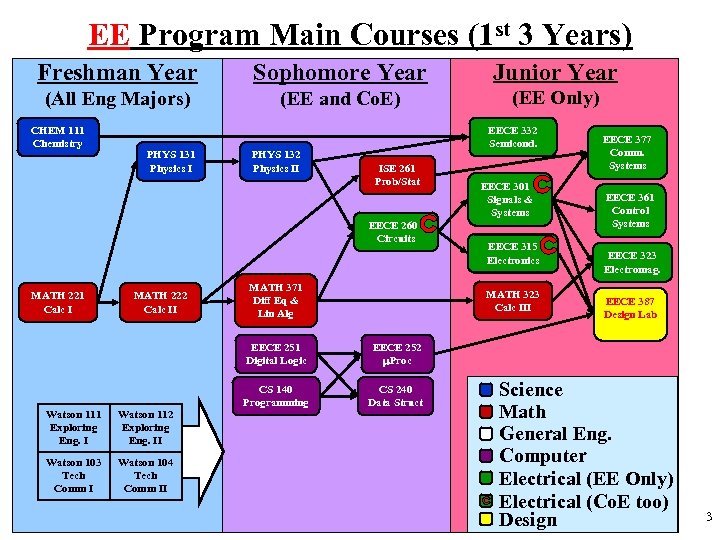 EE Program Main Courses (1 st 3 Years) Freshman Year Sophomore Year Junior Year (All Eng Majors) (EE and Co. E) (EE Only) CHEM 111 Chemistry PHYS 131 Physics I PHYS 132 Physics II EECE 332 Semicond. ISE 261 Prob/Stat EECE 260 Circuits MATH 221 Calc I MATH 222 Calc II MATH 371 Diff Eq & Lin Alg Watson 112 Exploring Eng. II Watson 103 Tech Comm I Watson 104 Tech Comm II EECE 315 Electronics MATH 323 Calc III EECE 251 Digital Logic Watson 111 Exploring Eng. I EECE 301 Signals & Systems CS 240 Data Struct EECE 361 Control Systems EECE 323 Electromag. EECE 387 Design Lab EECE 252 Proc CS 140 Programming EECE 377 Comm. Systems Science Math General Eng. Computer Electrical (EE Only) Electrical (Co. E too) Design 3
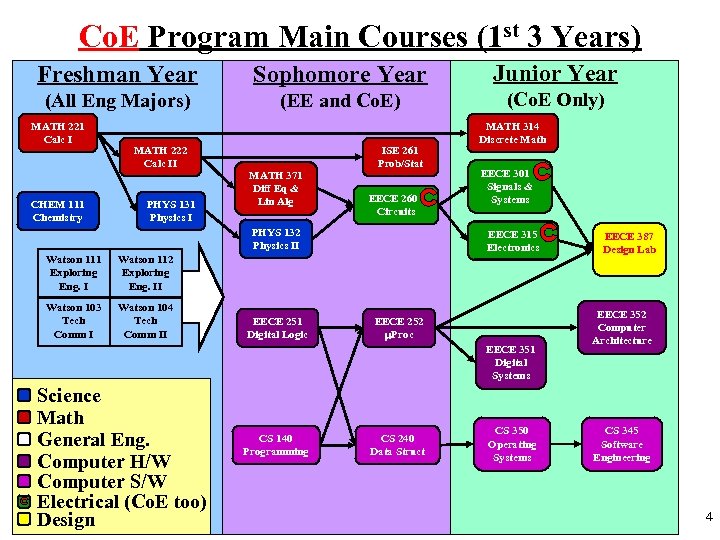 Co. E Program Main Courses (1 st 3 Years) Freshman Year Sophomore Year Junior Year (All Eng Majors) (EE and Co. E) (Co. E Only) MATH 221 Calc I CHEM 111 Chemistry MATH 222 Calc II PHYS 131 Physics I MATH 371 Diff Eq & Lin Alg ISE 261 Prob/Stat EECE 260 Circuits PHYS 132 Physics II Watson 111 Exploring Eng. I Watson 104 Tech Comm II EECE 301 Signals & Systems EECE 315 Electronics Watson 112 Exploring Eng. II Watson 103 Tech Comm I MATH 314 Discrete Math EECE 251 Digital Logic EECE 252 Proc EECE 351 Digital Systems Science Math General Eng. Computer H/W Computer S/W Electrical (Co. E too) Design CS 140 Programming CS 240 Data Struct CS 350 Operating Systems EECE 387 Design Lab EECE 352 Computer Architecture CS 345 Software Engineering 4
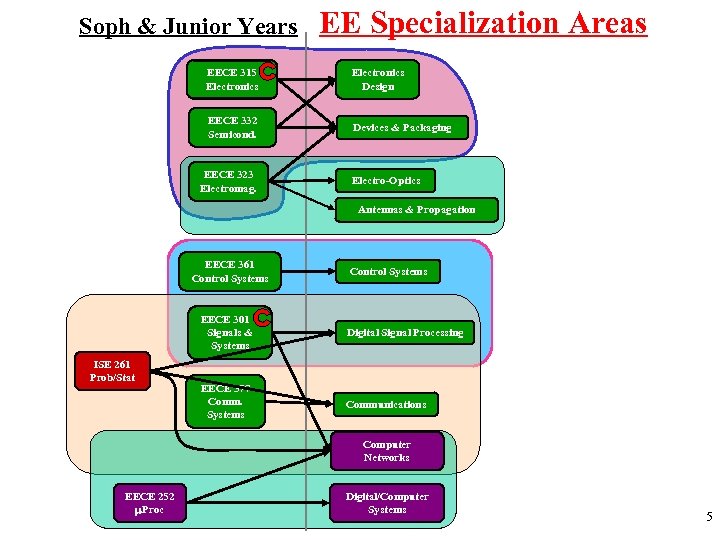 Soph & Junior Years EE Specialization Areas EECE 315 Electronics Design EECE 332 Semicond. Devices & Packaging EECE 323 Electromag. Electro-Optics Antennas & Propagation EECE 361 Control Systems EECE 301 Signals & Systems ISE 261 Prob/Stat Digital Signal Processing EECE 377 Comm. Systems Communications Computer Networks EECE 252 Proc Digital/Computer Systems 5
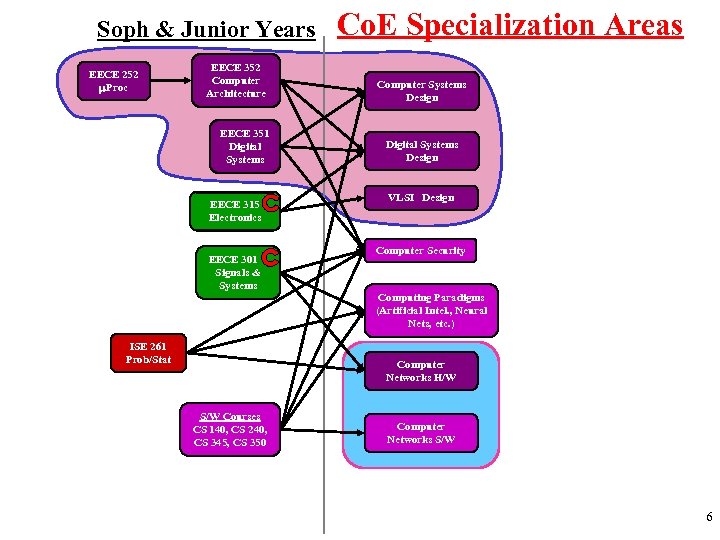 Soph & Junior Years EECE 252 Proc EECE 352 Computer Architecture EECE 351 Digital Systems EECE 315 Electronics EECE 301 Signals & Systems ISE 261 Prob/Stat Co. E Specialization Areas Computer Systems Design Digital Systems Design VLSI Design Computer Security Computing Paradigms (Artificial Intel. , Neural Nets, etc. ) Computer Networks H/W S/W Courses CS 140, CS 240, CS 345, CS 350 Computer Networks S/W 6
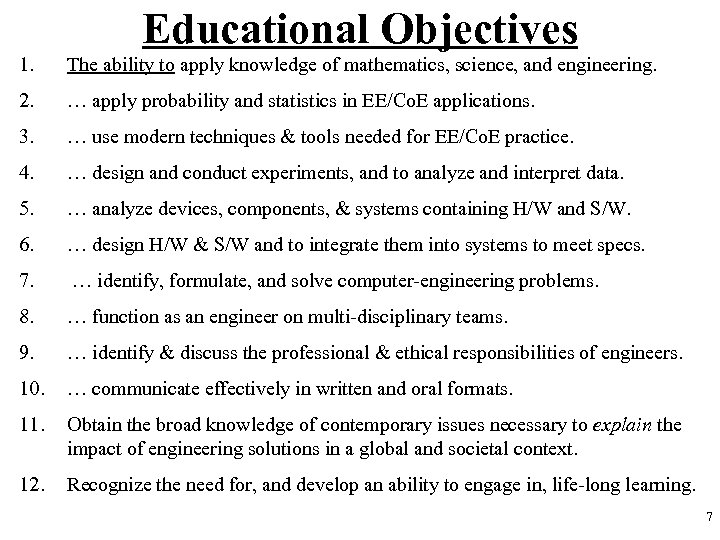 Educational Objectives 1. The ability to apply knowledge of mathematics, science, and engineering. 2. … apply probability and statistics in EE/Co. E applications. 3. … use modern techniques & tools needed for EE/Co. E practice. 4. … design and conduct experiments, and to analyze and interpret data. 5. … analyze devices, components, & systems containing H/W and S/W. 6. … design H/W & S/W and to integrate them into systems to meet specs. 7. … identify, formulate, and solve computer-engineering problems. 8. … function as an engineer on multi-disciplinary teams. 9. … identify & discuss the professional & ethical responsibilities of engineers. 10. … communicate effectively in written and oral formats. 11. Obtain the broad knowledge of contemporary issues necessary to explain the impact of engineering solutions in a global and societal context. 12. Recognize the need for, and develop an ability to engage in, life-long learning. 7
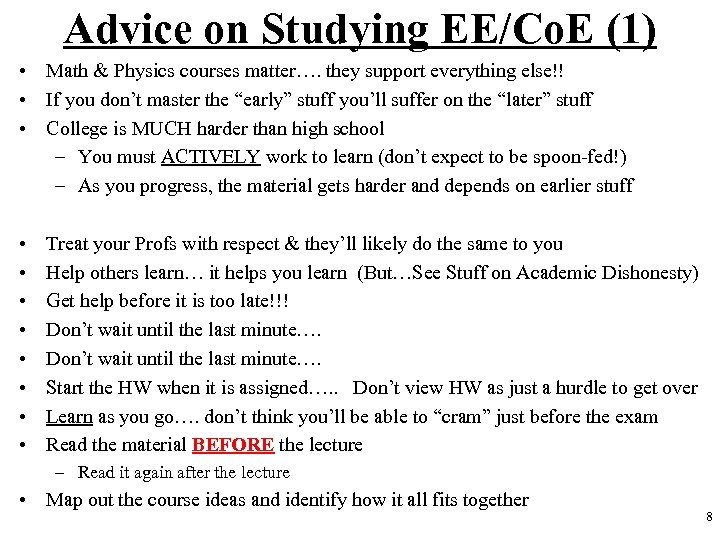 Advice on Studying EE/Co. E (1) • Math & Physics courses matter…. they support everything else!! • If you don’t master the “early” stuff you’ll suffer on the “later” stuff • College is MUCH harder than high school – You must ACTIVELY work to learn (don’t expect to be spoon-fed!) – As you progress, the material gets harder and depends on earlier stuff • • Treat your Profs with respect & they’ll likely do the same to you Help others learn… it helps you learn (But…See Stuff on Academic Dishonesty) Get help before it is too late!!! Don’t wait until the last minute…. Start the HW when it is assigned…. . Don’t view HW as just a hurdle to get over Learn as you go…. don’t think you’ll be able to “cram” just before the exam Read the material BEFORE the lecture – Read it again after the lecture • Map out the course ideas and identify how it all fits together 8
 Advice on Studying EE/Co. E (2) • You are expected to pay attention in class (or at the very least… be quiet!) – Is doing your other class’s HW really the best way to spend class time? ? ? • Seek help from your Profs & TAs… we only SEEM intimidating. • When you come to office hours… – Be sure you have made an honest attempt at the problem – Come prepared… know exactly what you want to ask – Feel free to ask “stupid” questions, but don’t “BE” stupid • If you don’t really want to be an EE/Co. E…. go do something else!!!! • Treat your time here as a learning process… not a set of hurdles to be cleared – ACTIVELY work to learn – Join IEEE and start reading IEEE Spectrum – Talk to Profs/TAs about EE/Co. E topics and careers 9
 Academic Dishonesty • Cheating • Plagiarism • Etc. 10
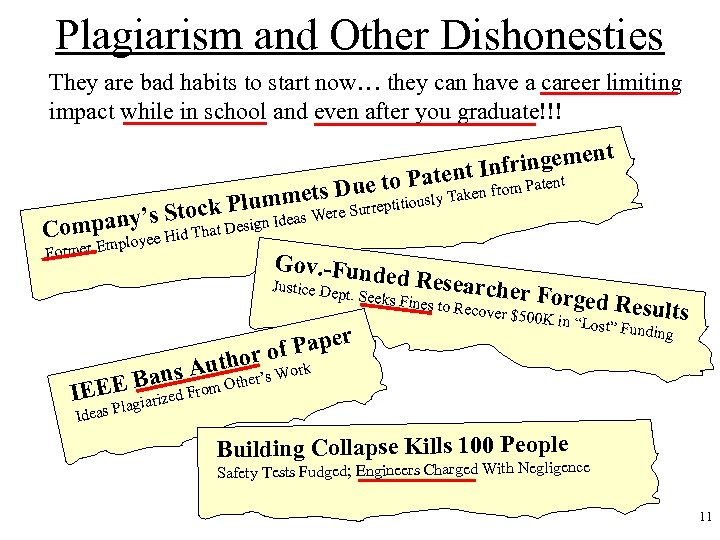 Plagiarism and Other Dishonesties They are bad habits to start now… they can have a career limiting impact while in school and even after you graduate!!! t ingemen ent Infr ue to Palt Taken from Patent mets D sy u tock Plumdeas Were Surreptitio s. S ompany’ Hid That Design I C loyee mp Former E Gov. -Fund ed Resear Justice Dept. Seek s Paper Fines to R cher Forg ecover $50 ed Results 0 K in “Los f thor so. Work s Au t” Funding E Bain d From Other’ IEE ze iar lag Ideas P Building Collapse Kills 100 People Safety Tests Fudged; Engineers Charged With Negligence 11
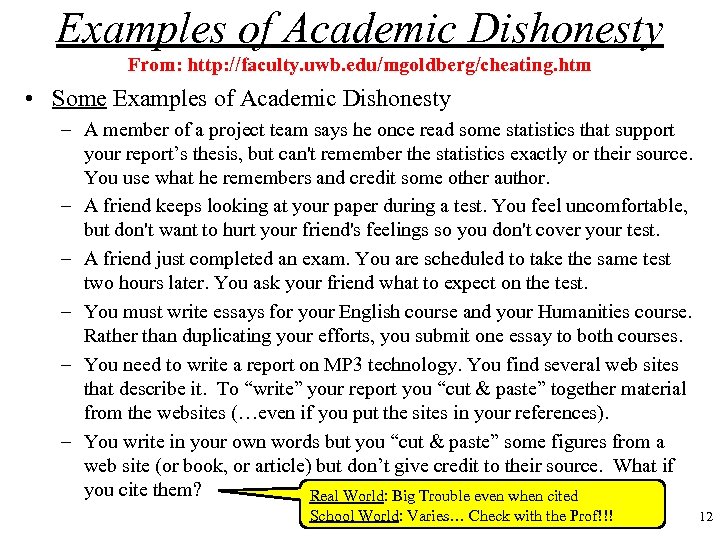 Examples of Academic Dishonesty From: http: //faculty. uwb. edu/mgoldberg/cheating. htm • Some Examples of Academic Dishonesty – A member of a project team says he once read some statistics that support your report’s thesis, but can't remember the statistics exactly or their source. You use what he remembers and credit some other author. – A friend keeps looking at your paper during a test. You feel uncomfortable, but don't want to hurt your friend's feelings so you don't cover your test. – A friend just completed an exam. You are scheduled to take the same test two hours later. You ask your friend what to expect on the test. – You must write essays for your English course and your Humanities course. Rather than duplicating your efforts, you submit one essay to both courses. – You need to write a report on MP 3 technology. You find several web sites that describe it. To “write” your report you “cut & paste” together material from the websites (…even if you put the sites in your references). – You write in your own words but you “cut & paste” some figures from a web site (or book, or article) but don’t give credit to their source. What if you cite them? Real World: Big Trouble even when cited School World: Varies… Check with the Prof!!! 12
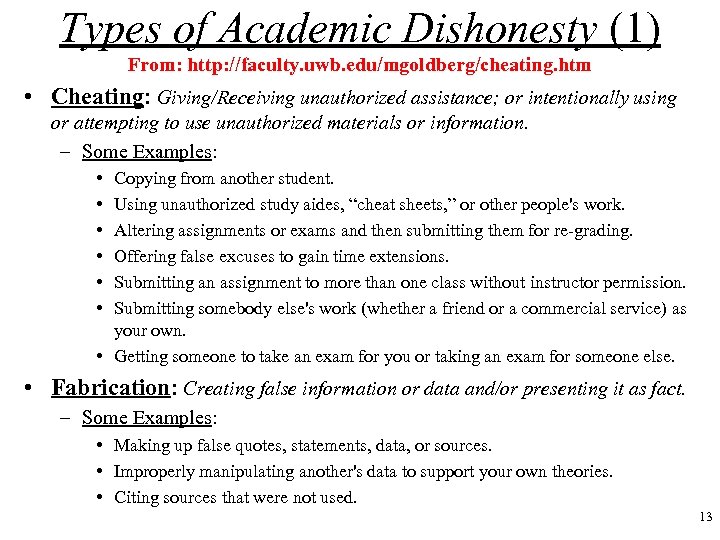 Types of Academic Dishonesty (1) From: http: //faculty. uwb. edu/mgoldberg/cheating. htm • Cheating: Giving/Receiving unauthorized assistance; or intentionally using or attempting to use unauthorized materials or information. – Some Examples: • • • Copying from another student. Using unauthorized study aides, “cheat sheets, ” or other people's work. Altering assignments or exams and then submitting them for re-grading. Offering false excuses to gain time extensions. Submitting an assignment to more than one class without instructor permission. Submitting somebody else's work (whether a friend or a commercial service) as your own. • Getting someone to take an exam for you or taking an exam for someone else. • Fabrication: Creating false information or data and/or presenting it as fact. – Some Examples: • Making up false quotes, statements, data, or sources. • Improperly manipulating another's data to support your own theories. • Citing sources that were not used. 13
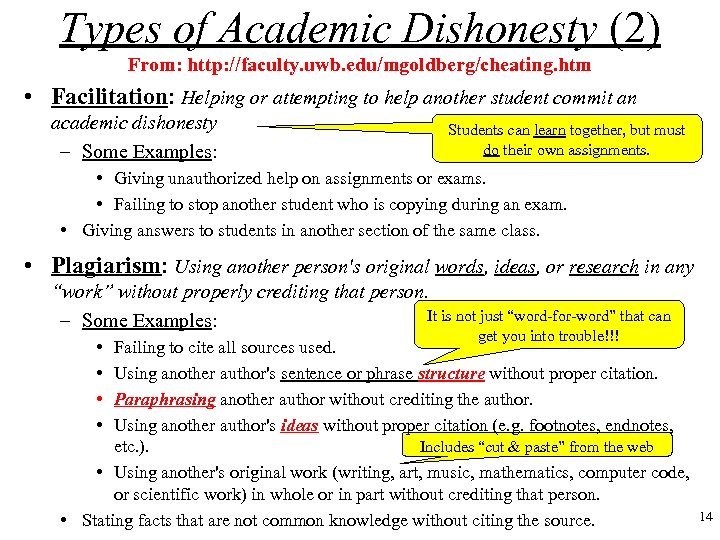 Types of Academic Dishonesty (2) From: http: //faculty. uwb. edu/mgoldberg/cheating. htm • Facilitation: Helping or attempting to help another student commit an academic dishonesty – Some Examples: Students can learn together, but must do their own assignments. • Giving unauthorized help on assignments or exams. • Failing to stop another student who is copying during an exam. • Giving answers to students in another section of the same class. • Plagiarism: Using another person's original words, ideas, or research in any “work” without properly crediting that person. It is not just “word-for-word” that can – Some Examples: • • get you into trouble!!! Failing to cite all sources used. Using another author's sentence or phrase structure without proper citation. Paraphrasing another author without crediting the author. Using another author's ideas without proper citation (e. g. footnotes, endnotes, Includes “cut & paste” from the web etc. ). • Using another's original work (writing, art, music, mathematics, computer code, or scientific work) in whole or in part without crediting that person. • Stating facts that are not common knowledge without citing the source. 14
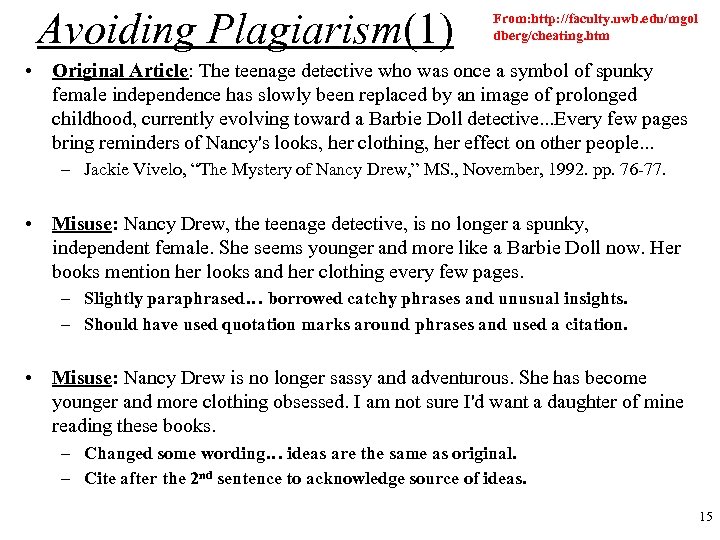 Avoiding Plagiarism(1) From: http: //faculty. uwb. edu/mgol dberg/cheating. htm • Original Article: The teenage detective who was once a symbol of spunky female independence has slowly been replaced by an image of prolonged childhood, currently evolving toward a Barbie Doll detective. . . Every few pages bring reminders of Nancy's looks, her clothing, her effect on other people. . . – Jackie Vivelo, “The Mystery of Nancy Drew, ” MS. , November, 1992. pp. 76 -77. • Misuse: Nancy Drew, the teenage detective, is no longer a spunky, independent female. She seems younger and more like a Barbie Doll now. Her books mention her looks and her clothing every few pages. – Slightly paraphrased… borrowed catchy phrases and unusual insights. – Should have used quotation marks around phrases and used a citation. • Misuse: Nancy Drew is no longer sassy and adventurous. She has become younger and more clothing obsessed. I am not sure I'd want a daughter of mine reading these books. – Changed some wording… ideas are the same as original. – Cite after the 2 nd sentence to acknowledge source of ideas. 15
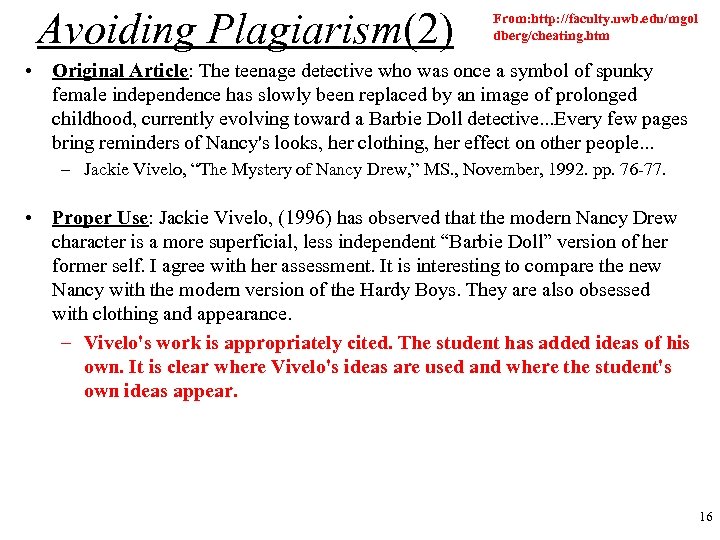 Avoiding Plagiarism(2) From: http: //faculty. uwb. edu/mgol dberg/cheating. htm • Original Article: The teenage detective who was once a symbol of spunky female independence has slowly been replaced by an image of prolonged childhood, currently evolving toward a Barbie Doll detective. . . Every few pages bring reminders of Nancy's looks, her clothing, her effect on other people. . . – Jackie Vivelo, “The Mystery of Nancy Drew, ” MS. , November, 1992. pp. 76 -77. • Proper Use: Jackie Vivelo, (1996) has observed that the modern Nancy Drew character is a more superficial, less independent “Barbie Doll” version of her former self. I agree with her assessment. It is interesting to compare the new Nancy with the modern version of the Hardy Boys. They are also obsessed with clothing and appearance. – Vivelo's work is appropriately cited. The student has added ideas of his own. It is clear where Vivelo's ideas are used and where the student's own ideas appear. 16
 Overview of EE and Co. E What do EEs and Co. Es do? ? ? 17
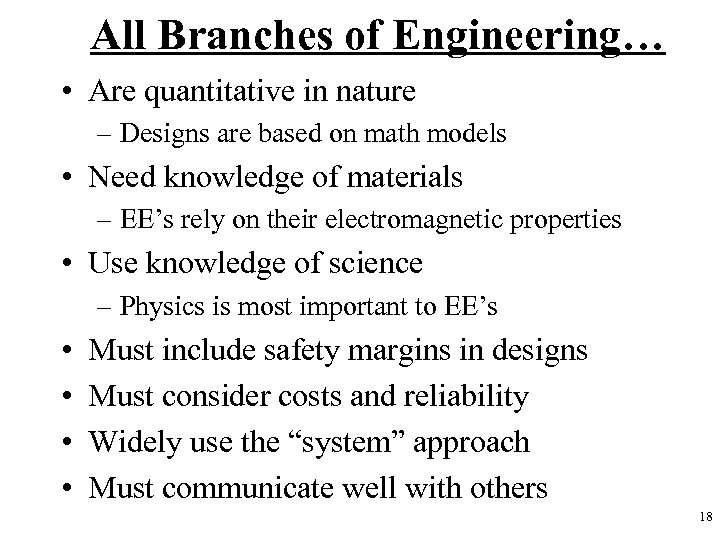 All Branches of Engineering… • Are quantitative in nature – Designs are based on math models • Need knowledge of materials – EE’s rely on their electromagnetic properties • Use knowledge of science – Physics is most important to EE’s • • Must include safety margins in designs Must consider costs and reliability Widely use the “system” approach Must communicate well with others 18
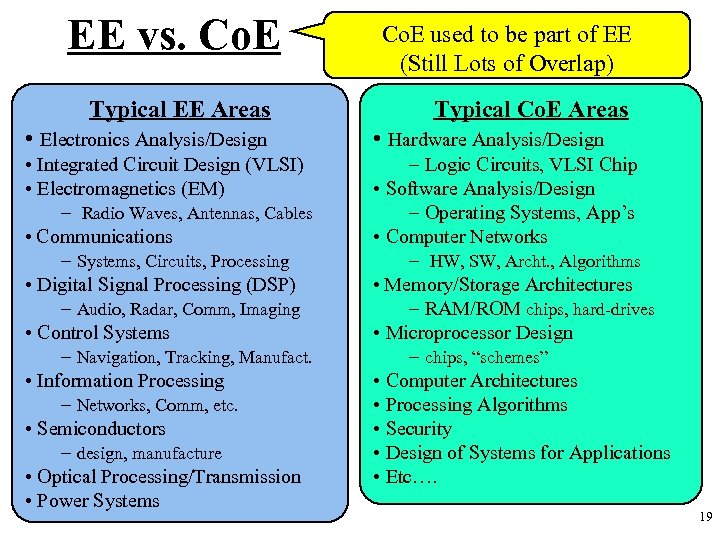 EE vs. Co. E Typical EE Areas Co. E used to be part of EE (Still Lots of Overlap) Typical Co. E Areas • Electronics Analysis/Design • Hardware Analysis/Design • Integrated Circuit Design (VLSI) • Electromagnetics (EM) – Radio Waves, Antennas, Cables • Communications – Systems, Circuits, Processing • Digital Signal Processing (DSP) – Audio, Radar, Comm, Imaging • Control Systems – Navigation, Tracking, Manufact. • Information Processing – Networks, Comm, etc. • Semiconductors – design, manufacture • Optical Processing/Transmission • Power Systems – Logic Circuits, VLSI Chip • Software Analysis/Design – Operating Systems, App’s • Computer Networks – HW, SW, Archt. , Algorithms • Memory/Storage Architectures – RAM/ROM chips, hard-drives • Microprocessor Design – chips, “schemes” • Computer Architectures • Processing Algorithms • Security • Design of Systems for Applications • Etc…. 19
 Semi-Realistic Example Showing What EEs and Co. Es Do 20
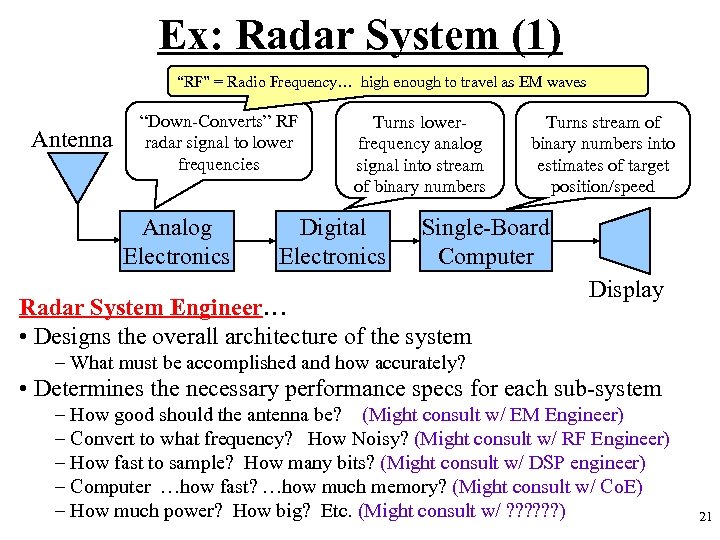 Ex: Radar System (1) “RF” = Radio Frequency… high enough to travel as EM waves Antenna “Down-Converts” RF radar signal to lower frequencies Analog Electronics Turns lowerfrequency analog signal into stream of binary numbers Digital Electronics Turns stream of binary numbers into estimates of target position/speed Single-Board Computer Radar System Engineer… • Designs the overall architecture of the system Display – What must be accomplished and how accurately? • Determines the necessary performance specs for each sub-system – How good should the antenna be? (Might consult w/ EM Engineer) – Convert to what frequency? How Noisy? (Might consult w/ RF Engineer) – How fast to sample? How many bits? (Might consult w/ DSP engineer) – Computer …how fast? …how much memory? (Might consult w/ Co. E) – How much power? How big? Etc. (Might consult w/ ? ? ? ) 21
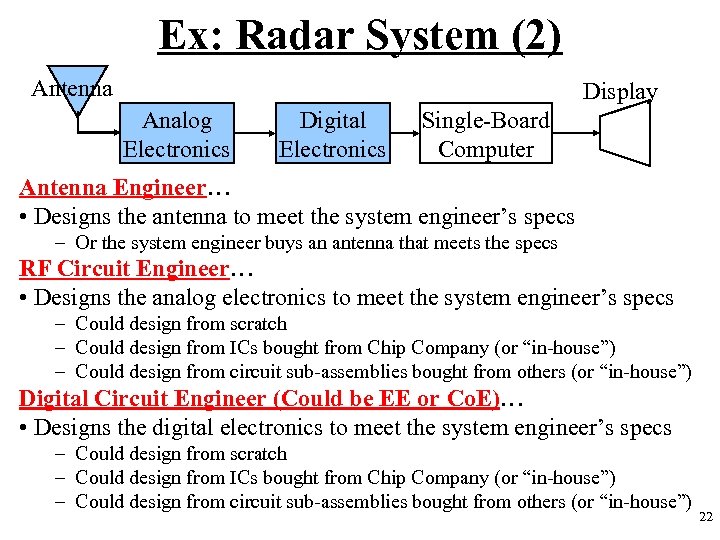 Ex: Radar System (2) Antenna Display Analog Electronics Digital Electronics Single-Board Computer Antenna Engineer… • Designs the antenna to meet the system engineer’s specs – Or the system engineer buys an antenna that meets the specs RF Circuit Engineer… • Designs the analog electronics to meet the system engineer’s specs – Could design from scratch – Could design from ICs bought from Chip Company (or “in-house”) – Could design from circuit sub-assemblies bought from others (or “in-house”) Digital Circuit Engineer (Could be EE or Co. E)… • Designs the digital electronics to meet the system engineer’s specs – Could design from scratch – Could design from ICs bought from Chip Company (or “in-house”) – Could design from circuit sub-assemblies bought from others (or “in-house”) 22
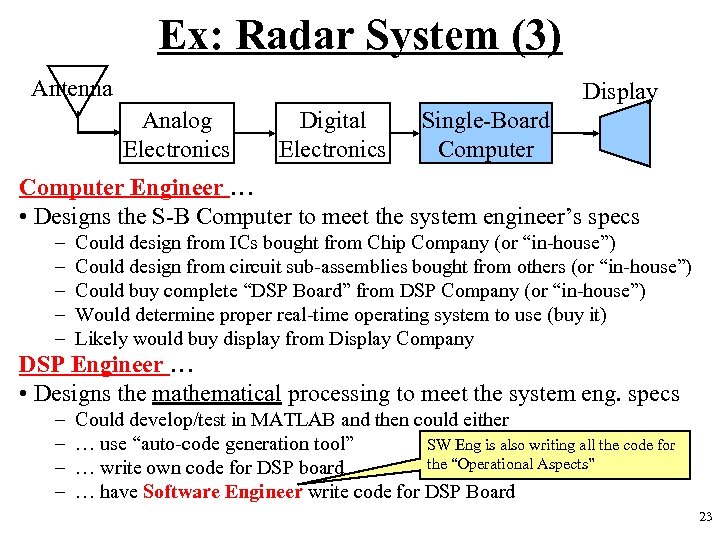 Ex: Radar System (3) Antenna Display Analog Electronics Digital Electronics Single-Board Computer Engineer … • Designs the S-B Computer to meet the system engineer’s specs – – – Could design from ICs bought from Chip Company (or “in-house”) Could design from circuit sub-assemblies bought from others (or “in-house”) Could buy complete “DSP Board” from DSP Company (or “in-house”) Would determine proper real-time operating system to use (buy it) Likely would buy display from Display Company DSP Engineer … • Designs the mathematical processing to meet the system eng. specs – – Could develop/test in MATLAB and then could either SW Eng is also writing all the code for … use “auto-code generation tool” the “Operational Aspects” … write own code for DSP board … have Software Engineer write code for DSP Board 23
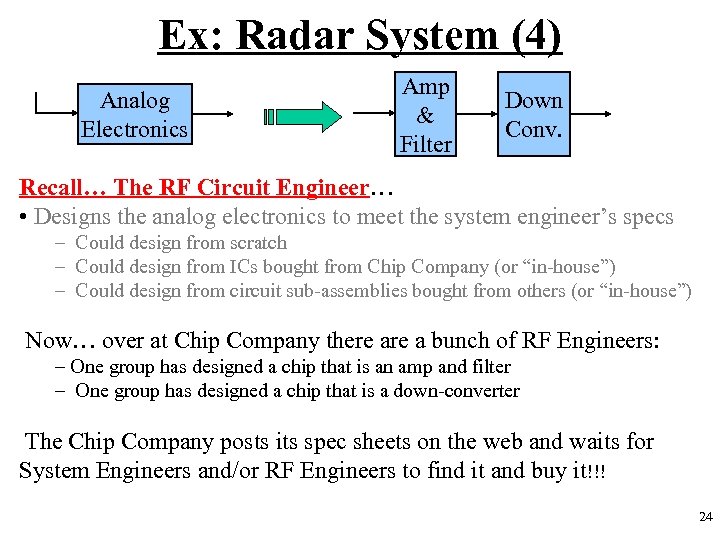 Ex: Radar System (4) Analog Electronics Amp & Filter Down Conv. Recall… The RF Circuit Engineer… • Designs the analog electronics to meet the system engineer’s specs – Could design from scratch – Could design from ICs bought from Chip Company (or “in-house”) – Could design from circuit sub-assemblies bought from others (or “in-house”) Now… over at Chip Company there a bunch of RF Engineers: – One group has designed a chip that is an amp and filter – One group has designed a chip that is a down-converter The Chip Company posts its spec sheets on the web and waits for System Engineers and/or RF Engineers to find it and buy it!!! 24
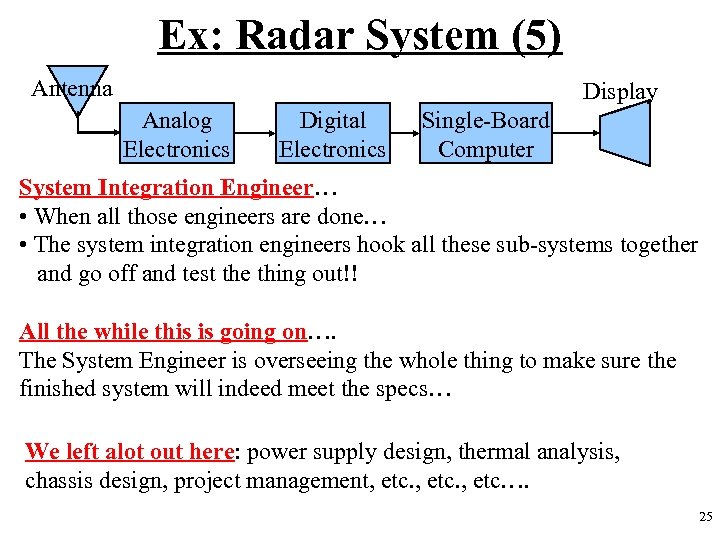 Ex: Radar System (5) Antenna Display Analog Electronics Digital Electronics Single-Board Computer System Integration Engineer… • When all those engineers are done… • The system integration engineers hook all these sub-systems together and go off and test the thing out!! All the while this is going on…. The System Engineer is overseeing the whole thing to make sure the finished system will indeed meet the specs… We left alot out here: power supply design, thermal analysis, chassis design, project management, etc…. 25