


 Скачать презентацию ECE 232 Hardware Organization and Design Part 1
560219b1bc88465dcf20c4b3ce46fed2.ppt
- Количество слайдов: 23
 ECE 232: Hardware Organization and Design Part 1: Introduction http: //www. ecs. umass. edu/ece 232/ Adapted from Computer Organization and Design, Patterson & Hennessy, UCB
 Course Administration - 1 § Instructors: Israel Koren koren@ecs. umass. edu Mani Krishna krishna@ecs. umass. edu § § TAs: Daniel Gomez-Prado Kunal Ganeshpure Nitin Prakash Office Hours & e-mail addresses posted on the course web page § § § URL: SPARK: Text: The Edition, ECE 232: Intro 2 http: //www. ecs. umass. edu/ece 232/ http: //spark. oit. umass. edu/ Required: Computer Organization and Design, Hardware/Software Interface by D. A. Patterson and J. L. Hennessy, Morgan Kaufmann; 4 th ISBN 978 -0123744937 Adapted from Computer Organization & Design, Patterson & Hennessy, UCB and Kundu, UMass Koren
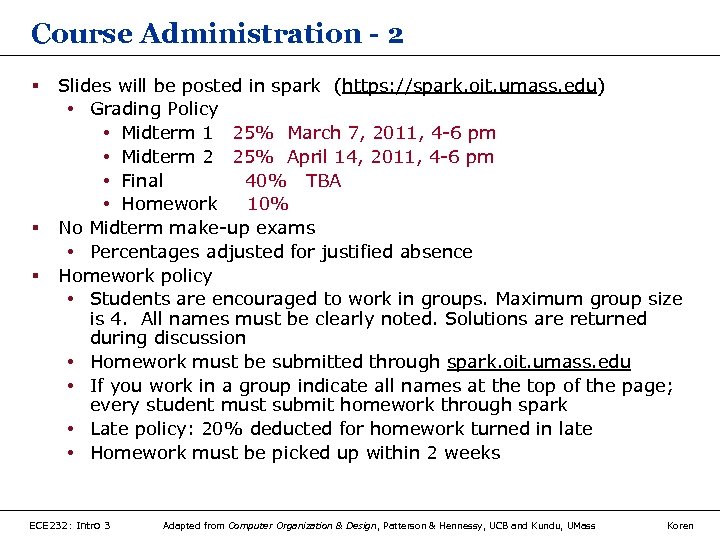 Course Administration - 2 § § § Slides will be posted in spark (https: //spark. oit. umass. edu) • Grading Policy • Midterm 1 25% March 7, 2011, 4 -6 pm • Midterm 2 25% April 14, 2011, 4 -6 pm • Final 40% TBA • Homework 10% No Midterm make-up exams • Percentages adjusted for justified absence Homework policy • Students are encouraged to work in groups. Maximum group size is 4. All names must be clearly noted. Solutions are returned during discussion • Homework must be submitted through spark. oit. umass. edu • If you work in a group indicate all names at the top of the page; every student must submit homework through spark • Late policy: 20% deducted for homework turned in late • Homework must be picked up within 2 weeks ECE 232: Intro 3 Adapted from Computer Organization & Design, Patterson & Hennessy, UCB and Kundu, UMass Koren
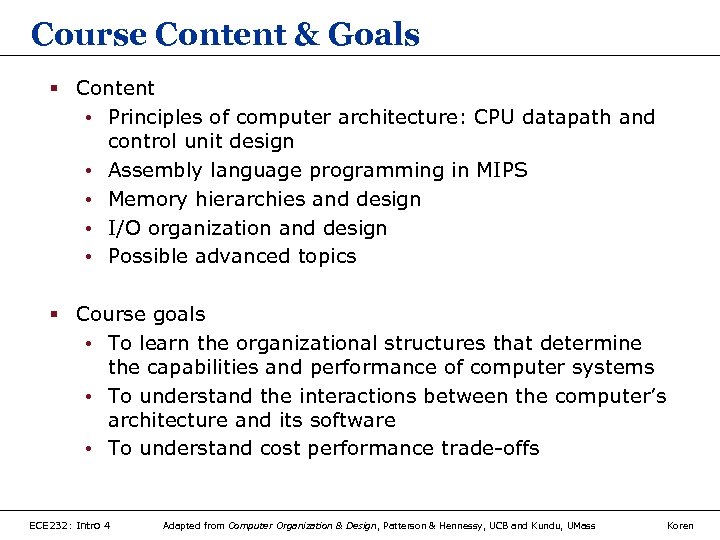 Course Content & Goals § Content • Principles of computer architecture: CPU datapath and control unit design • Assembly language programming in MIPS • Memory hierarchies and design • I/O organization and design • Possible advanced topics § Course goals • To learn the organizational structures that determine the capabilities and performance of computer systems • To understand the interactions between the computer’s architecture and its software • To understand cost performance trade-offs ECE 232: Intro 4 Adapted from Computer Organization & Design, Patterson & Hennessy, UCB and Kundu, UMass Koren
 What You Should Know Binary numbers Read and write basic C/java programs Understand the steps in compiling and executing a program Basic Verliog constructs • To deal with HW assignments § Logic design • logical equations, schematic diagrams • Combinational vs. sequential logic • Finite state machines (FSMs) § § ECE 232: Intro 5 Adapted from Computer Organization & Design, Patterson & Hennessy, UCB and Kundu, UMass Koren
 Why you should know hardware organization? § Computer organization principles are everywhere • Embedded computer vs. general-purpose computers: • Cellphone • Digital Camera • MP 3 music player • Industrial process control § Complex system design • How to partition a problem • Functional Spec Control & Datapath Physical implementation • Modern CAD tools ECE 232: Intro 6 Adapted from Computer Organization & Design, Patterson & Hennessy, UCB and Kundu, UMass Koren
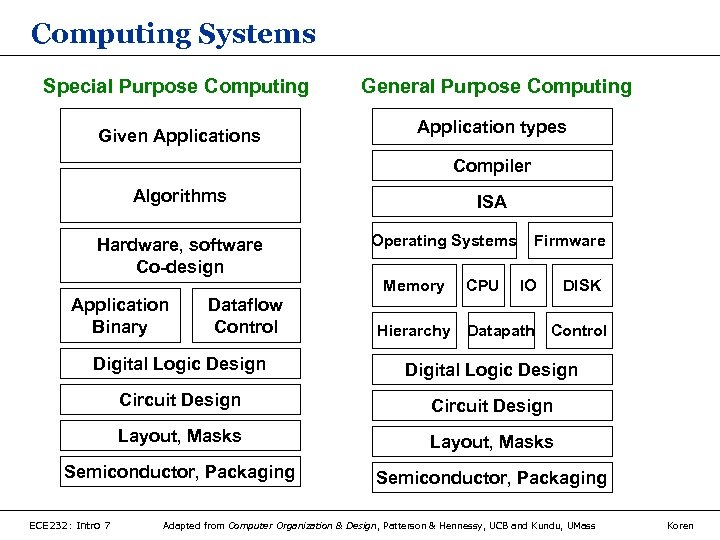 Computing Systems Special Purpose Computing General Purpose Computing Given Applications Application types Compiler Algorithms Hardware, software Co-design ISA Operating Systems Memory Application Binary Dataflow Control CPU Firmware IO DISK Hierarchy Datapath Control Digital Logic Design Circuit Design Layout, Masks Semiconductor, Packaging ECE 232: Intro 7 Adapted from Computer Organization & Design, Patterson & Hennessy, UCB and Kundu, UMass Koren
 Abstractions: ISA and ABI § Abstraction helps us deal with complexity • Hide lower-level detail § Instruction set architecture - ISA: An abstract interface between the hardware and the lowest level software of a machine • Encompasses all the information necessary to write a machine language program that will run correctly, including • instructions, registers, memory access, I/O § ABI (application binary interface): The user portion of the instruction set plus the operating system interfaces used by application programmers • Defines a standard for binary portability across computers ECE 232: Intro 8 Adapted from Computer Organization & Design, Patterson & Hennessy, UCB and Kundu, UMass Koren
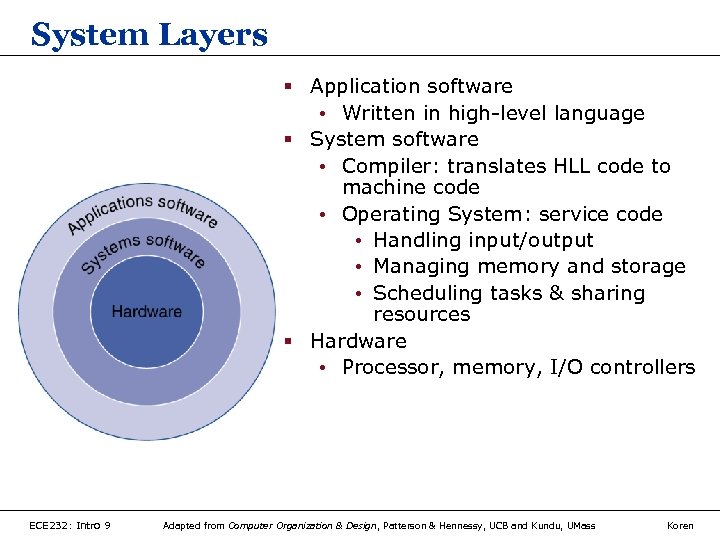 System Layers § Application software • Written in high-level language § System software • Compiler: translates HLL code to machine code • Operating System: service code • Handling input/output • Managing memory and storage • Scheduling tasks & sharing resources § Hardware • Processor, memory, I/O controllers ECE 232: Intro 9 Adapted from Computer Organization & Design, Patterson & Hennessy, UCB and Kundu, UMass Koren
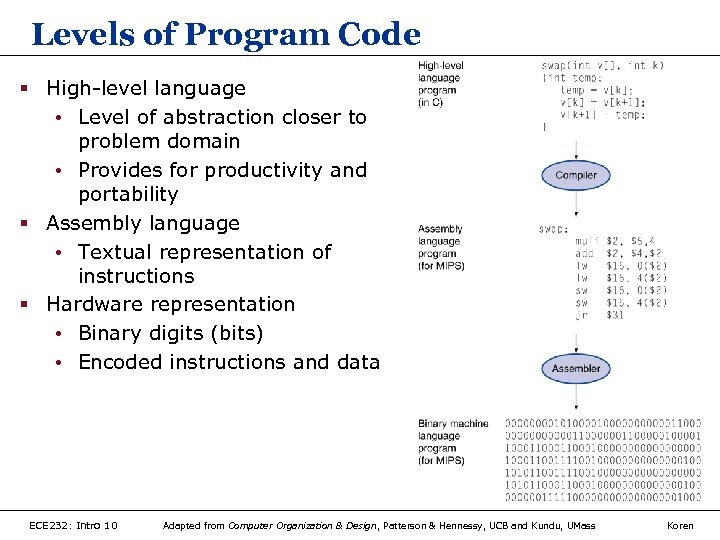 Levels of Program Code § High-level language • Level of abstraction closer to problem domain • Provides for productivity and portability § Assembly language • Textual representation of instructions § Hardware representation • Binary digits (bits) • Encoded instructions and data ECE 232: Intro 10 Adapted from Computer Organization & Design, Patterson & Hennessy, UCB and Kundu, UMass Koren
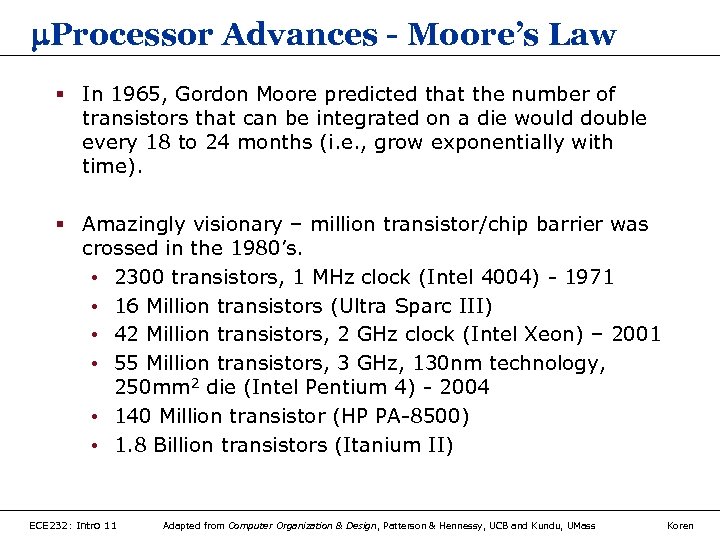 Processor Advances - Moore’s Law § In 1965, Gordon Moore predicted that the number of transistors that can be integrated on a die would double every 18 to 24 months (i. e. , grow exponentially with time). § Amazingly visionary – million transistor/chip barrier was crossed in the 1980’s. • 2300 transistors, 1 MHz clock (Intel 4004) - 1971 • 16 Million transistors (Ultra Sparc III) • 42 Million transistors, 2 GHz clock (Intel Xeon) – 2001 • 55 Million transistors, 3 GHz, 130 nm technology, 250 mm 2 die (Intel Pentium 4) - 2004 • 140 Million transistor (HP PA-8500) • 1. 8 Billion transistors (Itanium II) ECE 232: Intro 11 Adapted from Computer Organization & Design, Patterson & Hennessy, UCB and Kundu, UMass Koren
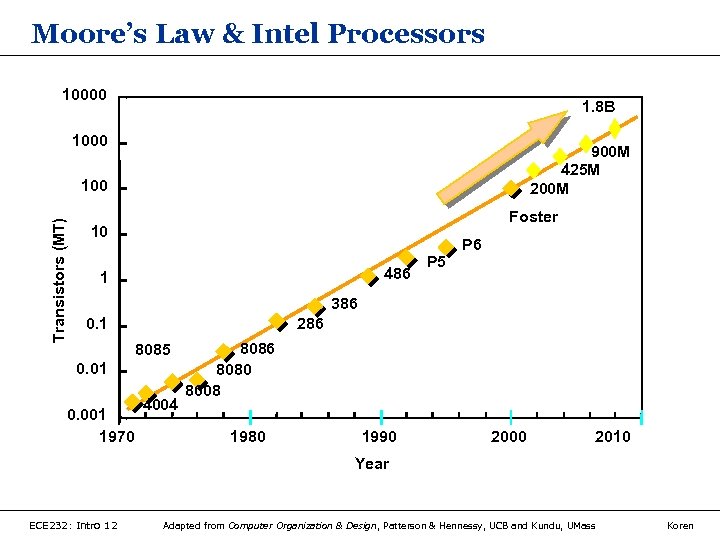 Moore’s Law & Intel Processors 10000 1. 8 B 1000 900 M 425 M 200 M Transistors (MT) 100 Foster 10 486 1 P 5 P 6 386 0. 1 286 8085 0. 01 0. 001 1970 4004 8086 8080 8008 1980 1990 2000 2010 Year ECE 232: Intro 12 Adapted from Computer Organization & Design, Patterson & Hennessy, UCB and Kundu, UMass Koren
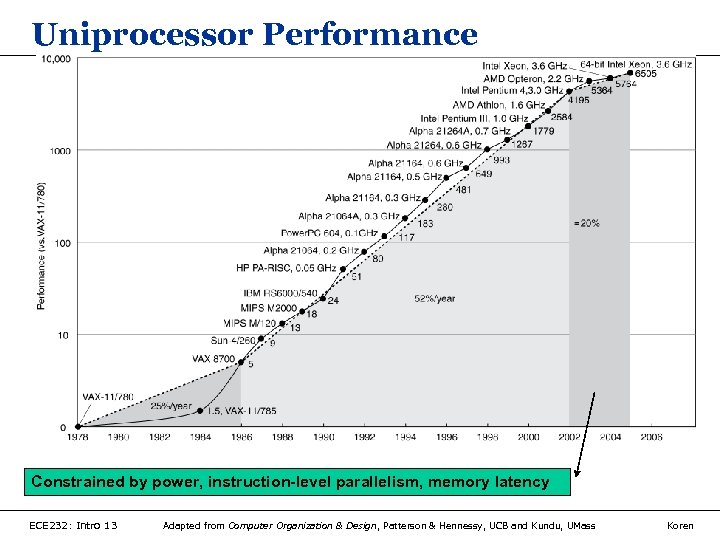 Uniprocessor Performance Constrained by power, instruction-level parallelism, memory latency ECE 232: Intro 13 Adapted from Computer Organization & Design, Patterson & Hennessy, UCB and Kundu, UMass Koren
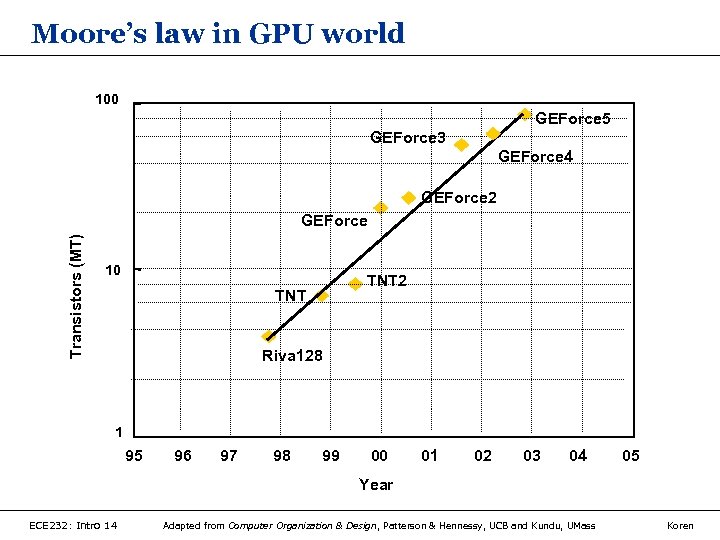 Moore’s law in GPU world 100 GEForce 5 GEForce 3 GEForce 4 GEForce 2 Transistors (MT) GEForce 10 TNT 2 TNT Riva 128 1 95 96 97 98 99 00 01 02 03 04 05 Year ECE 232: Intro 14 Adapted from Computer Organization & Design, Patterson & Hennessy, UCB and Kundu, UMass Koren
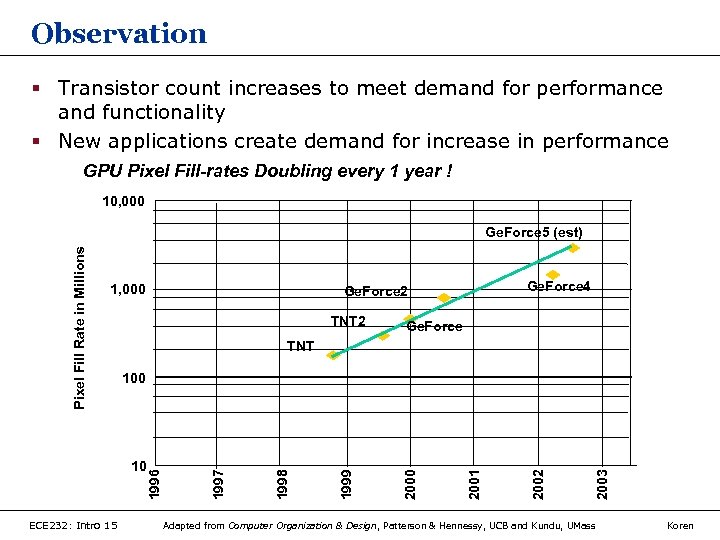 Observation § Transistor count increases to meet demand for performance and functionality § New applications create demand for increase in performance GPU Pixel Fill-rates Doubling every 1 year ! 10, 000 1, 000 TNT 2 Ge. Force TNT 2003 2002 2001 2000 1999 1996 1998 100 10 ECE 232: Intro 15 Ge. Force 4 Ge. Force 2 1997 Pixel Fill Rate in Millions Ge. Force 5 (est) Adapted from Computer Organization & Design, Patterson & Hennessy, UCB and Kundu, UMass Koren
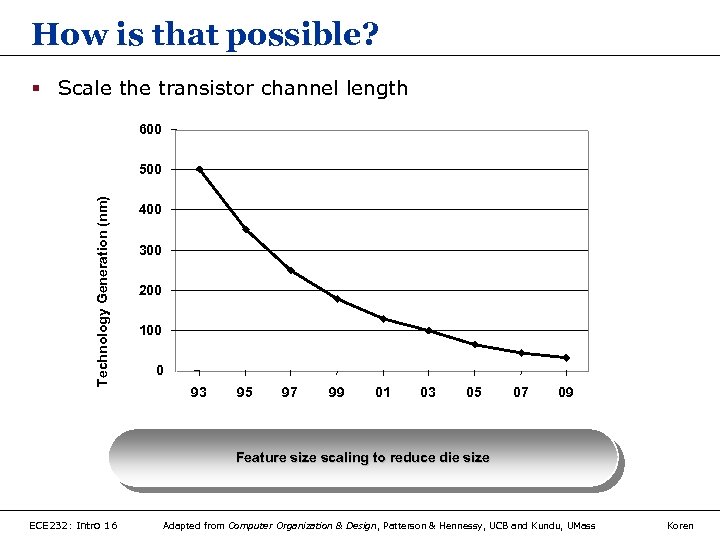 How is that possible? § Scale the transistor channel length 600 Technology Generation (nm) 500 400 300 200 100 0 93 95 97 99 01 03 05 07 09 Feature size scaling to reduce die size ECE 232: Intro 16 Adapted from Computer Organization & Design, Patterson & Hennessy, UCB and Kundu, UMass Koren
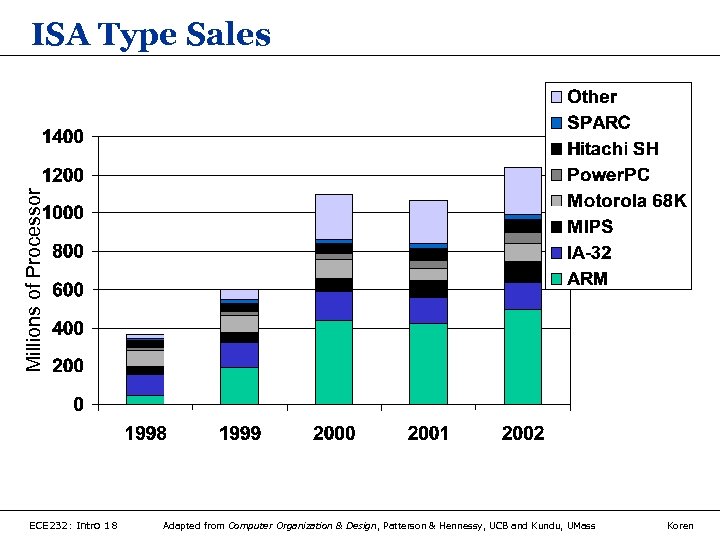 Millions of Processor ISA Type Sales ECE 232: Intro 18 Adapted from Computer Organization & Design, Patterson & Hennessy, UCB and Kundu, UMass Koren
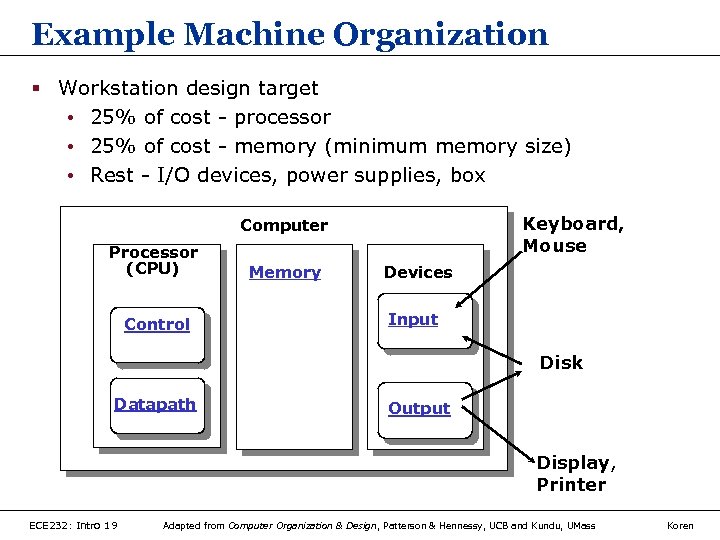 Example Machine Organization § Workstation design target • 25% of cost - processor • 25% of cost - memory (minimum memory size) • Rest - I/O devices, power supplies, box Keyboard, Mouse Computer Processor (CPU) Control Memory Devices Input Disk Datapath Output Display, Printer ECE 232: Intro 19 Adapted from Computer Organization & Design, Patterson & Hennessy, UCB and Kundu, UMass Koren
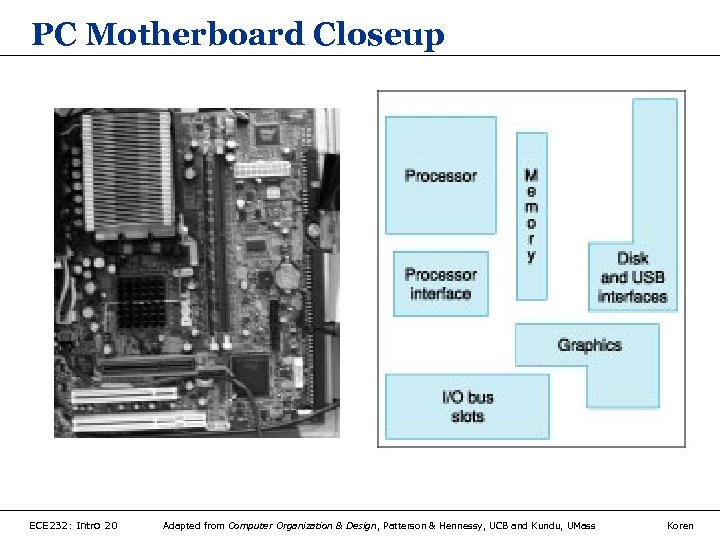 PC Motherboard Closeup ECE 232: Intro 20 Adapted from Computer Organization & Design, Patterson & Hennessy, UCB and Kundu, UMass Koren
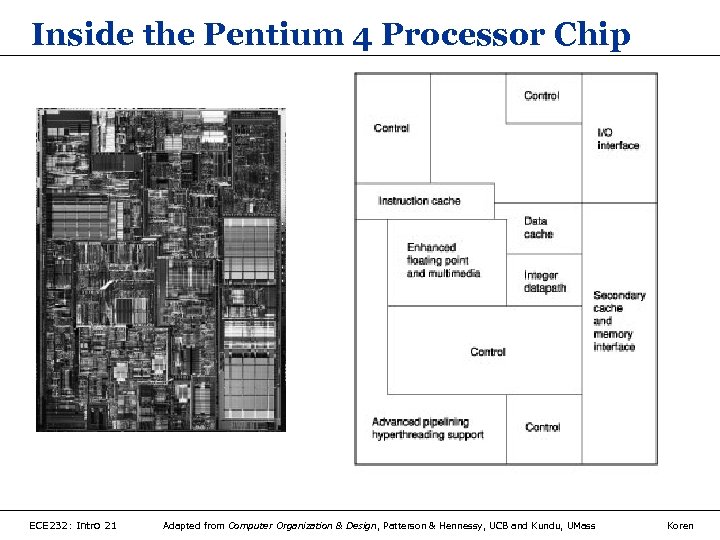 Inside the Pentium 4 Processor Chip ECE 232: Intro 21 Adapted from Computer Organization & Design, Patterson & Hennessy, UCB and Kundu, UMass Koren
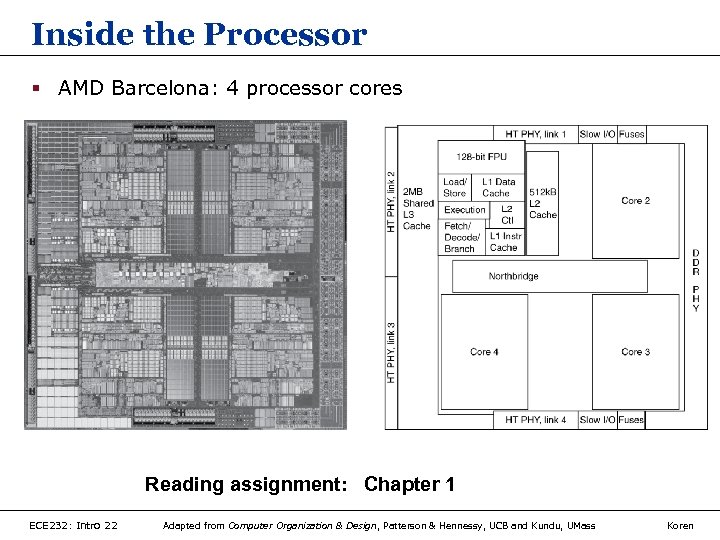 Inside the Processor § AMD Barcelona: 4 processor cores Reading assignment: Chapter 1 ECE 232: Intro 22 Adapted from Computer Organization & Design, Patterson & Hennessy, UCB and Kundu, UMass Koren
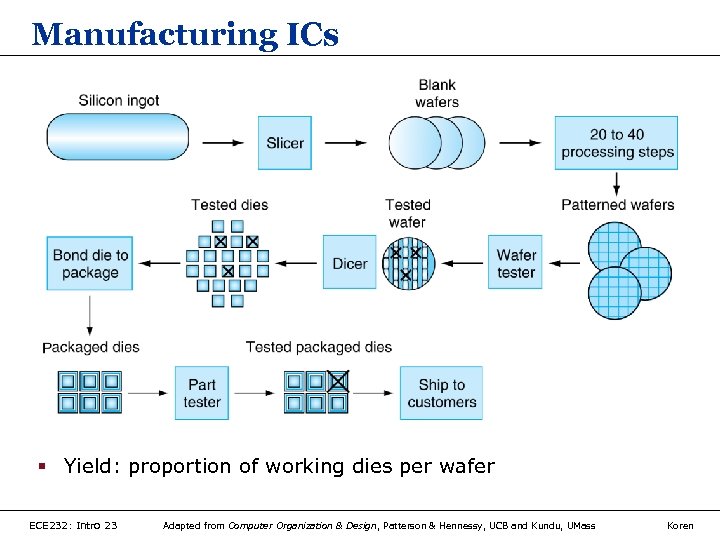 Manufacturing ICs § Yield: proportion of working dies per wafer ECE 232: Intro 23 Adapted from Computer Organization & Design, Patterson & Hennessy, UCB and Kundu, UMass Koren
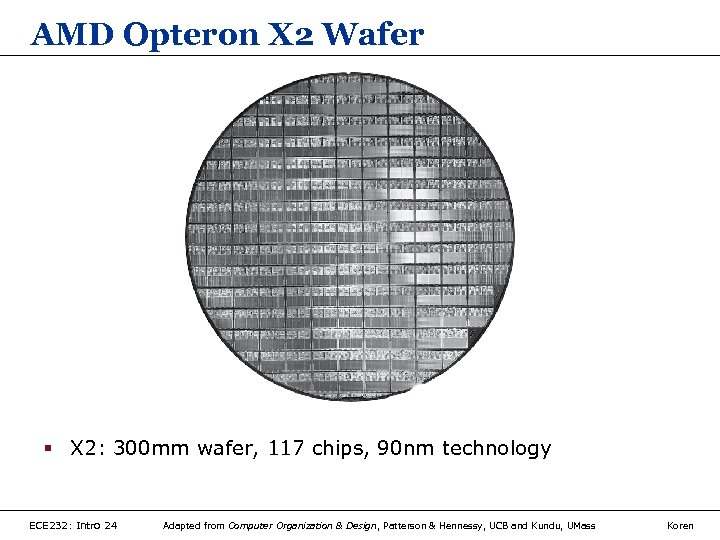 AMD Opteron X 2 Wafer § X 2: 300 mm wafer, 117 chips, 90 nm technology ECE 232: Intro 24 Adapted from Computer Organization & Design, Patterson & Hennessy, UCB and Kundu, UMass Koren