 Скачать презентацию ECE 101 Sections 5 6 Gadget Lab
51cad8cc6769441a1ce986deac678af9.ppt
- Количество слайдов: 18



ECE 101 Sections 5 & 6 “Gadget Lab” Dr. Cindy Harnett ECE Dept.
Syllabus -A 6 -session once-weekly course -No homework/tests -Learn electrical safety and basic circuit building through lectures, projects, and “teardowns” -Learn where to find more information for your own projects

Course Website • It’s on Blackboard • Contains reference material on projects • Contains external links to free tutorials, project kits/ideas, and component vendors Occasional announcements may be made by email. Please list your preferred email on the signup sheet.
Project Kits • Good news: no textbook required • Bad news: project kits required ($30 total for three projects) • Good news: you choose and keep the projects. View and select projects later in today’s class. Take payment form to ECE Dept (Susan Cunningham). Project kits will be distributed in class on or before the 4 th class session.
Q&A! • • Majors? Electronic experience? (Not required) Dream projects? Concerns? (Safety, will this be horribly confusing, what if my project never works, etc) • What’s inside my ipod? • What courses/books/online resources can help me find out about…
Why learn electronics? • Civil, mechanical, bio, computer and other areas of engineering usually bump into electrical engineering at some point • Especially, interfacing “analog” signals with computers. (This Class) • Someone also needs to build the computers. (VLSI Class: Very Large Scale Integration)

Where do project ideas come from? • (The best) Something you always wanted to build/use/buy that doesn’t exist • Find inspiration in project books, magazines, online in project collections: http: //www. makezine. com • Enter contests sponsored by semiconductor manufacturers • Open up consumer items to see how it’s done • Need circuit to make a class or lab project work (Visit Belknap Research Bldg!)
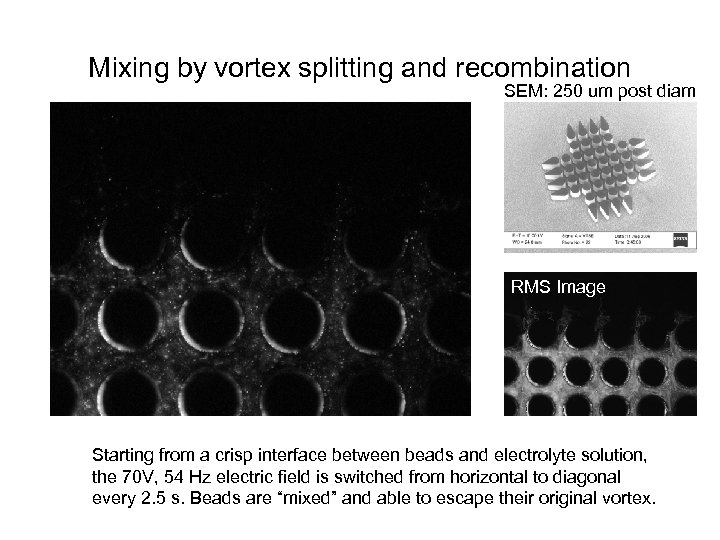
Mixing by vortex splitting and recombination SEM: 250 um post diam RMS Image Starting from a crisp interface between beads and electrolyte solution, the 70 V, 54 Hz electric field is switched from horizontal to diagonal every 2. 5 s. Beads are “mixed” and able to escape their original vortex.
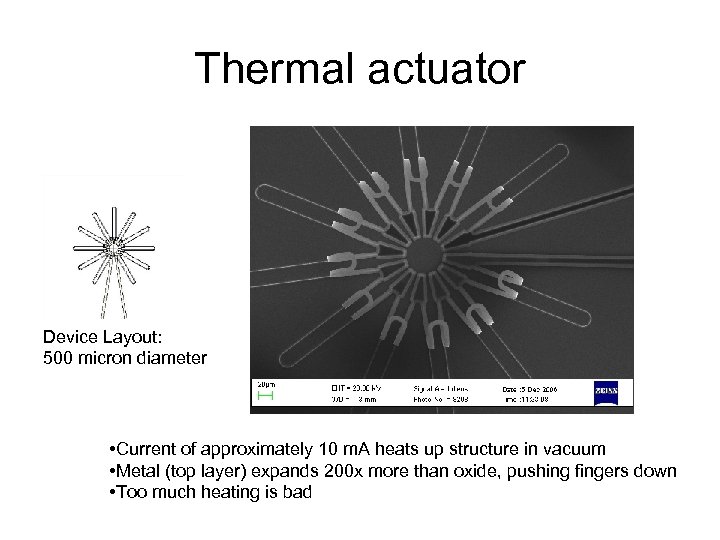
Thermal actuator Device Layout: 500 micron diameter • Current of approximately 10 m. A heats up structure in vacuum • Metal (top layer) expands 200 x more than oxide, pushing fingers down • Too much heating is bad
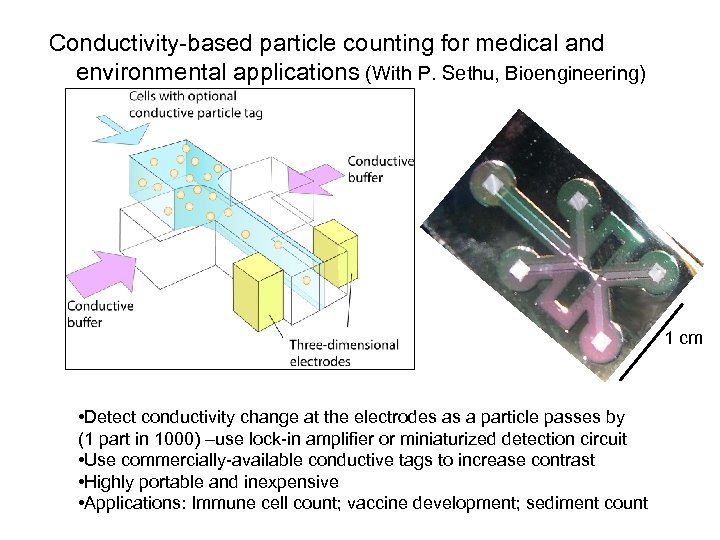
Conductivity-based particle counting for medical and environmental applications (With P. Sethu, Bioengineering) 1 cm • Detect conductivity change at the electrodes as a particle passes by (1 part in 1000) –use lock-in amplifier or miniaturized detection circuit • Use commercially-available conductive tags to increase contrast • Highly portable and inexpensive • Applications: Immune cell count; vaccine development; sediment count
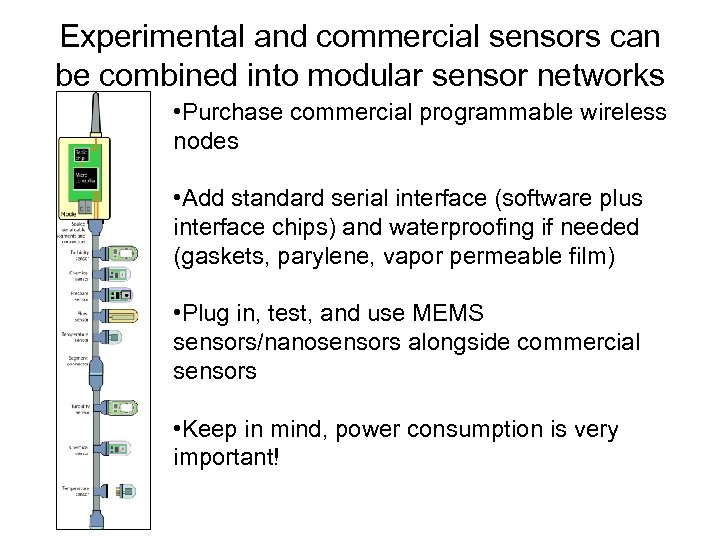
Experimental and commercial sensors can be combined into modular sensor networks • Purchase commercial programmable wireless nodes • Add standard serial interface (software plus interface chips) and waterproofing if needed (gaskets, parylene, vapor permeable film) • Plug in, test, and use MEMS sensors/nanosensors alongside commercial sensors • Keep in mind, power consumption is very important!
Safety • Three dangers: Shocks, burns, toxic compounds • Unplug it before ever opening the case: AC (wall outlet) is dangerous. Take care with high voltage objects like old CRT monitors. • Shock risk is minimal in solar and batterypowered electronics. However, Taser is battery powered! • Burns from soldering irons: know basic first aid (cold water). Switch it off, wear safety glasses. • Toxic lead solder: Main danger is ingestion, not inhalation. Flux fumes can be corrosive. Wash hands/try lead-free solder/use good ventilation. • Any “experiences” with the above? What would you warn us to do differently next time?
Electricity Basics • Safety discussion leads us to Ohm’s Law: V=IR (Voltage=Current* Resistance) • Units of V=Volts, I=Amps, R= Ohms • In practical experience it should be “I=V/R”. Usually, we apply a known “V” to a “R” and see what Current (I) comes out. This tells us about the size of “R. ” • Example: V=9 V battery, R=thumb, I= small. • When R= tongue, I= bigger. Conclusion? ? ? • It’s smarter to test Ohm’s Law using resistors and a multimeter.
Electricity Basics • Predicting it (Ohm’s Law) - Water pipe analogy/Freeway analogy. “Ground” is missing from these analogies, however. • Getting it: Specify and locate components. • Assembling it: Breadboards, soldering, etc • Powering it: AC, “Wall Wart, ” Battery, Solar • Measuring it: Multimeter, oscilloscope, A to D system (Analog to Digital) • Translating it: convert an unknown resistance into a voltage using a voltage divider, then measure that voltage with an A to D system.
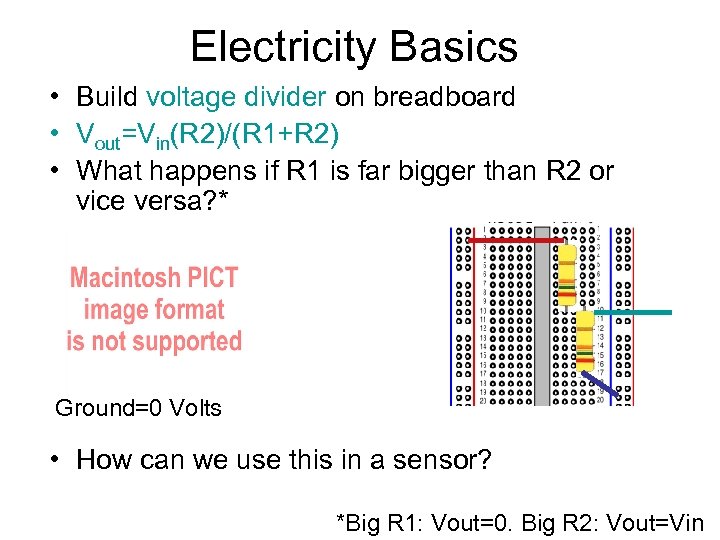
Electricity Basics • Build voltage divider on breadboard • Vout=Vin(R 2)/(R 1+R 2) • What happens if R 1 is far bigger than R 2 or vice versa? * Ground=0 Volts • How can we use this in a sensor? *Big R 1: Vout=0. Big R 2: Vout=Vin
Projects on demo table • Choose 3 to complete in any order during class sessions 4, 5 and 6: • • • Solar Robot Optical Theremin Electroluminescent Lamp LED Firefly Muscle Wire actuator Solar Battery Charger • There’s lots of room for creativity in assembling these projects. • I need your project selection form today…
Teardowns • • Computer Mouse Electronic Jumprope Multimeter Note prevalence of digital microcontrollers (“bugs”) sometimes covered by epoxy (black dot) • Next time: VCR. (Electromechanical parts) • Have other teardowns for next time? (no TVs or computer monitors please)
 Скачать презентацию ECE 101 Sections 5 6 Gadget Lab
51cad8cc6769441a1ce986deac678af9.ppt