 Скачать презентацию ECE 101 Section 5 Gadget Lab Lecture 3
88e6273d2c2dbcfe688335cd43b17191.ppt
- Количество слайдов: 18



ECE 101 Section 5 “Gadget Lab” Lecture 3: Integrated Circuits and Soldering Dr. Cindy Harnett ECE Dept.
What is an “IC” ? • Integrated circuit--more than a single resistor, capacitor, or transistor. Several components are integrated into one buglike package. • Can have any function--see the datasheet • Denoted by “U” on a circuit board (U 1, U 2, etc) for some reason. • Thousands of kinds are available: amplifiers, “AND” gates, other logic gates, counters, microcontrollers and computer chips are ICs.
Silicon chemistry enables microscopic circuit production • Silicon can be formulated with a small fraction of phosphorus, boron or other ions. Small amounts: semiconductor (transistor). Large amounts: metallic (a wire or resistor) • Silicon in an oxygen atmosphere forms an oxide (glass). Highly insulating (the filling in a capacitor) • Layer by layer, tiny patterns of insulators, semiconductors and metals are arranged on silicon to form an integrated circuit.
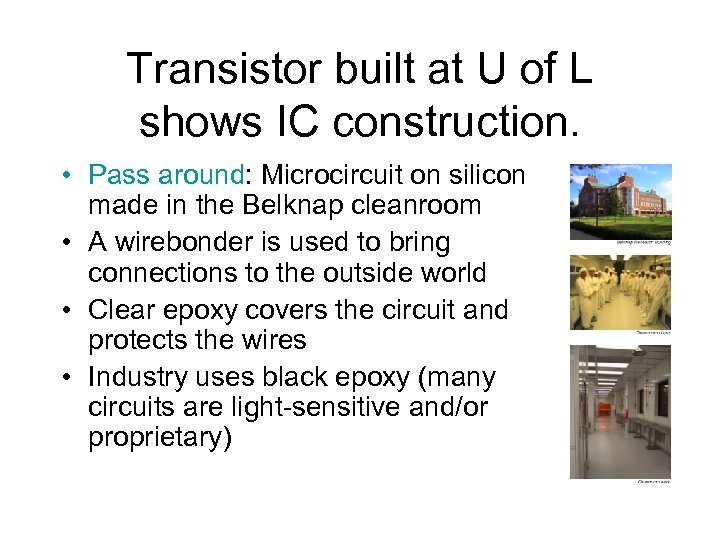
Transistor built at U of L shows IC construction. • Pass around: Microcircuit on silicon made in the Belknap cleanroom • A wirebonder is used to bring connections to the outside world • Clear epoxy covers the circuit and protects the wires • Industry uses black epoxy (many circuits are light-sensitive and/or proprietary)
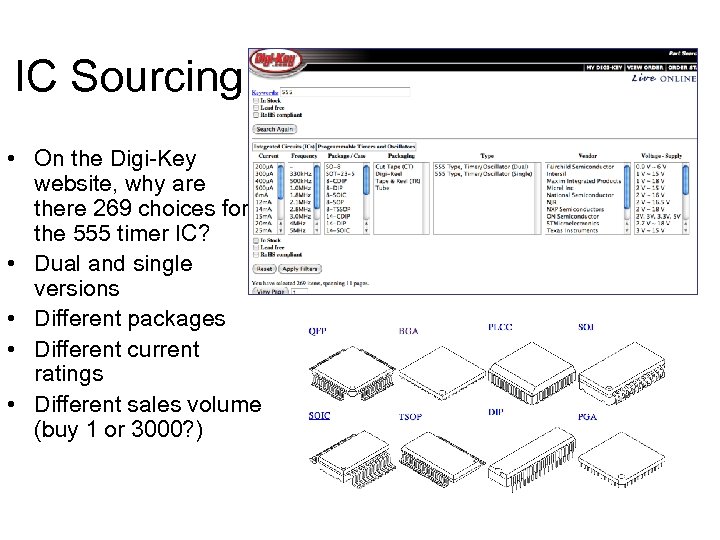
IC Sourcing • On the Digi-Key website, why are there 269 choices for the 555 timer IC? • Dual and single versions • Different packages • Different current ratings • Different sales volume (buy 1 or 3000? )
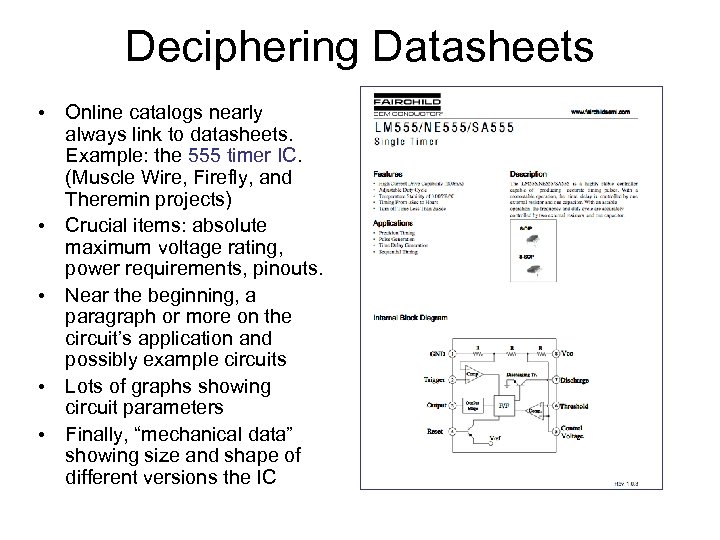
Deciphering Datasheets • Online catalogs nearly always link to datasheets. Example: the 555 timer IC. (Muscle Wire, Firefly, and Theremin projects) • Crucial items: absolute maximum voltage rating, power requirements, pinouts. • Near the beginning, a paragraph or more on the circuit’s application and possibly example circuits • Lots of graphs showing circuit parameters • Finally, “mechanical data” showing size and shape of different versions the IC
IC Safety • ICs generally have more to worry about than you do. However, the ones we use are pretty robust. • Electrostatic discharge (ESD) can short out devices by putting a different voltage on parts a few microns apart (Electric field: “volts per meter”) • ESD can be prevented, especially grounding your fingertips by touching the table or chip container before touching chips. • Also, as a general rule, apply power to a chip before applying input/output signals. ESD-damaged IC photo at http: //www. bunniestudios. com/blog/? cat=6
Breadboarding a 555 Timer • We’ll use a 555 timer IC to make a LED flash at ~1 Hz. • 2 resistors and a capacitor determine the timing of a pulse train from the 555: • Frequency=1. 44/((R 1+2*R 2)* C) The fine print Maximum values for R 1 and R 2: 3, 300, 000 ohms (3. 3 meg ohms) Minimum values for R 1 and R 2: 1, 000 ohms Minimum recommended capacitance: 500 p. F Maximum capacitance: Limited by capacitor leakage Maximum frequency: Theoretically 1 MHz, but in practical usage, around 300 KHz http: //www. markallen. com/teaching/ucsd/147 a/lectures/lecture 4/5. php
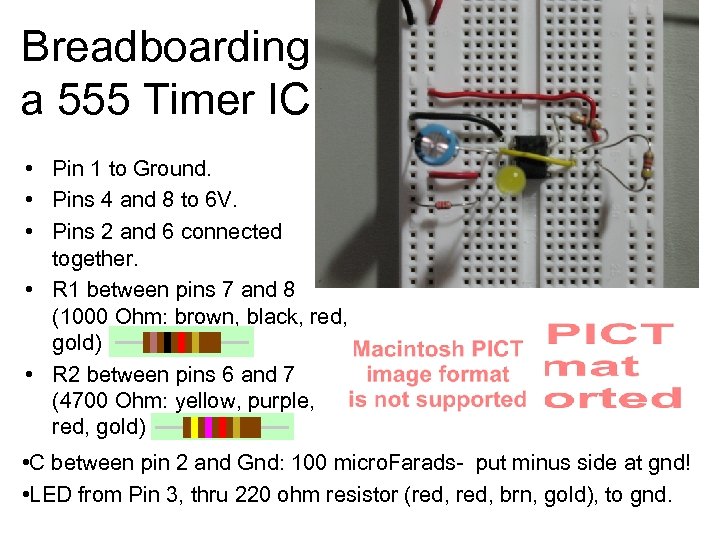
Breadboarding a 555 Timer IC • Pin 1 to Ground. • Pins 4 and 8 to 6 V. • Pins 2 and 6 connected together. • R 1 between pins 7 and 8 (1000 Ohm: brown, black, red, gold) • R 2 between pins 6 and 7 (4700 Ohm: yellow, purple, red, gold) • C between pin 2 and Gnd: 100 micro. Farads- put minus side at gnd! • LED from Pin 3, thru 220 ohm resistor (red, brn, gold), to gnd.
Soldering • Heat the part, then solder will flow onto it • A small bit of solder on the tip of the iron will help make thermal contact • Datasheets show max temperature--you can eventually damage an IC by heating too much • Excess solder is removed by copper braid “wick” or vacuumed by “solder sucker” • Solder contains a flux core that helps prep the metal surface to accept solder. Extra flux can be dispensed from pens/bottles. • Copper, platinum, gold easy to solder with mild flux; stainless steel needs stronger flux Wire Solder Heat the wire and the copper pad, then apply the solder
Use sockets when you don’t want permanent attachment • DIP sockets add a “solderless breadboard” plug-in style attachment for your 555 or similar chip. • Good for microcontrollers that have to be reprogrammed or reused. • ZIF sockets (Zero Insertion Force) also good for such chips. Available for surface mount chips. A reversible clamp or lever moves clips into contact with the pins. Can be expensive.
How do I get a custom PCB? • Printed circuit boards (PCBs) can be produced on a thin film of copper on an insulating base. • Phototransfer and etching of your design is done by PCB companies (Express. PCB) • People on campus use a cutter to machine the copper, for simple boards • Wax printing and copper etching process is also done locally
Freeform soldering • No printed circuit board, just parts • Not typically used in industry. • Needed for Solar Robot project and (to a smaller extent) the solar charger project. • Take “thermal mass” into account: wires and thin film solar cells heat quickly, but motor takes a long time in contact with the iron • Need some practice holding onto components
Advanced soldering: surface mount parts with small spacing • • • Surface mount devices (SMDs) are often the next step to miniaturize your design. A fine-tipped soldering iron works on SOIC parts with ~1 mm spacing (Electroluminescent project) Attach finer-pitched parts (typical QFP parts have 40 pins and up, 0. 5 mm or less apart) by stenciling solder paste, attaching part and sending all through a “reflow oven” Also BGA parts (Ball Grid Array) with all pins under part. A soldering iron would not work here. Remove mistakes using Chip. Quik low melting solder. http: //www. seattlerobotics. org/en coder/200006/oven_art. htm Solder paste being applied to 132 pads Surface tension pulls part into place during heating
Industrial board assembly • For larger quantities, boards can be sent out to be “stuffed” with components. • Smaller and smaller production runs are possible. • Companies use “pick and place” machines along with components in “tape” form to speed the process. http: //www. brightmanufacturing. com/Shop. Photos. htm
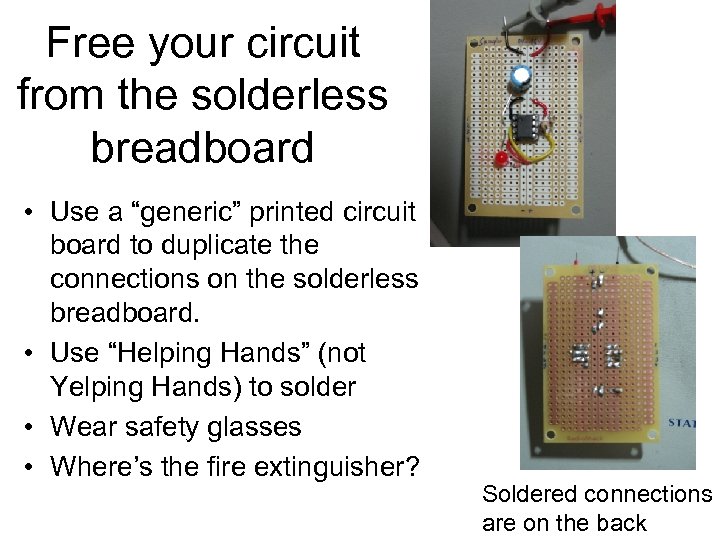
Free your circuit from the solderless breadboard • Use a “generic” printed circuit board to duplicate the connections on the solderless breadboard. • Use “Helping Hands” (not Yelping Hands) to solder • Wear safety glasses • Where’s the fire extinguisher? Soldered connections are on the back
Component identification • Some websites help you learn to identify ICs and other components (links on Black. Board) • Good for identifying a “mystery component” from a salvaged board or a junk drawer. • Teardowns- new insights? ? http: //www. uchobby. com /index. php/2007/07/15/id entifying-electroniccomponents/
Teardowns • Computer card • Electric toothbrush • CD player (Component identification) • Have other teardowns for next time? (no TVs or computer monitors please)
Скачать презентацию ECE 101 Section 5 Gadget Lab Lecture 3
88e6273d2c2dbcfe688335cd43b17191.ppt