


 Скачать презентацию ECDL 2004 Spatial Ranking Methods for Geographic Information
473eb572abfc6afeb6f4ce42f49ede89.ppt
- Количество слайдов: 41
 ECDL 2004 Spatial Ranking Methods for Geographic Information Retrieval (GIR) in Digital Libraries Ray R. Larson and Patricia Frontiera University of California, Berkeley ECDL 2004. 09. 13 - SLIDE 1
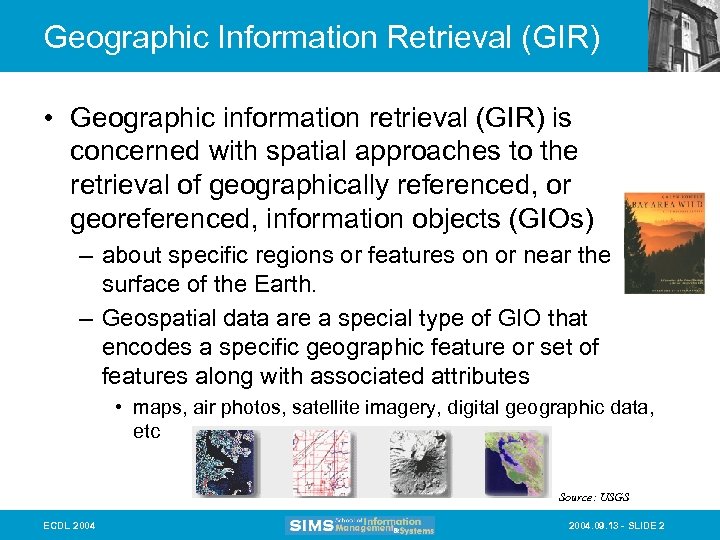 Geographic Information Retrieval (GIR) • Geographic information retrieval (GIR) is concerned with spatial approaches to the retrieval of geographically referenced, or georeferenced, information objects (GIOs) – about specific regions or features on or near the surface of the Earth. – Geospatial data are a special type of GIO that encodes a specific geographic feature or set of features along with associated attributes • maps, air photos, satellite imagery, digital geographic data, etc Source: USGS ECDL 2004. 09. 13 - SLIDE 2
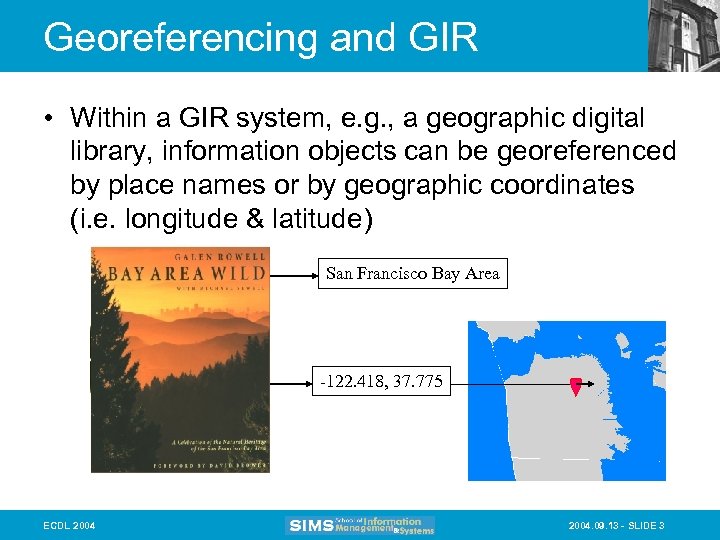 Georeferencing and GIR • Within a GIR system, e. g. , a geographic digital library, information objects can be georeferenced by place names or by geographic coordinates (i. e. longitude & latitude) San Francisco Bay Area -122. 418, 37. 775 ECDL 2004. 09. 13 - SLIDE 3
 GIR is not GIS • GIS is concerned with spatial representations, relationships, and analysis at the level of the individual spatial object or field. • GIR is concerned with the retrieval of geographic information resources (and geographic information objects at the set level) that may be relevant to a geographic query region. ECDL 2004. 09. 13 - SLIDE 4
 Spatial Approaches to GIR • A spatial approach to geographic information retrieval is one based on the integrated use of spatial representations, and spatial relationships. • A spatial approach to GIR can be qualitative or quantitative – Quantitative: based on the geometric spatial properties of a geographic information object – Qualitative: based on the non-geometric spatial properties. ECDL 2004. 09. 13 - SLIDE 5
 Spatial Matching and Ranking • Spatial similarity can be considered as a indicator of relevance: documents whose spatial content is more similar to the spatial content of query will be considered more relevant to the information need represented by the query. • Need to consider both: – Qualitative, non-geometric spatial attributes – Quantitative, geometric spatial attributes • Topological relationships and metric details • We focus on the latter… ECDL 2004. 09. 13 - SLIDE 6
 Spatial Similarity Measures and Spatial Ranking • Three basic approaches to spatial similarity measures and ranking • Method 1: Simple Overlap • Method 2: Topological Overlap • Method 3: Degree of Overlap: ECDL 2004. 09. 13 - SLIDE 7
 Method 1: Simple Overlap • Candidate geographic information objects (GIOs) that have any overlap with the query region are retrieved. • Included in the result set are any GIOs that are contained within, overlap, or contain the query region. • The spatial score for all GIOs is either relevant (1) or not relevant (0). • The result set cannot be ranked – topological relationship only, no metric refinement ECDL 2004. 09. 13 - SLIDE 8
 Method 2: Topological Overlap • Spatial searches are constrained to only those candidate GIOs that either: – are completely contained within the query region, – overlap with the query region, – or, contain the query region. • Each category is exclusive and all retrieved items are considered relevant. • The result set cannot be ranked – categorized topological relationship only, – no metric refinement ECDL 2004. 09. 13 - SLIDE 9
 Method 3: Degree of Overlap • Candidate geographic information objects (GIOs) that have any overlap with the query region are retrieved. • A spatial similarity score is determined based on the degree to which the candidate GIO overlaps with the query region. • The greater the overlap with respect to the query region, the higher the spatial similarity score. • This method provides a score by which the result set can be ranked – topological relationship: overlap – metric refinement: area of overlap ECDL 2004. 09. 13 - SLIDE 10
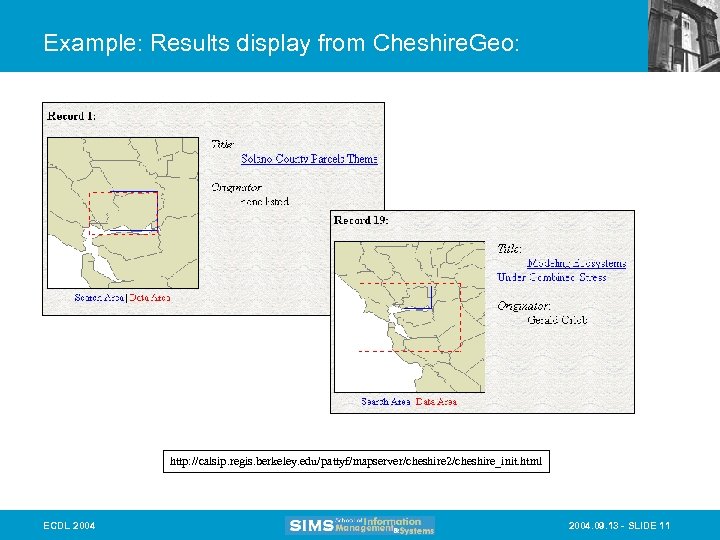 Example: Results display from Cheshire. Geo: http: //calsip. regis. berkeley. edu/pattyf/mapserver/cheshire 2/cheshire_init. html ECDL 2004. 09. 13 - SLIDE 11
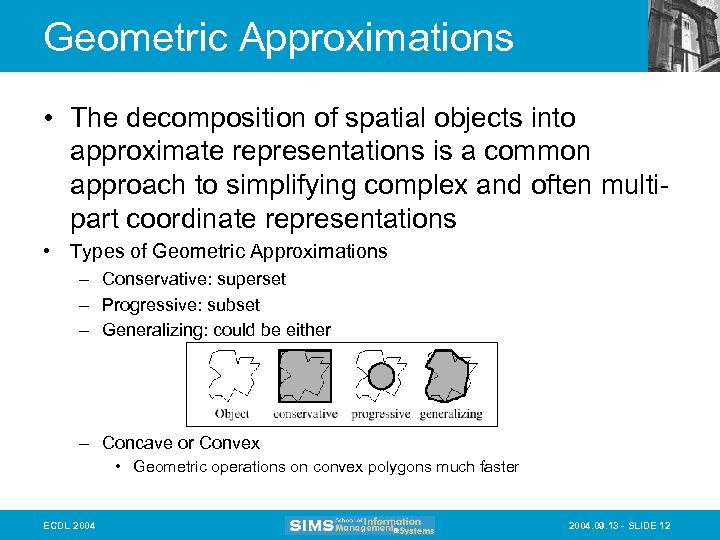 Geometric Approximations • The decomposition of spatial objects into approximate representations is a common approach to simplifying complex and often multipart coordinate representations • Types of Geometric Approximations – Conservative: superset – Progressive: subset – Generalizing: could be either – Concave or Convex • Geometric operations on convex polygons much faster ECDL 2004. 09. 13 - SLIDE 12
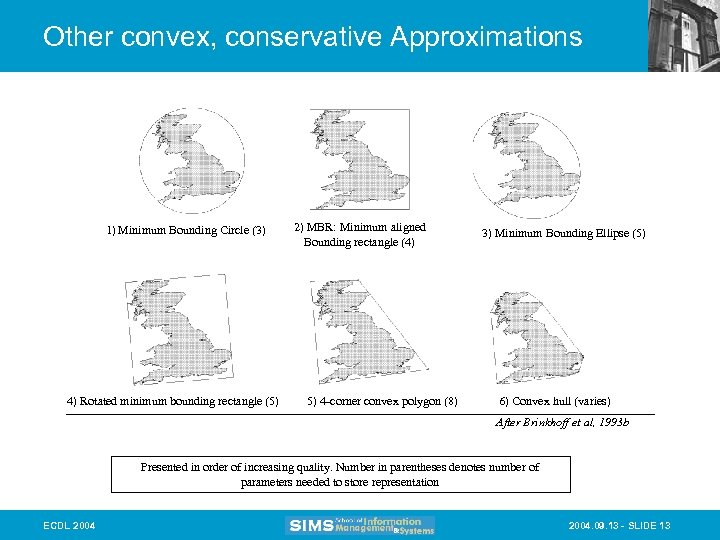 Other convex, conservative Approximations 1) Minimum Bounding Circle (3) 4) Rotated minimum bounding rectangle (5) 2) MBR: Minimum aligned Bounding rectangle (4) 5) 4 -corner convex polygon (8) 3) Minimum Bounding Ellipse (5) 6) Convex hull (varies) After Brinkhoff et al, 1993 b Presented in order of increasing quality. Number in parentheses denotes number of parameters needed to store representation ECDL 2004. 09. 13 - SLIDE 13
 Our Research Questions • Spatial Ranking – How effectively can the spatial similarity between a query region and a document region be evaluated and ranked based on the overlap of the geometric approximations for these regions? • Geometric Approximations & Spatial Ranking: – How do different geometric approximations affect the rankings? • MBRs: the most popular approximation • Convex hulls: the highest quality convex approximation ECDL 2004. 09. 13 - SLIDE 14
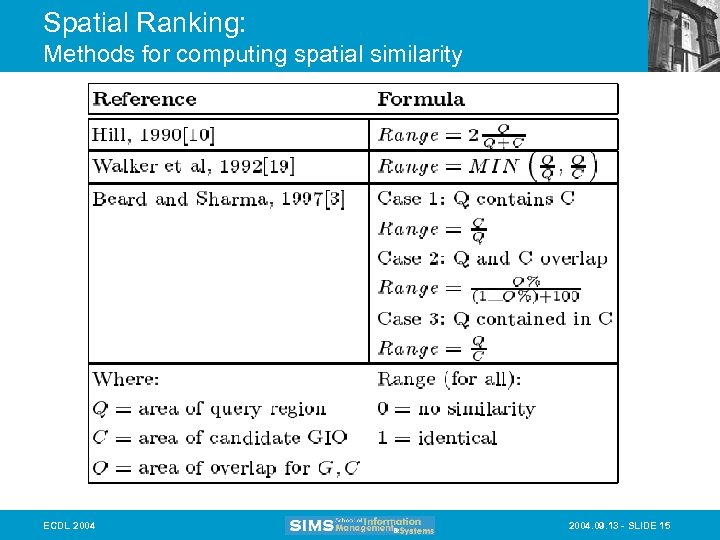 Spatial Ranking: Methods for computing spatial similarity ECDL 2004. 09. 13 - SLIDE 15
 Proposed Ranking Method • Probabilistic Spatial Ranking using Logistic Inference • Probabilistic Models – Rigorous formal model attempts to predict the probability that a given document will be relevant to a given query – Ranks retrieved documents according to this probability of relevance (Probability Ranking Principle) – Rely on accurate estimates of probabilities ECDL 2004. 09. 13 - SLIDE 16
 Logistic Regression Probability of relevance is based on Logistic regression from a sample set of documents to determine values of the coefficients. At retrieval the probability estimate is obtained by: For the m X attribute measures (on the following page) ECDL 2004. 09. 13 - SLIDE 17
 Probabilistic Models: Logistic Regression attributes • X 1 = area of overlap(query region, candidate GIO) / area of query region • X 2 = area of overlap(query region, candidate GIO) / area of candidate GIO • X 3 = 1 – abs(fraction of overlap region that is onshore fraction of candidate GIO that is onshore) • Where: Range for all variables is 0 (not similar) to 1 (same) ECDL 2004. 09. 13 - SLIDE 18
 Probabilistic Models Advantages • Strong theoretical basis • In principle should supply the best predictions of relevance given available information • Computationally efficient, straight- forward implementation (if based on LR) ECDL 2004 Disadvantages • Relevance information is required -- or is “guestimated” • Important indicators of relevance may not be captured by the model • Optimally requires ongoing collection of relevance information 2004. 09. 13 - SLIDE 19
 Test Collection • California Environmental Information Catalog (CEIC) • http: //ceres. ca. gov/catalog. • Approximately 2500 records selected from collection (Aug 2003) of ~ 4000. ECDL 2004. 09. 13 - SLIDE 20
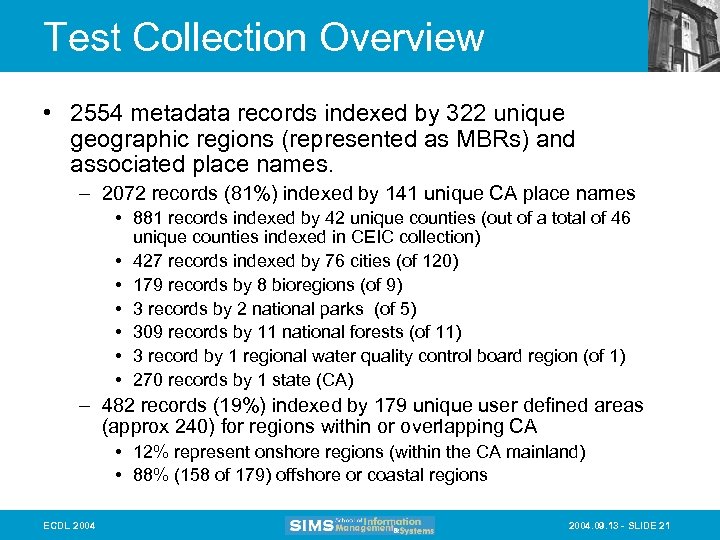 Test Collection Overview • 2554 metadata records indexed by 322 unique geographic regions (represented as MBRs) and associated place names. – 2072 records (81%) indexed by 141 unique CA place names • 881 records indexed by 42 unique counties (out of a total of 46 unique counties indexed in CEIC collection) • 427 records indexed by 76 cities (of 120) • 179 records by 8 bioregions (of 9) • 3 records by 2 national parks (of 5) • 309 records by 11 national forests (of 11) • 3 record by 1 regional water quality control board region (of 1) • 270 records by 1 state (CA) – 482 records (19%) indexed by 179 unique user defined areas (approx 240) for regions within or overlapping CA • 12% represent onshore regions (within the CA mainland) • 88% (158 of 179) offshore or coastal regions ECDL 2004. 09. 13 - SLIDE 21
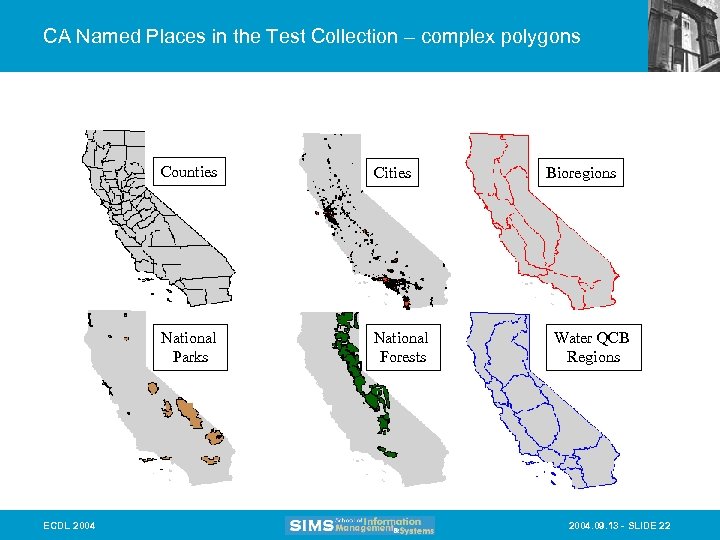 CA Named Places in the Test Collection – complex polygons Counties National Parks ECDL 2004 Cities National Forests Bioregions Water QCB Regions 2004. 09. 13 - SLIDE 22
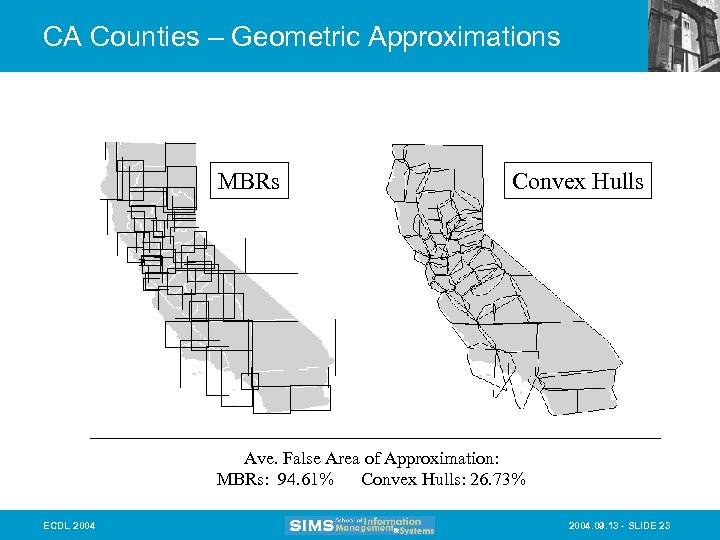 CA Counties – Geometric Approximations MBRs Convex Hulls Ave. False Area of Approximation: MBRs: 94. 61% Convex Hulls: 26. 73% ECDL 2004. 09. 13 - SLIDE 23
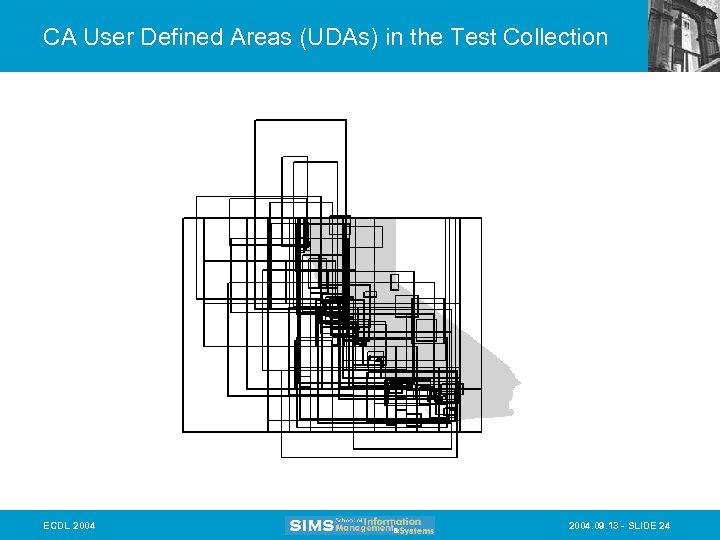 CA User Defined Areas (UDAs) in the Test Collection ECDL 2004. 09. 13 - SLIDE 24
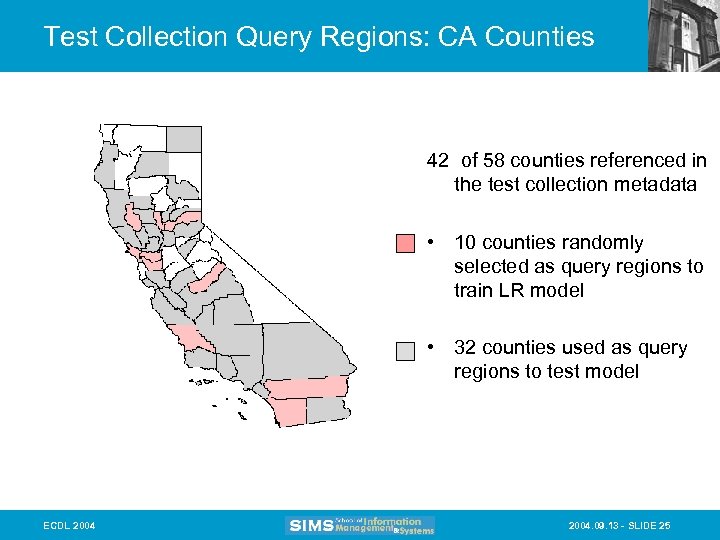 Test Collection Query Regions: CA Counties 42 of 58 counties referenced in the test collection metadata • 10 counties randomly selected as query regions to train LR model • 32 counties used as query regions to test model ECDL 2004. 09. 13 - SLIDE 25
 Test Collection Relevance Judgements • • • Determine the reference set of candidate GIO regions relevant to each county query region: Complex polygon data was used to select all CA place named regions (i. e. counties, cities, bioregions, national parks, national forests, and state regional water quality control boards) that overlap each county query region. All overlapping regions were reviewed (semi-automatically) to remove sliver matches, i. e. those regions that only overlap due to differences in the resolution of the 6 data sets. – Automated review: overlaps where overlap area/GIO area >. 00025 considered relevant, else not relevant. – Cases manually reviewed: overlap area/query area <. 001 and overlap area/GIO area <. 02 • • The MBRs and metadata for all information objects referenced by UDAs (user-defined areas) were manually reviewed to determine their relevance to each query region. This process could not be automated because, unlike the CA place named regions, there are no complex polygon representations that delineate the UDAs. This process resulted in a master file of CA place named regions and UDAs relevant to each of the 42 CA county query regions. ECDL 2004. 09. 13 - SLIDE 26
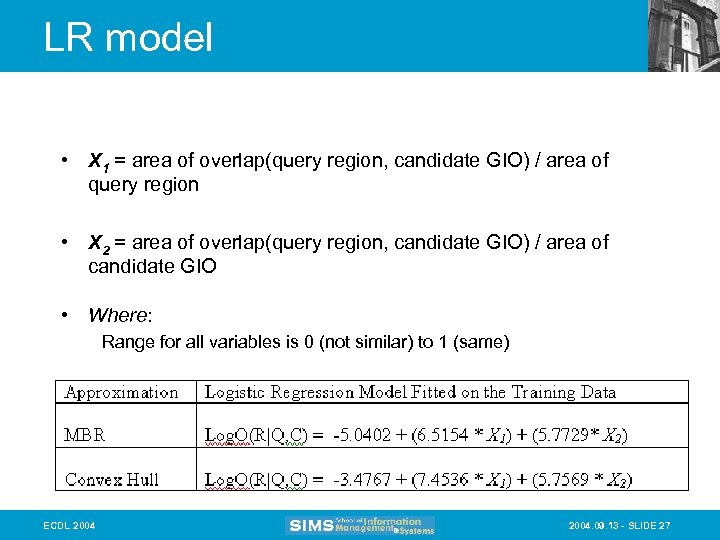 LR model • X 1 = area of overlap(query region, candidate GIO) / area of query region • X 2 = area of overlap(query region, candidate GIO) / area of candidate GIO • Where: Range for all variables is 0 (not similar) to 1 (same) ECDL 2004. 09. 13 - SLIDE 27
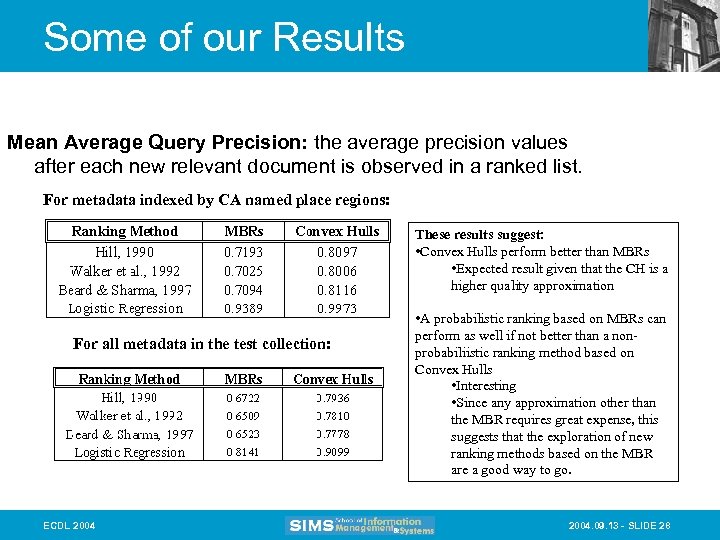 Some of our Results Mean Average Query Precision: the average precision values after each new relevant document is observed in a ranked list. For metadata indexed by CA named place regions: These results suggest: • Convex Hulls perform better than MBRs • Expected result given that the CH is a higher quality approximation For all metadata in the test collection: ECDL 2004 • A probabilistic ranking based on MBRs can perform as well if not better than a nonprobabiliistic ranking method based on Convex Hulls • Interesting • Since any approximation other than the MBR requires great expense, this suggests that the exploration of new ranking methods based on the MBR are a good way to go. 2004. 09. 13 - SLIDE 28
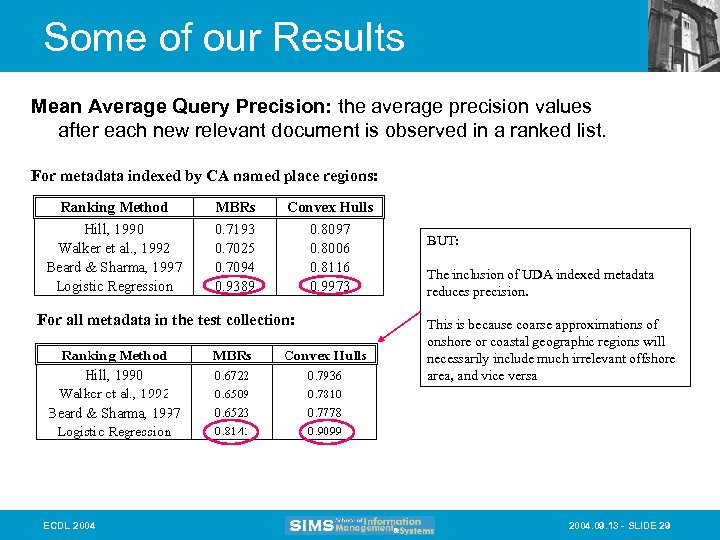 Some of our Results Mean Average Query Precision: the average precision values after each new relevant document is observed in a ranked list. For metadata indexed by CA named place regions: BUT: The inclusion of UDA indexed metadata reduces precision. For all metadata in the test collection: ECDL 2004 This is because coarse approximations of onshore or coastal geographic regions will necessarily include much irrelevant offshore area, and vice versa 2004. 09. 13 - SLIDE 29
 Precision Results for MBR - Named data Recall ECDL 2004. 09. 13 - SLIDE 30
 Precision Results for Convex Hulls -Named Recall ECDL 2004. 09. 13 - SLIDE 31
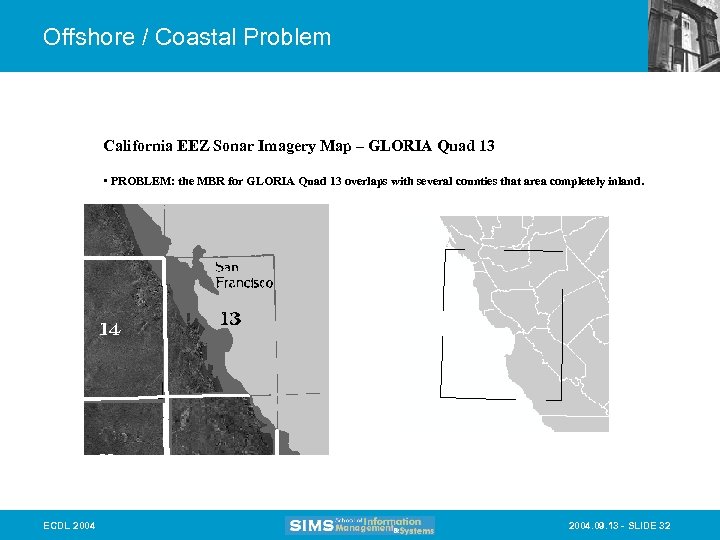 Offshore / Coastal Problem California EEZ Sonar Imagery Map – GLORIA Quad 13 • PROBLEM: the MBR for GLORIA Quad 13 overlaps with several counties that area completely inland. ECDL 2004. 09. 13 - SLIDE 32
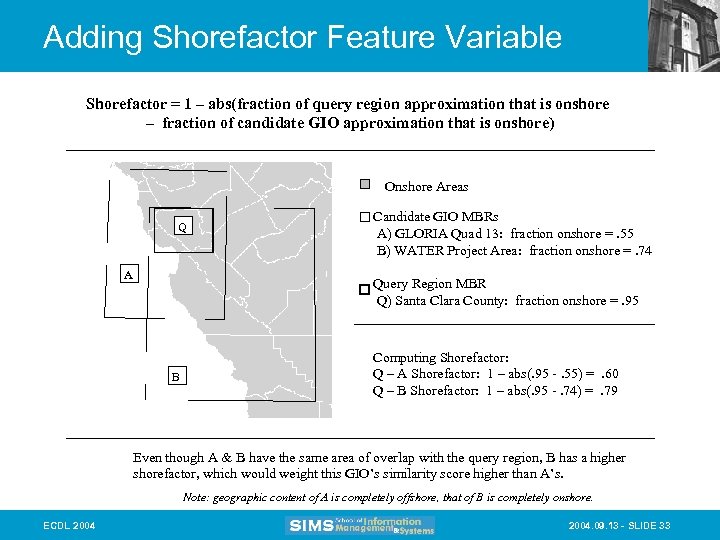 Adding Shorefactor Feature Variable Shorefactor = 1 – abs(fraction of query region approximation that is onshore – fraction of candidate GIO approximation that is onshore) Onshore Areas Q A Candidate GIO MBRs A) GLORIA Quad 13: fraction onshore =. 55 B) WATER Project Area: fraction onshore =. 74 Query Region MBR Q) Santa Clara County: fraction onshore =. 95 B Computing Shorefactor: Q – A Shorefactor: 1 – abs(. 95 -. 55) =. 60 Q – B Shorefactor: 1 – abs(. 95 -. 74) =. 79 Even though A & B have the same area of overlap with the query region, B has a higher shorefactor, which would weight this GIO’s similarity score higher than A’s. Note: geographic content of A is completely offshore, that of B is completely onshore. ECDL 2004. 09. 13 - SLIDE 33
 About the Shorefactor Variable • Characterizes the relationship between the query and candidate GIO regions based on the extent to which their approximations overlap with onshore areas (or offshore areas). • Assumption: a candidate region is more likely to be relevant to the query region if the extent to which its approximation is onshore (or offshore) is similar to that of the query region’s approximation. ECDL 2004. 09. 13 - SLIDE 34
 About the Shorefactor Variable • The use of the shorefactor variable is presented as an example of how geographic context can be integrated into the spatial ranking process. • Performance: Onshore fraction for each GIO approximation can be pre-indexed. Thus, for each query only the onshore fraction of the query region needs to be calculated using a geometric operation. The computational complexity of this type of operation is dependent on the complexity of the coordinate representations of the query region (we used the MBR and Convex hull approximations) and the onshore region (we used a very generalized concave polygon w/ only 154 pts). ECDL 2004. 09. 13 - SLIDE 35
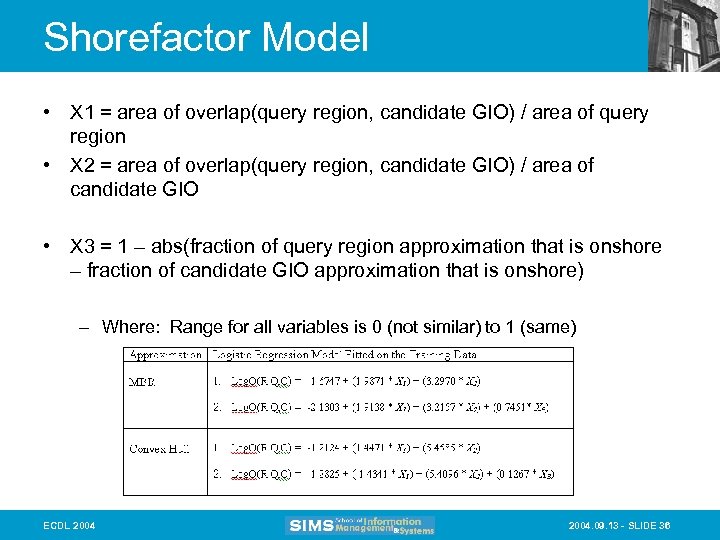 Shorefactor Model • X 1 = area of overlap(query region, candidate GIO) / area of query region • X 2 = area of overlap(query region, candidate GIO) / area of candidate GIO • X 3 = 1 – abs(fraction of query region approximation that is onshore – fraction of candidate GIO approximation that is onshore) – Where: Range for all variables is 0 (not similar) to 1 (same) ECDL 2004. 09. 13 - SLIDE 36
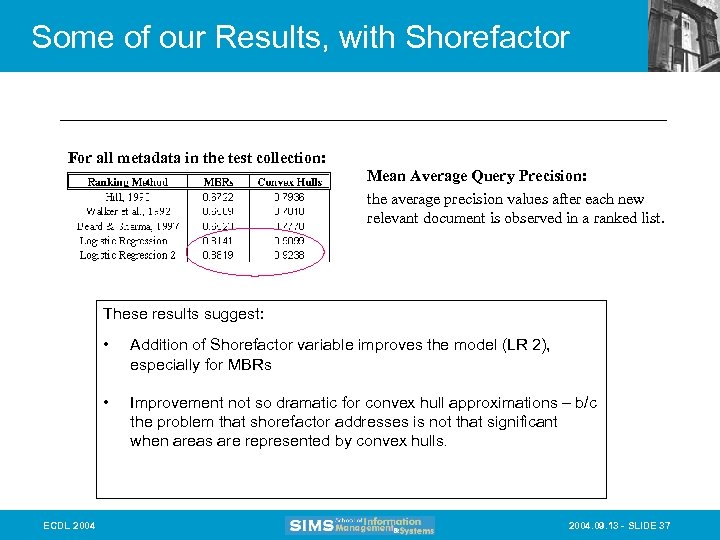 Some of our Results, with Shorefactor For all metadata in the test collection: Mean Average Query Precision: the average precision values after each new relevant document is observed in a ranked list. These results suggest: • • ECDL 2004 Addition of Shorefactor variable improves the model (LR 2), especially for MBRs Improvement not so dramatic for convex hull approximations – b/c the problem that shorefactor addresses is not that significant when areas are represented by convex hulls. 2004. 09. 13 - SLIDE 37
 Precision Results for All Data - MBRs Recall ECDL 2004. 09. 13 - SLIDE 38
 Precision Results for All Data - Convex Hull Recall ECDL 2004. 09. 13 - SLIDE 39
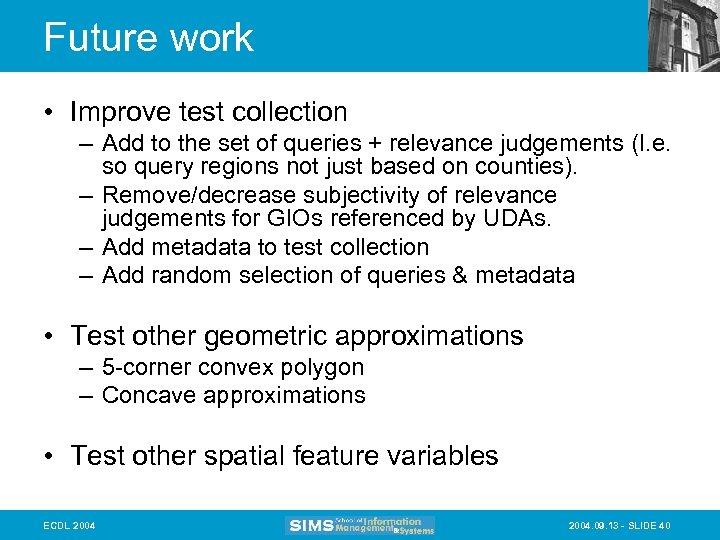 Future work • Improve test collection – Add to the set of queries + relevance judgements (I. e. so query regions not just based on counties). – Remove/decrease subjectivity of relevance judgements for GIOs referenced by UDAs. – Add metadata to test collection – Add random selection of queries & metadata • Test other geometric approximations – 5 -corner convex polygon – Concave approximations • Test other spatial feature variables ECDL 2004. 09. 13 - SLIDE 40
 ECDL 2004. 09. 13 - SLIDE 41