


 Скачать презентацию EC Electronic Data Interchange Kieran Mathieson Decision and
189a9ba737cfb3ec45018465c80dac2b.ppt
- Количество слайдов: 50
 EC Electronic Data Interchange Kieran Mathieson Decision and Information Sciences School of Business Administration Oakland University mathieso@oakland. edu
 EC Outline t t t What is EDI? The Business Case for EDI Standards Implementing EDI and the Internet
 EC What is EDI? t Interprocess (computer application to computer application) communication of business documents in a standardized electronic form – No rekeying – Data usually transmitted by networks – May involve intermediaries
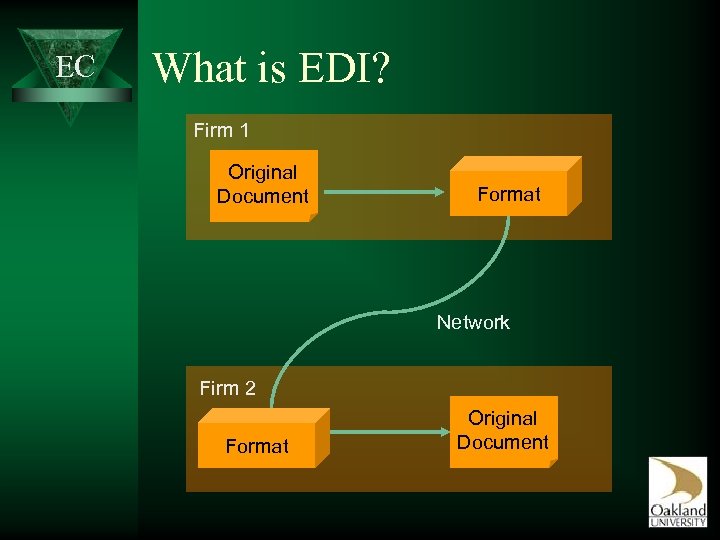 EC What is EDI? Firm 1 Original Document Format Network Firm 2 Format Original Document
 EC Questions t t t How is the data formatted? What network is used? What are the network specifications? – Protocol, speed, etc. t t t What if firms participate in many relationships? Do the firms’ internal systems change? What about security?
 EC EDI Necessity: Standards t t t Both sides must use the same formats Standards provide the formatting rules Bunch o’ standards organizations – ANSI ASC X 12 – UN/EDIFACT – UCC – AIAG t They are drawing together
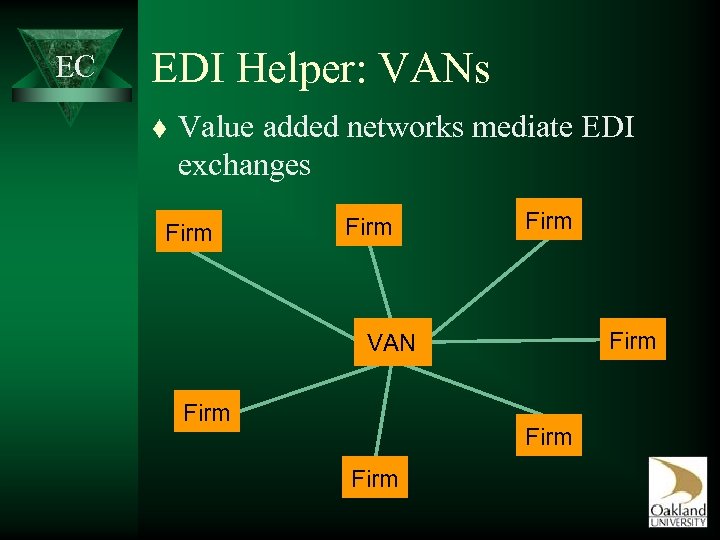 EC EDI Helper: VANs t Value added networks mediate EDI exchanges Firm VAN Firm
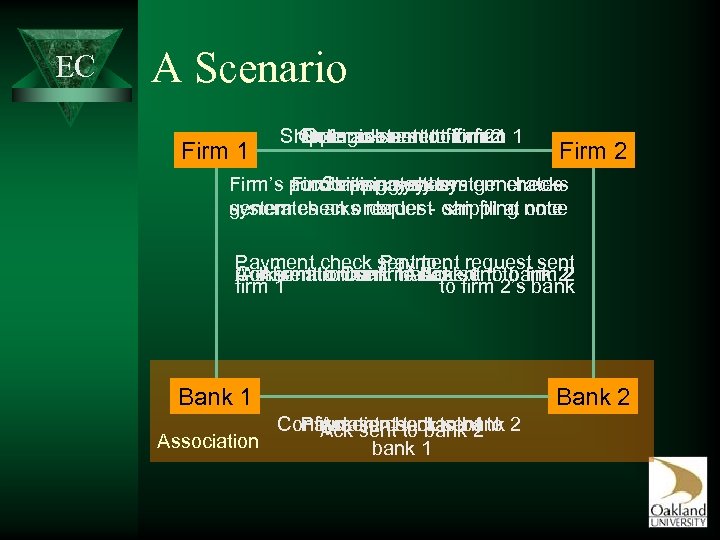 EC A Scenario Firm 1 Shippingack sentto firm 21 1 Order acksent to to firm Note is sent to firm 2 Order note sent firm Firm 2 Firm’s purchasing system generates accounts payable Firm’s inventory system checks Shipping system checks request- can fill at note generates an order shipping once Payment check sent to request sent Payment Ack sent to firm 1 to banksent bank 2 Confirmationbank 1 Ack sent toto firm 2 Ack sent to. Confirmation 1 sent Ack firm 1 to firm 2’s bank Bank 1 Confirmation sent to bank 2 Payment check sent to Ack sent to bank 1 Ack sent to bank 2 Association bank 1 Bank 2
 EC The Big Question Why invest in EDI?
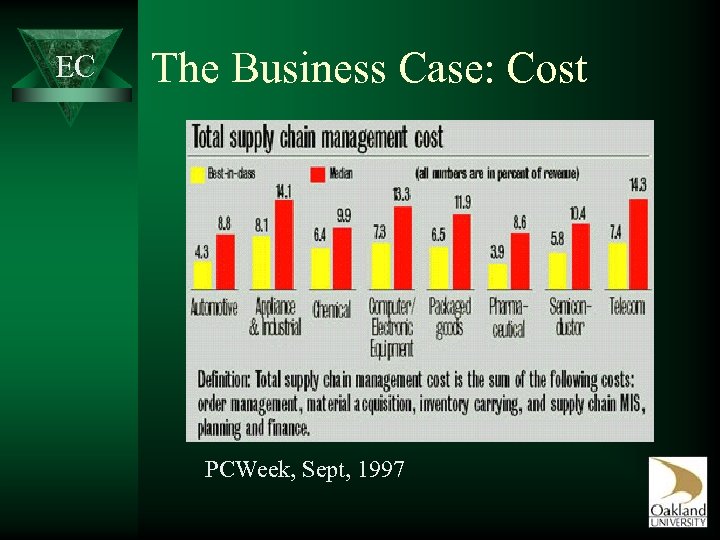 EC The Business Case: Cost PCWeek, Sept, 1997
 EC The Business Case: Cost t EDI can reduce – Time delays • Document transportation • Manual document processing – Labor costs • Keying, filing, document matching, … – Errors – Inventory • Some inventory held because of processing delays
 EC The Business Case: Cost Proctor & Gamble and H. E. Butt grocery EDI for Grocery Logistics project resulted in the following one-year improvements: · Reduction of over 3, 000 labor hours - 1, 700 in order processing hours and 1, 300 paper administration and data rekeying hours · 80% increase in speed of new items delivered to stores, price changes made and promotions implemented · 75% decrease in invoice deductions X 12 General Session Minutes October 5, 1998
 EC The Business Case: Cost The AIAG estimates that implementing EDI-style interactions via the Internet through four levels of the automotive supply chain would save manufacturers $71 per vehicle. That's about $1 billion annually industrywide.
 EC The Business Case: Strategy t EDI enables new ways of doing business – JIT – Mass customization t t These would be too costly without EDI Could Visa be “Everywhere you want to be” without EDI?
 EC Outline What is EDI? t The Business Case for EDI t EDI Standards t Implementing EDI t EDI and the Internet t
 EC Standards t Two levels – Communication standards • Network protocols, connection speeds, etc. • Concerned with getting data from one place to another, not what it means – Transaction standards • Concerned with what the data means • “Transaction sets” for many different types of transactions
 EC Standards Groups t Economy-wide – Work with many industries – X 12, EDIFACT t Industry-specific – Work with one or a few related industries – UCC, AIAG – Often implement broader standards • HIAG implements X 12 for healthcare t Proprietary
 EC Standards Groups t Increasing attention to coordination between groups – UCC and X 12 – X 12 - “alignment” with EDIFACT t t Important for international trade Important for cross-industry relationships
 EC Enforceable t EDI transactions must have the same legal force as other transactions – Role for government in EDI t Lack of enforcement is a barrier to doing EDI in some countries
 EC Payment Systems t t EDI for ordering, etc. , should be supported by EFT for payment Bank association agreements, credit card company payment systems, etc. , important to EDI – Agreements between can make payments as fast as orders
 EC Standards Example t VICS – Voluntary Inter-Industry Commerce Standard, used by the general merchandise retail industry – VICS EDI Retail Users Group formed in 1986 to interpret and expand X 12 – Used by over 1, 000 companies http: //www. uc-council. org/
 EC Sample VICS Transaction Sets 163 -Transportation Appointment Schedule Information Used by a transportation carrier and their trading partners to request and accept freight pick-up and delivery appointments. 180 -Return Merchandise Authorization and Notification Used to return merchandise to the vendor. This transaction set may satisfy request for returns, authorization or disposition of the return, notification of return or notification of consumer return. 204 -Motor Carrier Loan Tender Used to tender a shipment to a carrier and/or forward shipment details to a carrier, consignee or third party. Provides the receiver with detailed Bill of Lading rating and scheduling information pertinent to a shipment.
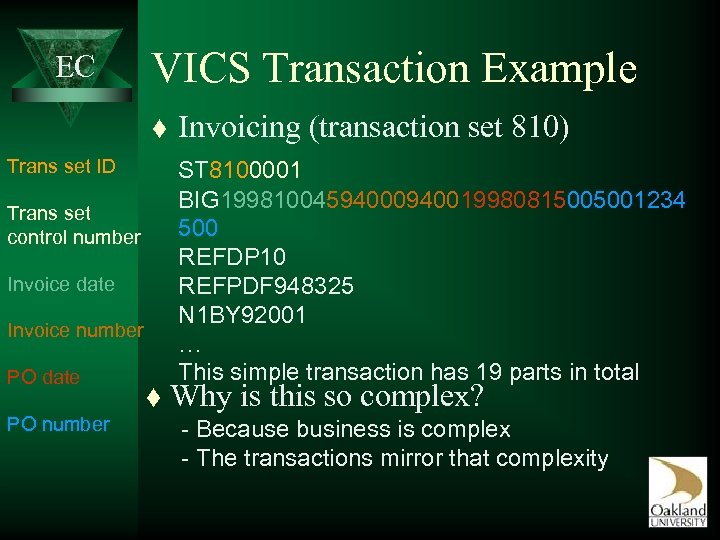 EC VICS Transaction Example t Trans set ID ST 8100001 BIG 19981004594000940019980815005001234 500 REFDP 10 REFPDF 948325 N 1 BY 92001 … This simple transaction has 19 parts in total Trans set control number Invoice date Invoice number PO date PO number Invoicing (transaction set 810) t Why is this so complex? - Because business is complex - The transactions mirror that complexity
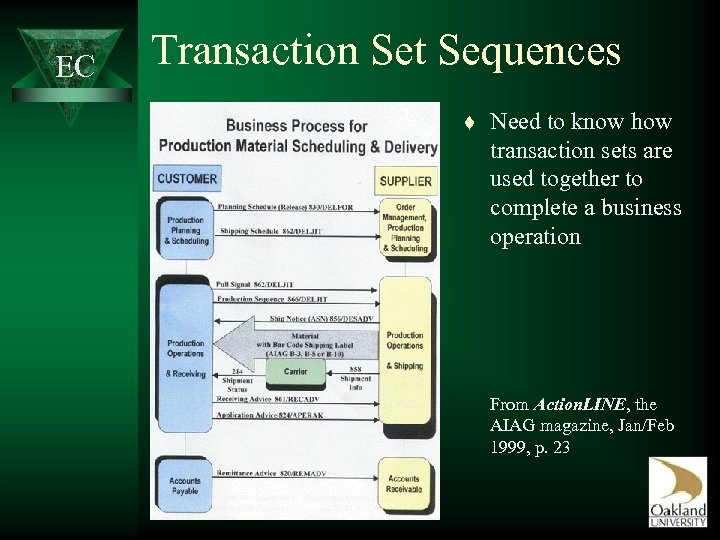 EC Transaction Set Sequences t Need to know how transaction sets are used together to complete a business operation From Action. LINE, the AIAG magazine, Jan/Feb 1999, p. 23
 EC Outline What is EDI? t The Business Case for EDI t EDI Standards t Implementing EDI t EDI and the Internet t
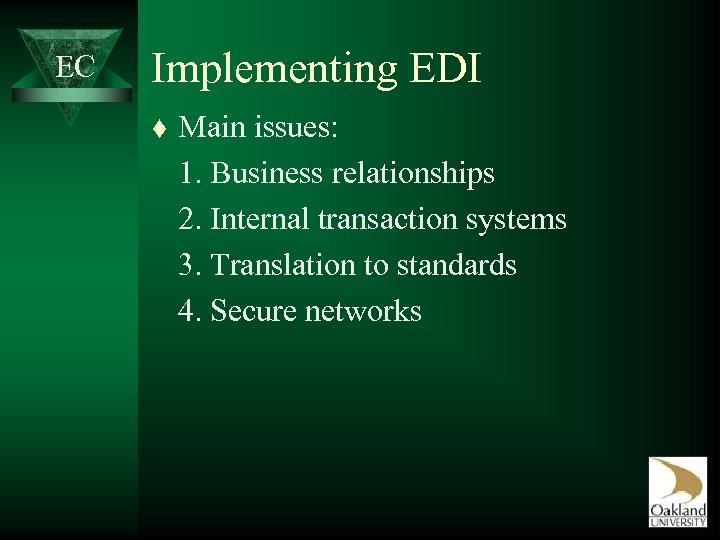 EC Implementing EDI t Main issues: 1. Business relationships 2. Internal transaction systems 3. Translation to standards 4. Secure networks
 EC 1. Business Relationships t t t If you receive an order and fulfill it, will you get paid? If you place an order, will it be shipped on time? Create agreements before EDI – Two-party contracts – Intermediary • E. g. , VISA’s merchant accounts
 EC 2. Internal Transaction Systems t Are your internal transaction processing systems ready for EDI? – Batch vs. real-time systems t Are your people ready for EDI? – Accountants – Auditors – Shippers – Receivers t Automatic ordering gives some people the heebie jeebies
 EC 3. Translation to Standards t Translate your internal formats to standards – Packages readily available – ERP systems often include these features, or make them available – VANs can help t Joining a standards organization? – Need to get, e. g. , a merchant id – Could let VAN handle the details
 EC 3. Translation to Standards t Translation software from GEIS: – EDI Application Integrator • UNIX based • User specifies mappings from internal formats – EDI*TRANSIT DOS • Similar product for DOS – Intercept Plus AS/400 • Similar product for AS/400 • Over 30, 000 installations world-wide
 EC 4. Secure Networks t Two issues – Authentication – Encryption t Much EDI happens on private networks – Easier to secure t Internal fraud often more of a threat than message interception – Humans don’t review transactions
 EC Outline What is EDI? t The Business Case for EDI t EDI Standards t Implementing EDI t EDI and the Internet t
 EC EDI and the Internet t Why the interest in the Internet? – Low cost • Connections to the Internet are cheap • Bandwidth available on demand • Internet links used for many purposes – Pervasive • The Internet is everywhere • Can create broader markets, with firms of all sizes able to interact
 EC But. . . t Security – Internet traffic can be intercepted t Reliability – No service level guarantees (yet)
 EC EDI and the Internet: Scenarios What is the Internet going to do to EDI? 1. No effect 2. VANs integrate the Internet into their offerings 3. New standards designed for the Internet
 EC Scenario 1: No Effect t Large trading partners will continue to use private networks for EDI – Easier to secure – Cost effective with sufficient transaction volume t Private networks still exist, and more are being developed – ANX
 EC Scenario 2: VANs Integrate t Why do firms use VANs? …the report did not find cost to be a significant motivating factor for EDI users to move to the Internet…. Assistance in converting trading partners to EDI, accountability in case of lost transactions, and logging audit trails were cited by users as some of the most sought-after valueadded services provided by VANs. EDI Insider, on a 1996 survey by Input, a consulting firm
 EC Scenario 2: VANs Integrate t The Internet sends bytes around. . . … but VANs provide many other services t t VANs might use the Internet to offer cheaper connectivity to small customers Problems – Security - certificates, tunneling protocols – Reliability - good connections, lower service level expectations t Is this happening?
 EC Scenario 2: VANs Integrate GEIS president and CEO Harvey Seegers confirmed the company is looking into new Web app services aimed at attracting a new kind of EDI customer. During the past two years, the company’s Trade. Web Internet-EDI transaction service, along with the Trading Process Network for posting EDI-based bid forms on the Web, have attracted 4, 000 new corporate customers, a 10 percent increase. Moreover, all of the new customers represent firms that never would have subscribed to the VAN model, Seegers said. In contrast, Trade. Web costs a flat $50 per month. Internet Week, March 30, 1998
 EC Scenario 3: New Standards t Several developing Internet-oriented EDI standards – OBI (Open Buying over the Internet) • Underwritten by American Express – The Value-Chain Initiative • From Microsoft – XML/EDI • From the XML/EDI Group • “Grass-roots organization” • Members include AT&T, Perot Systems, Motorola, Sprint and NIH
 EC XML/EDI t “The Power of Five” – EDI – XML - allows custom tags – Templates - process logic specs • How to process transactions – Agents • Execute the templates – Repository • Definitions of elements
 EC XML t HTML controls formatting – What pages look like t XML is about data – What data means – Use HTML-like tag sets to describe transactions, products, people, . . . – Use public “standard” tags, or create your own
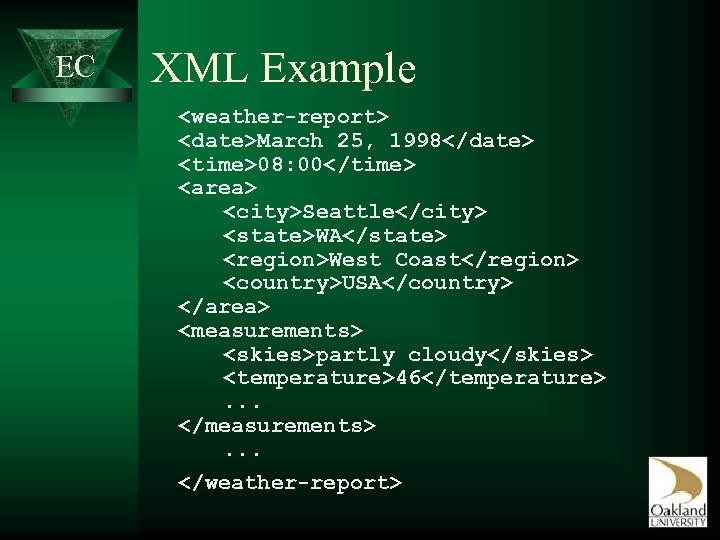 EC XML Example
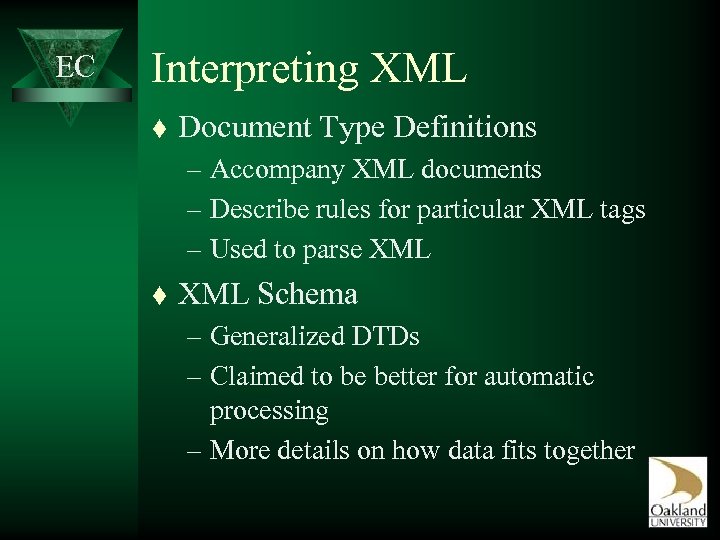 EC Interpreting XML t Document Type Definitions – Accompany XML documents – Describe rules for particular XML tags – Used to parse XML t XML Schema – Generalized DTDs – Claimed to be better for automatic processing – More details on how data fits together
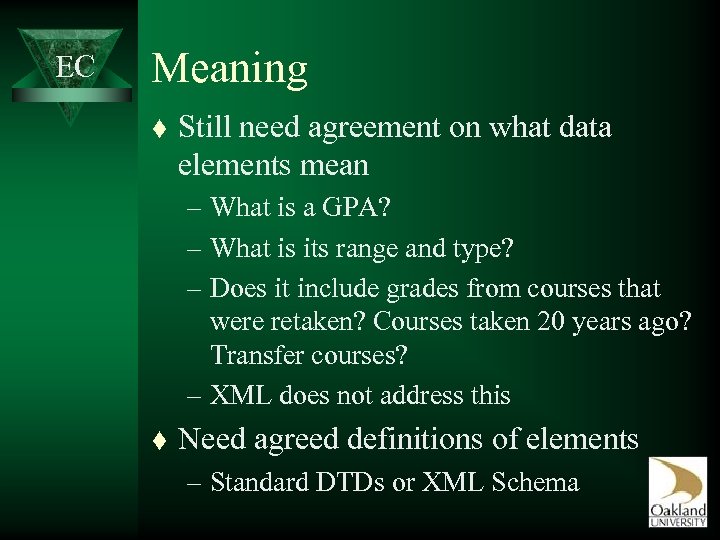 EC Meaning t Still need agreement on what data elements mean – What is a GPA? – What is its range and type? – Does it include grades from courses that were retaken? Courses taken 20 years ago? Transfer courses? – XML does not address this t Need agreed definitions of elements – Standard DTDs or XML Schema
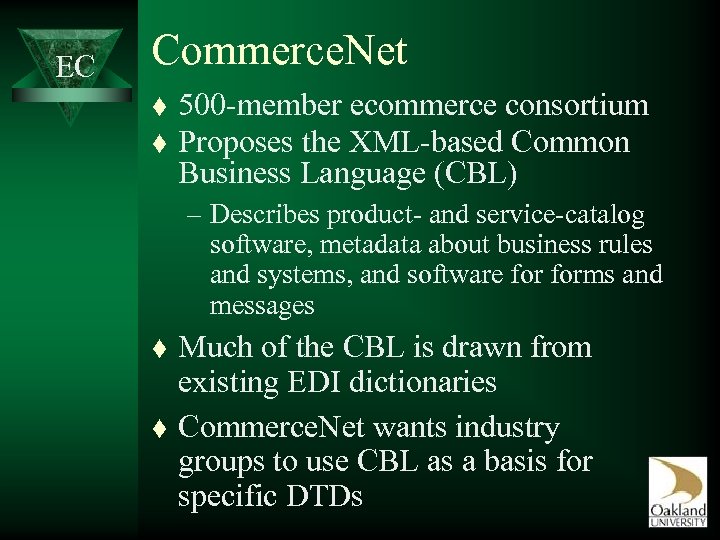 EC Commerce. Net t t 500 -member ecommerce consortium Proposes the XML-based Common Business Language (CBL) – Describes product- and service-catalog software, metadata about business rules and systems, and software forms and messages t t Much of the CBL is drawn from existing EDI dictionaries Commerce. Net wants industry groups to use CBL as a basis for specific DTDs
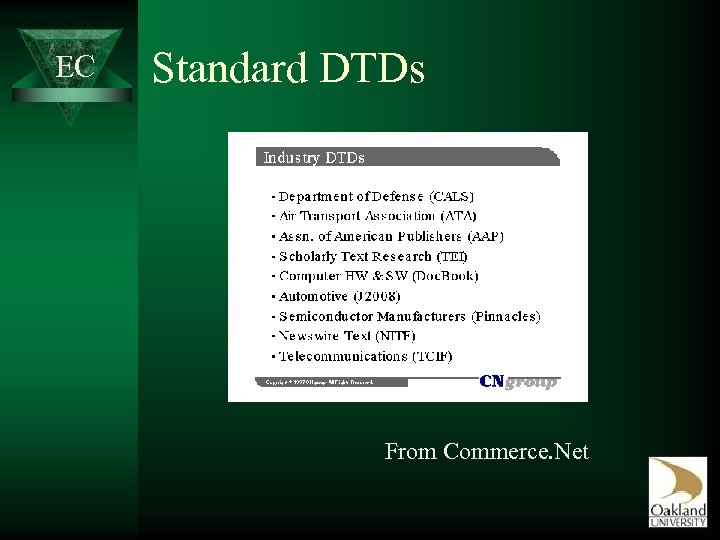 EC Standard DTDs From Commerce. Net
 EC Where Is This Going? t XML-based industry standards are key – Need equivalent of X 12 standards with strong semantic content t t They are developing Who knows what the future will hold?
 EC Outline t t t What is EDI? The Business Case for EDI Standards Implementing EDI and the Internet