Скачать презентацию EATING OUT RUSSIAN AND TATAR TRADITIONAL DISHES SHOPS
Unit 4 Eating out. Shopping.pptx
- Количество слайдов: 22
 EATING OUT RUSSIAN AND TATAR TRADITIONAL DISHES SHOPS AND SHOPPING Dialogues: Grammar: In a café Ordering a meal In the shop Reported speech Phrasal verbs Revision
 Russian cuisine derives its rich and varied character from the vast and multi-cultural expanse of Russia. Its foundations were laid by the peasant food of the rural population in an often harsh climate, with a combination of plentiful fish, poultry, game, mushrooms, berries, and honey. Crops of rye, wheat, barley, and millet provided the ingredients for a plethora of breads, pancakes, cereals, kvass, beer, and vodka. Soups and stews full of flavor are centered on seasonal or storable produce, fish, and meats.
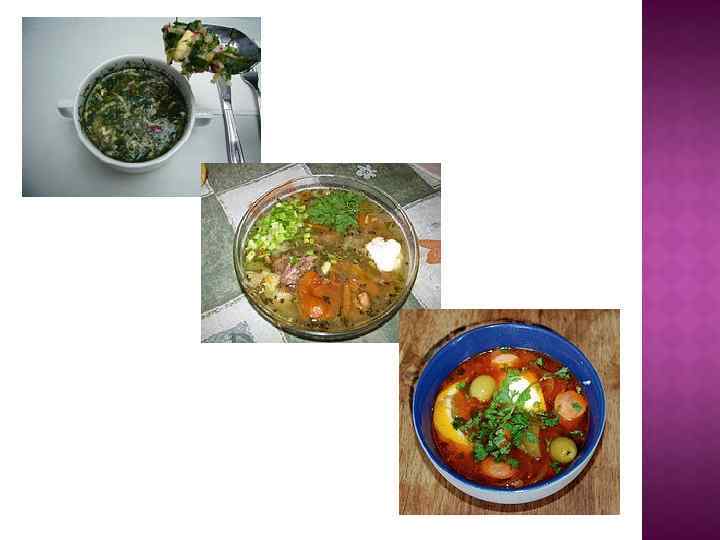
 Soups have always played an important role in the Russian meal. The traditional staple of soups such as shchi, ukha, rassolnik, solyanka, botvinya, okroshka, and tyurya was enlarged in the 18 th to 20 th centuries by both European and Central Asian staples like clear soups, pureed soups, stews, and many others. Russian soups can be divided into at least seven large groups: Chilled soups based on kvass, such as tyurya, okroshka, and botvinya. Light soups and stews based on water and vegetables. Noodle soups with meat, mushrooms, and milk. Soups based on cabbage, most prominently shchi. Thick soups based on meat broth, with a salty-sour base like rassolnik and solyanka. Fish soups such as ukha. Grain- and vegetable-based soups.
 Tatar cuisine is interesting and diverse, its development was not limited by ethnical traditions alone. It was largely influenced by cuisine of neighboring peoples. Tatar cuisine inherited katyk, bal-mai, kabartma from the Bulgars, pelmeni and tea from the Chinese, pilaw from the Uzbeks, pakhleve from the Tadjiks.
 Travelers, who visited Kazan, called national cuisine rich and tasty, plain and exquisite, they were surprised at the variety and rare combination of products as well as unforgettable hospitality. Traditionally, a table was laid in a festive manner and a visitor was treated to the best food - sweet chak (little balls of pastry with honey), sherbet, limeleaf honey, and scented tea. Hospitality in the East was always highly appreciated.
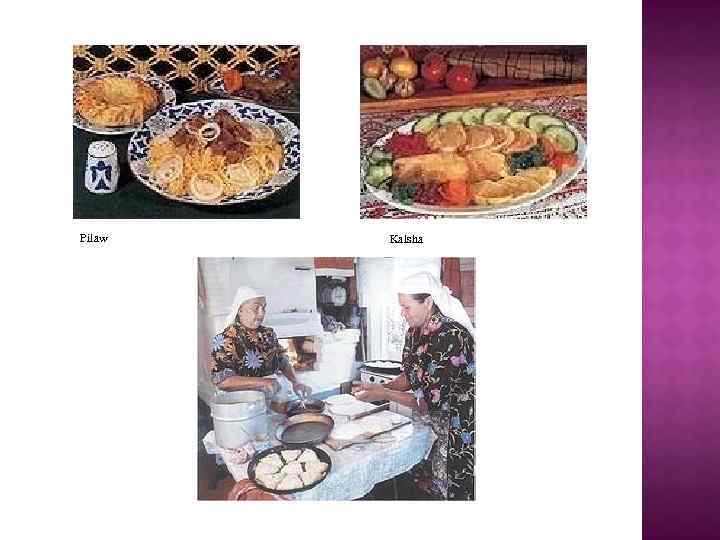 Pilaw Kalsha
 In May of 1722, Kazan hospitality was experienced by Russian czar Peter I. Peter celebrated his fiftieth anniversary in the house of rich Kazan merchant Ivan Mikhlayev. Numerous servants, with profound bows, brought in: "first, cold meat and fish dishes, then - first course, then roast meat followed by cakes, then sweets, with pies served in between : ". Special eating norms and rules were imposed by Islam. The Sheriat forbade using pork, as well as some birds such as falcon, swan considered to be sacred.
 In the ninth month of the Muslim lunar calendar, Ramadan, all Muslims older than 12 took a 29 -30 day fast -uraza - completely abstaining from food and drink in the light time of the day. The Sheriat called for moderateness of meal in everyday life too. One of the main food bans concerned wine and other liquors. The Koran says that wine, similar to a gambling game, has good and bad points, but the latter dominate. "Wine is an obvious root and source of sins, and he who drinks it loses his mind. He does not know God, respects nobody. . . " - Muhammad said.
 Each meal, according to adab - Islamic ethics, started with hand-washing. A prayer was obligatory before and after it. Men and women ate separately. Famous Tatar enlightener Kayum Nasyri described a set of table rules: "Sit down to table as soon as a meal is served, do not keep people waiting. Eat with your right hand, if there are respectable people at table, do not touch food ahead of them - it is impolite. Moderate meal is of great benefit - it promotes healthy body, precise mind, strong memory. «
 The basis of a diet was meat, dairy and vegetable food. The Tatars considered mutton their favorite meat, liked poultry. Popular meat dishes were pilaw and pelmeni, to which a young son-in-law and his pals were traditionally treated. Mainly milk products - cream, butter - were used. Fermented milk was made into a favorite Tatar drink - katyk, which was used to prepare Tatar curds syuzma. Other sorts of curds - yeremchek, cort.
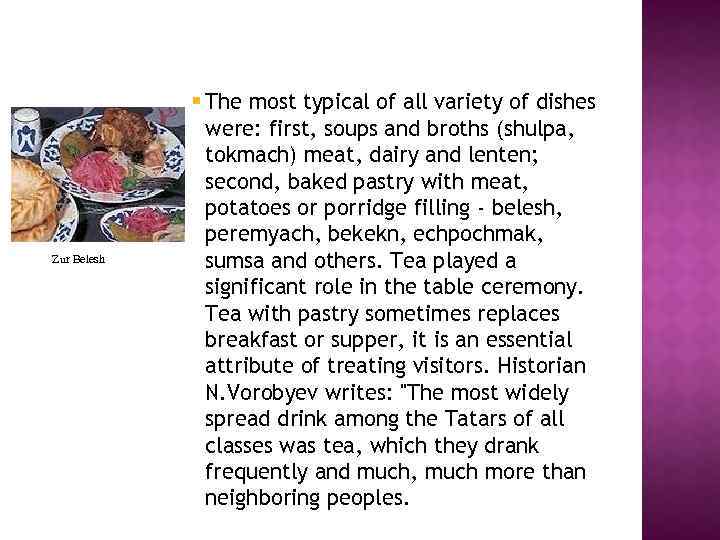 Zur Belesh § The most typical of all variety of dishes were: first, soups and broths (shulpa, tokmach) meat, dairy and lenten; second, baked pastry with meat, potatoes or porridge filling - belesh, peremyach, bekekn, echpochmak, sumsa and others. Tea played a significant role in the table ceremony. Tea with pastry sometimes replaces breakfast or supper, it is an essential attribute of treating visitors. Historian N. Vorobyev writes: "The most widely spread drink among the Tatars of all classes was tea, which they drank frequently and much, much more than neighboring peoples.
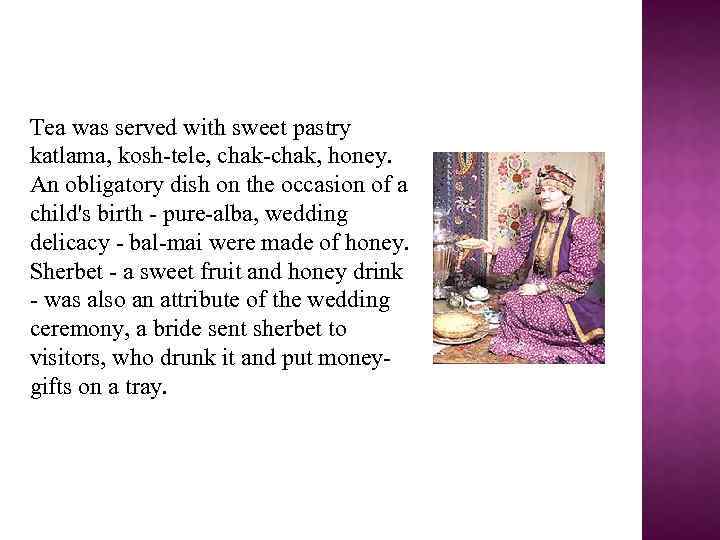 Tea was served with sweet pastry katlama, kosh-tele, chak-chak, honey. An obligatory dish on the occasion of a child's birth - pure-alba, wedding delicacy - bal-mai were made of honey. Sherbet - a sweet fruit and honey drink - was also an attribute of the wedding ceremony, a bride sent sherbet to visitors, who drunk it and put moneygifts on a tray.
 Kazan cuisine, which absorbed the culinary traditions of the Bulgars, Tatars, Russians, Eastern and European influence, is rich in most varied dishes of everyday and festive cooking. And both remarkable national recipes and hospitality, known for centuries, have been kept to this days.
 Places you can eat at café: you can have a cup of tea/coffee and a snack there (=something small to eat like a sandwich or a cake). They sometimes serve meals too. restaurant: you go there for a full meal; more expensive than a café. bar / pub: bars and pubs serve alcohol and soft drinks (=non-alcoholic drinks like fruit juice and lemonade); you can usually have a meal or a snack there too. sandwich bar: a place that serves lots of different kinds of sandwiches. People usually buy sandwiches and take them to eat in a different place, at work or in the park. fast food restaurant: you can get a quick hot meal there, for example burger and chips. self-service restaurant / café: you take what you want, pay for it and carry it to your table.
 want to buy something in the morning to eat at lunch-time at work? want a romantic dinner for two? have three small children with you? arrive half an hour early to meet a friend? are very thirsty? Do you have all the places in your country? Write down all the places you have. Give an example of an eating place of this type.
 waiter: Are you ready to order? customer: Yes, I’d like tomato soup and steak, please. w: Would you like the steak with chips or new potatoes? And how would you like your steak – rare, medium or well-done? c: Well-done, please. And with chips. w: And what would you like to drink? w: Is everything all right? c: Thank you, it’s very nice.
 A. : Good morning. B. : Good morning. Can I have an orange juice, please? A. : Here you are. Anything else? B. : No, thanks. A. : Ninety p, please. B. : Thanks. A. : Thank you.
 A. : Hi. Can I help? B. : Yes. Can I have a tuna and egg salad, please? A. : Anything to drink? B. : Yeah. A mineral water, please. A. : OK. Here you are. B. : How much is that? A. : Four pounds ninety-five, please. B. : Thanks.
 w: Are you ready for order? c: Yes. I like vegetable soup and steak, please. w: What would you like your steak? Rare, medium or done good? c: Rare, please. w: What you would like to drink? c: A orange juice, please.