


 Скачать презентацию Eastern Snake Plain Comprehensive Aquifer Management Plan A
c1c3879f19c99e8262c87078e29349a5.ppt
- Количество слайдов: 37
 Eastern Snake Plain Comprehensive Aquifer Management Plan A Positive Path Forward Hal N. Anderson June 11, 2009
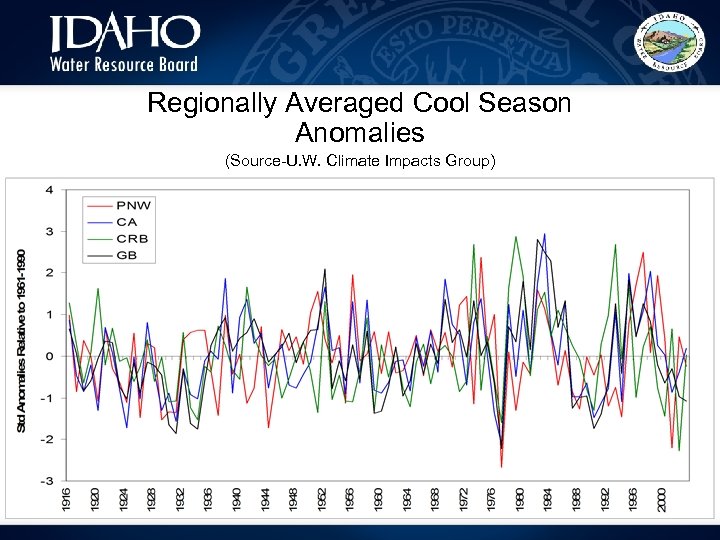 Regionally Averaged Cool Season Anomalies (Source-U. W. Climate Impacts Group)
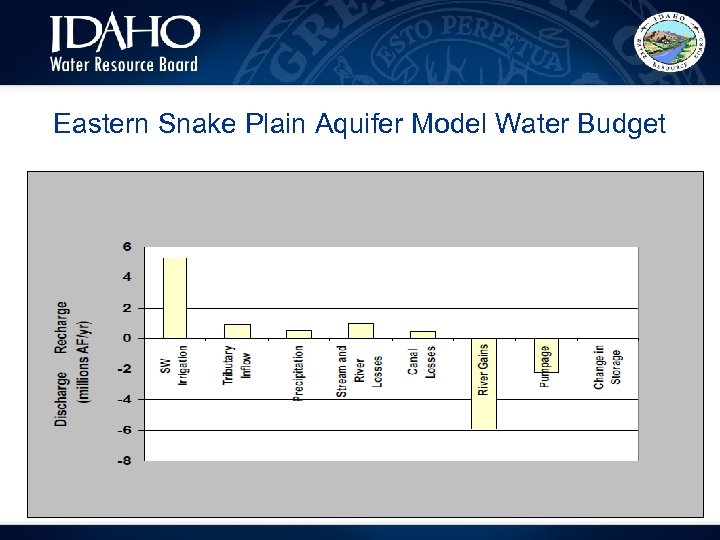 Eastern Snake Plain Aquifer Model Water Budget
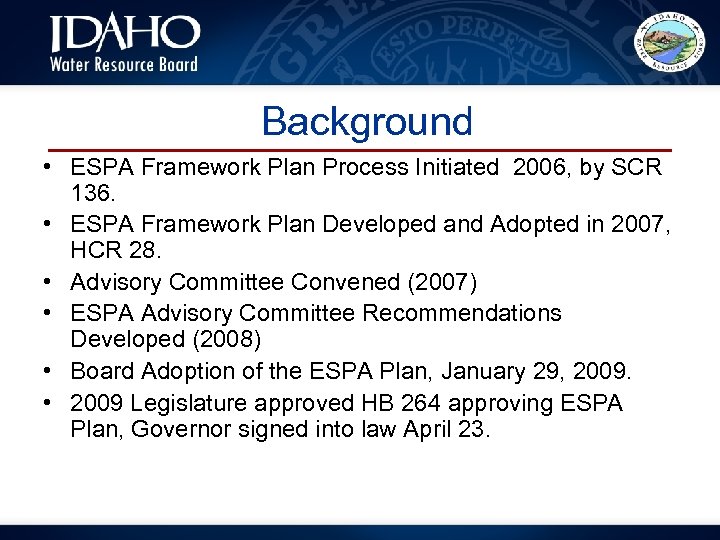 Background • ESPA Framework Plan Process Initiated 2006, by SCR 136. • ESPA Framework Plan Developed and Adopted in 2007, HCR 28. • Advisory Committee Convened (2007) • ESPA Advisory Committee Recommendations Developed (2008) • Board Adoption of the ESPA Plan, January 29, 2009. • 2009 Legislature approved HB 264 approving ESPA Plan, Governor signed into law April 23.
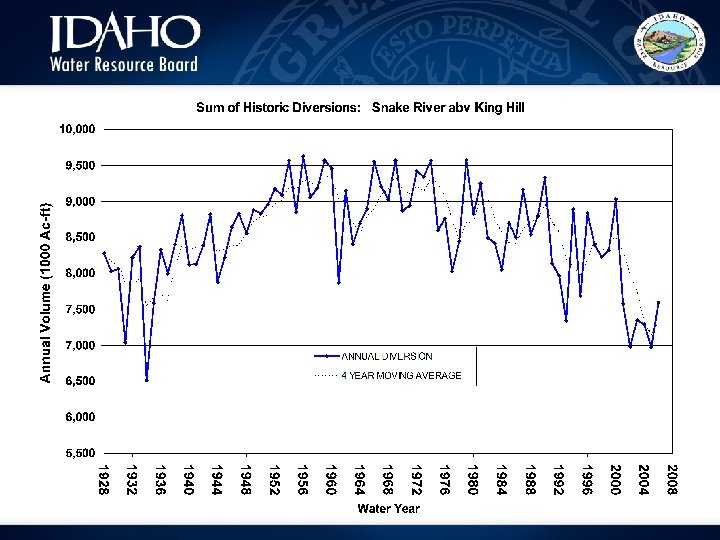
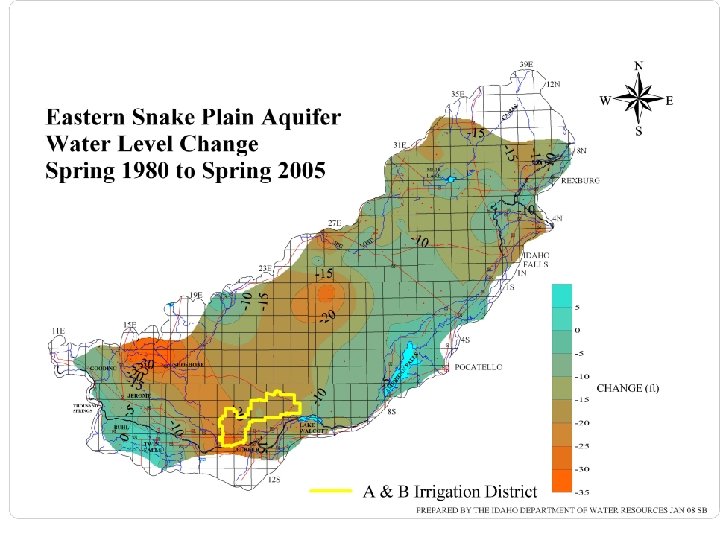
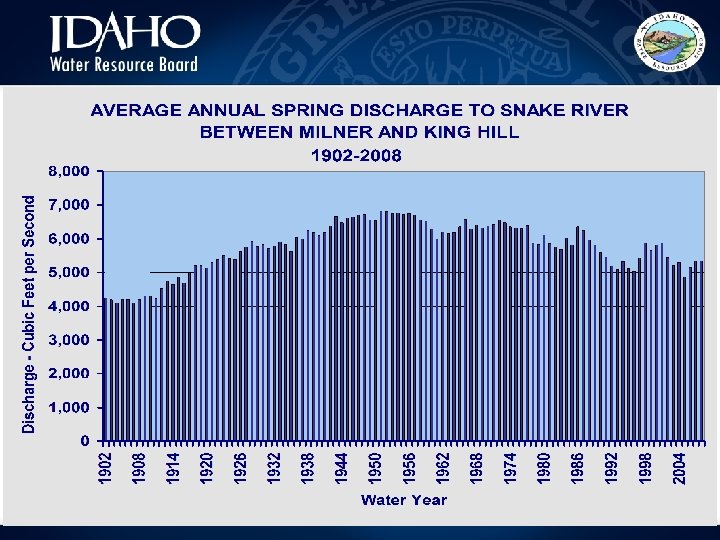
 Framework Plan Recognized that water supply and demand were out of balance in the aquifer and the Snake River, making more deliberate and coordinated management of surface and ground water on the ESPA a necessity.
 Objectives for ESPA Management • Increase predictability for water users by managing for reliable supply. • Create alternatives to administrative curtailment. • Manage overall demand for water within the Eastern Snake Plain. • Increase recharge to the aquifer. • Reduce withdrawals from the aquifer.


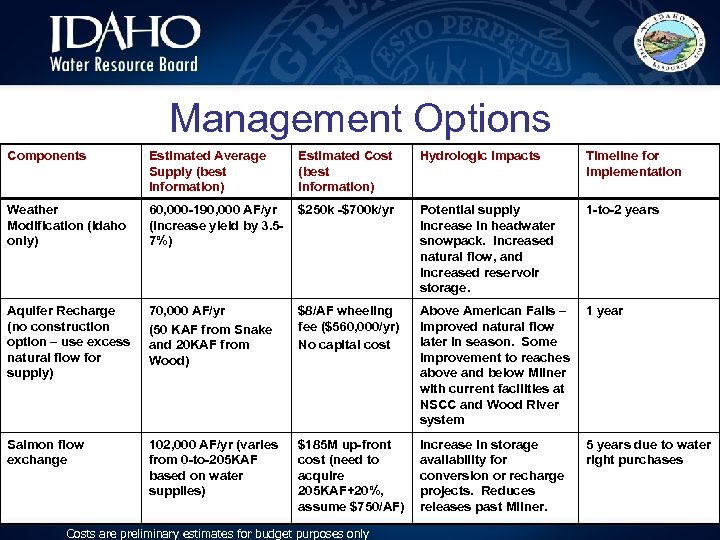 Management Options Components Estimated Average Supply (best information) Estimated Cost (best information) Hydrologic Impacts Timeline for implementation Weather Modification (Idaho only) 60, 000 -190, 000 AF/yr (increase yield by 3. 57%) $250 k -$700 k/yr Potential supply increase in headwater snowpack. Increased natural flow, and increased reservoir storage. 1 -to-2 years Aquifer Recharge (no construction option – use excess natural flow for supply) 70, 000 AF/yr (50 KAF from Snake and 20 KAF from Wood) $8/AF wheeling fee ($560, 000/yr) No capital cost Above American Falls – improved natural flow later in season. Some improvement to reaches above and below Milner with current facilities at NSCC and Wood River system 1 year Salmon flow exchange 102, 000 AF/yr (varies from 0 -to-205 KAF based on water supplies) $185 M up-front cost (need to acquire 205 KAF+20%, assume $750/AF) Increase in storage availability for conversion or recharge projects. Reduces releases past Milner. 5 years due to water right purchases Costs are preliminary estimates for budget purposes only
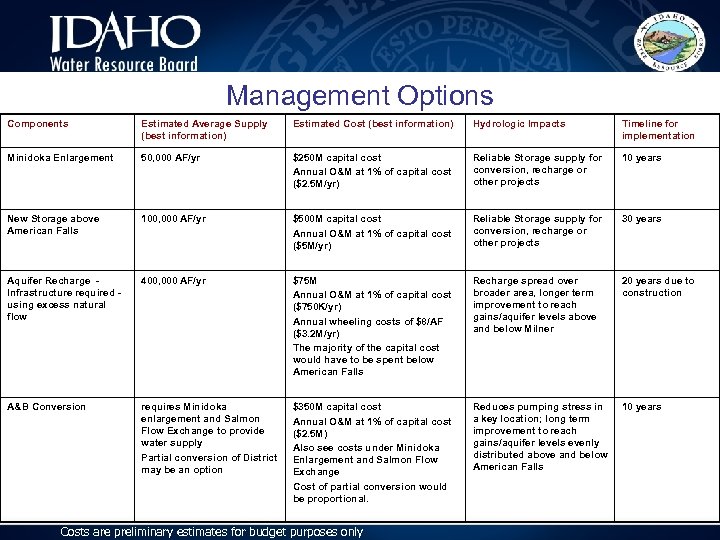 Management Options Components Estimated Average Supply (best information) Estimated Cost (best information) Hydrologic Impacts Timeline for implementation Minidoka Enlargement 50, 000 AF/yr $250 M capital cost Annual O&M at 1% of capital cost ($2. 5 M/yr) Reliable Storage supply for conversion, recharge or other projects 10 years New Storage above American Falls 100, 000 AF/yr $500 M capital cost Annual O&M at 1% of capital cost ($5 M/yr) Reliable Storage supply for conversion, recharge or other projects 30 years Aquifer Recharge Infrastructure required using excess natural flow 400, 000 AF/yr $75 M Annual O&M at 1% of capital cost ($750 K/yr) Annual wheeling costs of $8/AF ($3. 2 M/yr) The majority of the capital cost would have to be spent below American Falls Recharge spread over broader area, longer term improvement to reach gains/aquifer levels above and below Milner 20 years due to construction A&B Conversion requires Minidoka enlargement and Salmon Flow Exchange to provide water supply Partial conversion of District may be an option $350 M capital cost Annual O&M at 1% of capital cost ($2. 5 M) Also see costs under Minidoka Enlargement and Salmon Flow Exchange Cost of partial conversion would be proportional. Reduces pumping stress in a key location; long term improvement to reach gains/aquifer levels evenly distributed above and below American Falls 10 years Costs are preliminary estimates for budget purposes only
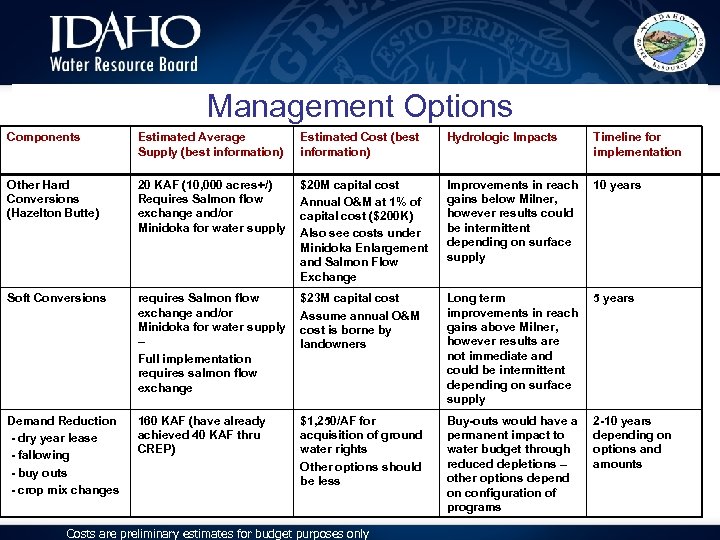 Management Options Components Estimated Average Supply (best information) Estimated Cost (best information) Hydrologic Impacts Timeline for implementation Other Hard Conversions (Hazelton Butte) 20 KAF (10, 000 acres+/) Requires Salmon flow exchange and/or Minidoka for water supply $20 M capital cost Annual O&M at 1% of capital cost ($200 K) Also see costs under Minidoka Enlargement and Salmon Flow Exchange Improvements in reach gains below Milner, however results could be intermittent depending on surface supply 10 years Soft Conversions requires Salmon flow exchange and/or Minidoka for water supply – Full implementation requires salmon flow exchange $23 M capital cost Assume annual O&M cost is borne by landowners Long term improvements in reach gains above Milner, however results are not immediate and could be intermittent depending on surface supply 5 years Demand Reduction - dry year lease - fallowing - buy outs - crop mix changes 160 KAF (have already achieved 40 KAF thru CREP) $1, 250/AF for acquisition of ground water rights Other options should be less Buy-outs would have a permanent impact to water budget through reduced depletions – other options depend on configuration of programs 2 -10 years depending on options and amounts Costs are preliminary estimates for budget purposes only
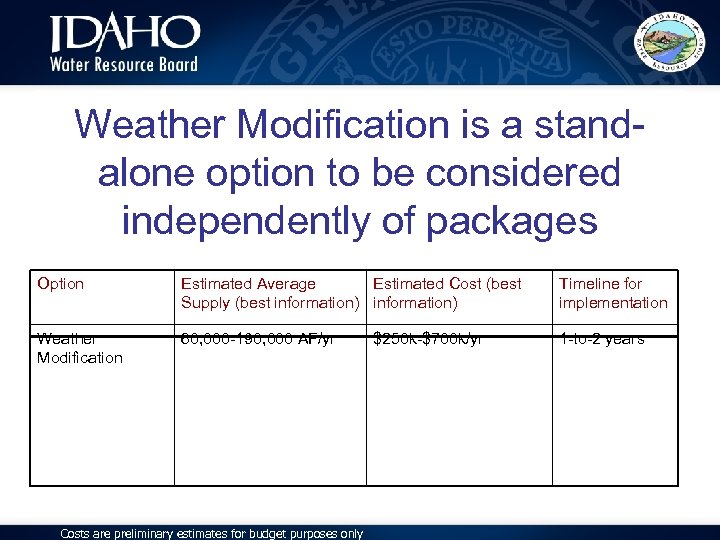 Weather Modification is a standalone option to be considered independently of packages Option Estimated Average Estimated Cost (best Supply (best information) Timeline for implementation Weather Modification 60, 000 -190, 000 AF/yr 1 -to-2 years Costs are preliminary estimates for budget purposes only $250 k-$700 k/yr
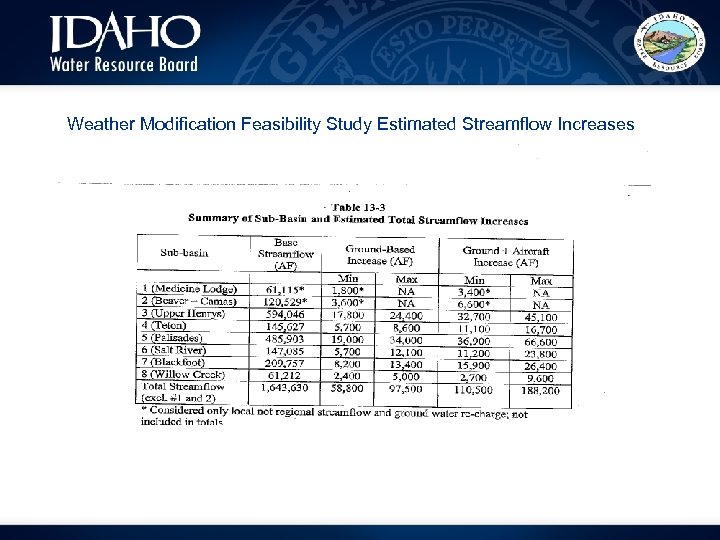 Weather Modification Feasibility Study Estimated Streamflow Increases
 Management Alternative Packages Developed include: – Small (300 KAF); least expensive and quickest to implement – Medium (600 KAF); more expensive and takes more time to fully implement – Large (900 KAF); most expensive and will take decades to fully implement – Demand Reduction and Recharge Emphasis
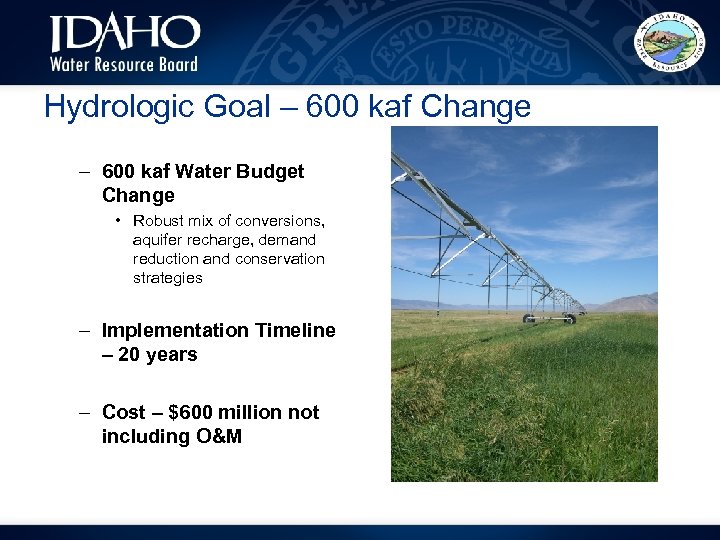 Hydrologic Goal – 600 kaf Change – 600 kaf Water Budget Change • Robust mix of conversions, aquifer recharge, demand reduction and conservation strategies – Implementation Timeline – 20 years – Cost – $600 million not including O&M
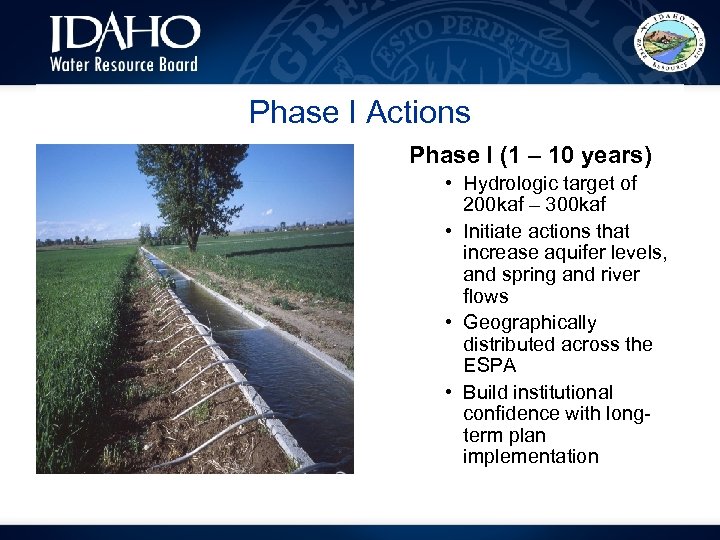 Phase I Actions Phase I (1 – 10 years) • Hydrologic target of 200 kaf – 300 kaf • Initiate actions that increase aquifer levels, and spring and river flows • Geographically distributed across the ESPA • Build institutional confidence with longterm plan implementation
 Phase I Actions – Groundwater to Surface Water Conversions – Managed Aquifer Recharge – Demand Reduction • • Buyouts, buy-downs and/or subordination agreements Rotating fallowing, dry-year lease agreement, CREP Crop mix modification Surface water conservation – Pilot Weather Modification Program
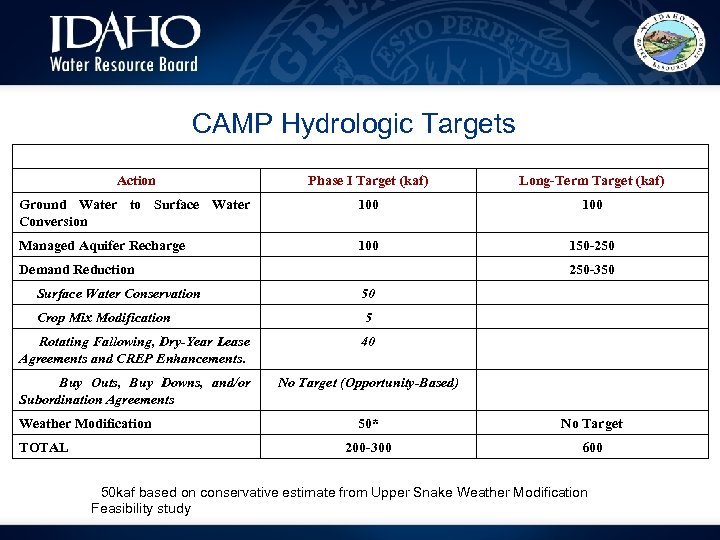 CAMP Hydrologic Targets PLAN HYDROLOGIC TARGETS Action Phase I Target (kaf) Long-Term Target (kaf) Ground Water to Surface Water Conversion 100 Managed Aquifer Recharge 100 150 -250 Demand Reduction 250 -350 Surface Water Conservation 50 Crop Mix Modification 5 Rotating Fallowing, Dry-Year Lease Agreements and CREP Enhancements. 40 Buy Outs, Buy Downs, and/or Subordination Agreements No Target (Opportunity-Based) Weather Modification TOTAL 50* No Target 200 -300 600 * 50 kaf based on conservative estimate from Upper Snake Weather Modification Feasibility study
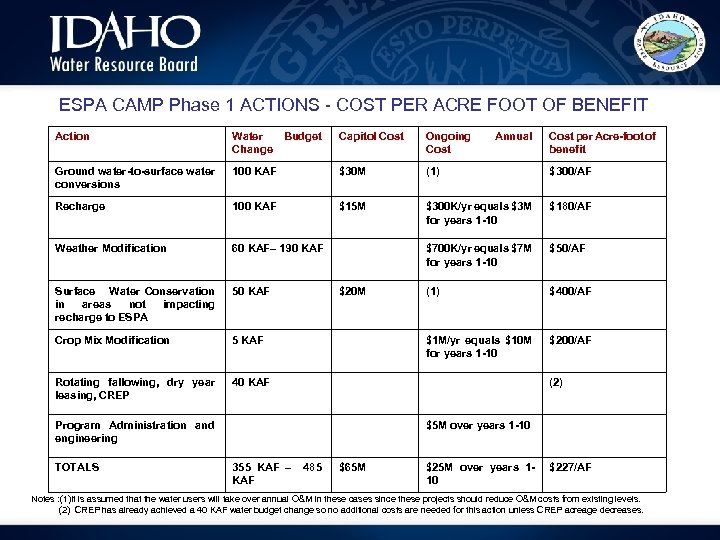 ESPA CAMP Phase 1 ACTIONS - COST PER ACRE FOOT OF BENEFIT Action Water Change Ground water-to-surface water conversions Budget Capitol Cost Ongoing Cost 100 KAF $30 M (1) $300/AF Recharge 100 KAF $15 M $300 K/yr equals $3 M for years 1 -10 $180/AF Weather Modification 60 KAF– 190 KAF $700 K/yr equals $7 M for years 1 -10 $50/AF Surface Water Conservation in areas not impacting recharge to ESPA 50 KAF (1) $400/AF Crop Mix Modification 5 KAF $1 M/yr equals $10 M for years 1 -10 $200/AF Rotating fallowing, dry year leasing, CREP 40 KAF $20 M Cost per Acre-foot of benefit (2) Program Administration and engineering TOTALS Annual $5 M over years 1 -10 355 KAF – KAF 485 $65 M $25 M over years 110 $227/AF Notes : (1)It is assumed that the water users will take over annual O&M in these cases since these projects should reduce O&M costs from existing levels. (2) CREP has already achieved a 40 KAF water budget change so no additional costs are needed for this action unless CREP acreage decreases.
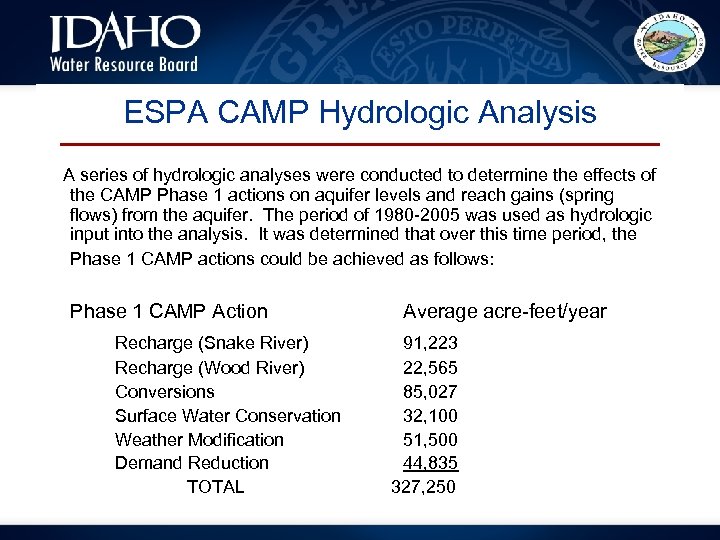 ESPA CAMP Hydrologic Analysis A series of hydrologic analyses were conducted to determine the effects of the CAMP Phase 1 actions on aquifer levels and reach gains (spring flows) from the aquifer. The period of 1980 -2005 was used as hydrologic input into the analysis. It was determined that over this time period, the Phase 1 CAMP actions could be achieved as follows: Phase 1 CAMP Action Recharge (Snake River) Recharge (Wood River) Conversions Surface Water Conservation Weather Modification Demand Reduction TOTAL Average acre-feet/year 91, 223 22, 565 85, 027 32, 100 51, 500 44, 835 327, 250
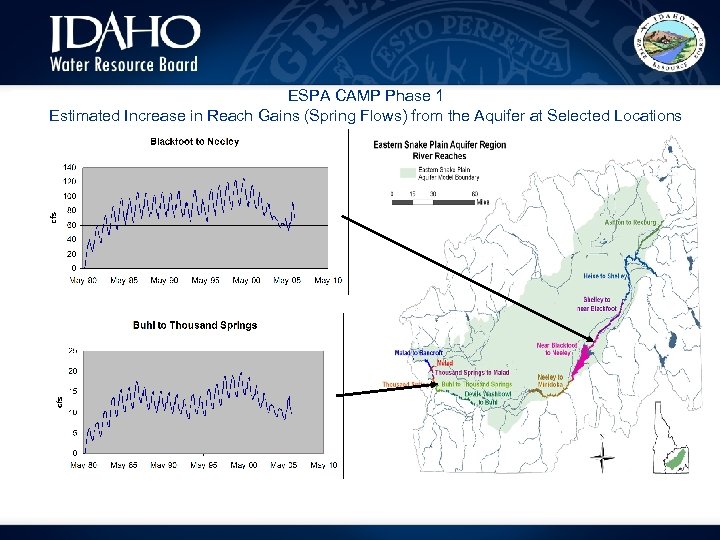 ESPA CAMP Phase 1 Estimated Increase in Reach Gains (Spring Flows) from the Aquifer at Selected Locations
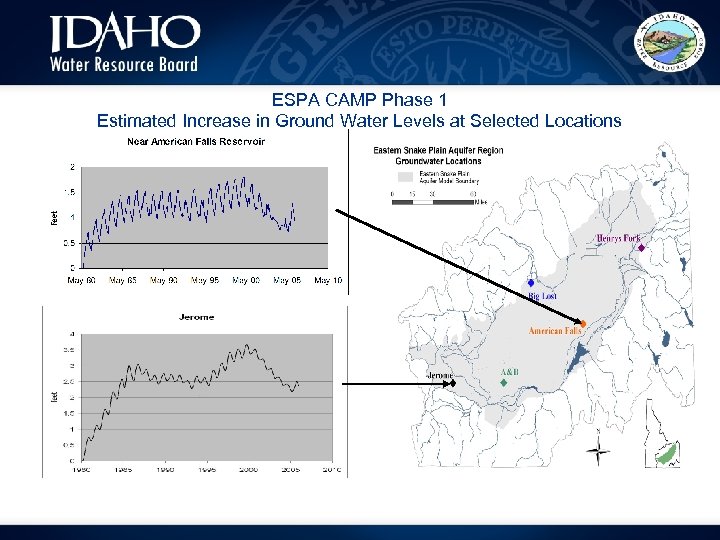 ESPA CAMP Phase 1 Estimated Increase in Ground Water Levels at Selected Locations
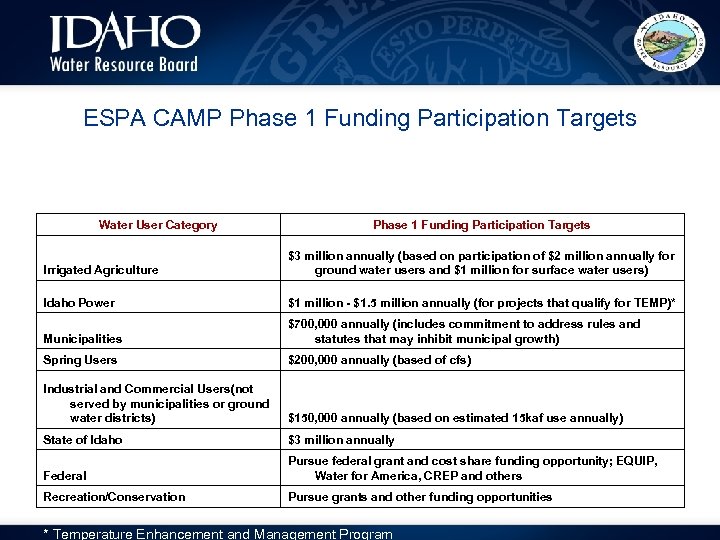 ESPA CAMP Phase 1 Funding Participation Targets Water User Category Phase 1 Funding Participation Targets Irrigated Agriculture $3 million annually (based on participation of $2 million annually for ground water users and $1 million for surface water users) Idaho Power $1 million - $1. 5 million annually (for projects that qualify for TEMP)* Municipalities $700, 000 annually (includes commitment to address rules and statutes that may inhibit municipal growth) Spring Users $200, 000 annually (based of cfs) Industrial and Commercial Users(not served by municipalities or ground water districts) $150, 000 annually (based on estimated 15 kaf use annually) State of Idaho $3 million annually Federal Pursue federal grant and cost share funding opportunity; EQUIP, Water for America, CREP and others Recreation/Conservation Pursue grants and other funding opportunities * Temperature Enhancement and Management Program
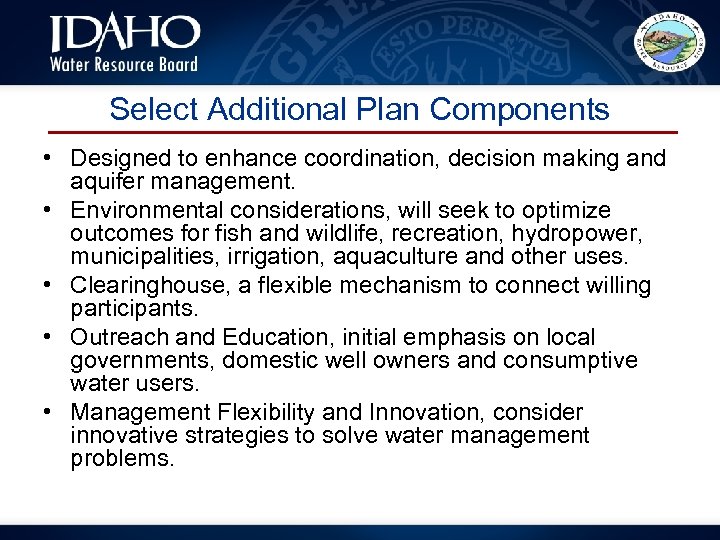 Select Additional Plan Components • Designed to enhance coordination, decision making and aquifer management. • Environmental considerations, will seek to optimize outcomes for fish and wildlife, recreation, hydropower, municipalities, irrigation, aquaculture and other uses. • Clearinghouse, a flexible mechanism to connect willing participants. • Outreach and Education, initial emphasis on local governments, domestic well owners and consumptive water users. • Management Flexibility and Innovation, consider innovative strategies to solve water management problems.
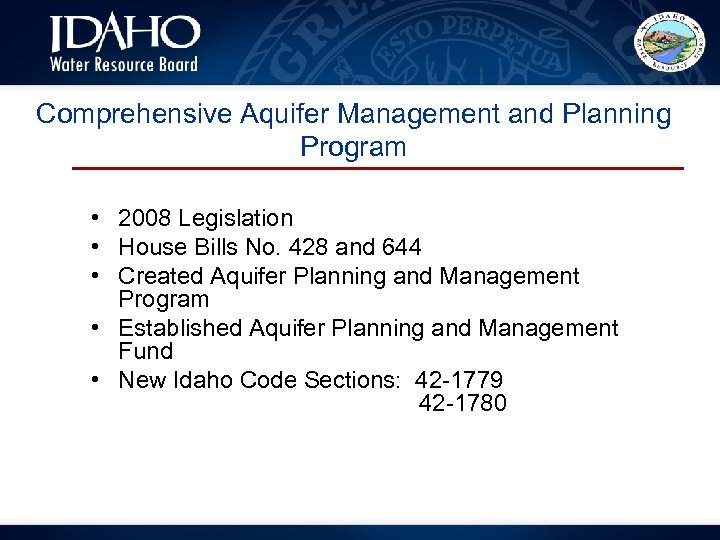 Comprehensive Aquifer Management and Planning Program • 2008 Legislation • House Bills No. 428 and 644 • Created Aquifer Planning and Management Program • Established Aquifer Planning and Management Fund • New Idaho Code Sections: 42 -1779 42 -1780
 Purpose • Conduct statewide comprehensive aquifer planning and management effort over a 10 year period • Avoid the Eastern Snake Plain conflicts in other areas of the state • Develop management plans for selected basins with potential ground-surface water conflicts or other potential conflicts
 Funding • 30 million dollar program to study and develop Comprehensive Aquifer Plans for 10 Major Aquifers. • Legislature Appropriated $20 million in FY 2009. • Appropriated $274, 900 to IDWR for first year of program • Interest from Fund will be routed back into Fund to extend funding for duration of program • Governor Recommended using $12 million in FY 2010 to offset General Fund Shortage. • Remaining $8 million will fund completion of Rathdrum and Treasure Valley Aquifers and ESPA Monitoring through FY 2013.
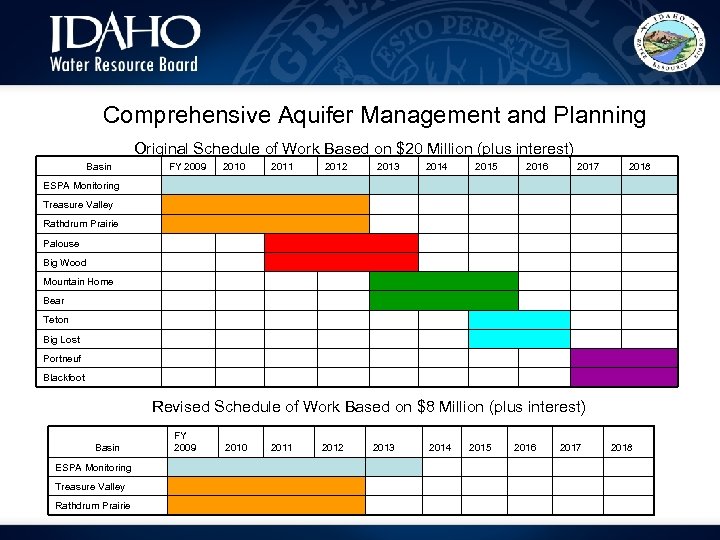 Comprehensive Aquifer Management and Planning Original Schedule of Work Based on $20 Million (plus interest) Basin FY 2009 2010 2011 2012 2013 2014 2015 2016 2017 2018 ESPA Monitoring Treasure Valley Rathdrum Prairie Palouse Big Wood Mountain Home Bear Teton Big Lost Portneuf Blackfoot Revised Schedule of Work Based on $8 Million (plus interest) Basin ESPA Monitoring Treasure Valley Rathdrum Prairie FY 2009 2010 2011 2012 2013 2014 2015 2016 2017 2018
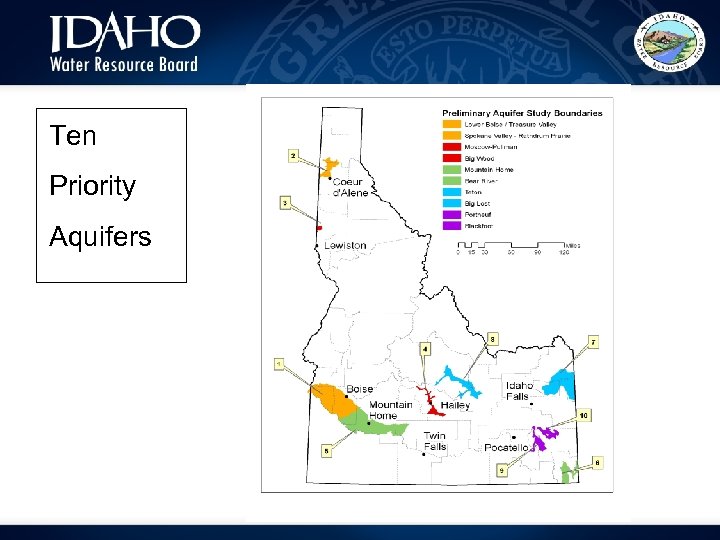 Ten Priority Aquifers
 Anticipated Technical Studies • • • Establish Monitoring Network Develop Hydrologic Framework Water Balance Ground Water Model Climate Change and Weather Modification feasibility. • Storage Opportunities
 Anticipated Planning Studies • Water Demand Projections (50 year) • Facilitators have been hired for Rathdrum and Treasure Valley. • Evaluate alternatives to meeting projected demands: – – – Water Use Transfers (i. e. , ag to DCMI) Weather Modification Feasibility Aquifer Recharge New Storage Inter-basin Transfers
 Questions ?