


 Скачать презентацию East Midlands Personalisation Programme Workforce Development Workshop Joseph
d1415f50db0a9742f8079e2441cfc1dd.ppt
- Количество слайдов: 39
 East Midlands Personalisation Programme Workforce Development Workshop Joseph Silva (i. MPOWER) Marie Lovell Christine Collymore (Skills for Care) 14/05/2009 The contents of this document are © i. MPOWER Consulting Ltd unless otherwise stated Registered office: 14 Clerkenwell Close, London EC 1 R 0 AN Registered in England Wales No: 3876501
 Agenda Introduction and objective setting How big is this change? What shapes the future workforce? New types of working – how others have approached it Lunch Case studies from participating LAs Group exercise Practical next steps 2
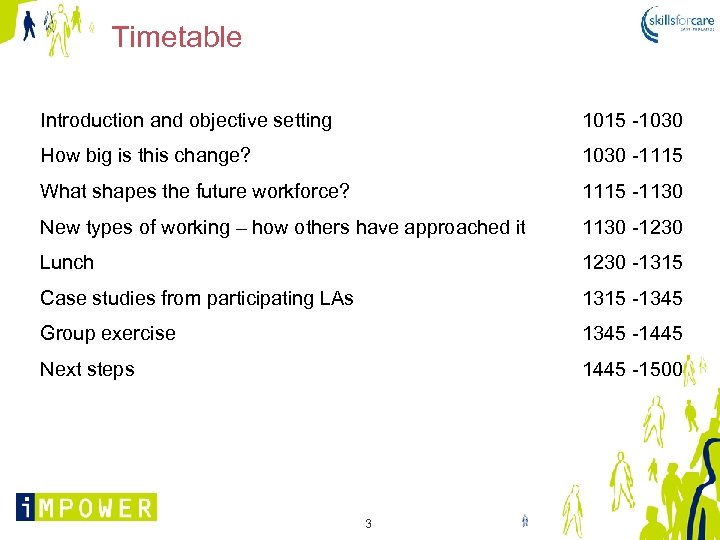 Timetable Introduction and objective setting 1015 -1030 How big is this change? 1030 -1115 What shapes the future workforce? 1115 -1130 New types of working – how others have approached it 1130 -1230 Lunch 1230 -1315 Case studies from participating LAs 1315 -1345 Group exercise 1345 -1445 Next steps 1445 -1500 3
 Agenda Introduction and objective setting How big is this change? What shapes the future workforce? New types of working – how others have approached it Lunch Case studies from participating LAs Group exercise Practical next steps 4
 How big is this change? Workforce challenges emerging from SDS The implications of SDS on the workforce are wide ranging and there will be few sections of the organisation which will remain unaffected by its implementation. Organisations previously considered external to councils will also be affected by these changes. Scope of workforce affected: Assessment and care management workforce. In-house service provider workforce. Private sector provider workforce. Voluntary sector provider workforce, and volunteers. Commissioning and contracting. Procurement workforce. The implementation of SDS provides authorities with the opportunity to now develop their workforce in order to respond to individual need and required outcomes and a process where there is a new emphasis on the citizen having real choice and control. 5
 Agenda Introduction and objective setting How big is this change? 1. Organisational structure challenges 2. Potential for efficiency savings 3. Workforce challenges What shapes the future workforce? New types of working – how others have approached it Lunch Case studies from participating LAs Group exercise Practical next steps 6
 Organisation Structure: Challenges emerging from SDS implies a new organisation structure which delivers a new balance between control and delegation: ð Enabling and supporting individuals to make their own choices and take control, while retaining safeguarding responsibilities. ð Managing transparency – managing expectations of customers, a focus on equity, and clearly separating advice about choice, from delivery of care. ð Market management techniques and encouraging innovative supply, and less on managing contracts and providers. ð Financial and performance reporting based around outcomes and overall spending, and less on unit costs and input measures. 7
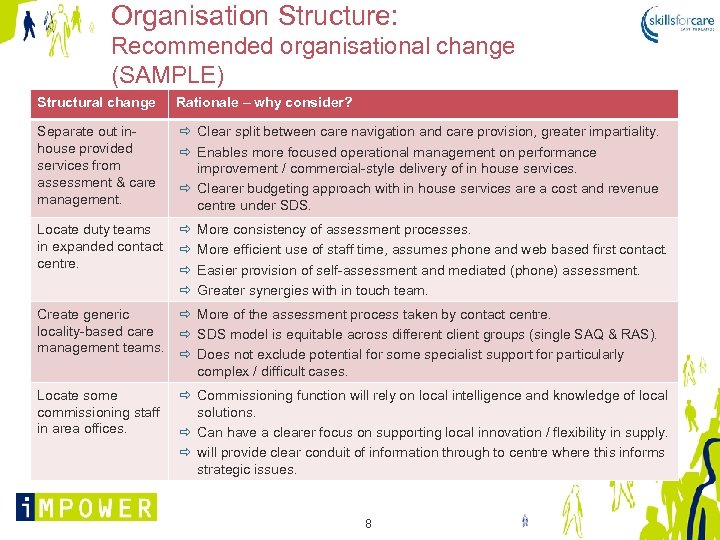 Organisation Structure: Recommended organisational change (SAMPLE) Structural change Rationale – why consider? Separate out inhouse provided services from assessment & care management. ð Clear split between care navigation and care provision, greater impartiality. ð Enables more focused operational management on performance improvement / commercial-style delivery of in house services. ð Clearer budgeting approach with in house services are a cost and revenue centre under SDS. Locate duty teams ð More consistency of assessment processes. in expanded contact ð More efficient use of staff time, assumes phone and web based first contact. centre. ð Easier provision of self-assessment and mediated (phone) assessment. ð Greater synergies with in touch team. Create generic locality-based care management teams. ð More of the assessment process taken by contact centre. ð SDS model is equitable across different client groups (single SAQ & RAS). ð Does not exclude potential for some specialist support for particularly complex / difficult cases. Locate some commissioning staff in area offices. ð Commissioning function will rely on local intelligence and knowledge of local solutions. ð Can have a clearer focus on supporting local innovation / flexibility in supply. ð will provide clear conduit of information through to centre where this informs strategic issues. 8
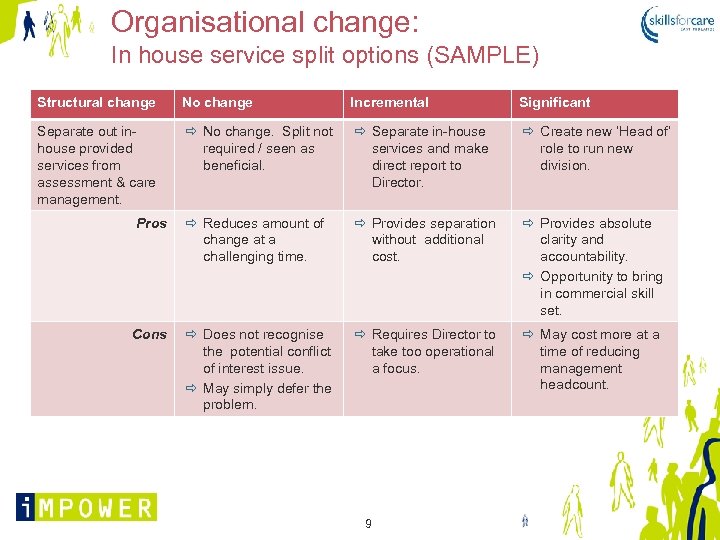 Organisational change: In house service split options (SAMPLE) Structural change No change Incremental Significant Separate out inhouse provided services from assessment & care management. ð No change. Split not required / seen as beneficial. ð Separate in-house services and make direct report to Director. ð Create new ‘Head of’ role to run new division. Pros ð Reduces amount of change at a challenging time. ð Provides separation without additional cost. ð Provides absolute clarity and accountability. ð Opportunity to bring in commercial skill set. Cons ð Does not recognise the potential conflict of interest issue. ð May simply defer the problem. ð Requires Director to take too operational a focus. ð May cost more at a time of reducing management headcount. 9
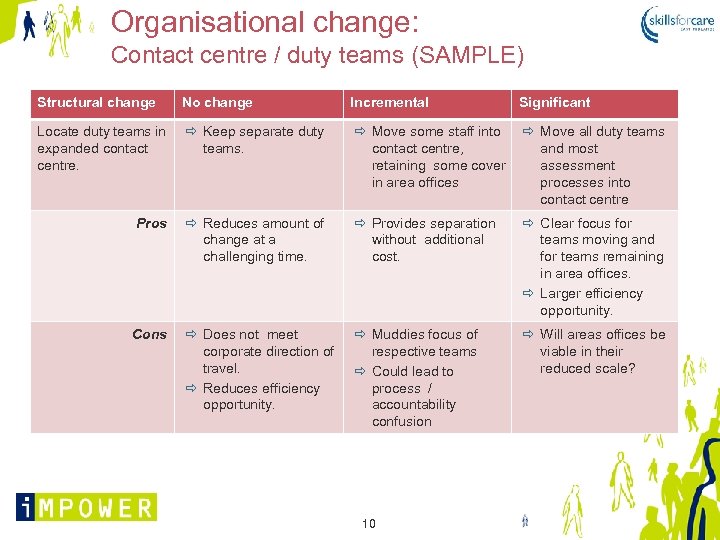 Organisational change: Contact centre / duty teams (SAMPLE) Structural change No change Incremental Locate duty teams in expanded contact centre. ð Keep separate duty teams. ð Move some staff into ð Move all duty teams contact centre, and most retaining some cover assessment in area offices processes into contact centre Pros ð Reduces amount of change at a challenging time. ð Provides separation without additional cost. ð Clear focus for teams moving and for teams remaining in area offices. ð Larger efficiency opportunity. Cons ð Does not meet corporate direction of travel. ð Reduces efficiency opportunity. ð Muddies focus of respective teams ð Could lead to process / accountability confusion ð Will areas offices be viable in their reduced scale? 10 Significant
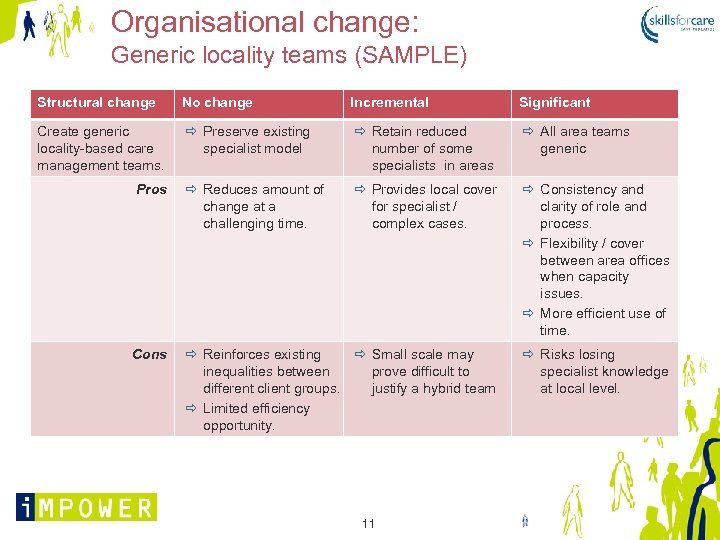 Organisational change: Generic locality teams (SAMPLE) Structural change No change Incremental Significant Create generic locality-based care management teams. ð Preserve existing specialist model ð Retain reduced number of some specialists in areas ð All area teams generic Pros ð Reduces amount of change at a challenging time. ð Provides local cover for specialist / complex cases. ð Consistency and clarity of role and process. ð Flexibility / cover between area offices when capacity issues. ð More efficient use of time. Cons ð Reinforces existing ð Small scale may inequalities between prove difficult to different client groups. justify a hybrid team ð Limited efficiency opportunity. 11 ð Risks losing specialist knowledge at local level.
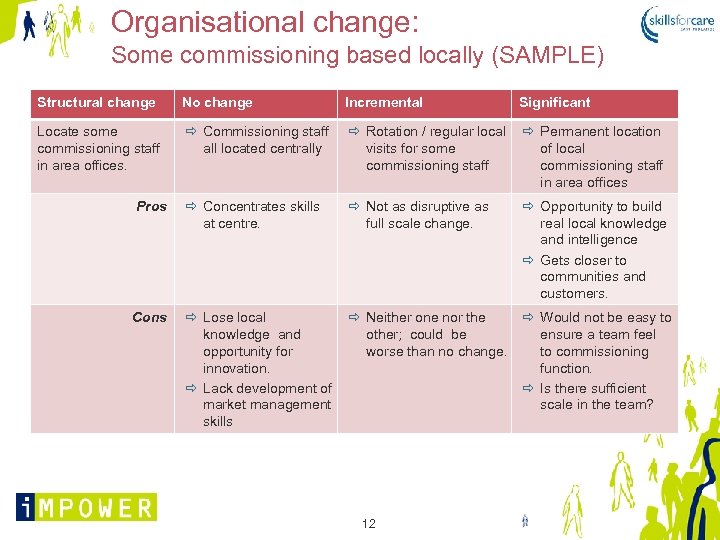 Organisational change: Some commissioning based locally (SAMPLE) Structural change No change Incremental Locate some commissioning staff in area offices. ð Commissioning staff all located centrally ð Rotation / regular local ð Permanent location visits for some of local commissioning staff in area offices Pros ð Concentrates skills at centre. ð Not as disruptive as full scale change. Cons ð Lose local ð Neither one nor the knowledge and other; could be opportunity for worse than no change. innovation. ð Lack development of market management skills 12 Significant ð Opportunity to build real local knowledge and intelligence ð Gets closer to communities and customers. ð Would not be easy to ensure a team feel to commissioning function. ð Is there sufficient scale in the team?
 Agenda Introduction and objective setting How big is this change? 1. Organisational structure challenges 2. Potential for efficiency savings 3. Workforce challenges What shapes the future workforce? New types of working – how others have approached it Lunch Case studies from participating LAs Group exercise Practical next steps 13
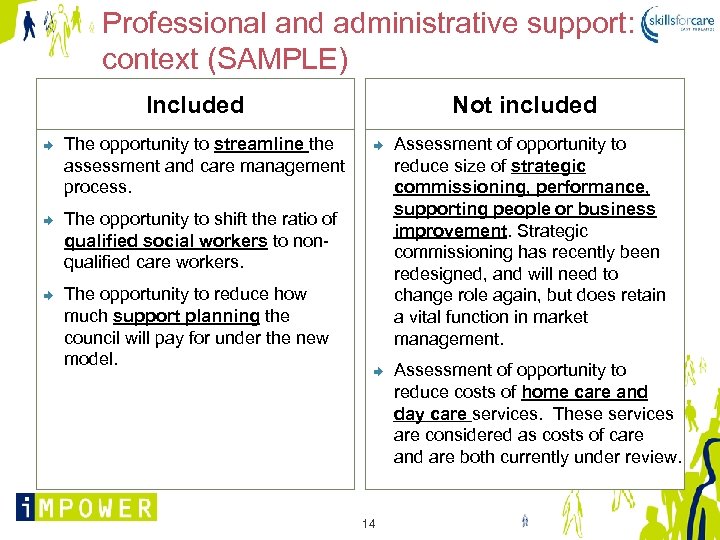 Professional and administrative support: context (SAMPLE) Included The opportunity to streamline the assessment and care management process. The opportunity to shift the ratio of qualified social workers to nonqualified care workers. The opportunity to reduce how much support planning the council will pay for under the new model. Not included Assessment of opportunity to reduce size of strategic commissioning, performance, supporting people or business improvement. Strategic commissioning has recently been redesigned, and will need to change role again, but does retain a vital function in market management. Assessment of opportunity to reduce costs of home care and day care services. These services are considered as costs of care and are both currently under review. 14
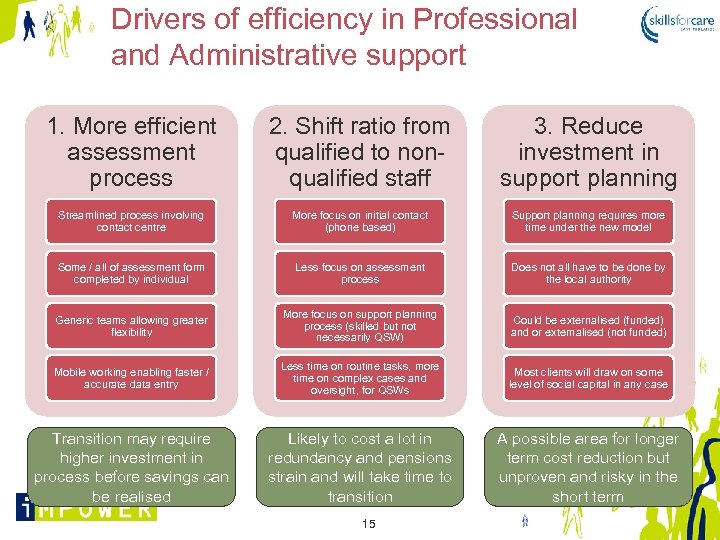 Drivers of efficiency in Professional and Administrative support 1. More efficient assessment process 2. Shift ratio from qualified to nonqualified staff 3. Reduce investment in support planning Streamlined process involving contact centre More focus on initial contact (phone based) Support planning requires more time under the new model Some / all of assessment form completed by individual Less focus on assessment process Does not all have to be done by the local authority Generic teams allowing greater flexibility More focus on support planning process (skilled but not necessarily QSW) Could be externalised (funded) and or externalised (not funded) Mobile working enabling faster / accurate data entry Less time on routine tasks, more time on complex cases and oversight, for QSWs Most clients will draw on some level of social capital in any case Transition may require higher investment in process before savings can be realised Likely to cost a lot in redundancy and pensions strain and will take time to transition A possible area for longer term cost reduction but unproven and risky in the short term 15
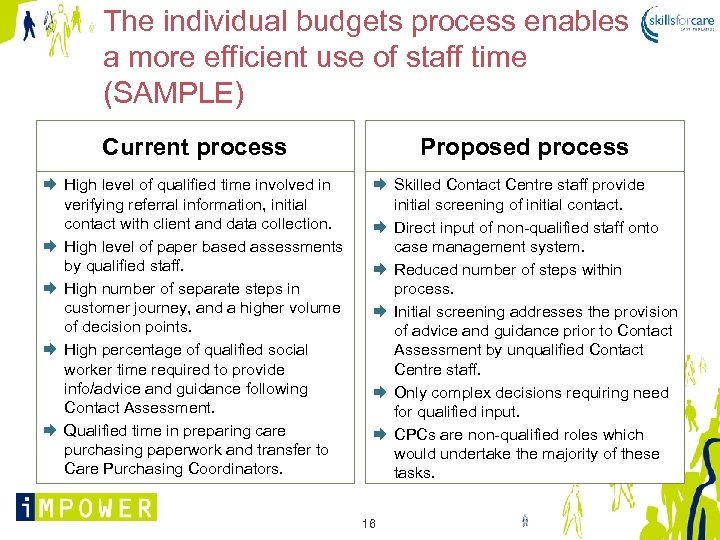 The individual budgets process enables a more efficient use of staff time (SAMPLE) Current process Proposed process High level of qualified time involved in verifying referral information, initial contact with client and data collection. High level of paper based assessments by qualified staff. High number of separate steps in customer journey, and a higher volume of decision points. High percentage of qualified social worker time required to provide info/advice and guidance following Contact Assessment. Qualified time in preparing care purchasing paperwork and transfer to Care Purchasing Coordinators. Skilled Contact Centre staff provide initial screening of initial contact. Direct input of non-qualified staff onto case management system. Reduced number of steps within process. Initial screening addresses the provision of advice and guidance prior to Contact Assessment by unqualified Contact Centre staff. Only complex decisions requiring need for qualified input. CPCs are non-qualified roles which would undertake the majority of these tasks. 16
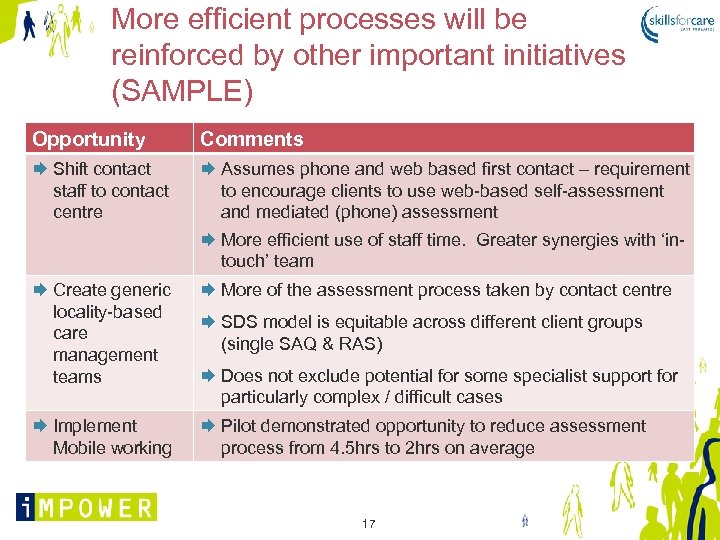 More efficient processes will be reinforced by other important initiatives (SAMPLE) Opportunity Comments Shift contact staff to contact centre Assumes phone and web based first contact – requirement to encourage clients to use web-based self-assessment and mediated (phone) assessment More efficient use of staff time. Greater synergies with ‘intouch’ team Create generic locality-based care management teams More of the assessment process taken by contact centre Implement Mobile working Pilot demonstrated opportunity to reduce assessment process from 4. 5 hrs to 2 hrs on average SDS model is equitable across different client groups (single SAQ & RAS) Does not exclude potential for some specialist support for particularly complex / difficult cases 17
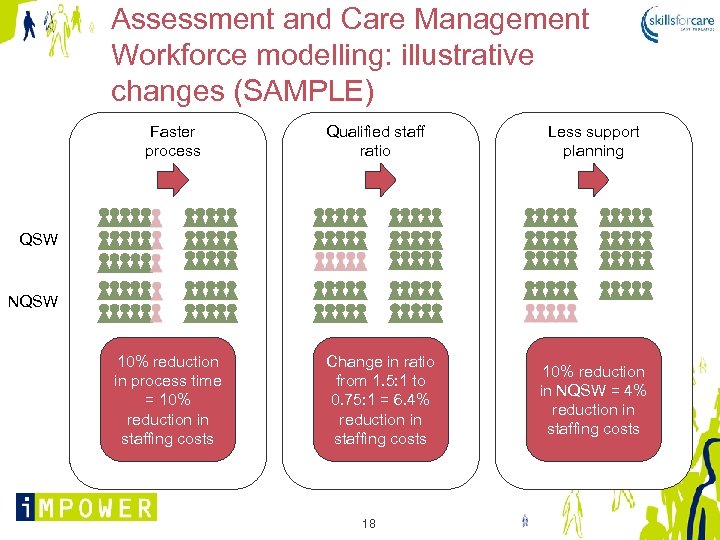 Assessment and Care Management Workforce modelling: illustrative changes (SAMPLE) Faster process Qualified staff ratio Less support planning QSW NQSW 10% reduction in process time = 10% reduction in staffing costs Change in ratio from 1. 5: 1 to 0. 75: 1 = 6. 4% reduction in staffing costs 18 10% reduction in NQSW = 4% reduction in staffing costs
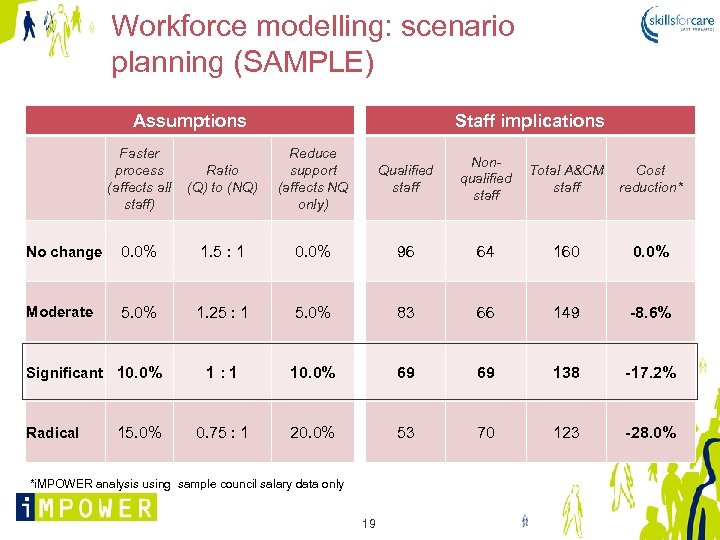 Workforce modelling: scenario planning (SAMPLE) Assumptions Faster process (affects all staff) No change Moderate Ratio (Q) to (NQ) Reduce support (affects NQ only) Qualified staff Nonqualified staff Total A&CM staff Cost reduction* 0. 0% 1. 5 : 1 0. 0% 96 64 160 0. 0% 5. 0% 1. 25 : 1 5. 0% 83 66 149 -8. 6% 1: 1 10. 0% 69 69 138 -17. 2% 0. 75 : 1 20. 0% 53 70 123 -28. 0% Significant 10. 0% Radical Staff implications 15. 0% *i. MPOWER analysis using sample council salary data only 19
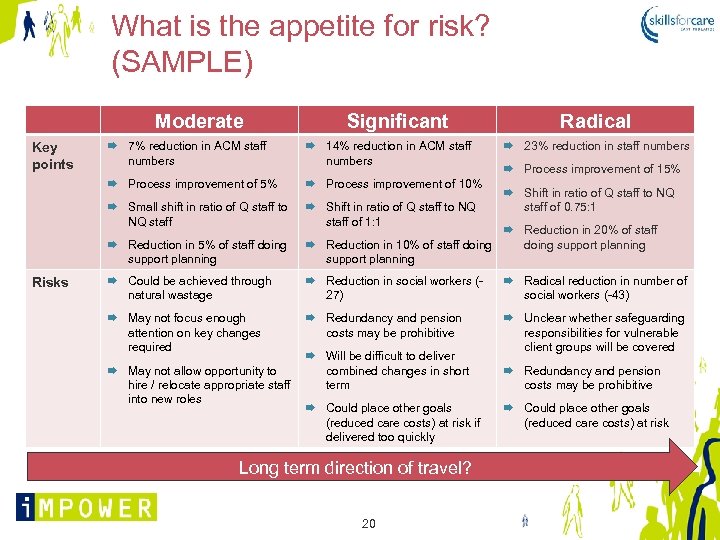 What is the appetite for risk? (SAMPLE) Moderate Significant 7% reduction in ACM staff numbers 14% reduction in ACM staff numbers Process improvement of 5% Process improvement of 10% Small shift in ratio of Q staff to NQ staff Key points Shift in ratio of Q staff to NQ staff of 1: 1 Radical 23% reduction in staff numbers Process improvement of 15% Shift in ratio of Q staff to NQ staff of 0. 75: 1 Reduction in 5% of staff doing support planning Risks Reduction in 20% of staff Reduction in 10% of staff doing support planning Could be achieved through natural wastage Reduction in social workers (27) Radical reduction in number of social workers (-43) May not focus enough attention on key changes required Redundancy and pension costs may be prohibitive Unclear whether safeguarding responsibilities for vulnerable client groups will be covered May not allow opportunity to hire / relocate appropriate staff into new roles Will be difficult to deliver combined changes in short term Could place other goals (reduced care costs) at risk if delivered too quickly Long term direction of travel? 20 Redundancy and pension costs may be prohibitive Could place other goals (reduced care costs) at risk
 Agenda Introduction and objective setting How big is this change? 1. Organisational structure challenges 2. Potential for efficiency savings 3. Workforce challenges What shapes the future workforce? New types of working – how others have approached it Lunch Case studies from participating LAs Group exercise Practical next steps 21
 Workforce Challenges emerging from SDS Change in Job Roles Councils will need to carefully consider the competencies and role of care managers and other health and social care staff and also consider the change in culture and use an organisational development model of change management. There will need to be an extensive programme of consultation with staff alongside additional investment in training and development. Some of the challenges which a change programme on this scale will need to address include: Anxiety around new 'professions'. Shift of care managers to a more enabling role. Less control over packages of care. Development of multi skilled teams. Geographical location of teams currently (and possibly move to generic locality based teams). Increased awareness and skills in risk management. The abilty of the worker to 'let go'. The ability to work within new structures, with new networks and partners. 22
 Agenda Introduction and objective setting How big is this change? 1. Organisational structure challenges 2. Potential for efficiency savings 3. Workforce challenges What shapes the future workforce? New types of working – how others have approached it Lunch Case studies from participating LAs Role development exercise Practical next steps 25
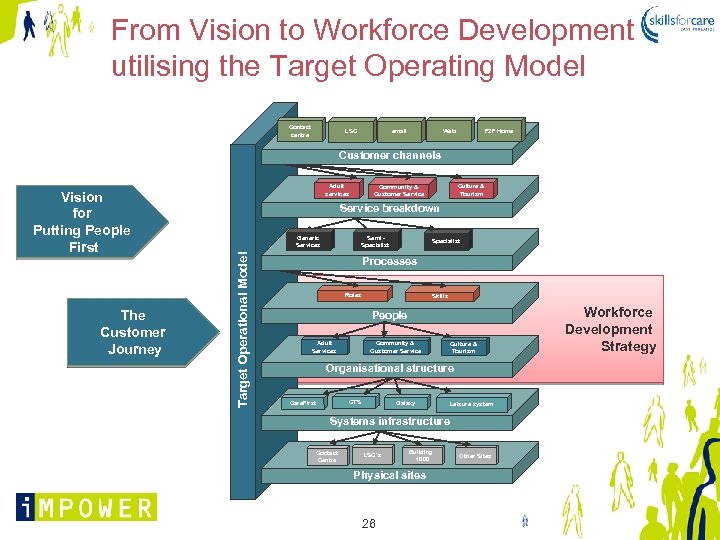 From Vision to Workforce Development utilising the Target Operating Model Contact centre F 2 F Home Web email LSC Customer channels The Customer Journey Adult services Culture & Tourism Community & Customer Service breakdown Generic Services Target Operational Model Operational blueprint Vision for Putting People First Semi Specialist Processes Roles Skills People Adult Services Community & Customer Service Culture & Tourism Organisational structure CTS Care. First Galaxy Leisure system Systems infrastructure Contact Centre LSC ’s Building 1000 Physical sites 26 Other Sites Workforce Development Strategy
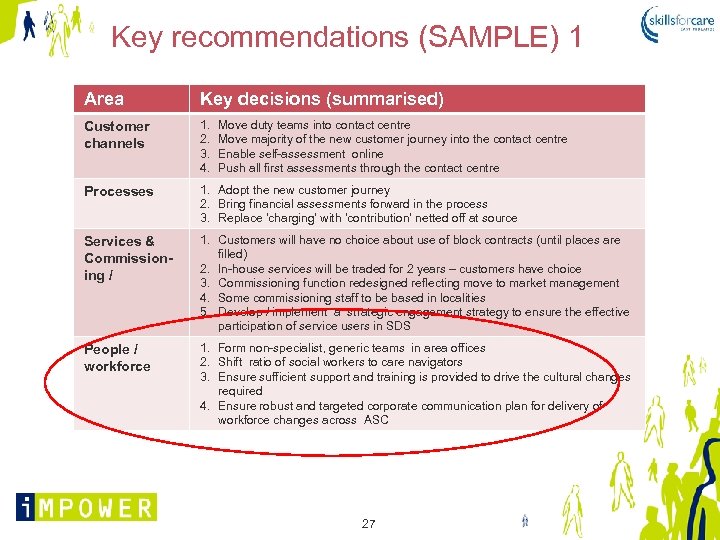 Key recommendations (SAMPLE) 1 Area Key decisions (summarised) Customer channels 1. 2. 3. 4. Processes 1. Adopt the new customer journey 2. Bring financial assessments forward in the process 3. Replace ‘charging’ with ‘contribution’ netted off at source Services & Commissioning / 1. Customers will have no choice about use of block contracts (until places are filled) 2. In-house services will be traded for 2 years – customers have choice 3. Commissioning function redesigned reflecting move to market management 4. Some commissioning staff to be based in localities 5. Develop / implement a strategic engagement strategy to ensure the effective participation of service users in SDS People / workforce 1. Form non-specialist, generic teams in area offices 2. Shift ratio of social workers to care navigators 3. Ensure sufficient support and training is provided to drive the cultural changes required 4. Ensure robust and targeted corporate communication plan for delivery of workforce changes across ASC Move duty teams into contact centre Move majority of the new customer journey into the contact centre Enable self-assessment online Push all first assessments through the contact centre 27
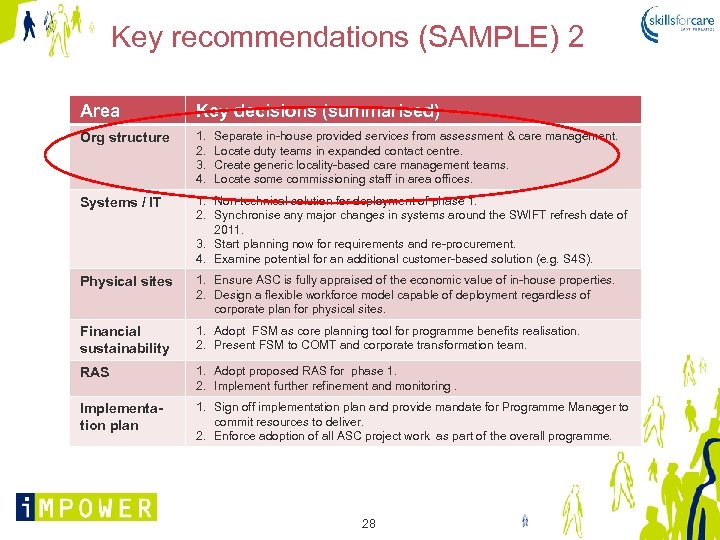 Key recommendations (SAMPLE) 2 Area Key decisions (summarised) Org structure 1. 2. 3. 4. Systems / IT 1. Non-technical solution for deployment of phase 1. 2. Synchronise any major changes in systems around the SWIFT refresh date of 2011. 3. Start planning now for requirements and re-procurement. 4. Examine potential for an additional customer-based solution (e. g. S 4 S). Physical sites 1. Ensure ASC is fully appraised of the economic value of in-house properties. 2. Design a flexible workforce model capable of deployment regardless of corporate plan for physical sites. Financial sustainability 1. Adopt FSM as core planning tool for programme benefits realisation. 2. Present FSM to COMT and corporate transformation team. RAS 1. Adopt proposed RAS for phase 1. 2. Implement further refinement and monitoring. Implementation plan 1. Sign off implementation plan and provide mandate for Programme Manager to commit resources to deliver. 2. Enforce adoption of all ASC project work as part of the overall programme. Separate in-house provided services from assessment & care management. Locate duty teams in expanded contact centre. Create generic locality-based care management teams. Locate some commissioning staff in area offices. 28
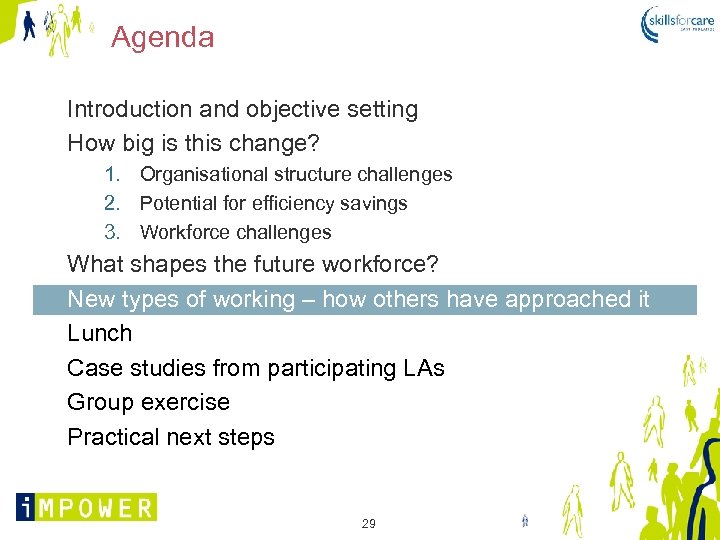 Agenda Introduction and objective setting How big is this change? 1. Organisational structure challenges 2. Potential for efficiency savings 3. Workforce challenges What shapes the future workforce? New types of working – how others have approached it Lunch Case studies from participating LAs Group exercise Practical next steps 29
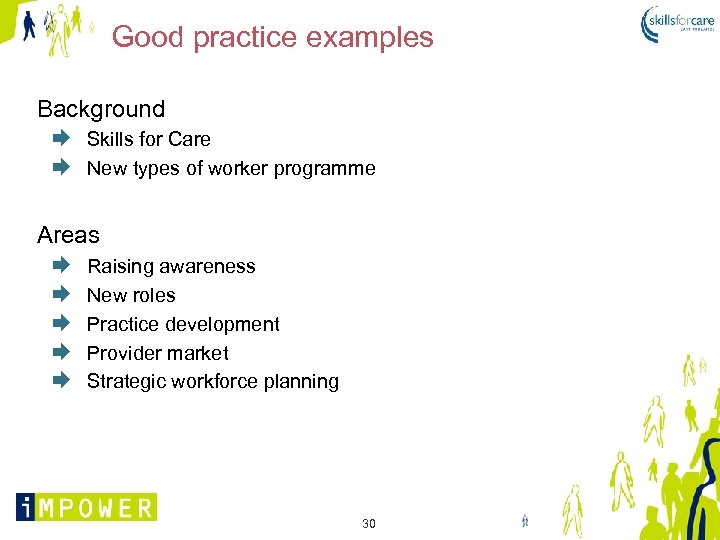 Good practice examples Background Skills for Care New types of worker programme Areas Raising awareness New roles Practice development Provider market Strategic workforce planning 30
 New Types of Working Local Authorities involvement Internal staff Micro employers Personal assistants Private, voluntary and independent sector Informal carers 31
 Future development Personal Assistant - induction standards - training National Minimum Data Set to capture micro employers and personal assistant data In. LAWS – Integrated local area workforce strategies 32
 Key resources Common core principles Principles of workforce redesign New types of working website – www. newtypesofworker. co. uk Adult social care workforce strategy Qualifications and Credit Framework 33
 Key resources Leadership and management National minimum data set – social care National Occupational Standards Knowledge Sets Regional contact person 34
 Agenda Introduction and objective setting How big is this change? 1. Organisational structure challenges 2. Potential for efficiency savings 3. Workforce challenges What shapes the future workforce? New types of working – how others have approached it Lunch Case studies from participating LAs Group exercise Practical next steps 35
 Agenda Introduction and objective setting How big is this change? 1. Organisational structure challenges 2. Potential for efficiency savings 3. Workforce challenges What shapes the future workforce? New types of working – how others have approached it Lunch Case studies from participating LAs Group exercise Practical next steps 36
 Discussion by LAs 37
 Agenda Introduction and objective setting How big is this change? 1. Organisational structure challenges 2. Potential for efficiency savings 3. Workforce challenges What shapes the future workforce? New types of working – how others have approached it Lunch Case studies from participating LAs Group exercise Practical next steps 38
 Group exercise 1. Break down into groups of 5 or 6. 2. Designate a reporter to feedback to the wider group. 3. Choose one of the five areas that have been discussed earlier (repeated below). Identify the issues and challenges in this area and provide one recommendation that you will need to undertake to ensure the successful delivery of this element. Raising awareness amongst social care providers Developing new roles Practice development Workforce changes within service providers Strategic workforce planning 39
 Agenda Introduction and objective setting How big is this change? 1. Organisational structure challenges 2. Potential for efficiency savings 3. Workforce challenges What shapes the future workforce? New types of working – how others have approached it Lunch Case studies from participating LAs Group exercise Practical next steps 40
 Next steps Regional Improvement and Efficiency Partnership Regional workshops Support to each Local Authority 41