


 Скачать презентацию East Asia China Japan 1920 s 1930
afe119ef8a33138c5beaf5046b501e3d.ppt
- Количество слайдов: 40
 East Asia—China & Japan 1920 s & 1930 s
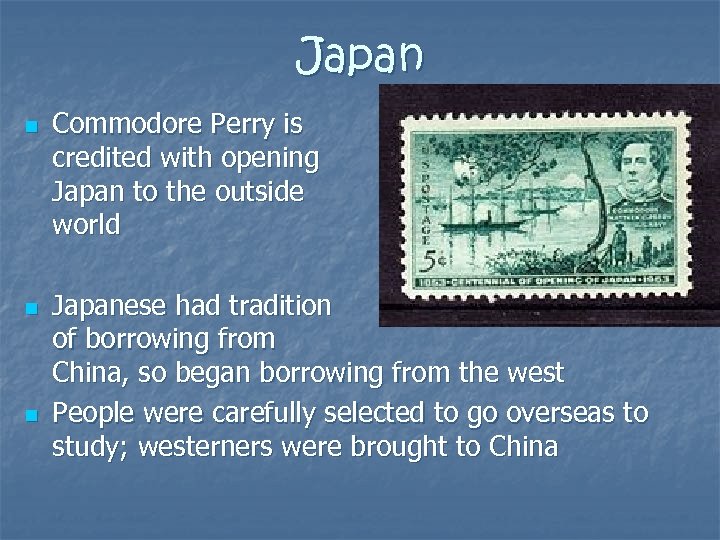 Japan n Commodore Perry is credited with opening Japan to the outside world Japanese had tradition of borrowing from China, so began borrowing from the west People were carefully selected to go overseas to study; westerners were brought to China
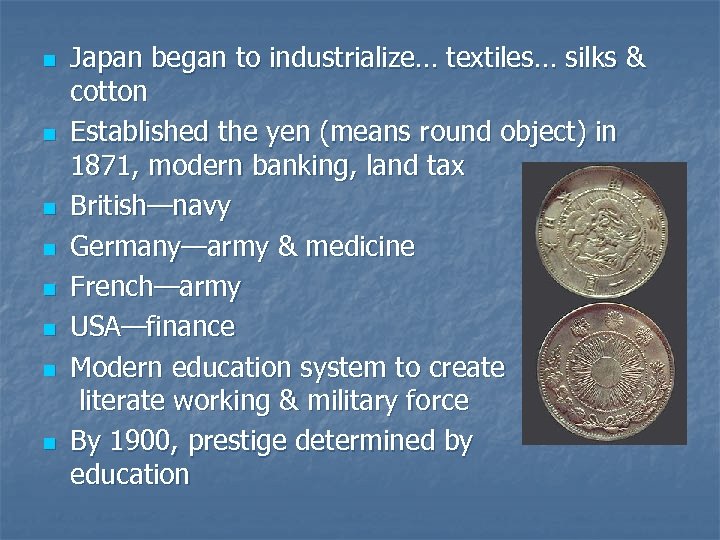 n n n n Japan began to industrialize… textiles… silks & cotton Established the yen (means round object) in 1871, modern banking, land tax British—navy Germany—army & medicine French—army USA—finance Modern education system to create literate working & military force By 1900, prestige determined by education
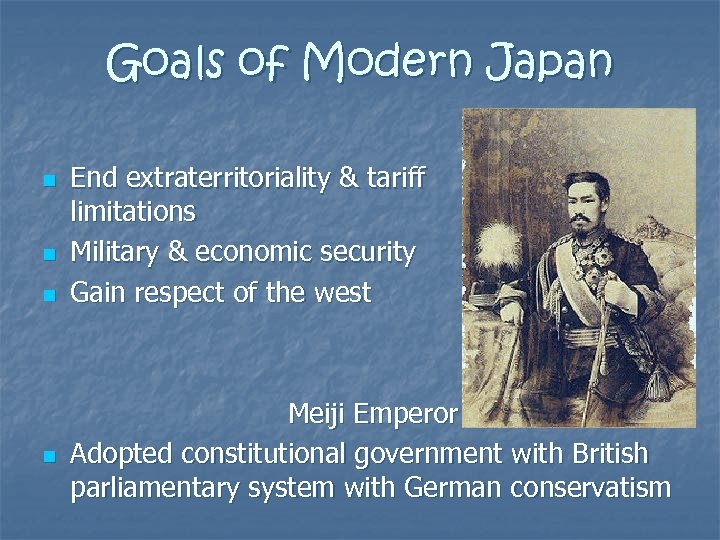 Goals of Modern Japan n n End extraterritoriality & tariff limitations Military & economic security Gain respect of the west Meiji Emperor Adopted constitutional government with British parliamentary system with German conservatism
 Selected Timeline n n n 1874—Taiwan/Formosa 1879—Okinawa/Ryukyu Islands 1894—Sino-Japanese War—rivalry over Korea 1895—gained unequal treaty privilege Western nations had in China 1899—British gave up extraterritoriality
 n n n 1902—Anglo-Japanese Alliance… alliance against France & Russia; if either Japan or Britain was at war with one country, the other would remain neutral. If either Japan or Britain was at war against two or more powers, the other would help 1904—Russo-Japanese War 1910—Japan annexed Korea By 1911 other countries ended their unequal treaties 1914—declared war on Germany (see Anglo. Japanese Alliance)—took German sphere of influence… Shandong Province in China
 Twenty-one Demands (1915) n n n List secretly given to China while the western nations were occupied fighting WW I Coupled by Japanese invasion of German sphere of influence in China… Shandong Province Japan demanded (a) China quit leasing territory to other foreign countries (b) Demanded control in Manchuria & Shandong Provinces (c) China accept Japanese “advisors” to help run its government
 Response to 21 Demands n n China signed… had no choice because Japan threatened to go to war with China Britain & US got Japan to remove the requirement for Japanese advisors to help run the Chinese government; part of US distrust of Japan Versailles Treaty… Japan given the German concession in Shandong Province Washington Naval Conference… Japan agreed to withdraw from Shandong Province and recognize Chinese sovereignty
 After WW I n n n 1919—Paris Peace Conference Founding member of League of Nations Permanent member of the Council Recognized as a “great power” Lof. N Covenant—clause for racial equality rejected 1921—end of Anglo-Japanese Alliance Great Britain pressured by US not to renew Politicians in Japan who wanted to use negotiation to solve diplomatic problems were weakened
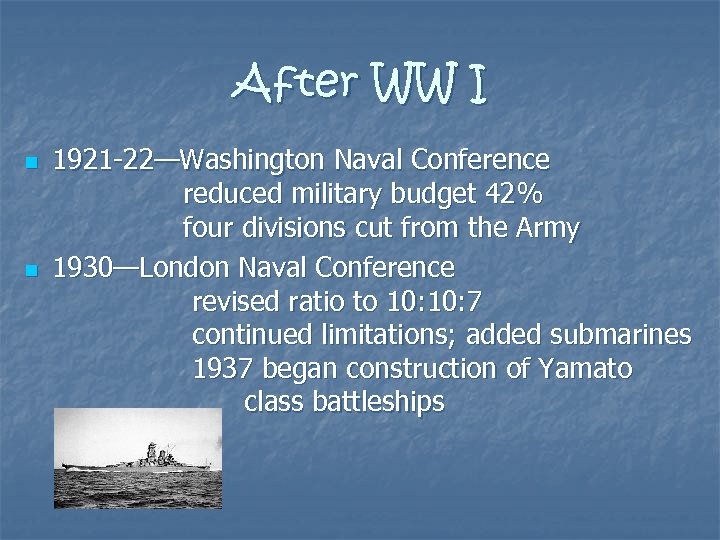 After WW I n n 1921 -22—Washington Naval Conference reduced military budget 42% four divisions cut from the Army 1930—London Naval Conference revised ratio to 10: 7 continued limitations; added submarines 1937 began construction of Yamato class battleships
 After WW I n n n USSR seen as an enemy… Japan’s government was very anti-communist 1922—Japanese troops withdrew from Siberia (US and other troops had withdrawn in 1920) USA & Great Britain seen as unreliable and untrustworthy because of unequal treatment (not renewing Alliance; naval ship ratios)
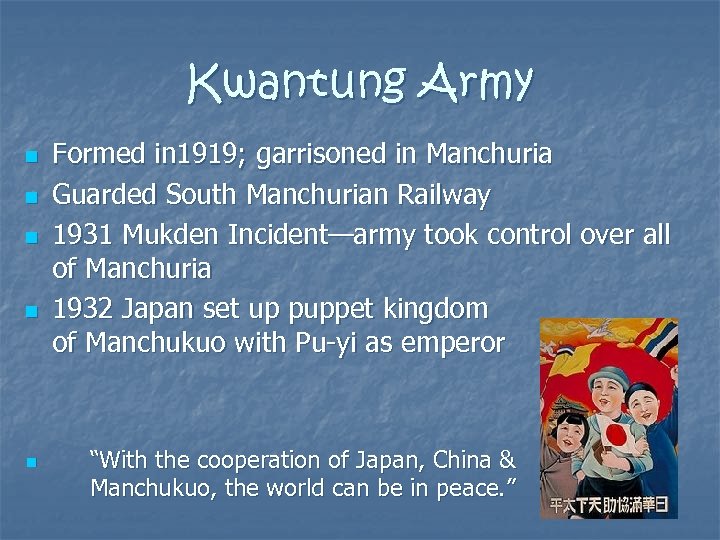 Kwantung Army n n n Formed in 1919; garrisoned in Manchuria Guarded South Manchurian Railway 1931 Mukden Incident—army took control over all of Manchuria 1932 Japan set up puppet kingdom of Manchukuo with Pu-yi as emperor “With the cooperation of Japan, China & Manchukuo, the world can be in peace. ”
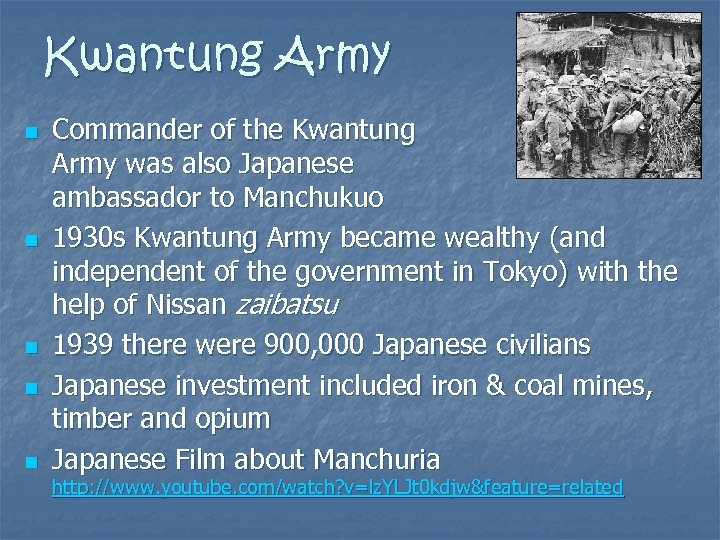 Kwantung Army n n n Commander of the Kwantung Army was also Japanese ambassador to Manchukuo 1930 s Kwantung Army became wealthy (and independent of the government in Tokyo) with the help of Nissan zaibatsu 1939 there were 900, 000 Japanese civilians Japanese investment included iron & coal mines, timber and opium Japanese Film about Manchuria http: //www. youtube. com/watch? v=lz. YLJt 0 kdjw&feature=related
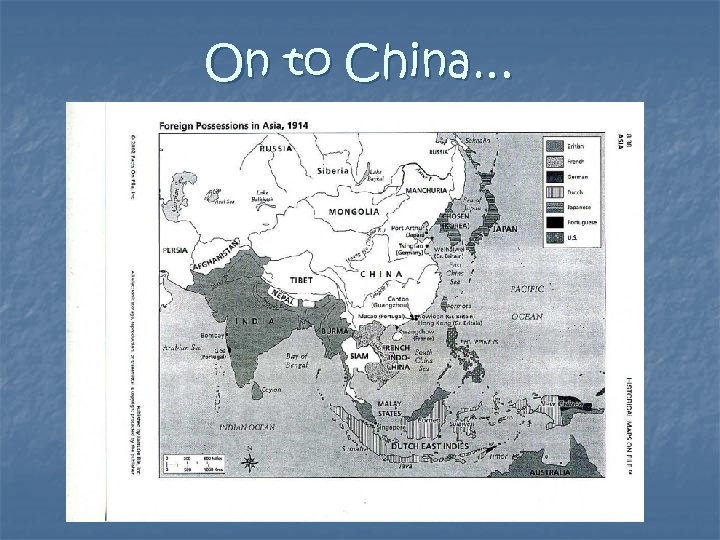 On to China…
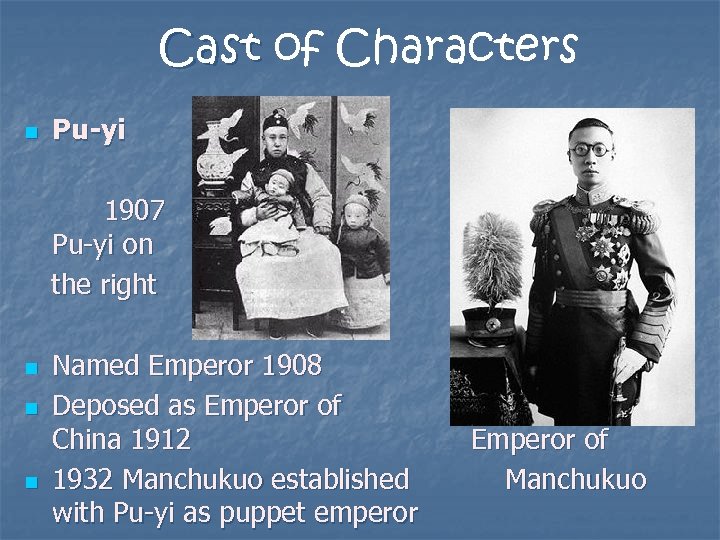 Cast of Characters n Pu-yi 1907 Pu-yi on the right n n n Named Emperor 1908 Deposed as Emperor of China 1912 1932 Manchukuo established with Pu-yi as puppet emperor Emperor of Manchukuo
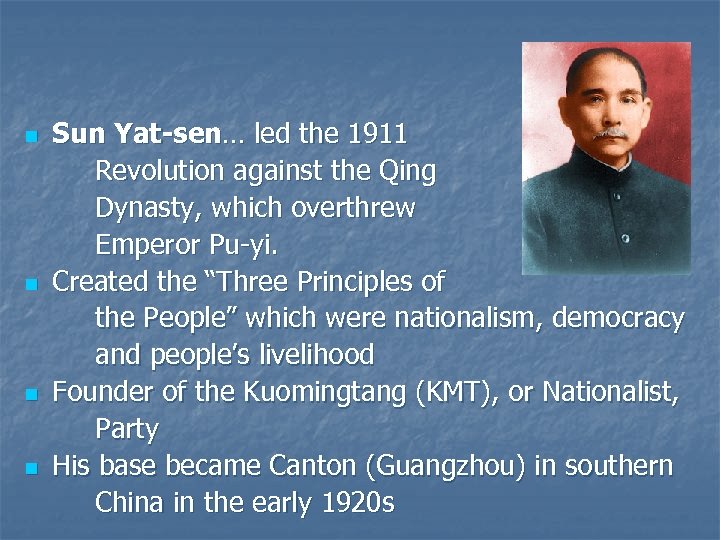 n n Sun Yat-sen… led the 1911 Revolution against the Qing Dynasty, which overthrew Emperor Pu-yi. Created the “Three Principles of the People” which were nationalism, democracy and people’s livelihood Founder of the Kuomingtang (KMT), or Nationalist, Party His base became Canton (Guangzhou) in southern China in the early 1920 s
 n n Sun received help from the USSR beginning in 1923 (the Comintern) after failing to gain aid from Britain or the USA. The Soviets proposed setting up a military academy, which became Whampoa Military Academy 1923 the Soviets convinced Sun to join with the Communists; Communists joined the KMT as individuals Sun died in 1925 and Chiang Kai-shek became leader of the KMT.
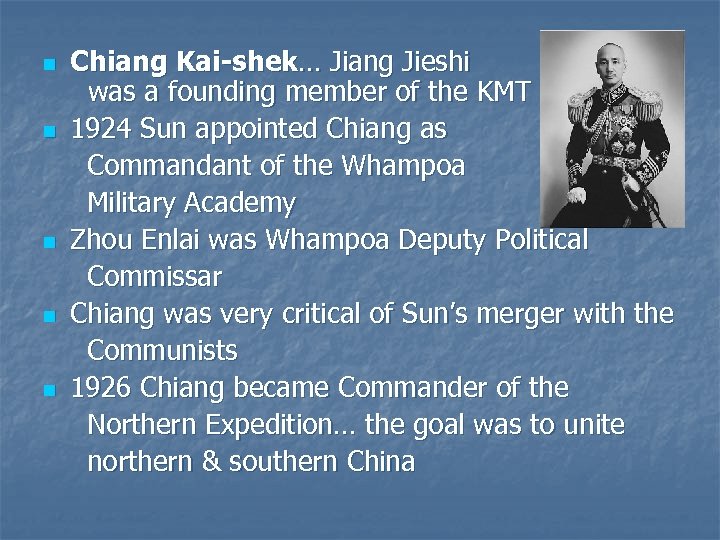 n n n Chiang Kai-shek… Jiang Jieshi was a founding member of the KMT 1924 Sun appointed Chiang as Commandant of the Whampoa Military Academy Zhou Enlai was Whampoa Deputy Political Commissar Chiang was very critical of Sun’s merger with the Communists 1926 Chiang became Commander of the Northern Expedition… the goal was to unite northern & southern China
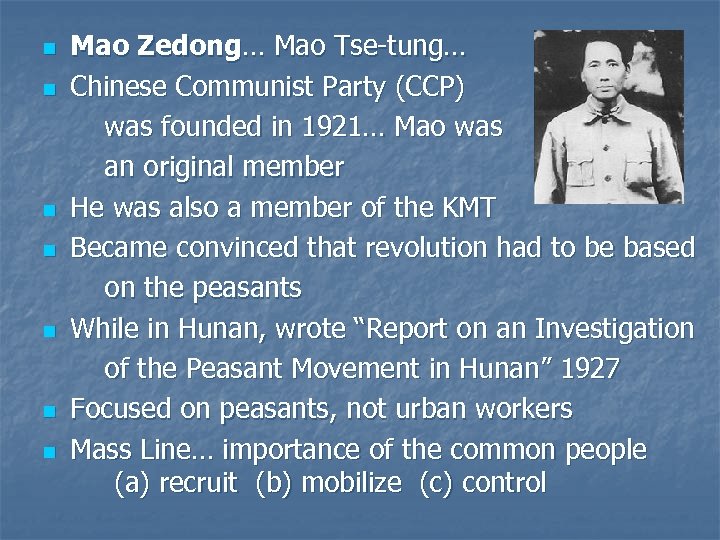 n n n n Mao Zedong… Mao Tse-tung… Chinese Communist Party (CCP) was founded in 1921… Mao was an original member He was also a member of the KMT Became convinced that revolution had to be based on the peasants While in Hunan, wrote “Report on an Investigation of the Peasant Movement in Hunan” 1927 Focused on peasants, not urban workers Mass Line… importance of the common people (a) recruit (b) mobilize (c) control
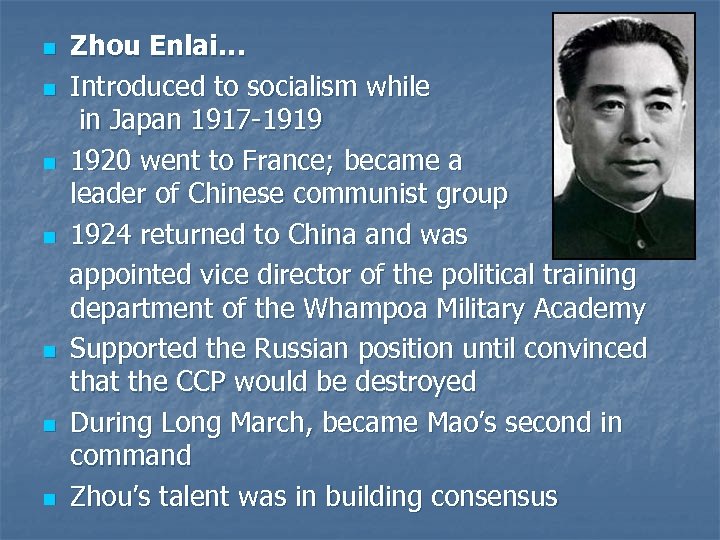 n n n n Zhou Enlai… Introduced to socialism while in Japan 1917 -1919 1920 went to France; became a leader of Chinese communist group 1924 returned to China and was appointed vice director of the political training department of the Whampoa Military Academy Supported the Russian position until convinced that the CCP would be destroyed During Long March, became Mao’s second in command Zhou’s talent was in building consensus
 Events n n n n May Fourth Movement 1919 Founding of CCP 1921 in Shanghai CCP members instructed by Comintern to join KMT as individuals 1923 Sun Yat-sen died; Chiang became leader of KMT 1925 Northern Expedition 1926 -1928 Mao wrote “Report on an Investigation of the Peasant Movement in Hunan” 1927 KMT purge of Communists from KMT 1927— some use this date for start of Chinese Civil War
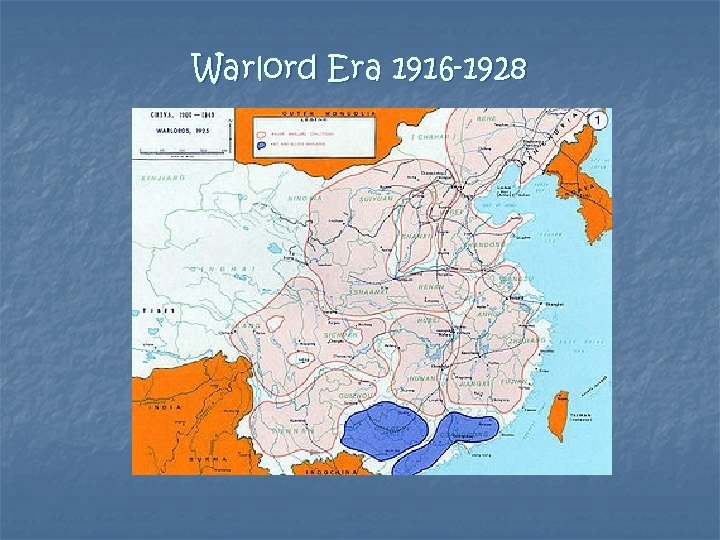 Warlord Era 1916 -1928
 n n n Chiang entered Beijing 1928 Chiang made Nanking (Nanjing) his capital; ruler of China by 1930 KMT continued attempt to eliminate Communists from China 1927 -1933 Muken Incident 1931—Japan took over Manchuria Chinese Soviet Republic set up in Kiangsi 1931 as a “democratic dictatorship of the proletariat & peasantry”
 n n n Japanese bombed Shanghai 1932 Manchukuo set up with Pu-yi as puppet emperor 1932 L of N Lytton Report condemned Japanese for taking Manchuria; Japan left L of N 1933 Long March 1934 -1936 By 1935 Mao was in control of the CCP Sian (Xian) Incident 1936
 n n n Marco Polo Bridge Incident 1937—official start of WW II in Asia USSR-Chinese (ROC) Non-Aggression Pact 1937 Nanking Massacre & Japanese take over of Nanking 1937; Chiang moved his government west, eventually settling in Chungking
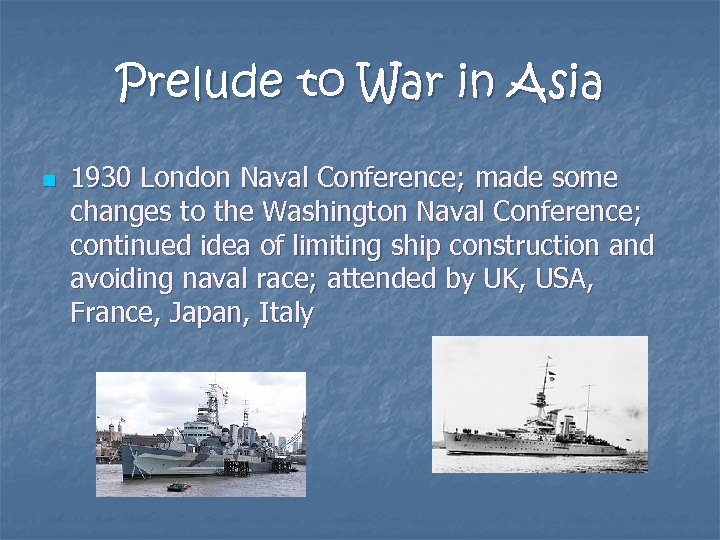 Prelude to War in Asia n 1930 London Naval Conference; made some changes to the Washington Naval Conference; continued idea of limiting ship construction and avoiding naval race; attended by UK, USA, France, Japan, Italy
 Prelude to War in Asia n n Japanese army believed that Chiang Kai-shek’s Northern Expedition (1926 -1928) was a threat to Japanese security Anti-foreign/nationalistic feelings were very high Result was a boycott of Japanese goods The Mukden Incident increased the intensity of the Chinese boycott of Japanese goods… Japanese imports into China dropped to 1/6 of their former value
 Prelude to War in Asia— Manchurian or Mukden Incident n n n 1931—Japan took control of Manchuria was an important industrial area; hoped Japanese would move there to alleviate population problems in Japan; also important as a defense against the Soviet Union; military goods were manufactured for the army; rice & cotton from Manchuria were used to take care of the army http: //www. youtube. com/watch? v=5 D 9 VZH 5 Fi_4&feature=related
 1932 n n n Japanese planes bombed Shanghai WITH consent of the Japanese Emperor and Chiang Kai -shek; in response to Chinese boycott of Japanese goods; Japanese nationals in Shanghai “feared for their lives” Japanese announced recognition of “Manchukuo” Lytton Report made public in October
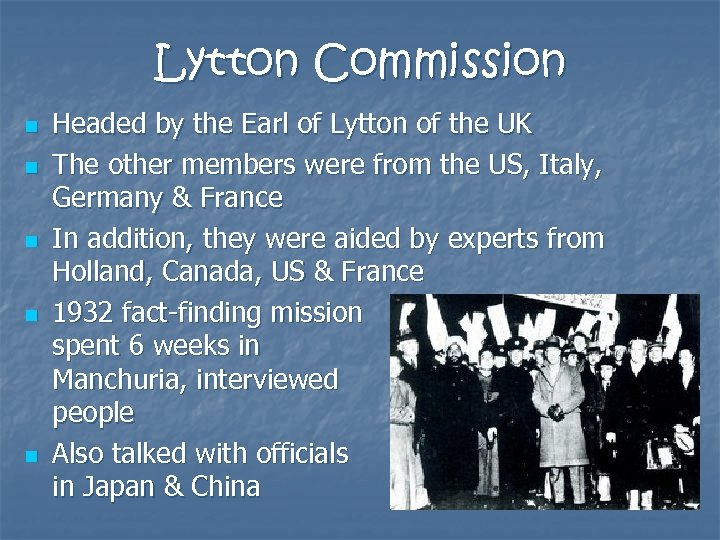 Lytton Commission n n Headed by the Earl of Lytton of the UK The other members were from the US, Italy, Germany & France In addition, they were aided by experts from Holland, Canada, US & France 1932 fact-finding mission spent 6 weeks in Manchuria, interviewed people Also talked with officials in Japan & China
 Lytton Commission n n In a report to the House of Lords, Lytton reported that the group saw themselves as working for the Lof. N, not their own individual governments The commission believed they were “explorers for peace”, not judges of the situation In addition to looking for the truth of the Incident, the commission saw as its task “to find, if we could, what were the conditions that would ensure peace in the future” Lytton Commission Report before the House of Lords 1932
 Lytton Commission Recommendations n n The recommendations fall into two groups… status of Manchuria and relations between China & Japan Manchuria should be autonomous within China; China should appoint the head of Manchuria to be advised by foreign advisors, some of them Japanese
 Lytton Commission Recommendations n China & Japan were advised to sign three new treaties: Define Japan’s rights or interests “Treaty of Conciliation & Arbitration, Non. Aggression and Mutual Assistance Commercial Treaty to end the boycotts n Time Magazine “Japan-China: Five Wise Westerners” Oct. 10, 1932 n n n
 n n Japan withdrew from the League of Nations (1933) after the Lytton Report condemned Japanese invasion of Manchuria & demanded Japan withdraw 1935 Second London Naval Conference; Japan withdrew when the US and UK rejected Japanese demands for equality in naval power; by 1938 all powers were constructing naval ships in violation of the naval agreements
 Sian (Xian) Incident 1936 n n Manchurian warlord and KMT general, Zhang Xueliang, captured Chiang Kai-shek Generals Zhang & Yang Hucheng both opposed Chiang’s policy of non-resistance toward the Japanese, instead concentrating on fighting Mao & communists Zhou Enlai went to Sian to represent the CCP Chiang was forced to agree to a United Front to fight the Japanese and allow the CCP to join in the fight against the Japanese
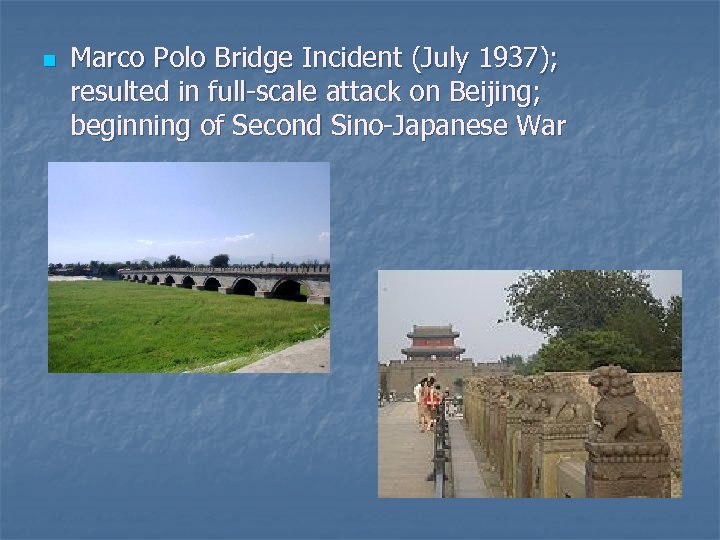 n Marco Polo Bridge Incident (July 1937); resulted in full-scale attack on Beijing; beginning of Second Sino-Japanese War
 Prelude to World War II US involvement n n n 1940 US partial oil embargo; shortage led to decision to take over Indonesia & plan attack on US Invasion of northern Indo. China 1940 Tripartite Pact with Germany & Italy 1941 Neutrality Pact with USSR July 1941 US full oil embargo and freeze of Japanese assets
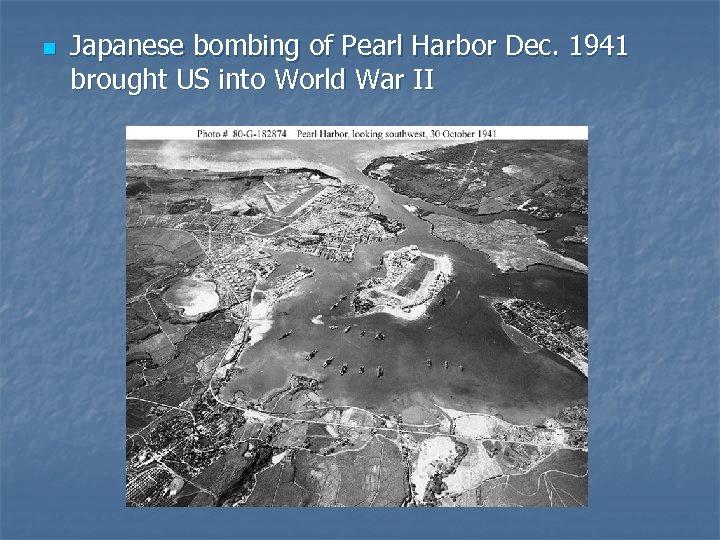 n Japanese bombing of Pearl Harbor Dec. 1941 brought US into World War II
 Pictures n n n n n Text n n n n n Sources http: //en. wikipedia. org/wiki/Sun_Yat-sen http: //en. wikipedia. org/wiki/Chiang_Kai-shek http: //en. wikipedia. org/wiki/Mao_Zedong http: //en. wikipedia. org/wiki/Puyi http: //en. wikipedia. org/wiki/File: Lugouqiao 2. jpg http: //en. wikipedia. org/wiki/File: Pearl_Harbor_looking_southwest-Oct 41. jpg http: //en. wikipedia. org/wiki/Matthew_Perry_(naval_officer) http: //en. wikipedia. org/wiki/Emperor_Meiji http: //en. wikipedia. org/wiki/Japanese_battleship_Yamato English: Created by the US Military Academy (West Point); retrieved from http: //www. dean. usma. edu/history/web 03/atlases/chinese%20 civil%20 war/chinese%20 civil%20 war%20 index. htm http: //www. wsu. edu/~dee/MODCHINA/SUN. HTM http: //www. time. com/time/asia/magazine/1999/990823/sun_yat_sen 1. html http: //www. spartacus. schoolnet. co. uk/2 WWchaing. htm http: //www. wellesley. edu/Anniversary/chiang. html http: //www. spartacus. schoolnet. co. uk/COLDmao. htm http: //www. marxists. org/reference/archive/mao/ http: //www. chaos. umd. edu/history/othersites. html http: //www. spartacus. schoolnet. co. uk/COLDmao. htm http: //www. fordham. edu/halsall/mod/1927 mao. html http: //www. marxists. org/reference/archive/mao/selected-works/volume-1/mswv 1_13. htm http: //history. sandiego. edu/gen/WW 2 Timeline/Prelude 08. html http: //www. firstworldwar. com/source/anglojapanesealliance 1902. htm http: //www. firstworldwar. com/source/21 demands. htm http: //www. mrallsophistory. com/revision. html China: A New History by John K Fairbank. Cambridge, MA: Harvard Univ. Press 1994. http: //www. chinaculture. org/library/2008 -02/15/content_32324. htm http: //afe. easia. columbia. edu/japanworkbook/modernhist/wwii. html