 Скачать презентацию EAS Overview Frank W Bell 2009 -2 -4
90e9a0796ab873acdd95669bbe331255.ppt
- Количество слайдов: 29



EAS+ Overview Frank W. Bell 2009 -2 -4
Contents l l l l l Introduction Opinion (2) Acronyms (2) Societal Situation Paradigm and Value Aspect (5) IPAWS EAS+ Improvements (6) EAS+ Protocol (4), Implementation Conclusion Appendix on value (3) EAS+ Overview 2
Introduction l For countries that have MOU with FEMA l CONELRAD, tubes, relays, alert tone Mutually Assured Destruction situation l EBS, transistors, ICs, more versatile l EAS, microcontroller and EPROM code l EAS+, microprocessor, application on OS, digital TV and HD radio, smart consumer electronics feature EAS+ Overview 3
Opinion -1 l Considerable dissatisfaction expressed at FEMA/FCC summit for EAS l This Federal and large disaster system is little used by local EMOs because it is currently unsuitable and it cannot be incorporated into exercises l Original ENDECS mostly over 10 years old and are due for replacement l HD radio & digital TV offer possibilities EAS+ Overview 4
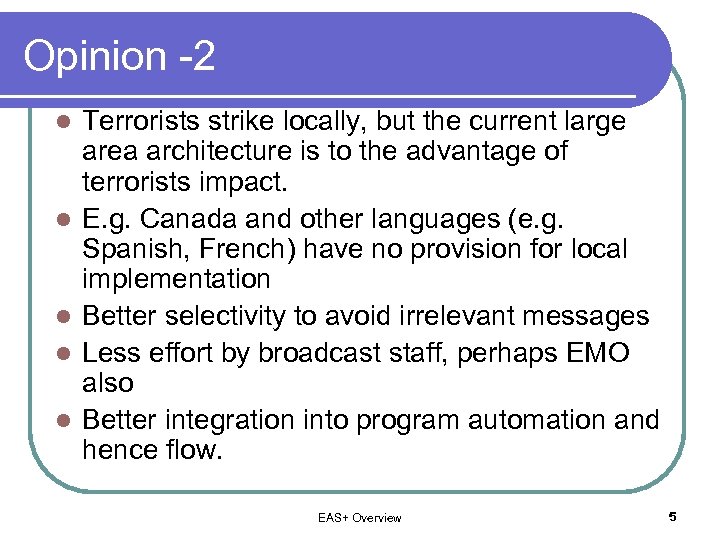
Opinion -2 l l l Terrorists strike locally, but the current large area architecture is to the advantage of terrorists impact. E. g. Canada and other languages (e. g. Spanish, French) have no provision for local implementation Better selectivity to avoid irrelevant messages Less effort by broadcast staff, perhaps EMO also Better integration into program automation and hence flow. EAS+ Overview 5
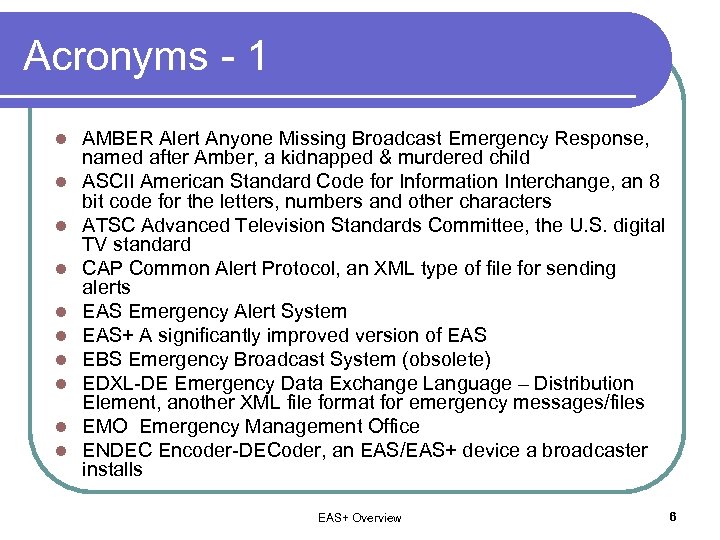
Acronyms - 1 l l l l l AMBER Alert Anyone Missing Broadcast Emergency Response, named after Amber, a kidnapped & murdered child ASCII American Standard Code for Information Interchange, an 8 bit code for the letters, numbers and other characters ATSC Advanced Television Standards Committee, the U. S. digital TV standard CAP Common Alert Protocol, an XML type of file for sending alerts EAS Emergency Alert System EAS+ A significantly improved version of EAS EBS Emergency Broadcast System (obsolete) EDXL-DE Emergency Data Exchange Language – Distribution Element, another XML file format for emergency messages/files EMO Emergency Management Office ENDEC Encoder-DECoder, an EAS/EAS+ device a broadcaster installs EAS+ Overview 6
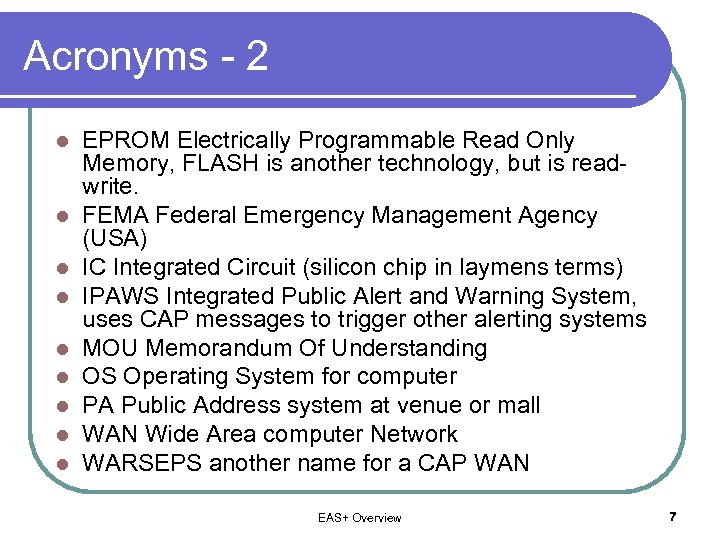
Acronyms - 2 l l l l l EPROM Electrically Programmable Read Only Memory, FLASH is another technology, but is readwrite. FEMA Federal Emergency Management Agency (USA) IC Integrated Circuit (silicon chip in laymens terms) IPAWS Integrated Public Alert and Warning System, uses CAP messages to trigger other alerting systems MOU Memorandum Of Understanding OS Operating System for computer PA Public Address system at venue or mall WAN Wide Area computer Network WARSEPS another name for a CAP WAN EAS+ Overview 7
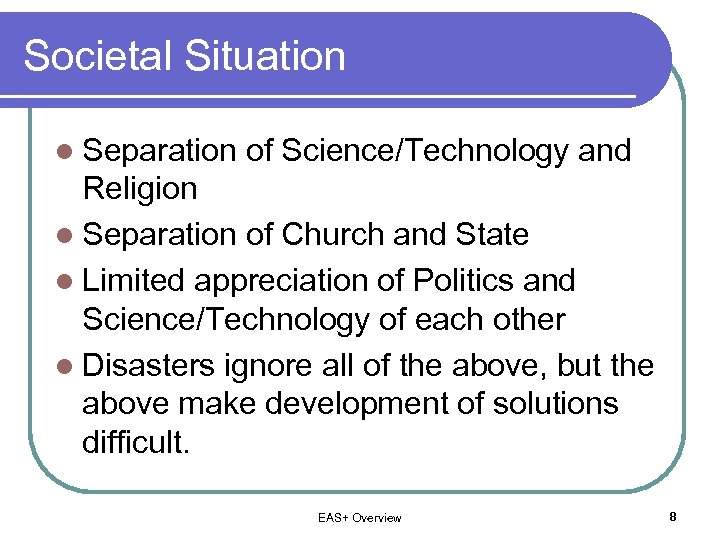
Societal Situation l Separation of Science/Technology and Religion l Separation of Church and State l Limited appreciation of Politics and Science/Technology of each other l Disasters ignore all of the above, but the above make development of solutions difficult. EAS+ Overview 8
Paradigm and Value aspect l Government Mandate; these may differ between governments, technically limited l Standards Based; best technology, global economics advantage l Value Based Paradigm; needs market research and including all stakeholders l What is the relationship between severity and frequency of disasters, to decide value? EAS+ Overview 9
The Primary Thrusts The Value Base Paradigm l Standards-based to realize better technology and the economics of consumer electronics, rather than one specification for one country. l A redefinition of the protocol in binary which is compatible with ASCII to take advantage of the possibilities with digital TV and HD radio. l These three are complementary like the sides of a triangle. CAP Broadcast future direction. l EAS+ Overview 10
Value Based Paradigm l The value of a message is the Importance of the message times the number of recipients it is important to, less the Annoyance of the population receiving the message who are not intended recipients. l This depends on the Event code and the Customer selection ability to select important messages. l Market research is needed EAS+ Overview 11
Value of different technologies l The different technologies can vary by; l P, the penetration into the coverage area as a fraction of the population reached at any time. l R, the response time of the technology, earthquakes require rapid response l F, the maximum frequency of usage EAS+ Overview 12
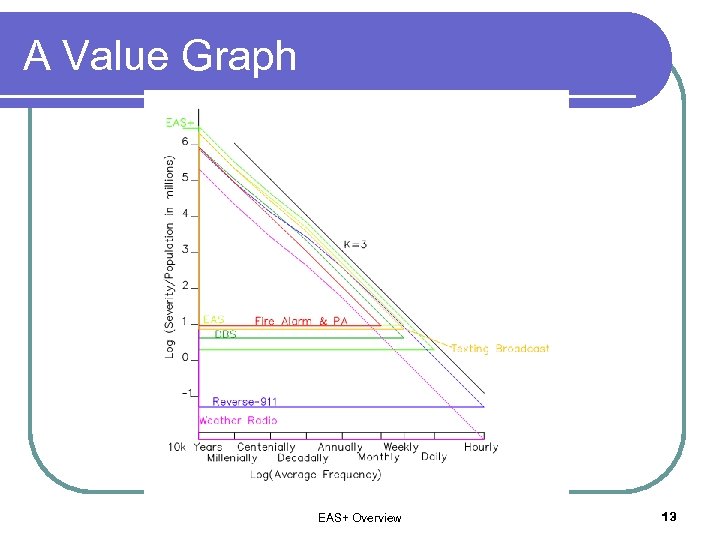
A Value Graph EAS+ Overview 13
IPAWS l l l l l Integrated Public Alert Warning System Common Alert Protocol based Varying alerting technologies, e. g. ; EAS+ Cellphone Text Broadcast Email/texting Emergency Telephone Notification (R 911) Fire Alarms & PA Systems (& Sirens) Future delivery to computers of alerts and publication files (CAP Broadcast mode EAS+) EAS+ Overview 14
EAS+ improvements over EAS l Capabilities beyond current CAP standard l Backward compatible with EAS for simple migration. Old ENDECS OK for analog with software upgrade. l Priority scheme, 1 is immediate override, others can be scheduled by automation l First responders exercise mode EAS+ Overview 15
EAS+ improvements - 2 l. A tunneling mode possible to replace the daisy chain l Response time in seconds for priority 1 l Selectivity by location by county sector or polygon defined l Car radios can use polygons with navigation systems l More Event Codes for local emergencies EAS+ Overview 16
EAS+ improvements -3 l Selectivity by polygons to 1 yard/meter resolution (or better) l Selectivity by receiver category (vehicles, Intelligent Highway Sign) l Selectivity by user category (e. g. first responder) l Customer adjustable selectivity, by feature or other (e. g. priority) EAS+ Overview 17
EAS+ improvements -4 l l l Country code Language code, and up to four languages of audio (text via CAP? ) AMBER Alert pictures To Fire Alarm/PA systems possible Multistate broadcast coverage possible for message routing (e. g. NYC to 3 states) Automated QC and value calculation with monitoring receivers and emails EAS+ Overview 18
EAS+ improvements -5 l Standards based architecture means that consumer electronics manufacturers can add this as a feature for the small additional cost. Also other countries adopting this would be aided by the volume economics of consumer electronics. l CAP becoming world standard, EAS+ also is possible EAS+ Overview 19
EAS+ improvements -6 l An EAS+ message can be used to regenerate a CAP message. This is useful in the event of CAP distribution network failure. EAS really can’t do that l EAS+ compatible ENDECS are already available, with an application upgrade that also supports the FEMA CAP to EAS specification available soon l An EAS+ CG protocol is appropriate EAS+ Overview 20
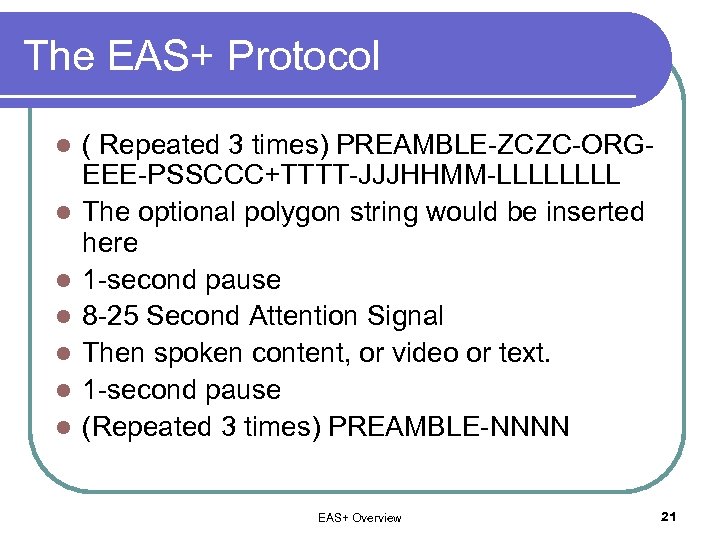
The EAS+ Protocol l l l ( Repeated 3 times) PREAMBLE-ZCZC-ORGEEE-PSSCCC+TTTT-JJJHHMM-LLLL The optional polygon string would be inserted here 1 -second pause 8 -25 Second Attention Signal Then spoken content, or video or text. 1 -second pause (Repeated 3 times) PREAMBLE-NNNN EAS+ Overview 21
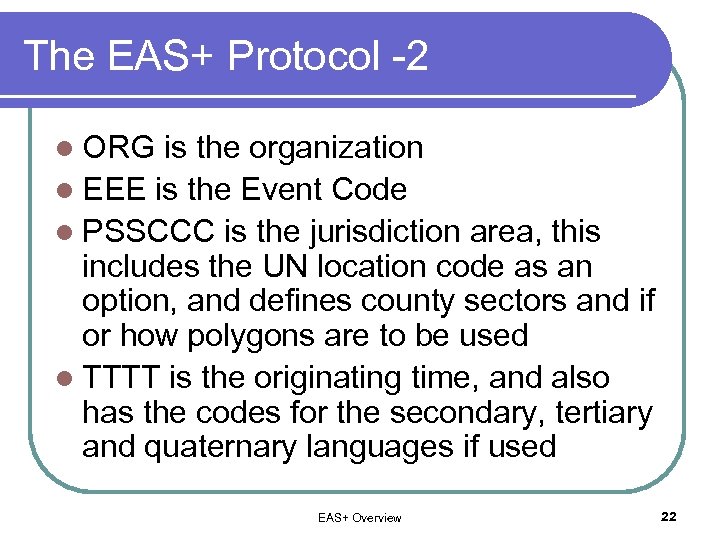
The EAS+ Protocol -2 l ORG is the organization l EEE is the Event Code l PSSCCC is the jurisdiction area, this includes the UN location code as an option, and defines county sectors and if or how polygons are to be used l TTTT is the originating time, and also has the codes for the secondary, tertiary and quaternary languages if used EAS+ Overview 22
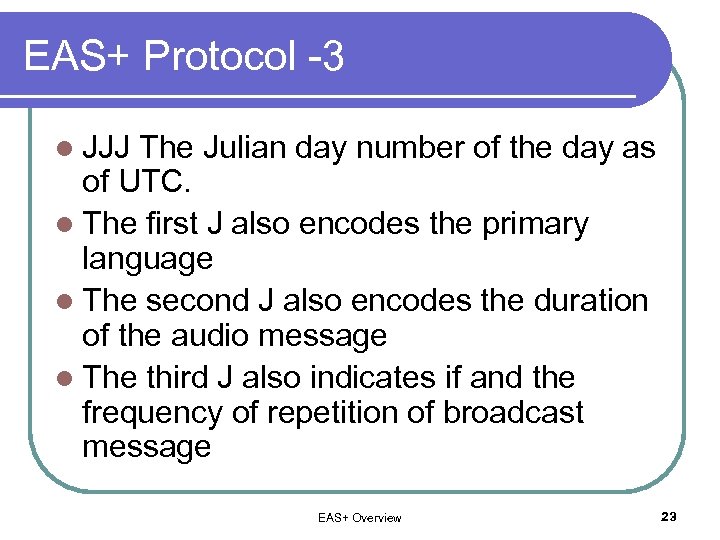
EAS+ Protocol -3 l JJJ The Julian day number of the day as of UTC. l The first J also encodes the primary language l The second J also encodes the duration of the audio message l The third J also indicates if and the frequency of repetition of broadcast message EAS+ Overview 23
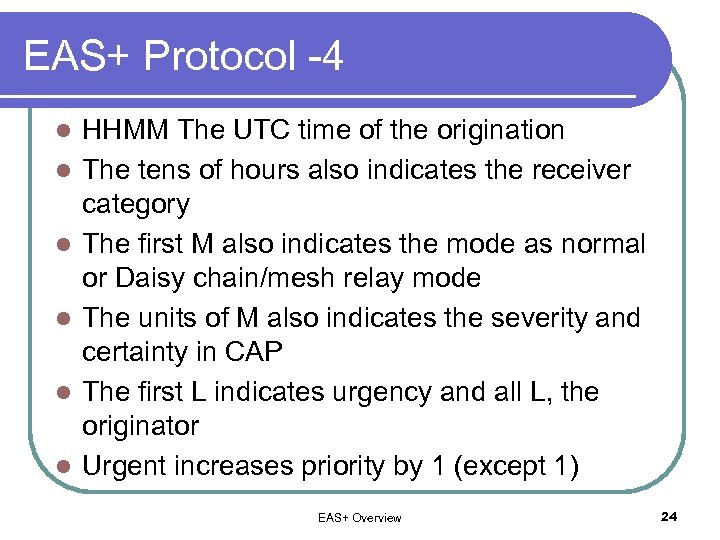
EAS+ Protocol -4 l l l HHMM The UTC time of the origination The tens of hours also indicates the receiver category The first M also indicates the mode as normal or Daisy chain/mesh relay mode The units of M also indicates the severity and certainty in CAP The first L indicates urgency and all L, the originator Urgent increases priority by 1 (except 1) EAS+ Overview 24
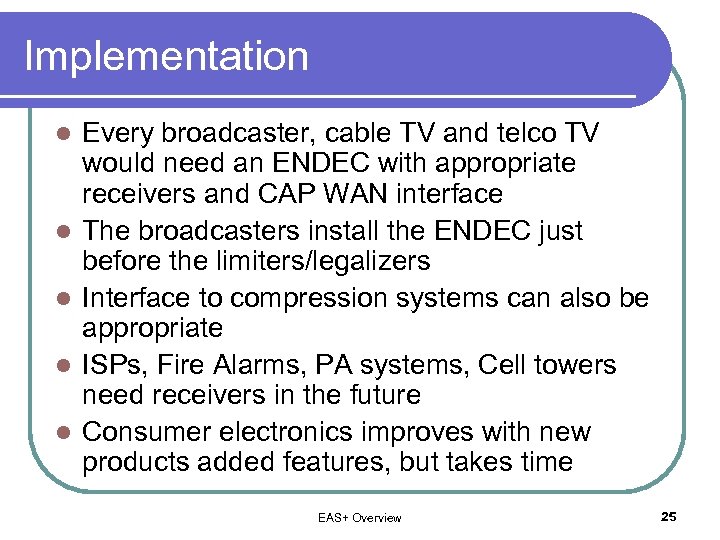
Implementation l l l Every broadcaster, cable TV and telco TV would need an ENDEC with appropriate receivers and CAP WAN interface The broadcasters install the ENDEC just before the limiters/legalizers Interface to compression systems can also be appropriate ISPs, Fire Alarms, PA systems, Cell towers need receivers in the future Consumer electronics improves with new products added features, but takes time EAS+ Overview 25
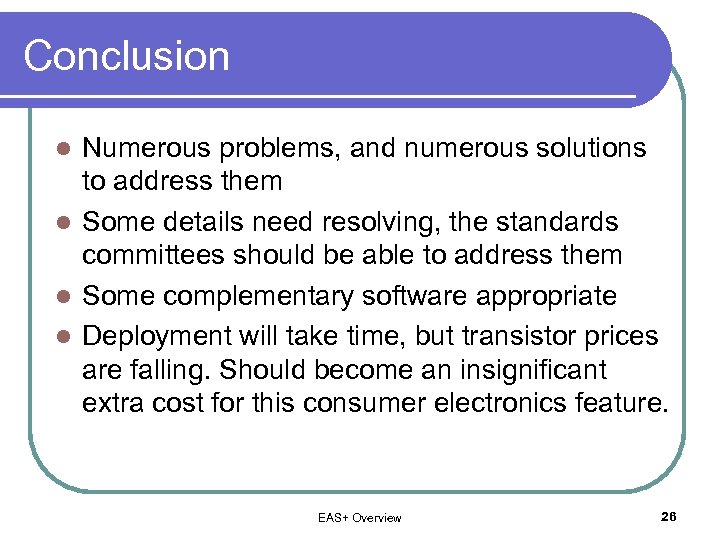
Conclusion Numerous problems, and numerous solutions to address them l Some details need resolving, the standards committees should be able to address them l Some complementary software appropriate l Deployment will take time, but transistor prices are falling. Should become an insignificant extra cost for this consumer electronics feature. l EAS+ Overview 26
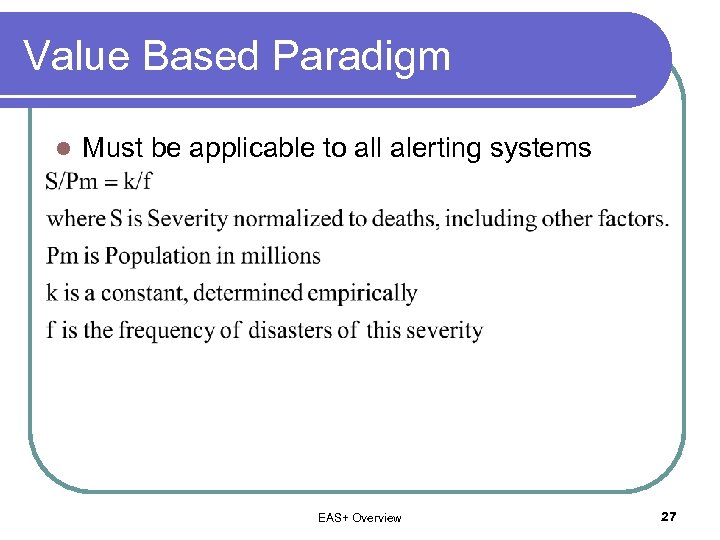
Value Based Paradigm l Must be applicable to all alerting systems EAS+ Overview 27
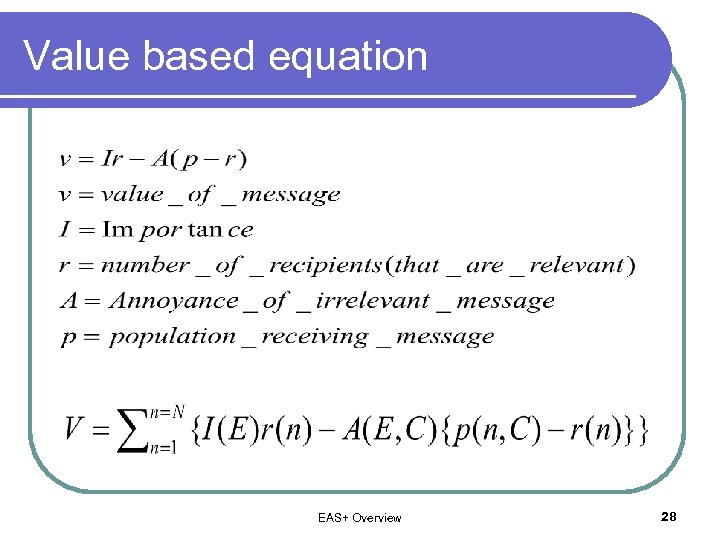
Value based equation EAS+ Overview 28
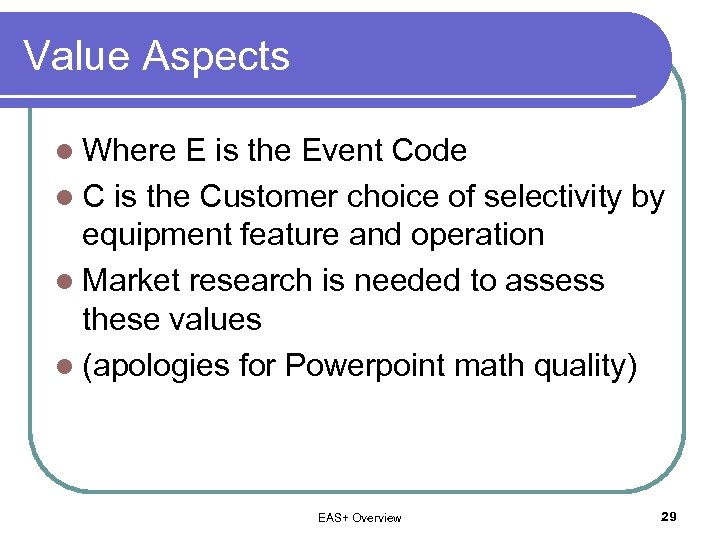
Value Aspects l Where E is the Event Code l C is the Customer choice of selectivity by equipment feature and operation l Market research is needed to assess these values l (apologies for Powerpoint math quality) EAS+ Overview 29
Скачать презентацию EAS Overview Frank W Bell 2009 -2 -4
90e9a0796ab873acdd95669bbe331255.ppt