 Скачать презентацию EARTHQUAKE-JAPAN earthquakes are mostly almost imperceptible and magnitude
Earthquake-Japan.pptx
- Количество слайдов: 6



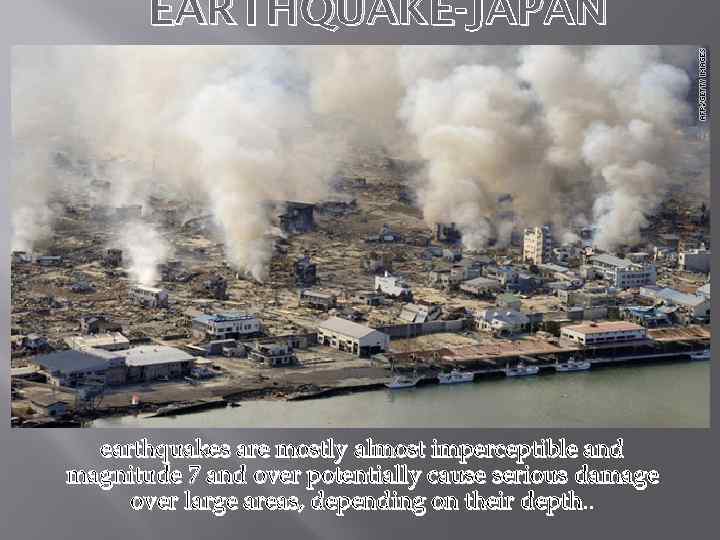
EARTHQUAKE-JAPAN earthquakes are mostly almost imperceptible and magnitude 7 and over potentially cause serious damage over large areas, depending on their depth. . depth
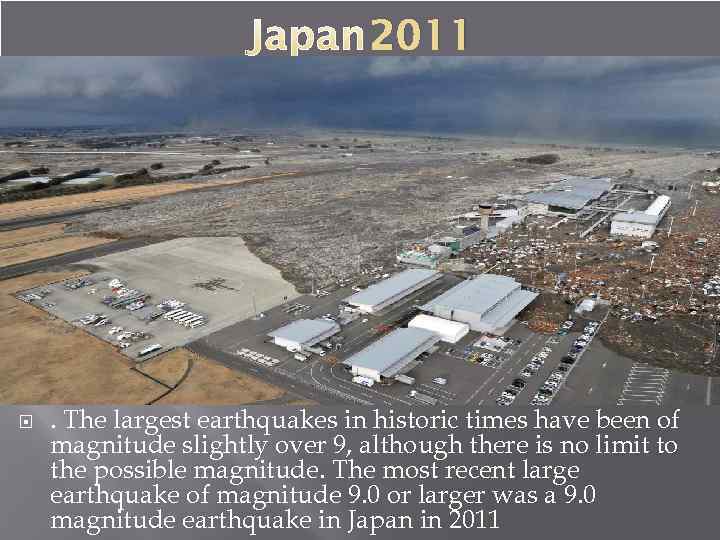
2011 . The largest earthquakes in historic times have been of magnitude slightly over 9, although there is no limit to the possible magnitude. The most recent large earthquake of magnitude 9. 0 or larger was a 9. 0 magnitude earthquake in Japan in 2011
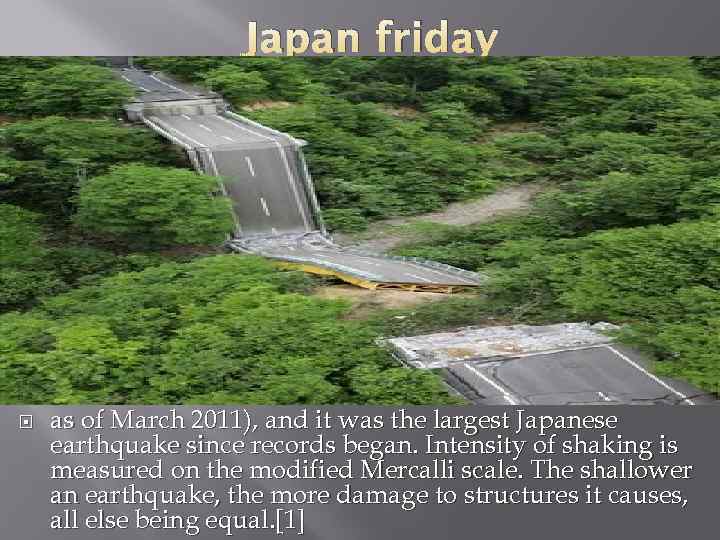
Japan friday as of March 2011), and it was the largest Japanese earthquake since records began. Intensity of shaking is measured on the modified Mercalli scale. The shallower an earthquake, the more damage to structures it causes, all else being equal. [1]
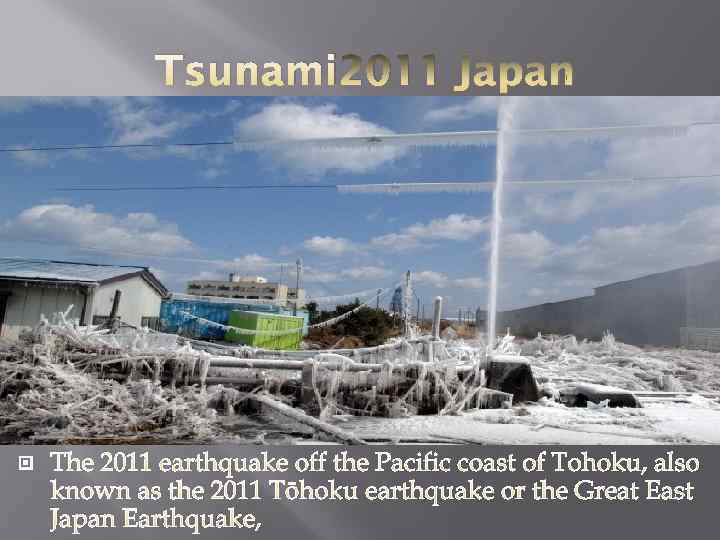
Tsunami 2011 Japan
![5: 46 and 14: 46 (東日本大震災 Higashi Nihon Daishinsai? )[fn 1]) was a magnitude](https://present5.com/presentation/98668827_28688079/image-5.jpg "5: 46 and 14: 46 (東日本大震災 Higashi Nihon Daishinsai? )[fn 1]) was a magnitude")
5: 46 and 14: 46 (東日本大震災 Higashi Nihon Daishinsai? )[fn 1]) was a magnitude 9. 0 (Mw) undersea megathrust earthquake off the coast of Japan that occurred at 14: 46 JST (05: 46 UTC) on Friday, 11 March 2011, [2][3][8] with the epicenter approximately 70 kilometres (43 mi)
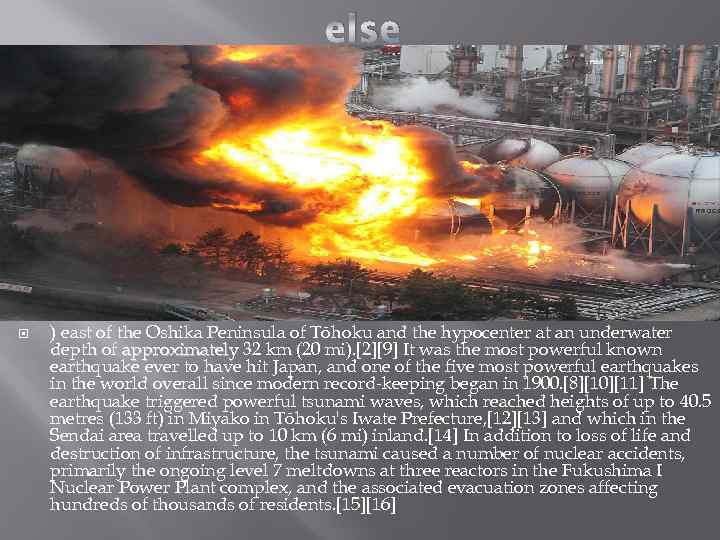
else ) east of the Oshika Peninsula of Tōhoku and the hypocenter at an underwater depth of approximately 32 km (20 mi). [2][9] It was the most powerful known earthquake ever to have hit Japan, and one of the five most powerful earthquakes in the world overall since modern record-keeping began in 1900. [8][10][11] The earthquake triggered powerful tsunami waves, which reached heights of up to 40. 5 metres (133 ft) in Miyako in Tōhoku's Iwate Prefecture, [12][13] and which in the Sendai area travelled up to 10 km (6 mi) inland. [14] In addition to loss of life and destruction of infrastructure, the tsunami caused a number of nuclear accidents, primarily the ongoing level 7 meltdowns at three reactors in the Fukushima I Nuclear Power Plant complex, and the associated evacuation zones affecting hundreds of thousands of residents. [15][16]
Скачать презентацию EARTHQUAKE-JAPAN earthquakes are mostly almost imperceptible and magnitude
Earthquake-Japan.pptx