


 Скачать презентацию Earth System Science Potential Roadmap and Measurement Development
a30d92f30e57529e25f1b89d3ba065cc.ppt
- Количество слайдов: 16
 Earth System Science: Potential Roadmap and Measurement Development Activities April 4, 2005 Note: This material is the latest version for taking 6 science roadmaps, interpreting to science objectives and measurement scenarios. 03 -23 -2005
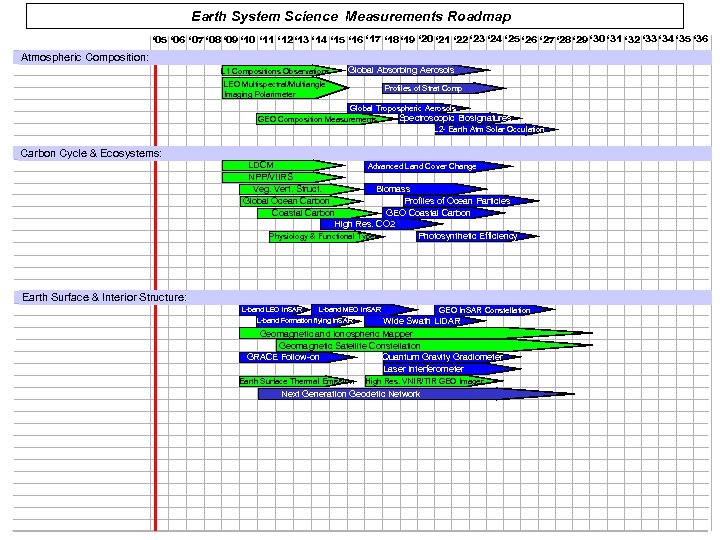 Earth System Science Measurements Roadmap ‘ 05 ‘ 06 ‘ 07 ‘ 08 ‘ 09 ‘ 10 ‘ 11 ‘ 12 ‘ 13 ‘ 14 ‘ 15 ‘ 16 ‘ 17 ‘ 18 ‘ 19 ‘ 20 ‘ 21 ‘ 22 ‘ 23 ‘ 24 ‘ 25 ‘ 26 ‘ 27 ‘ 28 ‘ 29 ‘ 30 ‘ 31 ‘ 32 ‘ 33 ‘ 34 ‘ 35 ‘ 36 Atmospheric Composition: L 1 Compositions Observations Global Absorbing Aerosols LEO Multispectral/Multiangle Imaging Polarimeter Profiles of Strat Comp Global Tropospheric Aerosols Spectroscopic Biosignatures GEO Composition Measurements L 2 - Earth Atm Solar Occulation Carbon Cycle & Ecosystems: OCO LDCM Advanced Land Cover Change NPP/VIIRS Veg. Vert. Struct. Biomass Global Ocean Carbon Profiles of Ocean Particles GEO Coastal Carbon High Res. CO 2 Photosynthetic Efficiency Physiology & Functional Types Earth Surface & Interior Structure: L-band MEO In. SAR L-band LEO In. SAR L-band Formation flying In. SAR Wide GEO In. SAR Constellation Swath LIDAR Geomagnetic and Ionospheric Mapper Geomagnetic Satellite Constellation GRACE Follow-on Quantum Gravity Gradiometer Laser Interferometer Earth Surface Thermal Emission High Res. VNIR/TIR GEO Imager Next Generation Geodetic Network
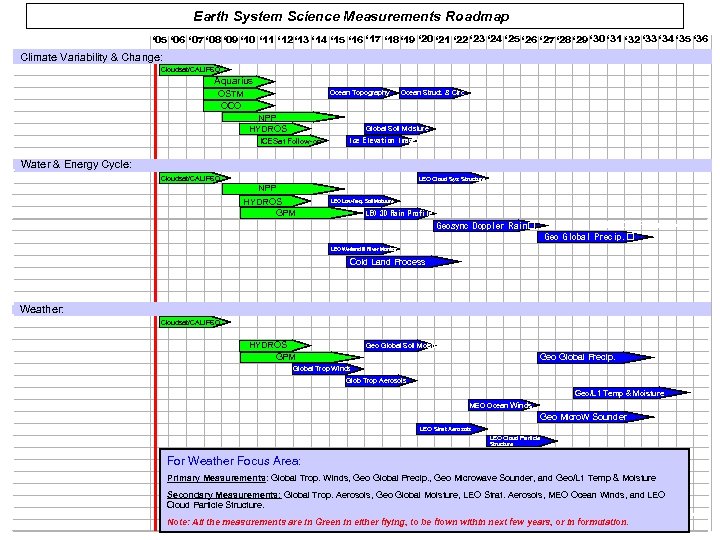 Earth System Science Measurements Roadmap ‘ 05 ‘ 06 ‘ 07 ‘ 08 ‘ 09 ‘ 10 ‘ 11 ‘ 12 ‘ 13 ‘ 14 ‘ 15 ‘ 16 ‘ 17 ‘ 18 ‘ 19 ‘ 20 ‘ 21 ‘ 22 ‘ 23 ‘ 24 ‘ 25 ‘ 26 ‘ 27 ‘ 28 ‘ 29 ‘ 30 ‘ 31 ‘ 32 ‘ 33 ‘ 34 ‘ 35 ‘ 36 Climate Variability & Change: Cloudsat/CALIPSO Aquarius Ocean Topography OSTM OCO NPP HYDROS Ocean Struct. & Circ Global Soil Moisture ICESat Follow-on Ice Elevation Imager Water & Energy Cycle: Cloudsat/CALIPSO LEO Cloud Sys Structure NPP HYDROS GPM LEO Low-freq. Soil Moisture LEO 3 D Rain Profile Geosync Doppler Rain Geo Global Precip. LEO Wetland & River Monitor LEO Sun-sync Earth Surface Mapper Cold Land Process Weather: Cloudsat/CALIPSO HYDROS GPM Geo Global Soil Moisture Geo Global Precip. Global Trop Winds Glob Trop Aerosols Geo/L 1 Temp & Moisture MEO Ocean Winds Geo Micro. W Sounder LEO Strat Aerosols LEO Cloud Particle Structure For Weather Focus Area: Primary Measurements: Global Trop. Winds, Geo Global Precip. , Geo Microwave Sounder, and Geo/L 1 Temp & Moisture Secondary Measurements: Global Trop. Aerosols, Geo Global Moisture, LEO Strat. Aerosols, MEO Ocean Winds, and LEO Cloud Particle Structure. Ocean Color, Salinity Note: All the measurements are in Green in either flying, to be flown within next few years, or in formulation.
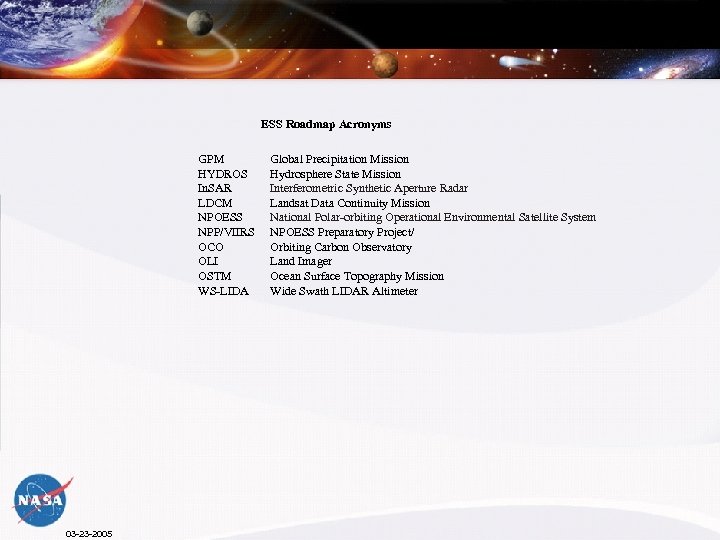 ESS Roadmap Acronyms GPM HYDROS In. SAR LDCM NPOESS NPP/VIIRS OCO OLI OSTM WS-LIDA 03 -23 -2005 Global Precipitation Mission Hydrosphere State Mission Interferometric Synthetic Aperture Radar Landsat Data Continuity Mission National Polar-orbiting Operational Environmental Satellite System NPOESS Preparatory Project/ Orbiting Carbon Observatory Land Imager Ocean Surface Topography Mission Wide Swath LIDAR Altimeter
 Earth Surface and Interior Science Focus Area Lead: John La. Brecque 03 -23 -2005
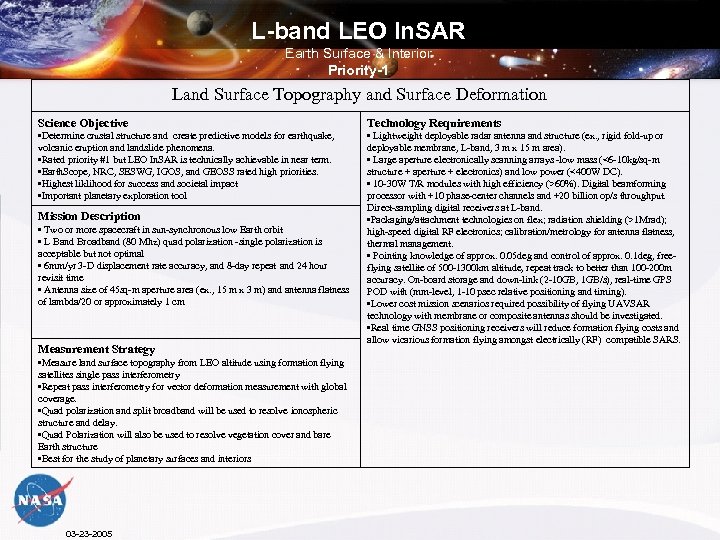 L-band LEO In. SAR Earth Surface & Interior Priority-1 Land Surface Topography and Surface Deformation Science Objective Technology Requirements • Determine crustal structure and create predictive models for earthquake, volcanic eruption and landslide phenomena. • Rated priority #1 but LEO In. SAR is technically achievable in near term. • Earth. Scope, NRC, SESWG, IGOS, and GEOSS rated high priorities. • Highest liklihood for success and societal impact • Important planetary exploration tool • Lightweight deployable radar antenna and structure (ex. , rigid fold-up or deployable membrane, L-band, 3 m x 15 m area). • Large aperture electronically scanning arrays -low mass (<6 -10 kg/sq-m structure + aperture + electronics) and low power (<400 W DC). • 10 -30 W T/R modules with high efficiency (>60%). Digital beamforming processor with +10 phase-center channels and +20 billion op/s throughput. Direct-sampling digital receivers at L-band. • Packaging/attachment technologies on flex; radiation shielding (>1 Mrad); high-speed digital RF electronics; calibration/metrology for antenna flatness, thermal management. • Pointing knowledge of approx. 0. 05 deg and control of approx. 0. 1 deg, freeflying satellite of 500 -1300 km altitude, repeat track to better than 100 -200 m accuracy. On-board storage and down-link (2 -10 GB, 1 GB/s), real-time GPS POD with (mm-level, 1 -10 psec relative positioning and timing). • Lower cost mission scenarios required possibility of flying UAVSAR technology with membrane or composite antennas should be investigated. • Real time GNSS positioning receivers will reduce formation flying costs and allow vicarious formation flying amongst electrically (RF) compatible SARS. Mission Description • Two or more spacecraft in sun-synchronous low Earth orbit • L Band Broadband (80 Mhz) quad polarization -single polarization is acceptable but not optimal • 6 mm/yr 3 -D displacement rate accuracy, and 8 -day repeat and 24 hour revisit time • Antenna size of 45 sq-m aperture area (ex. , 15 m x 3 m) and antenna flatness of lambda/20 or approximately 1 cm Measurement Strategy • Measure land surface topography from LEO altitude using formation flying satellites single pass interferometry • Repeat pass interferometry for vector deformation measurement with global coverage. • Quad polarization and split broadband will be used to resolve ionospheric structure and delay. • Quad Polarization will also be used to resolve vegetation cover and bare Earth structure • Best for the study of planetary surfaces and interiors 03 -23 -2005
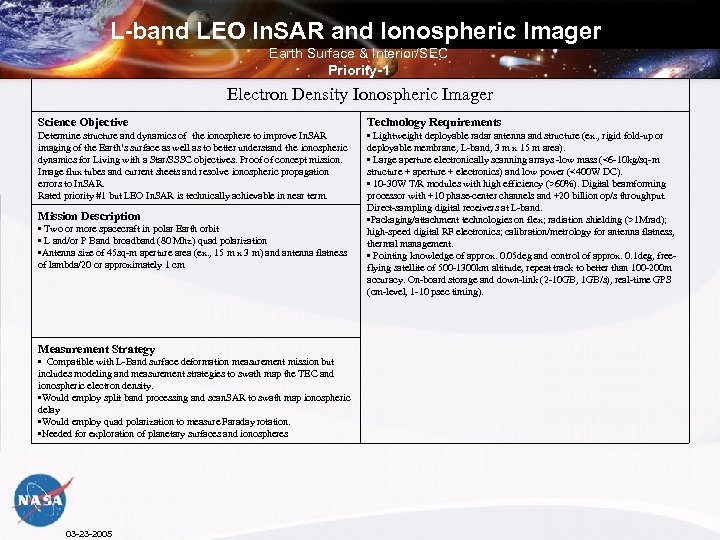 L-band LEO In. SAR and Ionospheric Imager Earth Surface & Interior/SEC Priority-1 Electron Density Ionospheric Imager Science Objective Technology Requirements Determine structure and dynamics of the ionosphere to improve In. SAR imaging of the Earth’s surface as well as to better understand the ionospheric dynamics for Living with a Star/SSSC objectives. Proof of concept mission. Image flux tubes and current sheets and resolve ionospheric propagation errors to In. SAR. Rated priority #1 but LEO In. SAR is technically achievable in near term. • Lightweight deployable radar antenna and structure (ex. , rigid fold-up or deployable membrane, L-band, 3 m x 15 m area). • Large aperture electronically scanning arrays -low mass (<6 -10 kg/sq-m structure + aperture + electronics) and low power (<400 W DC). • 10 -30 W T/R modules with high efficiency (>60%). Digital beamforming processor with +10 phase-center channels and +20 billion op/s throughput. Direct-sampling digital receivers at L-band. • Packaging/attachment technologies on flex; radiation shielding (>1 Mrad); high-speed digital RF electronics; calibration/metrology for antenna flatness, thermal management. • Pointing knowledge of approx. 0. 05 deg and control of approx. 0. 1 deg, freeflying satellite of 500 -1300 km altitude, repeat track to better than 100 -200 m accuracy. On-board storage and down-link (2 -10 GB, 1 GB/s), real-time GPS (cm-level, 1 -10 psec timing). Mission Description • Two or more spacecraft in polar Earth orbit • L and/or P Band broadband (80 Mhz) quad polarization • Antenna size of 45 sq-m aperture area (ex. , 15 m x 3 m) and antenna flatness of lambda/20 or approximately 1 cm Measurement Strategy • Compatible with L-Band surface deformation measurement mission but includes modeling and measurement strategies to swath map the TEC and ionospheric electron density. • Would employ split band processing and scan. SAR to swath map ionospheric delay • Would employ quad polarization to measure Faraday rotation. • Needed for exploration of planetary surfaces and ionospheres 03 -23 -2005
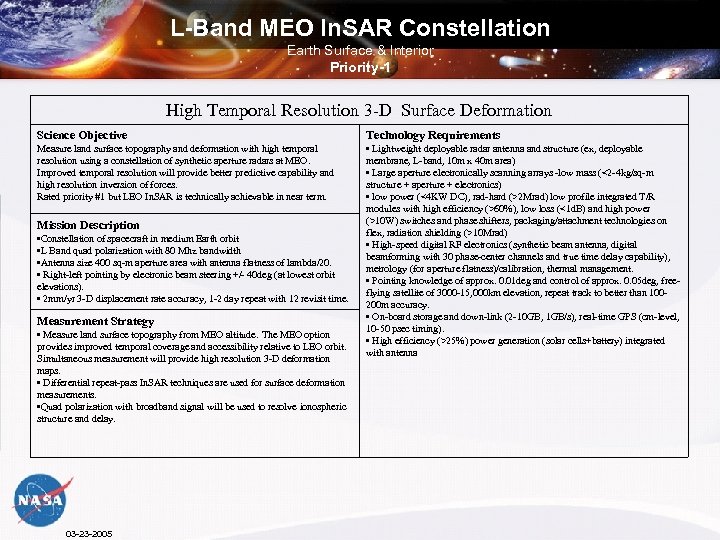 L-Band MEO In. SAR Constellation Earth Surface & Interior Priority-1 High Temporal Resolution 3 -D Surface Deformation Science Objective Technology Requirements Measure land surface topography and deformation with high temporal resolution using a constellation of synthetic aperture radars at MEO. Improved temporal resolution will provide better predictive capability and high resolution inversion of forces. Rated priority #1 but LEO In. SAR is technically achievable in near term. • Lightweight deployable radar antenna and structure (ex, deployable membrane, L-band, 10 m x 40 m area) • Large aperture electronically scanning arrays -low mass (<2 -4 kg/sq-m structure + aperture + electronics) • low power (<4 KW DC), rad-hard (>2 Mrad) low profile integrated T/R modules with high efficiency (>60%), low loss (<1 d. B) and high power (>10 W) switches and phase shifters, packaging/attachment technologies on flex, radiation shielding (>10 Mrad) • High-speed digital RF electronics (synthetic beam antenna, digital beamforming with 30 phase-center channels and true time delay capability), metrology (for aperture flatness)/calibration, thermal management. • Pointing knowledge of approx. 0. 01 deg and control of approx. 0. 05 deg, freeflying satellite of 3000 -15, 000 km elevation, repeat track to better than 100200 m accuracy. • On-board storage and down-link (2 -10 GB, 1 GB/s), real-time GPS (cm-level, 10 -50 psec timing). • High efficiency (>25%) power generation (solar cells+battery) integrated with antenna Mission Description • Constellation of spacecraft in medium Earth orbit • L Band quad polarization with 80 Mhz bandwidth • Antenna size 400 sq-m aperture area with antenna flatness of lambda/20. • Right-left pointing by electronic beam steering +/- 40 deg (at lowest orbit elevations). • 2 mm/yr 3 -D displacement rate accuracy, 1 -2 day repeat with 12 revisit time. Measurement Strategy • Measure land surface topography from MEO altitude. The MEO option provides improved temporal coverage and accessibility relative to LEO orbit. Simultaneous measurement will provide high resolution 3 -D deformation maps. • Differential repeat-pass In. SAR techniques are used for surface deformation measurements. • Quad polarization with broadband signal will be used to resolve ionospheric structure and delay. 03 -23 -2005
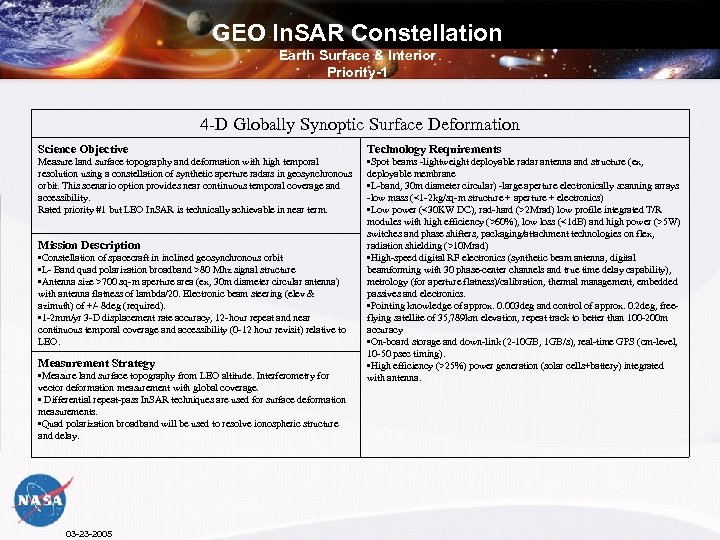 GEO In. SAR Constellation Earth Surface & Interior Priority-1 4 -D Globally Synoptic Surface Deformation Science Objective Technology Requirements Measure land surface topography and deformation with high temporal resolution using a constellation of synthetic aperture radars in geosynchronous orbit. This scenario option provides near continuous temporal coverage and accessibility. Rated priority #1 but LEO In. SAR is technically achievable in near term. • Spot beams -lightweight deployable radar antenna and structure (ex, deployable membrane • L-band, 30 m diameter circular) -large aperture electronically scanning arrays -low mass (<1 -2 kg/sq-m structure + aperture + electronics) • Low power (<30 KW DC), rad-hard (>2 Mrad) low profile integrated T/R modules with high efficiency (>60%), low loss (<1 d. B) and high power (>5 W) switches and phase shifters, packaging/attachment technologies on flex, radiation shielding (>10 Mrad) • High-speed digital RF electronics (synthetic beam antenna, digital beamforming with 30 phase-center channels and true time delay capability), metrology (for aperture flatness)/calibration, thermal management, embedded passives and electronics. • Pointing knowledge of approx. 0. 003 deg and control of approx. 0. 2 deg, freeflying satellite of 35, 789 km elevation, repeat track to better than 100 -200 m accuracy • On-board storage and down-link (2 -10 GB, 1 GB/s), real-time GPS (cm-level, 10 -50 psec timing). • High efficiency (>25%) power generation (solar cells+battery) integrated with antenna. Mission Description • Constellation of spacecraft in inclined geosynchronous orbit • L- Band quad polarization broadband >80 Mhz signal structure • Antenna size >700 sq-m aperture area (ex, 30 m diameter circular antenna) with antenna flatness of lambda/20. Electronic beam steering (elev & azimuth) of +/- 8 deg (required). • 1 -2 mm/yr 3 -D displacement rate accuracy, 12 -hour repeat and near continuous temporal coverage and accessibility (0 -12 hour revisit) relative to LEO. Measurement Strategy • Measure land surface topography from LEO altitude. Interferometry for vector deformation measurement with global coverage. • Differential repeat-pass In. SAR techniques are used for surface deformation measurements. • Quad polarization broadband will be used to resolve ionospheric structure and delay. 03 -23 -2005
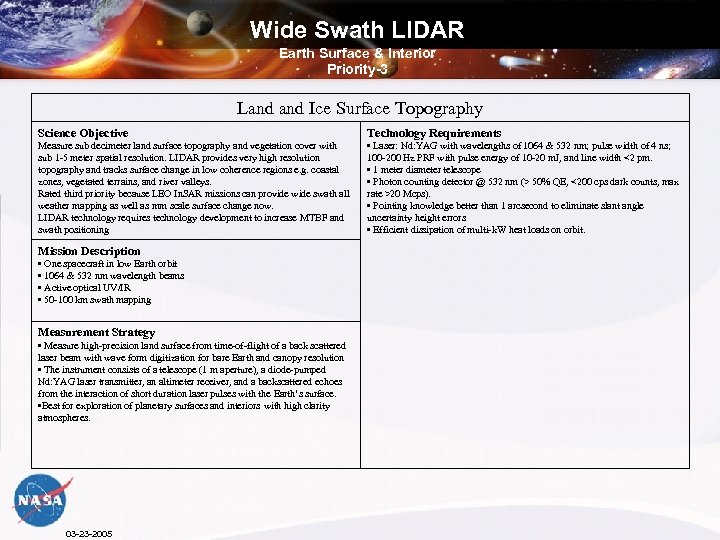 Wide Swath LIDAR Earth Surface & Interior Priority-3 Land Ice Surface Topography Science Objective Technology Requirements Measure sub decimeter land surface topography and vegetation cover with sub 1 -5 meter spatial resolution. LIDAR provides very high resolution topography and tracks surface change in low coherence regions e. g. coastal zones, vegetated terrains, and river valleys. Rated third priority because LEO In. SAR missions can provide wide swath all weather mapping as well as mm scale surface change now. LIDAR technology requires technology development to increase MTBF and swath positioning • Laser: Nd: YAG with wavelengths of 1064 & 532 nm; pulse width of 4 ns; 100 -200 Hz PRF with pulse energy of 10 -20 m. J, and line width <2 pm. • 1 meter diameter telescope • Photon counting detector @ 532 nm (> 50% QE, <200 cps dark counts, max rate >20 Mcps). • Pointing knowledge better than 1 arcsecond to eliminate slant angle uncertainty height errors • Efficient dissipation of multi-k. W heat loads on orbit. Mission Description • One spacecraft in low Earth orbit • 1064 & 532 nm wavelength beams • Active optical UV/IR • 50 -100 km swath mapping Measurement Strategy • Measure high-precision land surface from time-of-flight of a back scattered laser beam with wave form digitization for bare Earth and canopy resolution • The instrument consists of a telescope (1 m aperture), a diode-pumped Nd: YAG laser transmitter, an altimeter receiver, and a backscattered echoes from the interaction of short duration laser pulses with the Earth’s surface. • Best for exploration of planetary surfaces and interiors with high clarity atmospheres. 03 -23 -2005
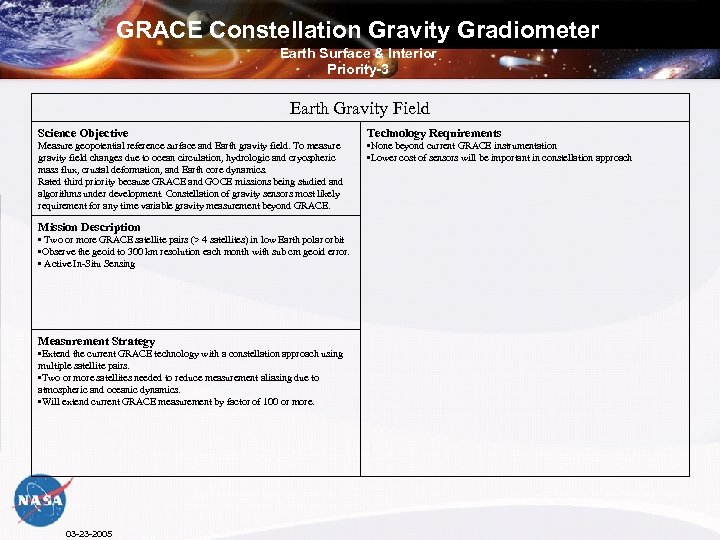 GRACE Constellation Gravity Gradiometer Earth Surface & Interior Priority-3 Earth Gravity Field Science Objective Technology Requirements Measure geopotential reference surface and Earth gravity field. To measure gravity field changes due to ocean circulation, hydrologic and cryospheric mass flux, crustal deformation, and Earth core dynamics. Rated third priority because GRACE and GOCE missions being studied and algorithms under development. Constellation of gravity sensors most likely requirement for any time variable gravity measurement beyond GRACE. • None beyond current GRACE instrumentation • Lower cost of sensors will be important in constellation approach Mission Description • Two or more GRACE satellite pairs (> 4 satellites) in low Earth polar orbit • Observe the geoid to 300 km resolution each month with sub cm geoid error. • Active In-Situ Sensing Measurement Strategy • Extend the current GRACE technology with a constellation approach using multiple satellite pairs. • Two or more satellites needed to reduce measurement aliasing due to atmospheric and oceanic dynamics. • Will extend current GRACE measurement by factor of 100 or more. 03 -23 -2005
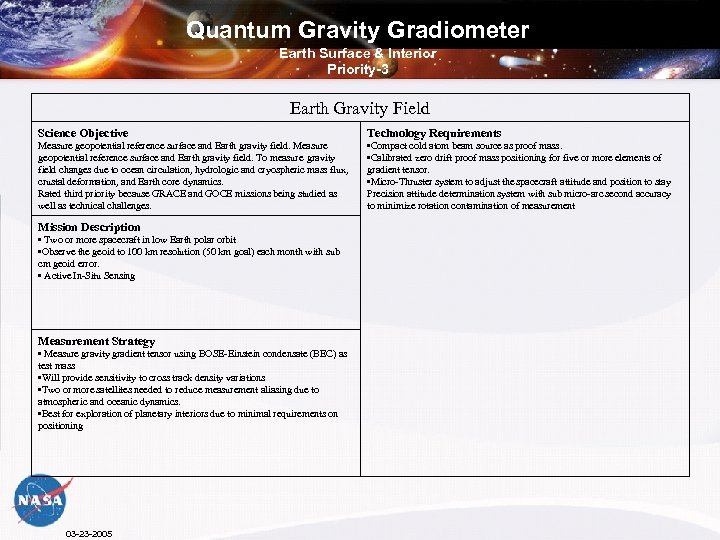 Quantum Gravity Gradiometer Earth Surface & Interior Priority-3 Earth Gravity Field Science Objective Technology Requirements Measure geopotential reference surface and Earth gravity field. To measure gravity field changes due to ocean circulation, hydrologic and cryospheric mass flux, crustal deformation, and Earth core dynamics. Rated third priority because GRACE and GOCE missions being studied as well as technical challenges. • Compact cold atom beam source as proof mass. • Calibrated zero drift proof mass positioning for five or more elements of gradient tensor. • Micro-Thruster system to adjust the spacecraft attitude and position to stay Precision attitude determination system with sub micro-arc second accuracy to minimize rotation contamination of measurement Mission Description • Two or more spacecraft in low Earth polar orbit • Observe the geoid to 100 km resolution (50 km goal) each month with sub cm geoid error. • Active In-Situ Sensing Measurement Strategy • Measure gravity gradient tensor using BOSE-Einstein condensate (BEC) as test mass • Will provide sensitivity to cross track density variations • Two or more satellites needed to reduce measurement aliasing due to atmospheric and oceanic dynamics. • Best for exploration of planetary interiors due to minimal requirements on positioning 03 -23 -2005
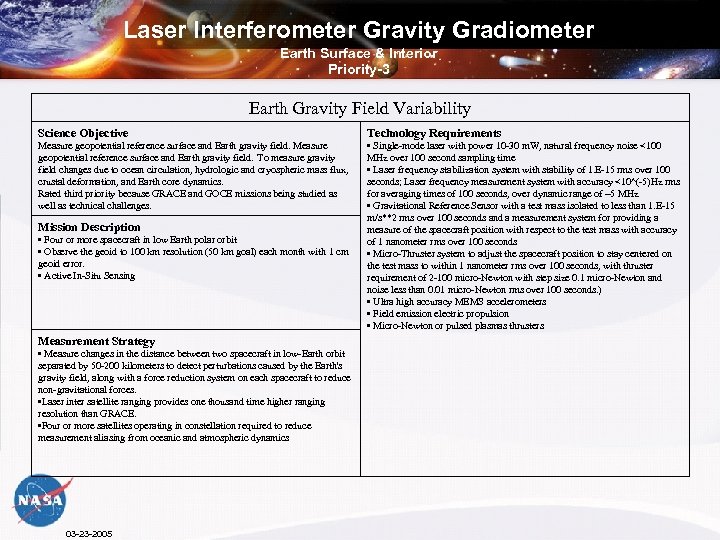 Laser Interferometer Gravity Gradiometer Earth Surface & Interior Priority-3 Earth Gravity Field Variability Science Objective Technology Requirements Measure geopotential reference surface and Earth gravity field. To measure gravity field changes due to ocean circulation, hydrologic and cryospheric mass flux, crustal deformation, and Earth core dynamics. Rated third priority because GRACE and GOCE missions being studied as well as technical challenges. • Single-mode laser with power 10 -30 m. W, natural frequency noise <100 MHz over 100 second sampling time • Laser frequency stabilization system with stability of 1. E-15 rms over 100 seconds; Laser frequency measurement system with accuracy <10^(-5)Hz rms for averaging times of 100 seconds, over dynamic range of ~5 MHz • Gravitational Reference Sensor with a test mass isolated to less than 1. E-15 m/s**2 rms over 100 seconds and a measurement system for providing a measure of the spacecraft position with respect to the test mass with accuracy of 1 nanometer rms over 100 seconds • Micro-Thruster system to adjust the spacecraft position to stay centered on the test mass to within 1 nanometer rms over 100 seconds, with thruster requirement of 2 -100 micro-Newton with step size 0. 1 micro-Newton and noise less than 0. 01 micro-Newton rms over 100 seconds. ) • Ultra high accuracy MEMS accelerometers • Field emission electric propulsion • Micro-Newton or pulsed plasmas thrusters Mission Description • Four or more spacecraft in low Earth polar orbit • Observe the geoid to 100 km resolution (50 km goal) each month with 1 cm geoid error. • Active In-Situ Sensing Measurement Strategy • Measure changes in the distance between two spacecraft in low-Earth orbit separated by 50 -200 kilometers to detect perturbations caused by the Earth's gravity field, along with a force reduction system on each spacecraft to reduce non-gravitational forces. • Laser inter satellite ranging provides one thousand time higher ranging resolution than GRACE. • Four or more satellites operating in constellation required to reduce measurement aliasing from oceanic and atmospheric dynamics 03 -23 -2005
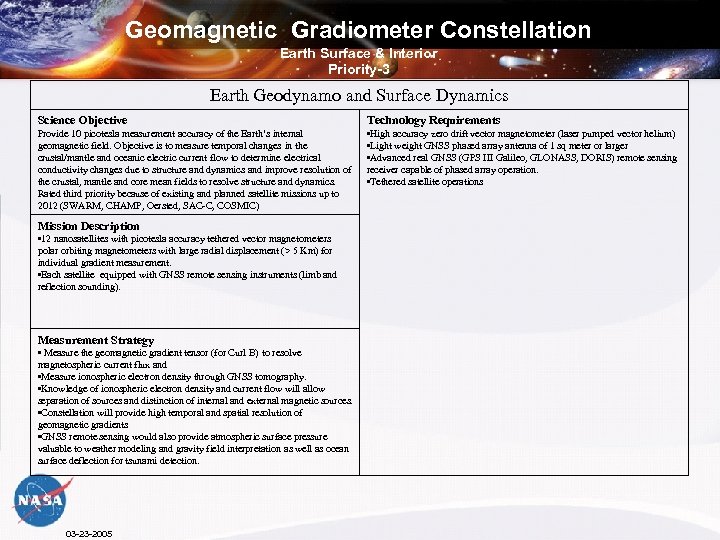 Geomagnetic Gradiometer Constellation Earth Surface & Interior Priority-3 Earth Geodynamo and Surface Dynamics Science Objective Technology Requirements Provide 10 picotesla measurement accuracy of the Earth’s internal geomagnetic field. Objective is to measure temporal changes in the crustal/mantle and oceanic electric current flow to determine electrical conductivity changes due to structure and dynamics and improve resolution of the crustal, mantle and core mean fields to resolve structure and dynamics. Rated third priority because of existing and planned satellite missions up to 2012 (SWARM, CHAMP, Oersted, SAC-C, COSMIC) • High accuracy zero drift vector magnetometer (laser pumped vector helium) • Light weight GNSS phased array antenna of 1 sq meter or larger • Advanced real GNSS (GPS III Galileo, GLONASS, DORIS) remote sensing receiver capable of phased array operation. • Tethered satellite operations Mission Description • 12 nanosatellites with picotesla accuracy tethered vector magnetometers polar orbiting magnetometers with large radial displacement (> 5 Km) for individual gradient measurement. • Each satellite equipped with GNSS remote sensing instruments (limb and reflection sounding). Measurement Strategy • Measure the geomagnetic gradient tensor (for Curl B) to resolve magnetospheric current flux and • Measure ionospheric electron density through GNSS tomography. • Knowledge of ionospheric electron density and current flow will allow separation of sources and distinction of internal and external magnetic sources. • Constellation will provide high temporal and spatial resolution of geomagnetic gradients • GNSS remote sensing would also provide atmospheric surface pressure valuable to weather modeling and gravity field interpretation as well as ocean surface deflection for tsunami detection. 03 -23 -2005
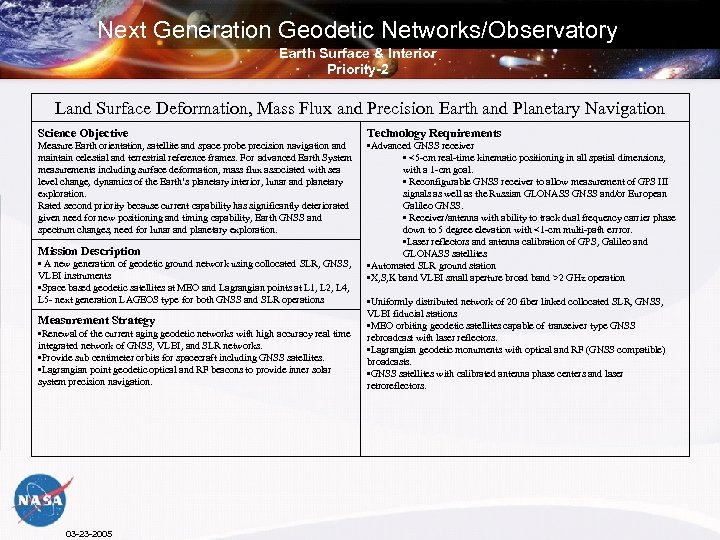 Next Generation Geodetic Networks/Observatory Earth Surface & Interior Priority-2 Land Surface Deformation, Mass Flux and Precision Earth and Planetary Navigation Science Objective Technology Requirements Measure Earth orientation, satellite and space probe precision navigation and maintain celestial and terrestrial reference frames. For advanced Earth System measurements including surface deformation, mass flux associated with sea level change, dynamics of the Earth’s planetary interior, lunar and planetary exploration. Rated second priority because current capability has significantly deteriorated given need for new positioning and timing capability, Earth GNSS and spectrum changes, need for lunar and planetary exploration. • Advanced GNSS receiver • <5 -cm real-time kinematic positioning in all spatial dimensions, with a 1 -cm goal. • Reconfigurable GNSS receiver to allow measurement of GPS III signals as well as the Russian GLONASS GNSS and/or European Galileo GNSS. • Receiver/antenna with ability to track dual frequency carrier phase down to 5 degree elevation with <1 -cm multi-path errror. • Laser reflectors and antenna calibration of GPS, Galileo and GLONASS satellites • Automated SLR ground station • X, S, K band VLBI small aperture broad band >2 GHz operation Mission Description • A new generation of geodetic ground network using collocated SLR, GNSS, VLBI instruments • Space based geodetic satellites at MEO and Lagrangian points at L 1, L 2, L 4, L 5 - next generation LAGEOS type for both GNSS and SLR operations Measurement Strategy • Renewal of the current aging geodetic networks with high accuracy real time integrated network of GNSS, VLBI, and SLR networks. • Provide sub centimeter orbits for spacecraft including GNSS satellites. • Lagrangian point geodetic optical and RF beacons to provide inner solar system precision navigation. 03 -23 -2005 • Uniformly distributed network of 20 fiber linked collocated SLR, GNSS, VLBI fiducial stations • MEO orbiting geodetic satellites capable of transeiver type GNSS rebroadcast with laser reflectors. • Lagrangian geodetic monuments with optical and RF (GNSS compatible) broadcasts. • GNSS satellites with calibrated antenna phase centers and laser retroreflectors.
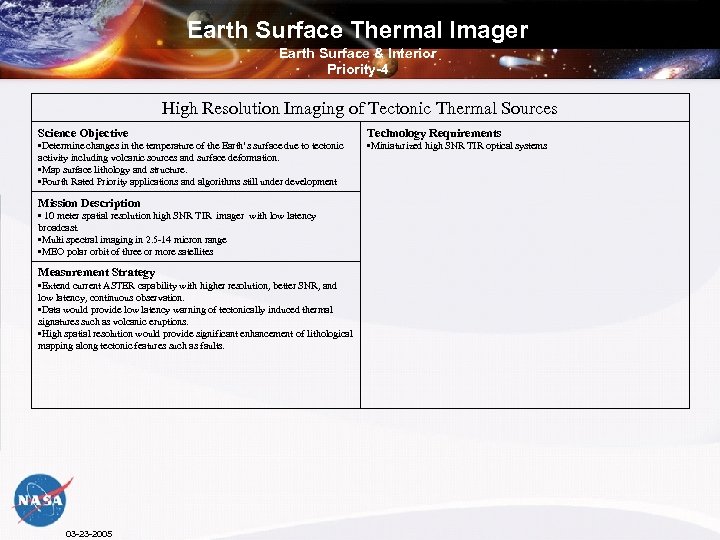 Earth Surface Thermal Imager Earth Surface & Interior Priority-4 High Resolution Imaging of Tectonic Thermal Sources Science Objective Technology Requirements • Determine changes in the temperature of the Earth’s surface due to tectonic activity including volcanic sources and surface deformation. • Map surface lithology and structure. • Fourth Rated Priority applications and algorithms still under development • Miniaturized high SNR TIR optical systems Mission Description • 10 meter spatial resolution high SNR TIR imager with low latency broadcast. • Multi spectral imaging in 2. 5 -14 micron range • MEO polar orbit of three or more satellites Measurement Strategy • Extend current ASTER capability with higher resolution, better SNR, and low latency, continuous observation. • Data would provide low latency warning of tectonically induced thermal signatures such as volcanic eruptions. • High spatial resolution would provide significant enhancement of lithological mapping along tectonic features such as faults. 03 -23 -2005