


 Скачать презентацию Earth-Sun System Division National Aeronautics and Space Administration
9b98ed3a79e23d4455e46c96de15746a.ppt
- Количество слайдов: 32
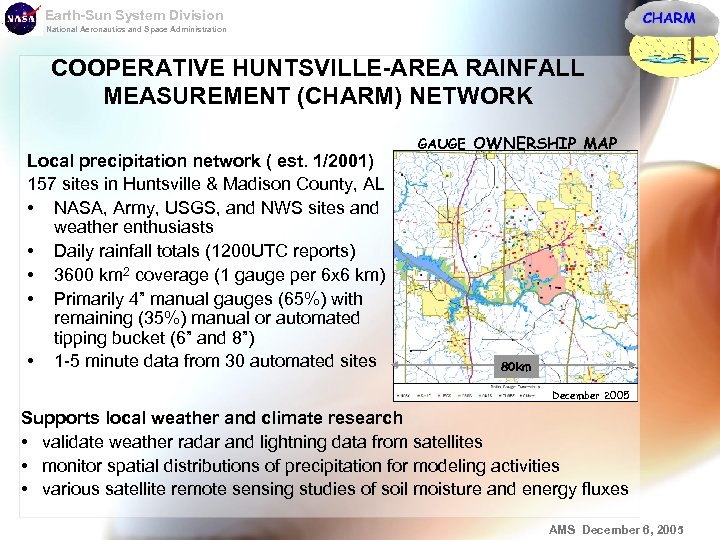 Earth-Sun System Division National Aeronautics and Space Administration COOPERATIVE HUNTSVILLE-AREA RAINFALL MEASUREMENT (CHARM) NETWORK Local precipitation network ( est. 1/2001) 157 sites in Huntsville & Madison County, AL • NASA, Army, USGS, and NWS sites and weather enthusiasts • Daily rainfall totals (1200 UTC reports) • 3600 km 2 coverage (1 gauge per 6 x 6 km) • Primarily 4” manual gauges (65%) with remaining (35%) manual or automated tipping bucket (6” and 8”) • 1 -5 minute data from 30 automated sites GAUGE OWNERSHIP MAP 80 km December 2005 Supports local weather and climate research • validate weather radar and lightning data from satellites • monitor spatial distributions of precipitation for modeling activities • various satellite remote sensing studies of soil moisture and energy fluxes AMS December 6, 2005
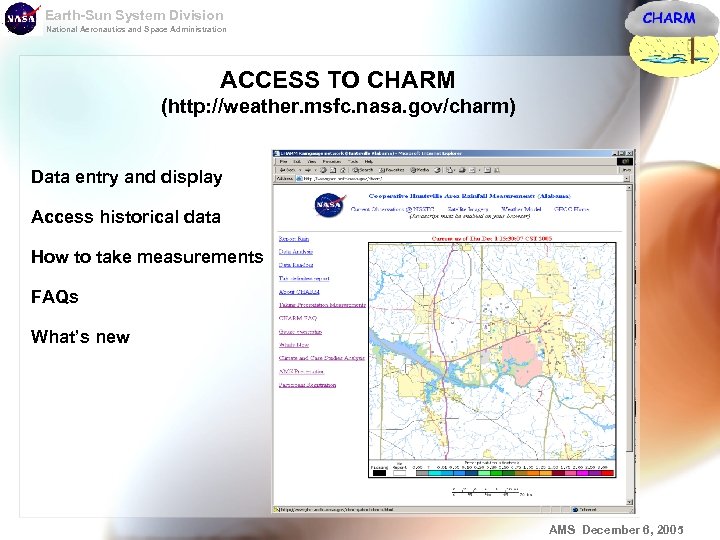 Earth-Sun System Division National Aeronautics and Space Administration ACCESS TO CHARM (http: //weather. msfc. nasa. gov/charm) Data entry and display Access historical data How to take measurements FAQs What’s new AMS December 6, 2005
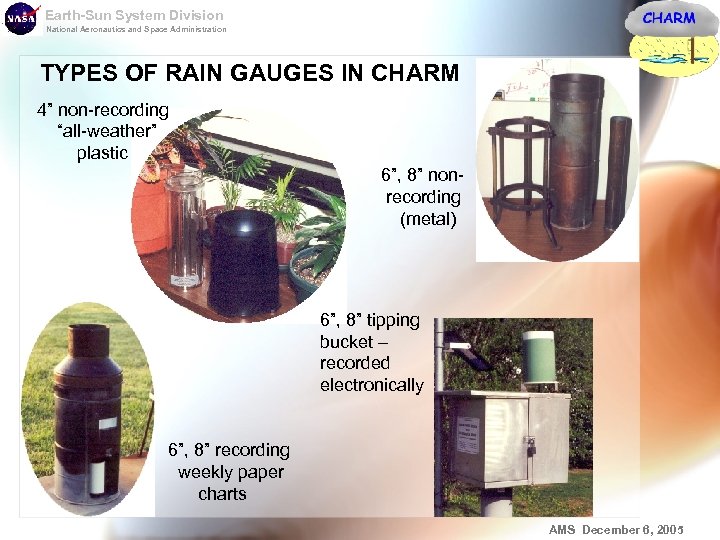 Earth-Sun System Division National Aeronautics and Space Administration TYPES OF RAIN GAUGES IN CHARM 4” non-recording “all-weather” plastic 6”, 8” nonrecording (metal) 6”, 8” tipping bucket – recorded electronically 6”, 8” recording weekly paper charts AMS December 6, 2005
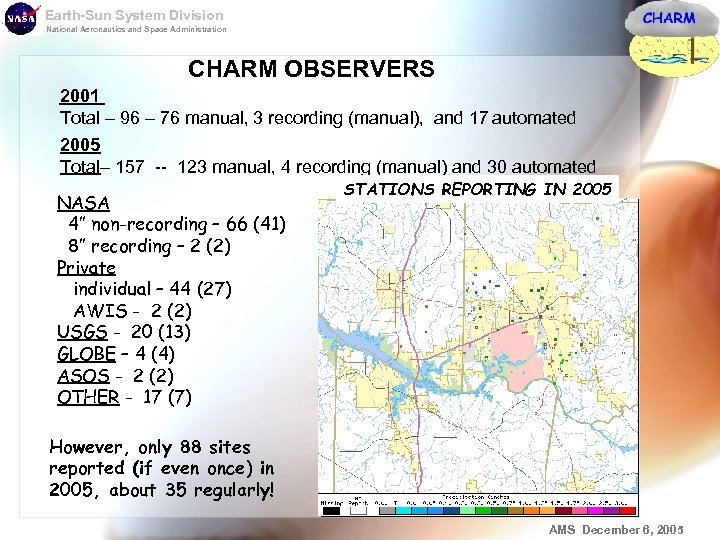 Earth-Sun System Division National Aeronautics and Space Administration CHARM OBSERVERS 2001 Total – 96 – 76 manual, 3 recording (manual), and 17 automated 2005 Total– 157 -- 123 manual, 4 recording (manual) and 30 automated GAUGE OWNERSHIP MAP STATIONS REPORTING IN 2005 NASA 4” non-recording – 66 (41) 8” recording – 2 (2) Private individual – 44 (27) AWIS - 2 (2) USGS - 20 (13) GLOBE – 4 (4) ASOS - 2 (2) OTHER - 17 (7) However, only 88 sites reported (if even once) in 2005, about 35 regularly! December 2005 2001 December AMS December 6, 2005
 Earth-Sun System Division National Aeronautics and Space Administration USE AND APPLICATIONS CHARM 86 – supported NASA meteorological experiment over Huntsville Existing measurements systems Aldridge Creek flood of 1999 Flooding of the AXAF clean room out at MSFC (1997) Environmental studies for MSFC Redstone Arsenal CHARM observations are part of the NWS (SHEF) data stream – LMRFC (Slidell) and SERFC (Atlanta) for hydrological studies – Local WFOs (HUN) Satellite and ground based (radar) intercomparison studies Short-term precipitation climatology studies AMS December 6, 2005
 Earth-Sun System Division National Aeronautics and Space Administration CHARM data has been used to validate forecast model estimates of precipitation AMS December 6, 2005
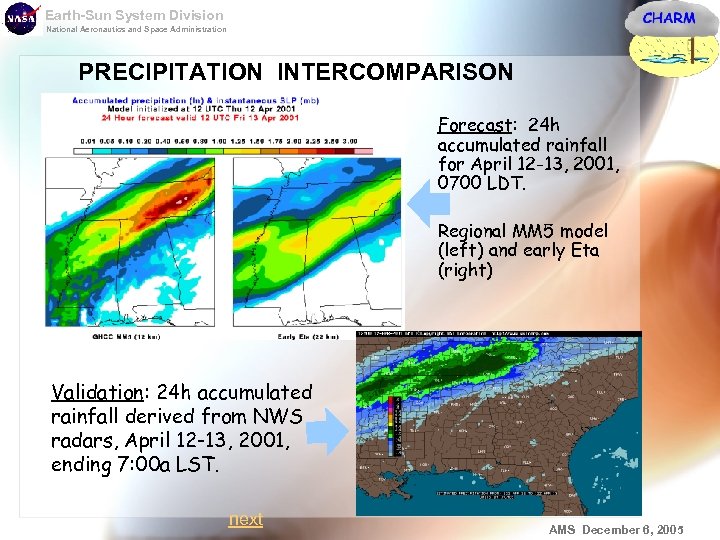 Earth-Sun System Division National Aeronautics and Space Administration PRECIPITATION INTERCOMPARISON Forecast: 24 h accumulated rainfall for April 12 -13, 2001, 0700 LDT. Regional MM 5 model (left) and early Eta (right) Validation: 24 h accumulated rainfall derived from NWS radars, April 12 -13, 2001, ending 7: 00 a LST. next AMS December 6, 2005
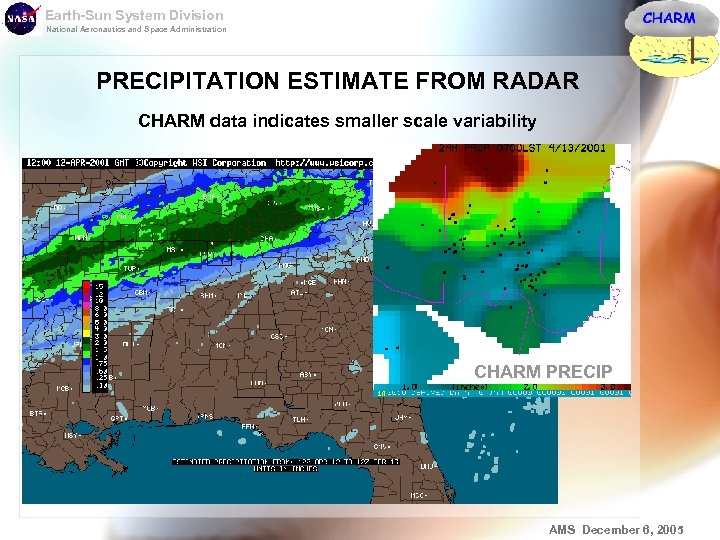 Earth-Sun System Division National Aeronautics and Space Administration PRECIPITATION ESTIMATE FROM RADAR CHARM data indicates smaller scale variability CHARM PRECIP AMS December 6, 2005
 Earth-Sun System Division National Aeronautics and Space Administration CHARM data has been used to validate radar estimates of precipitation AMS December 6, 2005
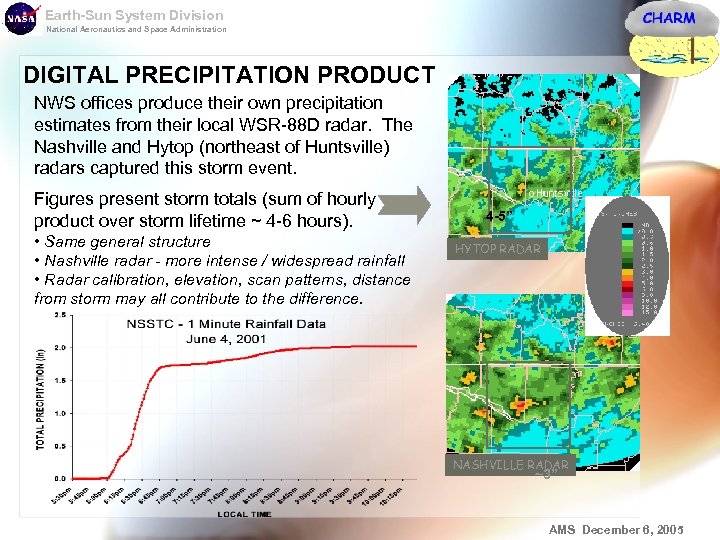 Earth-Sun System Division National Aeronautics and Space Administration DIGITAL PRECIPITATION PRODUCT NWS offices produce their own precipitation estimates from their local WSR-88 D radar. The Nashville and Hytop (northeast of Huntsville) radars captured this storm event. Figures present storm totals (sum of hourly product over storm lifetime ~ 4 -6 hours). • Same general structure • Nashville radar - more intense / widespread rainfall • Radar calibration, elevation, scan patterns, distance from storm may all contribute to the difference. 4 -5” HYTOP RADAR NASHVILLE RADAR ~3” AMS December 6, 2005
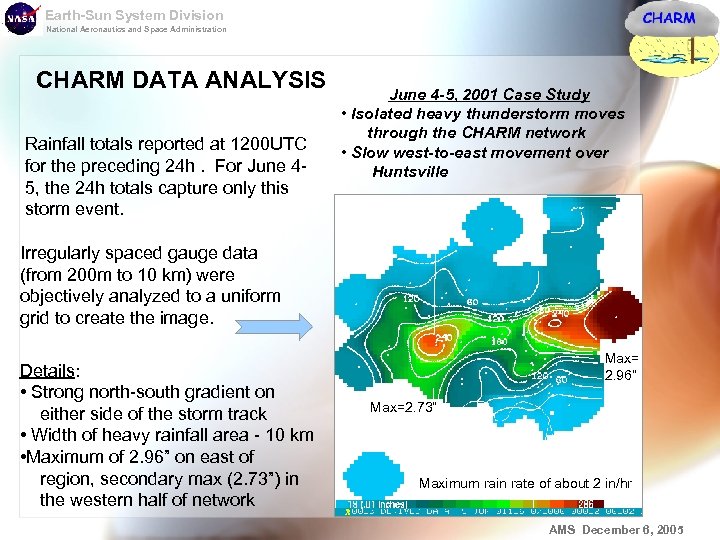 Earth-Sun System Division National Aeronautics and Space Administration CHARM DATA ANALYSIS Rainfall totals reported at 1200 UTC for the preceding 24 h. For June 45, the 24 h totals capture only this storm event. June 4 -5, 2001 Case Study • Isolated heavy thunderstorm moves through the CHARM network • Slow west-to-east movement over Huntsville Irregularly spaced gauge data (from 200 m to 10 km) were objectively analyzed to a uniform grid to create the image. Details: • Strong north-south gradient on either side of the storm track • Width of heavy rainfall area - 10 km • Maximum of 2. 96” on east of region, secondary max (2. 73”) in the western half of network Max= 2. 96” Max=2. 73” Maximum rain rate of about 2 in/hr AMS December 6, 2005
 Earth-Sun System Division National Aeronautics and Space Administration CHARM data has been used to verify and enhance special rainfall products used for climate studies AMS December 6, 2005
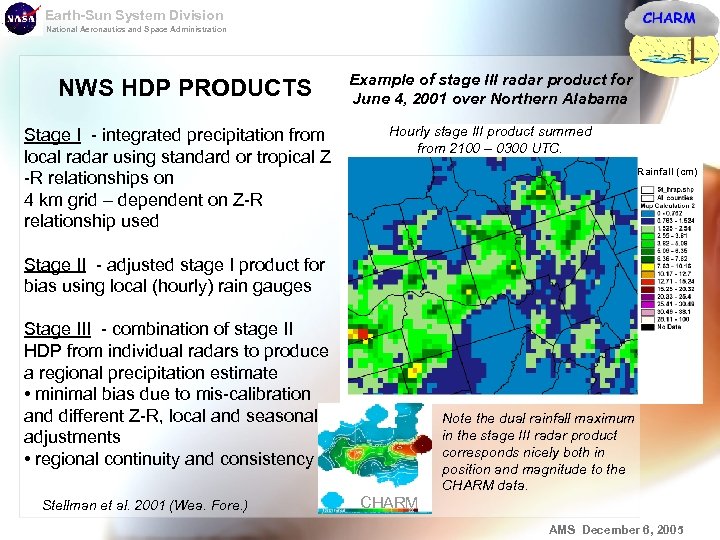 Earth-Sun System Division National Aeronautics and Space Administration NWS HDP PRODUCTS Stage I - integrated precipitation from local radar using standard or tropical Z -R relationships on 4 km grid – dependent on Z-R relationship used Example of stage III radar product for June 4, 2001 over Northern Alabama Hourly stage III product summed from 2100 – 0300 UTC. Rainfall (cm) Stage II - adjusted stage I product for bias using local (hourly) rain gauges Stage III - combination of stage II HDP from individual radars to produce a regional precipitation estimate • minimal bias due to mis-calibration and different Z-R, local and seasonal adjustments • regional continuity and consistency Stellman et al. 2001 (Wea. Fore. ) Note the dual rainfall maximum in the stage III radar product corresponds nicely both in position and magnitude to the CHARM data. CHARM AMS December 6, 2005
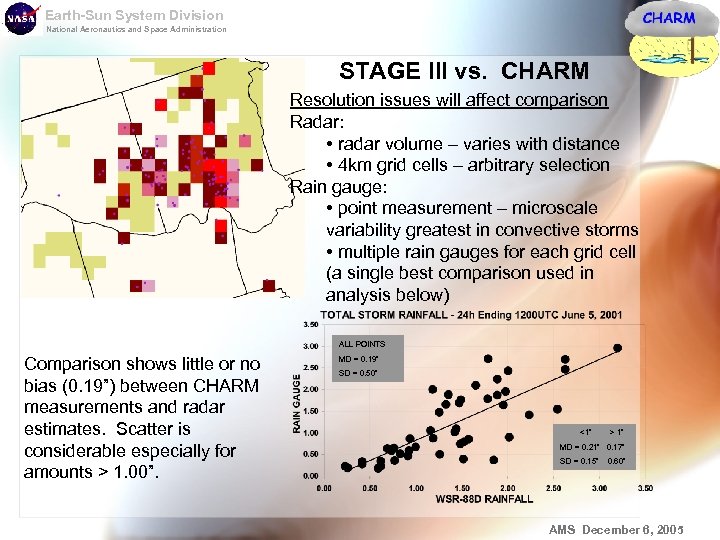 Earth-Sun System Division National Aeronautics and Space Administration STAGE III vs. CHARM Resolution issues will affect comparison Radar: • radar volume – varies with distance • 4 km grid cells – arbitrary selection Rain gauge: • point measurement – microscale variability greatest in convective storms • multiple rain gauges for each grid cell (a single best comparison used in analysis below) ALL POINTS Comparison shows little or no bias (0. 19”) between CHARM measurements and radar estimates. Scatter is considerable especially for amounts > 1. 00”. MD = 0. 19” SD = 0. 50” <1” > 1” MD = 0. 21” 0. 17” SD = 0. 15” 0. 60” AMS December 6, 2005
 Earth-Sun System Division National Aeronautics and Space Administration CHARM data is regularly used to evaluate short-term variations in precipitation climatology. AMS December 6, 2005
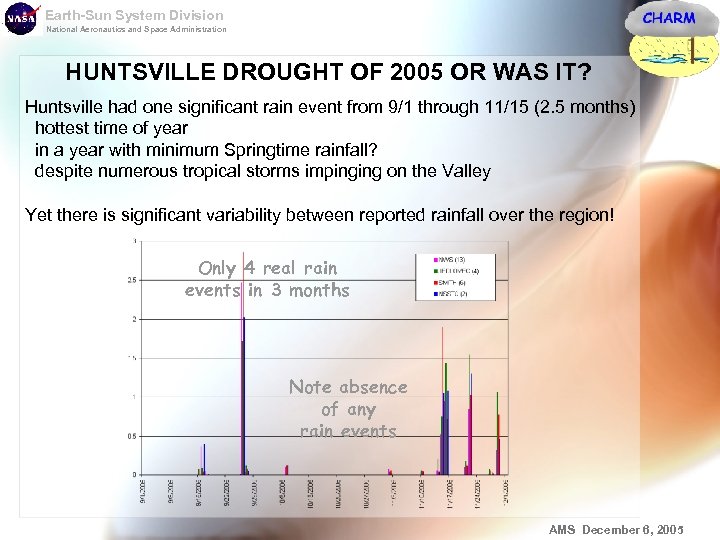 Earth-Sun System Division National Aeronautics and Space Administration HUNTSVILLE DROUGHT OF 2005 OR WAS IT? Huntsville had one significant rain event from 9/1 through 11/15 (2. 5 months) hottest time of year in a year with minimum Springtime rainfall? despite numerous tropical storms impinging on the Valley Yet there is significant variability between reported rainfall over the region! Only 4 real rain events in 3 months Note absence of any rain events AMS December 6, 2005
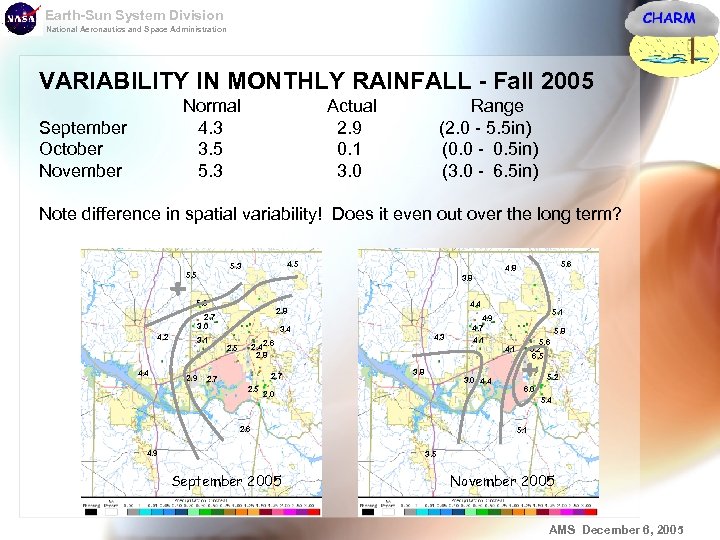 Earth-Sun System Division National Aeronautics and Space Administration VARIABILITY IN MONTHLY RAINFALL - Fall 2005 Normal 4. 3 3. 5 5. 3 September October November Actual 2. 9 0. 1 3. 0 Range (2. 0 - 5. 5 in) (0. 0 - 0. 5 in) (3. 0 - 6. 5 in) Note difference in spatial variability! Does it even out over the long term? + 4. 5 5. 3 3. 8 5. 5 4. 4 3. 1 2. 9 4. 4 2. 8 2. 7 3. 0 4. 2 5. 6 4. 8 5. 5 3. 4 4. 3 2. 4 2. 6 2. 5 4. 9 4. 7 4. 1 2. 8 2. 7 2. 5 3. 8 3. 0 4. 4 2. 0 5. 8 4. 1 5. 6 6. 2 6. 5 + 5. 2 6. 0 5. 4 2. 6 4. 9 5. 1 3. 5 September 2005 November 2005 AMS December 6, 2005
 Earth-Sun System Division National Aeronautics and Space Administration CHARM 2005 selected station monthly rainfall and anomalies (departure from normal). AMS December 6, 2005
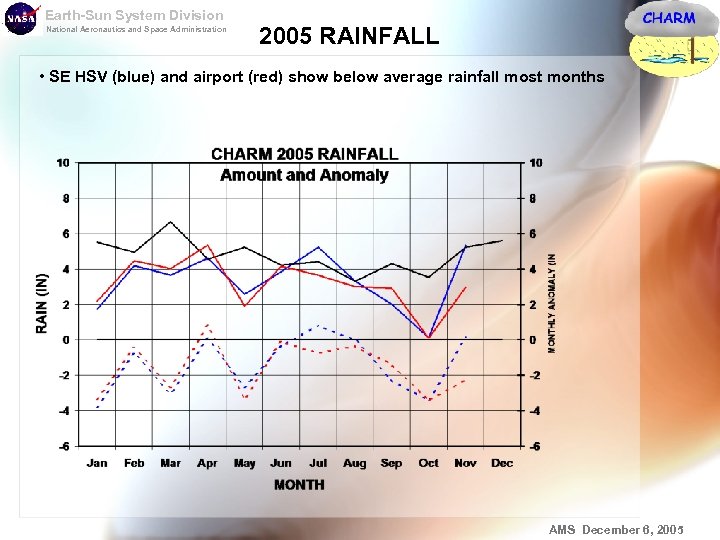 Earth-Sun System Division National Aeronautics and Space Administration 2005 RAINFALL • SE HSV (blue) and airport (red) show below average rainfall most months AMS December 6, 2005
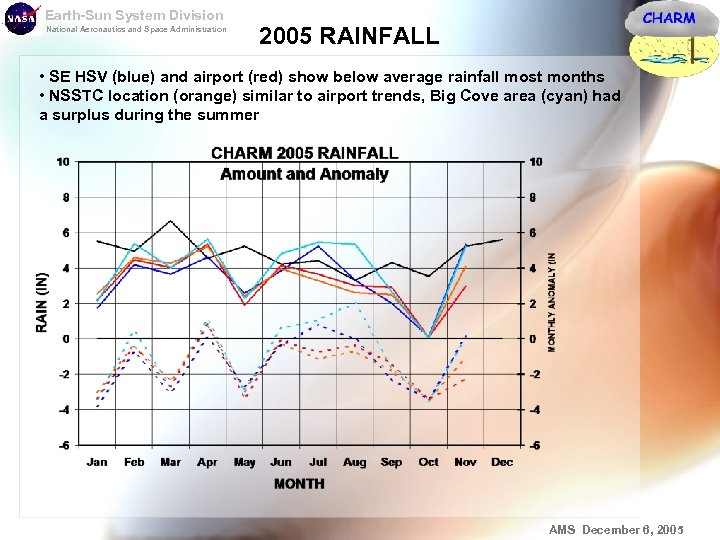 Earth-Sun System Division National Aeronautics and Space Administration 2005 RAINFALL • SE HSV (blue) and airport (red) show below average rainfall most months • NSSTC location (orange) similar to airport trends, Big Cove area (cyan) had a surplus during the summer AMS December 6, 2005
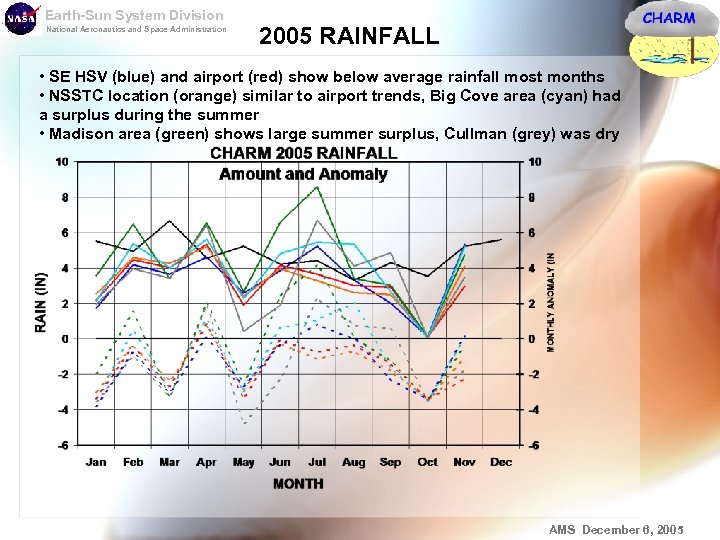 Earth-Sun System Division National Aeronautics and Space Administration 2005 RAINFALL • SE HSV (blue) and airport (red) show below average rainfall most months • NSSTC location (orange) similar to airport trends, Big Cove area (cyan) had a surplus during the summer • Madison area (green) shows large summer surplus, Cullman (grey) was dry AMS December 6, 2005
 Earth-Sun System Division National Aeronautics and Space Administration CHARM 2005 selected station monthly rainfall anomalies and yearly deficit (sum of departure from normal). AMS December 6, 2005
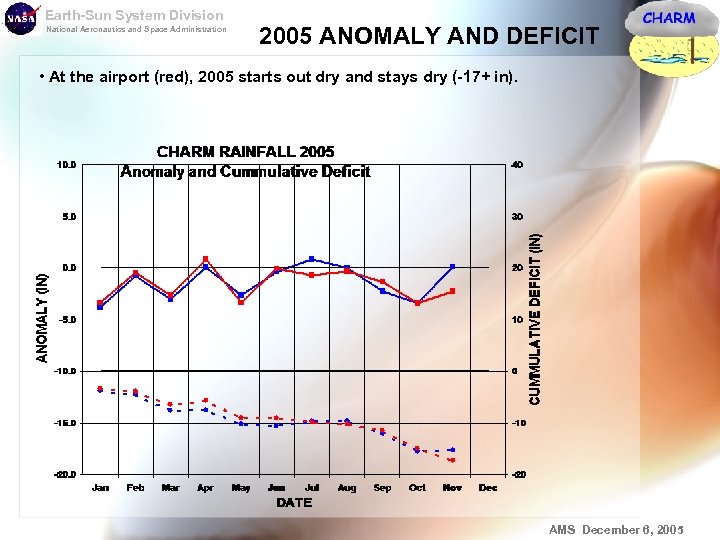 Earth-Sun System Division National Aeronautics and Space Administration 2005 ANOMALY AND DEFICIT • At the airport (red), 2005 starts out dry and stays dry (-17+ in). AMS December 6, 2005
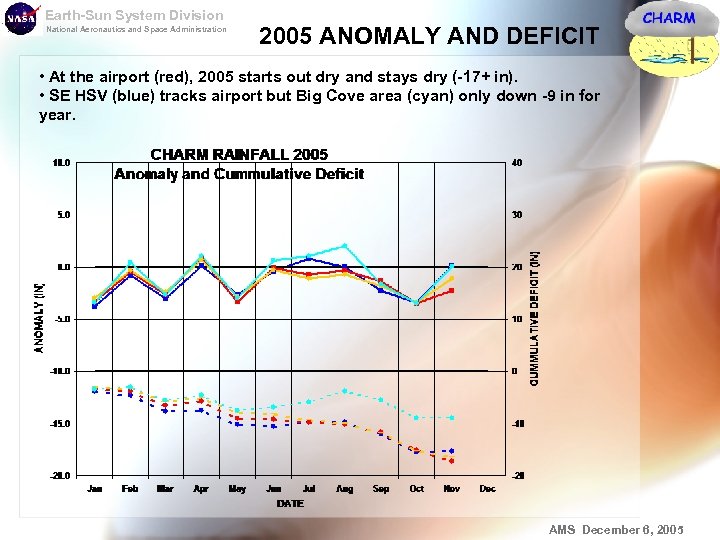 Earth-Sun System Division National Aeronautics and Space Administration 2005 ANOMALY AND DEFICIT • At the airport (red), 2005 starts out dry and stays dry (-17+ in). • SE HSV (blue) tracks airport but Big Cove area (cyan) only down -9 in for year. AMS December 6, 2005
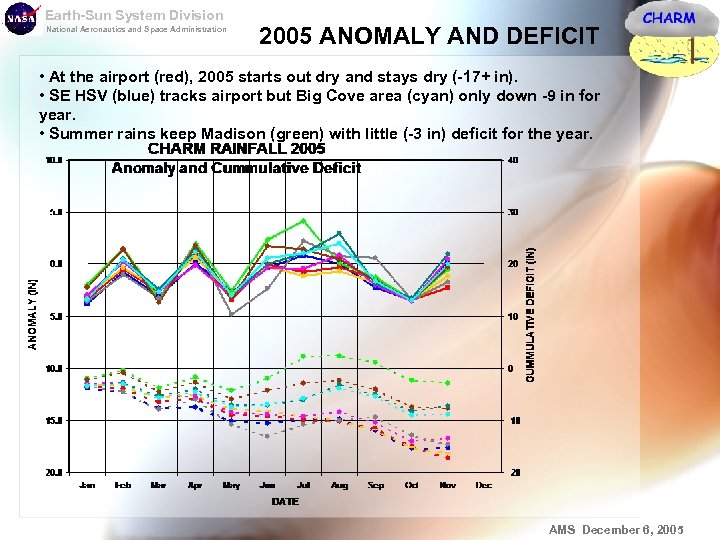 Earth-Sun System Division National Aeronautics and Space Administration 2005 ANOMALY AND DEFICIT • At the airport (red), 2005 starts out dry and stays dry (-17+ in). • SE HSV (blue) tracks airport but Big Cove area (cyan) only down -9 in for year. • Summer rains keep Madison (green) with little (-3 in) deficit for the year. AMS December 6, 2005
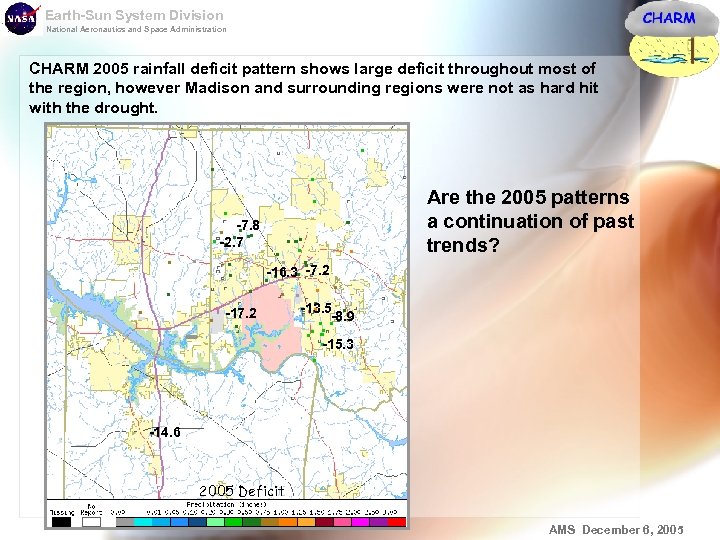 Earth-Sun System Division National Aeronautics and Space Administration CHARM 2005 rainfall deficit pattern shows large deficit throughout most of the region, however Madison and surrounding regions were not as hard hit with the drought. Are the 2005 patterns a continuation of past trends? -7. 8 -2. 7 -16. 3 -7. 2 - -17. 2 -13. 5 -8. 9 -15. 3 -14. 6 2005 Deficit AMS December 6, 2005
 Earth-Sun System Division National Aeronautics and Space Administration CHARM can be used to look at shortterm climate trends in rainfall. The following analysis highlights the 2001 -2005 period. AMS December 6, 2005
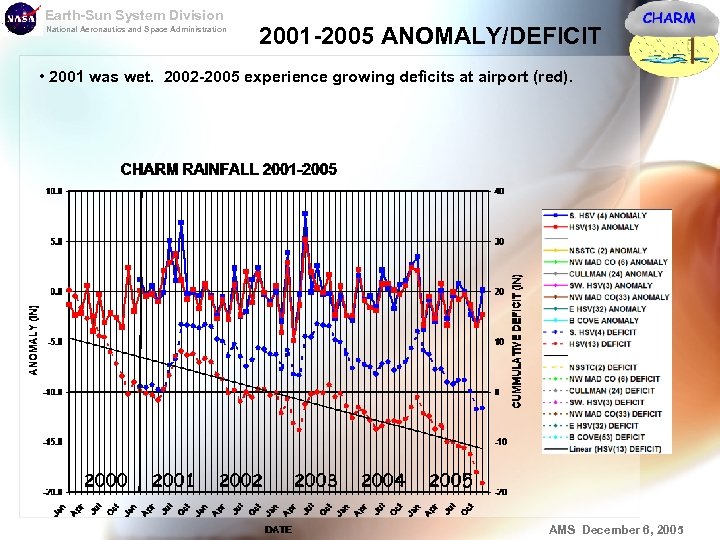 Earth-Sun System Division National Aeronautics and Space Administration 2001 -2005 ANOMALY/DEFICIT • 2001 was wet. 2002 -2005 experience growing deficits at airport (red). 2000 2001 2002 2003 2004 2005 AMS December 6, 2005
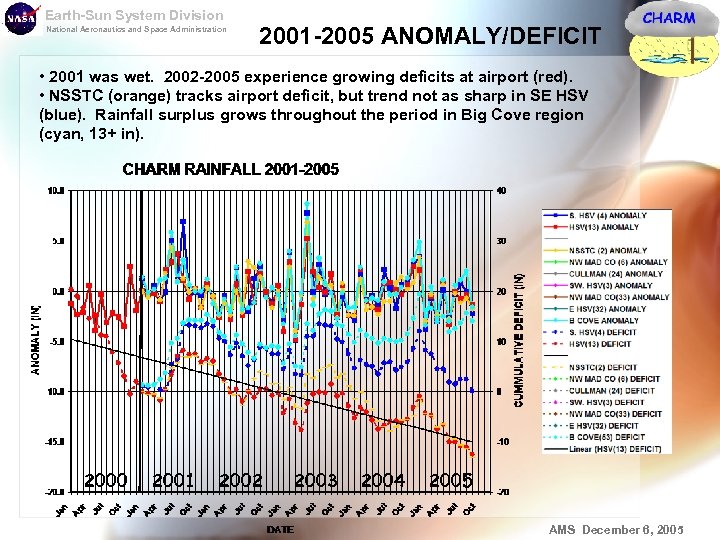 Earth-Sun System Division National Aeronautics and Space Administration 2001 -2005 ANOMALY/DEFICIT • 2001 was wet. 2002 -2005 experience growing deficits at airport (red). • NSSTC (orange) tracks airport deficit, but trend not as sharp in SE HSV (blue). Rainfall surplus grows throughout the period in Big Cove region (cyan, 13+ in). 2000 2001 2002 2003 2004 2005 AMS December 6, 2005
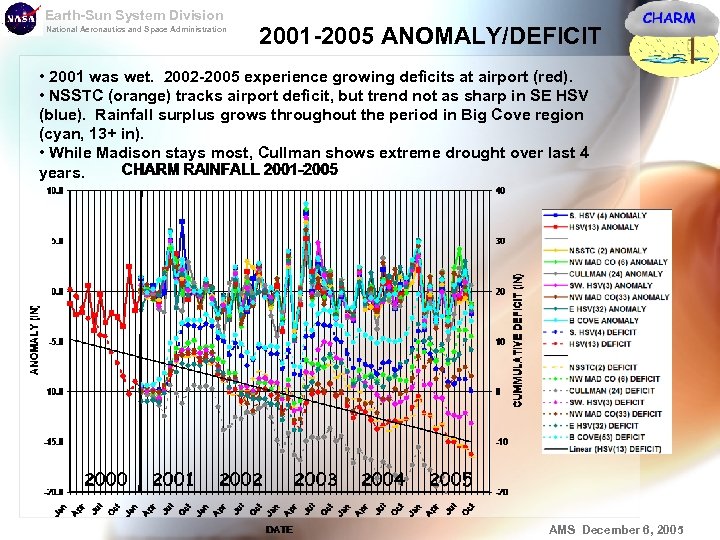 Earth-Sun System Division National Aeronautics and Space Administration 2001 -2005 ANOMALY/DEFICIT • 2001 was wet. 2002 -2005 experience growing deficits at airport (red). • NSSTC (orange) tracks airport deficit, but trend not as sharp in SE HSV (blue). Rainfall surplus grows throughout the period in Big Cove region (cyan, 13+ in). • While Madison stays most, Cullman shows extreme drought over last 4 years. 2000 2001 2002 2003 2004 2005 AMS December 6, 2005
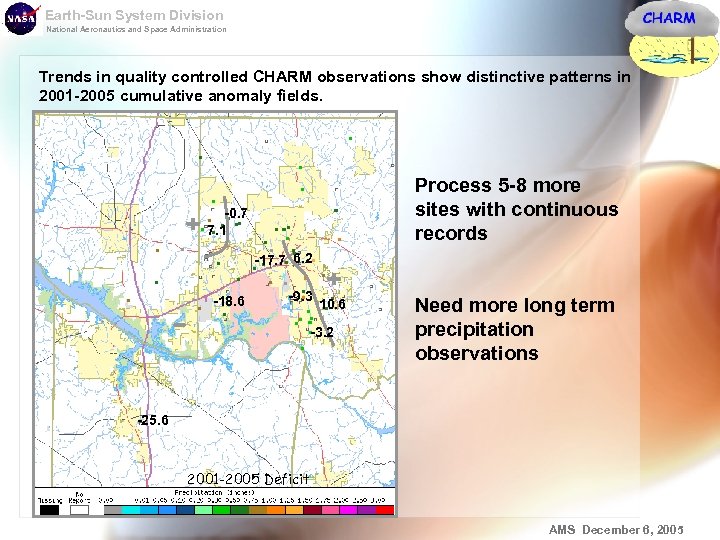 Earth-Sun System Division National Aeronautics and Space Administration Trends in quality controlled CHARM observations show distinctive patterns in 2001 -2005 cumulative anomaly fields. + Process 5 -8 more sites with continuous records -0. 7 7. 1 -17. 7 6. 2 - -18. 6 -9. 3 + 10. 6 -3. 2 Need more long term precipitation observations -25. 6 2001 -2005 Deficit AMS December 6, 2005
 Earth-Sun System Division National Aeronautics and Space Administration FUTURE OF CHARM Long-term activity to support NASA research projects • permanent (? ) to support Tennessee Valley weather resources • possible field program or GPM validation site Encourage long-term precipitation observations from existing participants • annual CHARM meeting of all participants – workshop on equipment and observation methods, scientific analysis – picnic or other gathering to share experiences • more recording gauges Expand network • outlying areas – fill in gaps (NE Madison Co, south of River, east of HSV) – weather enthusiasts AMS December 6, 2005