 Скачать презентацию EARTH OBSERVATIONS A NOAA Perspective Presenters Mary E
98a4f4c642d812a71f46960ae9f76860.ppt
- Количество слайдов: 24



EARTH OBSERVATIONS A NOAA Perspective Presenters Mary E. Kicza Assistant Administrator for Satellite and Information Services Zdenka S. Willis Director, Integrated Ocean Observing System, National Ocean Service Kevin J. Schrab, Ph. D Chief, Observing Services Division, National Weather Service Stephen K. Brown, Ph. D Chief, Assessment and Monitoring Division, National Marine Fisheries Service March 16, 2009 National Oceanic and Atmospheric Administration (NOAA)
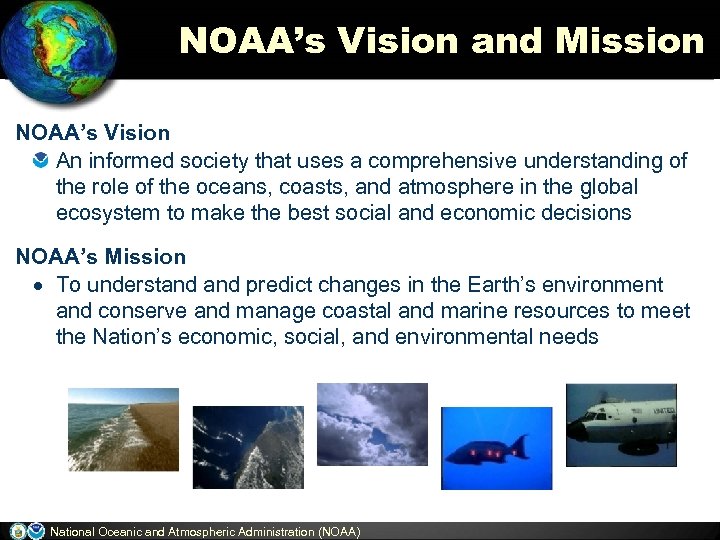
NOAA’s Vision and Mission NOAA’s Vision An informed society that uses a comprehensive understanding of the role of the oceans, coasts, and atmosphere in the global ecosystem to make the best social and economic decisions NOAA’s Mission · To understand predict changes in the Earth’s environment and conserve and manage coastal and marine resources to meet the Nation’s economic, social, and environmental needs National Oceanic and Atmospheric Administration (NOAA)
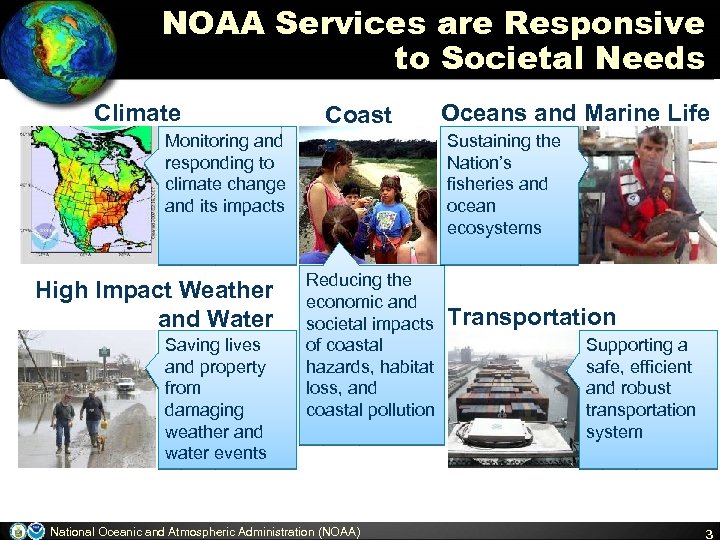
NOAA Services are Responsive to Societal Needs Climate Monitoring and responding to climate change and its impacts High Impact Weather and Water Saving lives and property from damaging weather and water events Coast s Reducing the economic and societal impacts of coastal hazards, habitat loss, and coastal pollution National Oceanic and Atmospheric Administration (NOAA) Oceans and Marine Life Sustaining the Nation’s fisheries and ocean ecosystems Transportation Supporting a safe, efficient and robust transportation system 3
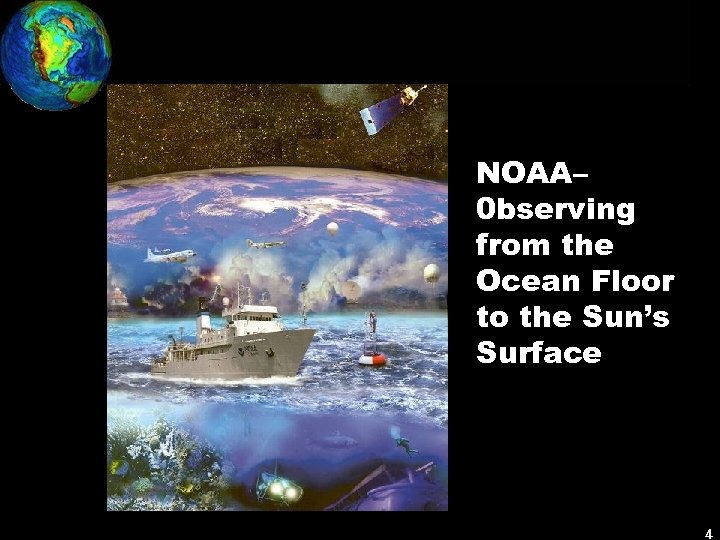
NOAA– 0 bserving from the Ocean Floor to the Sun’s Surface 4
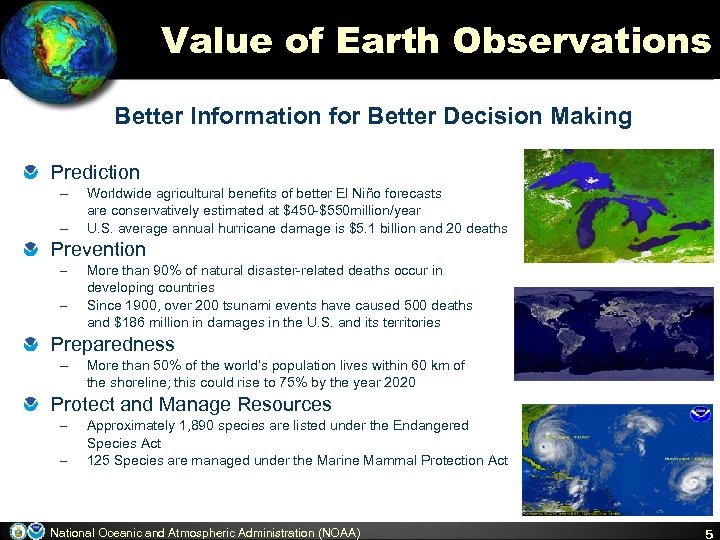
Value of Earth Observations Better Information for Better Decision Making Prediction – – Worldwide agricultural benefits of better El Niño forecasts are conservatively estimated at $450 -$550 million/year U. S. average annual hurricane damage is $5. 1 billion and 20 deaths Prevention – – More than 90% of natural disaster-related deaths occur in developing countries Since 1900, over 200 tsunami events have caused 500 deaths and $186 million in damages in the U. S. and its territories Preparedness – More than 50% of the world’s population lives within 60 km of the shoreline; this could rise to 75% by the year 2020 Protect and Manage Resources – – Approximately 1, 890 species are listed under the Endangered Species Act 125 Species are managed under the Marine Mammal Protection Act National Oceanic and Atmospheric Administration (NOAA) 5
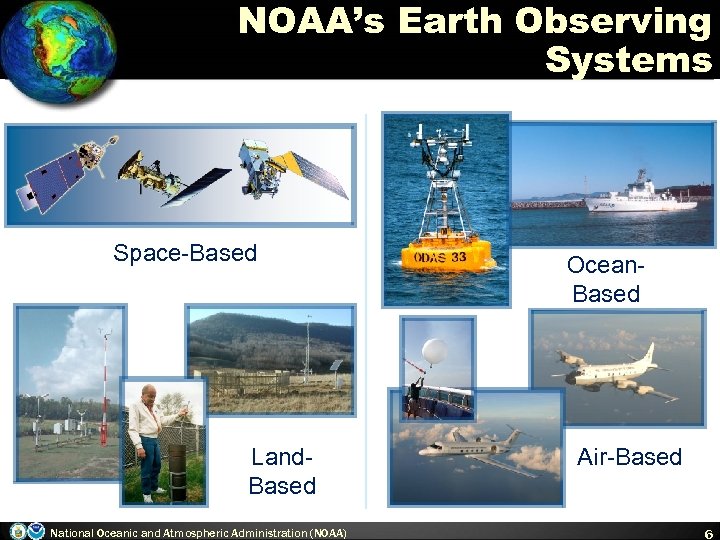
NOAA’s Earth Observing Systems Space-Based Land. Based National Oceanic and Atmospheric Administration (NOAA) Ocean. Based Air-Based 6
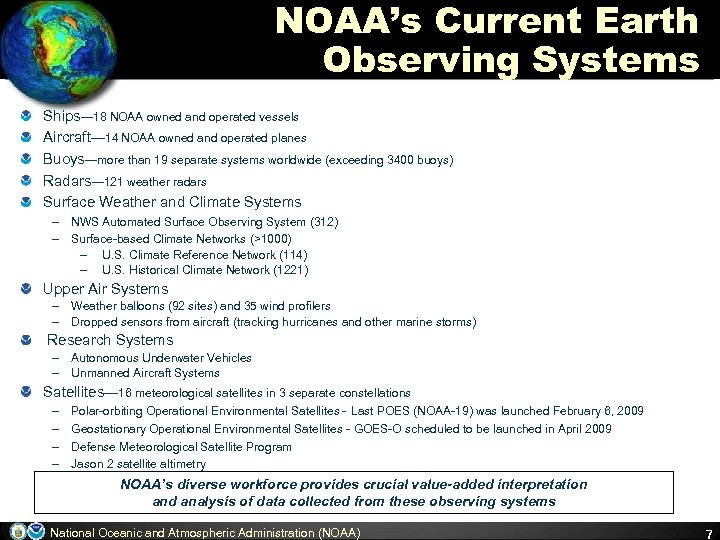
NOAA’s Current Earth Observing Systems Ships— 18 NOAA owned and operated vessels Aircraft— 14 NOAA owned and operated planes Buoys—more than 19 separate systems worldwide (exceeding 3400 buoys) Radars— 121 weather radars Surface Weather and Climate Systems – NWS Automated Surface Observing System (312) – Surface-based Climate Networks (>1000) – U. S. Climate Reference Network (114) – U. S. Historical Climate Network (1221) Upper Air Systems – Weather balloons (92 sites) and 35 wind profilers – Dropped sensors from aircraft (tracking hurricanes and other marine storms) Research Systems – Autonomous Underwater Vehicles – Unmanned Aircraft Systems Satellites— 16 meteorological satellites in 3 separate constellations – – Polar-orbiting Operational Environmental Satellites - Last POES (NOAA-19) was launched February 6, 2009 Geostationary Operational Environmental Satellites - GOES-O scheduled to be launched in April 2009 Defense Meteorological Satellite Program Jason 2 satellite altimetry NOAA’s diverse workforce provides crucial value-added interpretation and analysis of data collected from these observing systems National Oceanic and Atmospheric Administration (NOAA) 7
Mandates and Policy Drivers Directive Authorities · Weather Service Organic Act · Magnuson-Stevens Fishery Conservation and Management Act · Marine Mammal Protection Act · Endangered Species Act · Coastal Zone Management Act · National Marine Sanctuaries Act · Hydrographic Services Improvement Act · Tsunami Warning and Education Act · +…. . External Recommendations · · · U. S. Commission on Ocean Policy Ocean Action Plan Joint Ocean Commission Intergovernmental Panel on Climate Change (IPCC) +…… National Oceanic and Atmospheric Administration (NOAA) 8
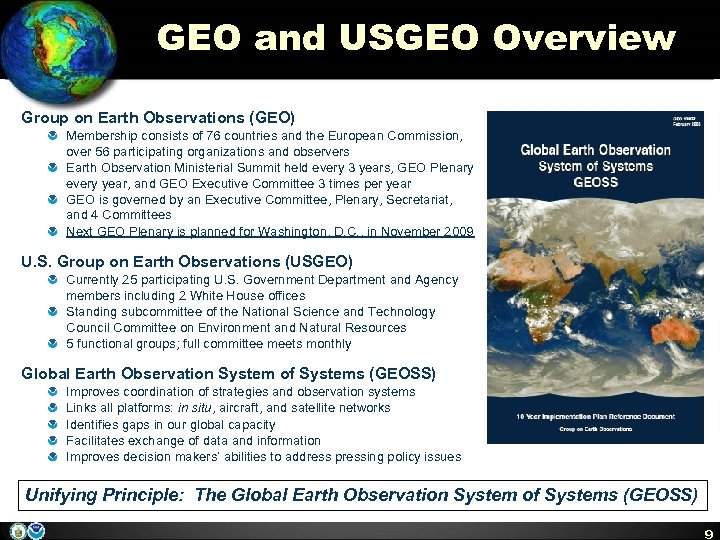
GEO and USGEO Overview Group on Earth Observations (GEO) Membership consists of 76 countries and the European Commission, over 56 participating organizations and observers Earth Observation Ministerial Summit held every 3 years, GEO Plenary every year, and GEO Executive Committee 3 times per year GEO is governed by an Executive Committee, Plenary, Secretariat, and 4 Committees Next GEO Plenary is planned for Washington, D. C. , in November 2009 U. S. Group on Earth Observations (USGEO) Currently 25 participating U. S. Government Department and Agency members including 2 White House offices Standing subcommittee of the National Science and Technology Council Committee on Environment and Natural Resources 5 functional groups; full committee meets monthly Global Earth Observation System of Systems (GEOSS) Improves coordination of strategies and observation systems Links all platforms: in situ, aircraft, and satellite networks Identifies gaps in our global capacity Facilitates exchange of data and information Improves decision makers’ abilities to address pressing policy issues Unifying Principle: The Global Earth Observation System of Systems (GEOSS) 9
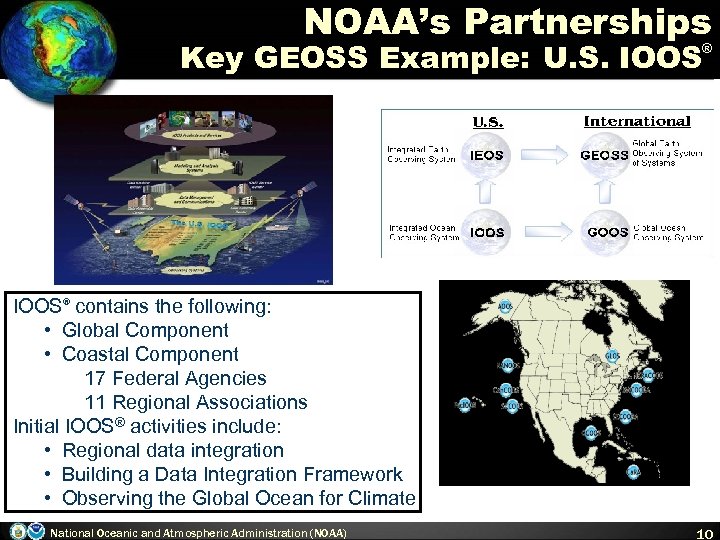
NOAA’s Partnerships Key GEOSS Example: U. S. IOOS® contains the following: • Global Component • Coastal Component 17 Federal Agencies 11 Regional Associations Initial IOOS® activities include: • Regional data integration • Building a Data Integration Framework • Observing the Global Ocean for Climate National Oceanic and Atmospheric Administration (NOAA) 10 10
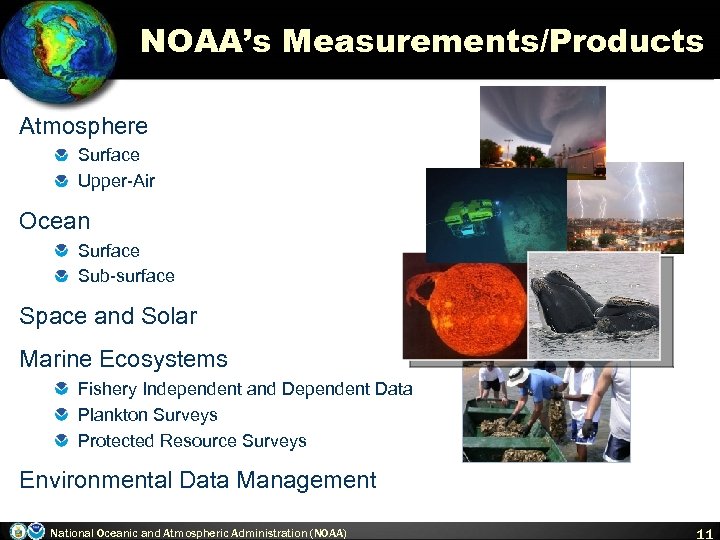
NOAA’s Measurements/Products Atmosphere Surface Upper-Air Ocean Surface Sub-surface Space and Solar Marine Ecosystems Fishery Independent and Dependent Data Plankton Surveys Protected Resource Surveys Environmental Data Management National Oceanic and Atmospheric Administration (NOAA) 11
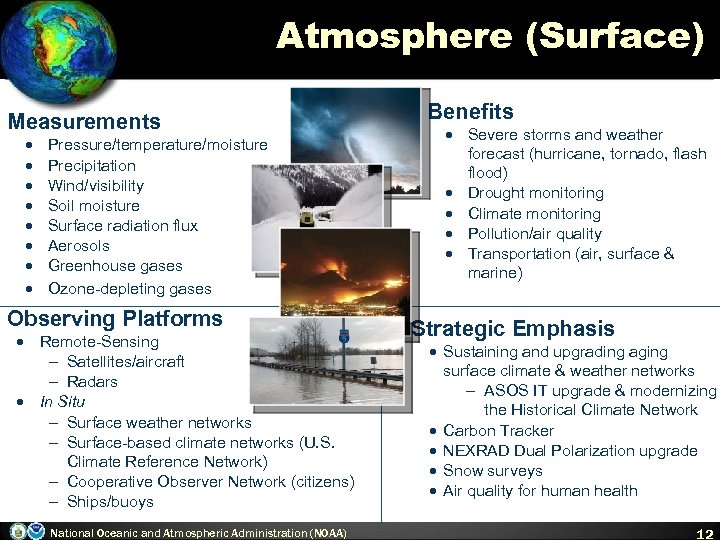
Atmosphere (Surface) Measurements · · · · Pressure/temperature/moisture Precipitation Wind/visibility Soil moisture Surface radiation flux Aerosols Greenhouse gases Ozone-depleting gases Observing Platforms · Remote-Sensing – Satellites/aircraft – Radars · In Situ – Surface weather networks – Surface-based climate networks (U. S. Climate Reference Network) – Cooperative Observer Network (citizens) – Ships/buoys National Oceanic and Atmospheric Administration (NOAA) Benefits · Severe storms and weather forecast (hurricane, tornado, flash flood) · Drought monitoring · Climate monitoring · Pollution/air quality · Transportation (air, surface & marine) Strategic Emphasis · Sustaining and upgrading aging surface climate & weather networks - ASOS IT upgrade & modernizing the Historical Climate Network · Carbon Tracker · NEXRAD Dual Polarization upgrade · Snow surveys · Air quality for human health 12
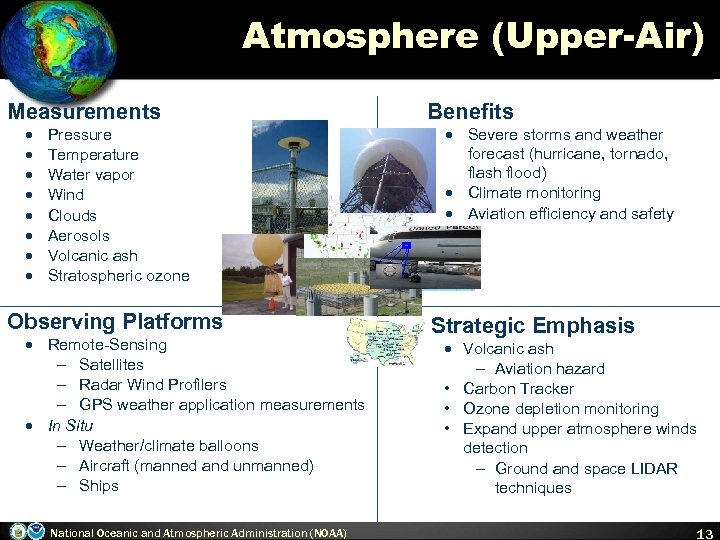
Atmosphere (Upper-Air) Measurements · · · · Pressure Temperature Water vapor Wind Clouds Aerosols Volcanic ash Stratospheric ozone Observing Platforms · Remote-Sensing – Satellites – Radar Wind Profilers – GPS weather application measurements · In Situ – Weather/climate balloons – Aircraft (manned and unmanned) – Ships National Oceanic and Atmospheric Administration (NOAA) Benefits · Severe storms and weather forecast (hurricane, tornado, flash flood) · Climate monitoring · Aviation efficiency and safety Strategic Emphasis · Volcanic ash - Aviation hazard • Carbon Tracker • Ozone depletion monitoring • Expand upper atmosphere winds detection – Ground and space LIDAR techniques 13
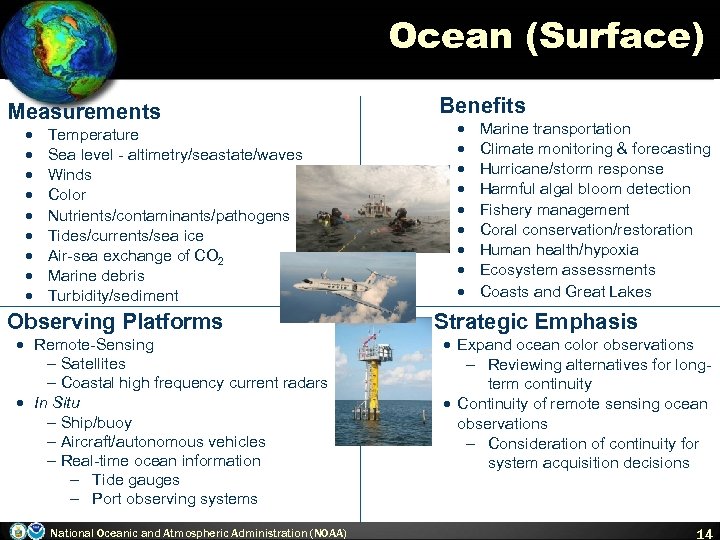
Ocean (Surface) Measurements · · · · · Temperature Sea level - altimetry/seastate/waves Winds Color Nutrients/contaminants/pathogens Tides/currents/sea ice Air-sea exchange of CO 2 Marine debris Turbidity/sediment Observing Platforms · Remote-Sensing – Satellites – Coastal high frequency current radars · In Situ – Ship/buoy – Aircraft/autonomous vehicles – Real-time ocean information – Tide gauges – Port observing systems National Oceanic and Atmospheric Administration (NOAA) Benefits · · · · · Marine transportation Climate monitoring & forecasting Hurricane/storm response Harmful algal bloom detection Fishery management Coral conservation/restoration Human health/hypoxia Ecosystem assessments Coasts and Great Lakes Strategic Emphasis · Expand ocean color observations – Reviewing alternatives for longterm continuity · Continuity of remote sensing ocean observations – Consideration of continuity for system acquisition decisions 14
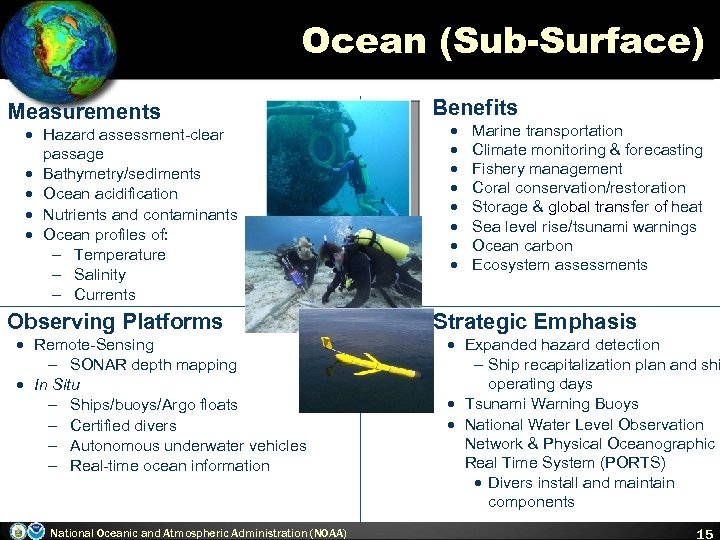
Ocean (Sub-Surface) Measurements Benefits Observing Platforms Strategic Emphasis · Hazard assessment-clear passage · Bathymetry/sediments · Ocean acidification · Nutrients and contaminants · Ocean profiles of: – Temperature – Salinity – Currents · Remote-Sensing – SONAR depth mapping · In Situ – Ships/buoys/Argo floats – Certified divers – Autonomous underwater vehicles – Real-time ocean information National Oceanic and Atmospheric Administration (NOAA) · · · · Marine transportation Climate monitoring & forecasting Fishery management Coral conservation/restoration Storage & global transfer of heat Sea level rise/tsunami warnings Ocean carbon Ecosystem assessments · Expanded hazard detection - Ship recapitalization plan and shi operating days · Tsunami Warning Buoys · National Water Level Observation Network & Physical Oceanographic Real Time System (PORTS) · Divers install and maintain components 15
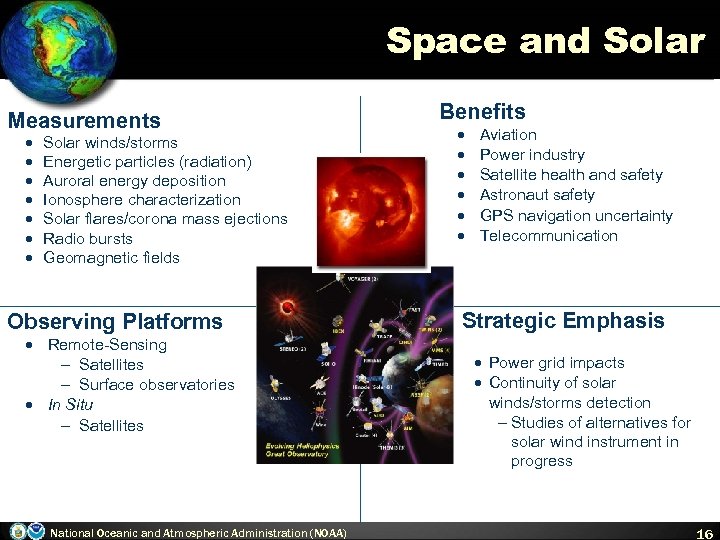
Space and Solar Measurements · · · · Solar winds/storms Energetic particles (radiation) Auroral energy deposition Ionosphere characterization Solar flares/corona mass ejections Radio bursts Geomagnetic fields Observing Platforms · Remote-Sensing – Satellites – Surface observatories · In Situ – Satellites National Oceanic and Atmospheric Administration (NOAA) Benefits · · · Aviation Power industry Satellite health and safety Astronaut safety GPS navigation uncertainty Telecommunication Strategic Emphasis · Power grid impacts · Continuity of solar winds/storms detection - Studies of alternatives for solar wind instrument in progress 16
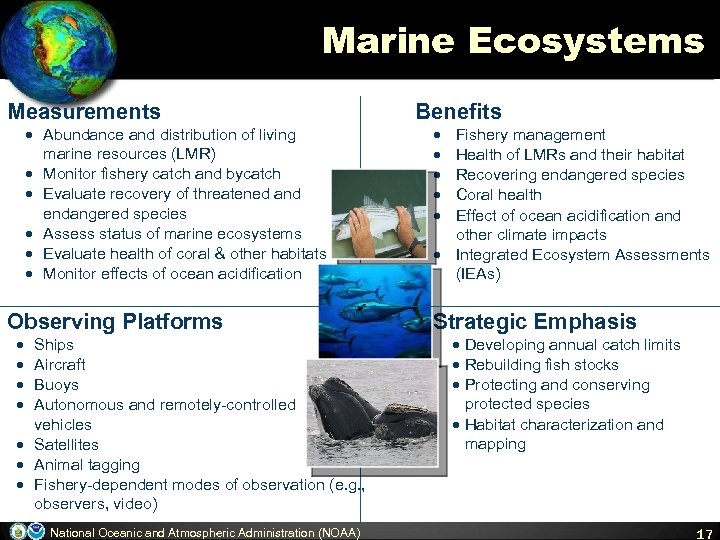
Marine Ecosystems Measurements · Abundance and distribution of living marine resources (LMR) · Monitor fishery catch and bycatch · Evaluate recovery of threatened and endangered species · Assess status of marine ecosystems · Evaluate health of coral & other habitats · Monitor effects of ocean acidification Observing Platforms · · Ships Aircraft Buoys Autonomous and remotely-controlled vehicles · Satellites · Animal tagging · Fishery-dependent modes of observation (e. g. , observers, video) National Oceanic and Atmospheric Administration (NOAA) Benefits · · · Fishery management Health of LMRs and their habitat Recovering endangered species Coral health Effect of ocean acidification and other climate impacts · Integrated Ecosystem Assessments (IEAs) Strategic Emphasis · Developing annual catch limits · Rebuilding fish stocks · Protecting and conserving protected species · Habitat characterization and mapping 17
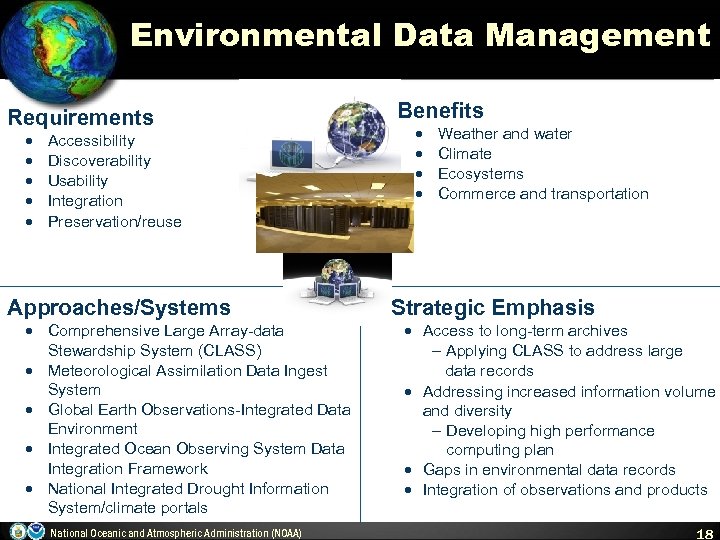
Environmental Data Management Requirements · · · Accessibility Discoverability Usability Integration Preservation/reuse Approaches/Systems · Comprehensive Large Array-data Stewardship System (CLASS) · Meteorological Assimilation Data Ingest System · Global Earth Observations-Integrated Data Environment · Integrated Ocean Observing System Data Integration Framework · National Integrated Drought Information System/climate portals National Oceanic and Atmospheric Administration (NOAA) Benefits · · Weather and water Climate Ecosystems Commerce and transportation Strategic Emphasis · Access to long-term archives - Applying CLASS to address large data records · Addressing increased information volume and diversity - Developing high performance computing plan · Gaps in environmental data records · Integration of observations and products 18
Summary • Earth observations are a critical element of NOAA’s mission • NOAA has a broad mission--requires extensive observing systems • NOAA leads U. S. Government in operational Earth observing systems • Demand for Earth observations continues to grow • NOAA must continue to invest in EO to ensure the Nation has access to crucial observations in the future Final Presentation will be posted online: www. legislative. noaa. gov/policybriefs. html" National Oceanic and Atmospheric Administration (NOAA) 19
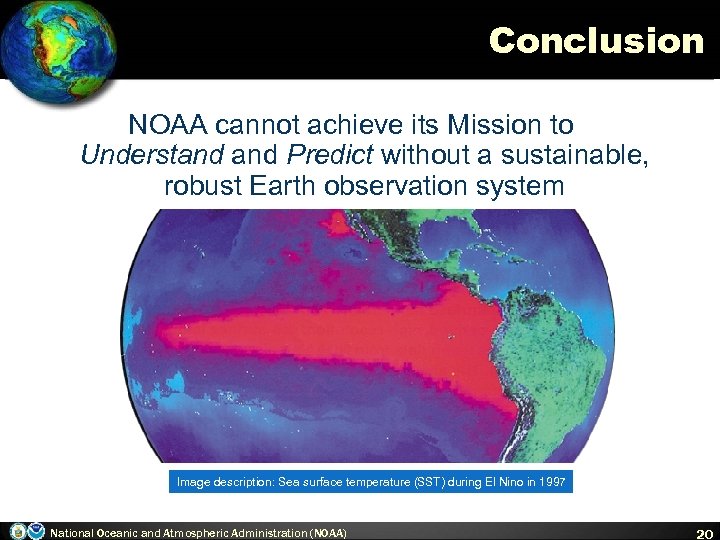
Conclusion NOAA cannot achieve its Mission to Understand Predict without a sustainable, robust Earth observation system Image description: Sea surface temperature (SST) during El Nino in 1997 National Oceanic and Atmospheric Administration (NOAA) 20
BACKUP SLIDES National Oceanic and Atmospheric Administration (NOAA) 21
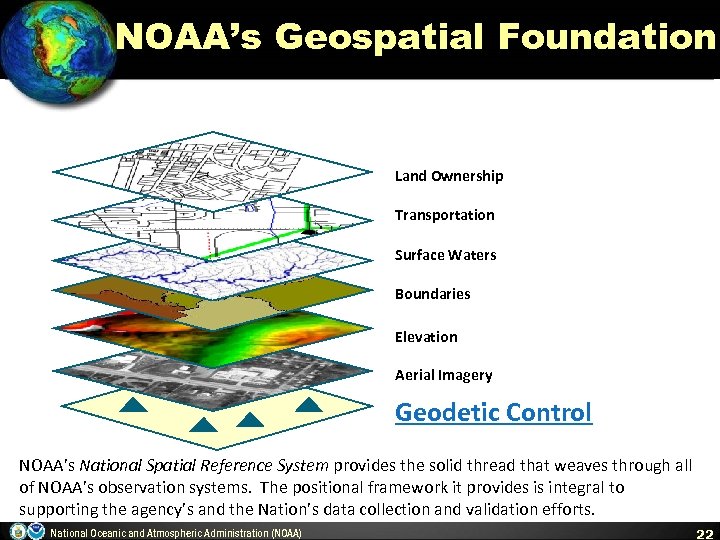
NOAA’s Geospatial Foundation Land Ownership Transportation Surface Waters Boundaries Elevation Aerial Imagery Geodetic Control NOAA’s National Spatial Reference System provides the solid thread that weaves through all of NOAA’s observation systems. The positional framework it provides is integral to supporting the agency’s and the Nation’s data collection and validation efforts. National Oceanic and Atmospheric Administration (NOAA) 22
NOAA’s Areas of Strategic Emphasis · · Ships—Recapitalization Plan Aircraft—Recapitalization Plan Buoys—Recapitalization Plan Phase 1 and 2 Radars – Dual-Polarization – Multi-function Phased Array – Wind Profiler Network · Satellite – Continuity and Research to Operations (R 2 O) · Surface Weather and Climate Systems – Historical Climate Network Modernization – U. S. Climate Reference Network sustainment – Surface weather sensor sustainment · Upper Air Systems – Climate Reference Radiosonde – GPS improved resolution upgrade · Fishery Dependent Systems – National Observer Program/Fisheries Information System/Port Sampling System – Socio-economic surveys · Build the U. S. IOOS National Oceanic and Atmospheric Administration (NOAA) 23
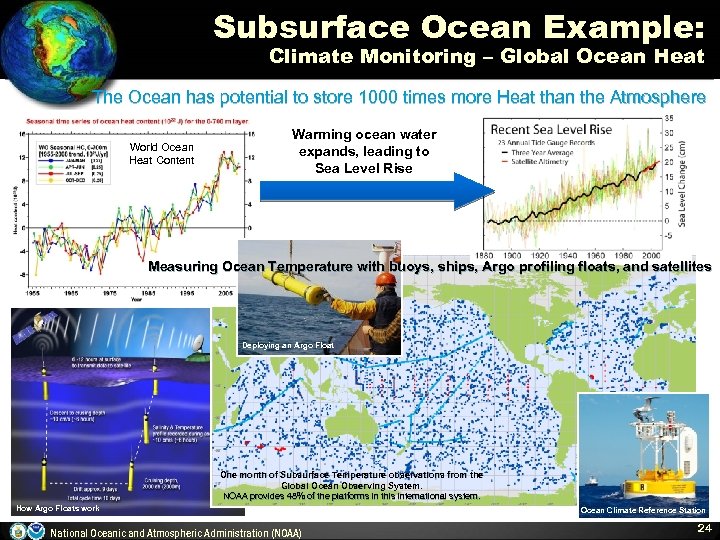
Subsurface Ocean Example: Climate Monitoring – Global Ocean Heat The Ocean has potential to store 1000 times more Heat than the Atmosphere World Ocean Heat Content Warming ocean water expands, leading to Sea Level Rise Measuring Ocean Temperature with buoys, ships, Argo profiling floats, and satellites Deploying an Argo Float One month of Subsurface Temperature observations from the Global Ocean Observing System. NOAA provides 48% of the platforms in this international system. How Argo Floats work National Oceanic and Atmospheric Administration (NOAA) Ocean Climate Reference Station 24
Скачать презентацию EARTH OBSERVATIONS A NOAA Perspective Presenters Mary E
98a4f4c642d812a71f46960ae9f76860.ppt