 Скачать презентацию Earth Observation Information Meeting Brussels SPOT 4 SPOT
8d8a79868e9dac3ad98f60b88ac4b0e4.ppt
- Количество слайдов: 29



Earth Observation Information Meeting, Brussels SPOT 4, SPOT 5 and VEGETATION, Pléiades and further mini/microsats opportunities J. L. Fellous 1) and D. Massonnet 2) CNES, Paris, France 2) CNES, Toulouse, France 1) 1 J. L. FELLOUS and D. MASSONNET - Oct 3, 2000
Earth Observation Information Meeting, Brussels CNES programs for Earth Observation, Science and Applications ð Framework : international cooperation l European cooperation u u l bilateral (Belgium, Sweden, Germany, Italy, European Commission, etc. ) multilateral (ESA, EUMETSAT) International cooperation u u u United States (NASA, NOAA) Japan (NASDA) India (ISRO) ð Satellite and instrument "series" or "families" ð High resolution imagery satellite series l l SPOT, PLEIADES, ESA radar satellites for science and civilian applications HELIOS : Defense needs ð Meteorological satellite series l Improving operational satellite missions for weather forecast 2 J. L. FELLOUS and D. MASSONNET - Oct 3, 2000
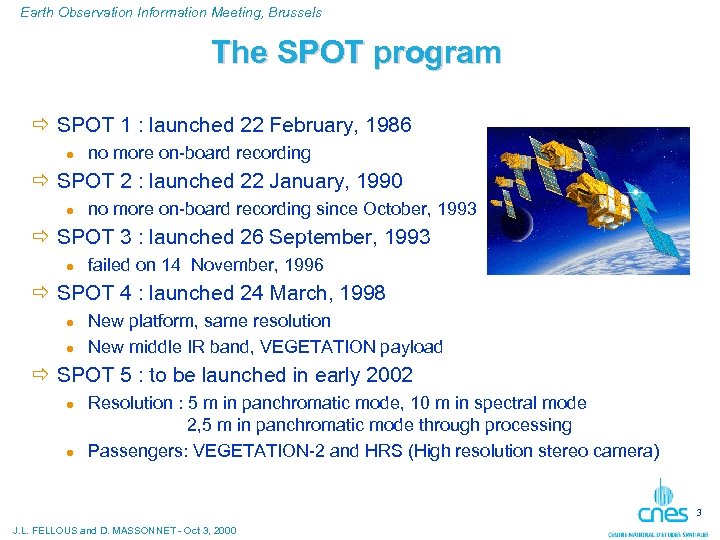
Earth Observation Information Meeting, Brussels The SPOT program ð SPOT 1 : launched 22 February, 1986 l no more on-board recording ð SPOT 2 : launched 22 January, 1990 l no more on-board recording since October, 1993 ð SPOT 3 : launched 26 September, 1993 l failed on 14 November, 1996 ð SPOT 4 : launched 24 March, 1998 l l New platform, same resolution New middle IR band, VEGETATION payload ð SPOT 5 : to be launched in early 2002 l l Resolution : 5 m in panchromatic mode, 10 m in spectral mode 2, 5 m in panchromatic mode through processing Passengers: VEGETATION-2 and HRS (High resolution stereo camera) 3 J. L. FELLOUS and D. MASSONNET - Oct 3, 2000
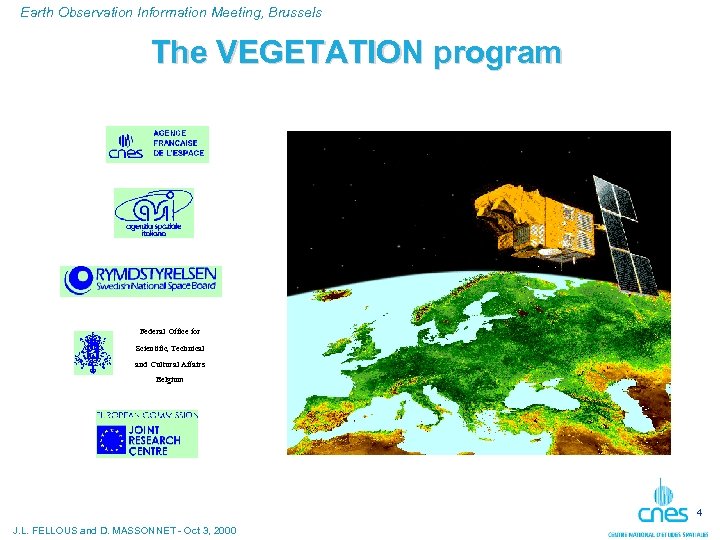
Earth Observation Information Meeting, Brussels The VEGETATION program Federal Office for Scientific, Technical and Cultural Affairs Belgium 4 J. L. FELLOUS and D. MASSONNET - Oct 3, 2000
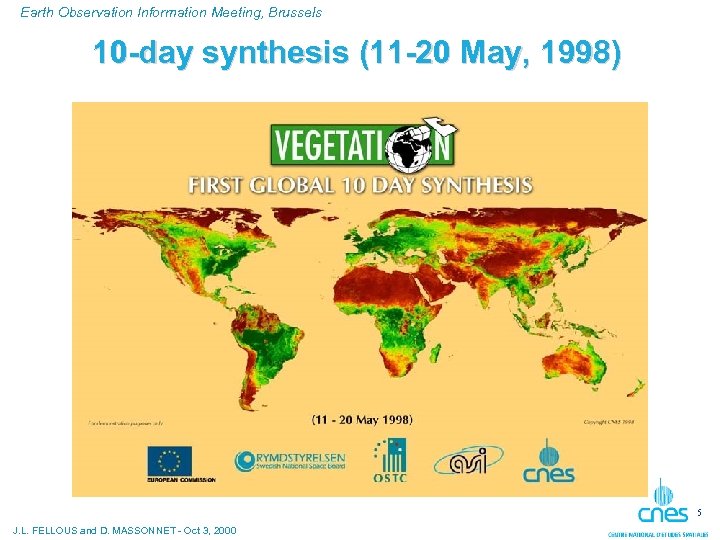
Earth Observation Information Meeting, Brussels 10 -day synthesis (11 -20 May, 1998) 5 J. L. FELLOUS and D. MASSONNET - Oct 3, 2000
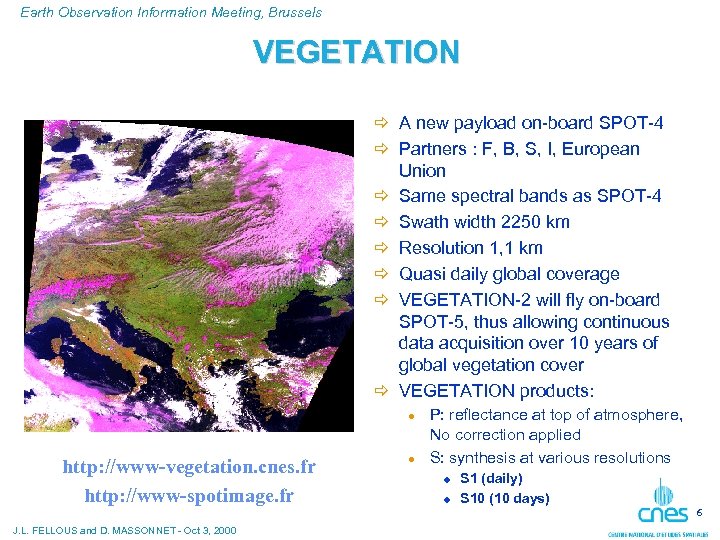
Earth Observation Information Meeting, Brussels VEGETATION ð A new payload on-board SPOT-4 ð Partners : F, B, S, I, European Union ð Same spectral bands as SPOT-4 ð Swath width 2250 km ð Resolution 1, 1 km ð Quasi daily global coverage ð VEGETATION-2 will fly on-board SPOT-5, thus allowing continuous data acquisition over 10 years of global vegetation cover ð VEGETATION products: l http: //www-vegetation. cnes. fr http: //www-spotimage. fr l P: reflectance at top of atmosphere, No correction applied S: synthesis at various resolutions u u S 1 (daily) S 10 (10 days) 6 J. L. FELLOUS and D. MASSONNET - Oct 3, 2000
Earth Observation Information Meeting, Brussels The VEGETATION Millenium Initiative ð Objectives l Contribution of the VEGETATION Program to the international Millenium Ecosystem Assessment initiative: free access to global VEGETATION daily composites ð Expected outcomes l Production of global and regional land cover maps with specific reference to the implementation and control of the international conventions u u 2000 land cover inventory for the globe Global assessment of burnt areas per land cover class ð Mechanism l l Initiative open to the international science community Announcement of opportunity released in June 2000 ð Partnership l l Data provision sponsored by the partners of the VEGETATION Program Support from international programs such as IGBP and GOFC 7 J. L. FELLOUS and D. MASSONNET - Oct 3, 2000
Earth Observation Information Meeting, Brussels Pléiades 8 J. L. FELLOUS and D. MASSONNET - Oct 3, 2000
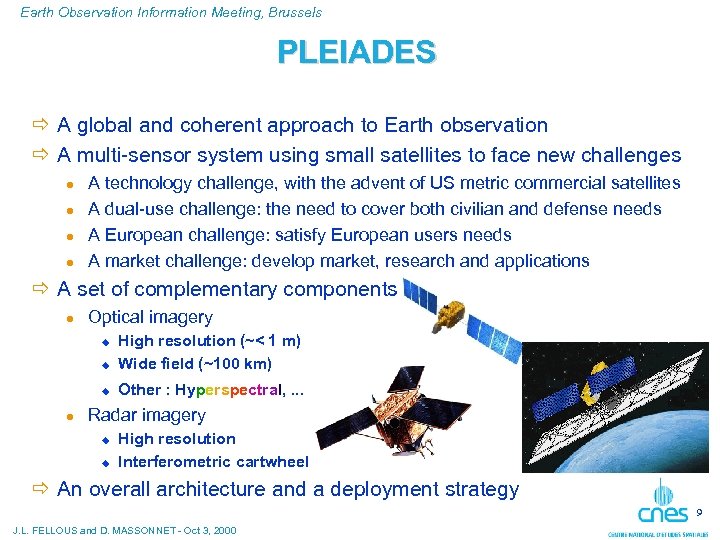
Earth Observation Information Meeting, Brussels PLEIADES ð A global and coherent approach to Earth observation ð A multi-sensor system using small satellites to face new challenges l l A technology challenge, with the advent of US metric commercial satellites A dual-use challenge: the need to cover both civilian and defense needs A European challenge: satisfy European users needs A market challenge: develop market, research and applications ð A set of complementary components l Optical imagery u High resolution (~< 1 m) Wide field (~100 km) u Other : Hyperspectral, . . . u l Radar imagery u u High resolution Interferometric cartwheel ð An overall architecture and a deployment strategy 9 J. L. FELLOUS and D. MASSONNET - Oct 3, 2000
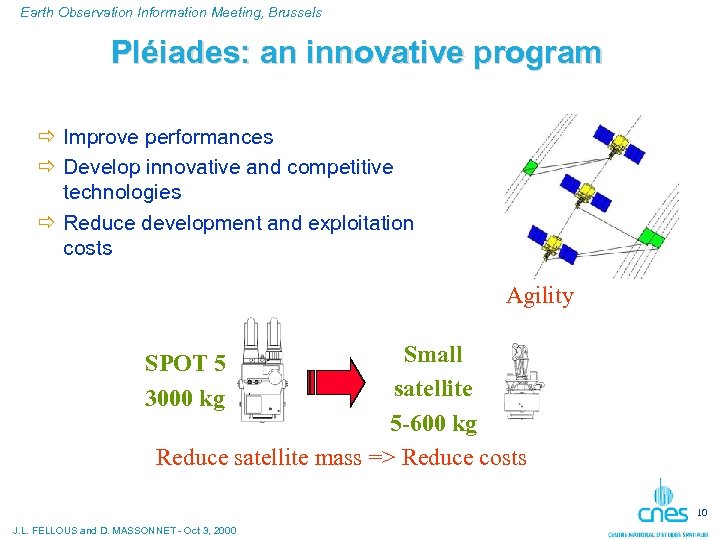
Earth Observation Information Meeting, Brussels Pléiades: an innovative program ð Improve performances ð Develop innovative and competitive technologies ð Reduce development and exploitation costs Agility Small satellite 5 -600 kg Reduce satellite mass => Reduce costs SPOT 5 3000 kg 10 J. L. FELLOUS and D. MASSONNET - Oct 3, 2000
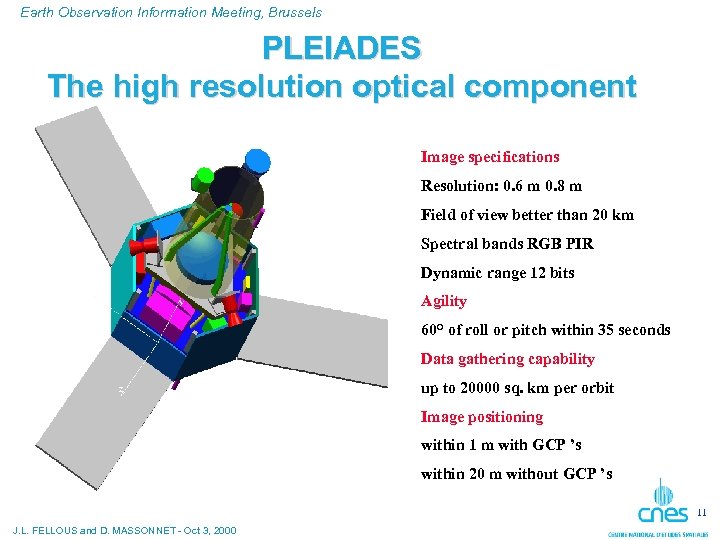
Earth Observation Information Meeting, Brussels PLEIADES The high resolution optical component Image specifications Resolution: 0. 6 m 0. 8 m Field of view better than 20 km Spectral bands RGB PIR Dynamic range 12 bits Agility 60° of roll or pitch within 35 seconds Data gathering capability up to 20000 sq. km per orbit Image positioning within 1 m with GCP ’s within 20 m without GCP ’s 11 J. L. FELLOUS and D. MASSONNET - Oct 3, 2000
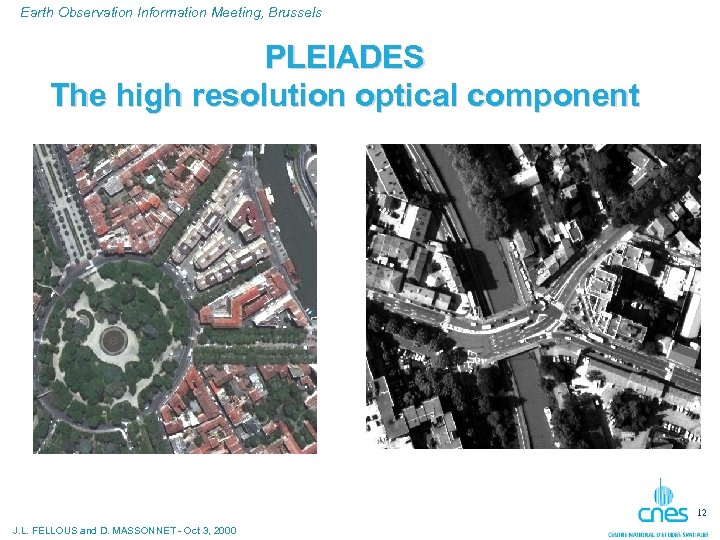
Earth Observation Information Meeting, Brussels PLEIADES The high resolution optical component 12 J. L. FELLOUS and D. MASSONNET - Oct 3, 2000
Earth Observation Information Meeting, Brussels PLEIADES The Super spectral component ð Precision farming applications ð In partnership with Aventis, Astrium, Inra, Spot Image ð Main characteristics of the space segment l l l resolution 10 to 20 m 10 to 20 spectral bands revisit time ; 2 to 8 days ð deployment logic l l l definition and validation of the various products definition and construction of a probatory system : launch 2003 definition and construction of an operationnal system : launch 2006 13 J. L. FELLOUS and D. MASSONNET - Oct 3, 2000
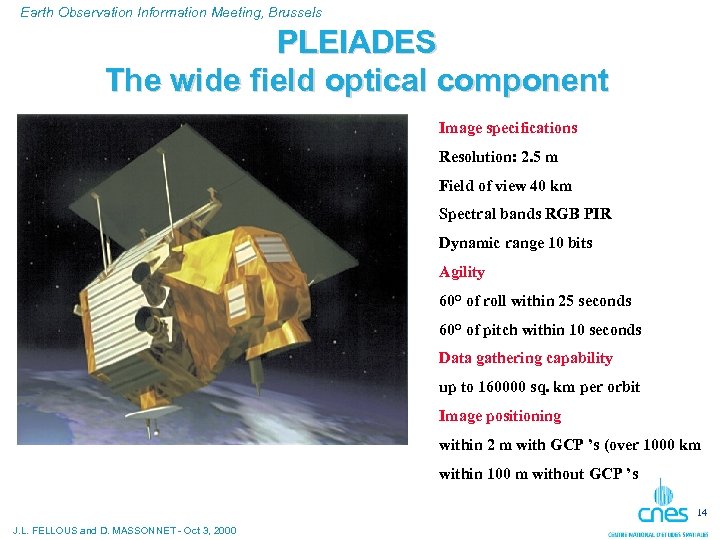
Earth Observation Information Meeting, Brussels PLEIADES The wide field optical component Image specifications Resolution: 2. 5 m Field of view 40 km Spectral bands RGB PIR Dynamic range 10 bits Agility 60° of roll within 25 seconds 60° of pitch within 10 seconds Data gathering capability up to 160000 sq. km per orbit Image positioning within 2 m with GCP ’s (over 1000 km within 100 m without GCP ’s 14 J. L. FELLOUS and D. MASSONNET - Oct 3, 2000
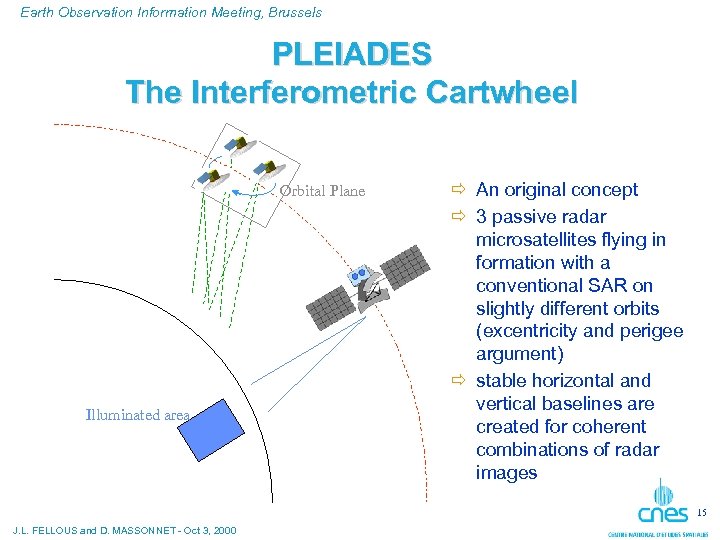
Earth Observation Information Meeting, Brussels PLEIADES The Interferometric Cartwheel Orbital Plane Illuminated area ð An original concept ð 3 passive radar microsatellites flying in formation with a conventional SAR on slightly different orbits (excentricity and perigee argument) ð stable horizontal and vertical baselines are created for coherent combinations of radar images 15 J. L. FELLOUS and D. MASSONNET - Oct 3, 2000
Earth Observation Information Meeting, Brussels PLEIADES The Interferometric Cartwheel ð Main applications l Digital Elevation Model : metric capability with a several kilometers baseline after a preliminary correction with a 30 m DEM ð Other applications l l super-resolution : up to a factor 2 with respect to the transmitter’s resolution depending on the baselines mapping of ocean currents using along track interferometry ð Planning l l l End of feasability studies ; mid 2001 first launch of ICW: 2004 (with ALOS in L-band) Exploration of an ENVISAT Cartwheel (CNES/DLR in close relation to ESA) 16 J. L. FELLOUS and D. MASSONNET - Oct 3, 2000
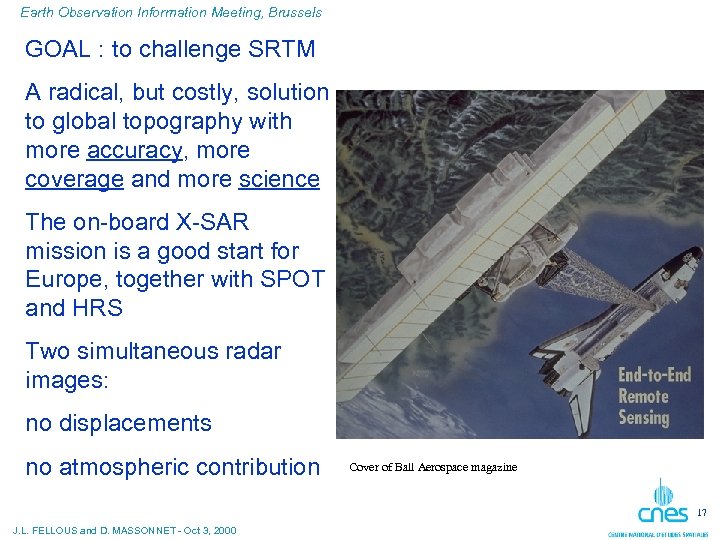
Earth Observation Information Meeting, Brussels GOAL : to challenge SRTM A radical, but costly, solution to global topography with more accuracy, more coverage and more science The on-board X-SAR mission is a good start for Europe, together with SPOT and HRS Two simultaneous radar images: no displacements no atmospheric contribution Cover of Ball Aerospace magazine 17 J. L. FELLOUS and D. MASSONNET - Oct 3, 2000
Earth Observation Information Meeting, Brussels Implementation of Earth observation in partnership with other initiatives ð Goals l l understanding the Earth system (GMES) fulfilling the observational needs of major international programs (IGOS) ð Dual Missions l l Bi-lateral cooperations (regardless of purely military missions) High Resolution Optical, High Resolution X-band Radar ð Commercial Missions l Public Private Partnership: high precision agriculture with superspectral data ð Scientific and/or technological Missions l ESA (Earth Explorer, Earthwatch…) L band radar, hyperspectral. . . ð “Operational” Missions l Various cooperations within Earthwatch, in particular with EUMETSAT 18 J. L. FELLOUS and D. MASSONNET - Oct 3, 2000
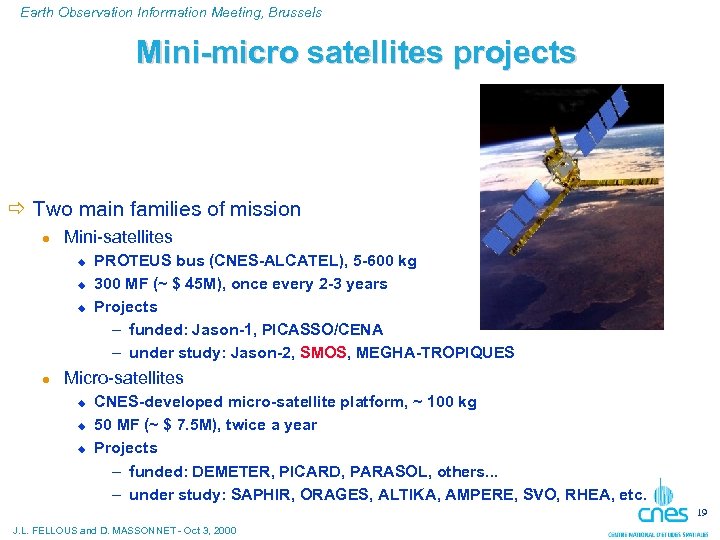
Earth Observation Information Meeting, Brussels Mini-micro satellites projects ð Two main families of mission l Mini-satellites u u u l PROTEUS bus (CNES-ALCATEL), 5 -600 kg 300 MF (~ $ 45 M), once every 2 -3 years Projects – funded: Jason-1, PICASSO/CENA – under study: Jason-2, SMOS, MEGHA-TROPIQUES Micro-satellites u u u CNES-developed micro-satellite platform, ~ 100 kg 50 MF (~ $ 7. 5 M), twice a year Projects – funded: DEMETER, PICARD, PARASOL, others. . . – under study: SAPHIR, ORAGES, ALTIKA, AMPERE, SVO, RHEA, etc. 19 J. L. FELLOUS and D. MASSONNET - Oct 3, 2000
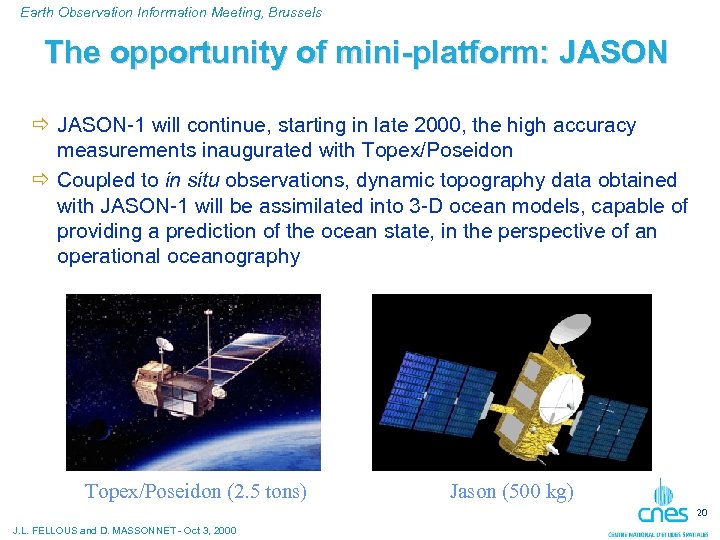
Earth Observation Information Meeting, Brussels The opportunity of mini-platform: JASON ð JASON-1 will continue, starting in late 2000, the high accuracy measurements inaugurated with Topex/Poseidon ð Coupled to in situ observations, dynamic topography data obtained with JASON-1 will be assimilated into 3 -D ocean models, capable of providing a prediction of the ocean state, in the perspective of an operational oceanography Topex/Poseidon (2. 5 tons) Jason (500 kg) 20 J. L. FELLOUS and D. MASSONNET - Oct 3, 2000
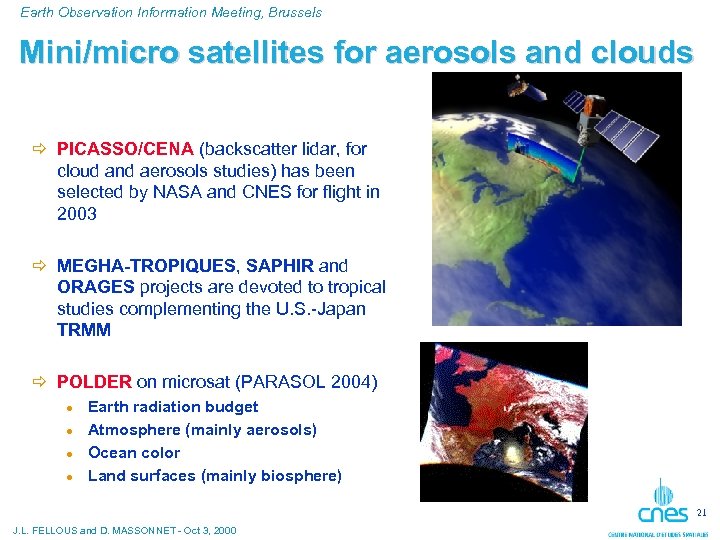
Earth Observation Information Meeting, Brussels Mini/micro satellites for aerosols and clouds ð PICASSO/CENA (backscatter lidar, for cloud and aerosols studies) has been selected by NASA and CNES for flight in 2003 ð MEGHA-TROPIQUES, SAPHIR and ORAGES projects are devoted to tropical studies complementing the U. S. -Japan TRMM ð POLDER on microsat (PARASOL 2004) l l Earth radiation budget Atmosphere (mainly aerosols) Ocean color Land surfaces (mainly biosphere) 21 J. L. FELLOUS and D. MASSONNET - Oct 3, 2000
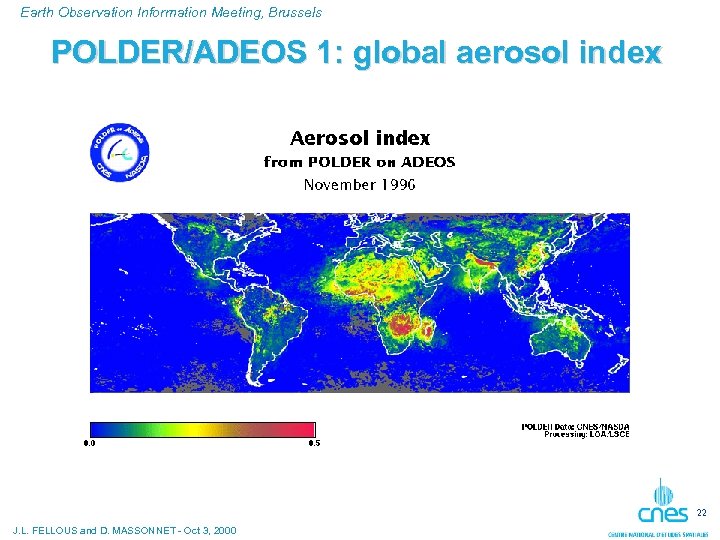
Earth Observation Information Meeting, Brussels POLDER/ADEOS 1: global aerosol index 22 J. L. FELLOUS and D. MASSONNET - Oct 3, 2000
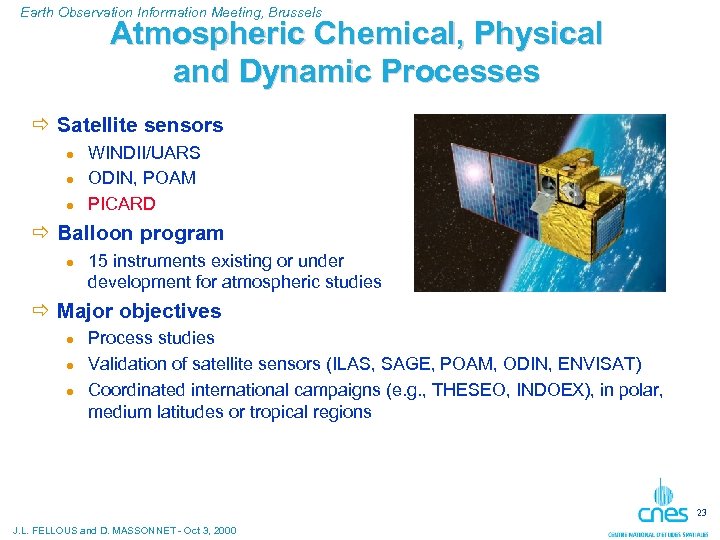
Earth Observation Information Meeting, Brussels Atmospheric Chemical, Physical and Dynamic Processes ð Satellite sensors l l l WINDII/UARS ODIN, POAM PICARD ð Balloon program l 15 instruments existing or under development for atmospheric studies ð Major objectives l l l Process studies Validation of satellite sensors (ILAS, SAGE, POAM, ODIN, ENVISAT) Coordinated international campaigns (e. g. , THESEO, INDOEX), in polar, medium latitudes or tropical regions 23 J. L. FELLOUS and D. MASSONNET - Oct 3, 2000
Earth Observation Information Meeting, Brussels PICARD ð Proposed by L. Damé, Service d’Aéronomie ð Second CNES micro-satellite (decision Oct. 1998) ð Scientific objectives : l climatology u u l influence of solar forcing on earth climate relationship between Sun diameter and constant Solar physics and internal structure ð Payload (30 kg): l l SODISM: imaging telescope (CCD 2048 x 2048) to mesure (at 1 mas) the solar diameter differential radiometer SOVAP (Belgian contribution) and photometers UVSPM (Swiss contribution) to measure the absolute solar constant ð Launch late 2003 -early 2004 ð Sunsynchronous orbit (660 km, 98°, 6 h-18 h) 24 J. L. FELLOUS and D. MASSONNET - Oct 3, 2000
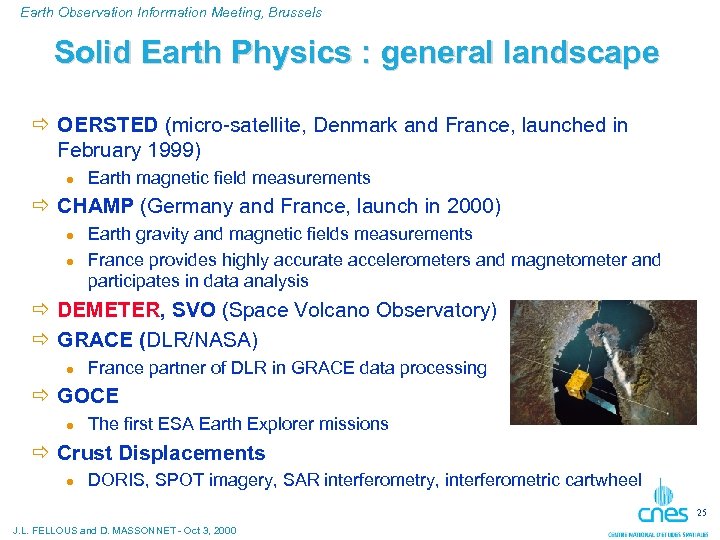
Earth Observation Information Meeting, Brussels Solid Earth Physics : general landscape ð OERSTED (micro-satellite, Denmark and France, launched in February 1999) l Earth magnetic field measurements ð CHAMP (Germany and France, launch in 2000) l l Earth gravity and magnetic fields measurements France provides highly accurate accelerometers and magnetometer and participates in data analysis ð DEMETER, SVO (Space Volcano Observatory) ð GRACE (DLR/NASA) l France partner of DLR in GRACE data processing ð GOCE l The first ESA Earth Explorer missions ð Crust Displacements l DORIS, SPOT imagery, SAR interferometry, interferometric cartwheel 25 J. L. FELLOUS and D. MASSONNET - Oct 3, 2000
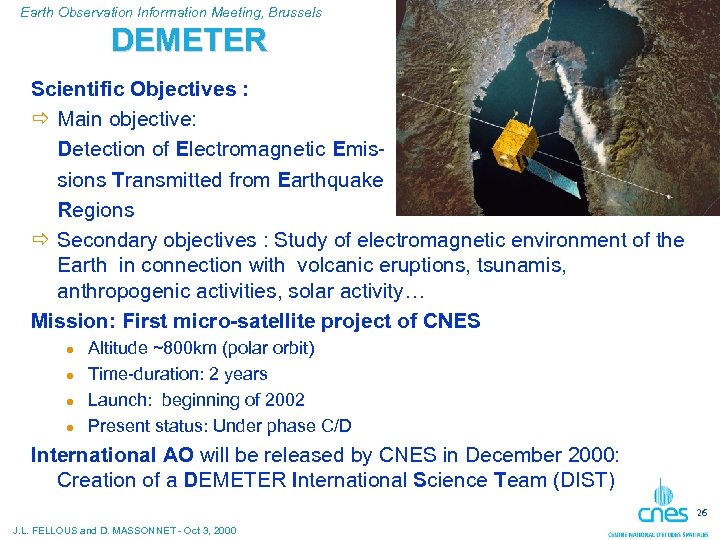
Earth Observation Information Meeting, Brussels DEMETER Scientific Objectives : ð Main objective: Detection of Electromagnetic Emissions Transmitted from Earthquake Regions ð Secondary objectives : Study of electromagnetic environment of the Earth in connection with volcanic eruptions, tsunamis, anthropogenic activities, solar activity… Mission: First micro-satellite project of CNES l l Altitude ~800 km (polar orbit) Time-duration: 2 years Launch: beginning of 2002 Present status: Under phase C/D International AO will be released by CNES in December 2000: Creation of a DEMETER International Science Team (DIST) 26 J. L. FELLOUS and D. MASSONNET - Oct 3, 2000
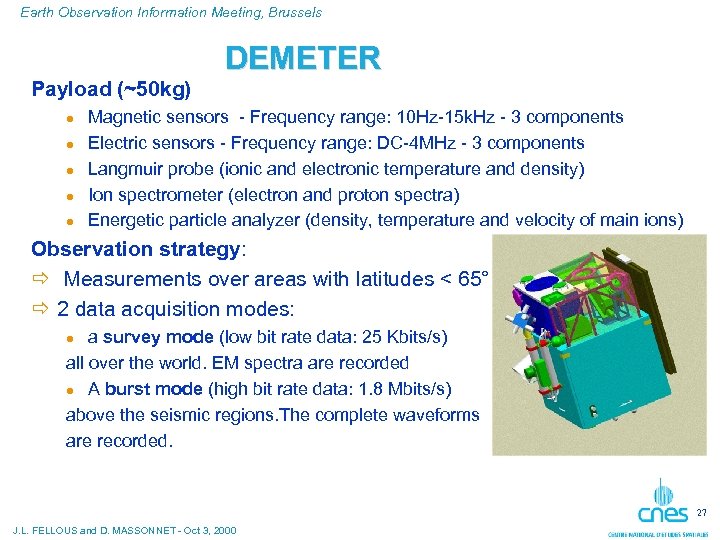
Earth Observation Information Meeting, Brussels DEMETER Payload (~50 kg) l l l Magnetic sensors - Frequency range: 10 Hz-15 k. Hz - 3 components Electric sensors - Frequency range: DC-4 MHz - 3 components Langmuir probe (ionic and electronic temperature and density) Ion spectrometer (electron and proton spectra) Energetic particle analyzer (density, temperature and velocity of main ions) Observation strategy: ð Measurements over areas with latitudes < 65°. ð 2 data acquisition modes: a survey mode (low bit rate data: 25 Kbits/s) all over the world. EM spectra are recorded l A burst mode (high bit rate data: 1. 8 Mbits/s) above the seismic regions. The complete waveforms are recorded. l 27 J. L. FELLOUS and D. MASSONNET - Oct 3, 2000
Earth Observation Information Meeting, Brussels Last but not least : ground segment ð A dedicated ground segment for data processing and information production is a fundamental part of any Earth Observation program ð CNES policy l l Mandate: process all data up to level 2, although hardly sufficient Work with user organizations, in France and abroad, to ensure proper development, production and delivery of higher-level products to science and applications users ð Examples: l l Ocean altimetry data system for Topex/Poseidon, ERS, ENVISAT Atmospheric chemistry data system for UARS, ENVISAT, balloon campaigns Clouds and aerosols data system for POLDER, Sca. Ra. B, IASI, PICASSOCENA, etc. ALOS Data European Node (ADEN) 28 J. L. FELLOUS and D. MASSONNET - Oct 3, 2000
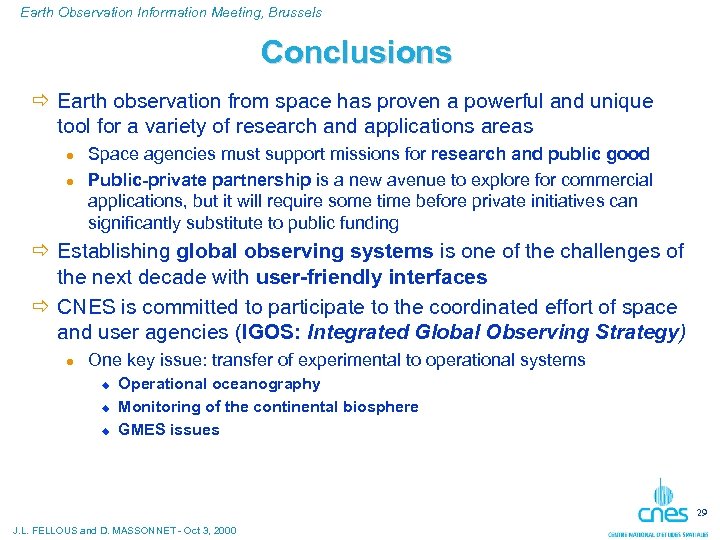
Earth Observation Information Meeting, Brussels Conclusions ð Earth observation from space has proven a powerful and unique tool for a variety of research and applications areas l l Space agencies must support missions for research and public good Public-private partnership is a new avenue to explore for commercial applications, but it will require some time before private initiatives can significantly substitute to public funding ð Establishing global observing systems is one of the challenges of the next decade with user-friendly interfaces ð CNES is committed to participate to the coordinated effort of space and user agencies (IGOS: Integrated Global Observing Strategy) l One key issue: transfer of experimental to operational systems u u u Operational oceanography Monitoring of the continental biosphere GMES issues 29 J. L. FELLOUS and D. MASSONNET - Oct 3, 2000
Скачать презентацию Earth Observation Information Meeting Brussels SPOT 4 SPOT
8d8a79868e9dac3ad98f60b88ac4b0e4.ppt