 Скачать презентацию Earth Observation in Brasil Data and Applications Ministério
41bce201c483bbb7013daad8e739c730.ppt
- Количество слайдов: 89



Earth Observation in Brasil: Data and Applications Ministério da Ciência e Tecnologia
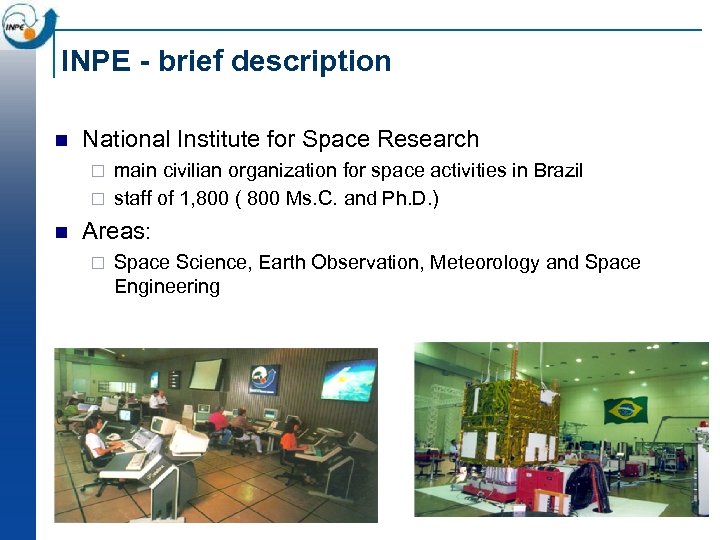
INPE - brief description n National Institute for Space Research main civilian organization for space activities in Brazil ¨ staff of 1, 800 ( 800 Ms. C. and Ph. D. ) ¨ n Areas: ¨ Space Science, Earth Observation, Meteorology and Space Engineering
Earth Observation at INPE n Remote Sensing Ground Station n CBERS Chinese Brazilian Satellite n Remote Sensing Data Centre n Remote Sensing Research and Applications n GIS Technology Research and Applications n Environmental Modelling
Remote Sensing Ground Station Ministério da Ciência e Tecnologia
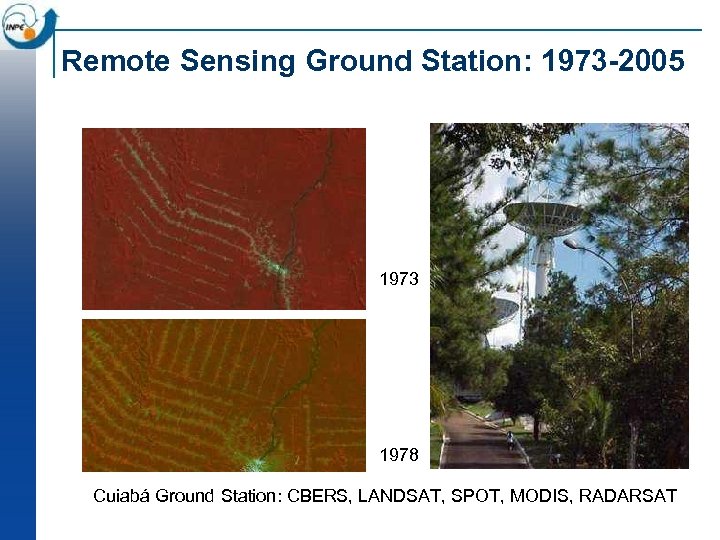
Remote Sensing Ground Station: 1973 -2005 1973 1978 Cuiabá Ground Station: CBERS, LANDSAT, SPOT, MODIS, RADARSAT
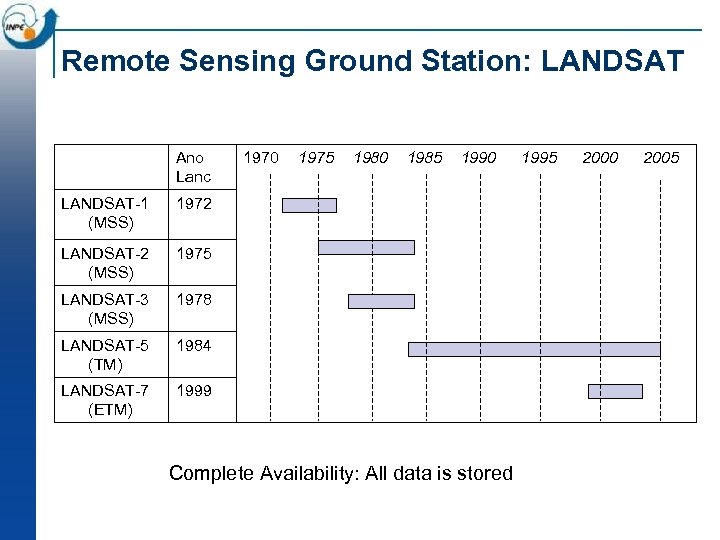
Remote Sensing Ground Station: LANDSAT Ano Lanc LANDSAT 1 (MSS) 1990 1984 LANDSAT 7 (ETM) 1985 1978 LANDSAT 5 (TM) 1980 1975 LANDSAT 3 (MSS) 1975 1972 LANDSAT 2 (MSS) 1970 1999 Complete Availability: All data is stored 1995 2000 2005
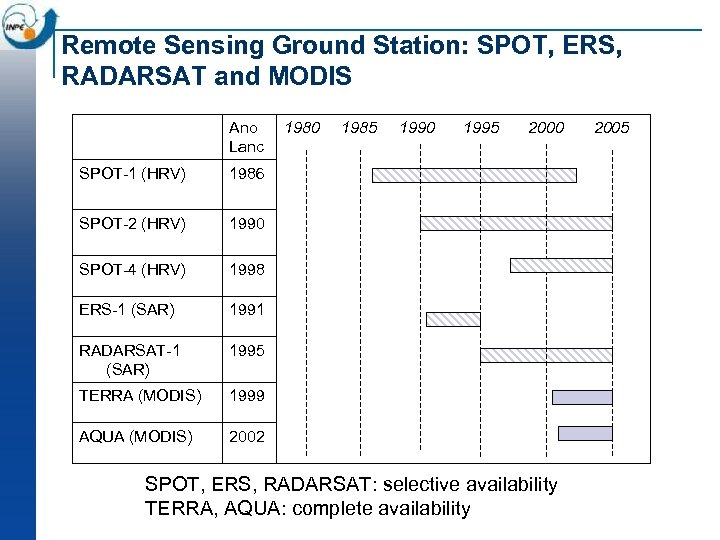
Remote Sensing Ground Station: SPOT, ERS, RADARSAT and MODIS Ano Lanc SPOT 1 (HRV) 1995 TERRA (MODIS) 1999 AQUA (MODIS) 2000 1991 RADARSAT 1 (SAR) 1995 1998 ERS 1 (SAR) 1990 SPOT 4 (HRV) 1985 1986 SPOT 2 (HRV) 1980 2002 SPOT, ERS, RADARSAT: selective availability TERRA, AQUA: complete availability 2005
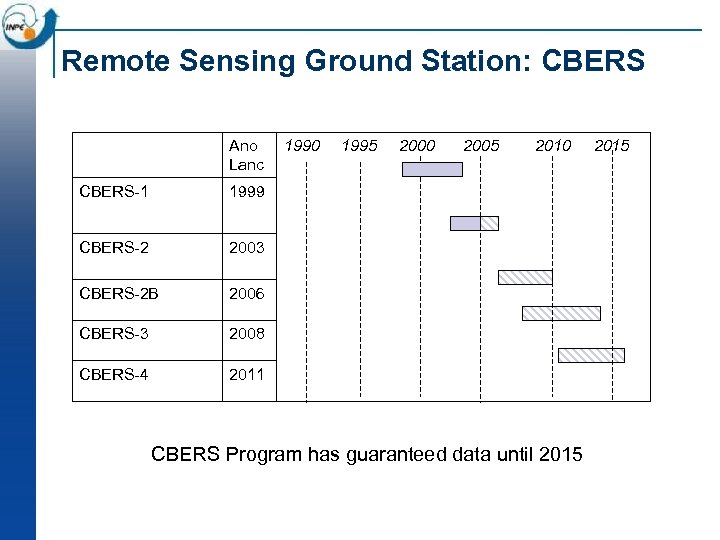
Remote Sensing Ground Station: CBERS Ano Lanc CBERS 1 2010 2008 CBERS 4 2005 2006 CBERS 3 2000 2003 CBERS 2 B 1995 1999 CBERS 2 1990 2011 CBERS Program has guaranteed data until 2015
Remote Sensing Ground Station: Current Situation n In Operation CBERS 2 ¨ LANDSAT 5 ¨ AQUA, TERRA (MODIS) ¨ n Additional Capability RADARSAT 1 ¨ SPOT 2, SPOT 4 ¨
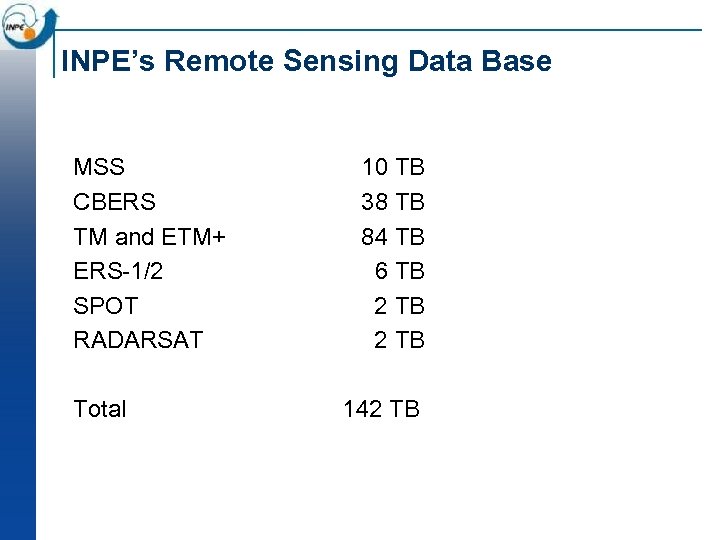
INPE’s Remote Sensing Data Base MSS CBERS TM and ETM+ ERS 1/2 SPOT RADARSAT Total 10 TB 38 TB 84 TB 6 TB 2 TB 142 TB
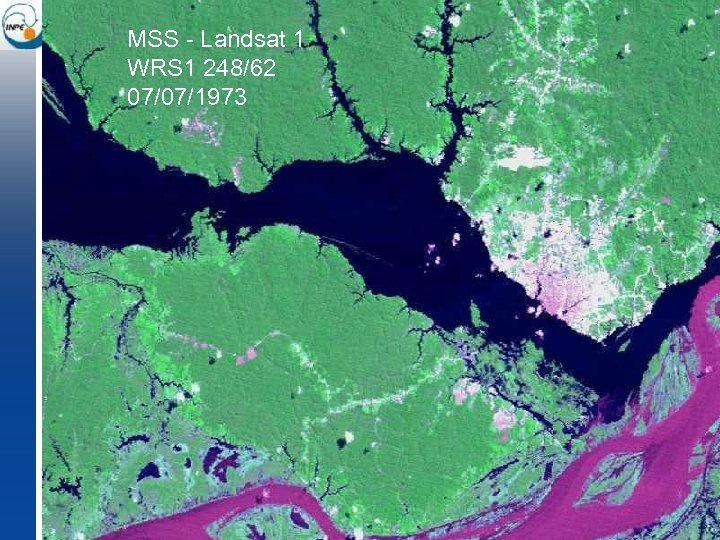
MSS Landsat 1 WRS 1 248/62 07/07/1973
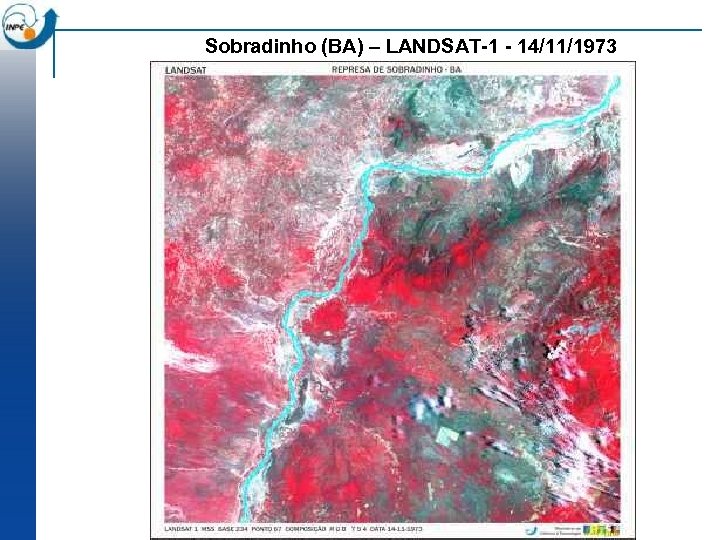
Sobradinho (BA) – LANDSAT-1 - 14/11/1973
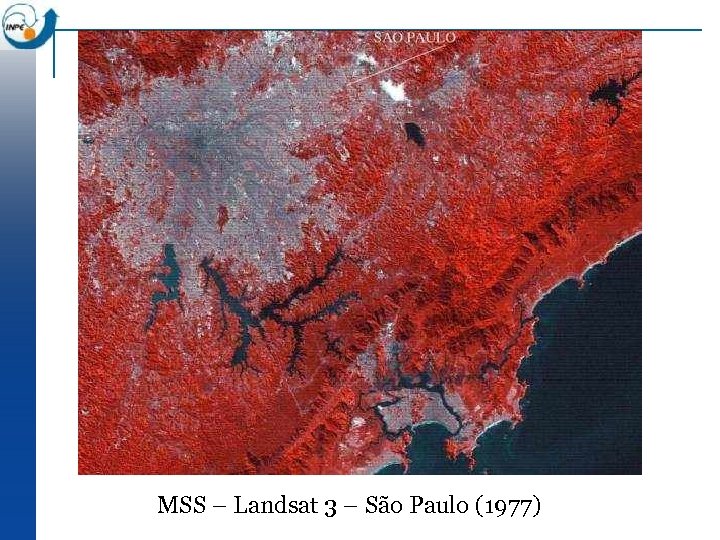
MSS – Landsat 3 – São Paulo (1977)
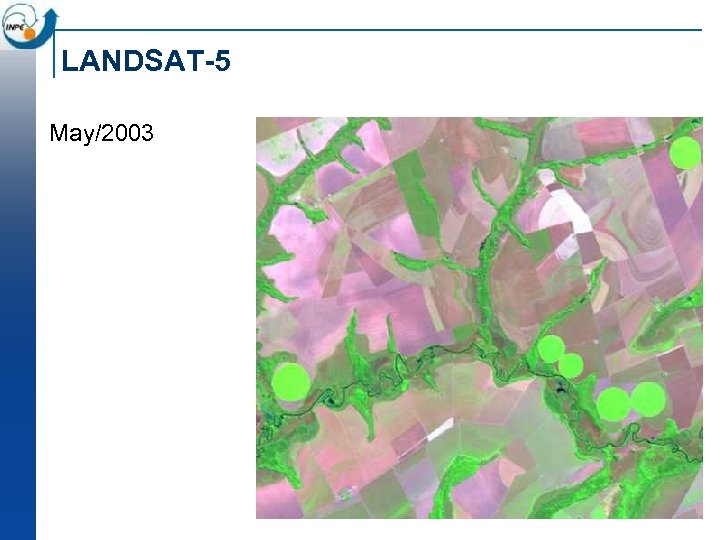
LANDSAT-5 May/2003
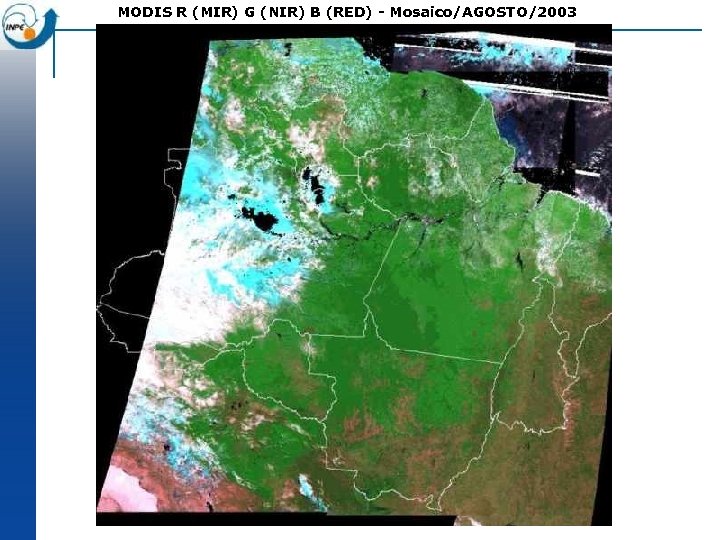
MODIS R (MIR) G (NIR) B (RED) - Mosaico/AGOSTO/2003
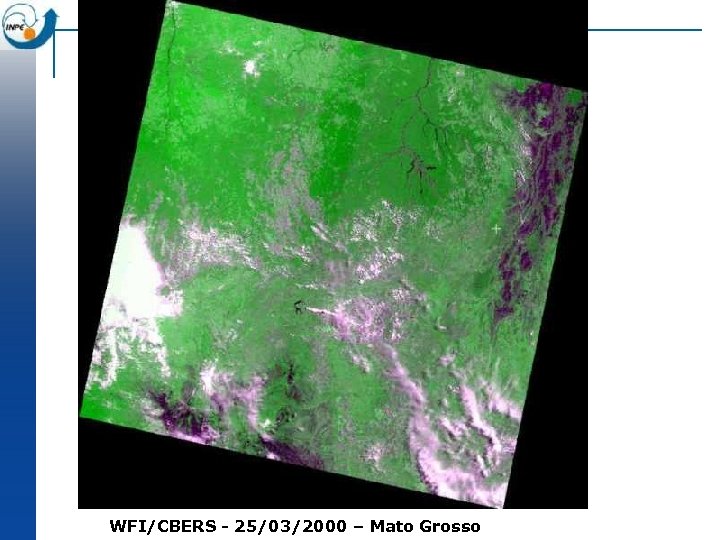
WFI/CBERS - 25/03/2000 – Mato Grosso
CBERS Program: An Overview Ministério da Ciência e Tecnologia
CBERS: China-Brazil Earth Resources Satellite n Brief History Initial agreement signed in July 6 th, 1988, covering CBERS 1 and 2. ¨ In 2002, both governments decided to expand the initial agreement by including CBERS 3 and 4. ¨ n Program objectives Build a family of remote sensing satellites to support the needs of users in earth resources applications ¨ Improve the industrial capabilities of space technology in Brazil and China ¨
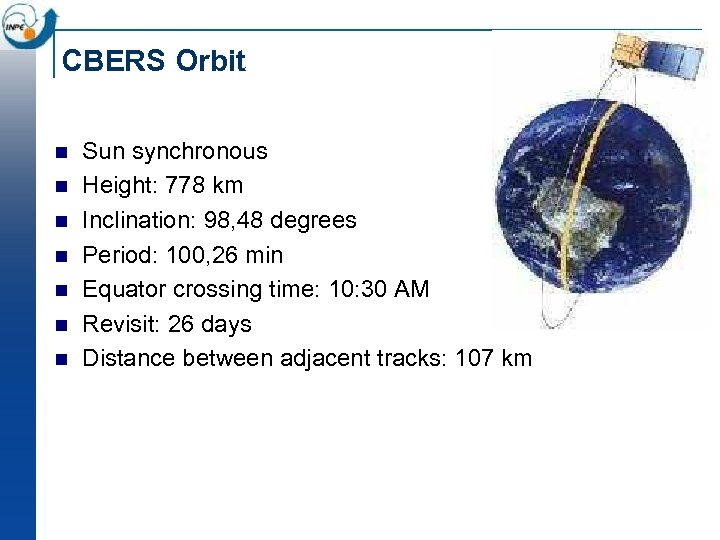
CBERS Orbit n n n n Sun synchronous Height: 778 km Inclination: 98, 48 degrees Period: 100, 26 min Equator crossing time: 10: 30 AM Revisit: 26 days Distance between adjacent tracks: 107 km
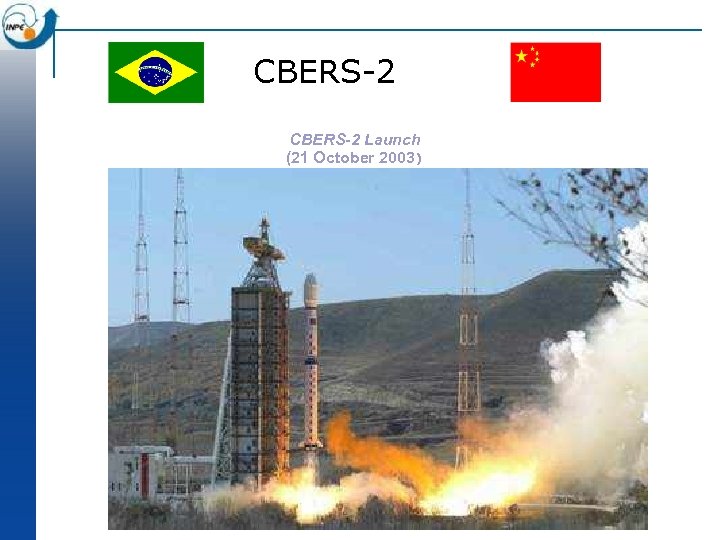
CBERS-2 Launch (21 October 2003)
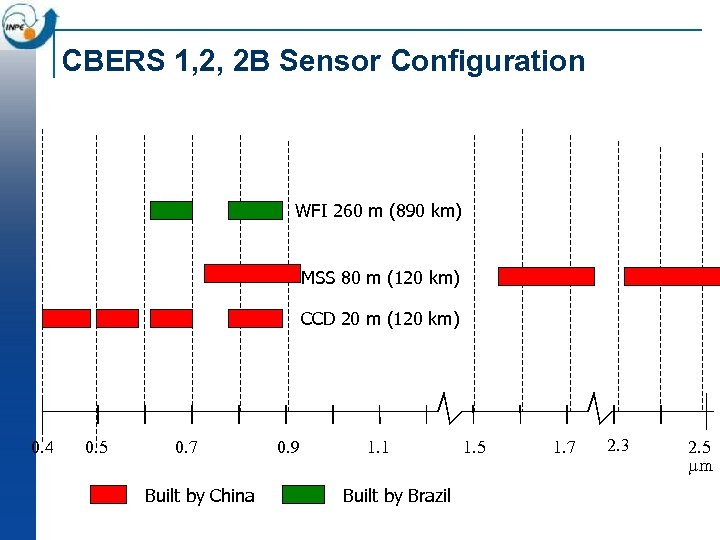
CBERS 1, 2, 2 B Sensor Configuration WFI 260 m (890 km) MSS 80 m (120 km) CCD 20 m (120 km) 0. 4 0. 5 0. 7 Built by China 0. 9 1. 1 Built by Brazil 1. 5 1. 7 2. 3 2. 5 mm
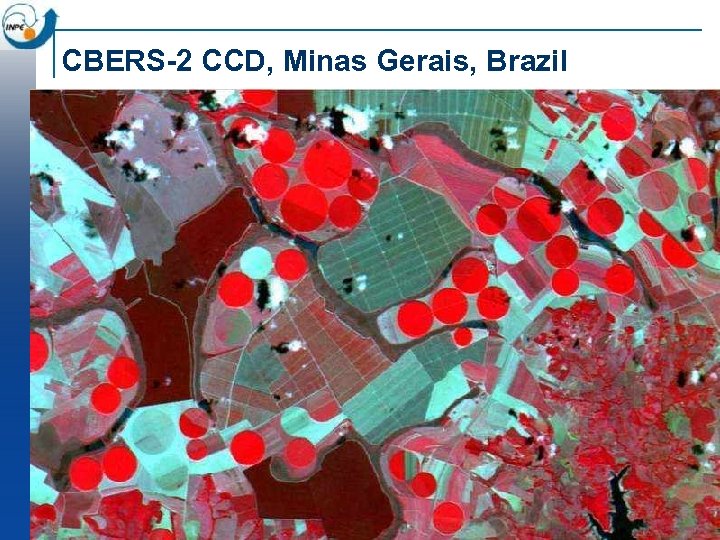
CBERS-2 CCD, Minas Gerais, Brazil
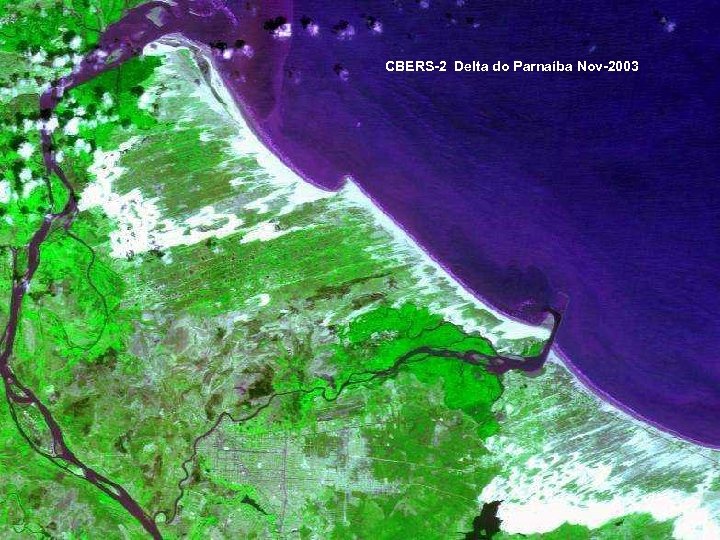
CBERS-2 Delta do Parnaíba Nov-2003
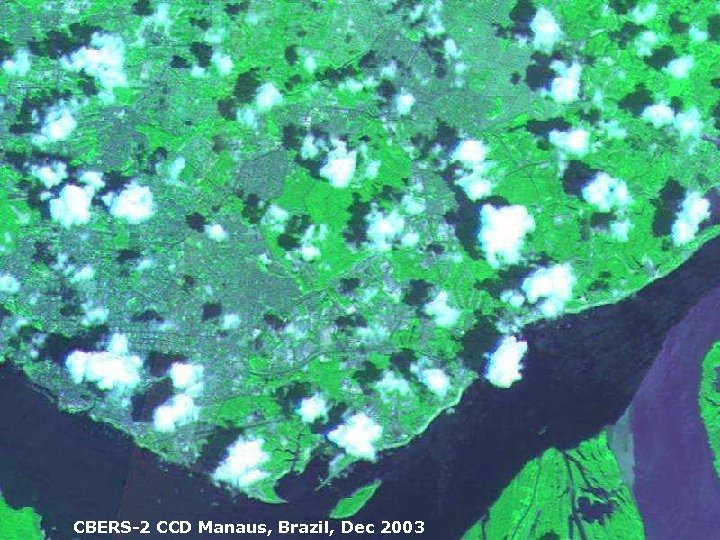
CBERS-2 CCD Manaus, Brazil, Dec 2003
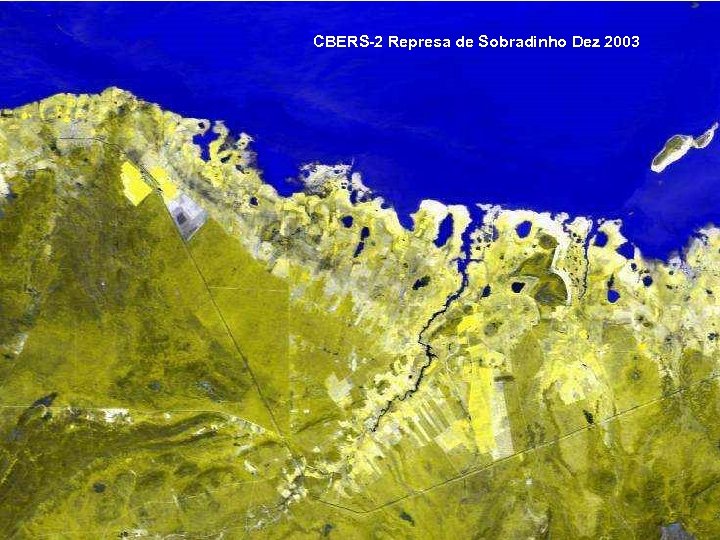
CBERS-2 Represa de Sobradinho Dez 2003
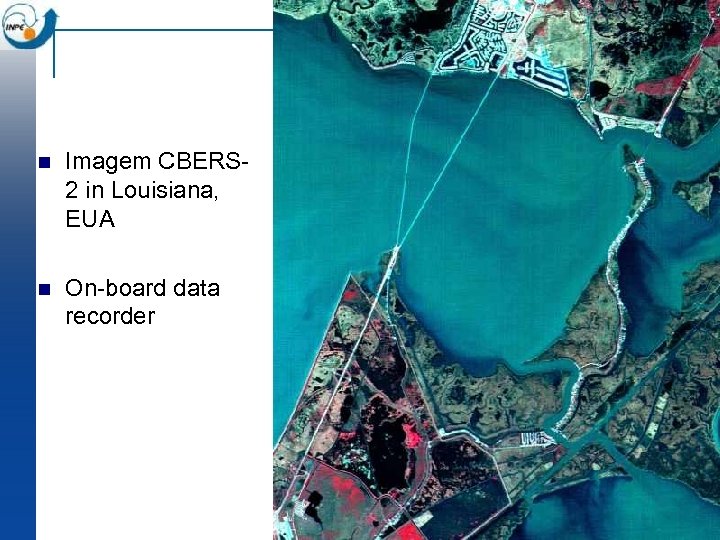
n Imagem CBERS 2 in Louisiana, EUA n On board data recorder
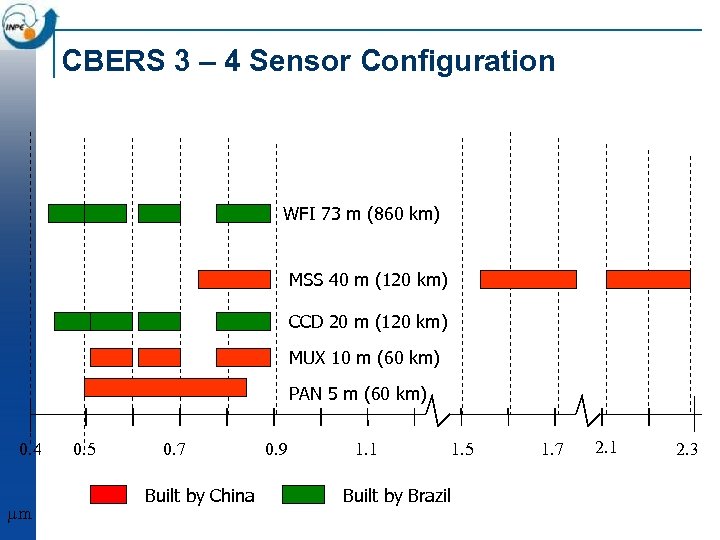
CBERS 3 – 4 Sensor Configuration WFI 73 m (860 km) MSS 40 m (120 km) CCD 20 m (120 km) MUX 10 m (60 km) PAN 5 m (60 km) 0. 4 mm 0. 5 0. 7 Built by China 0. 9 1. 1 Built by Brazil 1. 5 1. 7 2. 1 2. 3
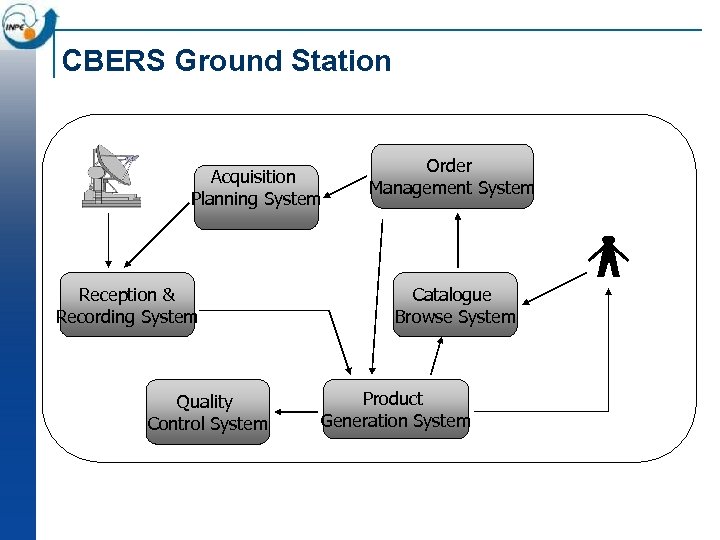
CBERS Ground Station Acquisition Planning System Reception & Recording System Quality Control System Order Management System Catalogue Browse System Product Generation System
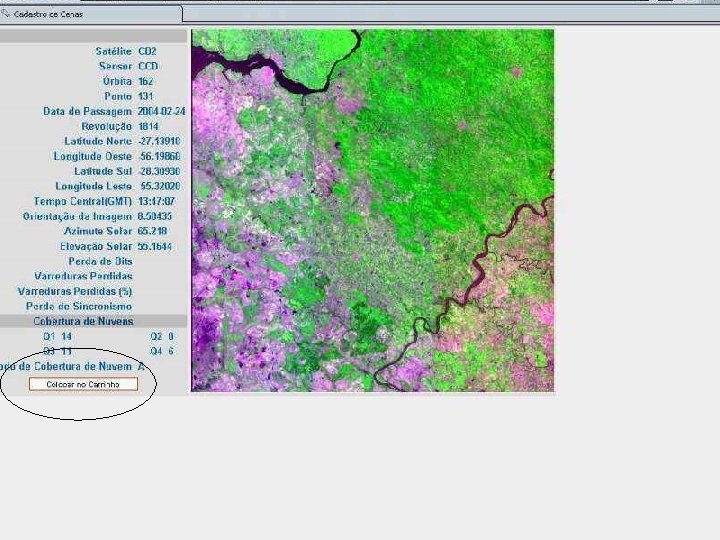
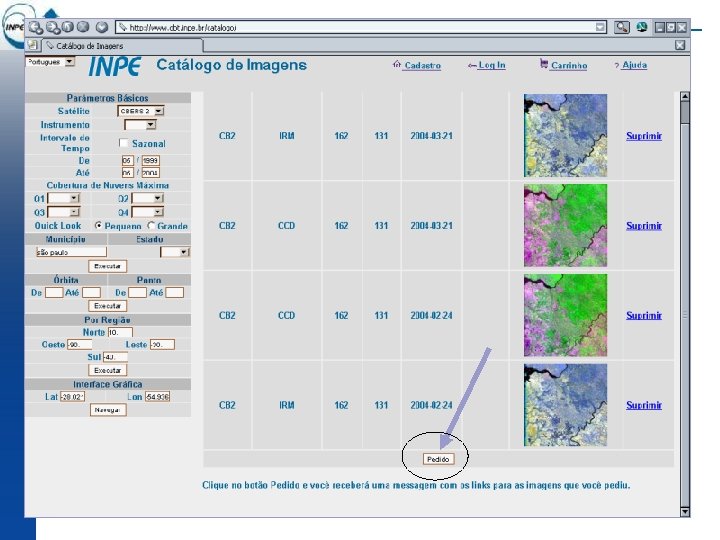
CBERS Ground Station in Brazil n Developed by Brazilian company and INPE ¨ n Major cost saving User centered design User requests products in a web interface ¨ Products are generated automatically ¨ User can download products via FTP ¨ n Efficiency and scalability Based on low cost Linux PCs ¨ Totally automated, no operator intervention ¨
Data Policy for CBERS n The downlink data is open to any country or organization. n The data downlink for CBERS will be carried out through a ground station. n China and Brazil may, in a few special cases, upon mutual consultation, decide on the transfer of data free of charge. n The revenues resulting from the distribution of CBERS data will be equally shared between China and Brazil.
Policy for CBERS International Data Downlink n Access fee is charged on a LANDSAT like basis ¨ One flat annual fee for complete access to all data in the antenna’s footprint n Distribution in areas within the antenna’s footprint is the responsibility of the ground station operator n There is no additional charge for image distribution n Ground station operators are encouraged to distribute CBERS data free of charge on the Web
Remote Sensing Data Centre Ministério da Ciência e Tecnologia
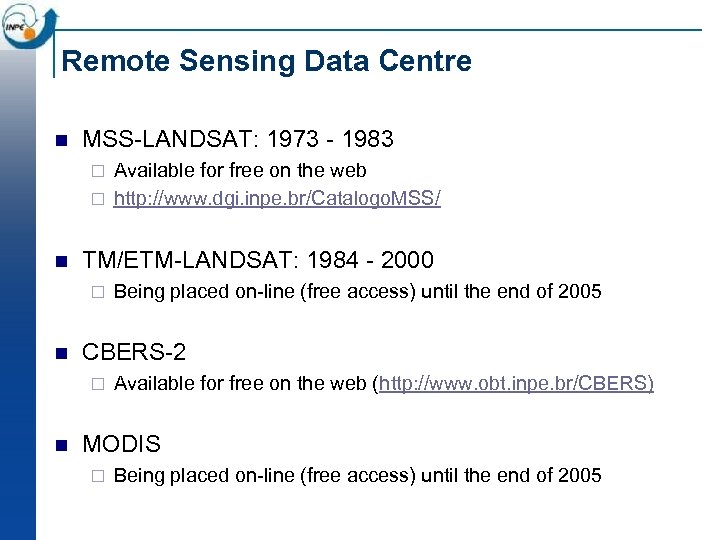
Remote Sensing Data Centre n MSS LANDSAT: 1973 1983 Available for free on the web ¨ http: //www. dgi. inpe. br/Catalogo. MSS/ ¨ n TM/ETM LANDSAT: 1984 2000 ¨ n CBERS 2 ¨ n Being placed on line (free access) until the end of 2005 Available for free on the web (http: //www. obt. inpe. br/CBERS) MODIS ¨ Being placed on line (free access) until the end of 2005
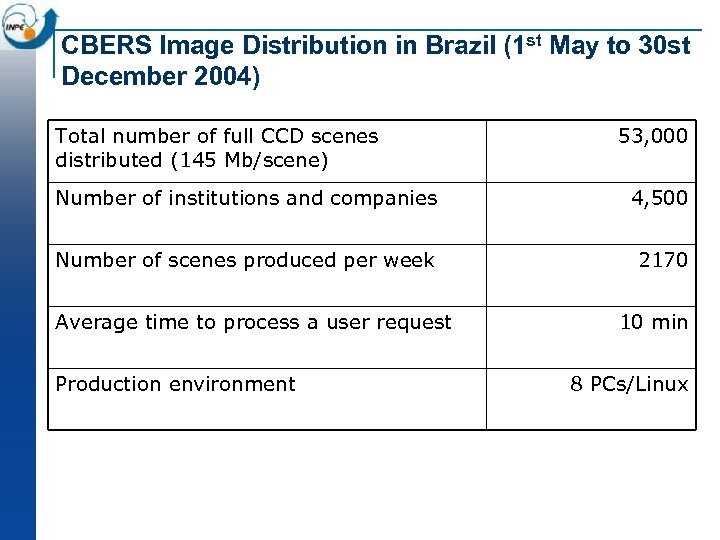
CBERS Image Distribution in Brazil (1 st May to 30 st December 2004) Total number of full CCD scenes distributed (145 Mb/scene) 53, 000 Number of institutions and companies 4, 500 Number of scenes produced per week 2170 Average time to process a user request Production environment 10 min 8 PCs/Linux
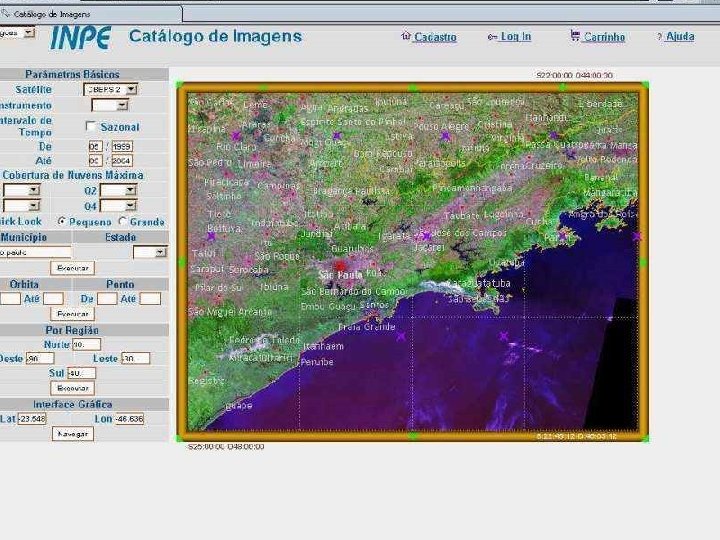
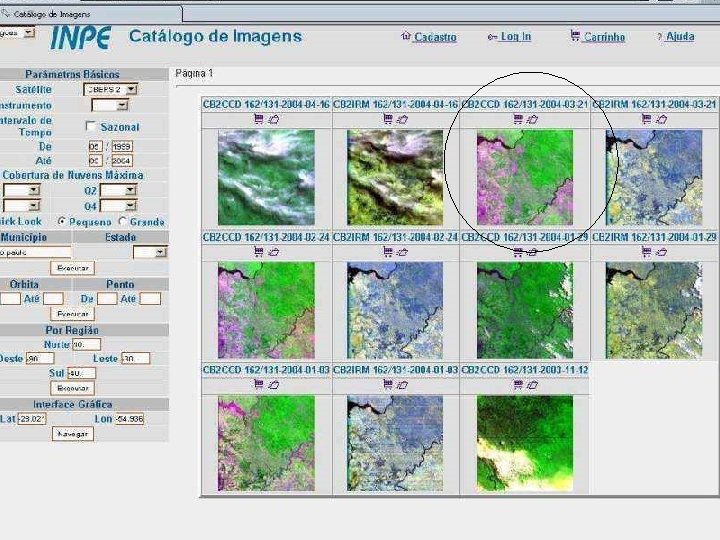
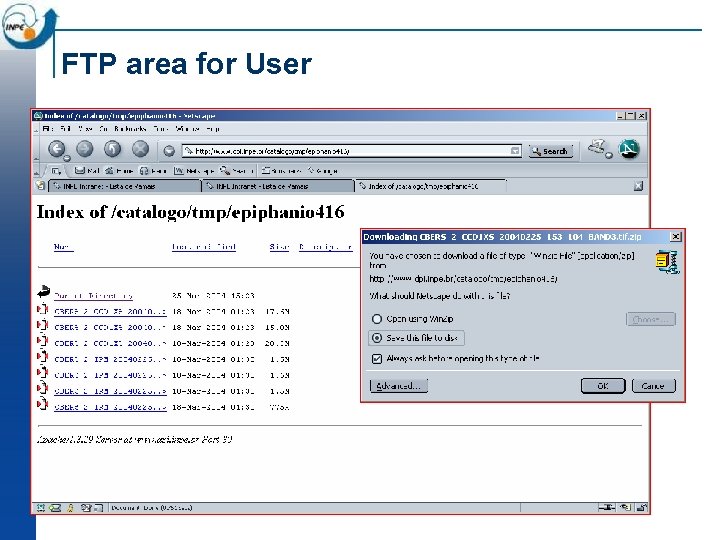
FTP area for User
Remote Sensing Research and Applications Ministério da Ciência e Tecnologia
Remote Sensing Teaching at INPE n Graduate Program in Remote Sensing (Ms. C and Ph. D) ¨ n Short Courses in GIS and Remote Sensing (40 h) ¨ n www. dpi. inpe. br/cursos Establishment of a distance learning program in GIS and Remote Sensing ¨ n 300+ graduate students ALFA project (EU funded) On line material (books, overheads)
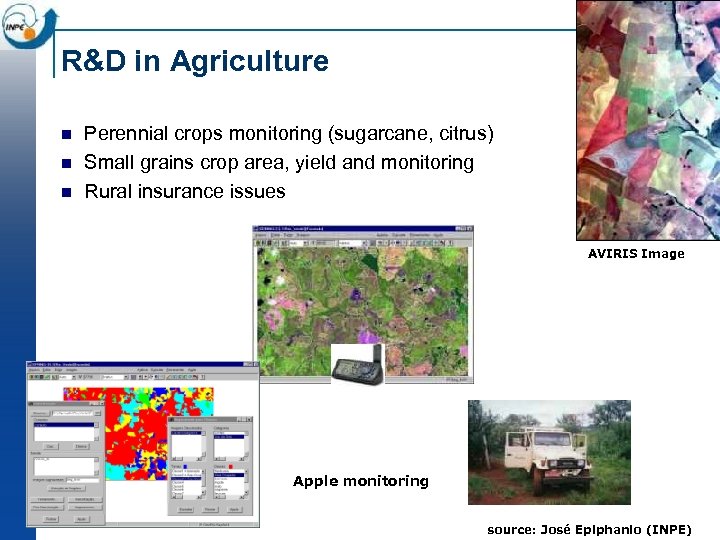
R&D in Agriculture n n n Perennial crops monitoring (sugarcane, citrus) Small grains crop area, yield and monitoring Rural insurance issues AVIRIS Image Apple monitoring source: José Epiphanio (INPE)
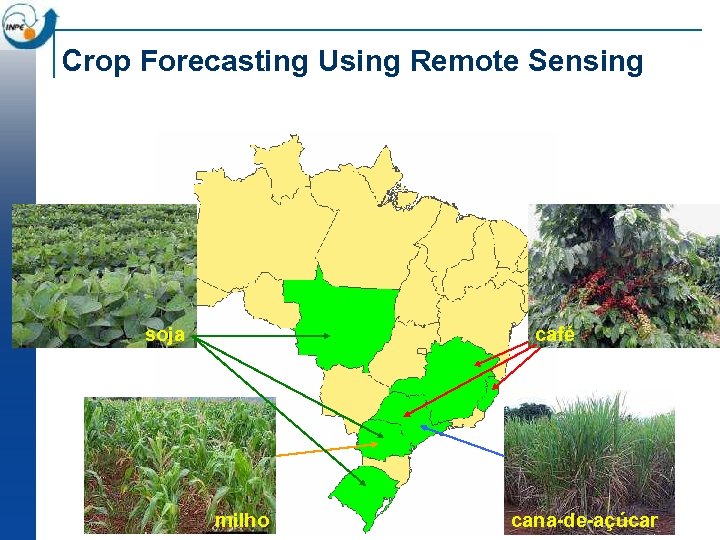
Crop Forecasting Using Remote Sensing soja café milho cana-de-açúcar
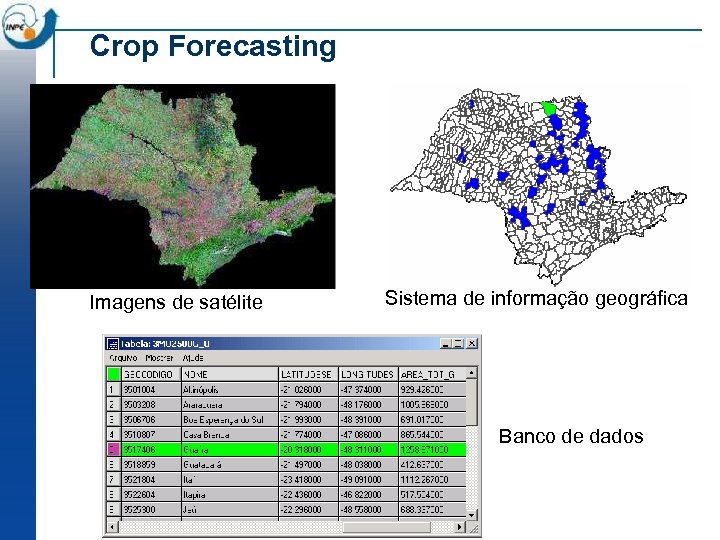
Crop Forecasting Imagens de satélite Sistema de informação geográfica Banco de dados
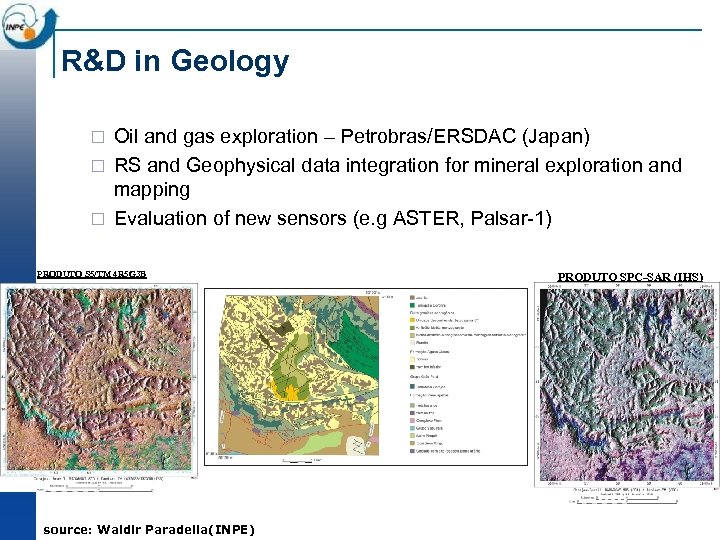
R&D in Geology Oil and gas exploration – Petrobras/ERSDAC (Japan) ¨ RS and Geophysical data integration for mineral exploration and mapping ¨ Evaluation of new sensors (e. g ASTER, Palsar 1) ¨ PRODUTO S 5/TM 4 R 5 G 3 B source: Waldir Paradella(INPE) PRODUTO SPC-SAR (IHS)
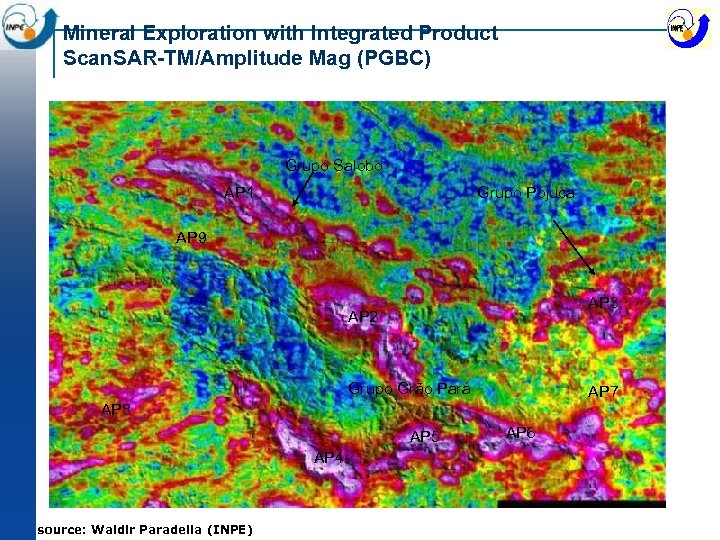
Mineral Exploration with Integrated Product Scan. SAR-TM/Amplitude Mag (PGBC) Grupo Salobo AP 1 Grupo Pojuca AP 9 AP 3 AP 2 Grupo Grão Pará AP 7 AP 8 AP 5 AP 4 source: Waldir Paradella (INPE) AP 6
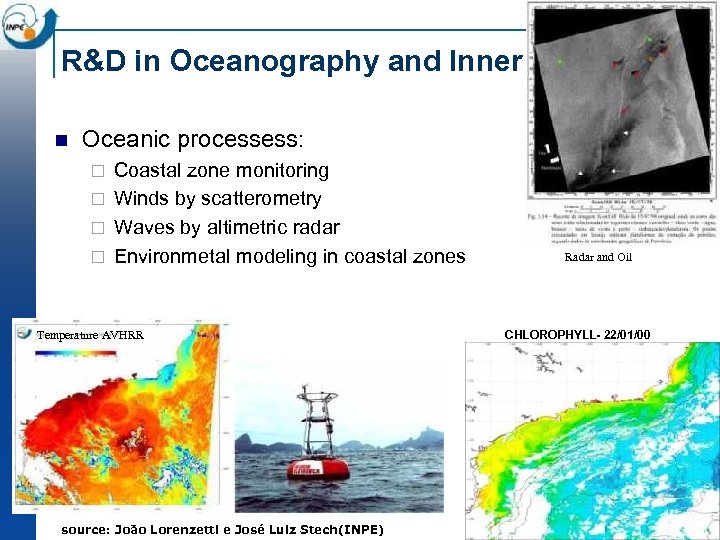
R&D in Oceanography and Inner Water n Oceanic processess: Coastal zone monitoring ¨ Winds by scatterometry ¨ Waves by altimetric radar ¨ Environmetal modeling in coastal zones ¨ Temperature AVHRR source: João Lorenzetti e José Luiz Stech(INPE) Radar and Oil CHLOROPHYLL- 22/01/00
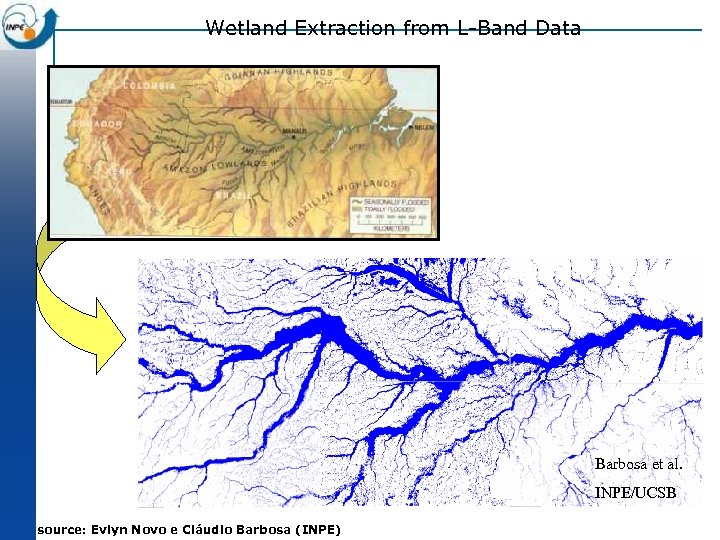
Wetland Extraction from L-Band Data Ica Manaus Santarem Barbosa et al. INPE/UCSB Jurua source: Evlyn Novo e Cláudio Barbosa (INPE) Purus Tapajós
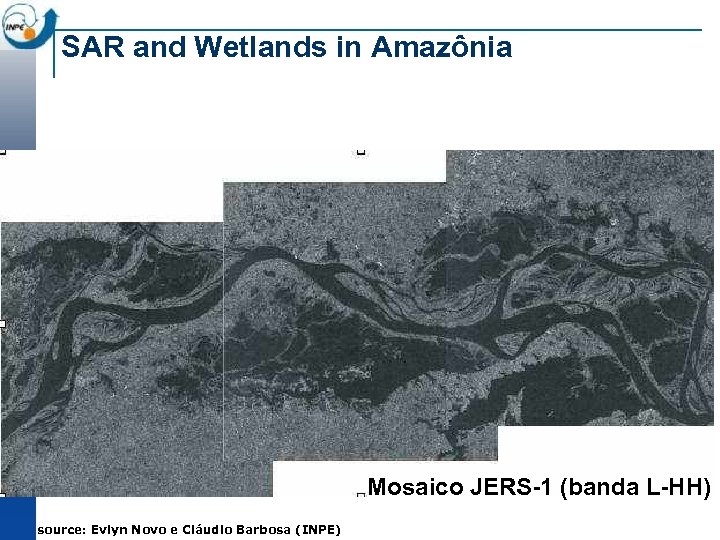
SAR and Wetlands in Amazônia Mosaico JERS-1 (banda L-HH) source: Evlyn Novo e Cláudio Barbosa (INPE)
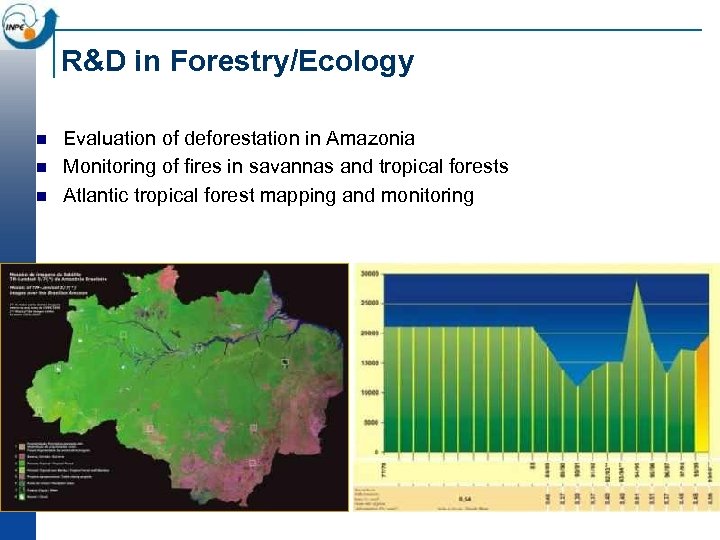
R&D in Forestry/Ecology n n n Evaluation of deforestation in Amazonia Monitoring of fires in savannas and tropical forests Atlantic tropical forest mapping and monitoring
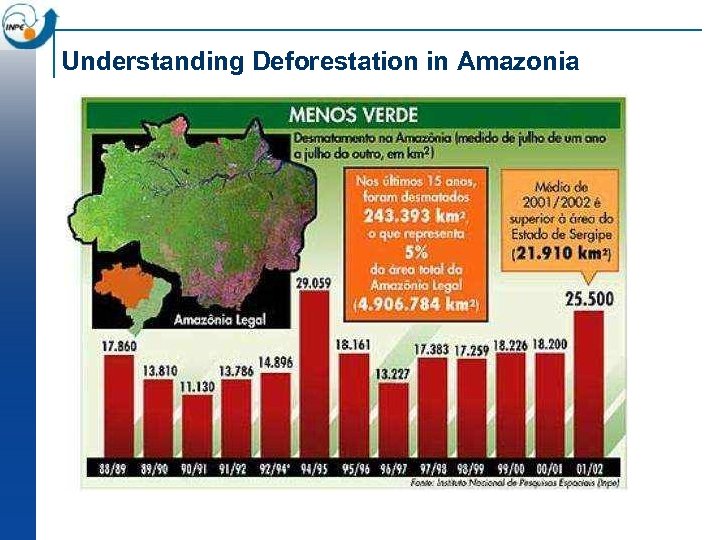
Understanding Deforestation in Amazonia
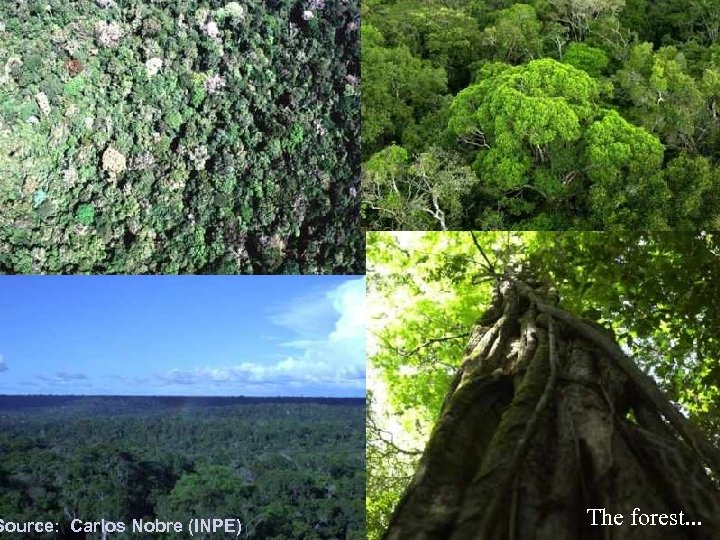
Source: Carlos Nobre (INPE) The forest. . .
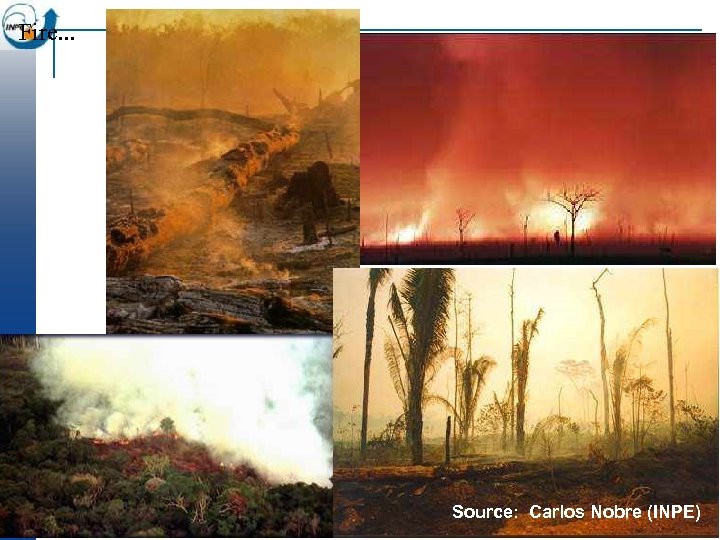
Fire. . . Source: Carlos Nobre (INPE)
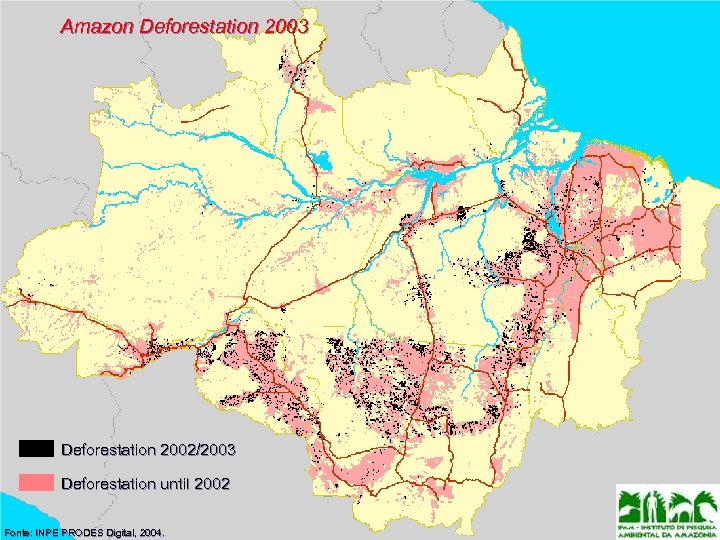
Amazon Deforestation 2003 Deforestation 2002/2003 Deforestation until 2002 Fonte: INPE PRODES Digital, 2004.
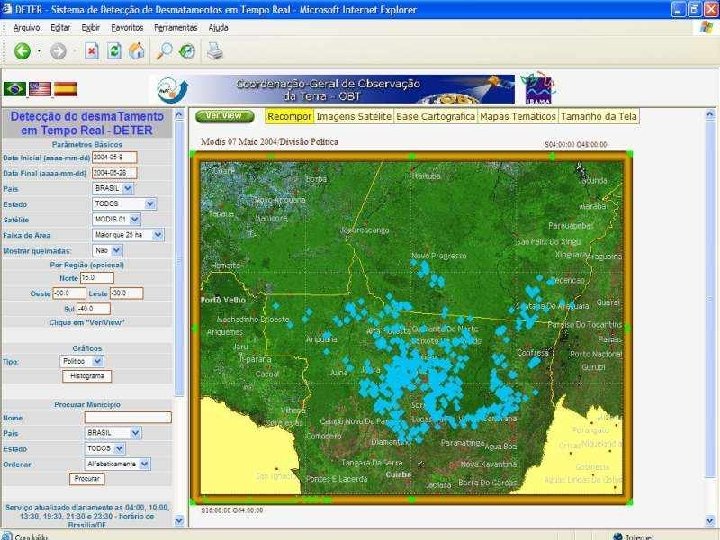
DETER Real Time Monitoring of Amazon Deforestation http: //www. obt. inpe. br/deter/
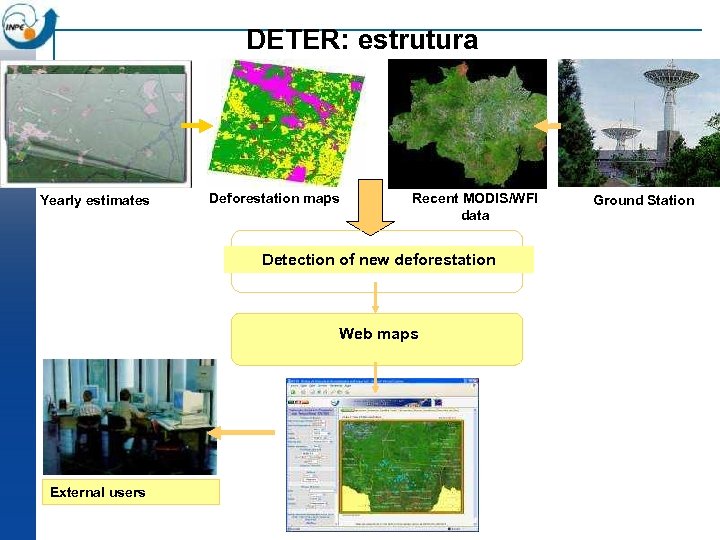
DETER: estrutura Yearly estimates Deforestation maps Recent MODIS/WFI data Detection of new deforestation Web maps External users Ground Station
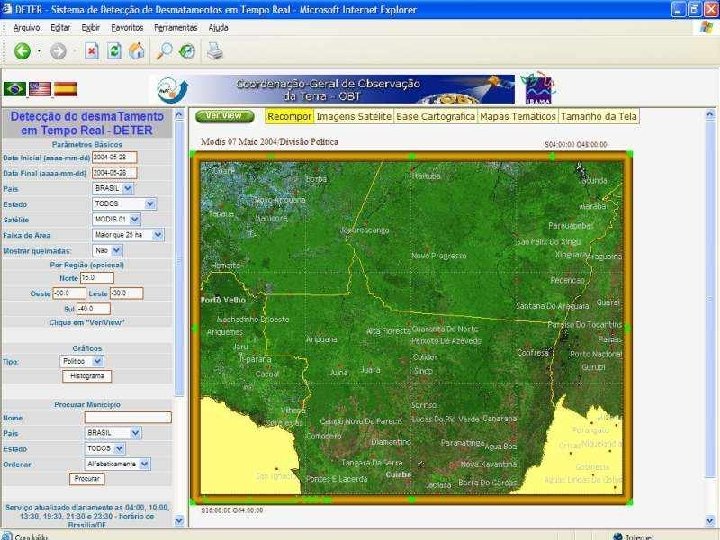
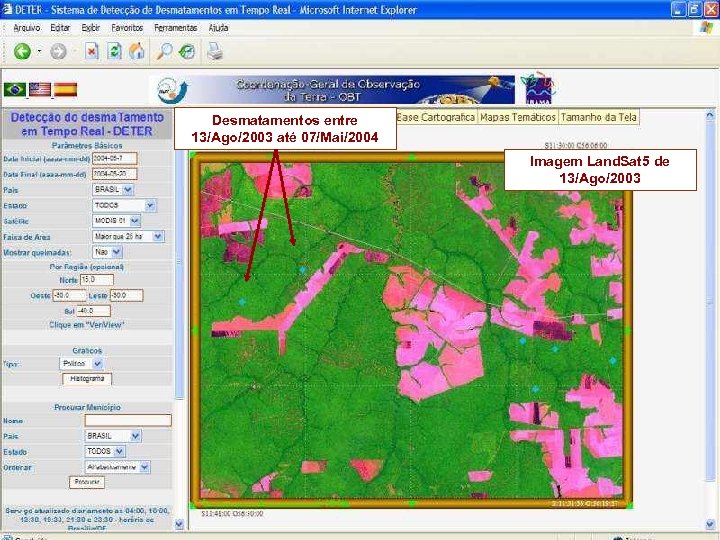
Desmatamentos entre 13/Ago/2003 até 07/Mai/2004 Imagem Land. Sat 5 de 13/Ago/2003
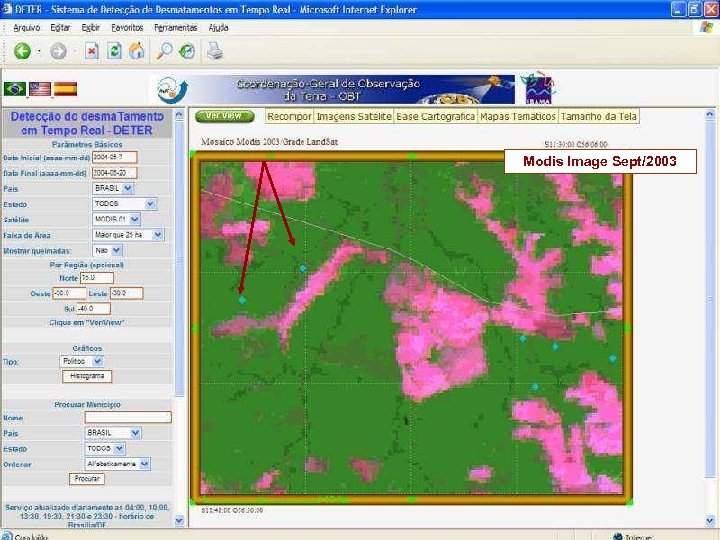
Modis Image Sept/2003
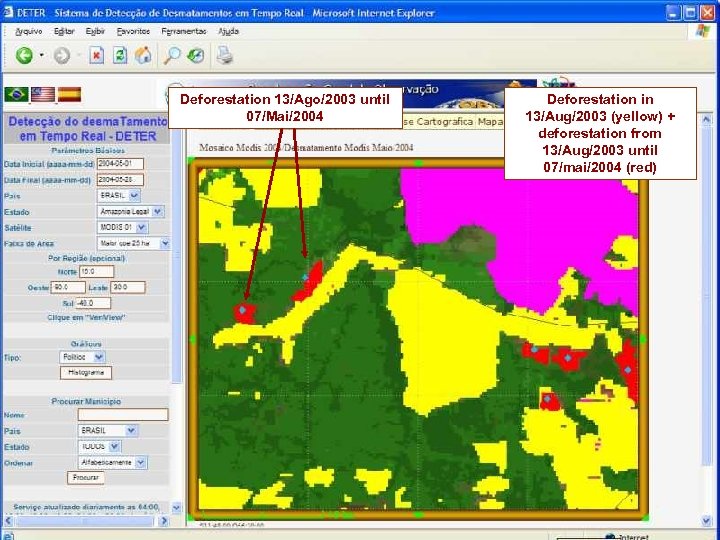
Deforestation 13/Ago/2003 until 07/Mai/2004 Deforestation in 13/Aug/2003 (yellow) + deforestation from 13/Aug/2003 until 07/mai/2004 (red)
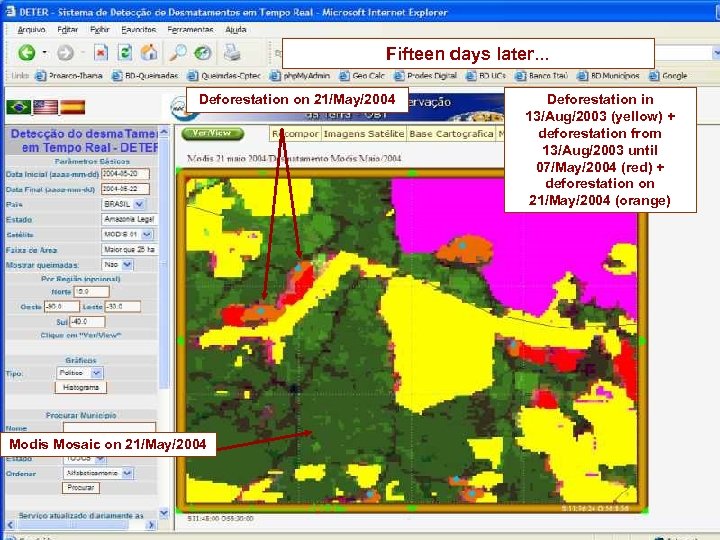
Fifteen days later. . . Deforestation on 21/May/2004 Modis Mosaic on 21/May/2004 Deforestation in 13/Aug/2003 (yellow) + deforestation from 13/Aug/2003 until 07/May/2004 (red) + deforestation on 21/May/2004 (orange)
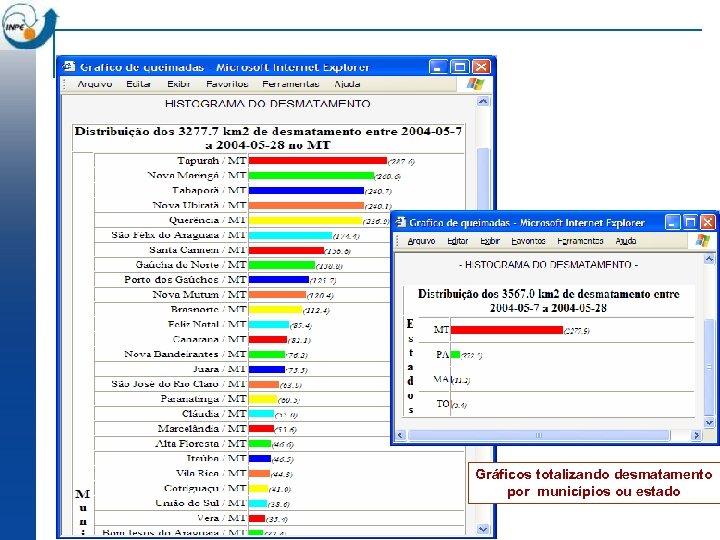
Gráficos totalizando desmatamento por municípios ou estado
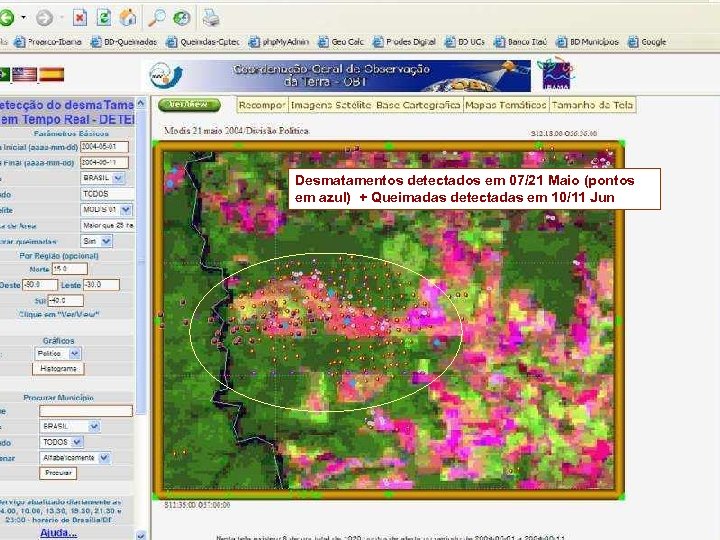
Desmatamentos detectados em 07/21 Maio (pontos em azul) + Queimadas detectadas em 10/11 Jun
GIS Technology R&D Ministério da Ciência e Tecnologia
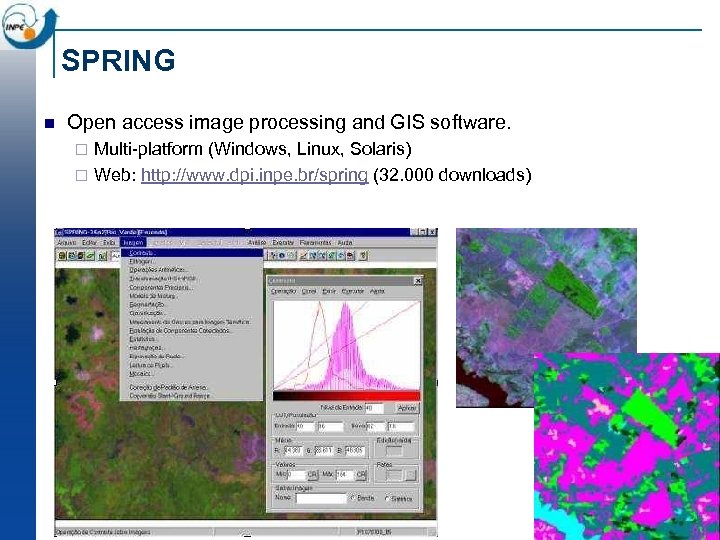
SPRING n Open access image processing and GIS software. Multi platform (Windows, Linux, Solaris) ¨ Web: http: //www. dpi. inpe. br/spring (32. 000 downloads) ¨
Technology as a social product n Research system in the developed world ¨ discourages the production of training material ¨ There are good books on GIS! n n unfortunately, these books are in English and are expensive Need for open access of information ¨ Open access literature in local language n Brazilian experience ¨ three volume set (“Introduction to GIS”, “Spatial Analysis”, “Spatial Databases”) ¨ Application examples using SPRING: key factors in software adoption
SPRING: User adoption n Universities Driving factors: documentation and examples, not price ¨ Graduate and undergrads: Geography, Earth Sciences, Social Sciences ¨ n Government institutions ¨ n Replace existing US based commercial solutions n Agricultural research agency (EMBRAPA) n Geological Survey (CPRM) n Census bureau (IBGE) Private companies Saving of licensing costs ¨ Local support and training ¨
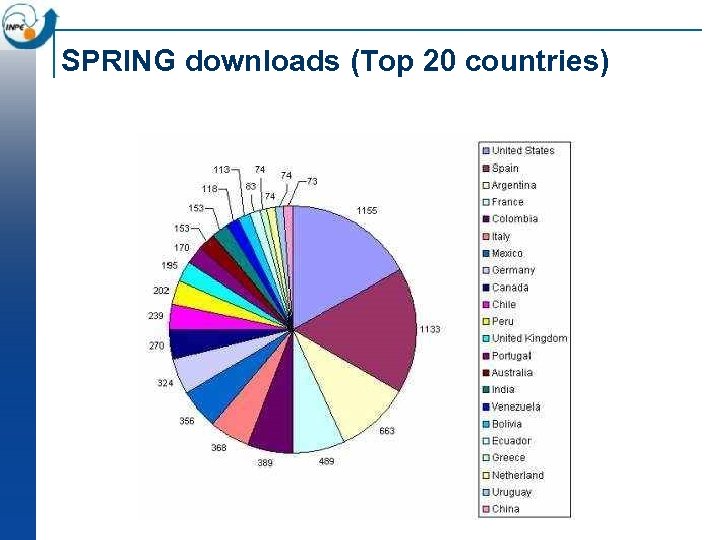
SPRING downloads (Top 20 countries)
Innovation in GIS n Current generation of GIS Built on proprietary architectures ¨ Interface + functions + database = “monolithic” system ¨ Geometric data structures = archived outside of the DBMS ¨ n New generation of spatial information technology All data will be handled by the database (inclusive images and maps) ¨ Users can develop customized applications (“small GIS”) ¨ They need appropriate tools! ¨
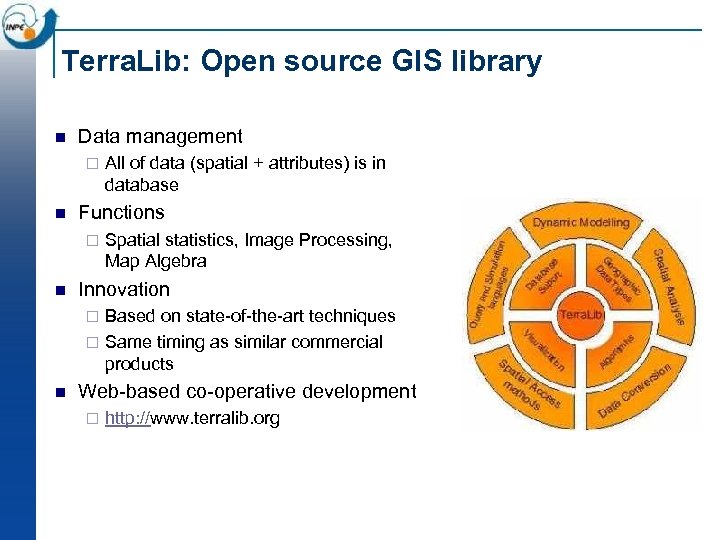
Terra. Lib: Open source GIS library n Data management ¨ n Functions ¨ n All of data (spatial + attributes) is in database Spatial statistics, Image Processing, Map Algebra Innovation Based on state of the art techniques ¨ Same timing as similar commercial products ¨ n Web based co operative development ¨ http: //www. terralib. org
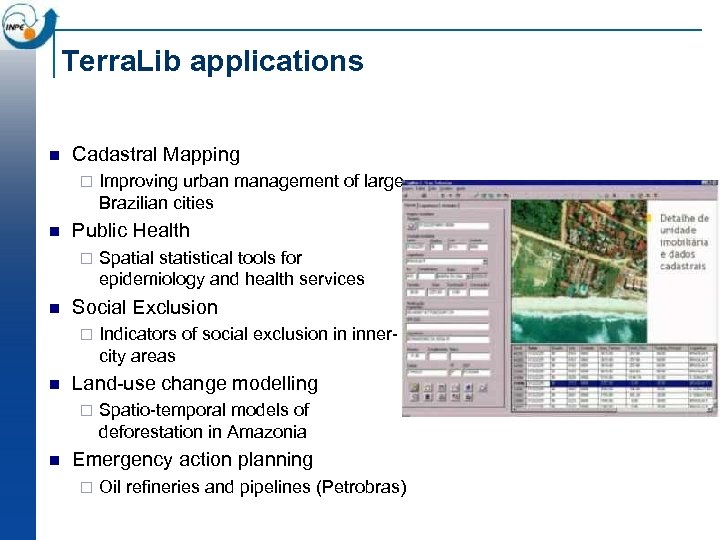
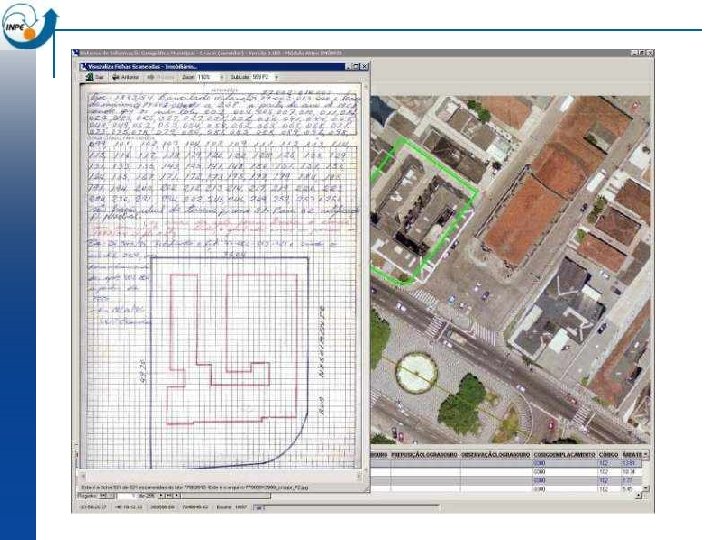
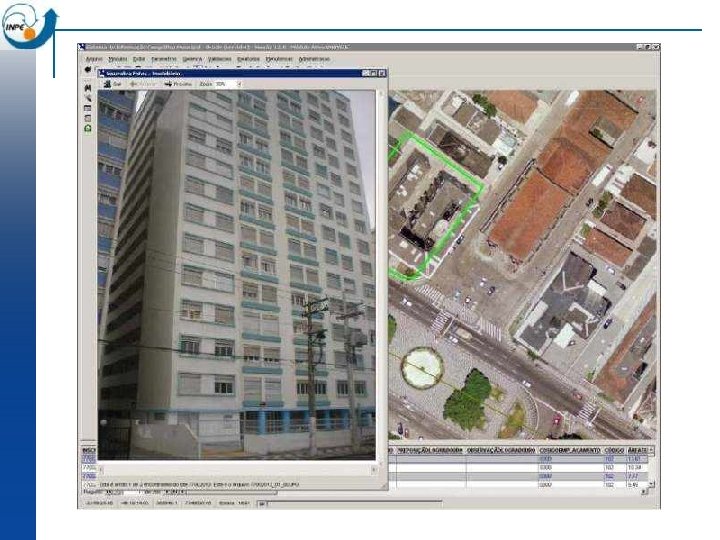
Terra. Lib applications n Cadastral Mapping ¨ n Public Health ¨ n Indicators of social exclusion in inner city areas Land use change modelling ¨ n Spatial statistical tools for epidemiology and health services Social Exclusion ¨ n Improving urban management of large Brazilian cities Spatio temporal models of deforestation in Amazonia Emergency action planning ¨ Oil refineries and pipelines (Petrobras)
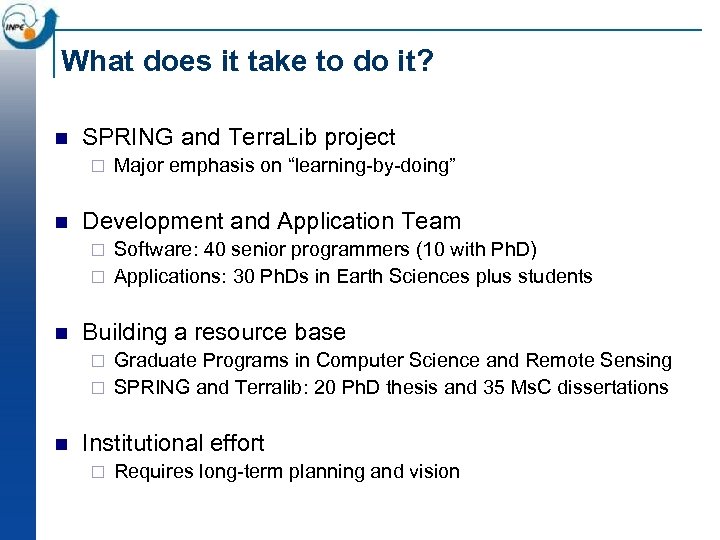
What does it take to do it? n SPRING and Terra. Lib project ¨ n Major emphasis on “learning by doing” Development and Application Team Software: 40 senior programmers (10 with Ph. D) ¨ Applications: 30 Ph. Ds in Earth Sciences plus students ¨ n Building a resource base Graduate Programs in Computer Science and Remote Sensing ¨ SPRING and Terralib: 20 Ph. D thesis and 35 Ms. C dissertations ¨ n Institutional effort ¨ Requires long term planning and vision
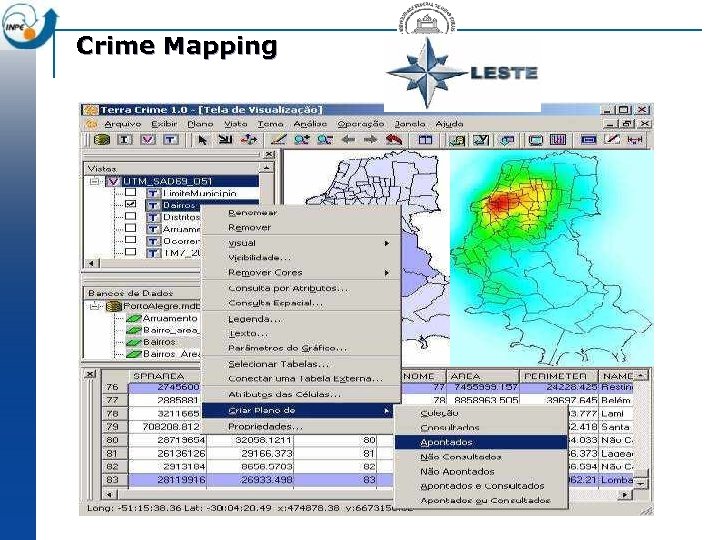
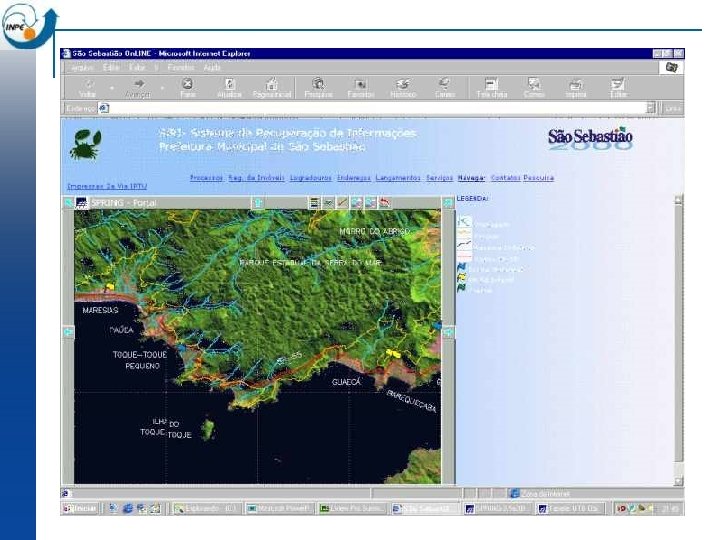
Crime Mapping
Environmental Modelling Ministério da Ciência e Tecnologia
The Future of Brazilian Amazonia is a key environmental resource n Environment and biodiversity conservation n Economic development n Native populations
Environmental Modelling in Brasil n GEOMA: “Rede Cooperativa de Modelagem Ambiental” Cooperative Network for Environmental Modelling ¨ Established by Ministry of Science and Technology ¨ INPE/OBT, INPE/CPTEC, LNCC, INPA, IMPA, MPEG ¨ n Long term objectives Develop computational mathematical models to predict the spatial dynamics of ecological and socio economic systems at different geographic scales, within the framework of sustainability ¨ Support policy decision making at local, regional and national levels, by providing decision makers with qualified analytical tools. ¨
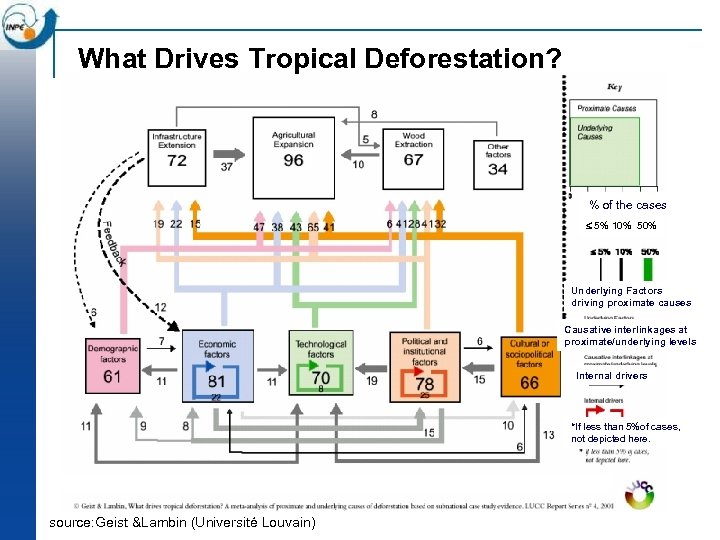
What Drives Tropical Deforestation? % of the cases 5% 10% 50% Underlying Factors driving proximate causes Causative interlinkages at proximate/underlying levels Internal drivers *If less than 5%of cases, not depicted here. source: Geist &Lambin (Université Louvain)
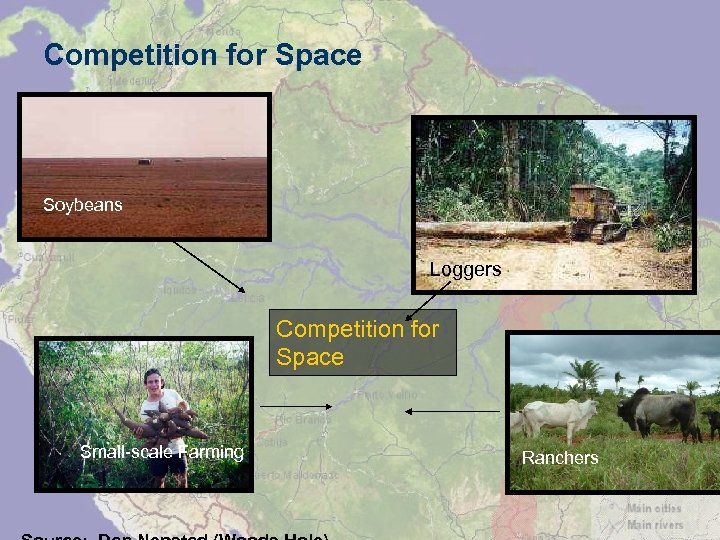
Competition for Space Soybeans Loggers Competition for Space Small scale Farming Ranchers
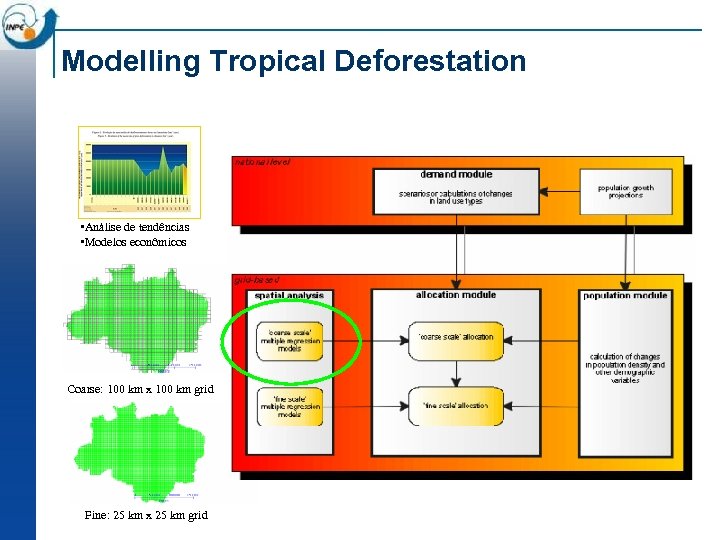
Modelling Tropical Deforestation • Análise de tendências • Modelos econômicos Coarse: 100 km x 100 km grid Fine: 25 km x 25 km grid
Modelling Deforestation in Amazonia n High coefficients of multiple determination were obtained on all models built (R 2 from 0. 80 to 0. 86). n The main factors identified were: ¨ ¨ n Population density; Connection to national markets; Climatic conditions; Indicators related to land distribution between large and small farmers. The main current agricultural frontier areas, in Pará and Amazonas States, where intense deforestation processes are taking place now were correctly identified as hot spots of change.
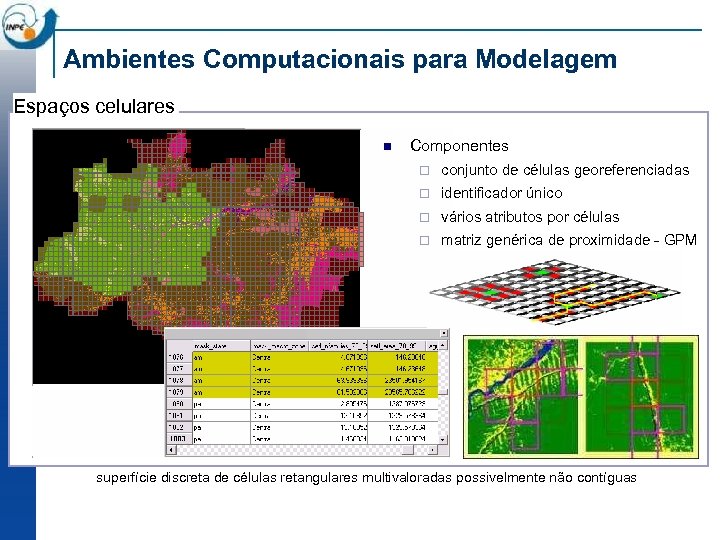
Ambientes Computacionais para Modelagem Espaços celulares n Componentes ¨ conjunto de células georeferenciadas ¨ identificador único ¨ vários atributos por células ¨ matriz genérica de proximidade GPM superfície discreta de células retangulares multivaloradas possivelmente não contíguas
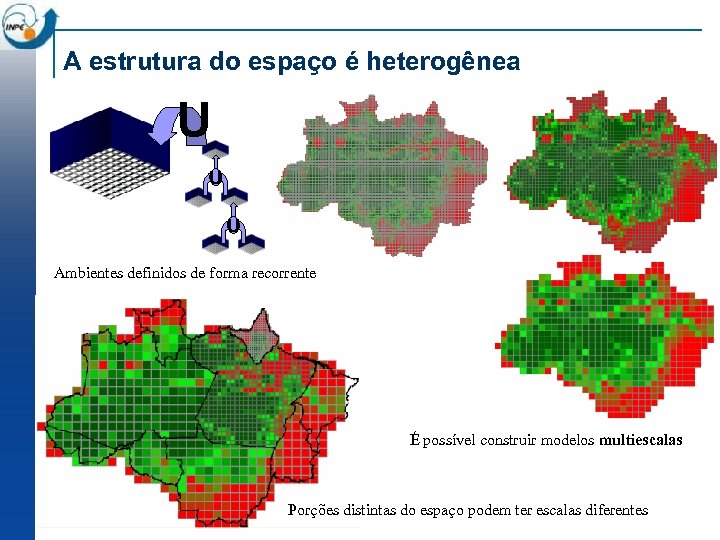
A estrutura do espaço é heterogênea U U U Ambientes definidos de forma recorrente É possível construir modelos multiescalas Porções distintas do espaço podem ter escalas diferentes
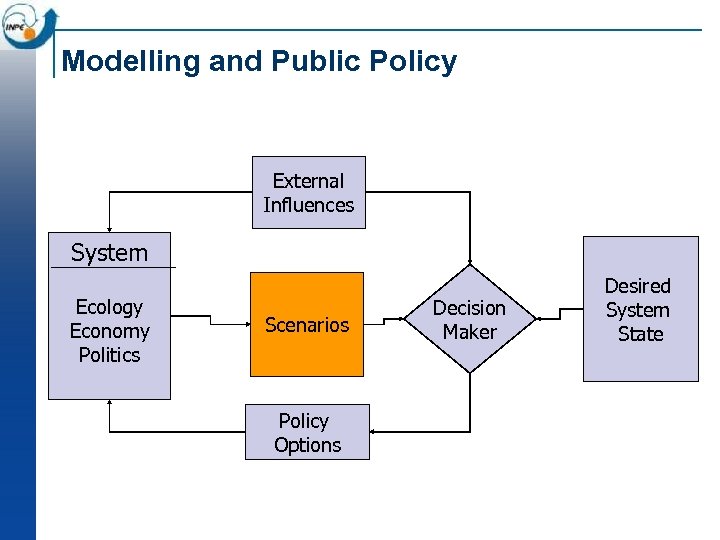
Modelling and Public Policy External Influences System Ecology Economy Politics Scenarios Policy Options Decision Maker Desired System State
In Conclusion: Earth Observation in Brazil n Amazonian Rain Forest ¨ n Semi Arid North East ¨ n Crop forecasting and yield estimation are crucial information needs Large Urban Settlements ¨ n Period droughts affect 25% of Brazilian Population South. East and Central Regions ¨ n Human actions are modifying environmental conditions Increasing intra urban social exclusion and environmental vulnerability Remote Sensing and GIS Technologies are essential from management of Brazilian territory
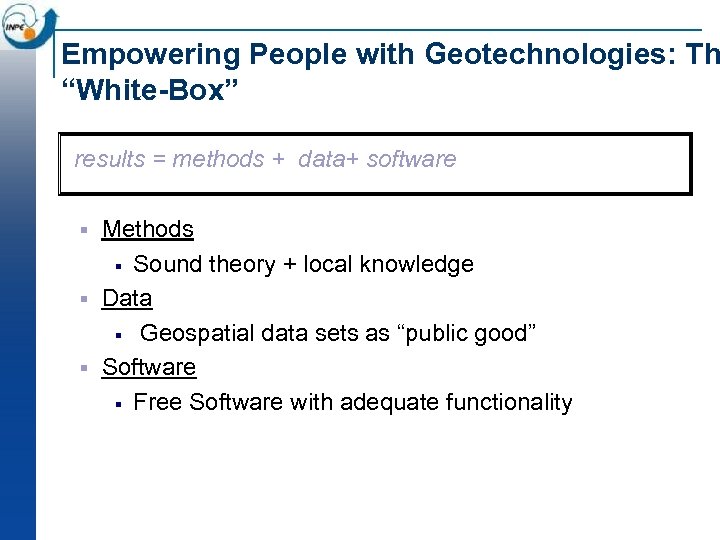
Empowering People with Geotechnologies: Th “White-Box” results = methods + data+ software Methods § Sound theory + local knowledge § Data § Geospatial data sets as “public good” § Software § Free Software with adequate functionality §
Скачать презентацию Earth Observation in Brasil Data and Applications Ministério
41bce201c483bbb7013daad8e739c730.ppt