


 Скачать презентацию Ears 2 U Hearing 101 o Stephen A
af5555f7e2c917bcf4b3d402adf38cf8.ppt
- Количество слайдов: 44
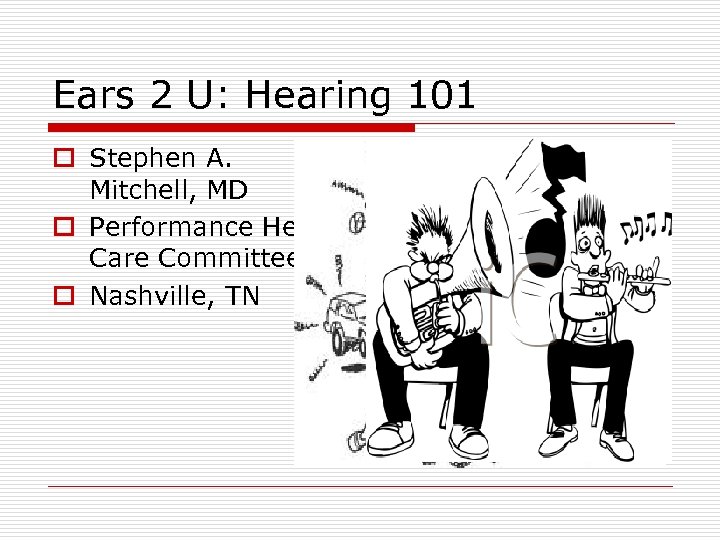 Ears 2 U: Hearing 101 o Stephen A. Mitchell, MD o Performance Health Care Committee o Nashville, TN
 Disclaimer o Not selling anything o Don’t care if you buy anything o Not on payroll of any company that is applicable to this presentation o So there
 Creds o Otolaryngologist > 33 years o Performance Health Care Committees of NFA for MANY years (don’t ask) o Performing Arts Medicine Association since it started o Wife her sister professional flutists o I have ears
 Why Should You Stay Awake For This Talk? o If you can’t hear, your career is over o If you hurt your hearing, you will suffer and be impaired forever o Stupid things you do now may cause irreversible damage to your ears with no hope of restoration o Things you do now can save your ears
 What’s the difference between: o Using your $14, 000 gold flute to hammer a nail into the wall, o or o Sitting in the front row of a Smashing Pumpkins Concert with no ear plugs? o Answer: o Not much, both are foolish and will negate the time and effort and skill you spent to learn your craft
 What We Will Cover Today o o o Anatomy Physiology (how it works) Testing Causes of Hearing Loss Prevention
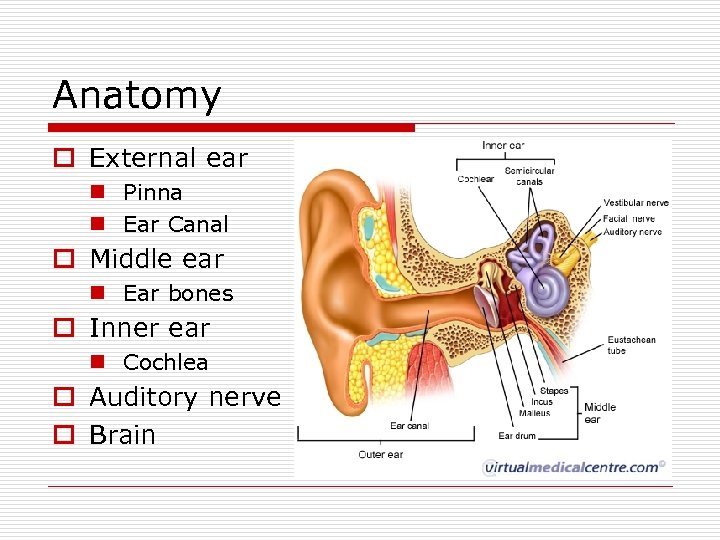 Anatomy o External ear n Pinna n Ear Canal o Middle ear n Ear bones o Inner ear n Cochlea o Auditory nerve o Brain
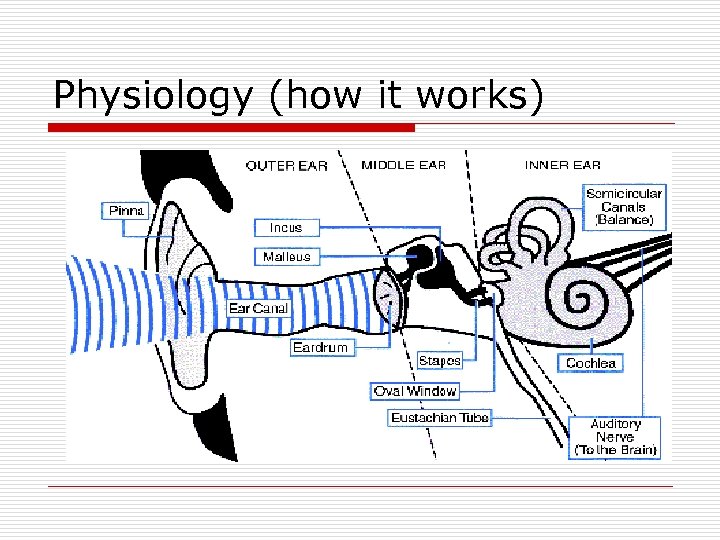 Physiology (how it works)
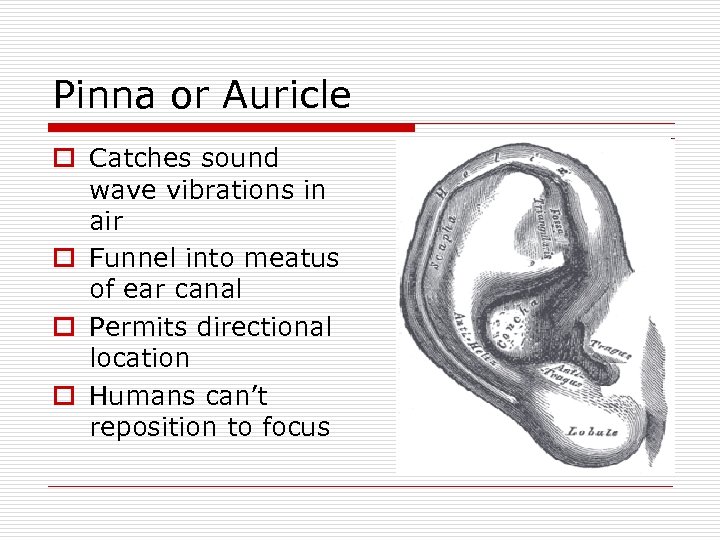 Pinna or Auricle o Catches sound wave vibrations in air o Funnel into meatus of ear canal o Permits directional location o Humans can’t reposition to focus
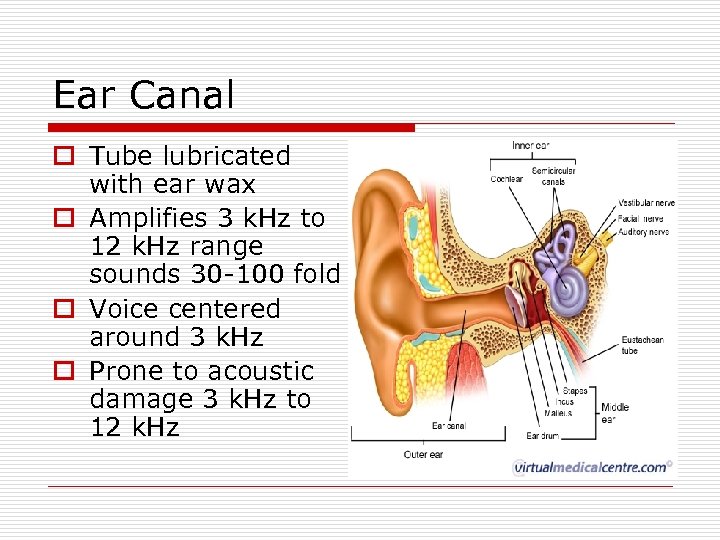 Ear Canal o Tube lubricated with ear wax o Amplifies 3 k. Hz to 12 k. Hz range sounds 30 -100 fold o Voice centered around 3 k. Hz o Prone to acoustic damage 3 k. Hz to 12 k. Hz
 Ear Drum or Tympanic Membrane o Membrane at end of ear canal o Separates external from middle ear o Converts air vibration of sound to mechanical bone vibration of ossicles (ear bones) o Can rupture if air wave too intense, protecting inner ear
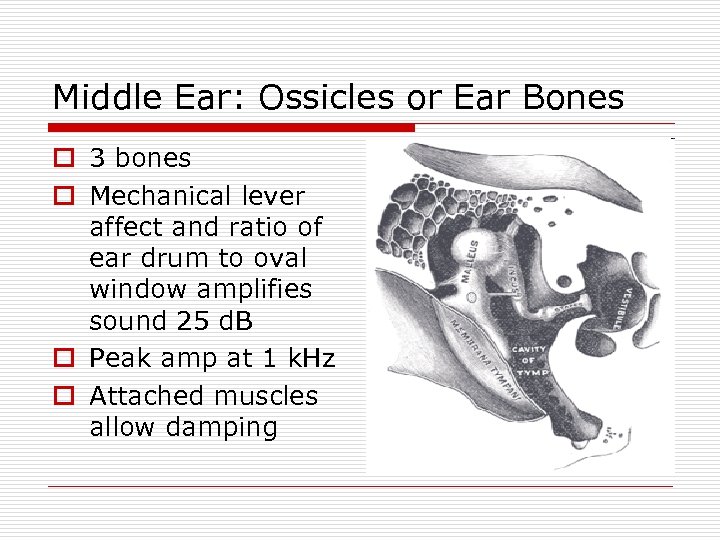 Middle Ear: Ossicles or Ear Bones o 3 bones o Mechanical lever affect and ratio of ear drum to oval window amplifies sound 25 d. B o Peak amp at 1 k. Hz o Attached muscles allow damping
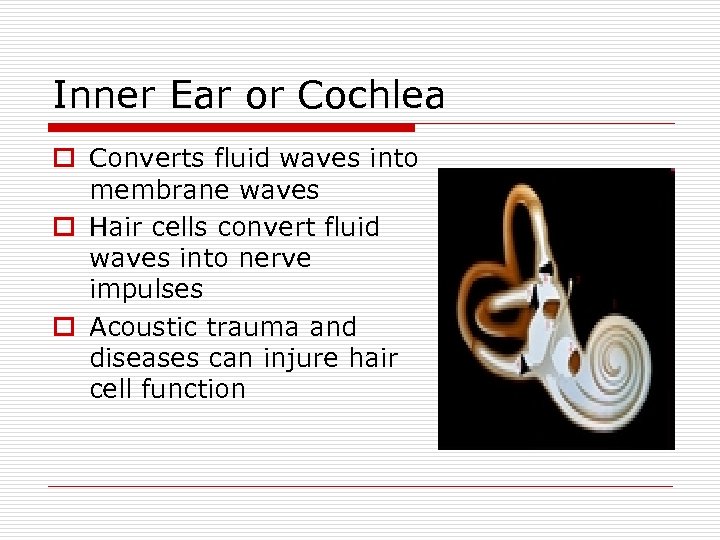 Inner Ear or Cochlea o Converts fluid waves into membrane waves o Hair cells convert fluid waves into nerve impulses o Acoustic trauma and diseases can injure hair cell function
 Auditory Nerve o Pathway for electrical impulses from cochlea to brain o Preferred term is vestibulocochlear nerve since it carries balance information as well. o Can be injured by skull fractures, head trauma, or tumors
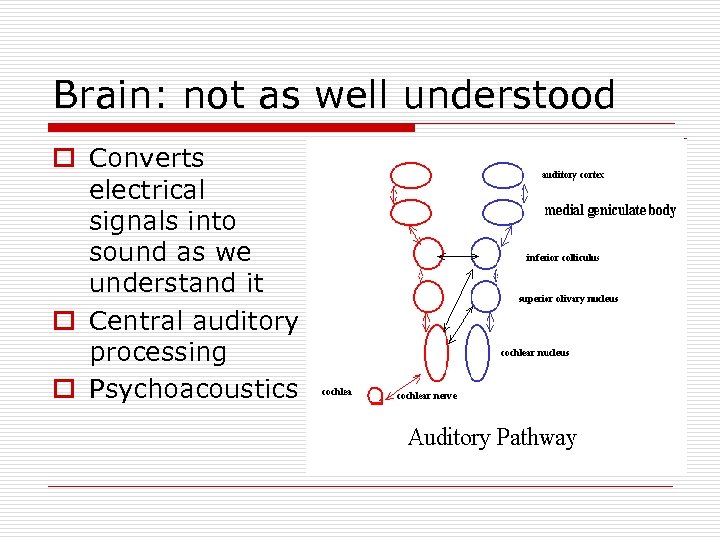 Brain: not as well understood o Converts electrical signals into sound as we understand it o Central auditory processing o Psychoacoustics
 Testing of Hearing System o Establish baseline hearing o Determine site and extent of damage o Predict success of treatment or rate of deterioration o Rule out serious illness or tumors
 Methods of Testing o o o Clinical History and Exam Audiogram Tympanogram Others: ABR, ECo. G, OAE, CAP, ENG Radiologic: CT, MRI, PET Blood work: CBC, Glucose, Thyroid, Lipids, etc
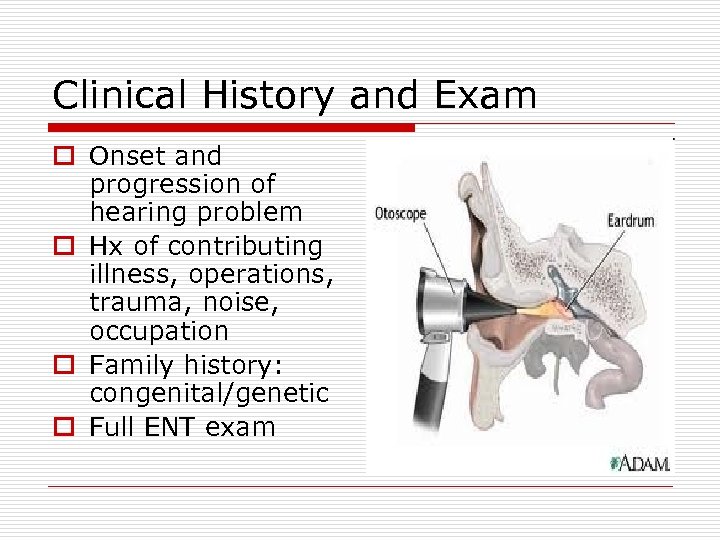 Clinical History and Exam o Onset and progression of hearing problem o Hx of contributing illness, operations, trauma, noise, occupation o Family history: congenital/genetic o Full ENT exam
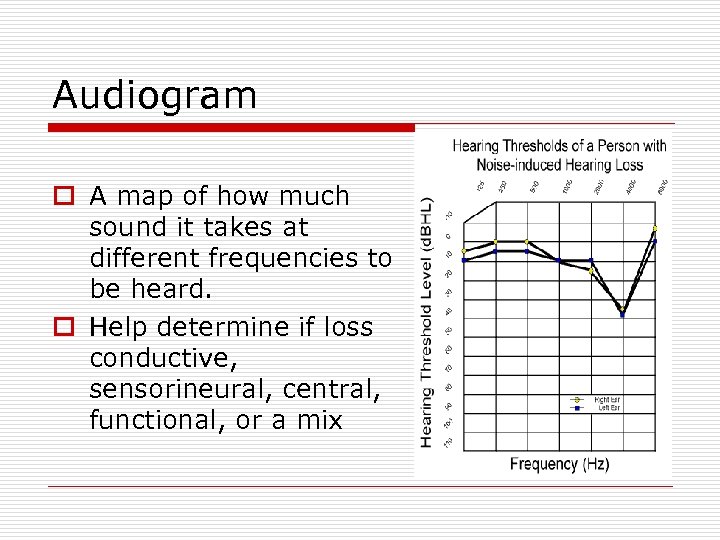 Audiogram o A map of how much sound it takes at different frequencies to be heard. o Help determine if loss conductive, sensorineural, central, functional, or a mix
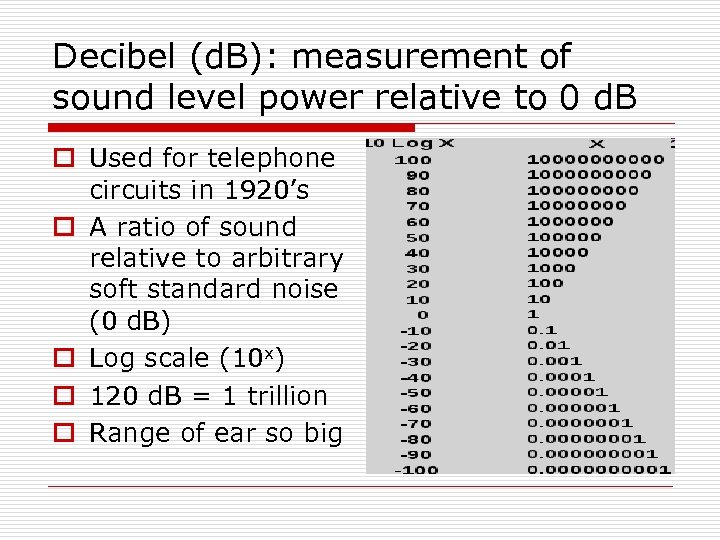 Decibel (d. B): measurement of sound level power relative to 0 d. B o Used for telephone circuits in 1920’s o A ratio of sound relative to arbitrary soft standard noise (0 d. B) o Log scale (10 x) o 120 d. B = 1 trillion o Range of ear so big
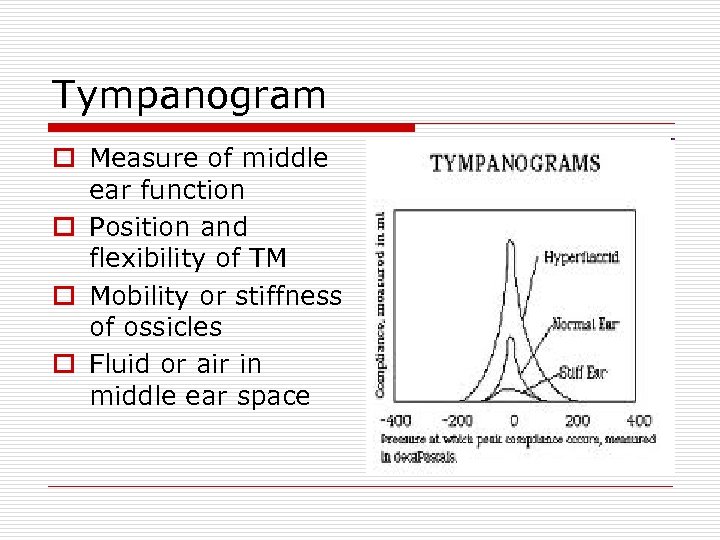 Tympanogram o Measure of middle ear function o Position and flexibility of TM o Mobility or stiffness of ossicles o Fluid or air in middle ear space
 Other Basic Hearing/Ear Tests o o o ABR: nerve function from ear to brain ECo. G: inner ear pressure (Meniere’s) OAE: hair cell health CAP: central auditory processing ENG: balance testing, inner ear and brain contribution
 Radiologic Tests o CT scan temporal bone (contains ear) n Look for infection, tumor, congenital defects o MRI Brain and internal auditory canal n Look for tumor, stroke, degenerative disorders o PET scan n Tumor
 Causes of Hearing Loss o Hereditary (bad parental selection) n Can be present at birth n Most show up later in life o Nonhereditary n n Conductive Sensorineural Central: brain has problems processing Functional: faking for psychological or financial gain
 Conductive Hearing Loss o External ear n Wax, foreign body, canal infection (swimmers ear), tumor o Ear Drum n Perforation, scarring o Middle ear n Fluid (otitis media) n Ossicles stiff, fracture, eroded, otosclerosis
 Sensorineural Hearing Loss (SNHL) o Neural: auditory nerve damage n Tumor (acoustic neuroma) n Trauma after temporal bone fracture or shearing force to nerve and brain o Sensory: inner ear n n Cochlea and hair cells Unilateral or bilateral Sudden or gradual onset Congenital or acquired
 Acquired Causes of SNHL o o o o Inflammatory (measles, mumps, HIV) Ototoxic drugs (chemotx, ASA, Lasik) Autoimmune (SLE, RA, Lortab) Trauma and Tumor Meniere’s (multiple causes) Sudden SNHL (vascular, idiopathic) Presbycusis (aging ear) Noise induced
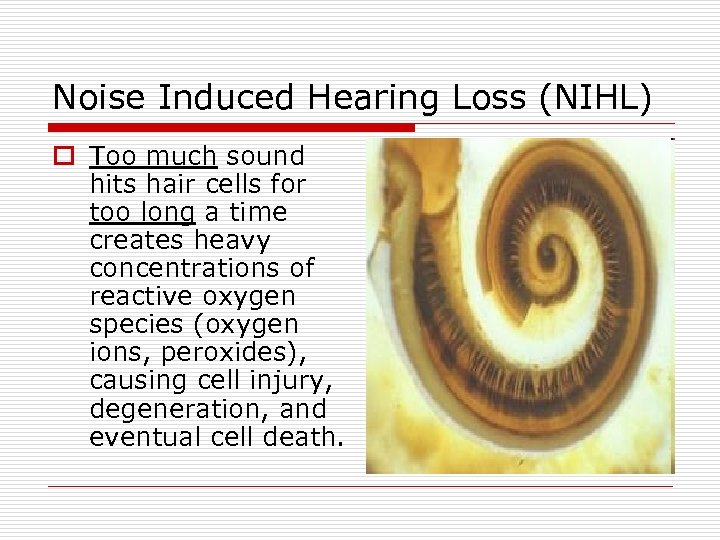 Noise Induced Hearing Loss (NIHL) o Too much sound hits hair cells for too long a time creates heavy concentrations of reactive oxygen species (oxygen ions, peroxides), causing cell injury, degeneration, and eventual cell death.
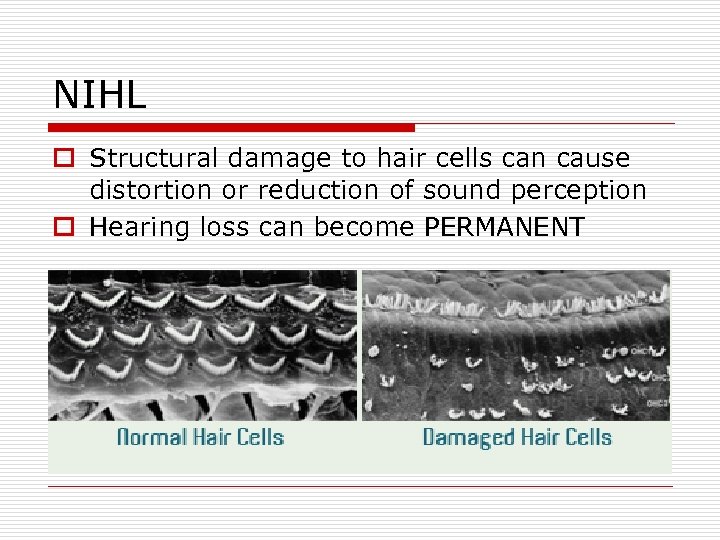 NIHL o Structural damage to hair cells can cause distortion or reduction of sound perception o Hearing loss can become PERMANENT
 Types of NIHL o Acute: permanent from one time exposure to excessive sound pressure n Explosion, gunfire, open hand slap to ear, drum, air horn o Gradual noise induced hearing loss n Repeat exposure to loud sounds over long period of time n Heavy equipment, aircraft, personal media players, MUSIC-INDUCED hearing loss
 Gradual NIHL (aka: threshold shift) o Initial injury causes Temporary Threshold Shift (TTS) of hearing after injury, returning to normal after few hours away from noise o After sufficient injury over time, shift becomes Permanent Threshold Shift (PTS) and is irreversible
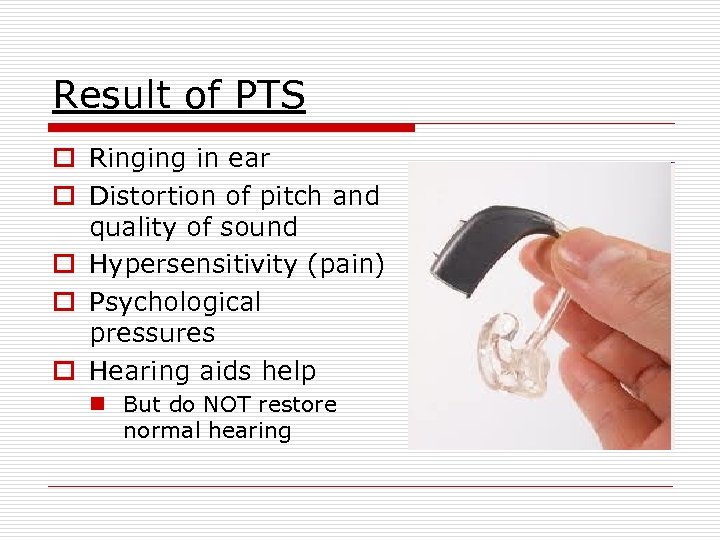 Result of PTS o Ringing in ear o Distortion of pitch and quality of sound o Hypersensitivity (pain) o Psychological pressures o Hearing aids help n But do NOT restore normal hearing
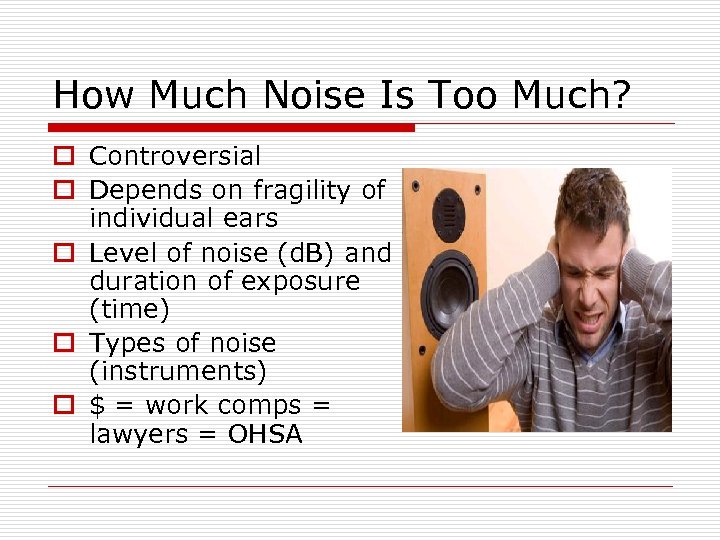 How Much Noise Is Too Much? o Controversial o Depends on fragility of individual ears o Level of noise (d. B) and duration of exposure (time) o Types of noise (instruments) o $ = work comps = lawyers = OHSA
 Music-Induced Hearing Loss o o Occupational hearing loss accepted Music-induced hearing loss debated Rock music loss accepted Classical music loss controversial n Hard to determine which individuals or groups are consistently at risk with defined classical music exposure n Not all research studies in agreement
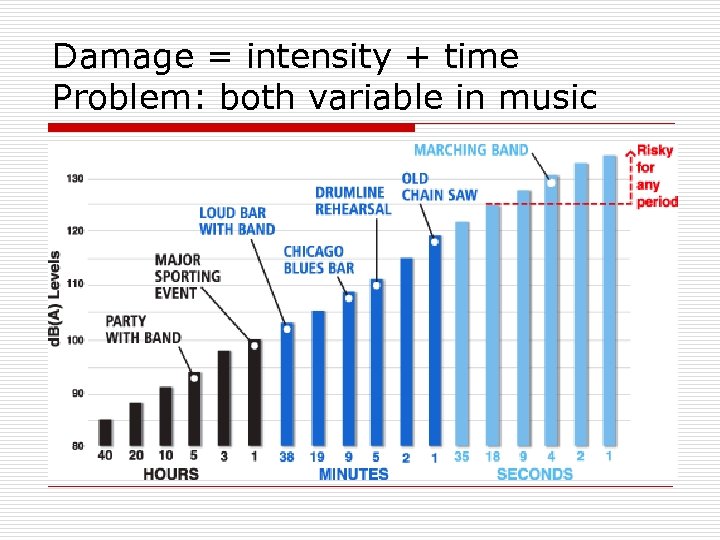 Damage = intensity + time Problem: both variable in music
 Problem: Apples and Oranges o Scand Audiol. 1983; 12(4): 257 -64. o The hearing of symphony orchestra musicians. o Karlsson K, Lundquist PG, Olaussen T. o We suggest that the sound exposure criteria for industrial noise are not valid when discussing such sounds as are produced by acoustic instruments in a symphonic environment.
 Musicians and NIHL: Now What? o Fact: Musicians must hear good o Fact: Noise can injure your hearing o You are responsible for your health n Not some Washington drone o YOUR management of your soundlevel exposure is critical: just as important as learning fingerings
 Prevention of NIHL o Education n Self education n Teacher provided education n Your application above (“Just Do It”) o Modify lifestyle o Modify practice habits o Modify workplace o Spread the word to others o Lobby for appropriate standards
 Self Education o If you’re awake, you’re self educated o Internet search: “NASM-PAMA Draft” n Draft by National Association of Schools of Music (NASM) and Performing Arts Medicine Association (PAMA) n Recommendation to Faculty and Students in Schools of Music n Kris Chesky at UNT held NASM-PAMA conference July 2004 to jump start
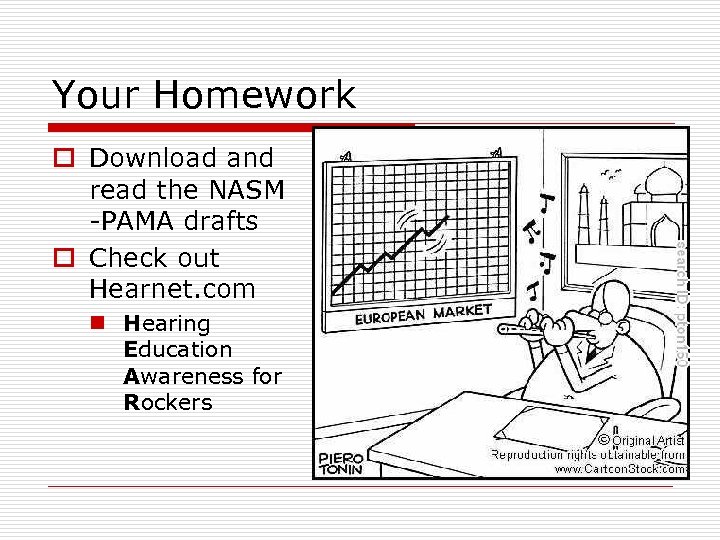 Your Homework o Download and read the NASM -PAMA drafts o Check out Hearnet. com n Hearing Education Awareness for Rockers
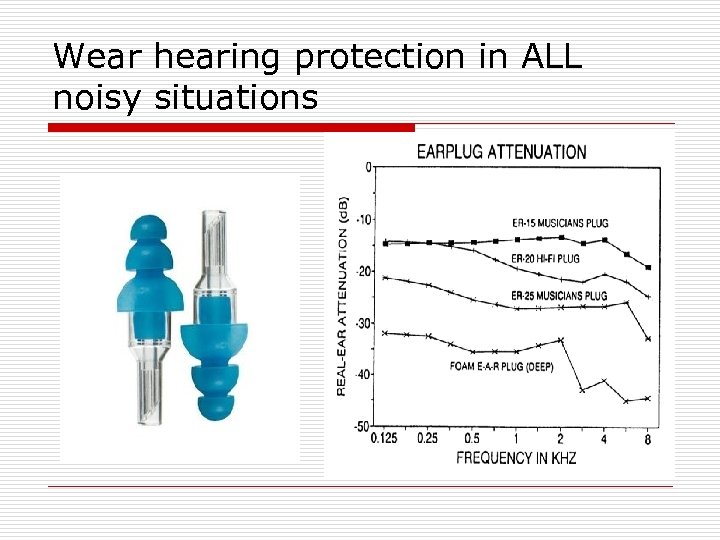 Wear hearing protection in ALL noisy situations
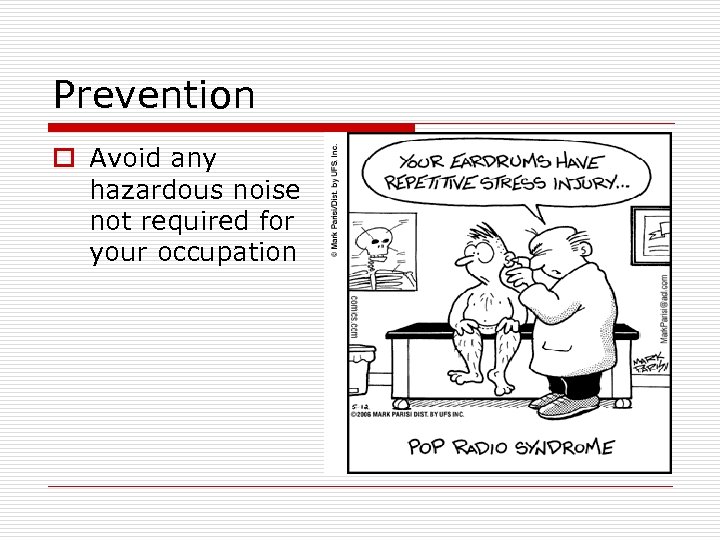 Prevention o Avoid any hazardous noise not required for your occupation
 “I’m from the government and I’m here to help you” o Do NOT count on OSHA standards to protect your ears o Regulations are based on industrial noise o Represent minimum allowable standards that politicians can agree on n We are NOT clones
 Thank you, “enjoy” the exhibit hall