 Скачать презентацию Earnings Based Valuations Dr Mangold California State University
3f94063a994979618a474c7b1f2474f6.ppt
- Количество слайдов: 25



Earnings Based Valuations Dr. Mangold California State University, East Bay
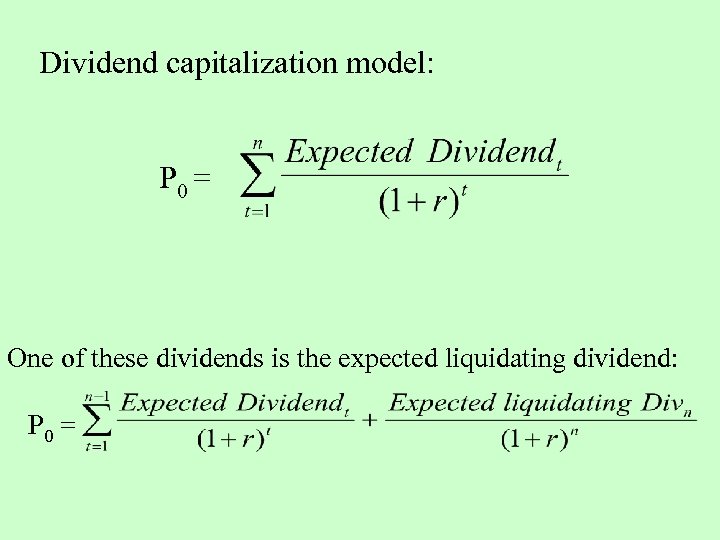
Dividend capitalization model: P 0 = One of these dividends is the expected liquidating dividend: P 0 =
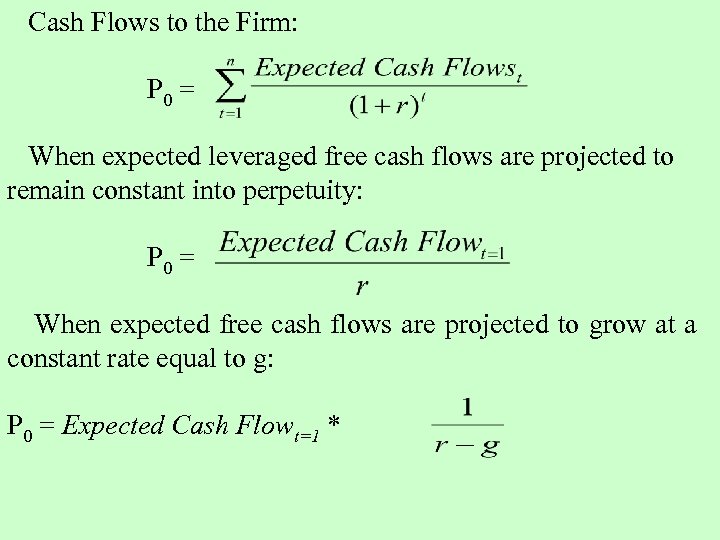
Cash Flows to the Firm: P 0 = When expected leveraged free cash flows are projected to remain constant into perpetuity: P 0 = When expected free cash flows are projected to grow at a constant rate equal to g: P 0 = Expected Cash Flowt=1 *
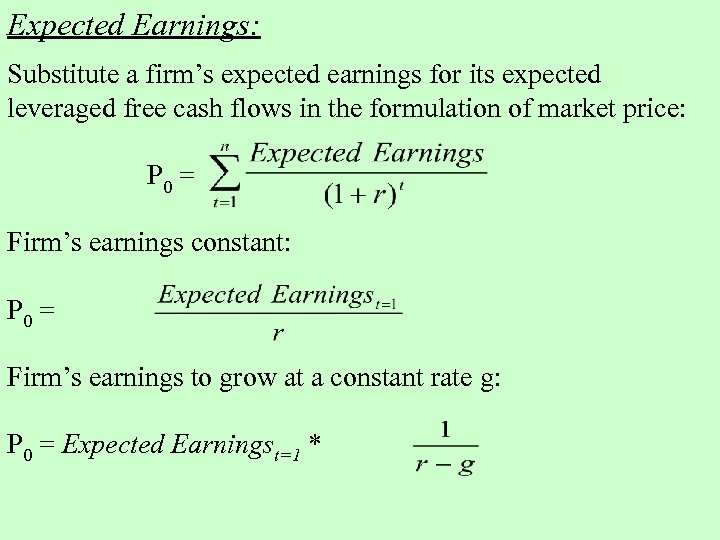
Expected Earnings: Substitute a firm’s expected earnings for its expected leveraged free cash flows in the formulation of market price: P 0 = Firm’s earnings constant: P 0 = Firm’s earnings to grow at a constant rate g: P 0 = Expected Earningst=1 *
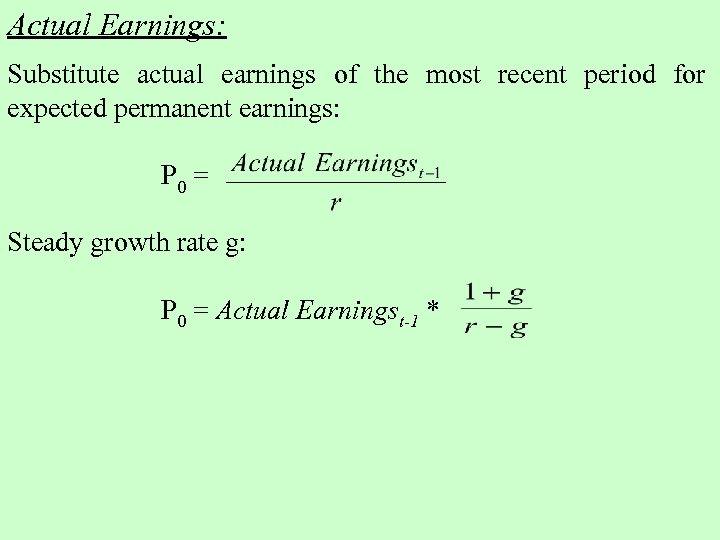
Actual Earnings: Substitute actual earnings of the most recent period for expected permanent earnings: P 0 = Steady growth rate g: P 0 = Actual Earningst-1 *
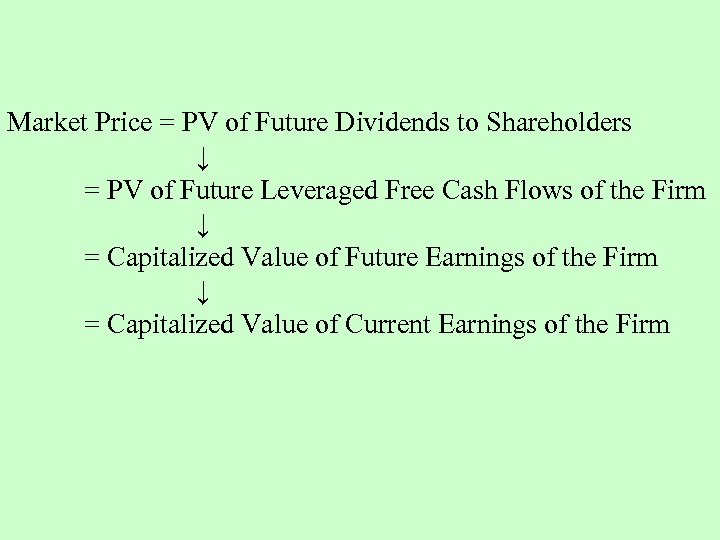
Market Price = PV of Future Dividends to Shareholders ↓ = PV of Future Leveraged Free Cash Flows of the Firm ↓ = Capitalized Value of Future Earnings of the Firm ↓ = Capitalized Value of Current Earnings of the Firm
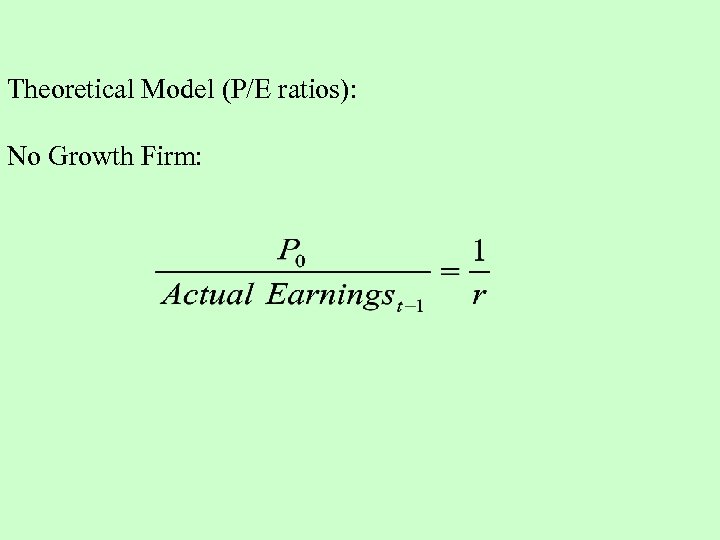
Theoretical Model (P/E ratios): No Growth Firm:
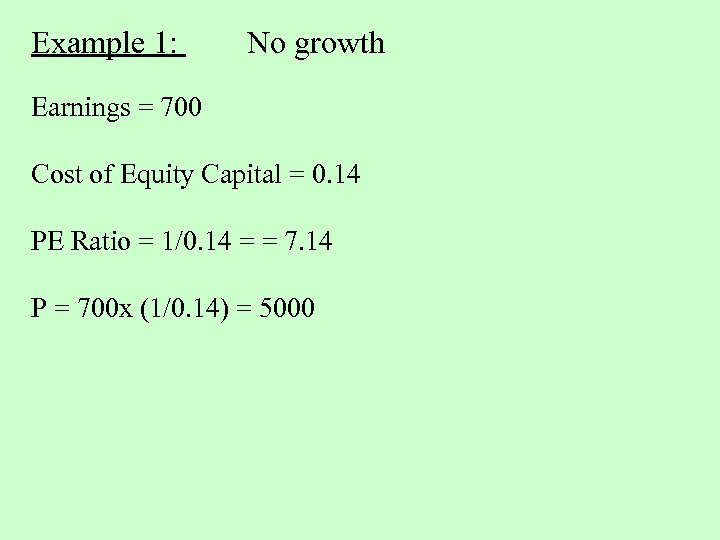
Example 1: No growth Earnings = 700 Cost of Equity Capital = 0. 14 PE Ratio = 1/0. 14 = = 7. 14 P = 700 x (1/0. 14) = 5000
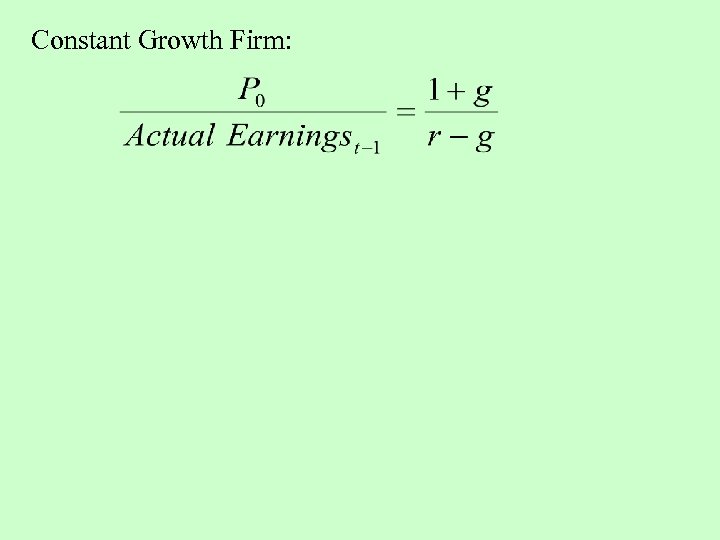
Constant Growth Firm:
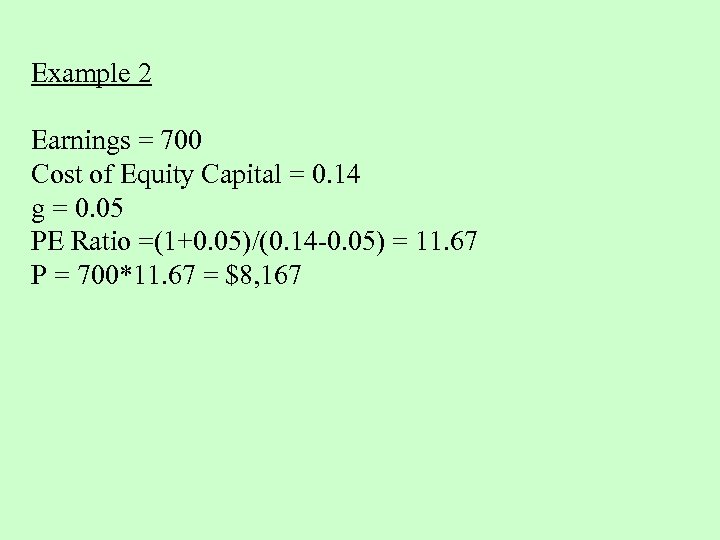
Example 2 Earnings = 700 Cost of Equity Capital = 0. 14 g = 0. 05 PE Ratio =(1+0. 05)/(0. 14 -0. 05) = 11. 67 P = 700*11. 67 = $8, 167
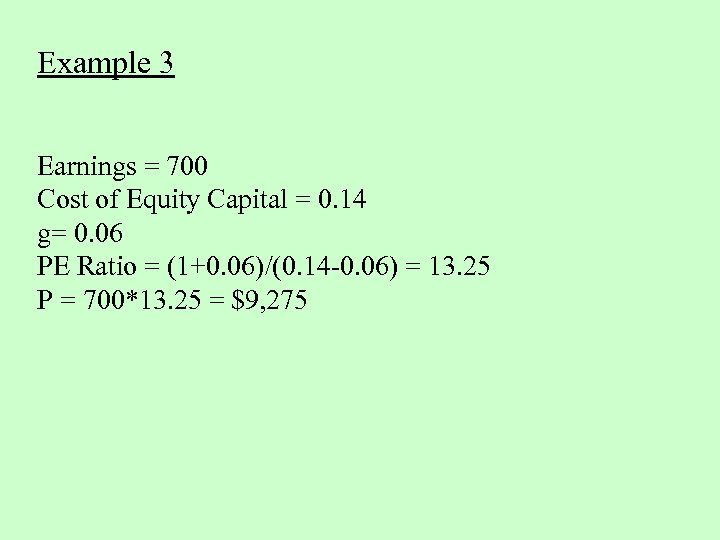
Example 3 Earnings = 700 Cost of Equity Capital = 0. 14 g= 0. 06 PE Ratio = (1+0. 06)/(0. 14 -0. 06) = 13. 25 P = 700*13. 25 = $9, 275
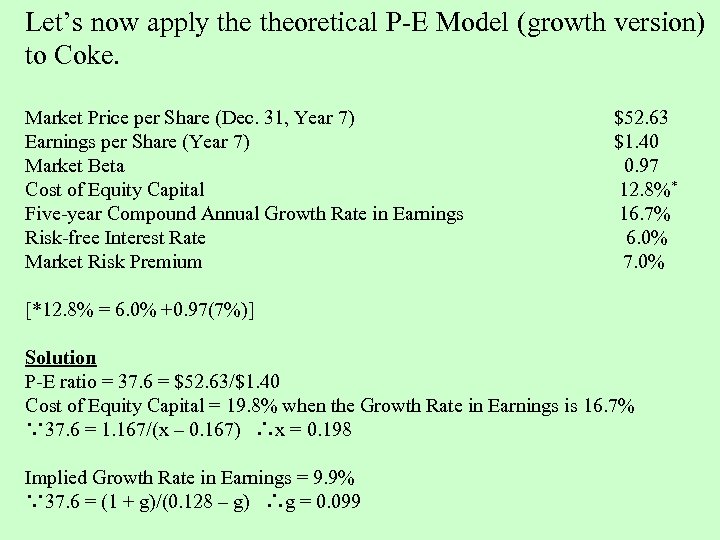
Let’s now apply theoretical P-E Model (growth version) to Coke. Market Price per Share (Dec. 31, Year 7) $52. 63 Earnings per Share (Year 7) $1. 40 Market Beta 0. 97 Cost of Equity Capital 12. 8%* Five-year Compound Annual Growth Rate in Earnings 16. 7% Risk-free Interest Rate 6. 0% Market Risk Premium 7. 0% [*12. 8% = 6. 0% +0. 97(7%)] Solution P-E ratio = 37. 6 = $52. 63/$1. 40 Cost of Equity Capital = 19. 8% when the Growth Rate in Earnings is 16. 7% ∵ 37. 6 = 1. 167/(x – 0. 167) ∴x = 0. 198 Implied Growth Rate in Earnings = 9. 9% ∵ 37. 6 = (1 + g)/(0. 128 – g) ∴g = 0. 099
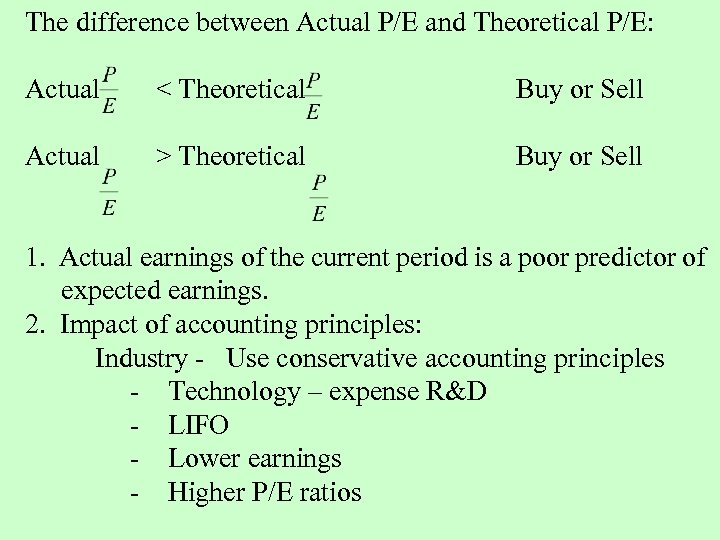
The difference between Actual P/E and Theoretical P/E: Actual < Theoretical Buy or Sell Actual > Theoretical Buy or Sell 1. Actual earnings of the current period is a poor predictor of expected earnings. 2. Impact of accounting principles: Industry - Use conservative accounting principles - Technology – expense R&D - LIFO - Lower earnings - Higher P/E ratios
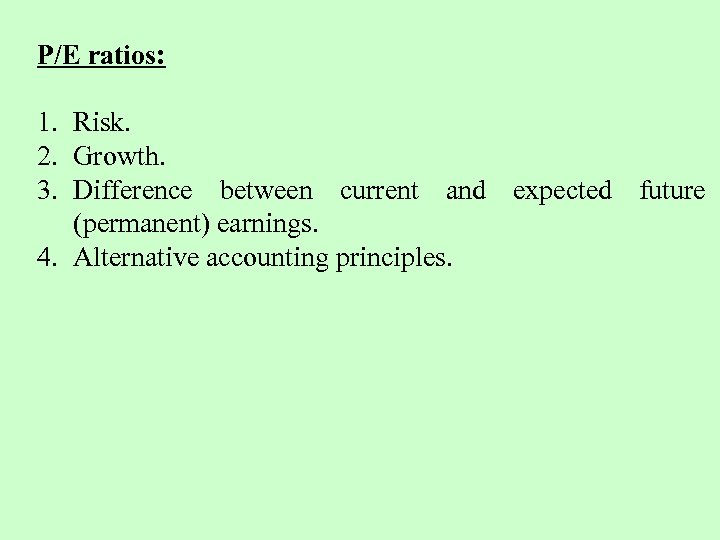
P/E ratios: 1. Risk. 2. Growth. 3. Difference between current and expected future (permanent) earnings. 4. Alternative accounting principles.
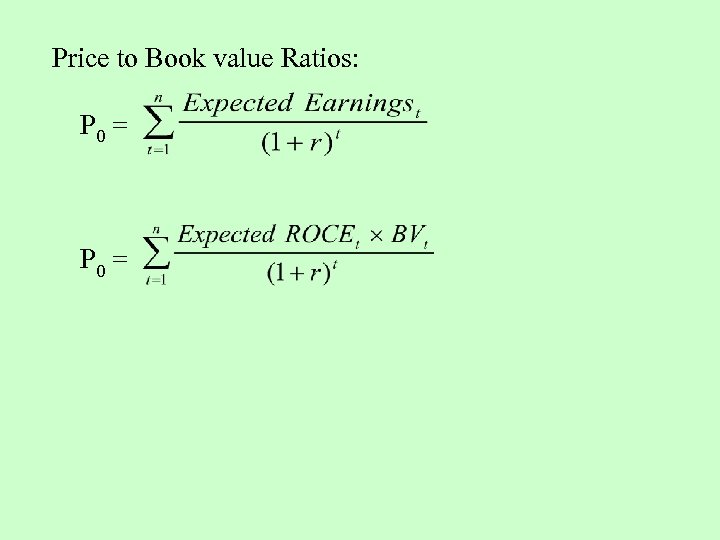
Price to Book value Ratios: P 0 =
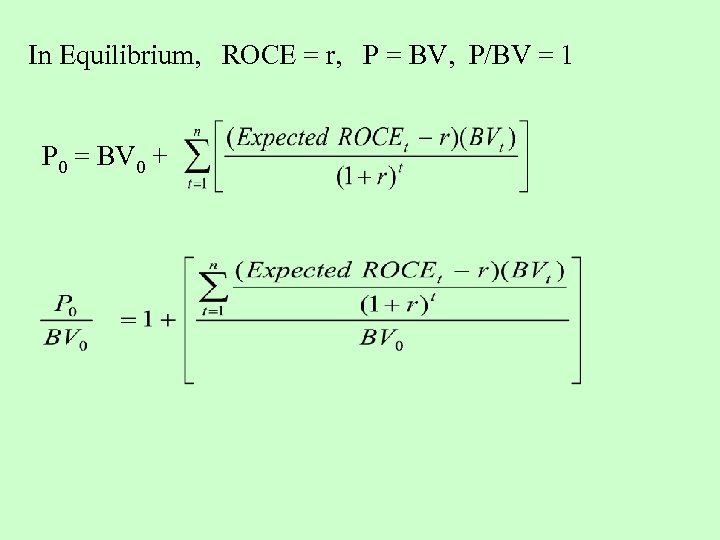
In Equilibrium, ROCE = r, P = BV, P/BV = 1 P 0 = BV 0 +
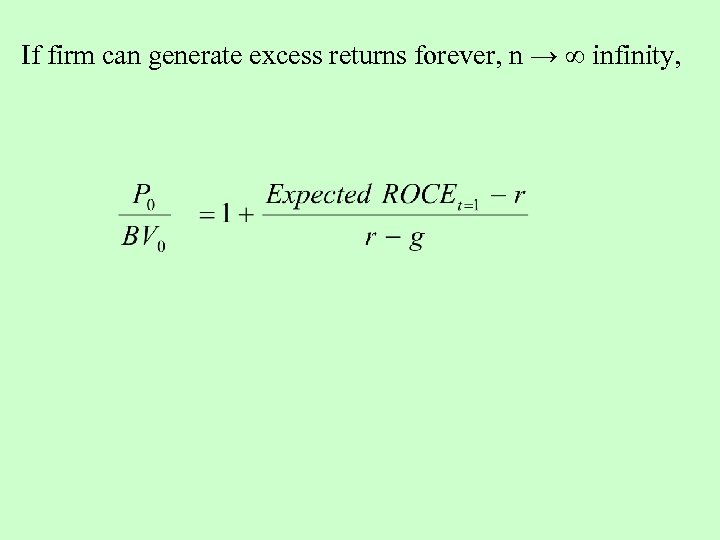
If firm can generate excess returns forever, n → ∞ infinity,
P-BV Ratio • A function of • The expected level of profitability relative to the required rate of return • Growth in the book value of common shareholders’ equity – Growth in book value is a function of – Earnings generated each period in excess of dividends paid plus additional capital contributions by shareholders
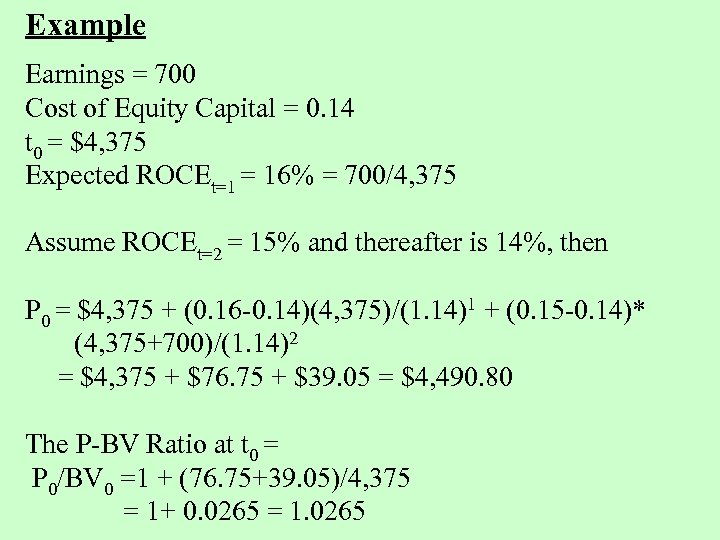
Example Earnings = 700 Cost of Equity Capital = 0. 14 t 0 = $4, 375 Expected ROCEt=1 = 16% = 700/4, 375 Assume ROCEt=2 = 15% and thereafter is 14%, then P 0 = $4, 375 + (0. 16 -0. 14)(4, 375)/(1. 14)1 + (0. 15 -0. 14)* (4, 375+700)/(1. 14)2 = $4, 375 + $76. 75 + $39. 05 = $4, 490. 80 The P-BV Ratio at t 0 = P 0/BV 0 =1 + (76. 75+39. 05)/4, 375 = 1+ 0. 0265 = 1. 0265
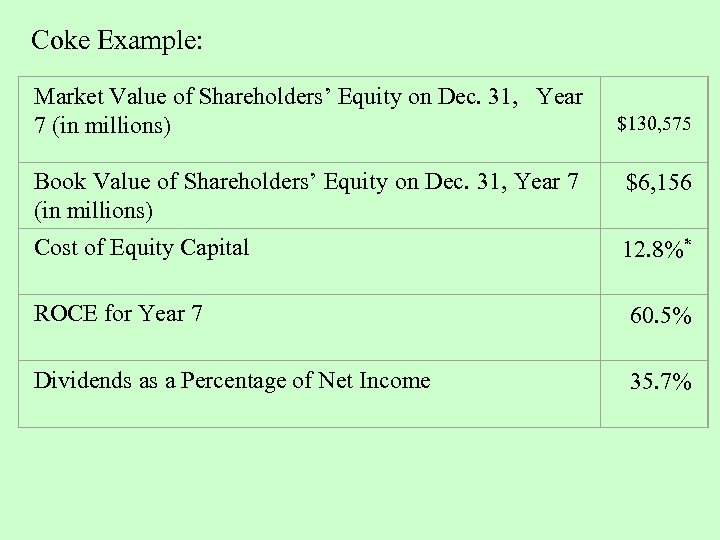
Coke Example: Market Value of Shareholders’ Equity on Dec. 31, Year 7 (in millions) $130, 575 Book Value of Shareholders’ Equity on Dec. 31, Year 7 (in millions) $6, 156 Cost of Equity Capital 12. 8%* ROCE for Year 7 60. 5% Dividends as a Percentage of Net Income 35. 7%
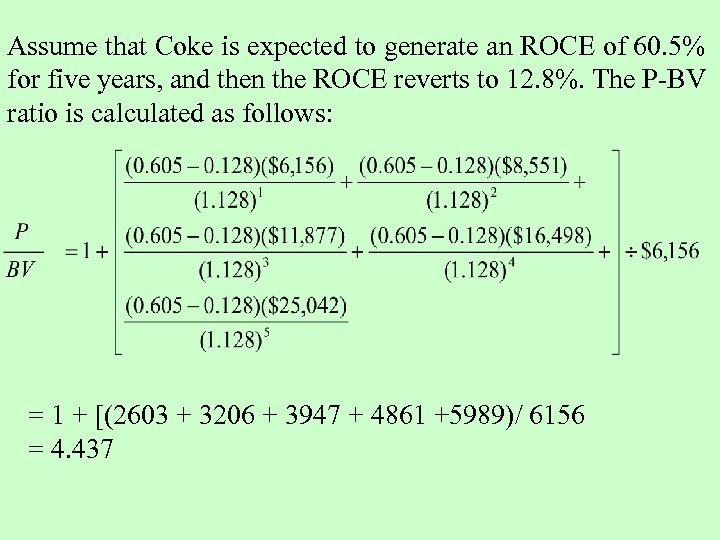
Assume that Coke is expected to generate an ROCE of 60. 5% for five years, and then the ROCE reverts to 12. 8%. The P-BV ratio is calculated as follows: = 1 + [(2603 + 3206 + 3947 + 4861 +5989)/ 6156 = 4. 437
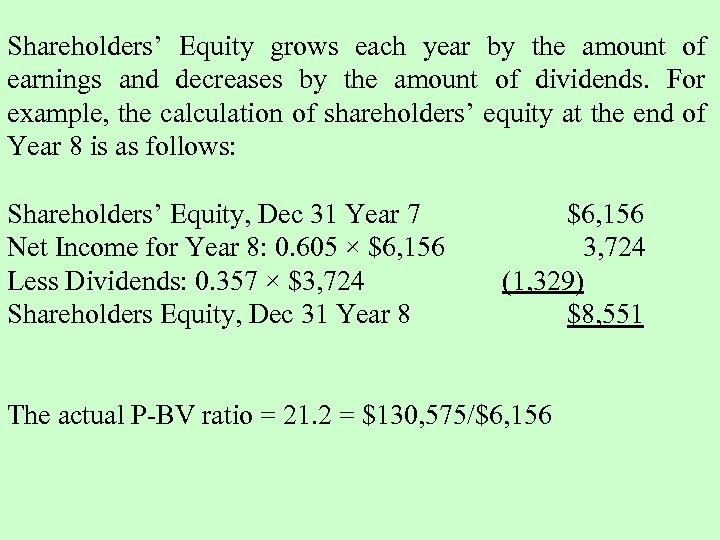
Shareholders’ Equity grows each year by the amount of earnings and decreases by the amount of dividends. For example, the calculation of shareholders’ equity at the end of Year 8 is as follows: Shareholders’ Equity, Dec 31 Year 7 $6, 156 Net Income for Year 8: 0. 605 × $6, 156 3, 724 Less Dividends: 0. 357 × $3, 724 (1, 329) Shareholders Equity, Dec 31 Year 8 $8, 551 The actual P-BV ratio = 21. 2 = $130, 575/$6, 156
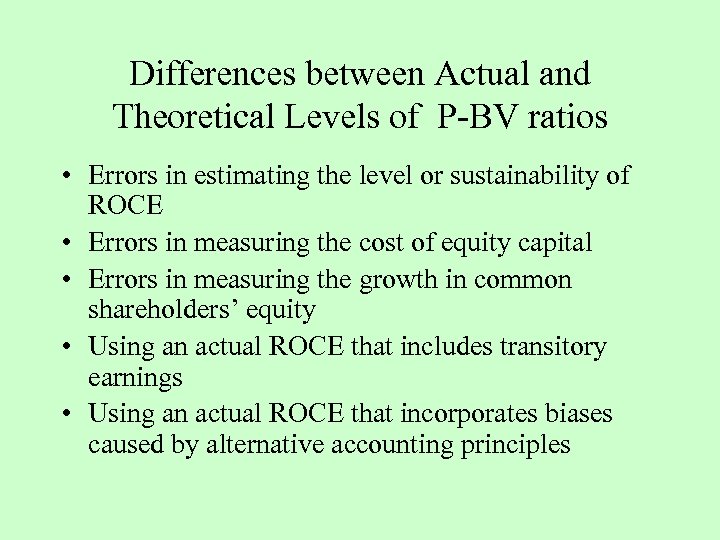
Differences between Actual and Theoretical Levels of P-BV ratios • Errors in estimating the level or sustainability of ROCE • Errors in measuring the cost of equity capital • Errors in measuring the growth in common shareholders’ equity • Using an actual ROCE that includes transitory earnings • Using an actual ROCE that incorporates biases caused by alternative accounting principles
Using P/E ratios and P/BV ratios of Comparable Firms: • Analysts can use • P-E and P-BV ratios of comparable firms • to assess the corresponding ratios of publicly traded firms.
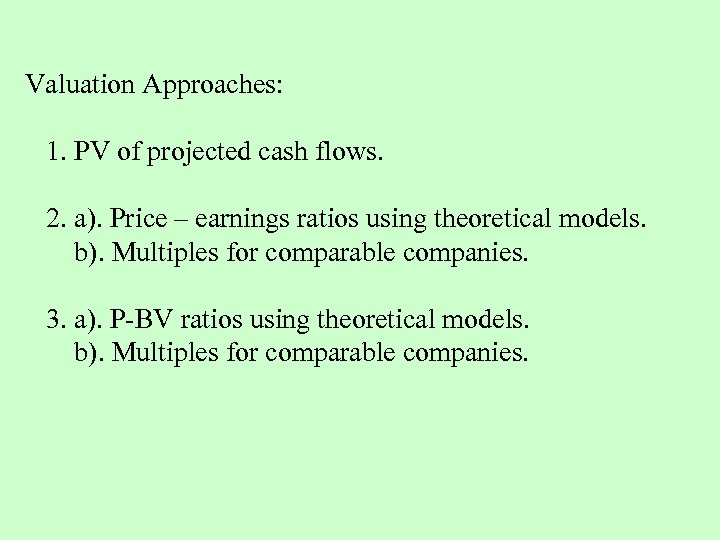
Valuation Approaches: 1. PV of projected cash flows. 2. a). Price – earnings ratios using theoretical models. b). Multiples for comparable companies. 3. a). P-BV ratios using theoretical models. b). Multiples for comparable companies.
Скачать презентацию Earnings Based Valuations Dr Mangold California State University
3f94063a994979618a474c7b1f2474f6.ppt