


 Скачать презентацию Earned Value Management project management with the lights
a0f316a9736d83bdde72c52001118d8a.ppt
- Количество слайдов: 38
 Earned Value Management ‘project management with the lights on’ Presentation to BCS David Galley 15 -Jan-2002 © 2001 David Galley 1
 Agenda n n n Project Management in the dark Illumination • Earned Value (EV) & Variance • Performance indices • Forecasting Earned Value Management (EVM) • 32 criteria • Organisation [WBS, OBS, RAM, CA] • Budgeting n EVM in the UK n Where to go for more information © 2001 David Galley 2
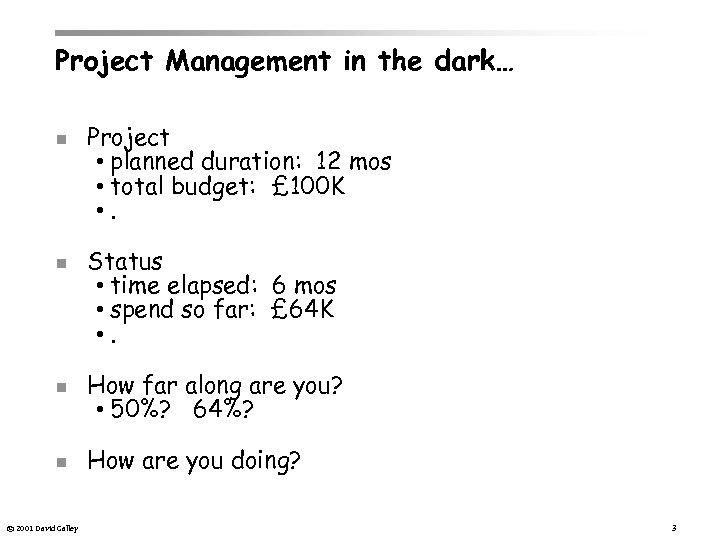 Project Management in the dark… n n Project • planned duration: 12 mos • total budget: £ 100 K • . Status • time elapsed: 6 mos • spend so far: £ 64 K • . n How far along are you? • 50%? 64%? n How are you doing? © 2001 David Galley 3
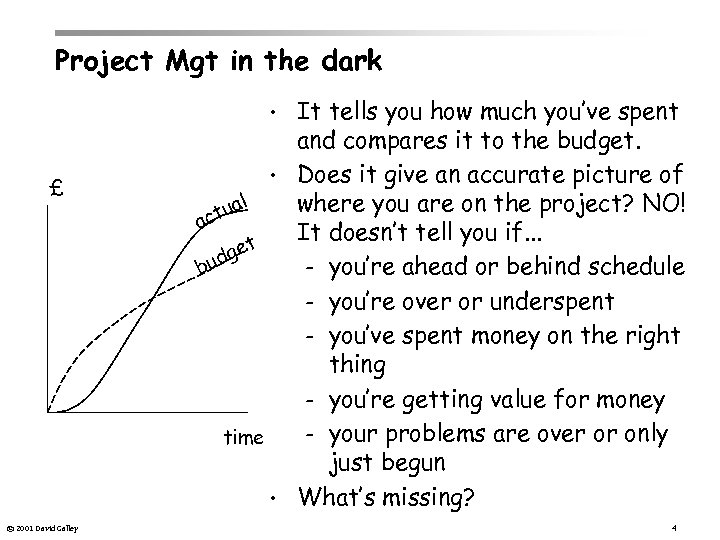 Project Mgt in the dark • £ ual ct a • get ud b time • © 2001 David Galley It tells you how much you’ve spent and compares it to the budget. Does it give an accurate picture of where you are on the project? NO! It doesn’t tell you if. . . – you’re ahead or behind schedule – you’re over or underspent – you’ve spent money on the right thing – you’re getting value for money – your problems are over or only just begun What’s missing? 4
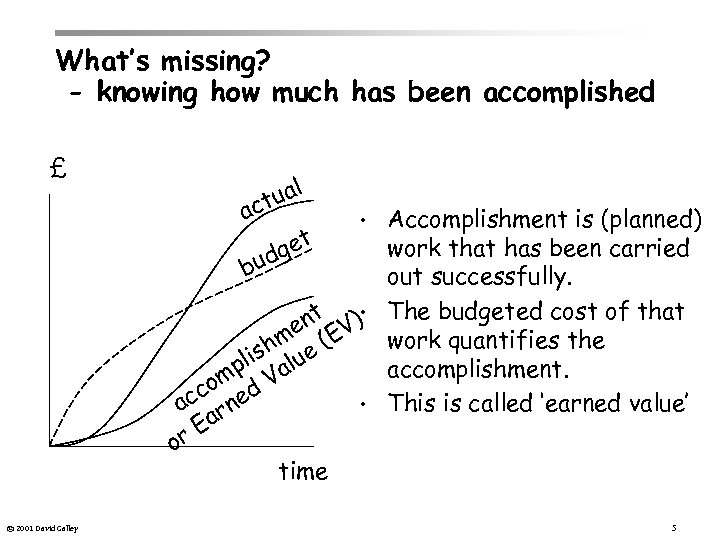 What’s missing? - knowing how much has been accomplished £ a ual ct Accomplishment is (planned) work that has been carried get d bu out successfully. nt V) • The budgeted cost of that me (E work quantifies the sh lue pli a accomplishment. om d V cc ne • This is called ‘earned value’ a r Ea or time © 2001 David Galley • 5
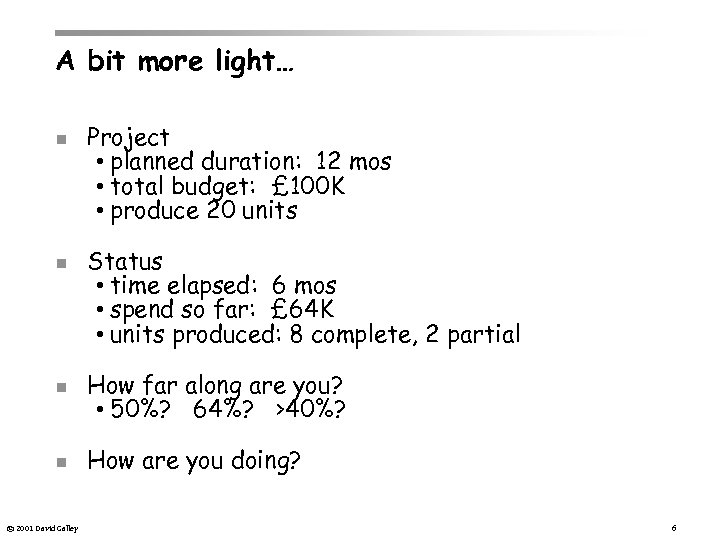 A bit more light… n n Project • planned duration: 12 mos • total budget: £ 100 K • produce 20 units Status • time elapsed: 6 mos • spend so far: £ 64 K • units produced: 8 complete, 2 partial n How far along are you? • 50%? 64%? >40%? n How are you doing? © 2001 David Galley 6
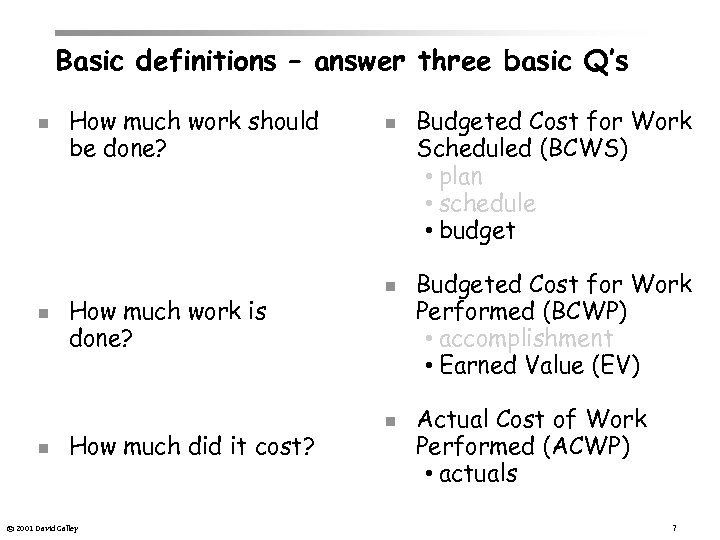 Basic definitions – answer three basic Q’s n n n How much work should be done? How much work is done? How much did it cost? © 2001 David Galley n n n Budgeted Cost for Work Scheduled (BCWS) • plan • schedule • budget Budgeted Cost for Work Performed (BCWP) • accomplishment • Earned Value (EV) Actual Cost of Work Performed (ACWP) • actuals 7
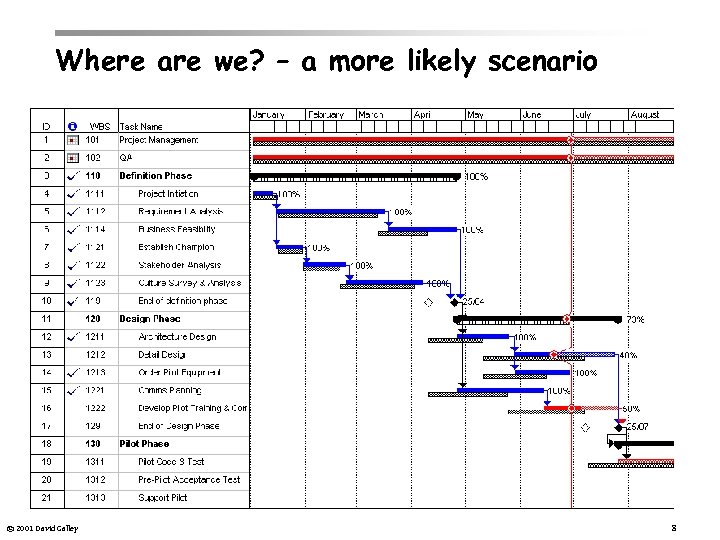 Where are we? – a more likely scenario © 2001 David Galley 8
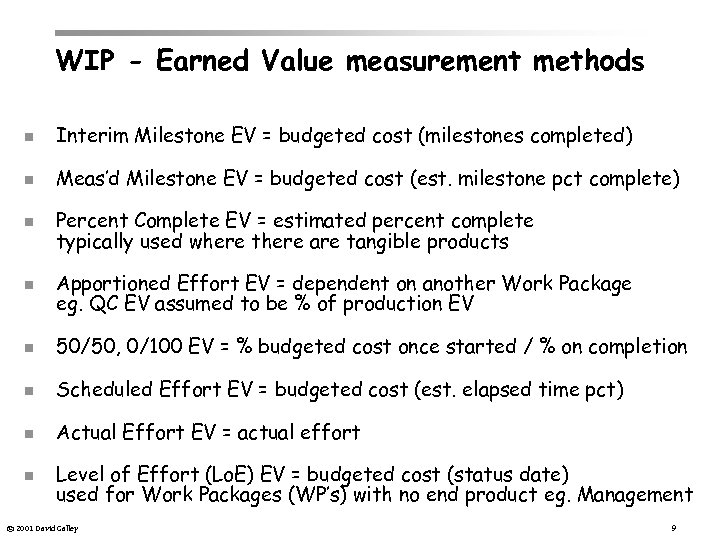 WIP - Earned Value measurement methods n Interim Milestone EV = budgeted cost (milestones completed) n Meas’d Milestone EV = budgeted cost (est. milestone pct complete) n Percent Complete EV = estimated percent complete typically used where there are tangible products n Apportioned Effort EV = dependent on another Work Package eg. QC EV assumed to be % of production EV n 50/50, 0/100 EV = % budgeted cost once started / % on completion n Scheduled Effort EV = budgeted cost (est. elapsed time pct) n Actual Effort EV = actual effort n Level of Effort (Lo. E) EV = budgeted cost (status date) used for Work Packages (WP’s) with no end product eg. Management © 2001 David Galley 9
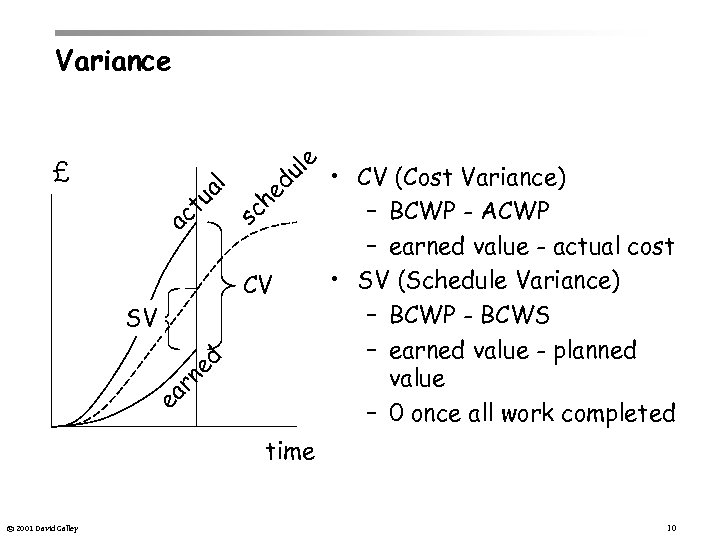 Variance du he sc ac tu al le £ CV ea rn ed SV • CV (Cost Variance) – BCWP - ACWP – earned value - actual cost • SV (Schedule Variance) – BCWP - BCWS – earned value - planned value – 0 once all work completed time © 2001 David Galley 10
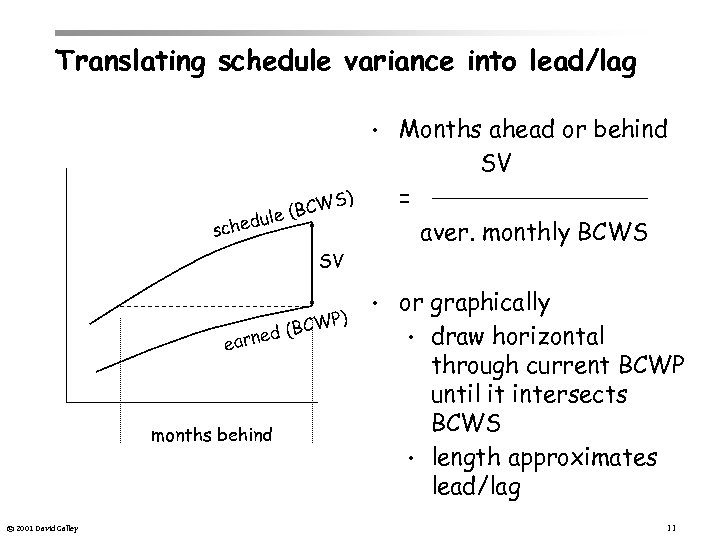 Translating schedule variance into lead/lag • Months ahead or behind SV = aver. monthly BCWS • or graphically • draw horizontal through current BCWP until it intersects BCWS • length approximates lead/lag ) S (BCW edule sch SV d earne months behind © 2001 David Galley (B CWP) 11
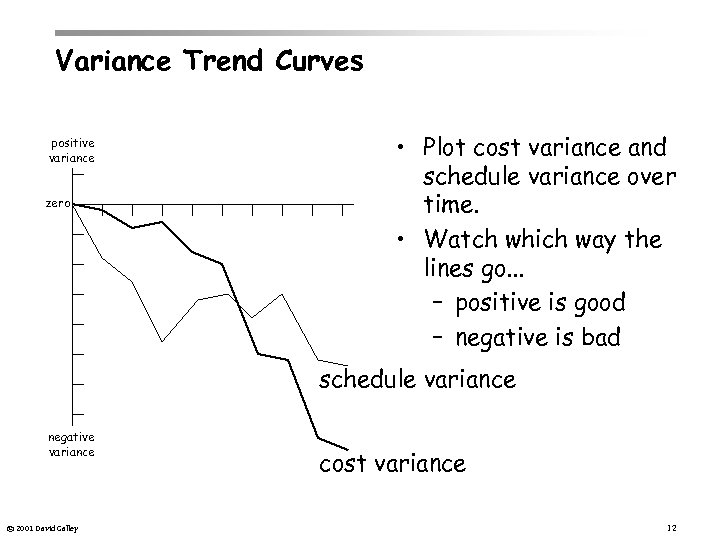 Variance Trend Curves positive variance zero • Plot cost variance and schedule variance over time. • Watch which way the lines go. . . – positive is good – negative is bad schedule variance negative variance © 2001 David Galley cost variance 12
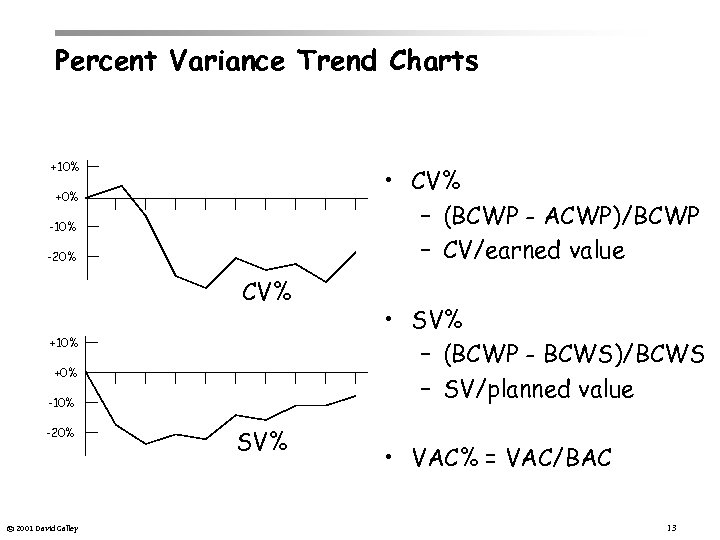 Percent Variance Trend Charts +10% • CV% – (BCWP - ACWP)/BCWP – CV/earned value +0% -10% -20% CV% +10% +0% -10% -20% © 2001 David Galley SV% • SV% – (BCWP - BCWS)/BCWS – SV/planned value • VAC% = VAC/BAC 13
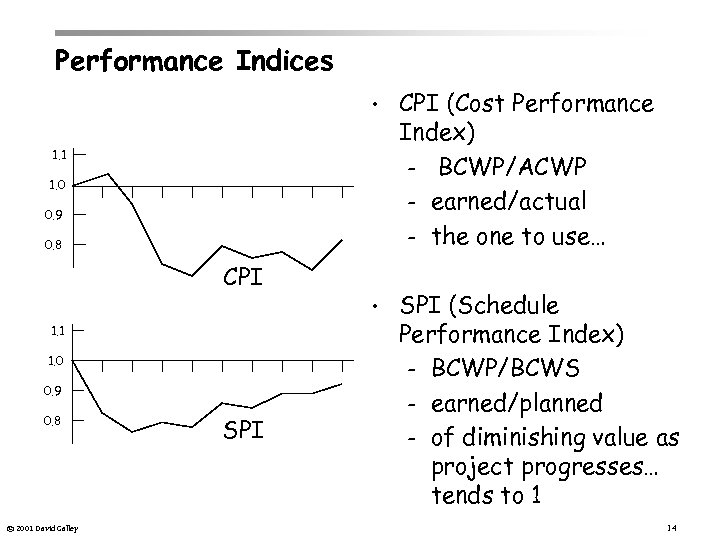 Performance Indices • CPI (Cost Performance Index) – BCWP/ACWP – earned/actual – the one to use… • SPI (Schedule Performance Index) – BCWP/BCWS – earned/planned – of diminishing value as project progresses… tends to 1 1. 0 0. 9 0. 8 CPI 1. 1 1. 0 0. 9 0. 8 © 2001 David Galley SPI 14
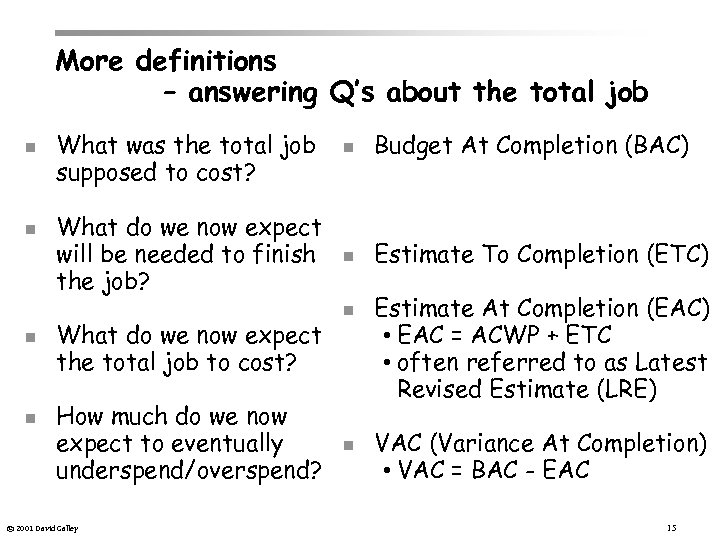 More definitions – answering Q’s about the total job n n What was the total job supposed to cost? What do we now expect will be needed to finish the job? What do we now expect the total job to cost? How much do we now expect to eventually underspend/overspend? © 2001 David Galley n Budget At Completion (BAC) n Estimate To Completion (ETC) n n Estimate At Completion (EAC) • EAC = ACWP + ETC • often referred to as Latest Revised Estimate (LRE) VAC (Variance At Completion) • VAC = BAC - EAC 15
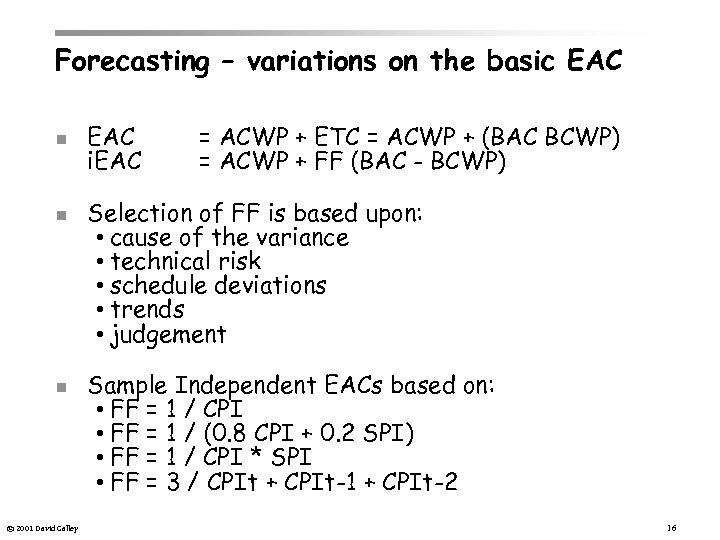 Forecasting – variations on the basic EAC n n n © 2001 David Galley EAC i. EAC = ACWP + ETC = ACWP + (BAC BCWP) = ACWP + FF (BAC - BCWP) Selection of FF is based upon: • cause of the variance • technical risk • schedule deviations • trends • judgement Sample Independent EACs based on: • FF = 1 / CPI • FF = 1 / (0. 8 CPI + 0. 2 SPI) • FF = 1 / CPI * SPI • FF = 3 / CPIt + CPIt-1 + CPIt-2 16
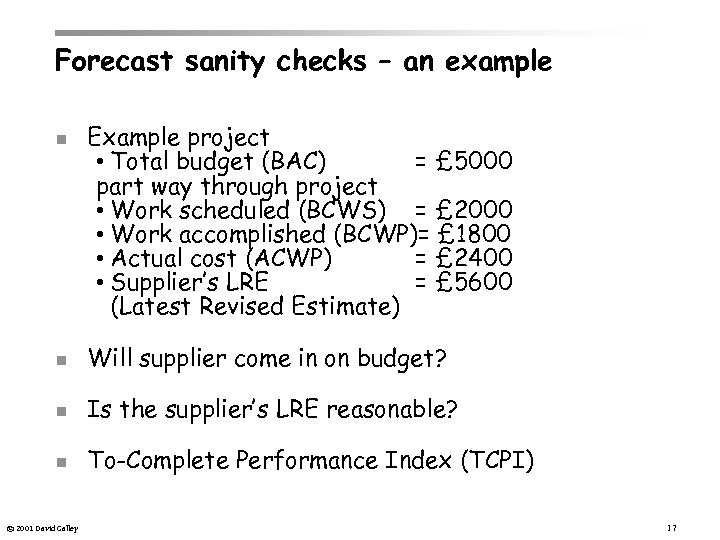 Forecast sanity checks – an example n Example project • Total budget (BAC) = £ 5000 part way through project • Work scheduled (BCWS) = £ 2000 • Work accomplished (BCWP)= £ 1800 • Actual cost (ACWP) = £ 2400 • Supplier’s LRE = £ 5600 (Latest Revised Estimate) n Will supplier come in on budget? n Is the supplier’s LRE reasonable? n To-Complete Performance Index (TCPI) © 2001 David Galley 17
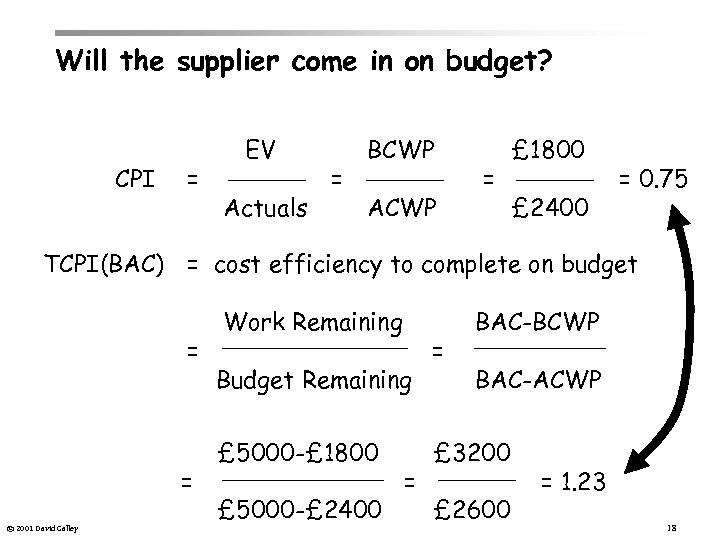 Will the supplier come in on budget? CPI = EV Actuals = BCWP ACWP = £ 1800 £ 2400 = 0. 75 TCPI(BAC) = cost efficiency to complete on budget = = © 2001 David Galley Work Remaining Budget Remaining £ 5000 -£ 1800 £ 5000 -£ 2400 = = BAC-BCWP BAC-ACWP £ 3200 £ 2600 = 1. 23 18
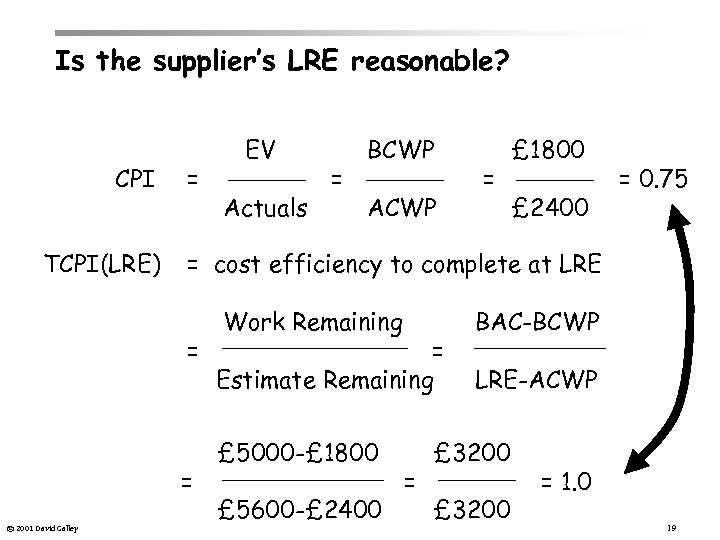 Is the supplier’s LRE reasonable? CPI TCPI(LRE) = Actuals = BCWP ACWP = £ 1800 £ 2400 = 0. 75 = cost efficiency to complete at LRE = = © 2001 David Galley EV Work Remaining = Estimate Remaining £ 5000 -£ 1800 £ 5600 -£ 2400 = BAC-BCWP LRE-ACWP £ 3200 = 1. 0 19
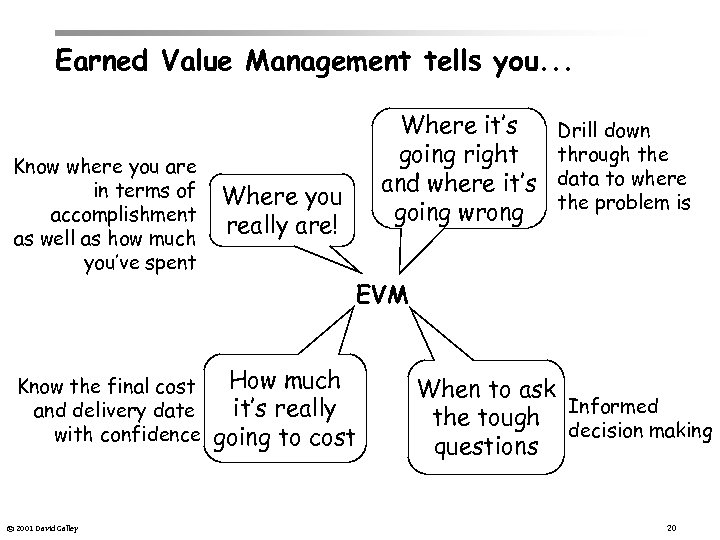 Earned Value Management tells you. . . Know where you are in terms of accomplishment as well as how much you’ve spent Where it’s going right and where it’s going wrong Where you really are! Drill down through the data to where the problem is EVM Know the final cost and delivery date with confidence © 2001 David Galley How much it’s really going to cost When to ask Informed the tough decision making questions 20
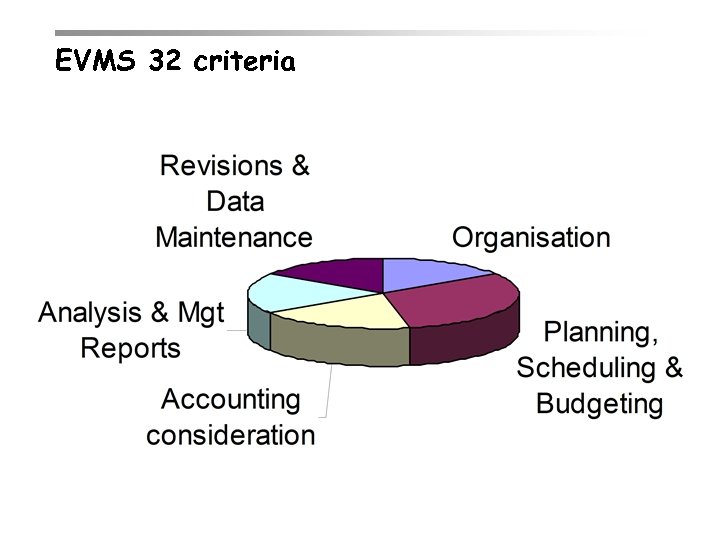 EVMS 32 criteria © 2001 David Galley 21
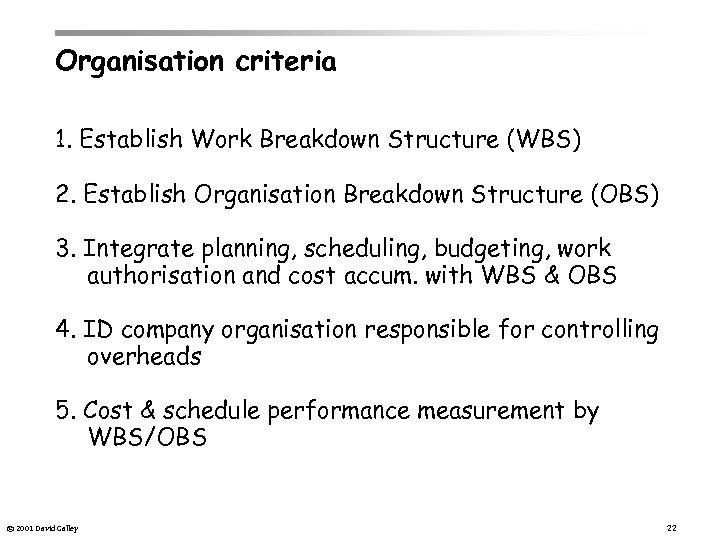 Organisation criteria 1. Establish Work Breakdown Structure (WBS) 2. Establish Organisation Breakdown Structure (OBS) 3. Integrate planning, scheduling, budgeting, work authorisation and cost accum. with WBS & OBS 4. ID company organisation responsible for controlling overheads 5. Cost & schedule performance measurement by WBS/OBS © 2001 David Galley 22
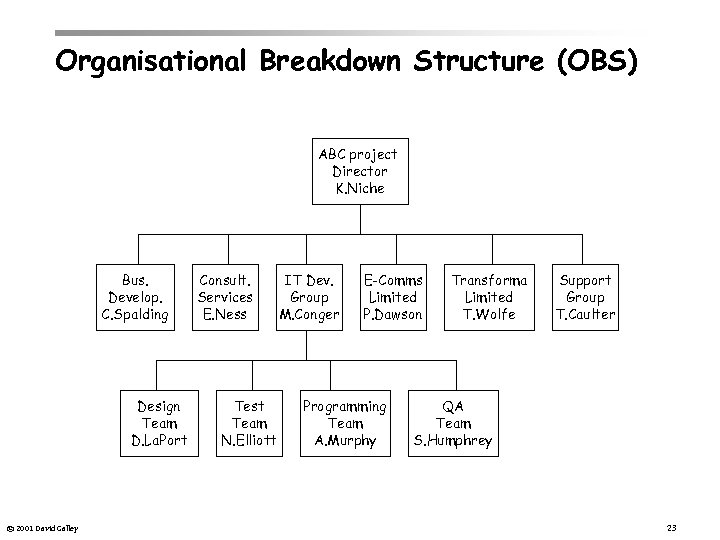 Organisational Breakdown Structure (OBS) ABC project Director K. Niche Bus. Develop. C. Spalding Design Team D. La. Port © 2001 David Galley Consult. Services E. Ness Test Team N. Elliott IT Dev. Group M. Conger E-Comms Limited P. Dawson Programming Team A. Murphy Transforma Limited T. Wolfe Support Group T. Caulter QA Team S. Humphrey 23
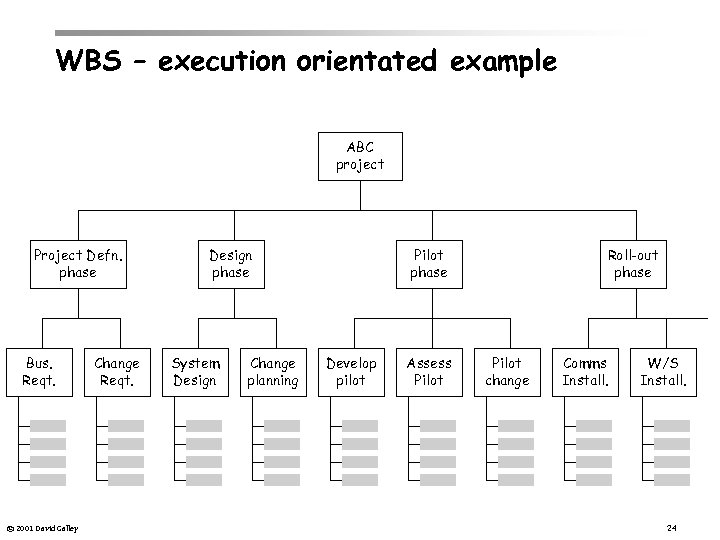 WBS – execution orientated example ABC project Project Defn. phase Bus. Reqt. © 2001 David Galley Change Reqt. Design phase System Design Change planning Pilot phase Develop pilot Assess Pilot Roll-out phase Pilot change Comms Install. W/S Install. 24
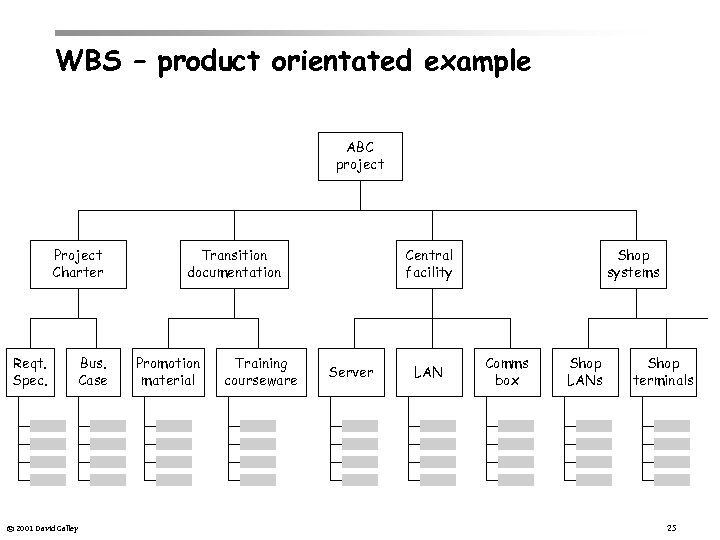 WBS – product orientated example ABC project Project Charter Reqt. Spec. Bus. Case © 2001 David Galley Transition documentation Promotion material Training courseware Central facility Server LAN Shop systems Comms box Shop LANs Shop terminals 25
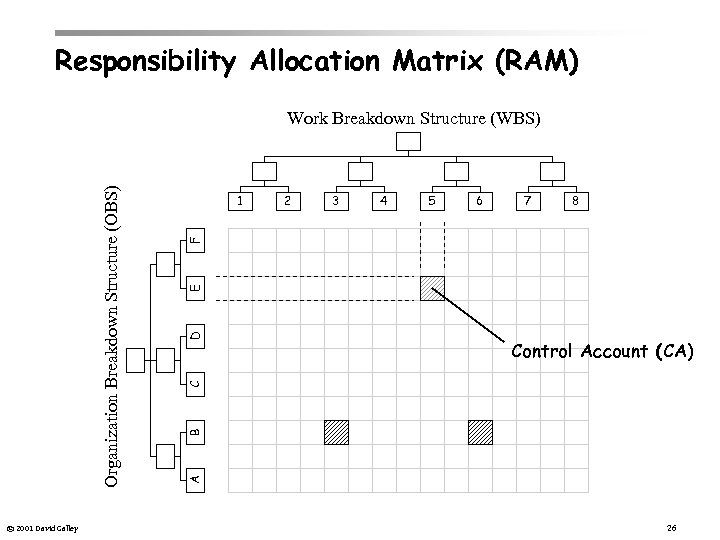 Responsibility Allocation Matrix (RAM) © 2001 David Galley 2 3 4 5 6 7 8 Control Account (CA) B C D E F 1 A Organization Breakdown Structure (OBS) Work Breakdown Structure (WBS) 26
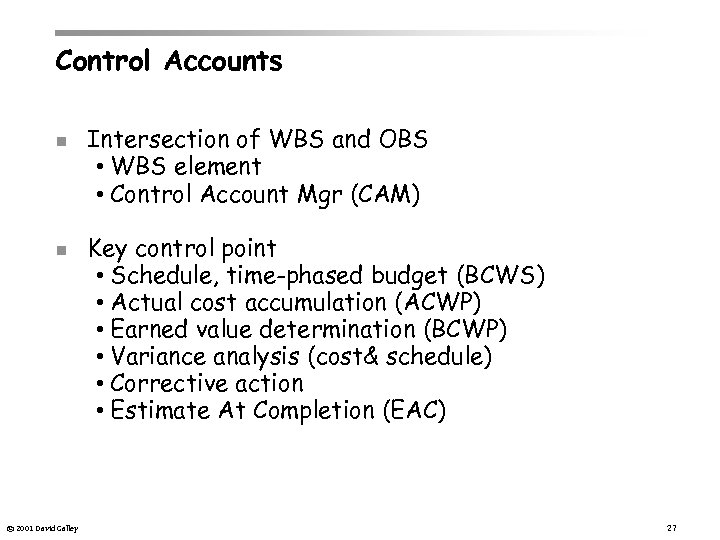 Control Accounts n n © 2001 David Galley Intersection of WBS and OBS • WBS element • Control Account Mgr (CAM) Key control point • Schedule, time-phased budget (BCWS) • Actual cost accumulation (ACWP) • Earned value determination (BCWP) • Variance analysis (cost& schedule) • Corrective action • Estimate At Completion (EAC) 27
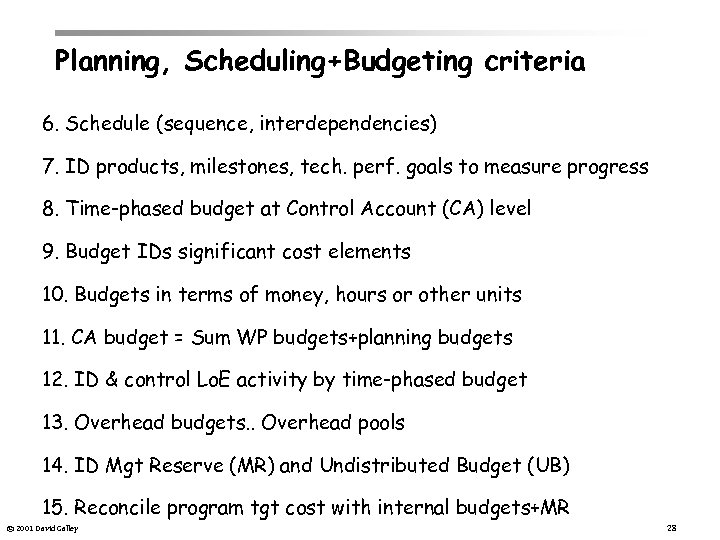 Planning, Scheduling+Budgeting criteria 6. Schedule (sequence, interdependencies) 7. ID products, milestones, tech. perf. goals to measure progress 8. Time-phased budget at Control Account (CA) level 9. Budget IDs significant cost elements 10. Budgets in terms of money, hours or other units 11. CA budget = Sum WP budgets+planning budgets 12. ID & control Lo. E activity by time-phased budget 13. Overhead budgets. . Overhead pools 14. ID Mgt Reserve (MR) and Undistributed Budget (UB) 15. Reconcile program tgt cost with internal budgets+MR © 2001 David Galley 28
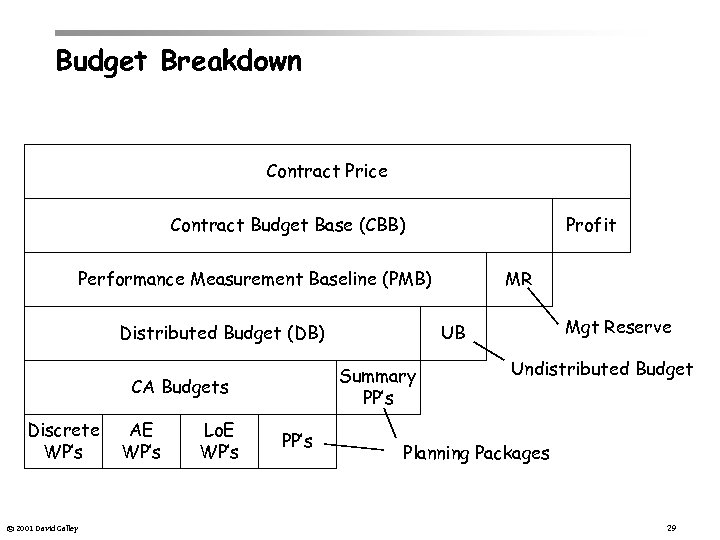 Budget Breakdown Contract Price Contract Budget Base (CBB) Profit Performance Measurement Baseline (PMB) Distributed Budget (DB) Discrete WP’s © 2001 David Galley AE WP’s Lo. E WP’s PP’s Mgt Reserve UB Summary PP’s CA Budgets MR Undistributed Budget Planning Packages 29
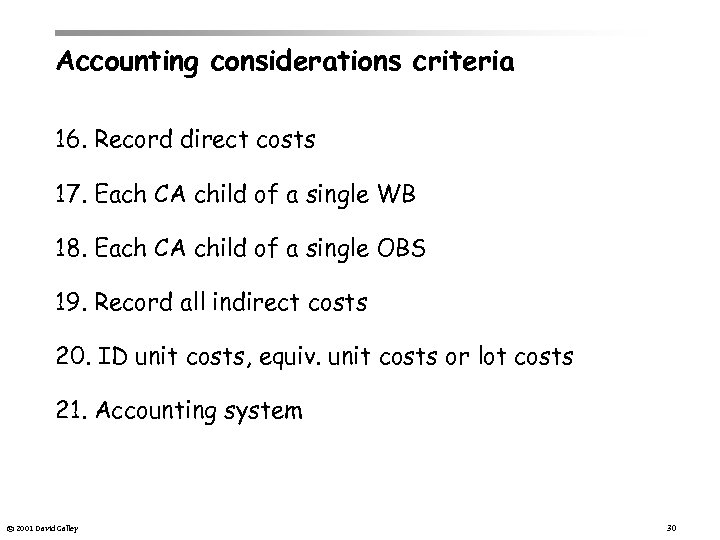 Accounting considerations criteria 16. Record direct costs 17. Each CA child of a single WB 18. Each CA child of a single OBS 19. Record all indirect costs 20. ID unit costs, equiv. unit costs or lot costs 21. Accounting system © 2001 David Galley 30
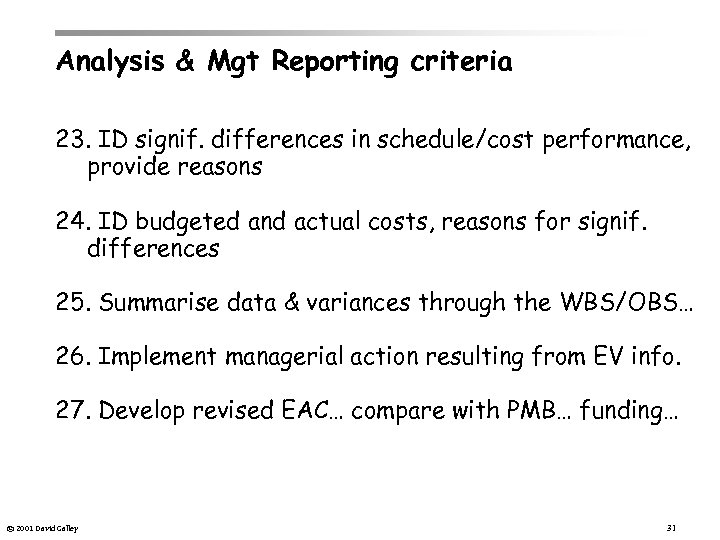 Analysis & Mgt Reporting criteria 23. ID signif. differences in schedule/cost performance, provide reasons 24. ID budgeted and actual costs, reasons for signif. differences 25. Summarise data & variances through the WBS/OBS… 26. Implement managerial action resulting from EV info. 27. Develop revised EAC… compare with PMB… funding… © 2001 David Galley 31
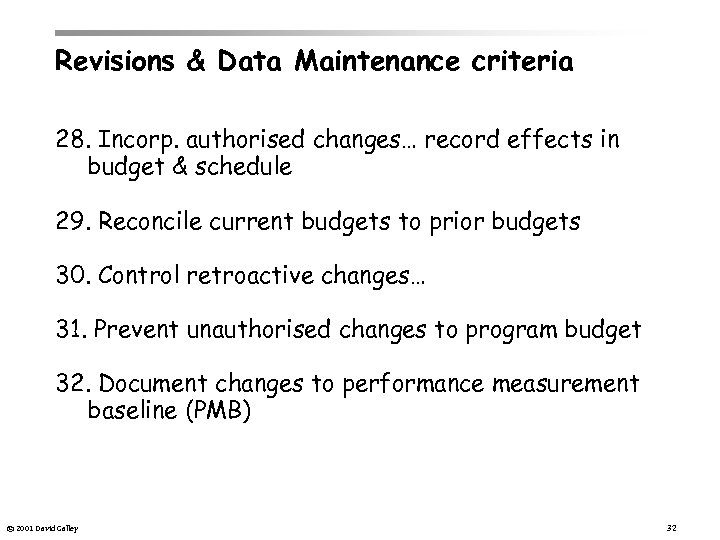 Revisions & Data Maintenance criteria 28. Incorp. authorised changes… record effects in budget & schedule 29. Reconcile current budgets to prior budgets 30. Control retroactive changes… 31. Prevent unauthorised changes to program budget 32. Document changes to performance measurement baseline (PMB) © 2001 David Galley 32
 Potential Benefits of EVM n Improved project performance n Management by exception n Good predictive capability n n © 2001 David Galley Database of completed projects, useful for comparative analysis Enabler for a new culture of openness, trust and honesty • improved contractor/customer relations • “the main problem with EVM is that it works” 33
 EVM in the UK n n n Defence • Mo. D - 30 IPT’s intend to or are using EVM • BAe Systems, Rolls-Royce, Stracham & Henshaw, GKN Westlands, Thales, BAe Systems (Nimrod, Hawk, Eurofighter, FOAS, JSF, Type 45, Astute, CVF) Construction • Laing, Millenium Dome, BAA Terminal 5 Software • IBM • Unisys • EDS © 2001 David Galley 34
 Where to go next? n n n © 2001 David Galley Websites www. acq. osd. mil/pm www. cpm-pmi. org www. evm. nasa. gov www. apm. org. uk/apm/evsig. htm ‘Earned Value Project Management’ • Quentin Fleming & Joel Koppelman • ISBN: 1 -880410 -27 -3 $35 APM EV SIG • Quango: NAO, OGC, Mo. D, EDS, IBM, Unisys, PMI, BAA T 5, Laing, Rolls-Royce, BAe Systems • UK standard • Implementation Guidelines (AIM) 35
 Who to go to next? – Steve Wake n Head of APM EV SIG n swprojects@cableinet. co. uk n © 2001 David Galley 7 th ‘EVA in the UK conference’ • Church House, Westminster • 20 -June-2002 • Sir John Bourn Auditor General – keynote speaker • Royal Shakespeare Company 36
 ‘EVA in the UK’ Church House, Westminster © 2001 David Galley www. churchhouseconf. co. uk/facilities/assembly-pan. htm 37
 Integrated Baseline Review n n © 2001 David Galley IBR - a formal and continual process conducted to assess the content and integrity of the Performance Measurement Baseline (PMB) Purpose – is to achieve and maintain a joint project/customer understanding of the risks inherent within the baseline and the management control processes that will operate • highlight expectations and assumptions early • clear understanding of the plan and risks • sound basis for — measuring & reporting project performance — proactive project management 38