 Скачать презентацию EARN Roundtable Chatham House London 12 December
92018d2481d9e242b0abc2240d04de53.ppt
- Количество слайдов: 19



EARN Roundtable Chatham House, London – 12 December 2008 The Africa-EU Strategic Partnership one year after Lisbon Mr José Briosa e Gala European Commission President’s Special Advisor and Personal Representative for Africa
EARN Roundtable Chatham House, London – 12 December 2008 The Africa-EU Strategic Partnership one year after Lisbon Major achievements and constraints in the implementation of the Joint Strategy and its first Action Plan (2008 -2010)
The Africa-EU Strategic Partnership one year after Lisbon • An ambitious policy framework • A complex institutional architecture • A multitude of stakeholders • 2008: first key achievements • Some constraints and challenges ahead
An ambitious policy framework Outstanding features: • A Strategic Partnership between equals, moving away from the traditional donor – beneficiary relation A Political dialogue for • – – – • Discussion of issues of common concern (eg. regional integration) A joint response to global challenges (eg. climate change, energy, peace & security); Promoting key issues for development (eg. MDGs, governance); Tackling new areas of cooperation : S&T, space, information soc. Promoting a broad-based people-centred partnership. 8 thematic partnerships for concrete action with tangible results
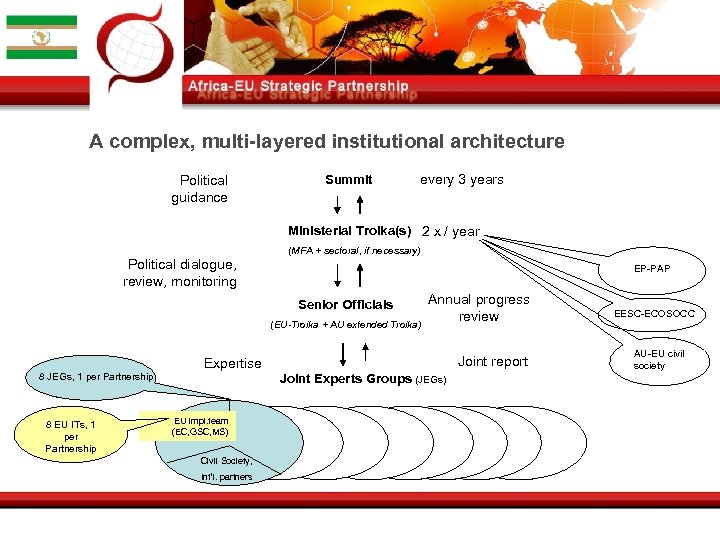
A complex, multi-layered institutional architecture Summit Political guidance every 3 years Ministerial Troika(s) 2 x / year (MFA + sectoral, if necessary) Political dialogue, review, monitoring EP-PAP Senior Officials (EU-Troika + AU extended Troika) 8 JEGs, 1 per Partnership 8 EU ITs, 1 per Partnership Annual progress review Joint report Expertise Joint Experts Groups (JEGs) EU impl. team (EC, GSC, MS) AUC, AU MS, RECs Civil Society, Int’l. partners EESC-ECOSOCC AU-EU civil society
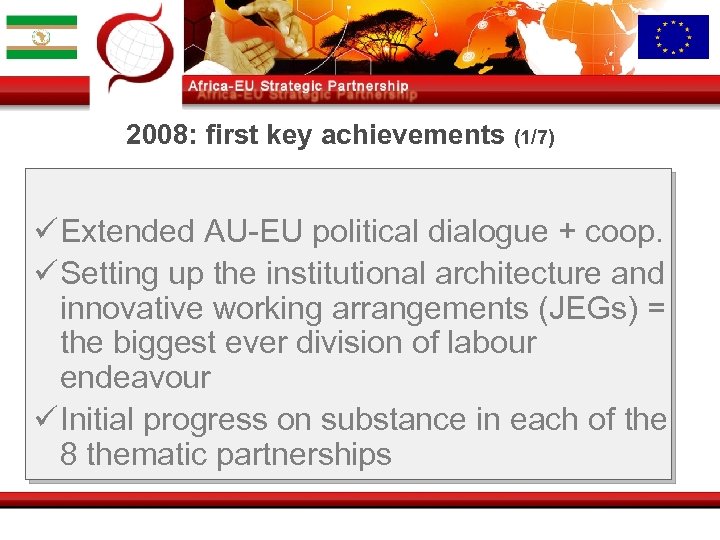
2008: first key achievements (1/7) ü Extended AU-EU political dialogue + coop. ü Setting up the institutional architecture and innovative working arrangements (JEGs) = the biggest ever division of labour endeavour ü Initial progress on substance in each of the 8 thematic partnerships
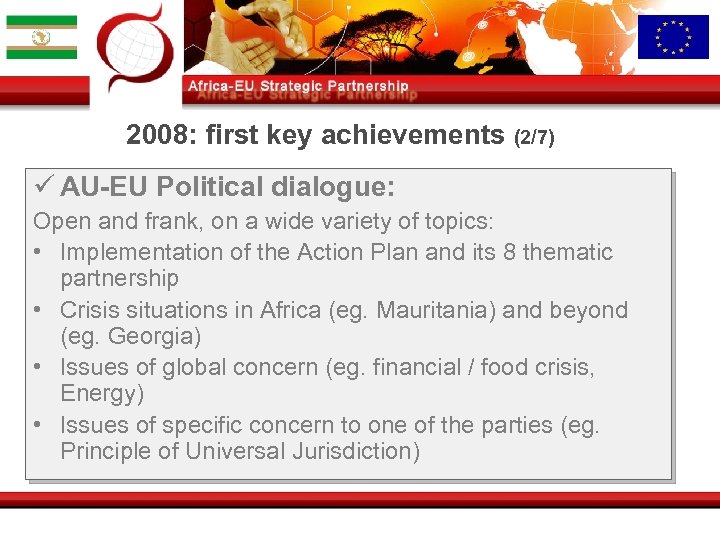
2008: first key achievements (2/7) ü AU-EU Political dialogue: Open and frank, on a wide variety of topics: • Implementation of the Action Plan and its 8 thematic partnership • Crisis situations in Africa (eg. Mauritania) and beyond (eg. Georgia) • Issues of global concern (eg. financial / food crisis, Energy) • Issues of specific concern to one of the parties (eg. Principle of Universal Jurisdiction)
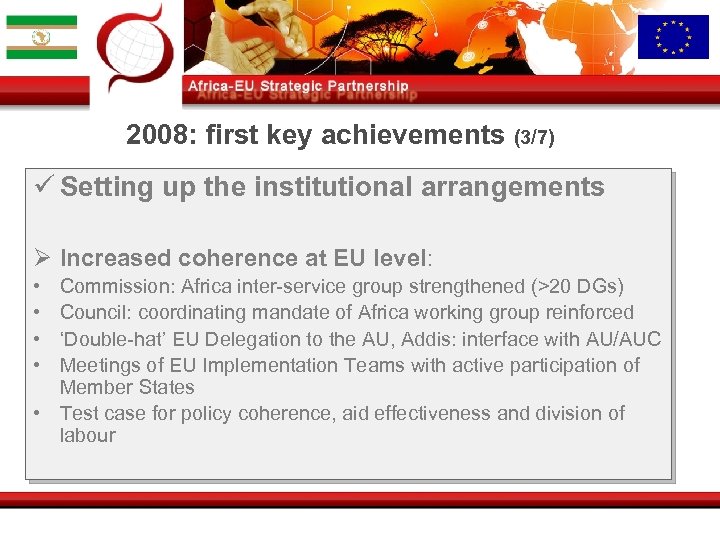
2008: first key achievements (3/7) ü Setting up the institutional arrangements Ø Increased coherence at EU level: • • Commission: Africa inter-service group strengthened (>20 DGs) Council: coordinating mandate of Africa working group reinforced ‘Double-hat’ EU Delegation to the AU, Addis: interface with AU/AUC Meetings of EU Implementation Teams with active participation of Member States • Test case for policy coherence, aid effectiveness and division of labour
2008: first key achievements (4/7) ü Setting up the institutional arrangements Ø At AU level: • New AU Commission: elected in Feb. , in service in April 08 • Strong commitment to the Africa-EU Partnership • Inter-service group set up between the various AUC Directorates involved • Recent designation of African co-chairs for the Joint Expert Groups, beyond the AUC
2008: first key achievements (5/7) ü Setting up the institutional arrangements Ø At joint AU-EU level: • 16/09: Ministerial Troika, endorsement of instit. architecture • Oct-Nov: First meetings of the informal joint expert groups (JEGs) on the 8 thematic partnerships • 20 -21/11: Ministerial Troika, endorsement of first joint progress report, communiqué and guidelines for JEGs
2008: first key achievements (6/7) ü Initial progress on substance Ø Peace & security: • Sept. 08: 1 st joint meeting of EU Political and Security Committee and the AU Peace and Security Council • Launch of Amani Africa / Euro-Recamp training cycle for the African Stand-by Force • New African Peace Facility (APF) agreed, € 300 M • Enhanced cooperation between EU-AU situation centres
2008: first key achievements (7/7) ü Initial progress on substance Ø Energy: • Visit of EU Commissioners Michel and Piebalgs to Africa: joint EC-AUC Statement on actions in favour of energy access and services in Africa + energy security Ø Climate change: • Joint Africa-EU Declaration, ahead of Poznan UNFCCC Ø + other thematic partnerships
Some constraints and challenges ahead (1/4) ü • • • Need to move quickly… from process to concrete action & deliverables from diplomatic to experts level (in joint expert groups) from a Commission- to a more Member State-driven dynamics Need to keep the political momentum and deliver concrete results by the next Troika Ministerial, Luxembourg, 28/04/09 by 2009 mid-term review (under SW presidency of the EU) by 2010 3 rd Africa-EU Summit
Some constraints and challenges ahead (2/4) ü Need to better involve: • Member States (AU / EU) • Regional Economic Communities (RECs) • European and Panafrican Parliaments • Economic and Social committees (EESC, ECOSOCC) • Other international partners (UN, Af. DB, IFIs) • EC Delegations in Africa ü Need to go beyond institutions and better integrate: • Civil society • Private sector • Local authorities
Some constraints and challenges ahead (3/4) ü Need to finance the implementation architecture (eg. participation of civil society; experts) ü Need to establish clear implementation roadmap: 8 partnerships: identify actors, (financial) resources, calendars, deliverables (Commissions, Member States, other actors) ü Need for JEGs to address all agreed priority actions (eg. not migration to the detriment of employment)
Some constraints and challenges ahead (4/4) ü Need for EU MS to increase their financial commitments to Africa in line with international commitments (Paris Declaration, Monterrey, Accra, Doha) ü Need for EU MS to address regional and continental dimension of the Partnership, beyond bilateral cooperation ü On the AU side, need to mobilise MS beyond South Africa and North African countries in steering thematic partnerships ü Need for African partners to deliver own contributions (policy, regulatory, financial, etc. )
Conclusion The Africa-EU Partnership: • ambitious and substantial • innovative working method (division of labour) • challenging timeframe • multi-stakeholders ü The political ambition must be matched with the necessary resources ü Make the « people-centred » dimension a reality
More information… . . on the Africa-EU Partnership: www. africa-eu-partnership. org
The Africa-EU Strategic Partnership one year after Lisbon Thank you for your attention!
Скачать презентацию EARN Roundtable Chatham House London 12 December
92018d2481d9e242b0abc2240d04de53.ppt