 Скачать презентацию EAPN Capacity Building Meeting POVERTY IN THE EUROPEAN
92fe592eb4ab81b9b19f8ec499211936.ppt
- Количество слайдов: 17



EAPN Capacity Building Meeting ‘POVERTY IN THE EUROPEAN UNION BUILDING A COMMON VISION FOR ACTION’ Brussels, 27 September 2012 Workshop 3: Portugal Presentation Hélder Ferreira
Objectives • Check EAPN analysis framework of poverty against each network point of view in order to discuss and rebuild a common vision likely to drive our fight in the coming years; • Exchange information about what is happening concretely in terms of poverty and policies implemented, also to complement picture of NRPs presented in last EAPN Report; • Assessment of the effectiveness of monitoring of poverty and social exclusion at national and EU level and ideas for proposals to improve indicators and data collection at national and EU level in the context of the upcoming revision of indicators and data collection on poverty at EU level. www. eapn. pt
Presentation of EAPN Portugal • Working against Poverty and Social Exclusion for more than 20 years (1991) • National network with 18 District Delegations www. eapn. pt
1. What poverty means today • The definitions do not capture the reality of the day-today struggle of living in poverty. • The analysis that relies on documents (EU and PT) and statistical data doesn’t capture the reality on the ground (ex: due to severe restrictions on income, citizens only buy partially the medication in prescriptions or don’t even buy them at all). • The contribution of PEP is vital to fully understand the reality of poverty (ex: access to basic utilities like power and water / access to finantial services / Should internet access be considered a basic utility? ) www. eapn. pt
1. What poverty means today Major Causes of poverty • • • Unemployment Poor quality jobs (i. e. precarious) Low wages / pensions / low income Informal economy / absence of rights/social protection Low levels of education and skills The size and type of family Gender Disability or ill-health Being a member of minority ethnic groups such as the Roma and immigrants/ undocumented migrants • Living in a remote or very disadvantaged community • No access to justice www. eapn. pt
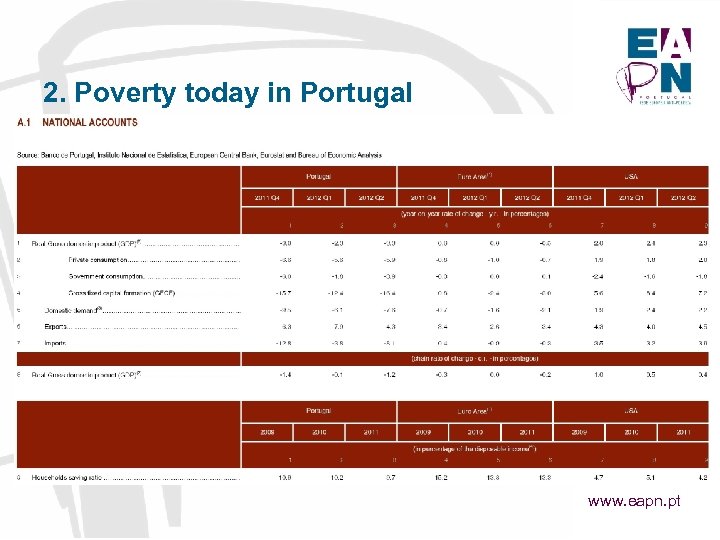
2. Poverty today in Portugal • Increased risk of being exposed to poverty, with the combination of growing unemployment and cuts in salaries, increased taxes and reduced social and unemployment benefits; • The rate of poverty risk of employees on behalf of others, in Portugal, is the third largest in the European Union and is rising: in 2010, almost 31% of employees were considered poor or at risk of being poor. www. eapn. pt
2. Poverty today in Portugal • A study by the European Commission indicated that these measures have had a disproportionately negative impact on the poorest of the country’s population; (Social Situation Observatory – Living Conditions and Income Distribution 2011); • The most vulnerable social groups have been the hardest hit by austerity measures implemented in Portugal (particularly the children, the elderly and Roma); • The risk of poverty is now more and more generalized, with increasing severity amongst the most fragile. www. eapn. pt
2. Poverty today in Portugal Impact of Government Policy • An economy under structural adjustment • Increasing tax burden and inequality • Labour Market severely affected by unemployment and precariousness • A more expensive cost of living • The non-registered economy - 25, 4% of GDP in 2011 (OBEGEF, FEP, 2011), comparing to 9, 4% of GDP in www. eapn. pt 1970.
2. Poverty today in Portugal www. eapn. pt
3. How is Poverty measured in Portugal The National Statistics Office (INE) uses the Europe 2020 poverty target indicators - relative poverty, severe material deprivation and low work intensity. www. eapn. pt
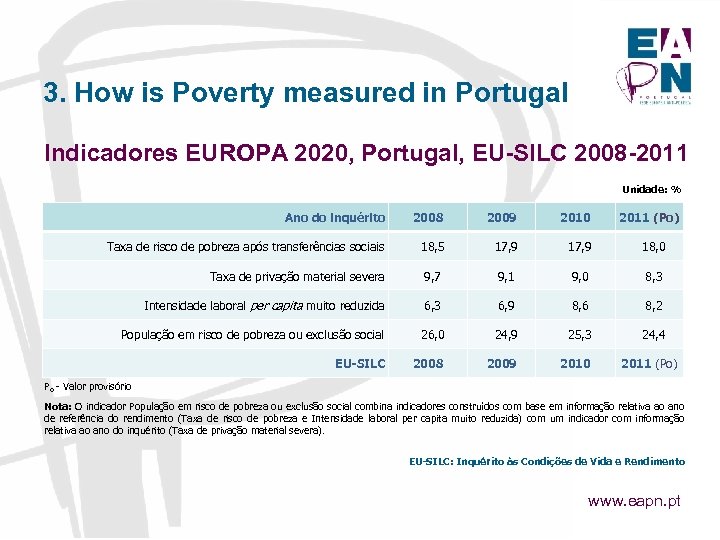
3. How is Poverty measured in Portugal Indicadores EUROPA 2020, Portugal, EU-SILC 2008 -2011 Unidade: % Ano do inquérito 2008 2009 2010 2011 (Po) Taxa de risco de pobreza após transferências sociais 18, 5 17, 9 18, 0 Taxa de privação material severa 9, 7 9, 1 9, 0 8, 3 Intensidade laboral per capita muito reduzida 6, 3 6, 9 8, 6 8, 2 População em risco de pobreza ou exclusão social 26, 0 24, 9 25, 3 24, 4 EU-SILC 2008 2009 2010 2011 (Po) Po - Valor provisório Nota: O indicador População em risco de pobreza ou exclusão social combina indicadores construídos com base em informação relativa ao ano de referência do rendimento (Taxa de risco de pobreza e Intensidade laboral per capita muito reduzida) com um indicador com informação relativa ao ano do inquérito (Taxa de privação material severa). EU-SILC: Inquérito às Condições de Vida e Rendimento www. eapn. pt
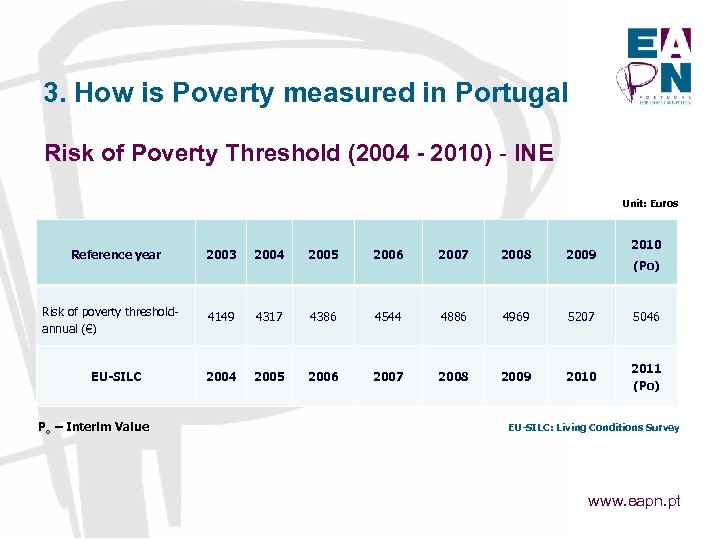
3. How is Poverty measured in Portugal Risk of Poverty Threshold (2004 - 2010) - INE Unit: Euros Reference year Risk of poverty thresholdannual (€) EU-SILC Po – Interim Value 2010 2003 2004 2005 2006 2007 2008 2009 4149 4317 4386 4544 4886 4969 5207 5046 2004 2005 2006 2007 2008 2009 2010 2011 (Po) EU-SILC: Living Conditions Survey www. eapn. pt
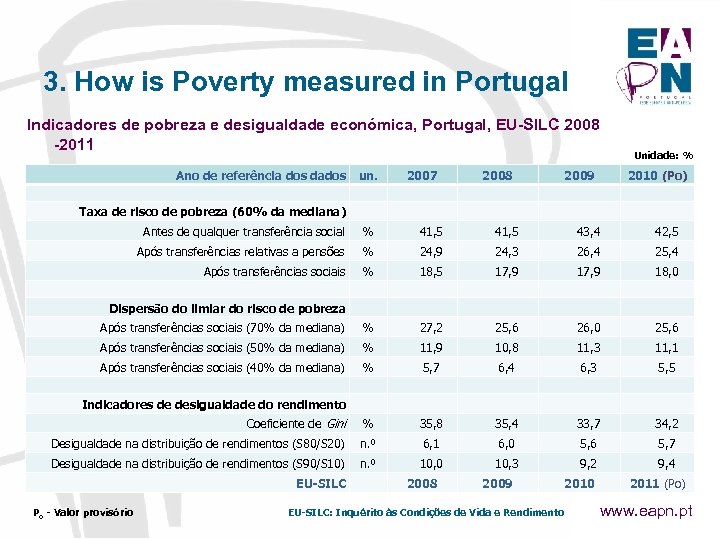
3. How is Poverty measured in Portugal Indicadores de pobreza e desigualdade económica, Portugal, EU-SILC 2008 -2011 Ano de referência dos dados un. 2007 2008 2009 Unidade: % 2010 (Po) Taxa de risco de pobreza (60% da mediana) Antes de qualquer transferência social % 41, 5 43, 4 42, 5 Após transferências relativas a pensões % 24, 9 24, 3 26, 4 25, 4 Após transferências sociais % 18, 5 17, 9 18, 0 Após transferências sociais (70% da mediana) % 27, 2 25, 6 26, 0 25, 6 Após transferências sociais (50% da mediana) % 11, 9 10, 8 11, 3 11, 1 Após transferências sociais (40% da mediana) % 5, 7 6, 4 6, 3 5, 5 Coeficiente de Gini % 35, 8 35, 4 33, 7 34, 2 Desigualdade na distribuição de rendimentos (S 80/S 20) n. º 6, 1 6, 0 5, 6 5, 7 Desigualdade na distribuição de rendimentos (S 90/S 10) n. º 10, 0 10, 3 9, 2 9, 4 Dispersão do limiar do risco de pobreza Indicadores de desigualdade do rendimento EU-SILC Po - Valor provisório 2008 2009 EU-SILC: Inquérito às Condições de Vida e Rendimento 2010 2011 (Po) www. eapn. pt
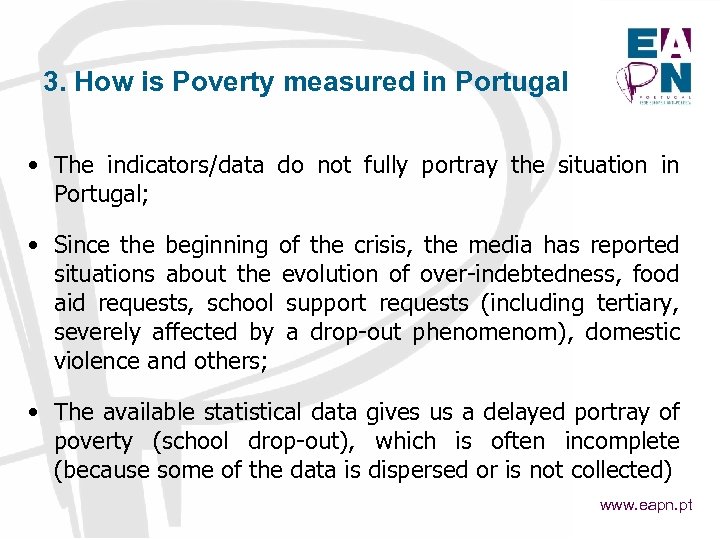
3. How is Poverty measured in Portugal • The indicators/data do not fully portray the situation in Portugal; • Since the beginning of the crisis, the media has reported situations about the evolution of over-indebtedness, food aid requests, school support requests (including tertiary, severely affected by a drop-out phenom), domestic violence and others; • The available statistical data gives us a delayed portray of poverty (school drop-out), which is often incomplete (because some of the data is dispersed or is not collected) www. eapn. pt
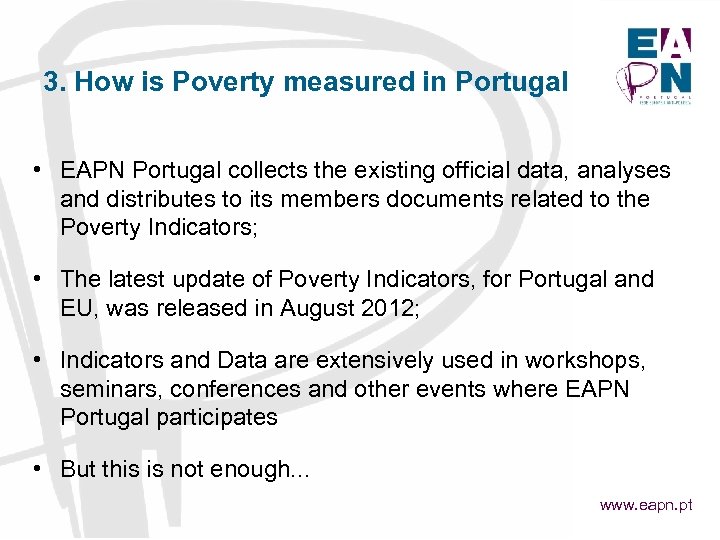
3. How is Poverty measured in Portugal • EAPN Portugal collects the existing official data, analyses and distributes to its members documents related to the Poverty Indicators; • The latest update of Poverty Indicators, for Portugal and EU, was released in August 2012; • Indicators and Data are extensively used in workshops, seminars, conferences and other events where EAPN Portugal participates • But this is not enough. . . www. eapn. pt
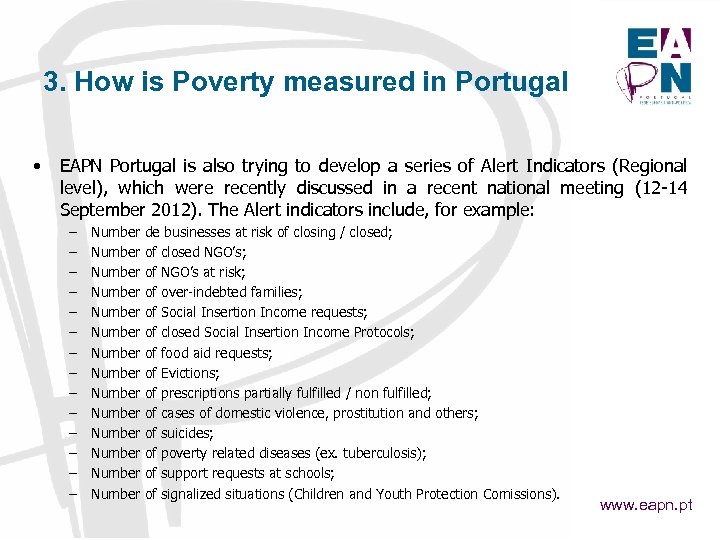
3. How is Poverty measured in Portugal • EAPN Portugal is also trying to develop a series of Alert Indicators (Regional level), which were recently discussed in a recent national meeting (12 -14 September 2012). The Alert indicators include, for example: – – – – Number Number Number Number de businesses at risk of closing / closed; of closed NGO’s; of NGO’s at risk; of over-indebted families; of Social Insertion Income requests; of closed Social Insertion Income Protocols; of food aid requests; of Evictions; of prescriptions partially fulfilled / non fulfilled; of cases of domestic violence, prostitution and others; of suicides; of poverty related diseases (ex. tuberculosis); of support requests at schools; of signalized situations (Children and Youth Protection Comissions). www. eapn. pt
Thank you for your attention Rua de Costa Cabral, 2368 | 4200 -218 Porto Tel: +351 225 420 800 Fax: +351 225 403 250 E-mail: sandra. araujo@eapn. pt Aveiro Beja Bragança Castelo Branco Coimbra Évora Faro Guarda Leiria Lisboa Portalegre Porto Santarém Setúbal Viana do Castelo Vila Real Viseu www. eapn. pt
Скачать презентацию EAPN Capacity Building Meeting POVERTY IN THE EUROPEAN
92fe592eb4ab81b9b19f8ec499211936.ppt