


 Скачать презентацию EAEVE and Veterinary Education in Europe Marcel Wanner
f12f168629d9a67fb66f125e5ea02c9b.ppt
- Количество слайдов: 20
 EAEVE and Veterinary Education in Europe Marcel Wanner European Association of Establishments for Veterinary Education Institute of Animal Nutrition University of Zurich
 Content EAEVE EU Legislation Governing Veterinary Training Evaluation Procedure Main Category 1 Deficiences Current Situation of Evaluation in Turkey
 EAEVE: Objectives European Association of Establishments for Veterinary Education Founded in Alfort (F) on May 27 th, 1988 The objective shall be - to promote and develop veterinary education - to reinforce co-operation between establishments for higher education in veterinary science - to act as forum for discussion of matters for veterinary education in order to improve and harmonize education - to manage the European System of Evaluation of Veterinary Training, based on the mandate given by the Commission of the European Community www. eaeve. org
 Members Group Group 1: 2: 3: 4: 5: 6: UK 7, Ireland 1, The Netherlands 1 Spain 10, Portugal 5 Italy 13, Greece 2, Albania 1, Israel 1, Romania 4 France 4, Belgium 2 Germany 5, Austria 1, Switzerland 1 Denmark 1, Norway 1, Sweden 1, Finland 1, Estonia 1, Latvia 1, Lithuania 1 Group 7: Slovak Republic 1, Czech Republic 2, Hungary 1, Slovenia 1, Poland 4, Croatia 1 Group 8: Bosnia-Herzegovina 1, Yugoslavia 1, Macedonia 1, Bulgaria 2, Ukraine 2, Turkey 11, Serbia 1 (italic: non EU-member states) Member establishments 94 in 35 countries 72 in EU
 Obligation of EAEVE Membership is voluntary Statutes of EAEVE Article 4: …. Members should also comply with the principle of periodic peer-group evaluation of their functioning as an academic institution according to defined protocols. Current situation: 94 member establishments in 35 countries 79 faculties have either been visited or have visits pending
 The EC-Directive 2005/36 Directive of the European Parliament and of the Council on the recognition of professional qualifications Defines minimum requirements for veterinary training This is the basis of the European System of Evaluation of Veterinary Training managed by EAEVE together with FVE
 The EC-Directive 2005/36 Section 5 Veterinary Surgeons Article 38 The training of veterinary surgeons The training of vet surgeons shall comprise a total of at least five years of full-time theoretical and practical study at a university or at a higher institute providing training recognised as being of an equivalent level, or under the supervision of a university covering at least the study programme referred to in the Annex V, point 5. 4. 1
 Study Programme (I) The programme of studies shall include at least the following subjects: A. Basic subjects - Physics Chemistry Animal biology Plant biology Biomathematics Directive 2005/36/EC
 Study Programme (II) B. Specific subjects a. Basic sciences - Anatomy (including histology and embryology) Physiology Biochemistry Genetics Pharmacology Pharmacy Toxicology Microbiology Immunology Epidemiology Professional ethics Directive 2005/36/EC
 Study Programme (III) B. Specific subjects b. Clinical sciences - Obstetrics Pathology (including pathological anatomy) Parasitology Clinical medicine and surgery (including anaesthetics) Clinical lectures on the various domestic animals, poultry and other animal species Preventive medicine Radiology Reproduction and reproductive disorders Veterinary state medicine and public health Veterinary legislation and forensic medicine Therapeutics Propaedeutics Directive 2005/36/EC
 Study Programme (IV) B. Specific subjects c. Animal Production - Animal production Animal nutrition Agronomy Rural economics Veterinary hygiene Animal ethology and protection d. Food hygiene - Inspection and control of animal foodstuffs or foodstuffs of animal origin - Food hygiene and technology - Practical work (including practical work in places where slaugthering and processing of foodstuffs takes place Directive 2005/36/EC
 Omnicompetence after 5 Years The distribution of theoretical and practical training among the various groups of subjects shall be balanced and coordinated in such a way that the knowledge and experience may be acquired in a manner which will enable veterinary surgeons to perform all their duties. (Annex V, point 5. 4. 1) Directive 2005/36/EC
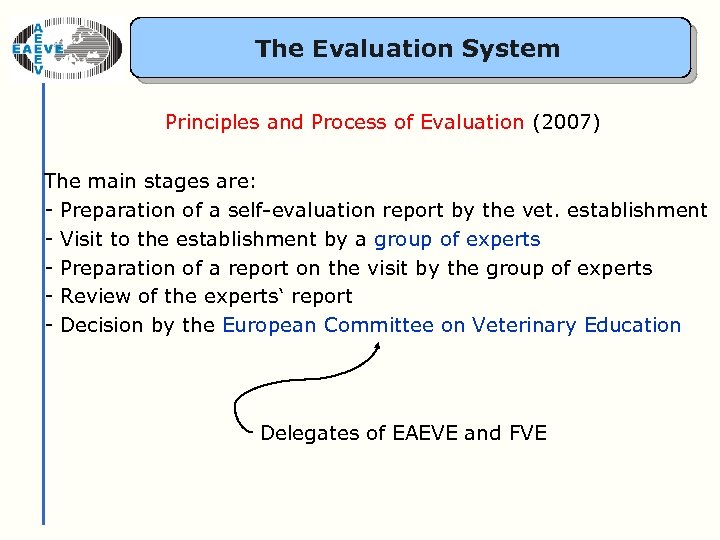 The Evaluation System Principles and Process of Evaluation (2007) The main stages are: - Preparation of a self-evaluation report by the vet. establishment - Visit to the establishment by a group of experts - Preparation of a report on the visit by the group of experts - Review of the experts‘ report - Decision by the European Committee on Veterinary Education Delegates of EAEVE and FVE
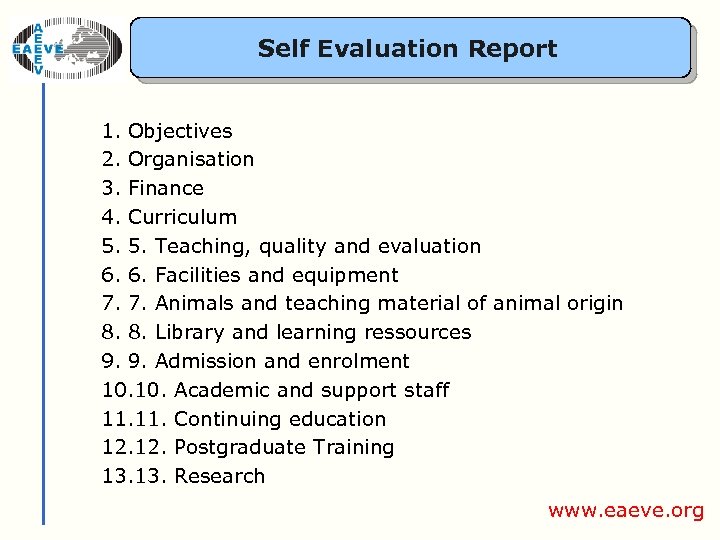 Self Evaluation Report 1. Objectives 2. Organisation 3. Finance 4. Curriculum 5. 5. Teaching, quality and evaluation 6. 6. Facilities and equipment 7. 7. Animals and teaching material of animal origin 8. 8. Library and learning ressources 9. 9. Admission and enrolment 10. Academic and support staff 11. Continuing education 12. Postgraduate Training 13. Research www. eaeve. org
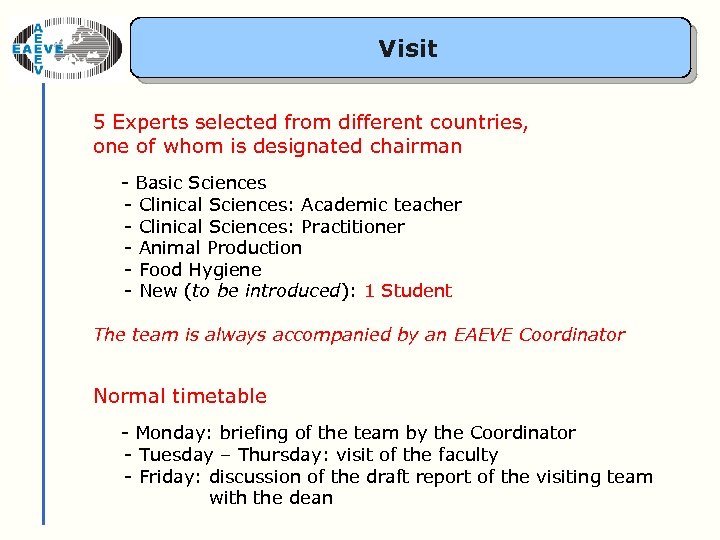 Visit 5 Experts selected from different countries, one of whom is designated chairman - Basic Sciences - Clinical Sciences: Academic teacher - Clinical Sciences: Practitioner - Animal Production - Food Hygiene - New (to be introduced): 1 Student The team is always accompanied by an EAEVE Coordinator Normal timetable - Monday: briefing of the team by the Coordinator - Tuesday – Thursday: visit of the faculty - Friday: discussion of the draft report of the visiting team with the dean
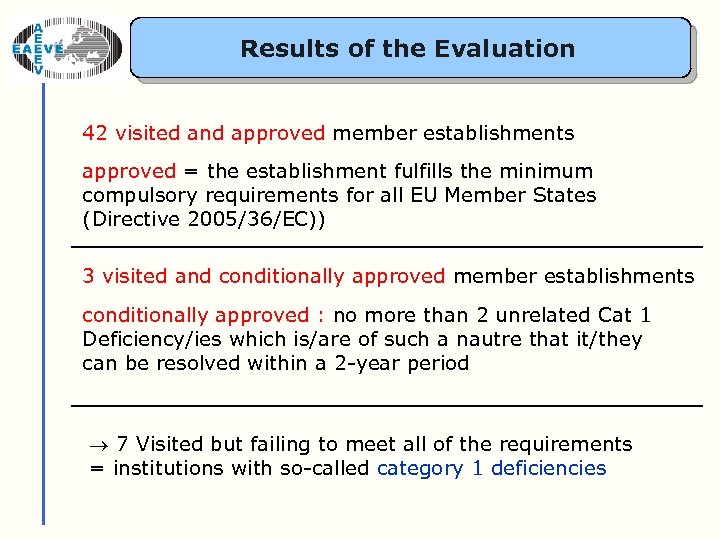 Results of the Evaluation 42 visited and approved member establishments approved = the establishment fulfills the minimum compulsory requirements for all EU Member States (Directive 2005/36/EC)) 3 visited and conditionally approved member establishments conditionally approved : no more than 2 unrelated Cat 1 Deficiency/ies which is/are of such a nautre that it/they can be resolved within a 2 -year period 7 Visited but failing to meet all of the requirements = institutions with so-called category 1 deficiencies
 Category 1 Deficiencies The clinical training has been the major weakness of veterinary education in Europe over the last 15 years! Insufficient caseload in the clinics Poor clinical training No isolation facilities for infected animals No mobile clinic Institutions must have a mobile clinic for farm animals so that students can practice veterinary medicine on the farm under expert supervision Lack of an emergency service Clinical and hospital facilities must operate day and night for most of the year – i. e. like a normal practice Insufficient number of necropsis No Acces to a farm No Acces to a slaughterhouse
 A Special Problem Pig medicine Local education for a global or at least European market
 Situation in Turkey 17 Faculties 12 Faculties = members of EAEVE 1 visited and approved faculty (Ankara) 1 conditional approved faculty (Bursa) 3 visited faculty (Istanbul, Kars, Konya) 1 pending visit (Van, 2010) 6 not yet applied for the evaluation (Antakya, Aydin, Burdur, Kayseri, Samsun, Urfa)
 The Goal The goal of the evaluation system is to help the veterinary education establishments to improve the quality of their training