


 Скачать презентацию EAA 502 GIS Data Model Dr Mohd Sanusi
6030383595bfbf6c395d0320af46f290.ppt
- Количество слайдов: 24
 EAA 502 GIS Data Model Dr. Mohd Sanusi S. Ahamad 1
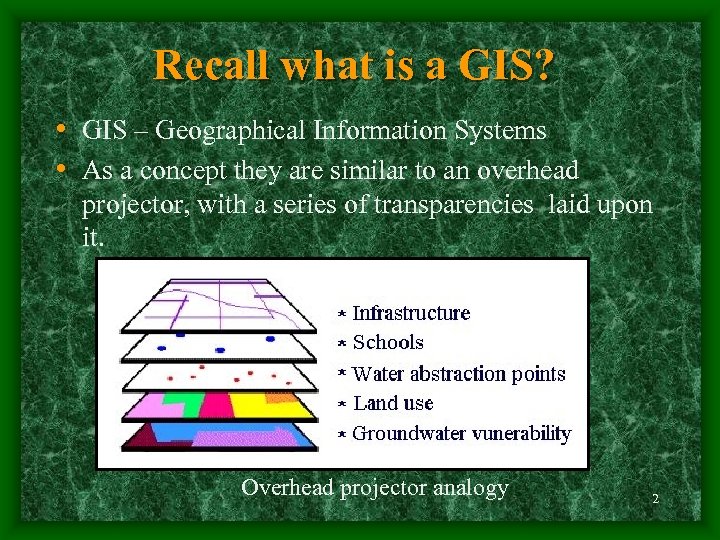 Recall what is a GIS? • GIS – Geographical Information Systems • As a concept they are similar to an overhead projector, with a series of transparencies laid upon it. Overhead projector analogy 2
 The Data Model • Geographical variation in the real world is infinitely complex. Therefore, we require a set of rules (‘the data model’) to convert real geographical variation into discrete objects. • ‘A set of guidelines for the representation of the logical organisation of the data in a database … (consisting) of named logical units of data and the relationships between them. ’ - Tsichritzis, T. C. and Lochovsky, F. H. (1977) Data Base Management Systems, Academic Press: New York. 3
 Types of data model The Raster Model Equivalent of a continuous grid covering the surface, whereby each cell in the grid represents a square on the ground. The Vector Model Attempts to represent objects as exactly and precisely as possible by storing points, lines (arcs) and polygons (areas) in a continuous co-ordinate space 4
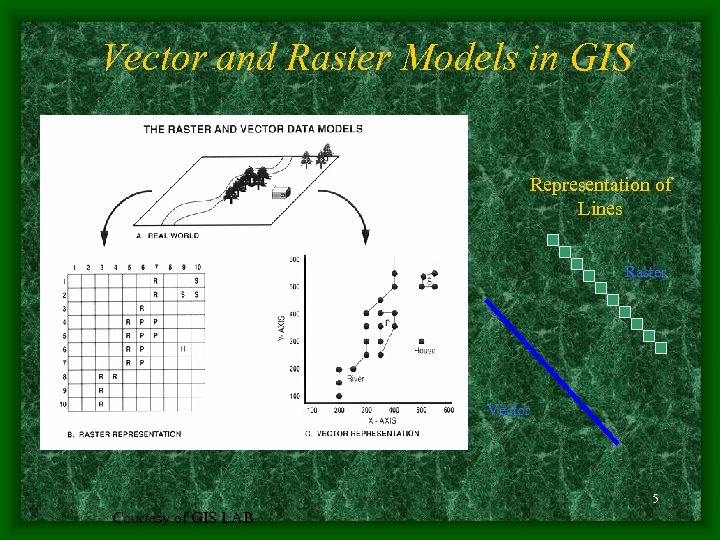 Vector and Raster Models in GIS Representation of Lines Raster Vector 5 Courtesy of GIS LAB
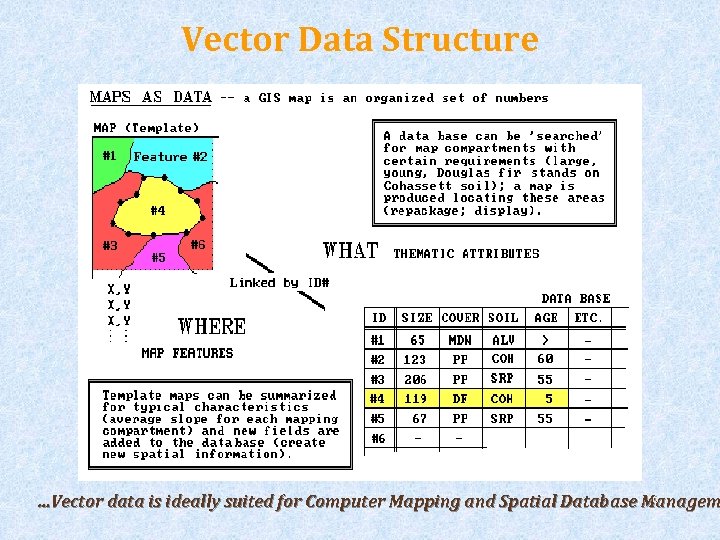 Vector Data Structure 6 …Vector data is ideally suited for Computer Mapping and Spatial Database Managem
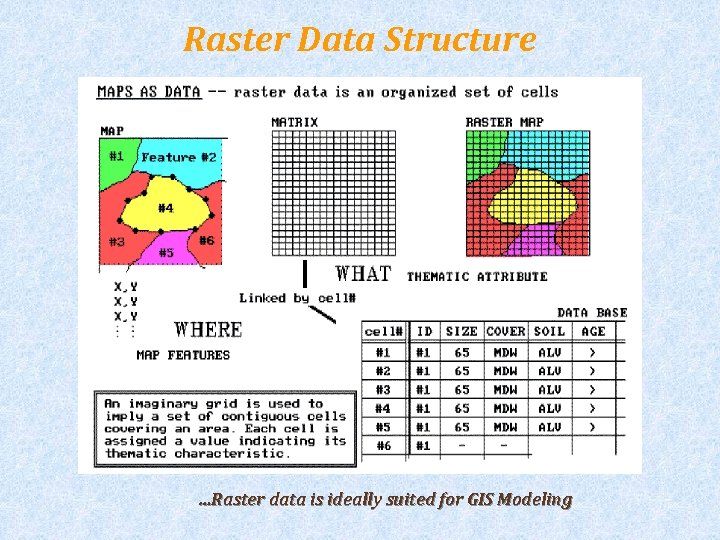 Raster Data Structure …Raster data is ideally suited for GIS Modeling 7
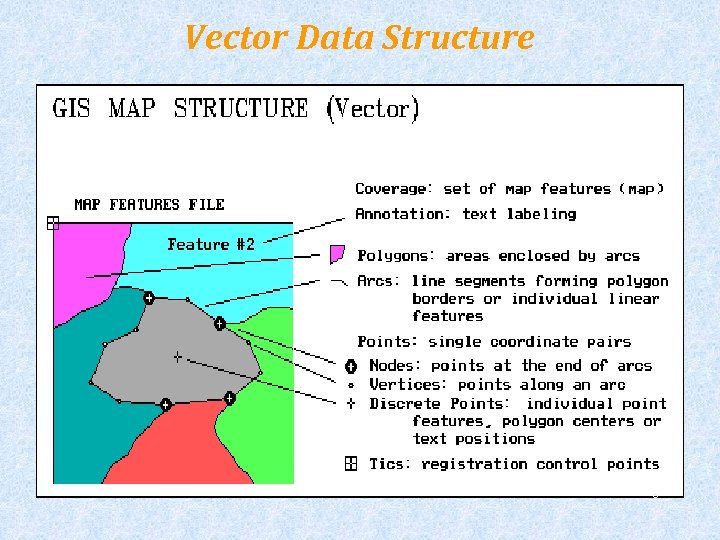 Vector Data Structure 8
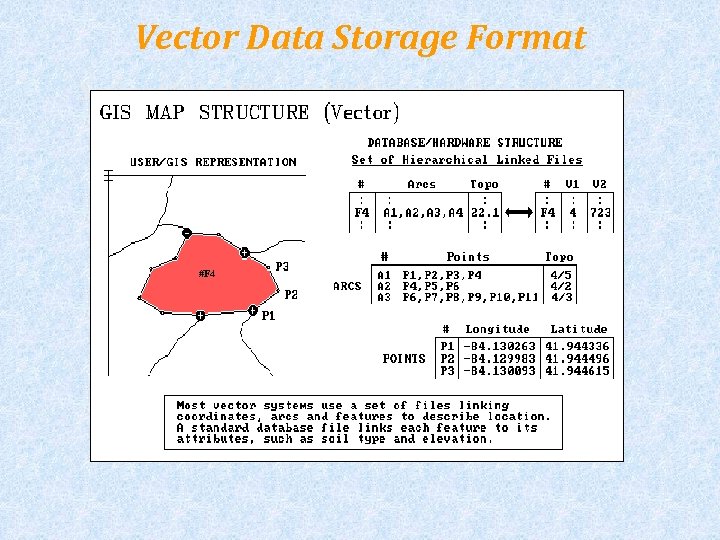 Vector Data Storage Format Series of linked files establishing explicit spatial topology (relationships among map features) #F 4
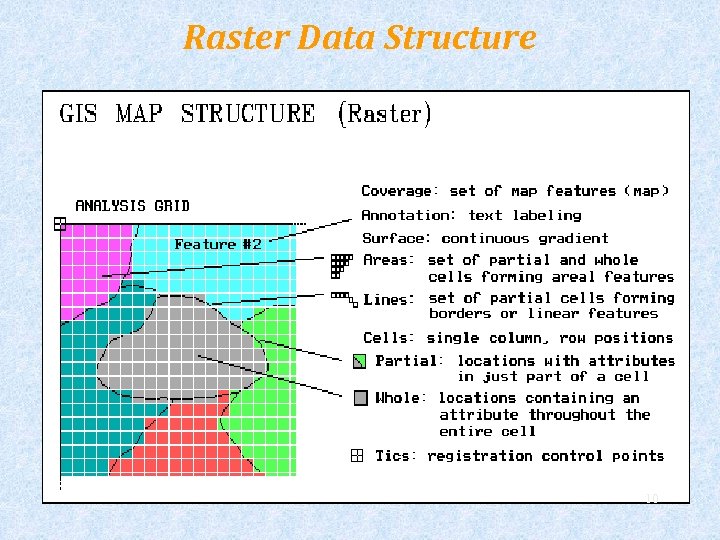 Raster Data Structure 10
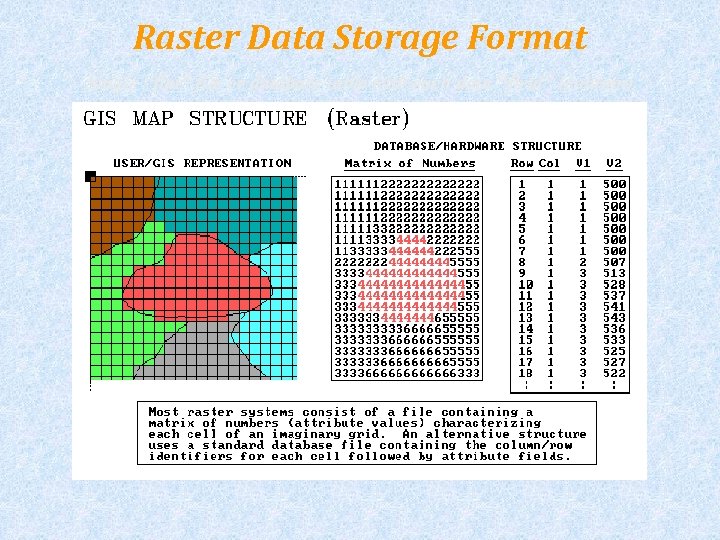 Raster Data Storage Format Single “flat” file or database table with each data “field” (column) stored as a separate map (implicit spatial topology)
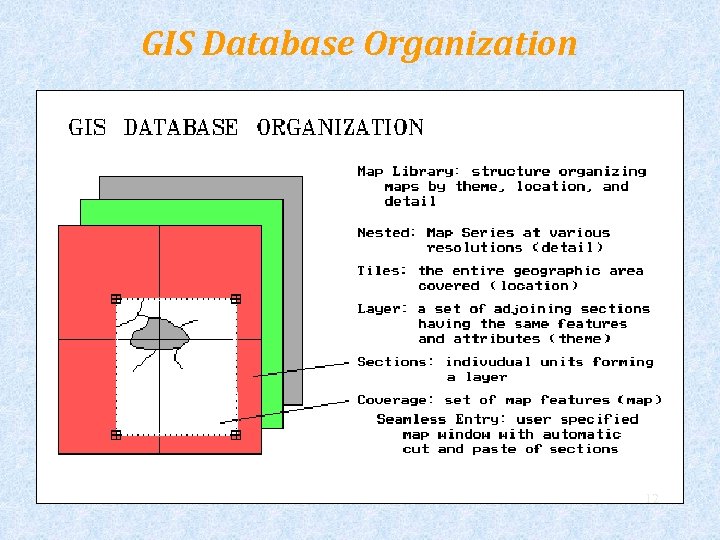 GIS Database Organization 12
 TOPOLOGY (for vector data) • • What is topology? Why is important? Three types of topological models in GIS Spatial operations of topology – Contiguity – Connectivity • Trade-offs of topological structure • Application model – Triangular Irregular Network (TIN): Vector-based GIS 13
 Spatial features and spatial relationships • Spatial features in maps – Points, lines and polygons • Human being interprets additional information from maps about the spatial relationships between features – A route trace from an airport to a house – Land contiguity adjacent to streets along which the lands are located 14
 The definition of Topology • The spatial relationships can be interpreted – identification of connecting lines along a path – definition of the areas enclosed within these lines – identification of contiguous areas • In digital maps, these relationships are depicted using ‘Topology’ • Topology = A mathematical procedure for explicitly defining spatial relationship • Topology is the description of how the spatial objects are related with spatial meaning 15
 Topological data models • Three types of topological concepts – Arc, Node and polygon topologies • Arc – Arcs have directions and left and right polygons (=contiguity) • Node – Nodes link arcs with start and end nodes (=connectivity) • Polygon – Arcs that connect to surround an area define a polygon (=area definition) 16
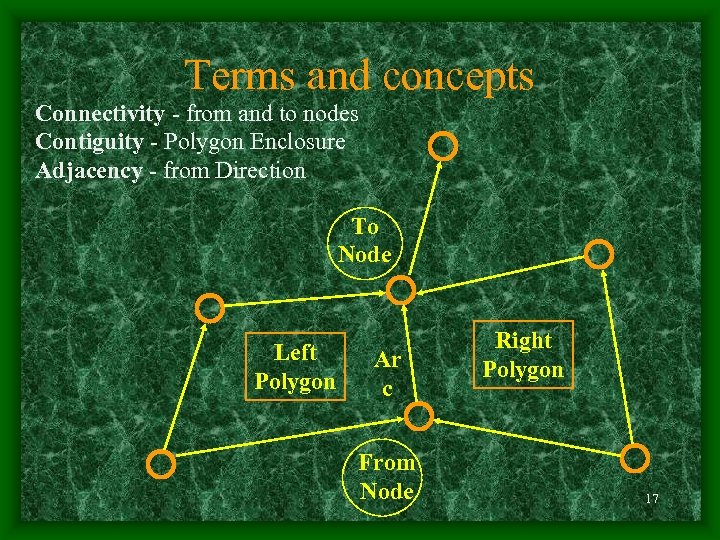 Terms and concepts Connectivity - from and to nodes Contiguity - Polygon Enclosure Adjacency - from Direction To Node Left Polygon Ar c From Node Right Polygon 17
 Spatial operations of topology • Connectivity and contiguity (Aronoff, 1989) – A basic, but core spatial analysis operations in GIS • Contiguity – A biologist might be interested in the habitats that occur next to each other – A city planner might be interested in zoning conflicts such as industrial zones bordering recreation areas • Connectivity – Transportation network, telecommunication systems, river systems – To find optimum routings or most efficient delivery routes or the fastest travel route – To predict loading at critical points in a river channel – To estimate water flow at a bridge crossing that will result from heavy flood 18
 Trade-offs of topology • Advantages – Spatial data is stored more efficiently – Analysis process faster and efficient for large data sets – By topological relationships, we can perform spatial analysis functions, – Modelling flow through the connection of lines in a network (i. e. buffering) – Combining adjacent polygons with similar characteristics (i. e. spatial merge) – Overlaying geographical features (i. e. spatial overlay) 19
 Disadvantages • Extra cost and time – creating topological structure does impose a cost – Topology should be always updated when a new map or existing map is updated • Additional batch job working – To avoid the extra efforts, GIS systems need to run a batch job (i. e. a process that can be run without user interactions); 70% of total GIS costs – Autoexec. bat in DOS – Macro languages such as AML (Arc/Info), Avenue (Arc. View), Map. Basic (Map. Info) and etc 20
 Conclusions of topology • When topology is created, we can identify – Know its positions of spatial features – Know what is around it – Understand its geographical characteristics by virtue of recognising its surroundings – Know how to get from A to B 21
 Metadata • Metadata is ‘data about data’. It should include such information as: – – – – The origin of the data source When the dataset was created Who created / modified it Data coverage and scale Accuracy and precision Ownership, copyright and restrictions on use Dataset file location • Critical to maintaining an effective GIS 22
 Relevant Reading • Aronoff, S. (1989) Geographic information systems : a • • management perspective, WDL Publications: Ottawa. Burrough, P. A. (1986) Principles of geographical information systems for land resources assessment, Clarendon Press: Oxford. Burrough, P. A. and Mc. Donnell, R. A. (1998) Principles of geographical information systems, Oxford University Press: Oxford. Heywood, I. Cornelius, S. and Carver, S. (1998) An Introduction to Geographical Information Systems, Longman: Harlow. Longley, P. A. et al (1999) Geographical Information Systems. Second edition. Wiley: Chichester. 23
 Journals • • • GEOEurope (formally G. I. S. Europe) GI News / Mapping Awareness G. I. S. World International Journal of GIS Photogrammetric Engineering and Remote Sensing • Transactions in GIS 24