 Скачать презентацию e-VLBI A Brief Overview Alan R Whitney MIT
b40a593f9d1c456bbf1ead9bb614f95e.ppt
- Количество слайдов: 20



e-VLBI: A Brief Overview Alan R. Whitney MIT Haystack Observatory
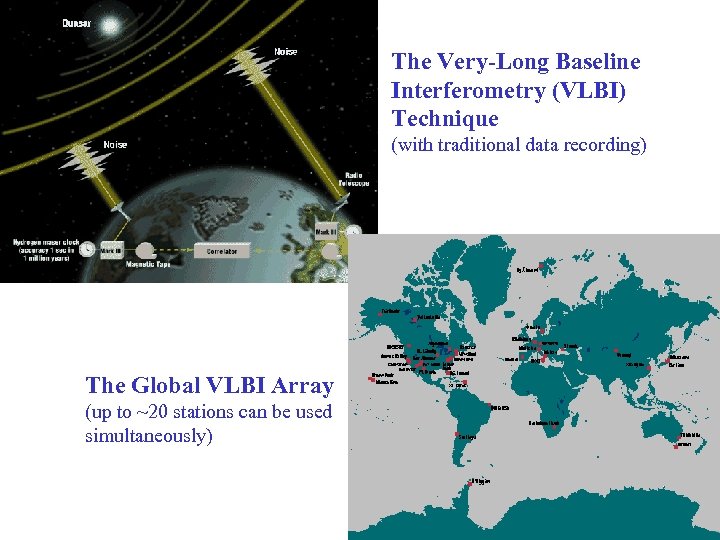
Traditional VLBI The Very-Long Baseline Interferometry (VLBI) Technique (with traditional data recording) The Global VLBI Array (up to ~20 stations can be used simultaneously)
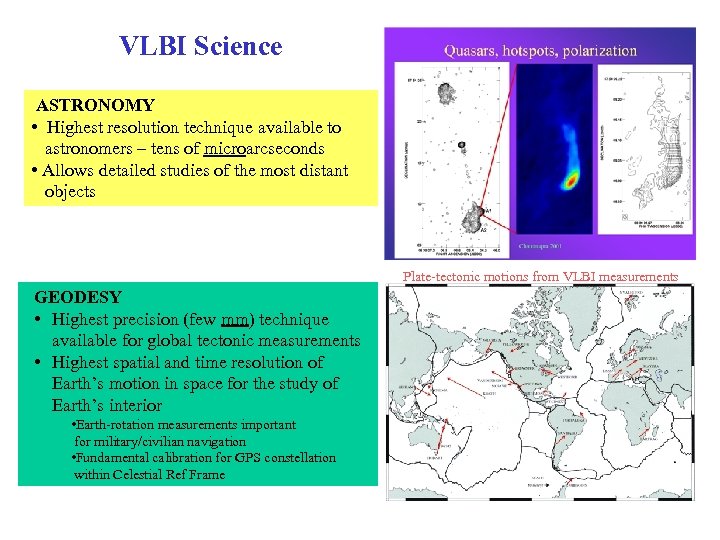
VLBI Science ASTRONOMY • Highest resolution technique available to astronomers – tens of microarcseconds • Allows detailed studies of the most distant objects Plate-tectonic motions from VLBI measurements GEODESY • Highest precision (few mm) technique available for global tectonic measurements • Highest spatial and time resolution of Earth’s motion in space for the study of Earth’s interior • Earth-rotation measurements important for military/civilian navigation • Fundamental calibration for GPS constellation within Celestial Ref Frame VLBI astronomy example
Scientific Advantages of e-VLBI • Bandwidth growth potential for higher sensitivity – VLBI sensitivity (SNR) proportional to square root of Bandwidth resulting in a large increase in number of observable objects (only alternative is bigger antennas – hugely expensive) – e-VLBI bandwidth potential growth far exceeds recording capability (practical recordable data rate limited to ~1 Gbps) • Rapid processing turnaround – Astronomy • Ability to study transient phenomena with feedback to steer observations – Geodesy • Higher-precision measurements for geophysical investigations • Better Earth-orientation predictions, particularly UT 1, important for military and civilian navigation
Practical Advantages of ‘e-VLBI’ • Increased Reliability – remove recording equipment out of field – remote performance monitor & control capability in near real-time • Lower Cost – Automated Operation Possible • eliminates manual handling and shipping of storage media – Near Real-time Processing • forestalls growth of storage-capacity requirements with bandwidth growth – Elimination of recording-media pool (millions of $’s!) • Avoid unexpected media-shipping interruptions and losses
Elements of e-VLBI Development • Phase 1: Develop e. VLBI-compatible data system – Mark 5 system development at MIT Haystack Observatory being supported by NRAO, NASA, USNO plus four international partners – Prototypes now deployed in U. S. and Europe • Phase 2: Demonstrate 1 Gbps e-VLBI using Bossnet (w/ DARPA and NASA support) – ~700 km link between Haystack Observatory and NASA/GSFC – First e-VLBI experiment achieved ~788 Mbps transfer rate • Phase 3: Establish adaptive network protocol (newly awarded NSF grant to Haystack Observatory; collaboration with MIT Lab for Computer Science and MIT Lincoln Laboratory); – New IP-based protocol tailored to operate in shared-network ‘background’ to efficiently using available bandwidth – Connect with telescopes worldwide (U. S. , Europe, Japan)
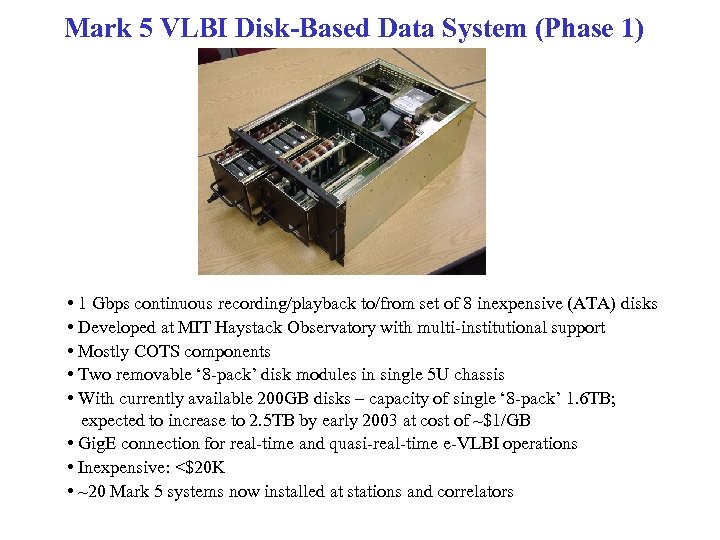
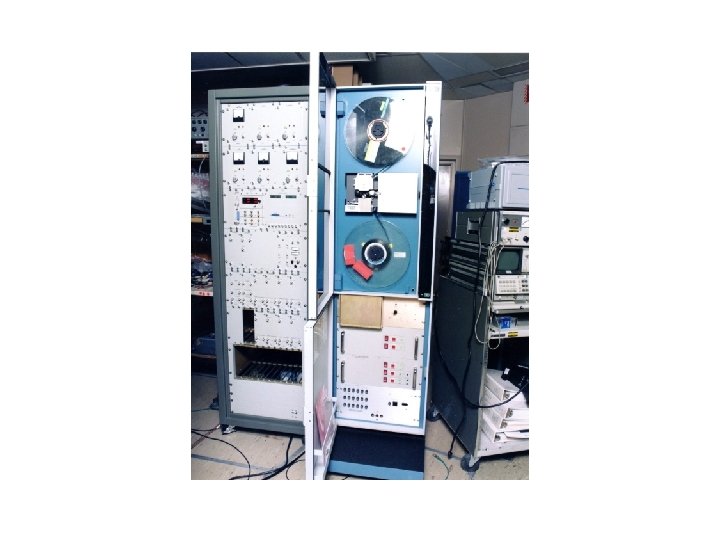
Mark 5 VLBI Disk-Based Data System (Phase 1) • 1 Gbps continuous recording/playback to/from set of 8 inexpensive (ATA) disks • Developed at MIT Haystack Observatory with multi-institutional support • Mostly COTS components • Two removable ‘ 8 -pack’ disk modules in single 5 U chassis • With currently available 200 GB disks – capacity of single ‘ 8 -pack’ 1. 6 TB; expected to increase to 2. 5 TB by early 2003 at cost of ~$1/GB • Gig. E connection for real-time and quasi-real-time e-VLBI operations • Inexpensive: <$20 K • ~20 Mark 5 systems now installed at stations and correlators
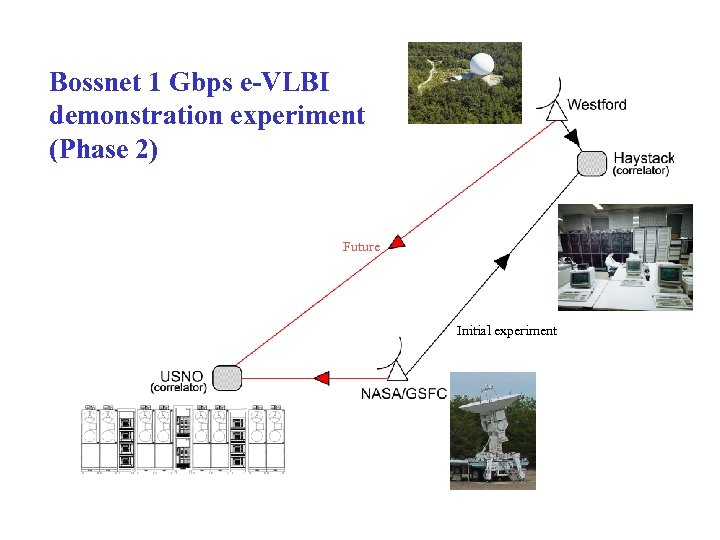
Bossnet 1 Gbps e-VLBI demonstration experiment (Phase 2) Future Initial experiment
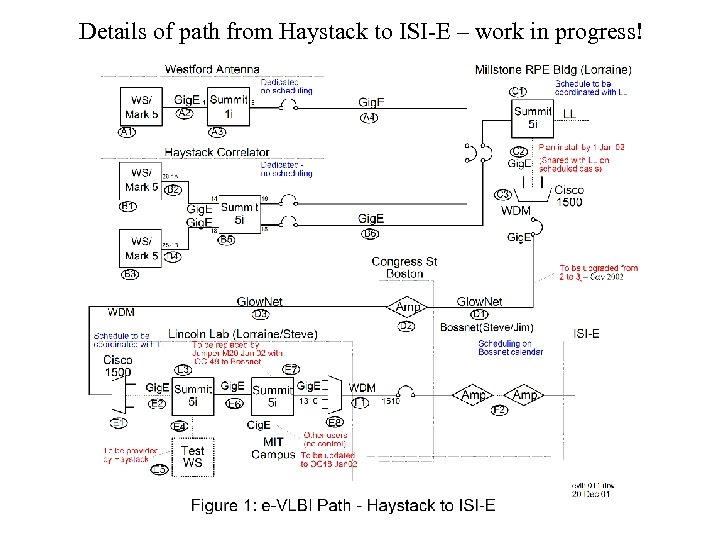
Details of path from Haystack to ISI-E – work in progress!
Details of path from ISI-E to GSFC Antenna – work in progress
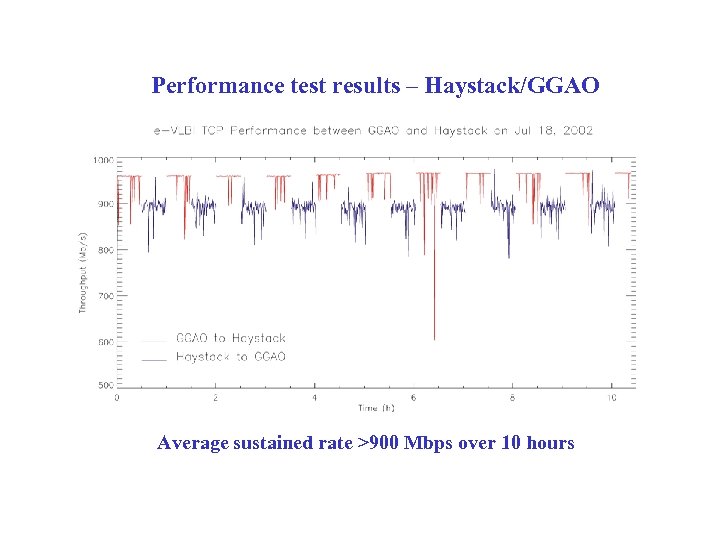
Performance test results – Haystack/GGAO Average sustained rate >900 Mbps over 10 hours
Westford-GGAO e-VLBI results • First near-real-time e-VLBI experiment conducted on 6 Oct 02 – – • Recorded data at 1152 Mbps on Westford-GGAO baseline GGAO disk-to-disk transfer at average 788 Mbps transfer rate Immediate correlation on Haystack Mark 4 correlator Nominal fringes observed Direct data transfer experiment conducted on 24 Oct 02 – Direct transfer of GGAO data to disk at Haystack at 256 Mbps – Immediate correlation with Westford data – Nominal fringes observed • Next step – full real-time e-vlbi – Mark 5 system is capable of transmitting in real-time – But, still need additional work on correlator software to synchronize correlator operation to real-time – Hope to conduct first experiment in early 2003 • Conclusion – e-VLBI at near Gbps speeds over ordinary shared networks is possible but still difficult
Westford-to-Kashima e-VLBI experiment • Westford/Kashima experiment conducted on 15 Oct 02 – Data recorded on K 5 at Kashima and Mark 5 at Westford at 256 Mbps – Files exchanged over Abilene/GEMnet networks • Nominal speed expected to be ~20 Mbps, but achieved <2 Mbps for unknown reasons - investigating – File formats software translated – Correlation on Mark 4 correlator at Haystack and PC Software correlator at Kashima – Nominal fringes obtained – Further experiments are anticipated
Plans for UT 1 Intensive e-VLBI • Daily ~1 hour VLBI sessions between Kokee Park, Hawaii and Wettzell, Germany are used for UT 1 measurements • Data are time sensitive since they are used for predicting UT 1 • Currently requires ~4 day turnaround shipping media • These measurements are an ideal candidate for routine e-VLBI – Short daily session collect <100 GB of data – Even 100 Mbps will allow transfer in a few hours • Work now in progress to make necessary connections – Network being organized from Kokee Park to USNO; connection speed OC-3 – Data from Mark 5 system in Wettzell will be carried to Univ. of Regensberg, about 1 hour drive; connection speed OC-3 – Negotiations ongoing for extension of MAX network to USNO with Gig. E connection
New IP Protocols for e-VLBI (Phase 3) • Based on observed usage statistics of networks such as Abilene, it is clear there is much unused capacity • New protocols are being developed to utilize networks in ‘background’ mode for applications such as e-VLBI – – Take advantage of special characteristics of e-VLBI data Will ‘scavenge’ and use ‘secondary’ bandwidth Will give priority to ‘normal’ users Requires a new ‘end-point adaptive strategy’ • Work being carried out by MIT Haystack Observatory in collaboration with MIT Laboratory for Computer Science and MIT Lincoln Laboratory – 3 -year program; will demonstrate e-VLBI connections both nationally and internationally
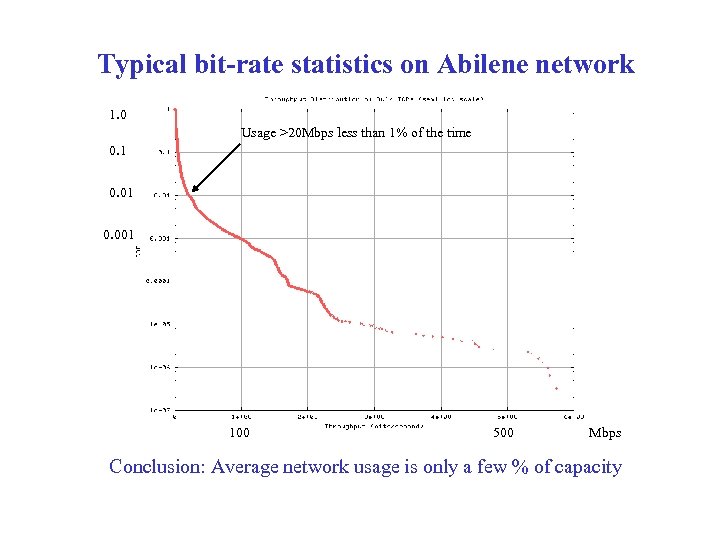
Typical bit-rate statistics on Abilene network 1. 0 Usage >20 Mbps less than 1% of the time 0. 1 0. 001 100 500 Mbps Conclusion: Average network usage is only a few % of capacity
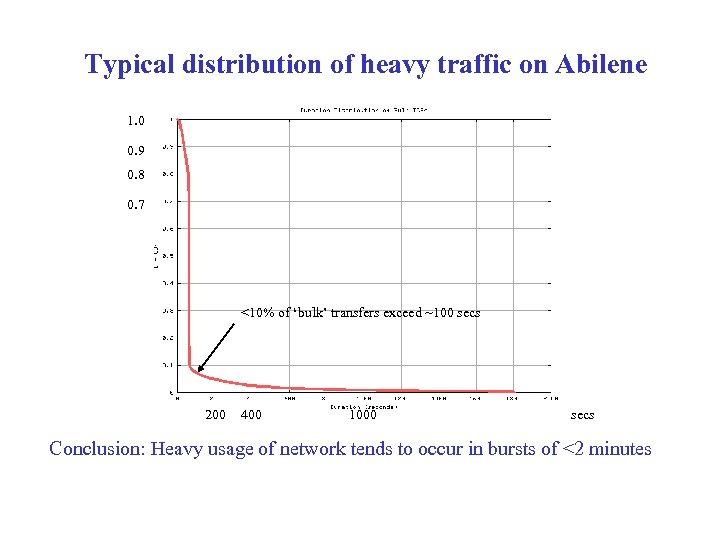
Typical distribution of heavy traffic on Abilene 1. 0 0. 9 0. 8 0. 7 <10% of ‘bulk’ transfers exceed ~100 secs 200 400 1000 secs Conclusion: Heavy usage of network tends to occur in bursts of <2 minutes
Impact of e-VLBI Program • Opens new doors for astronomical and geophysical research. • Represents an excellent match between modern Information Technology and a real science need. • Motivates the development of a new shared-network protocol that will benefit other similar applications. • Drives an innovative IT research application and fosters a strong international science collaboration.
Скачать презентацию e-VLBI A Brief Overview Alan R Whitney MIT
b40a593f9d1c456bbf1ead9bb614f95e.ppt