


 Скачать презентацию e SDO Algorithms Visualization Movie Tool Astro
2cccf02f0ff23c44b698f0cdaacd57ad.ppt
- Количество слайдов: 8
 e. SDO: Algorithms, Visualization Movie Tool, & Astro. Grid Data Integration Culhane 1, Y. P. E. C. Auden 1, J. L. Elsworth 2, A. Fludra 3, M. Thompson 4 1. 2. 3. 4. Mullard Space Science Laboratory, University College London. School of Physics and Astronomy, University of Birmingham Space Science and Technology, Rutherford Appleton Laboratory Department of Applied Mathematics, University of Sheffield
 Abstract The UK-based SDO e-Science consortium has been funded by PPARC as a three year project to work with US SDO investigation teams to extract data products and enable data access by the UK Solar Physics community. Following a year of research into meeting the UK solar community’s needs through algorithms, data centre access and visualization tools, two years of e. SDO development and implementation began in October, 2005. For more details, please visit http: //www. mssl. ucl. ac. uk/twiki/bin/view/SDO. The final project report and all code will be available from 1 October 2007 at http: //www. mssl. ucl. ac. uk/twiki/bin/view/Final. Delivera
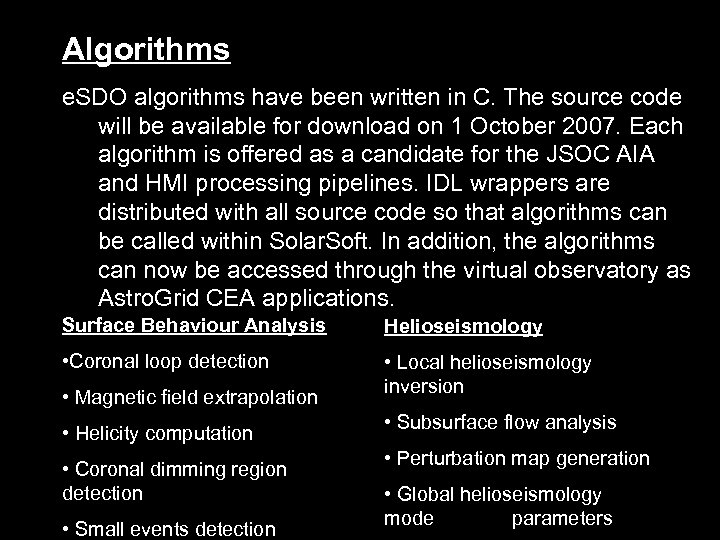 Algorithms e. SDO algorithms have been written in C. The source code will be available for download on 1 October 2007. Each algorithm is offered as a candidate for the JSOC AIA and HMI processing pipelines. IDL wrappers are distributed with all source code so that algorithms can be called within Solar. Soft. In addition, the algorithms can now be accessed through the virtual observatory as Astro. Grid CEA applications. Surface Behaviour Analysis Helioseismology • Coronal loop detection • Local helioseismology inversion • Magnetic field extrapolation • Helicity computation • Coronal dimming region detection • Small events detection • Subsurface flow analysis • Perturbation map generation • Global helioseismology mode parameters
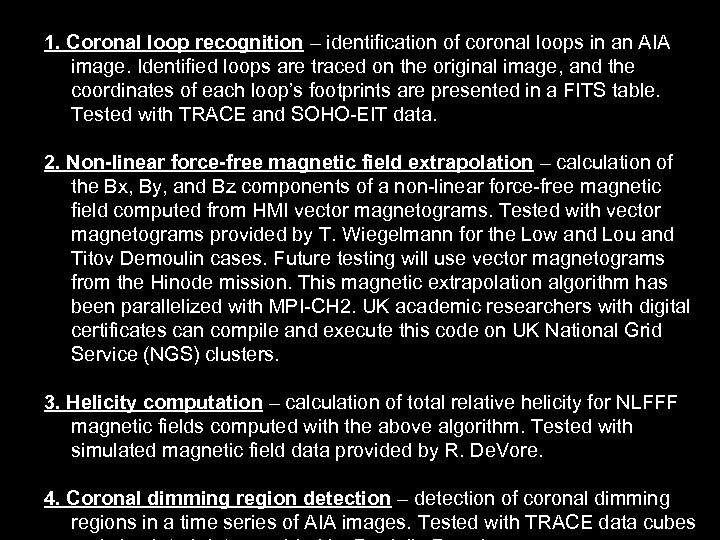 1. Coronal loop recognition – identification of coronal loops in an AIA image. Identified loops are traced on the original image, and the coordinates of each loop’s footprints are presented in a FITS table. Tested with TRACE and SOHO-EIT data. 2. Non-linear force-free magnetic field extrapolation – calculation of the Bx, By, and Bz components of a non-linear force-free magnetic field computed from HMI vector magnetograms. Tested with vector magnetograms provided by T. Wiegelmann for the Low and Lou and Titov Demoulin cases. Future testing will use vector magnetograms from the Hinode mission. This magnetic extrapolation algorithm has been parallelized with MPI-CH 2. UK academic researchers with digital certificates can compile and execute this code on UK National Grid Service (NGS) clusters. 3. Helicity computation – calculation of total relative helicity for NLFFF magnetic fields computed with the above algorithm. Tested with simulated magnetic field data provided by R. De. Vore. 4. Coronal dimming region detection – detection of coronal dimming regions in a time series of AIA images. Tested with TRACE data cubes
 5. Small event detection – detection of small events that persist through multiple frames of a time series of AIA images. The user can specify the minimum number of pixels per event. Tested with TRACE data cubes and simulated data provided by Danielle Bewsher. 6. Local helioseismology inversion – inversion of sound speed perturbation or subsurface flow calculated from HMI datacubes of skip distances. Tested with SOHO-MDI data and local helioseismology kernels. 7. Subsurface flow analysis – Calculation of subsurface flow travel times, Gabor wavelet fitting, and cross-correlation of skip distances using HMI datacubes tracked Dopplergrams. Tested using SOHOMDI data. 8. Perturbation map generation - Calculation of sound speed perturbation travel times, Gabor wavelet fitting, and cross-correlation of skip distances using HMI datacubes tracked Dopplergrams. Tested using SOHO-MDI data.
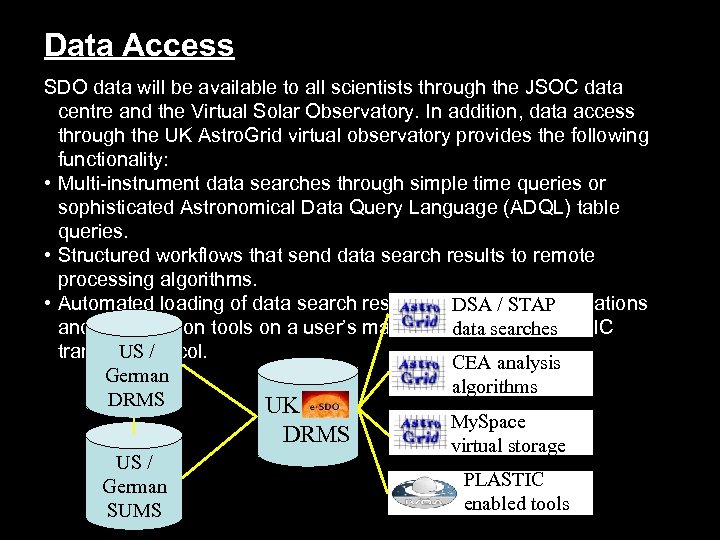 Data Access SDO data will be available to all scientists through the JSOC data centre and the Virtual Solar Observatory. In addition, data access through the UK Astro. Grid virtual observatory provides the following functionality: • Multi-instrument data searches through simple time queries or sophisticated Astronomical Data Query Language (ADQL) table queries. • Structured workflows that send data search results to remote processing algorithms. • Automated loading of data search results into analysis applications DSA / STAP and visualization tools on a user’s machine usingsearches data the PLASTIC transfer protocol. US / CEA analysis German algorithms DRMS UK My. Space DRMS virtual storage US / PLASTIC German enabled tools SUMS
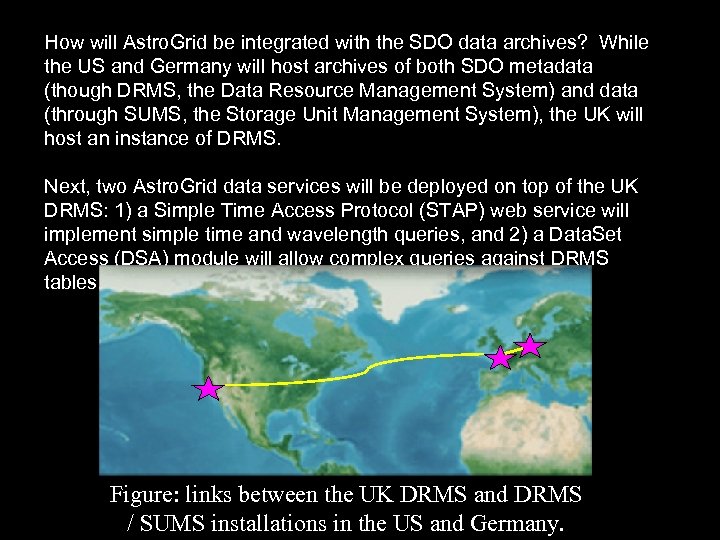 How will Astro. Grid be integrated with the SDO data archives? While the US and Germany will host archives of both SDO metadata (though DRMS, the Data Resource Management System) and data (through SUMS, the Storage Unit Management System), the UK will host an instance of DRMS. Next, two Astro. Grid data services will be deployed on top of the UK DRMS: 1) a Simple Time Access Protocol (STAP) web service will implement simple time and wavelength queries, and 2) a Data. Set Access (DSA) module will allow complex queries against DRMS tables. Figure: links between the UK DRMS and DRMS / SUMS installations in the US and Germany.
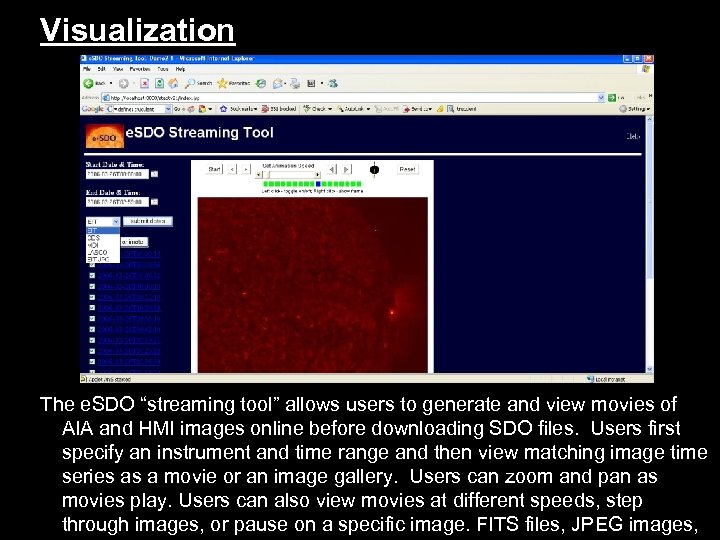 Visualization The e. SDO “streaming tool” allows users to generate and view movies of AIA and HMI images online before downloading SDO files. Users first specify an instrument and time range and then view matching image time series as a movie or an image gallery. Users can zoom and pan as movies play. Users can also view movies at different speeds, step through images, or pause on a specific image. FITS files, JPEG images,