 Скачать презентацию e s b 7 Small Business Strategies Imitation
f9060a87ef2c0138802c1f0f77395efd.ppt
- Количество слайдов: 26



e s b 7 Small Business Strategies: Imitation with a Twist Mc. Graw-Hill/Irwin Copyright © 2009 by The Mc. Graw-Hill Companies, Inc. All rights reserved.
e s b Chapter 7 Strategy in the Small Business • Strategy: the ideas and actions that explain Strategy how a firm will make its profit – Good strategy leads to greater chances for survival and higher profits for small businesses – What makes a strategy “good” is its fit to the particulars of your business and the resources you can bring to it 7 -2
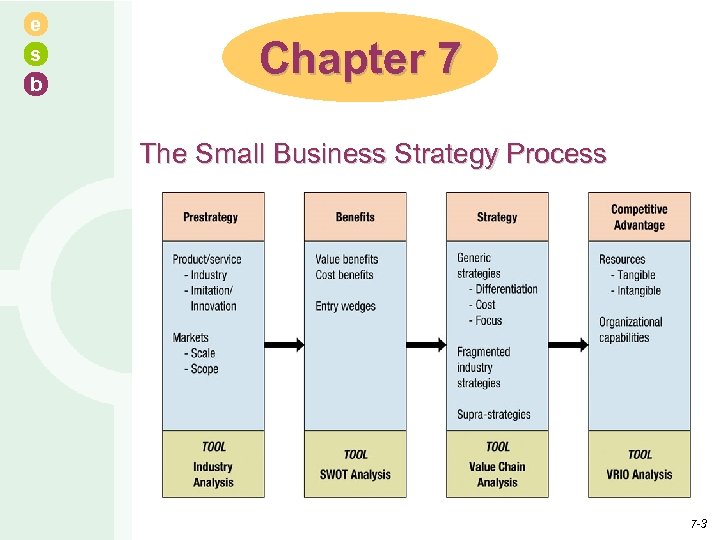
e s b Chapter 7 The Small Business Strategy Process 7 -3
e s b Chapter 7 1. Prestrategy: First Step of Strategic Planning • Goal is deciding on product or service you intend to offer and the general nature of your intended market • Industry: general name for line of product or Industry service being sold, or the firms in that line of business 7 -4
e s b Chapter 7 • Industry – Key is selecting an industry that offers good potential for making a profit – Also needs to offer attractive opportunities to work with a minimum of risk and competition – http: //www. census. gov/epcd/naics 02/ – Trade association: group of people in the association same industry who band together to represent the industry to the public and government 7 -5
e s b Chapter 7 • Market: business term for the population Market of customers for your product or service • Scale: size of the market Scale – Mass or Niche • Scope: geographic range covered by the Scope market – Local to Global 7 -6
e s b Chapter 7 • Scale: most industries have both mass Scale and niche markets – Mass market: large portions of the population market • Example: all men, all women, all teens, et al • Mass market is broad – Niche market: narrowly defined segment of market the population that is likely to share interests or concerns • Example: Hallmark vs. Simply. She 7 -7
e s b Chapter 7 Example 3 Rules for Niche Marketing • Niche marketing can be extremely costeffective • Niche marketing can be a low risk way to grow your business following 3 rules: – Meet their unique needs – Say the right thing – Always test-market http: //www. entrepreneur. com/marketingcolumnistkimtgordon/article 49608. html 7 -8
e s b Chapter 7 • Scope: local or global Scope – Can be local, regional, national, international, or global – Scope is important for two reasons: • Knowing your scope helps deciding where to focus sales and advertising efforts • Knowing your target market gives you a way to know which competitors to worry about most, namely those within your market scope 7 -9
e s b Chapter 7 • Imitative strategy: doing more or less strategy what others are doing – Classic small business strategy – Almost 2/3 of people starting business use this approach – Advantages: existing technologies, possibility Advantages to buy existing businesses, customers already know what you are offering 7 -10
e s b Chapter 7 • Degree of similarity: extent to which a similarity product or service is like another – Imitation is not likely to match precision or completeness or copying seen in franchising – Imitation plus one degree of similarity: copying of existing businesses with the exception of one or two key aspects in hopes of improving them • Pure innovation: new product or service, innovation also with a unique setting 7 -11
e s b Chapter 7 Tool: Industry Analysis • Industry analysis (IA): a research process that provides the entrepreneur with key information about the industry, such as current situation and trends – Helps to estimate possible financial returns 7 -12
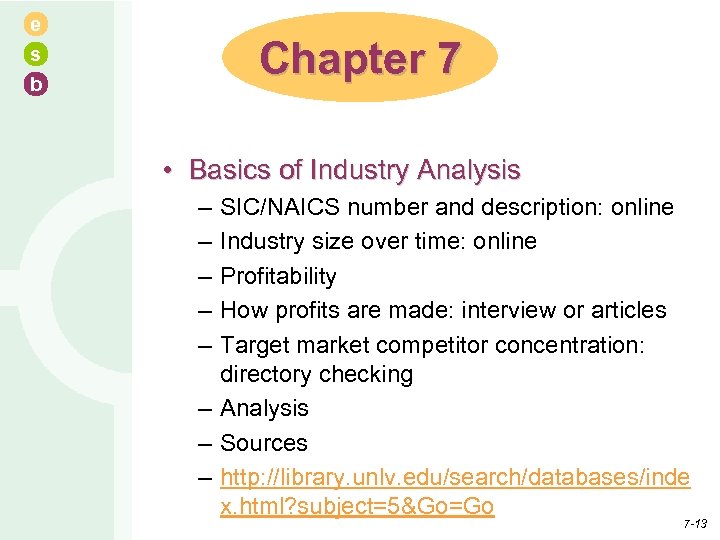
e s b Chapter 7 • Basics of Industry Analysis – – – SIC/NAICS number and description: online Industry size over time: online Profitability How profits are made: interview or articles Target market competitor concentration: directory checking – Analysis – Sources – http: //library. unlv. edu/search/databases/inde x. html? subject=5&Go=Go 7 -13
e s b Chapter 7 2. Benefits: Second Step of Strategic Planning • Benefits: characteristics of a product or service Benefits that the target customer would consider worthwhile (low cost or high quality) – Key decision is deciding what benefits you plan to offer to your customer 7 -14
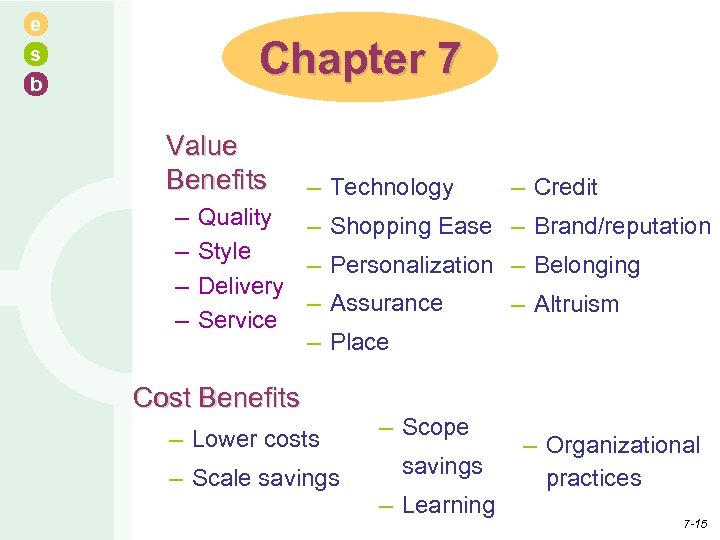
e s b Chapter 7 Value Benefits – – – Technology – Credit Quality – Shopping Ease – Brand/reputation Style – Personalization – Belonging Delivery – Assurance – Altruism Service – Place Cost Benefits – Lower costs – Scale savings – Scope savings – Learning – Organizational practices 7 -15
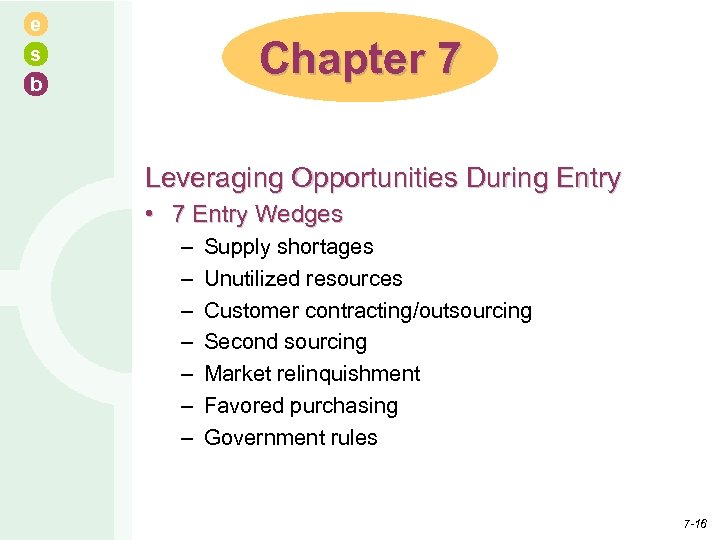
e s b Chapter 7 Leveraging Opportunities During Entry • 7 Entry Wedges – – – – Supply shortages Unutilized resources Customer contracting/outsourcing Second sourcing Market relinquishment Favored purchasing Government rules 7 -16
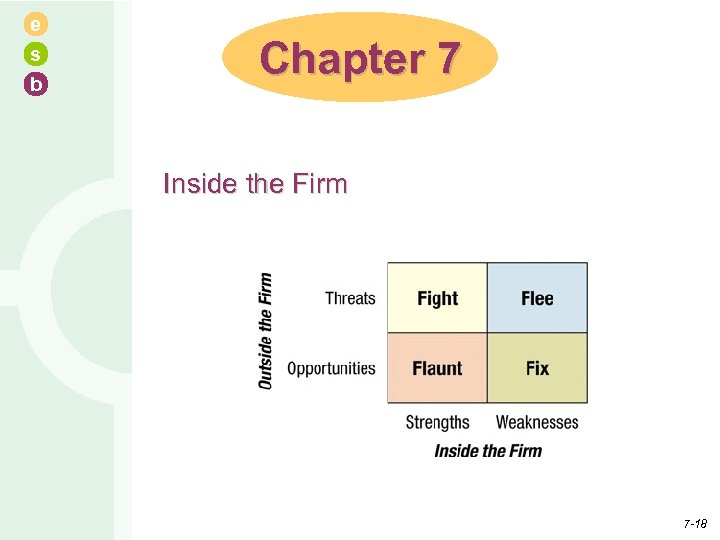
e s b Chapter 7 Tool: SWOT Analysis • S: Strength W: Weakness O: Opportunity (see entry wedges) T: Threat – SWOT looks critically at these factors – Used to organize and perform an analysis of your company’s current and future resources and situations 7 -17
e s b Chapter 7 Inside the Firm 7 -18
e s b Chapter 7 Example Use SWOT to Kick-Start Your Planning • The SWOT analysis--evaluating strengths, weaknesses, opportunities and threats--is one good way to start thinking strategically • As you perform a SWOT analysis, try to involve other people; it improves the brainstorming value • To clarify, strengths and weaknesses are about you and your company, its nature, history, and what it does and doesn't do well • Threats and opportunities are external-- factors outside of your business http: //www. entrepreneur. com/startingabusiness/businessplancoachtimberry/article 182034. html 7 -19
e s b Chapter 7 Strategy Suggestion • 3 Classic Strategies – Differentiation strategy: clarifying how one product is unlike another in a mass market – Cost strategy: firm offers a combination of cost benefits that appeals to the customer – Focus strategy: targets a portion of the market (segment or niche) 7 -20
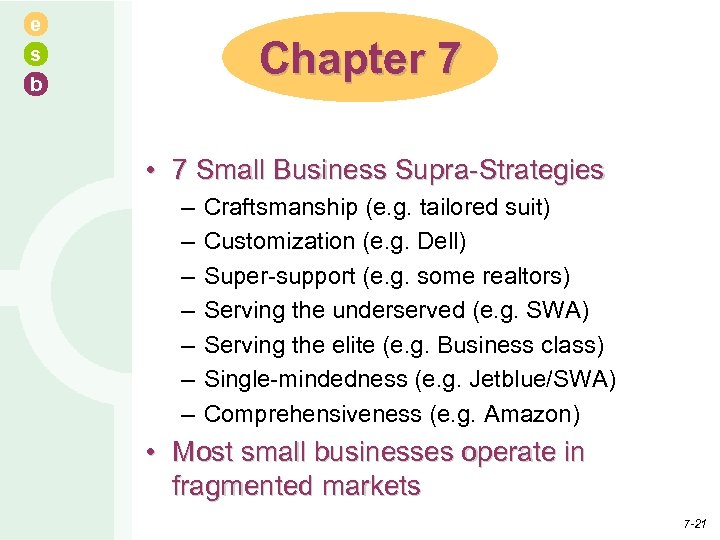
e s b Chapter 7 • 7 Small Business Supra-Strategies – – – – Craftsmanship (e. g. tailored suit) Customization (e. g. Dell) Super-support (e. g. some realtors) Serving the underserved (e. g. SWA) Serving the elite (e. g. Business class) Single-mindedness (e. g. Jetblue/SWA) Comprehensiveness (e. g. Amazon) • Most small businesses operate in fragmented markets 7 -21
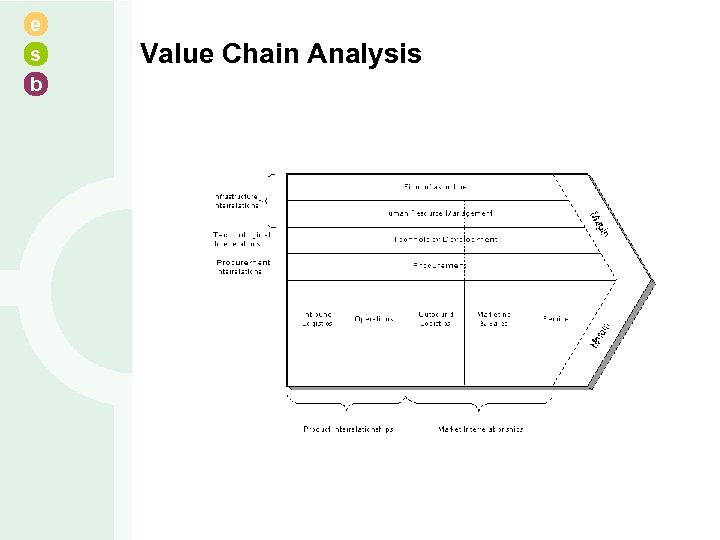
e s b Value Chain Analysis
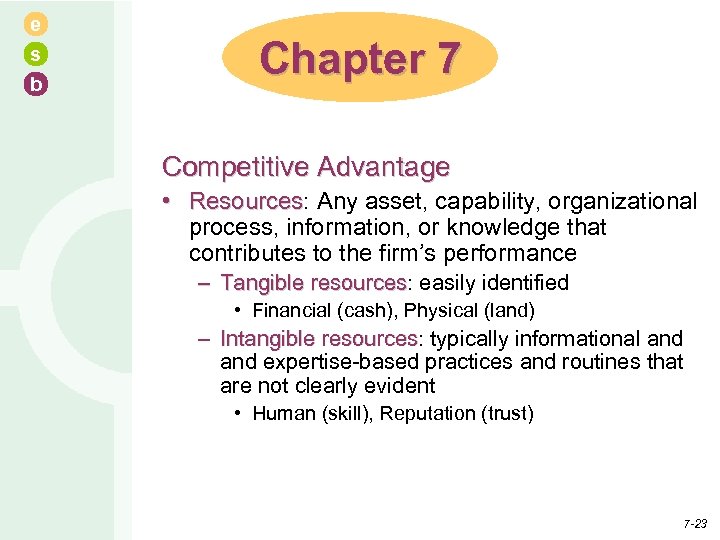
e s b Chapter 7 Competitive Advantage • Resources: Any asset, capability, organizational Resources process, information, or knowledge that contributes to the firm’s performance – Tangible resources: easily identified resources • Financial (cash), Physical (land) – Intangible resources: typically informational and resources and expertise-based practices and routines that are not clearly evident • Human (skill), Reputation (trust) 7 -23
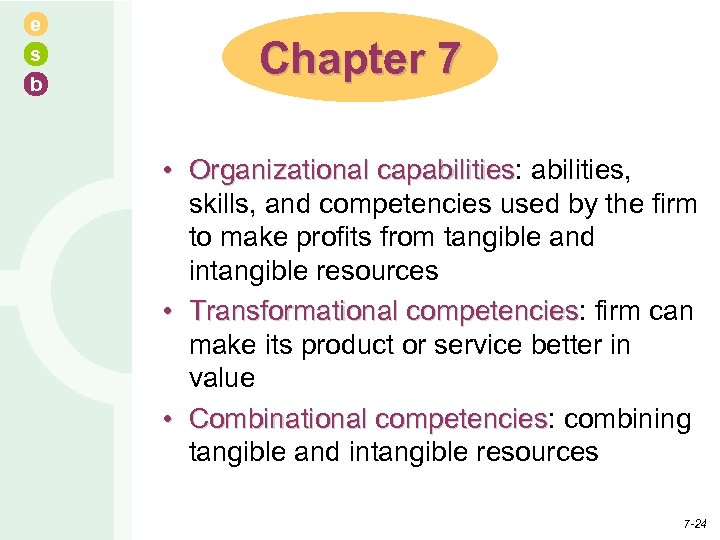
e s b Chapter 7 • Organizational capabilities: abilities, capabilities skills, and competencies used by the firm to make profits from tangible and intangible resources • Transformational competencies: firm can competencies make its product or service better in value • Combinational competencies: combining competencies tangible and intangible resources 7 -24
e s b Chapter 7 • The VRIO Analysis – Test 1: Value – does the resource help you increase sales or decrease costs – Test 2: Rareness – is the resource rare enough that you can charge more than competitors without the resource – Test 3: Imitability – can the competition imitate the resource – Test 4: Organization – can the firm make use of the resource 7 -25
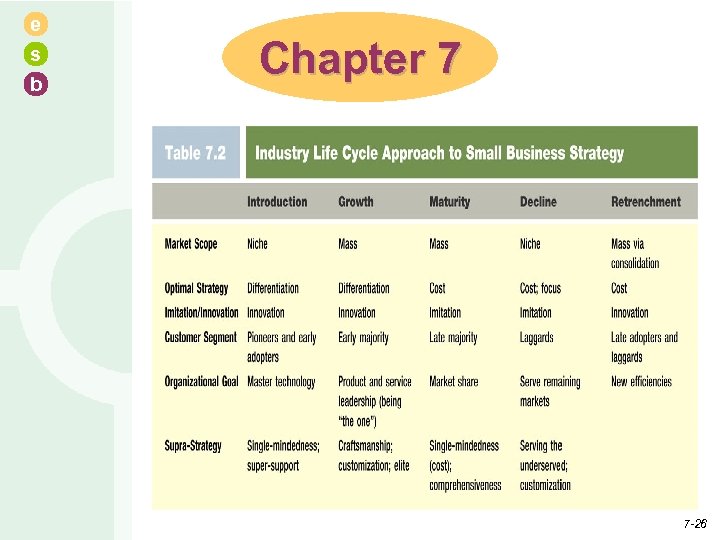
e s b Chapter 7 7 -26
Скачать презентацию e s b 7 Small Business Strategies Imitation
f9060a87ef2c0138802c1f0f77395efd.ppt