 Скачать презентацию e s b 5 Small Business Entry Paths
cdef651740da5e4b1f54621c624d6036.ppt
- Количество слайдов: 26



e s b 5 Small Business Entry: Paths to Part-Time Entrepreneurship
e s b Chapter 5 Objectives: • Know when and why part-time entrepreneurship makes sense • Learn the four major paths to entrepreneurship • Understand what it takes to be successful in parttime entrepreneurship • Learn how to optimize your delegation within the firm • Learn the benefits of bootstrapping • Learn the ethical challenges of part-time entrepreneurship • Find out about the challenges of moving from parttime to full-time entrepreneurship 5 -2
e s b Chapter 5 • Focus on Small Business: Kathryn Otoshi – BA in Graphic Design – Created her own design firm called KO Design and worked part-time while freelancing with large corporations while working for George Lucas’ ILM full-time – Quit ILM to publish illustrated children’s books – Remains part-time between her book business and KO design with large corporations 5 -3
e s b Chapter 5 Why Part-time Businesses Are Important • Part-time self-employment: working for yourself-employment for 35 or fewer hours a week – Full-time self-employment: 35 or more hours per self-employment week – This is the way most people start in entrepreneurship. – About 3/4 of those starting a business already work full-time for someone else. 5 -4
e s b Chapter 5 • Part-time self-employment is a major portion of all current entrepreneurial companies in the United States – Around half of 25. 8 million businesses are part-time businesses. – Volatility: frequency of business starts Volatility and stops – 6 million sellers online 5 -5
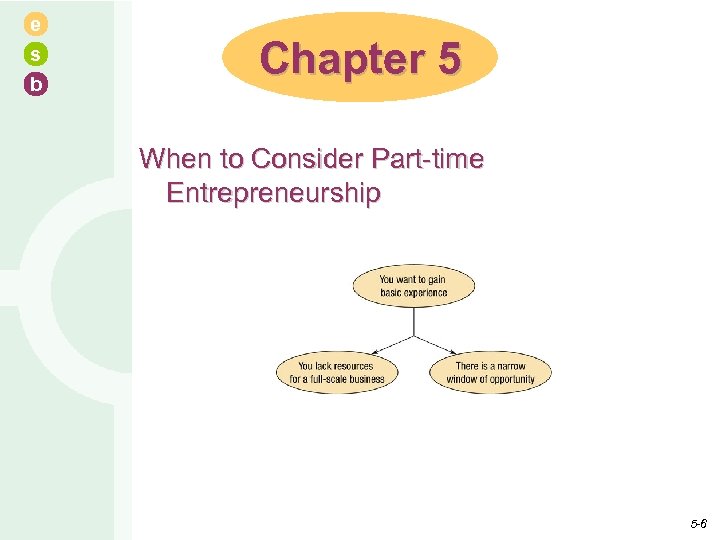
e s b Chapter 5 When to Consider Part-time Entrepreneurship 5 -6
e s b Chapter 5 What Kinds of Part-time Entrepreneurships Exist? • 4 Major Categories – – Stands Homes Consignment Mail Order 5 -7
e s b Chapter 5 • Stand retail: one of the most ancient retail forms of business – Mentioned in the Bible – Tend to be semi-permanent – Advantages: little investment, variety of Advantages locations, quickly established, easily ended – Disadvantages: variable income, legal Disadvantages requirements – Success Factors: location, inventory Factors 5 -8
e s b Chapter 5 • Home retail: parties and door-to-door retail – Avon, Mary Kay, Pampered Chef – Advantages: ease of setup, low cost of start. Advantages up, ability to work away from home and employer – Disadvantages: working on the road, lack of Disadvantages a base to organize and work, variable income, finding ways for customers to reach you – Success Factors: hosts with good contacts, Factors matching product to community, closing the sale 5 -9
e s b Chapter 5 • Consignment stores and Auctions: giving Auctions your product to someone else to sell – Auctions are a variety of consignment stores – Advantages: permit full-time sales with part. Advantages time involvement, low cost, lack of risk, flexibility – Disadvantages: high potential for competing Disadvantages offerings, amount of time before payouts, low profitability due to seller’s fees – Success Factors: location that attracts the Factors right customers, condition of location and merchandise 5 -10
e s b Chapter 5 • Mail order / Catalog sales: offers sales customers a description and picture, and how to order by mail, phone, or online – Advantages: Advantages • • • ability to sell on your schedule low costs potential for selling to large markets low inventory investments targeted customers – Success Factors: marketing, placing the ad Factors where the target market sees it 5 -11
e s b Chapter 5 • Microinventory: A set of goods or services that consists of only one or a few items • Just-in-time inventory: Having just enough product on your shelves to meet the immediate purchases. This usually requires frequent shipment from your supplier. 5 -12
e s b Chapter 5 Online Sales • e. Bay, largest online sales site, reports over 234 million members worldwide in 2007 • Internet is an attractive setting for entrepreneurs looking to create a business • Two major approaches – e. Bay or other online site – Web site of your own 5 -13
e s b Chapter 5 Example Smarts From A Savvy e. Bay Seller • Selling on e. Bay is not a piece of cake – Must fight to get sales in today’s e. Bay market • Cory Kossack – one of the 200 highest-grossing e. Bay sellers – Started in his college dorm room – Pulled in more than $1 million in revenue with nice profits as well http: //www. forbes. com/2007/08/09/small-business-ebay-ent-sales-cx_sn_0809 startupradioebay. html 5 -14
e s b Chapter 5 Success Factors for Part-time Businesses • Boundary: separating and balancing Boundary business and home – – Time management Use a to-do list Prioritize Keep it in its own space (home based) 5 -15
e s b Chapter 5 Keisner’s Six Key Ideas for Success • • • Do not waste time complaining Do not aim for perfection Do not dwell on the past Minimize time spent in meetings Schedule and protect quality time with family • Schedule and protect time for yourself 5 -16
e s b Chapter 5 • Exchange: dealing with others Exchange – Two key groups: Government and Customers – Government: registration, licensing, Government taxes, zoning – Customers: central to making sales Customers • “Sources for Network Connections” were seen in Chapter Two 5 -17
e s b Chapter 5 Pricing and Costing • Price goods or services to make profits • Part-time owners often underestimate costs • Recognize that your own time has value • Price against competitor’s offerings 5 -18
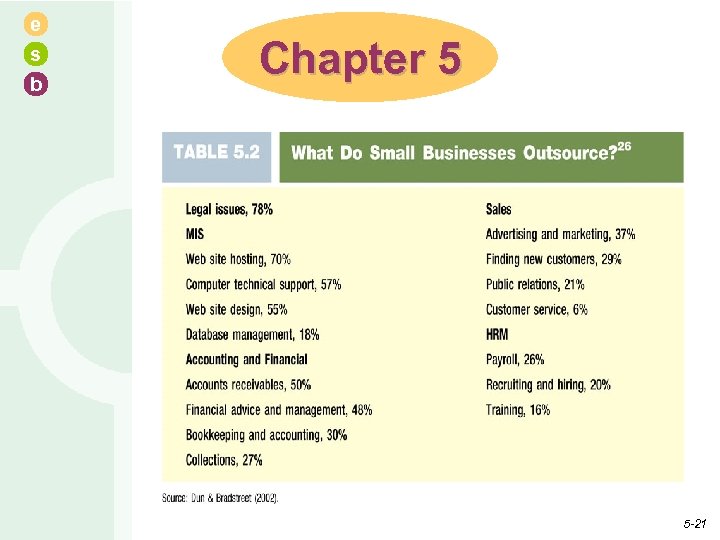
e s b Chapter 5 Delegation and Outsourcing • Key is leveraging other people’s time • Delegation: assigning work to those over Delegation whom you have power • Outsourcing: contracting with people or Outsourcing companies outside your business to do work for your business 5 -19
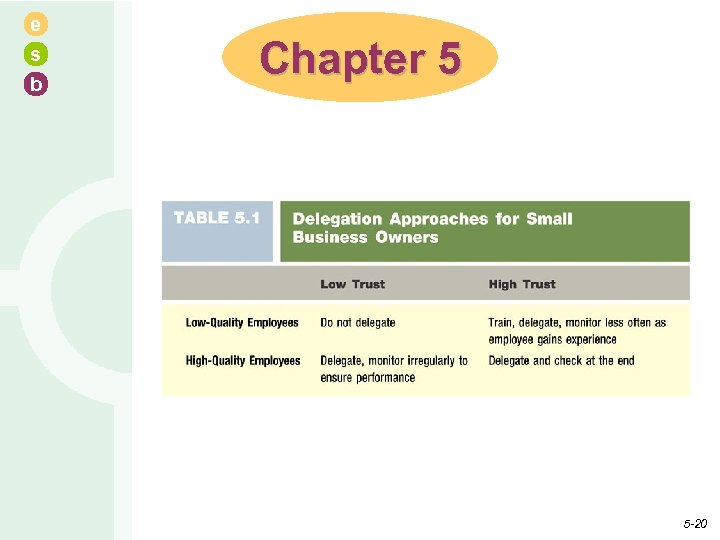
e s b Chapter 5 5 -20
e s b Chapter 5 5 -21
e s b Chapter 5 Making Do When You Are Starting Out • Bootstrapping: using low-cost or free Bootstrapping techniques to minimize your cost of doing business • Undercapitalization: not having enough Undercapitalization money available to the business to cover shortfalls in sales or profits 5 -22
e s b Chapter 5 Example Walk This Way • Most entrepreneurs must finance their own way, by cutting corners and putting all their earnings back into the business • Greg Easley, co-founder of Bottle Rocket Inc. , poured everything back into his business for 8 months – Easley says “Bootstrapping is scary, but in retrospect, it’s worth it – Learned to use the resources they had – Valuable lesson is learning how to function on a shoestring budget – Can too much startup money be a bad thing? http: //www. entrepreneur. com/magazine/entrepreneur/1998/october/16610. html 5 -23
e s b Chapter 5 • Key Ideas of Bootstrapping – Do without – Cut expenses – If you need something, borrow, barter, borrow barter or rent it – Substitute a lower-cost alternative – Ask to stretch out payments – When using a credit card, limit purchases – Always keep track of your cash! 5 -24
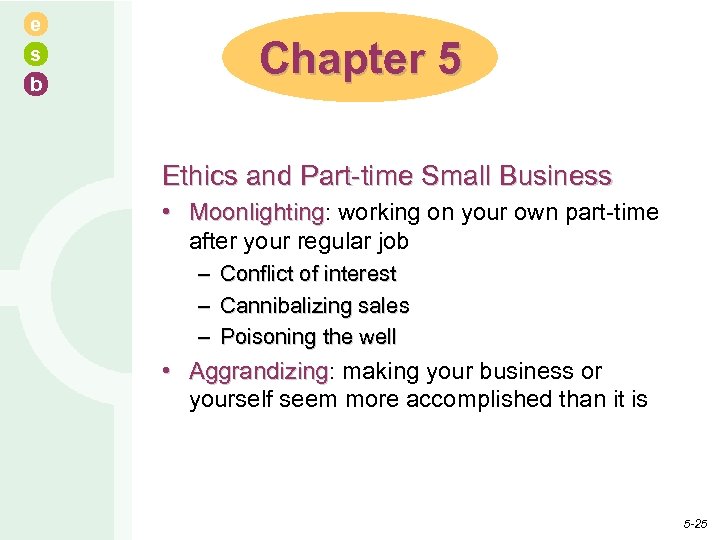
e s b Chapter 5 Ethics and Part-time Small Business • Moonlighting: working on your own part-time Moonlighting after your regular job – Conflict of interest – Cannibalizing sales – Poisoning the well • Aggrandizing: making your business or Aggrandizing yourself seem more accomplished than it is 5 -25
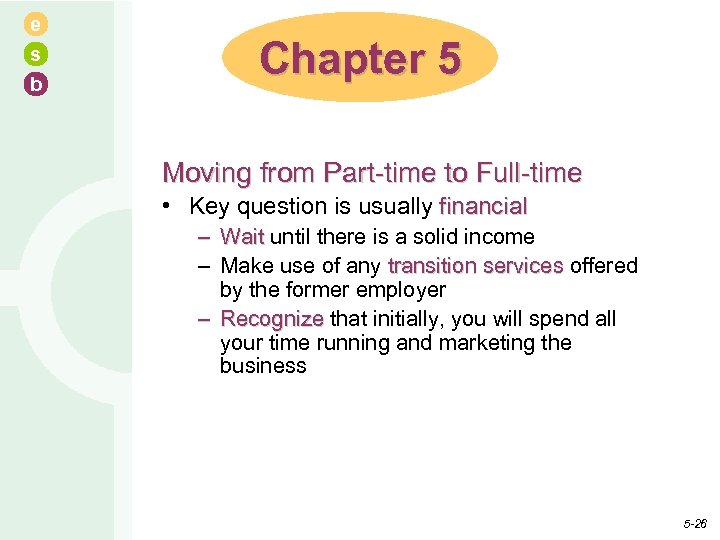
e s b Chapter 5 Moving from Part-time to Full-time • Key question is usually financial – Wait until there is a solid income – Make use of any transition services offered by the former employer – Recognize that initially, you will spend all your time running and marketing the business 5 -26
Скачать презентацию e s b 5 Small Business Entry Paths
cdef651740da5e4b1f54621c624d6036.ppt