


 Скачать презентацию E-Rare Networking research programmes on rare diseases in
d66763d33086d8806c8016d3e83b1b16.ppt
- Количество слайдов: 16
 E-Rare: Networking research programmes on rare diseases in Europe GIS-Institut des Maladies Rares (Paris, France) E-Rare Coordination Unit Support for the coordination of activities
 What is E-Rare? E-Rare: ERA-Net for research programmes on rare diseases - Project funded by the European Union through FP 6 Coordination action, 4 years (start date: June 2006) - Objective: coordinate existing national or regional research programmes on RD to: § Reduce fragmentation in research § Launch multinational joint calls and other joint initiatives § Eventually develop joint programmes on RD
 E-Rare partners § France: GIS-Institut des Maladies Rares (coordinator) & National Research Agency (ANR) § Germany: Project Management Agency of the German Aerospace Center (PT-DLR) & Federal Ministry for Education and Research (BMBF) § Spain: Institute of Health Carlos III/(FIS & IIER) § Belgium: National Funds for Scientific Research (FNRS) § Italy: National Institute of Health (ISS) § Israel: Ministry of Health (CSO-MOH) § Netherlands: Organisation for Health Research and Development (Zon. Mw) § Turkey: Scientific and Technological Research Council (TUBITAK) 2 affiliated partners : Russian Ministry of Science / Region of Lombardy (Italy)
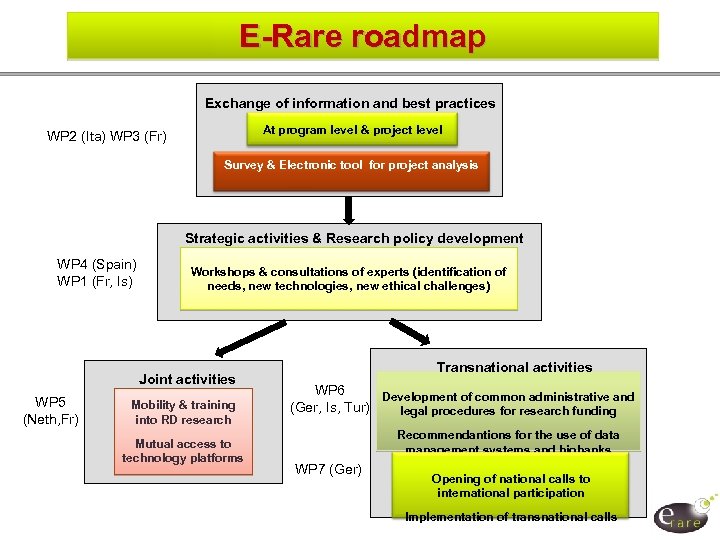 E-Rare roadmap Exchange of information and best practices At program level & project level WP 2 (Ita) WP 3 (Fr) Survey & Electronic tool for project analysis Strategic activities & Research policy development WP 4 (Spain) WP 1 (Fr, Is) Workshops & consultations of experts (identification of needs, new technologies, new ethical challenges) Joint activities WP 5 (Neth, Fr) Mobility & training into RD research Mutual access to technology platforms Transnational activities WP 6 Development of common administrative and (Ger, Is, Tur) legal procedures for research funding Recommendantions for the use of data management systems and biobanks WP 7 (Ger) Opening of national calls to international participation Implementation of transnational calls
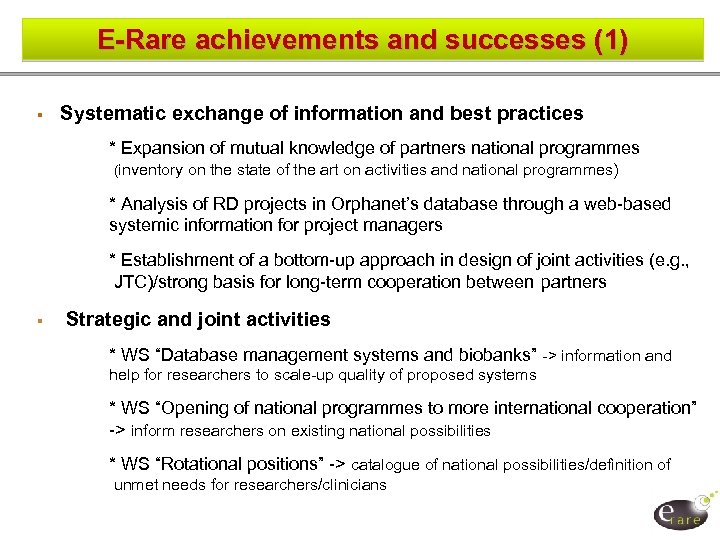 E-Rare achievements and successes (1) § Systematic exchange of information and best practices * Expansion of mutual knowledge of partners national programmes (inventory on the state of the art on activities and national programmes) * Analysis of RD projects in Orphanet’s database through a web-based systemic information for project managers * Establishment of a bottom-up approach in design of joint activities (e. g. , JTC)/strong basis for long-term cooperation between partners § Strategic and joint activities * WS “Database management systems and biobanks” -> information and help for researchers to scale-up quality of proposed systems * WS “Opening of national programmes to more international cooperation” -> inform researchers on existing national possibilities * WS “Rotational positions” -> catalogue of national possibilities/definition of unmet needs for researchers/clinicians
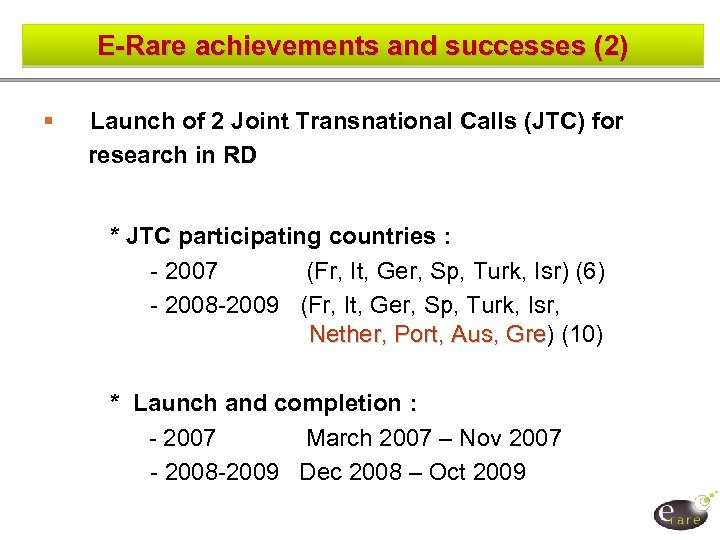 E-Rare achievements and successes (2) § Launch of 2 Joint Transnational Calls (JTC) for research in RD * JTC participating countries : - 2007 (Fr, It, Ger, Sp, Turk, Isr) (6) - 2008 -2009 (Fr, It, Ger, Sp, Turk, Isr, Nether, Port, Aus, Gre) (10) Gre * Launch and completion : - 2007 March 2007 – Nov 2007 - 2008 -2009 Dec 2008 – Oct 2009
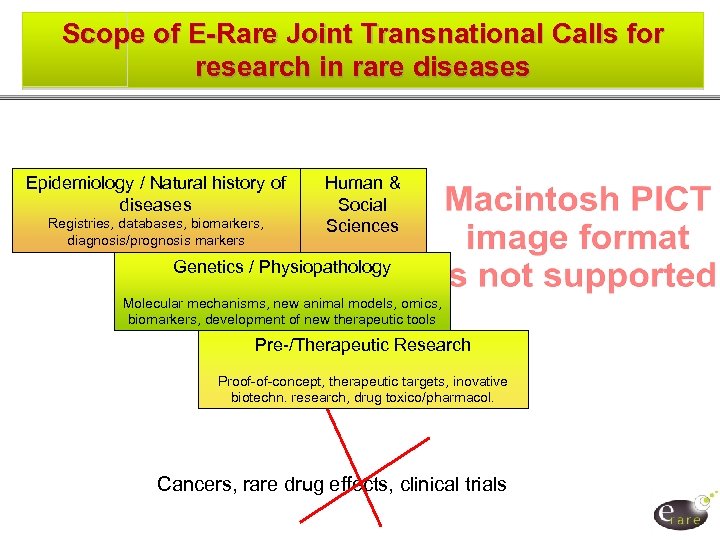 Scope of E-Rare Joint Transnational Calls for research in rare diseases Epidemiology / Natural history of diseases Registries, databases, biomarkers, diagnosis/prognosis markers Human & Social Sciences Genetics / Physiopathology Molecular mechanisms, new animal models, omics, biomarkers, development of new therapeutic tools Pre-/Therapeutic Research Proof-of-concept, therapeutic targets, inovative biotechn. research, drug toxico/pharmacol. Cancers, rare drug effects, clinical trials
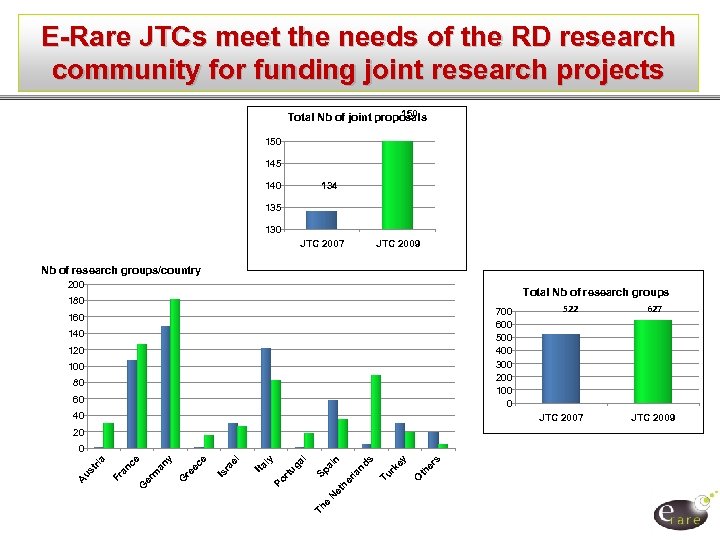 E-Rare JTCs meet the needs of the RD research community for funding joint research projects 150 Total Nb of joint proposals 150 145 140 134 135 130 JTC 2007 JTC 2009 Nb of research groups/country 200 180 160 140 120 100 80 60 40 Th e N et he rla nd s Tu rk ey O th er s n ai Sp rt ug al ly Po Ita el Is ra e y re ec G an er m G Fr an ce 0 us tr ia 700 600 500 400 300 200 100 0 522 JTC 2007 20 A Total Nb of research groups 627 JTC 2009
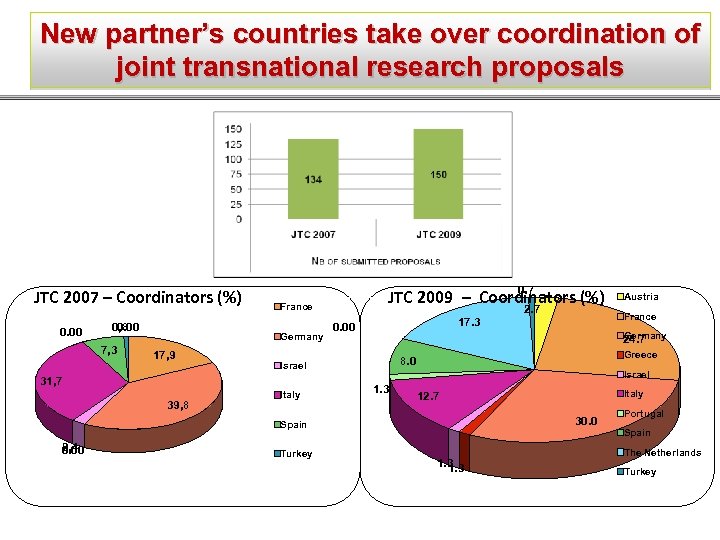 New partner’s countries take over coordination of joint transnational research proposals JTC 2007 – Coordinators (%) 0. 00 0, 8 0. 00 7, 3 0. 7 France Germany 17, 9 2. 7 Italy Germany 24. 7 Greece 8. 0 Israel 1. 3 Turkey Italy 12. 7 30. 0 Spain 2, 4 0. 00 Austria France 17. 3 0. 00 Israel 31, 7 39, 8 JTC 2009 – Coordinators (%) Portugal Spain 1. 3 The Netherlands Turkey
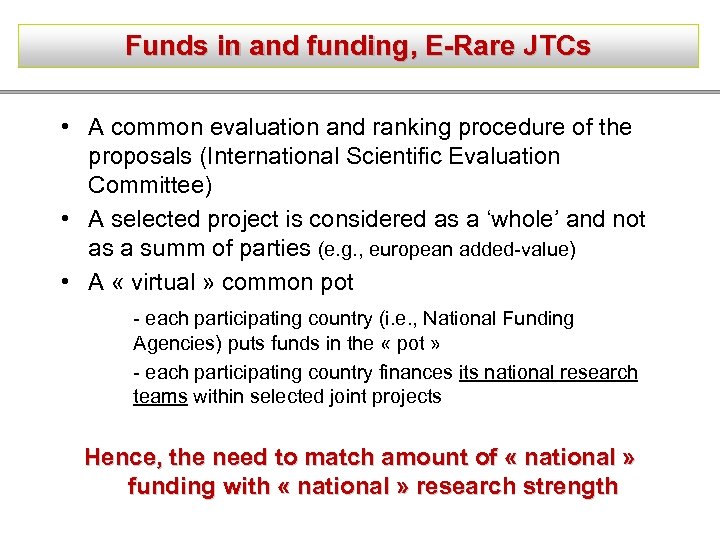 Funds in and funding, E-Rare JTCs • A common evaluation and ranking procedure of the proposals (International Scientific Evaluation Committee) • A selected project is considered as a ‘whole’ and not as a summ of parties (e. g. , european added-value) • A « virtual » common pot - each participating country (i. e. , National Funding Agencies) puts funds in the « pot » - each participating country finances its national research teams within selected joint projects Hence, the need to match amount of « national » funding with « national » research strength
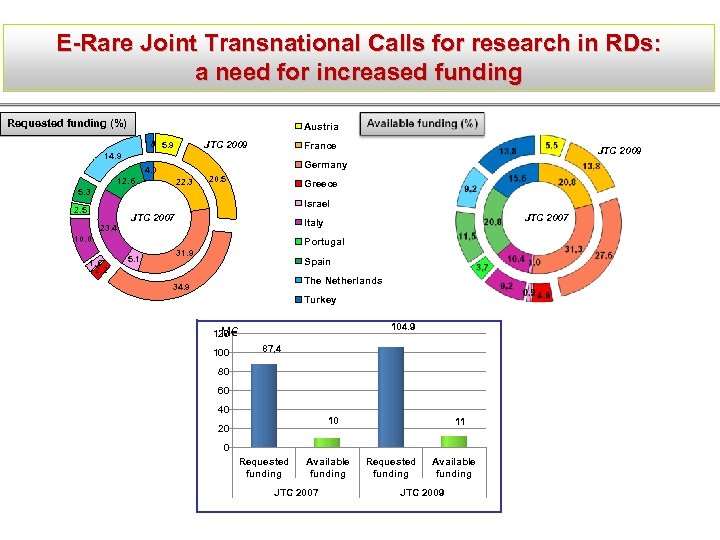 E-Rare Joint Transnational Calls for research in RDs: a need for increased funding Requested funding (%) Austria 1. 8 5. 9 JTC 2009 France 14. 9 JTC 2009 Germany 4. 0 12. 6 22. 3 20. 5 Greece 5. 3 Israel 2. 5 23. 4 JTC 2007 10. 0 1. 6 2. 2 JTC 2007 Italy Portugal 5. 1 31. 9 Spain The Netherlands 34. 9 Turkey 104. 9 M€ 120 100 87, 4 80 60 40 10 20 11 0 Requested funding Available funding JTC 2007 Requested funding Available funding JTC 2009
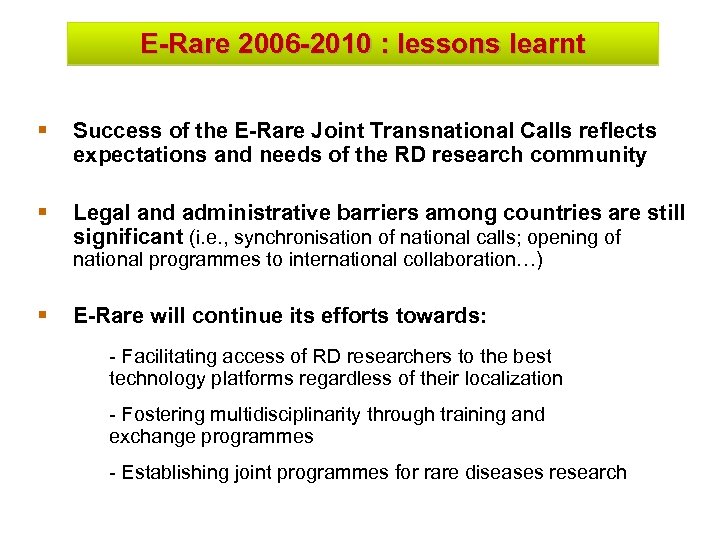 E-Rare 2006 -2010 : lessons learnt § Success of the E-Rare Joint Transnational Calls reflects expectations and needs of the RD research community § Legal and administrative barriers among countries are still significant (i. e. , synchronisation of national calls; opening of national programmes to international collaboration…) § E-Rare will continue its efforts towards: - Facilitating access of RD researchers to the best technology platforms regardless of their localization - Fostering multidisciplinarity through training and exchange programmes - Establishing joint programmes for rare diseases research
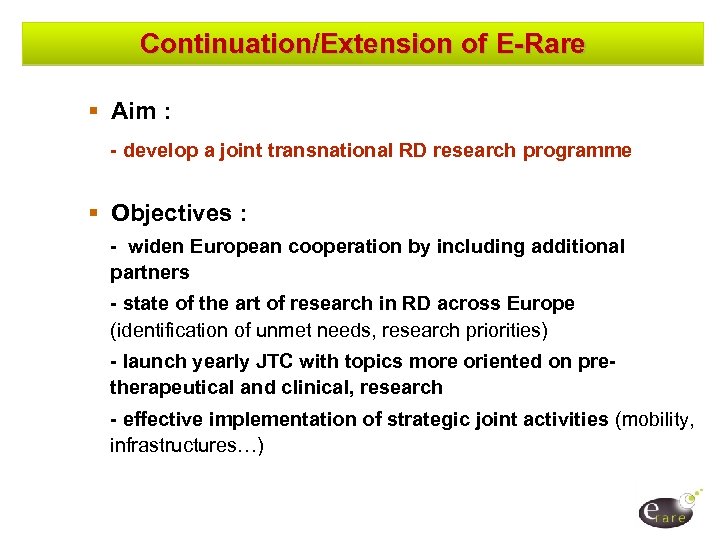 Continuation/Extension of E-Rare § Aim : - develop a joint transnational RD research programme § Objectives : - widen European cooperation by including additional partners - state of the art of research in RD across Europe (identification of unmet needs, research priorities) - launch yearly JTC with topics more oriented on pretherapeutical and clinical, research - effective implementation of strategic joint activities (mobility, infrastructures…)
 Thank you for your attention! 2006 www. e-rare. eu Coordination action
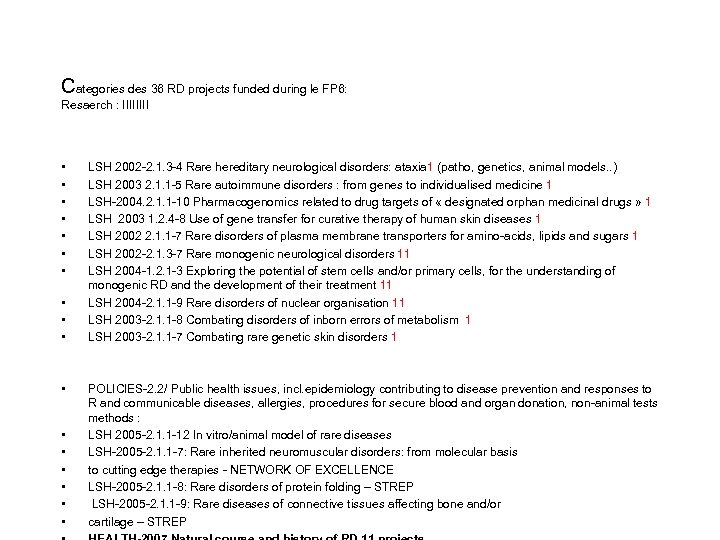 Categories des 36 RD projects funded during le FP 6: Resaerch : IIII • • • • • LSH 2002 -2. 1. 3 -4 Rare hereditary neurological disorders: ataxia 1 (patho, genetics, animal models. . ) LSH 2003 2. 1. 1 -5 Rare autoimmune disorders : from genes to individualised medicine 1 LSH-2004. 2. 1. 1 -10 Pharmacogenomics related to drug targets of « designated orphan medicinal drugs » 1 LSH 2003 1. 2. 4 -8 Use of gene transfer for curative therapy of human skin diseases 1 LSH 2002 2. 1. 1 -7 Rare disorders of plasma membrane transporters for amino-acids, lipids and sugars 1 LSH 2002 -2. 1. 3 -7 Rare monogenic neurological disorders 11 LSH 2004 -1. 2. 1 -3 Exploring the potential of stem cells and/or primary cells, for the understanding of monogenic RD and the development of their treatment 11 LSH 2004 -2. 1. 1 -9 Rare disorders of nuclear organisation 11 LSH 2003 -2. 1. 1 -8 Combating disorders of inborn errors of metabolism 1 LSH 2003 -2. 1. 1 -7 Combating rare genetic skin disorders 1 POLICIES-2. 2/ Public health issues, incl. epidemiology contributing to disease prevention and responses to R and communicable diseases, allergies, procedures for secure blood and organ donation, non-animal tests methods : LSH 2005 -2. 1. 1 -12 In vitro/animal model of rare diseases LSH-2005 -2. 1. 1 -7: Rare inherited neuromuscular disorders: from molecular basis to cutting edge therapies - NETWORK OF EXCELLENCE LSH-2005 -2. 1. 1 -8: Rare disorders of protein folding – STREP LSH-2005 -2. 1. 1 -9: Rare diseases of connective tissues affecting bone and/or cartilage – STREP
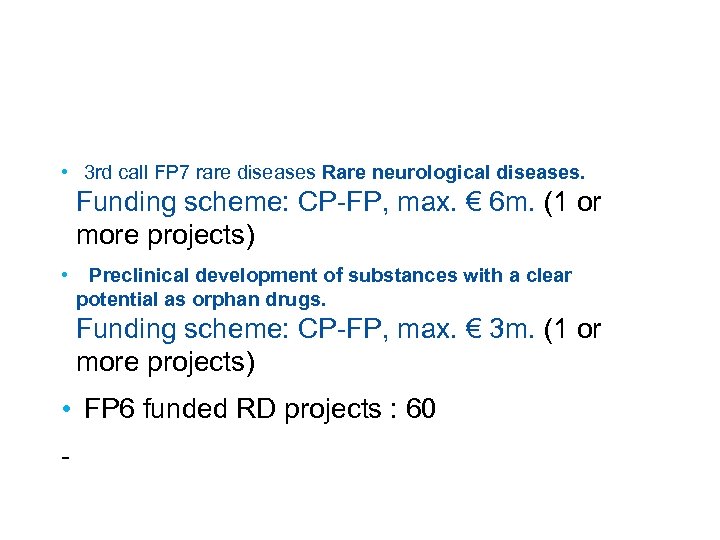 • 3 rd call FP 7 rare diseases Rare neurological diseases. Funding scheme: CP-FP, max. € 6 m. (1 or more projects) • Preclinical development of substances with a clear potential as orphan drugs. Funding scheme: CP-FP, max. € 3 m. (1 or more projects) • FP 6 funded RD projects : 60 -